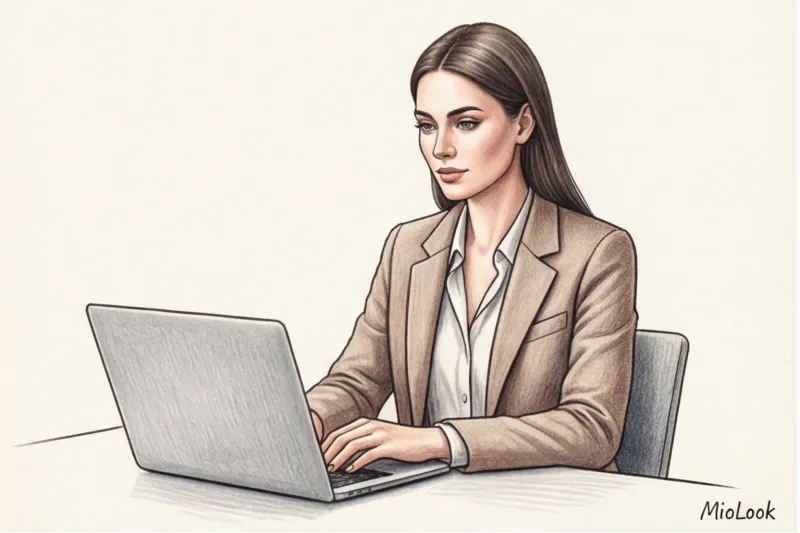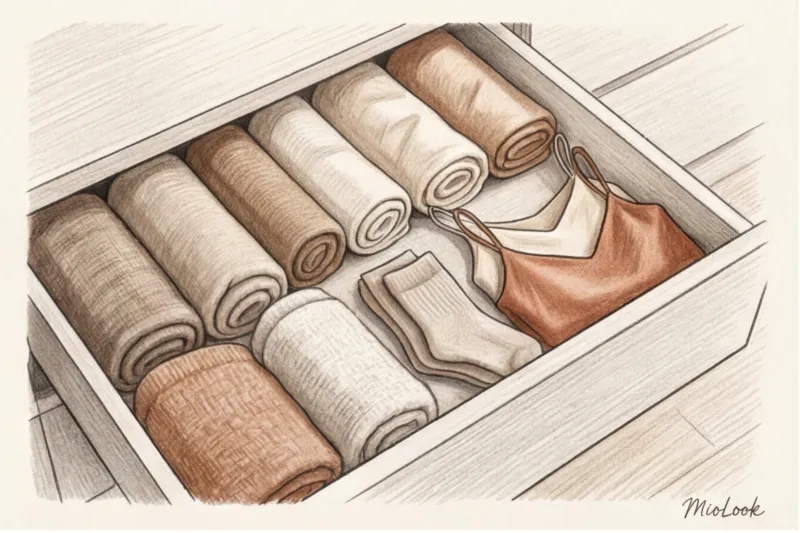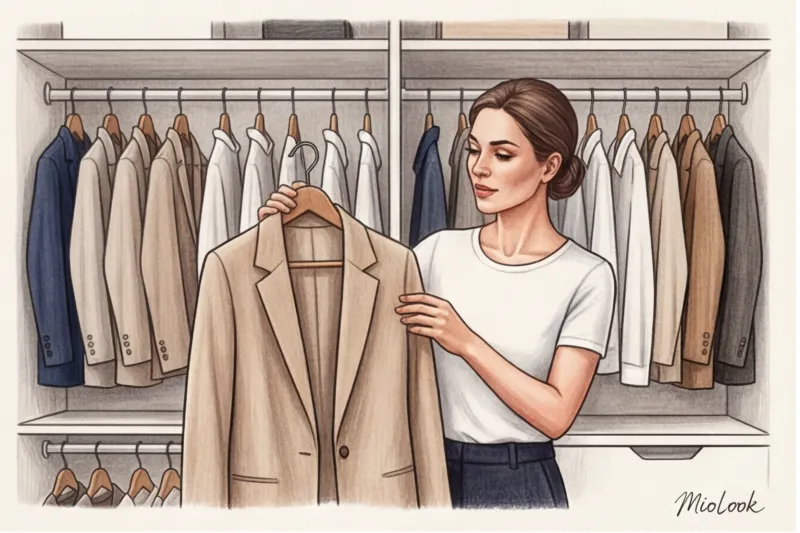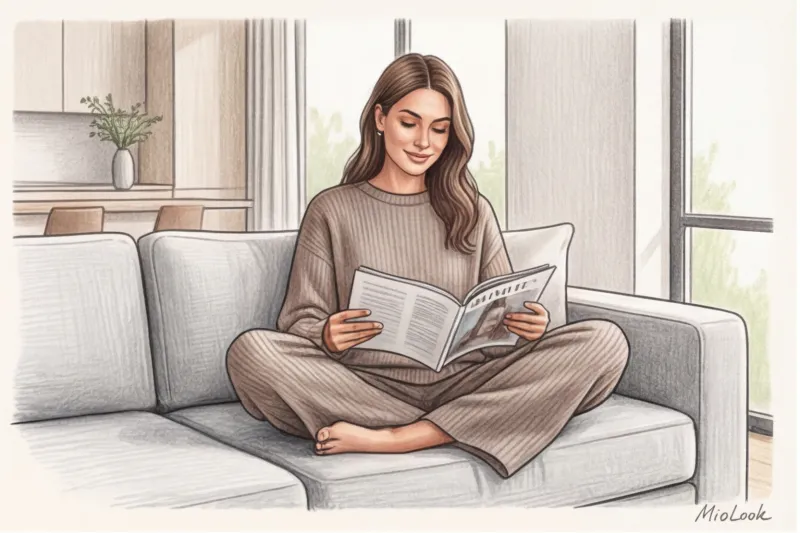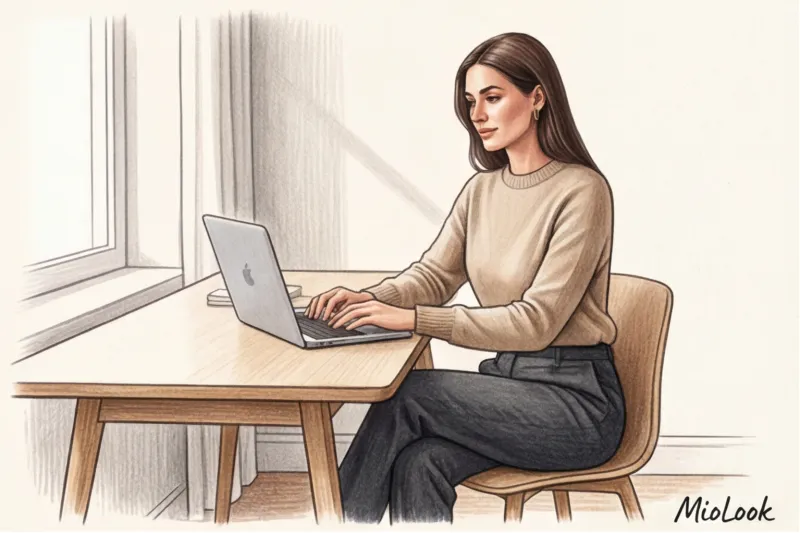
Why the typical "freelance wardrobe" doesn't work anymore
Have you ever noticed that on days when you work straight from your bed in your favorite stretched-out T-shirt, it's physically harder for you to tell a client a high price? Your voice sounds quieter, and your willingness to stand your ground in negotiations approaches zero. When we discuss wardrobe for a freelancer , a cliché often pops into mind: an oversized hoodie, sweatpants, and a bun. For years, this was considered the main advantage of remote work—freedom from dress codes.
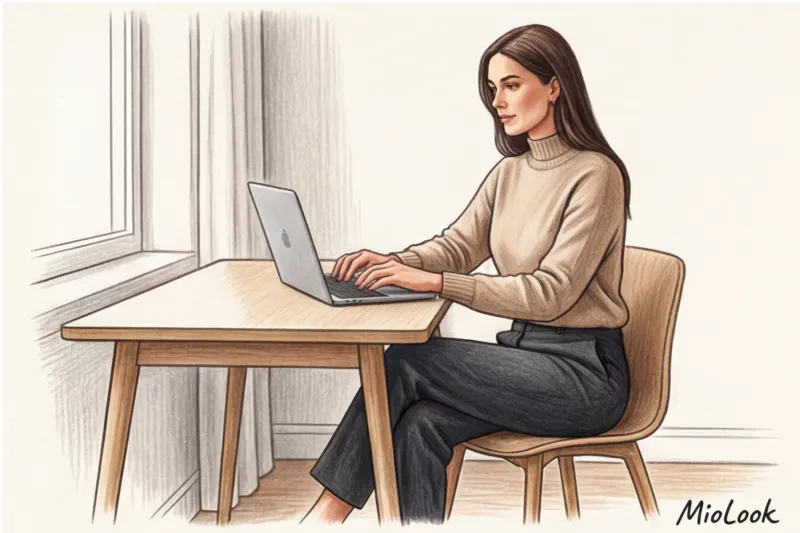
But as a stylist working with independent, premium experts, I have to say it bluntly: the era of pajamas is over. Your appearance directly translates into your paycheck. One of my clients, a senior UX designer, struggled to break the €4,000 per project ceiling for months. The problem wasn't her portfolio, but how she presented herself at briefings. People buy more than just your expertise; they buy peace of mind and status. And entrusting a complex project to someone who looks like they just woke up is psychologically challenging.
These aren't just my observations. In 2012, researchers at Northwestern University published a breakthrough study proving the phenomenon. Enclothed Cognition (clothed cognition). Scientists have discovered that the clothes we wear trigger specific neural connections, altering our cognitive abilities. When you put on shapeless loungewear, your brain automatically switches to energy-saving and restful mode. Your focus declines, and your analytical abilities diminish. You literally become less productive in stretched-out joggers.
"Clothing isn't just social camouflage for others. First and foremost, it's a tool for managing your own state. What touches your skin dictates your brain how you should act."
Here many people make the classic mistake of creating a so-called “Zoom half-breed” (aka Zoom mullet ): a smart jacket and perfectly styled hair in the portrait area, and pajama bottoms and slippers off-camera. There's a myth that this is the perfect hack for working remotely. In reality, it destroys your self-confidence. Cognitive dissonance arises: your body knows you're "hiding." This duality is instantly detectable at the micro level—in a rounded posture, stiff gestures, and a shifty gaze. You can't confidently defend a €10,000 estimate while tucking your bare feet under a chair.
This is why today independent specialists are massively moving towards the concept Soft Power Dressing (a "soft power" wardrobe). This seamless hybrid style is equally at home at your desk at home and at a casual meeting at a restaurant.
The basic principles of remote Soft Power Dressing:
- No rigid frame: We're replacing classic blazers with structured, chunky knit cardigans and soft, unlined blazers.
- Tactile luxury: The fabrics must be impeccable. Cashmere, mercerized cotton, dense viscose.
- Unified standard: You no longer divide your clothes into "home" and "go-out" pieces. You have a single wardrobe that works for your personal brand 24/7.
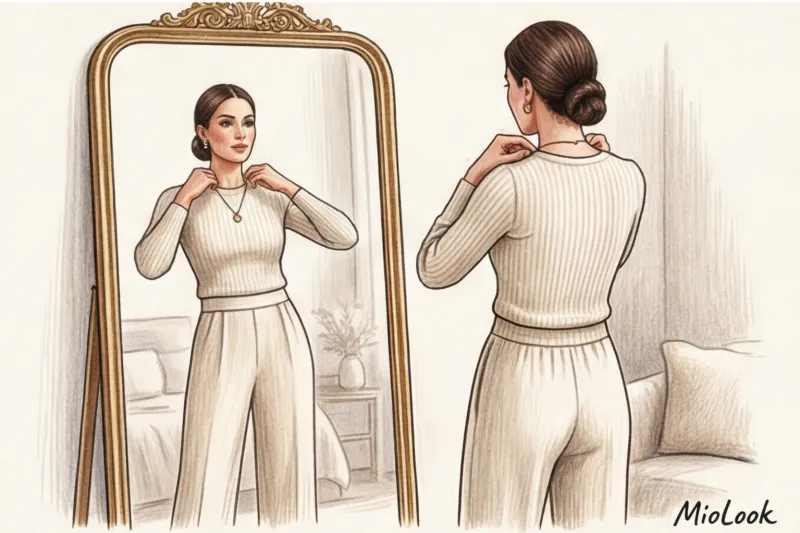
To transition to this format, you don't need to buy up half the boutiques. First, take stock of what you already have (I discussed how to do this quickly and effectively in the guide). How to quickly digitize your wardrobe: a weekend plan ). And to assemble a status hybrid capsule from your existing items, I recommend loading them into a smart wardrobe. MioLook The app's artificial intelligence will help you create kits that will convey your expertise even from a computer screen.
If you have too much stiff denim in your wardrobe that's uncomfortable for long periods of sitting, you might want to reconsider that part of your closet. Check out our everyday denim capsule To understand which silhouettes are best reserved for weekends and which are suitable for a hybrid work schedule. Remember the main rule: your home office is your headquarters, and you are the boss. Dress accordingly.
Hybrid capsule concept: from home office to VIP client meeting
Successful female experts regularly approach me with a paradoxical situation: their closets are filled with formal suits, silk blouses, and stiletto heels, yet every day they wear the same bland leggings and a stretched-out sweater. Why? Because the traditional wardrobe system has broken down in the realities of remote work. My main stylistic philosophy, which I instill in my clients, is as follows: If you spend 80% of your time working outside of a traditional office, 80% of your budget should go toward premium hybrid clothing. , and not on dresses for rare occasions.
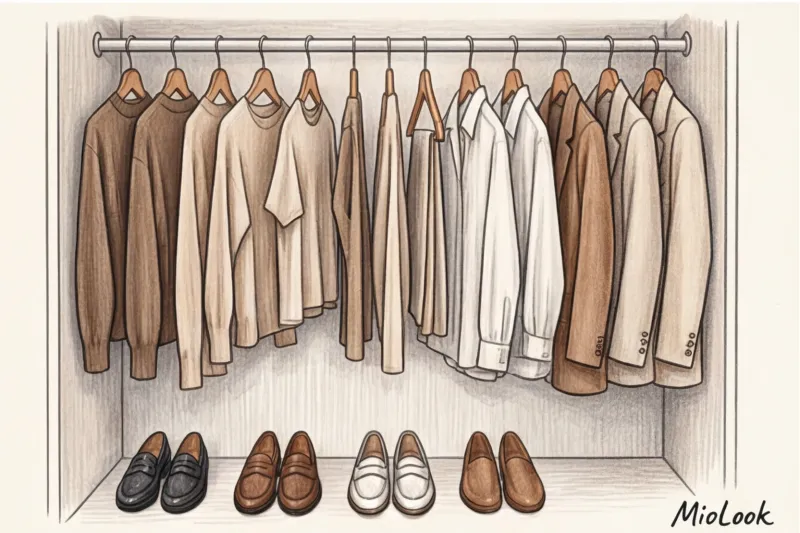
A hybrid capsule wardrobe is a chameleon wardrobe. It's a collection of interchangeable pieces that ensure a seamless transition between your home workspace, a spontaneous session at a coworking space, and a VIP lunch at a restaurant. Imagine this scenario: you're sitting in your favorite chair with your laptop in absolute comfort, but if you need to rush off to a meeting, you don't change your entire outfit. You simply swap your slippers for loafers, throw on a classy coat, and your look instantly becomes put-together and luxurious.
The first and most difficult step toward such a wardrobe is a categorical rejection of dividing things into "home" and "going out." This outdated habit of wearing clothes at home that are too embarrassing to appear in public subtly erodes your professional self-esteem. When you put on a faded sweatshirt, your brain receives the signal "we're relaxing" (or worse, "we're sick"). We're introducing a uniform standard of quality of life: what you wear while drinking your morning coffee in front of your computer must look aesthetically pleasing enough to handle an unexpected video call from an investor at any second.
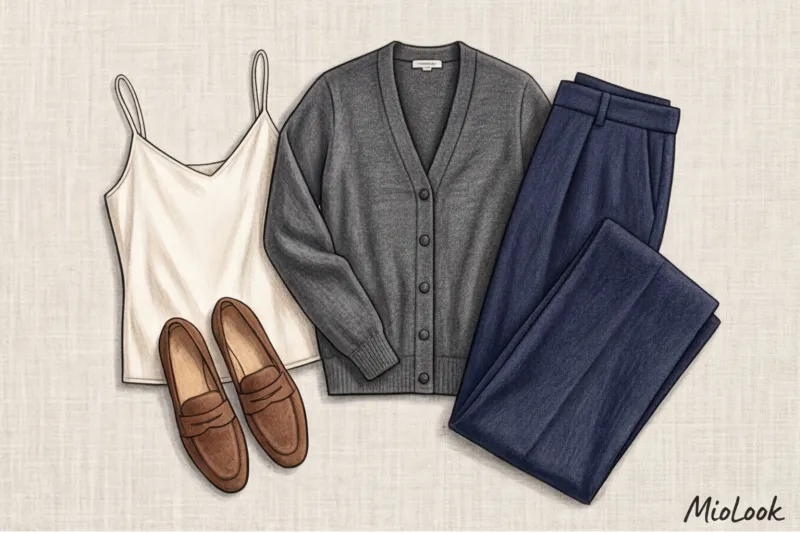
The Three Layers of Comfort Rule
To ensure the hybrid system functions flawlessly and doesn't descend into chaos, I use the "Three Layers of Comfort" principle in my work. This is an architectural approach to creating an image, where each layer fulfills its own specific function.
First layer (towards the body): tactile luxury. Anything that comes into direct contact with the skin should feel flawless. Here, we use natural silk, fine long-staple cotton (mako cotton), and high-tech, dense viscose. A seamless silk top or a basic mercerized cotton T-shirt aren't just comfortable—they create a subtle glow in the portrait area and promote proper posture.
Second layer (structure): silhouette for the camera. This layer is responsible for maintaining shape. Forget shapeless fleece. We need thick knits, textured cardigans, and soft, unconstructed jackets. They won't restrict your movement when you're typing for hours, but they create a crisp, professional shoulder line on camera, conveying your competence.
Third layer (exit): assemblage point. This is your status outerwear, which works like a magical filter. A voluminous camel coat, a minimalist leather trench, or an expensive pea coat. The purpose of the third layer is to instantly condense the relaxed first two layers into an elegant urban outfit. No one on the street will recognize that under this impeccable coat you're wearing the very same suit you just wore while coding or balancing the books.
Access to MioLook for €0.99 — one-time payment
Your personal AI stylist will help you create the perfect hybrid capsule wardrobe and digitize your current wardrobe.
Get access — €0.99 onceInvesting in fabrics: cashmere, silk, and wool blends
According to research by the WGSN Institute of Color and Materials (2023), tactile discomfort can reduce concentration by 15–20%. That's why synthetics in a freelancer's wardrobe aren't just a matter of aesthetics; they directly impact your productivity. When you sit in a chair for eight hours straight, 100% acrylic or polyester creates a greenhouse effect: your body's natural thermoregulation is disrupted, overheating occurs, micro-stress occurs, and you tire faster.
Instead, we invest in smart natural materials. Take, for example, the Italian artisans of the Biella region (a historic textile hub). They long ago developed a high-twist technology for processing extrafine merino wool. The result is an incredibly fine, breathable fabric with natural elasticity. It keeps you warm in winter, wicks away moisture in summer, and—critically important for a freelancer—is virtually wrinkle-free after long periods of sitting at a desk.
Let's break down the math behind a smart wardrobe using a formula cost-per-wear (CPW — cost per wear). Let's say you buy a premium cashmere-merino blend knit suit for €450. Your first thought might be, "Too expensive for loungewear!" But let's calculate: you'll wear it at least three times a week for six months of the cold season. That's about 75 wears.
Divide €450 by 75 outputs = €6 for one day of absolute comfort, warmth and self-confidence Now compare that to a fashionable acrylic sweater from a mass-market store for €60, which will become covered in unsightly pilling after exactly four washes (its CPW is €15). A quality basic item will always be cheaper in the long run.
The only caveat I always make clear is that these premium fabrics require careful handling. If you're not prepared to wash cashmere with special liquid detergents or dry clean it, your investment will quickly lose its appearance. But with a little care, these items will last for years, becoming the foundation of your impeccable personal brand.
A Freelancer's Essential Wardrobe: 12 Key Investments
The mathematics of wardrobe can be merciless. You can have a closet filled with thousands of euros' worth of random, trendy purchases, and yet waste precious energy every morning frantically rummaging through hangers before an important call. A client, a sought-after freelance interface designer, came to me with precisely this diagnosis—"wardrobe burnout." She admitted that the morning stress of choosing clothes was literally eating away at her energy, which she needed for complex negotiations with international clients.
We solved the problem radically: we removed visual noise and assembled a premium capsule collection of just 12 carefully curated pieces. The result exceeded expectations. The client stopped worrying about what to wear, delegating this task entirely to a ready-made system. The freed-up energy and increased self-confidence (she now always looked impeccable) allowed her to close two large contracts within three months and scale her business.
"An investment wardrobe isn't about limiting your choices, it's about freeing up your time for more important decisions. When every piece is flawless, you can't go wrong"—this is a rule I constantly repeat to my clients.
Herein lies the main secret: the principle of absolute interchangeability. A dozen well-chosen positions easily generate 30+ unique looks for any task—from focused work at a laptop on the veranda to signing a contract in a restaurant. To ensure this matrix runs like a Swiss watch, I insist on avoiding flashy prints in favor of a neutral yet deep palette.
Forget flat gray or boring office black. We're building a foundation on sophisticated, luxurious shades: rich camel, deep graphite, elegant ecru, and navy. According to the Pantone Institute's 2024 Color Trends, deep blue is subconsciously perceived by those on the other side of the screen as an absolute marker of trustworthiness. And ecru shades beautifully illuminate the face on a webcam, acting as a professional studio reflector. The only caveat is that lighter areas of portraits require slightly more expressive makeup or accent accessories to prevent the face from "getting lost" in the frame.
By the way, to avoid having to keep all these 30+ combinations in your head, I recommend digitizing your investment purchases through the "smart wardrobe" feature in MioLook The app will automatically generate a fresh stylistic approach for the day, taking into account your schedule and saving you those 15 minutes in the morning.
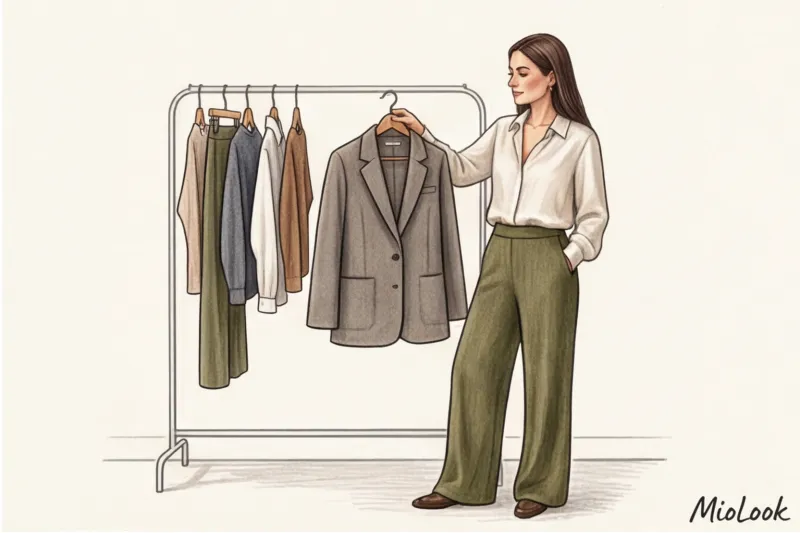
Smart Bottoms: An Alternative to Rigid Jeans
Many professionals, when switching to remote work, automatically make jeans their wardrobe staple. As a stylist, I'm categorically against this approach. Heavyweight 100% cotton denim is completely unsuitable for long periods of computer work. A stiff waistband compresses the pelvic organs, impairs circulation, and by midday, you're overcome with the urge to change into your pajamas.
Instead, we invest in smart bottoms that allow freedom of movement but maintain a sharp silhouette. My absolute favorite is tailored joggers with a drawstring made of fine suiting wool. Visually, they look like high-class trousers with a crease, but the comfort is just as good as sportswear. The elastic waistband makes it easy to wear a heavy lunch, and the virgin wool allows the skin to breathe. Reputable Italian models start at €150, but their cost-per-wear approaches zero within the first season.
Another must-have is palazzo pants made of heavy viscose and knit midi skirts. High-density viscose (from 300 g/m²) has a luxurious, heavy fall. It flows beautifully as you walk, doesn't stretch out at the knees, and creates an elegant vertical line. A ribbed knit midi skirt works on the same principle: it doesn't constrict the body anywhere, but instantly pulls the look together if you need to rush out to a meeting in the city.
Top: Zoom image architecture
The portrait area is your calling card. In a hybrid wardrobe, we create the right top architecture, abandoning stiff office jackets that constrict the shoulders and look awkward at home. They're replaced by textured knit cardigans. Thick, blended yarns (like cotton with cashmere) hold their shape well and create a defined shoulder line for the camera, but feel like a cozy blanket on the body.
We pair a cardigan with a basic, characterful piece. Instead of the usual thin tank tops that quickly lose their shape, I select basic t-shirts made of mercerized cotton for my clients. Mercerization is a process that removes microscopic fuzz from cotton thread. The result is a smooth, cool-to-the-touch fabric with a delicate, silk-like sheen. Priced at €60–€100, this t-shirt looks ten times more expensive than a typical mass-market item and, crucially, doesn't shrink even after twenty washes.
For meetings with VIP clients or important presentations, a silk blouse is a must-have. The perfect cut is with a soft ascot collar that can be tied in a casual knot, or a flattering V-neckline that visually elongates the neck. Natural silk has unique thermoregulation properties, making it comfortable even during the most intense, hours-long negotiations.
Shoes: from loafers to status sneakers
There's a dangerous misconception that shoes aren't important when working remotely. However, the right pair changes everything—your posture, your gait, and even your voice. A lack of structured footwear can leave you feeling relaxed, like you're on a weekend, which is unacceptable during work hours.
The foundation of a hybrid shoe wardrobe is suede loafers in true Italian style. Soft, premium suede, without a rigid last, conforms to the shape of your foot, providing the comfort of slippers while conveying status and impeccable taste. A good pair will cost around €400–€600, making them the best investment for working in a coworking space.
For more dynamic days when you need to hit multiple spots, minimalist leather sneakers are essential. Strict rules: no flashy logos, chunky ugly soles, or contrasting color inserts. Just clean lines and matte leather. This style pairs easily even with suit joggers.
For quick coffee outings or short informal meetings, I recommend keeping mules or slip-ons made of smooth premium leather on hand. The open heel offers freedom, while the closed toe maintains elegance. You can slip into them in a second and look like you've been carefully planning your look since the morning.
Accessories as an investment in your personal brand while working remotely
In television journalism, there's a professional term, "talking head." During Zoom conferences and online meetings, we all effectively become such announcers. According to research on visual perception in on-screen interactions (particularly from the Nielsen Norman Group), with a limited crop of the chest, 80% of the interviewee's attention is focused on details in the portrait area and hands. A soft cashmere sweater is a great base, but it's the crisp, structured accessories that instantly "pull together" relaxed knitwear, elevating your look from casual to expert.
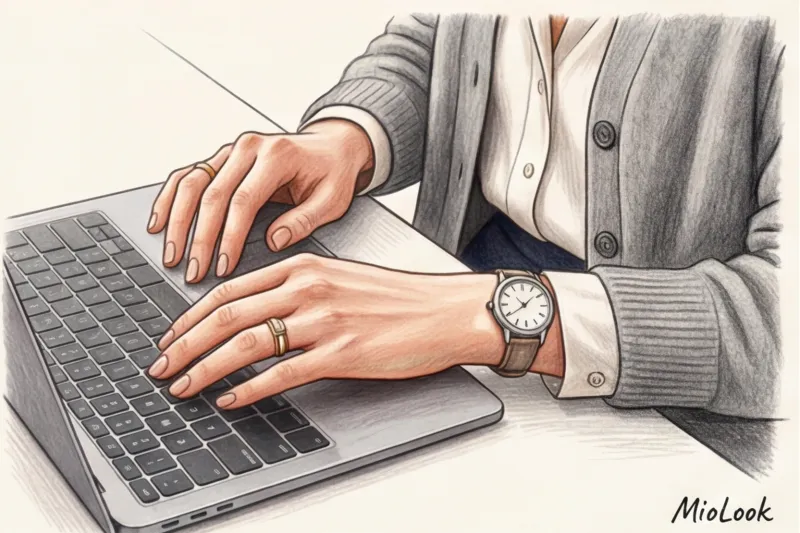
Let's talk about time management that you can literally wear on your wrist. A classic Swiss watch or premium smartwatch isn't just a device for keeping track of your schedule; it's a powerful nonverbal signal of your punctuality and business acumen. When, as you gesture, a strict geometric dial (in the style of the iconic Cartier Tank or Jaeger-LeCoultre) on a thick calfskin strap emerges from under the soft sleeve of a merino sweater, the contrast in textures works to your advantage. If you prefer a smartwatch, be sure to replace the basic sports silicone with leather or metal Milanese weave. Spending €150–€350 on a good strap can dramatically change the overall look.
Another functional optical illusion tool is computer glasses with designer frames. Even if you have perfect vision, blue block lenses in a quality frame from Tom Ford or Oliver Peoples (an investment of around €250–€400) add an intellectual touch. The frame creates additional facial architecture, elegantly conceals signs of fatigue after eight hours in front of a computer screen, and gives the face a focused, attentive expression. Choose classic tortoiseshell acetate or thin titanium—they always look expensive.
A freelancer's jewelry wardrobe requires special discipline. We emphasize strict jewelry minimalism. Forget about chunky, jingling bracelets—their sound will inevitably drown out your voice on the microphone and irritate your interviewers. Your go-to accessories: simple stud earrings (diamonds or the right sea pearls), thin chains peeking out from under an open collar, and statement rings. A smooth gold signet ring or a sculpted ring on your index finger draws the eye to your hands precisely when you're actively gesturing while explaining an important concept to a client.
To ensure this arsenal works flawlessly and you don't waste time selecting parts before a sudden call, I recommend digitizing your jewelry and watches in advance. MioLook The app will help you visually create ready-made formulas where the rugged textures of metal and leather perfectly balance your cozy knitted base.
Access to MioLook for €0.99 — one-time payment
Start creating perfect looks with the help of artificial intelligence and tidy up your accessories.
Get access — €0.99 onceUse cases: from a morning call to a restaurant meeting
At 10:00 AM, you're compiling reports at the kitchen island, at 12:15 PM, a key investor unexpectedly calls to discuss revisions, and at 3:00 PM, you have to be downtown for brunch with a new client. Sound familiar? Changing clothes three times a day is an unaffordable luxury for an independent professional whose time is precious.
The key to a well-designed investment capsule wardrobe is to seamlessly adapt to your changing schedule, rather than having you adapt to your closet's contents. In my styling practice, I implement the "10-Second Transformation" technique for my freelance clients. Its key secret: the foundation of your look (the first and second tactile layers) remains the same from the very beginning. You raise or lower the level of formality with exactly one element—a structured jacket, a pair of statement shoes, or a layer of thick lipstick.
Psychologists studying facial perception note an interesting fact: the brain of a conversational partner processes the entire picture within the first seven seconds. And the right shade of matte lipstick (for example, a deep ruby from Tom Ford or a subdued dusty rose from Charlotte Tilbury, which will cost approximately €45–60) acts as a powerful visual anchor. It instantly "pulls" your face together for the camera, signaling your readiness for a constructive dialogue.
To avoid wasting precious minutes before an important call sorting through hangers, I highly recommend digitizing this process. Upload your essentials to MioLook and create ready-made mini capsule wardrobes based on your level of formality. Simply open the app and know exactly which accessory will elevate your outfit from "morning coffee" to "serious business."
Scenario 1: Working from home + surprise video call
One of my regular clients, a senior UX designer, admitted that when a client called unexpectedly, she'd frantically search for a clean shirt, throwing it on over her leggings. This is a classic mistake that, firstly, makes you nervous and, secondly, limits your body language—you're afraid to accidentally stand up and ruin the fragile illusion of professionalism.
We completely overhauled her home base. Now, the ideal starting point is a 100% merino wool (extrafine merino) knit suit. This natural, high-tech material maintains proper body temperature regulation and is completely wrinkle-free, even if you're working reclined with a laptop on your lap. However, smooth knitwear alone feels too intimate for business.
Your 10-second transformation: You throw a structured cardigan in a thick, textured knit over your top (it acts as a soft jacket, creating a more defined shoulder line) and add statement earrings. Large vintage clip-on earrings, geometric gold Celine-style hoops, or baroque pearls instantly draw attention to your portrait. To the person on your screen, you look like someone who's been purposefully preparing for the meeting, when in reality, you've simply added two details to the items lying next to your keyboard.
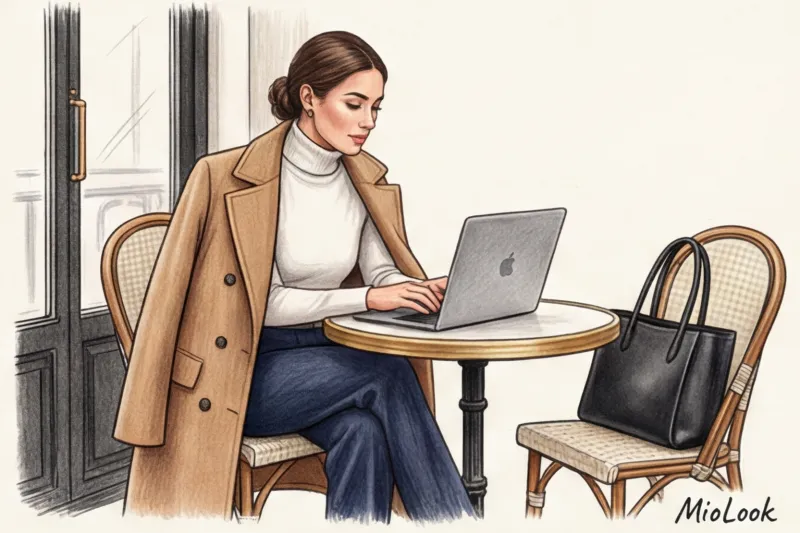
Scenario 2: Working in a high-status coworking space
When you go out to work in a public space—be it a private business club, a trendy coworking space, or the lobby of a luxury hotel—you need to strike a delicate balance between comfort for long hours of sitting and presentability. In such places, you sell your personal brand simply by your presence.
Your base for this scenario: Wide-leg palazzo pants made of a flowing wool blend (wool with added viscose or silk ensures that the knees don't get unsightly creases), a straight-cut silk top, and suede loafers. High-quality suede shoes (excellent options from local Italian manufacturers can be found in the €150–€250 range) look more refined than smooth leather and won't irritate your feet when you walk.
Transformation for cool conditioned air: Adding a cashmere sweater casually draped over the shoulders. This iconic touch of old-money aesthetics is far from a mere nod to passing trends. In terms of silhouette architecture, a sweater knotted at the chest creates the necessary visual volume. It replaces a scarf, creates a beautiful V-shaped neckline, and sends a clear signal of a certain level of taste. It's that elegant casualness that's physically impossible to imitate with cheap acrylic fabrics.
Scenario 3: Personal meeting with the client
Let's imagine that after a productive session in a coworking space, you have an in-person meeting with a new major client. Here, you need to demonstrate maximum composure and expertise. There's no need to completely change clothes if your first layer was strategically chosen.
The base remains the same: The same wide-leg trousers and silk top. If you invest in a heavy matte silk (22mm or higher), it won't show any telltale creases by midday, unlike budget linen blouses.
Your transformation: You slip your cashmere sweater off your shoulders and slip on a soft, double-breasted blazer. I always recommend choosing wool crepe blazers without a stiff lining—they hug the figure but still hold their shape perfectly. And the finishing touch: shoes with crisp, geometric lines.
"Shoes are the foundation of your sense of self. They physiologically change your posture and stride rhythm. By replacing flat shoes with an elegant heel, you instinctively straighten your back, and your gestures become more deliberate."
Swap your comfortable loafers for smooth leather pointed-toe ankle boots (in keeping with the Saint Laurent aesthetic) or elegant kitten heels (around 3-5 cm high). Just two changes—a structured upper instead of a soft sweater and a stiff last instead of suede slippers—and your look transforms from relaxed and bohemian to uncompromisingly businesslike. The whole magic takes 10 seconds, but your symbolic value in the eyes of your interlocutor increases exponentially.
Checklist: An Audit of Your Current Wardrobe for Freelancing
According to statistics from the consulting firm McKinsey, we regularly wear no more than 20% of the contents of our closets. For independent professionals, this figure often drops to a critical 10%. Before creating a new hybrid wardrobe for a freelancer, I prohibit my clients from opening brand websites and placing new orders. First, we conduct a rigorous inventory. Here's a precise step-by-step framework I apply during the first in-person review session.
Important warning: Cleaning out your closet is a physically and emotionally draining process. Don't try to squeeze it into a half-hour window between calls. Set aside at least three hours on your day off.
Step 1: Ruthless Sorting
The first rule is to get rid of overtly casual clothes during work hours. Clothes with micro-stains, stretched knees, faded T-shirts, and "cozy" washed-out hoodies should leave your work capsule immediately. I call this the "zero tolerance" rule. If you wouldn't be willing to open the door for a delivery person right now or suddenly turn on a camera in it, it has no place in your 9-to-5 schedule. Put such items in a separate drawer at the back exclusively for lazy Sundays.
Step 2: Blind Tactile Test
Check the remaining items for tactile feedback. Literally close your eyes and run your hand over the fabric. Remote work requires staying in one position for long periods of time, so any micro-aggressions from the material will distract you from your tasks. Feel free to discard scratchy wool, which requires layering stiff base shirts, and stiff polyester, which creates a greenhouse effect. We leave only those textures that feel like second nature on the skin - dense viscose, smooth cotton, cashmere and natural silk.
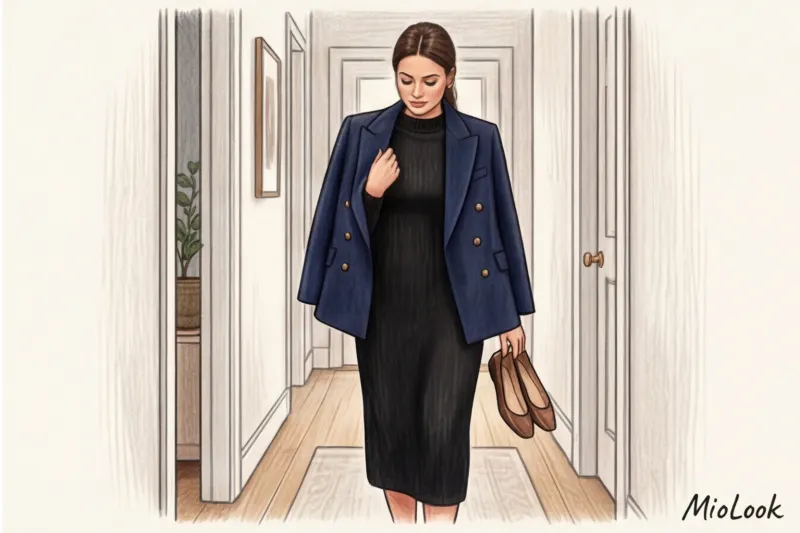
Step 3: Assessing the "portrait zone"
Since 80% of remote communication happens through a screen, take a critical look at your "portrait zone." Ask yourself honestly: do you have 5-7 high-quality tops for video calls? This is the gold standard of my methodology. You need pieces that maintain the image's structure in the frame: thick silk blouses, merino wool polos, structured V-neck cardigans. If you only have two decent shirts, you'll inevitably start repeating yourself or sabotaging the camera during important negotiations.
Your ideal image
it begins Here
Join thousands of users who look flawless every day with MioLook.
Get access — €0.99 onceStep 4: Anchor Investment Strategy
Only after a thorough purge should we create a shopping list, starting with the most expensive basic item. The biggest mistake is buying cheap T-shirts for quantity. Invest in the anchor of your capsule wardrobe—for example, a perfect pair of soft, fine wool suit trousers with a hidden drawstring (in the premium segment, such an investment will cost €250–400). This prestigious, impeccably tailored piece will set the highest standard for the rest of your wardrobe. Once you put on such trousers, you physically won't be able to complement them with a faded, shapeless top.
To consolidate the results of the audit and avoid buying duplicates in the future, I strongly recommend digitizing the selected database. Add your verified items to MioLook — this way you can visually control your work capsule directly on your smartphone and assemble kits in one click.
Common Mistakes When Creating a Freelance Wardrobe
Let's be completely honest. I can create the perfect capsule wardrobe of premium fabrics, select complex color combinations, and calculate the cost of each outfit, but even the most flawless personal branding strategy will fall apart if you sabotage your image with minor stylistic mistakes. In my practice as a luxury consultant, I sometimes have to act as a "stern critic," because self-respect begins long before your laptop camera turns on.
Over the years of working with independent experts, I've identified four critical mistakes that mercilessly destroy credibility in remote work.
Buying cheap pastel colored hoodies. In the professional world, this is known as the "teenage effect." A client may be a brilliant financial strategist earning €200 per hour, but when she appears on screen in a wrinkled, soft pink or mint hoodie from a mass-market store, she instantly loses her expert cachet. Cheap cotton with a polyester blend doesn't hold its shape well, and pastel shades make the complexion look sallow in room light, ruining natural contrast. If you prefer a sporty cut, swap out the shapeless hoodie for a structured sweatshirt made of thick jersey in a deep graphite, wine, or chocolate shade.
An overly relaxed look that blurs the lines between relaxation and work. The main psychological trap of freelancing is wearing the same clothes nonstop. When you check your morning email, hold a Zoom call, and then watch a TV show on the couch in the same elongated suit, your brain stops switching gears. Physiologically, this is a surefire way to burnout and loss of concentration. Work knitwear must be dense (at least 300 grams per square meter) and maintain the silhouette's structure. Once you take off your structured work clothes, the workday is officially over.
Ignoring shoes when working from home. It sounds counterintuitive, but working barefoot or in fluffy socks is a huge mistake. I always insist: get yourself some leather mules, clogs, or closed-toe loafers with a soft heel. The secret lies in biomechanics. High-quality shoes with a micro-heel or a firm last physiologically shift your center of gravity. You automatically sit up straighter, square your shoulders, and stop slouching over the keyboard. This physical composure is instantly detectable by your interlocutors through your gestures and the proud carriage of your head.
Forgotten styling and grooming. Perhaps my harshest, yet most honest advice: clothes are absolutely useless without a neat, polished look. You can wear a luxurious silk top from The Row or the perfect €600 cashmere cardigan, but if your hair is hastily twisted into a bun with a plastic clip and your skin looks dehydrated, the luxury magic is gone. Grooming is the basic setting for your investment pieces. Set aside exactly 10 minutes before the start of your workday for a disciplined routine: a light styling iron, moisturizing, concealer, and a neutral glow.
Freelancing offers incredible freedom, but this freedom shouldn't degenerate into sloppiness. In concluding our discussion of the hybrid wardrobe, I want to remind you of the key rule of the investment approach: you don't dress for clients, you dress for yourself. Your appearance dictates your internal standards.
Take a simple step tomorrow morning: put together your perfect work look for home, from shoes to accessories. And to avoid wasting valuable morning time mulling over your thoughts in the mirror, digitize this proven formula through the bow maker feature in the MioLook app When you dress like a highly paid professional, you convey that confidence in every word you say—even if you're sitting at the kitchen table of your own apartment right now.
Guide Chapters
Video Call Accessories: Stylish Accents for Your Screen
Forget about bulky Zoom jewelry. Learn how to choose stylish screen accessories that take webcam optics and pixels into account.
Freelancer Dress Code: Wardrobe for Different Professions
Working in pajamas is a thing of the past. Find out how the right outfit for Zoom calls helps freelancers boost their pay and professional status.
Quick Hairstyles for Zoom: 7 Hairstyles in 5 Minutes
Tired of looking sloppy during online meetings? We've compiled 7 quick hairstyles that will salvage your professional image in just a few minutes before your Zoom call.
Quick Zoom Makeup: A Fresh Face in 5 Minutes
The camera often distorts facial features and highlights fatigue. Learn how to look fresh and professional on any online call with the right makeup.
Cafe Work Attire: How to Dress Stylishly as a Freelancer
The line between "homey" and "office-friendly" is a fine one. We'll explain how to create a stylish and comfortable coffee shop look from a textile ergonomics perspective.
What to Wear to a Coworking Space: Stylish Outfits for Networking
Coworking is the new conference room. We'll explain how to put together an open-plan wardrobe that will make you look classy but still feel comfortable.
A virtual wardrobe for remote work: digitization at MioLook
The appearance of your home directly impacts your income and work ethic. Learn how to digitize your home and turn closet clutter into a useful asset.
Quick image transformation: from home to a meeting
How to transform a home outfit into a stylish business look for a spontaneous video call in 5 minutes. We reveal stylist secrets for those working from home.
Client Meeting Attire: Freelancer Style
The first seven seconds of a Zoom call can determine whether a client will approve your estimate. We explore how the right style can help freelancers sell their services for a higher price.
Zoom Outfits: How to Look Like a Pro on Video Calls
Wearing pajamas at home can lower your confidence on video calls. Learn how to dress appropriately for online meetings to always appear professional.
Stylish Loungewear for Remote Work: Forget Pajamas
Why are pajamas hurting your productivity? We'll show you how to create a comfortable and stylish work at-home wardrobe without sacrificing comfort.
A Capsule Wardrobe for Freelancers: A Formula for Remote Work
Forget pajamas and baggy hoodies. We'll show you how to create a work wardrobe based on neuroscience and style principles so you can look like a pro even at home.