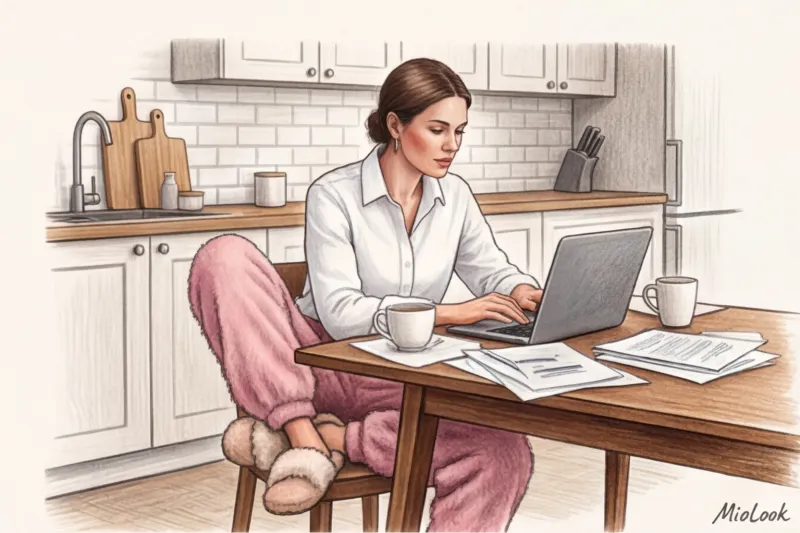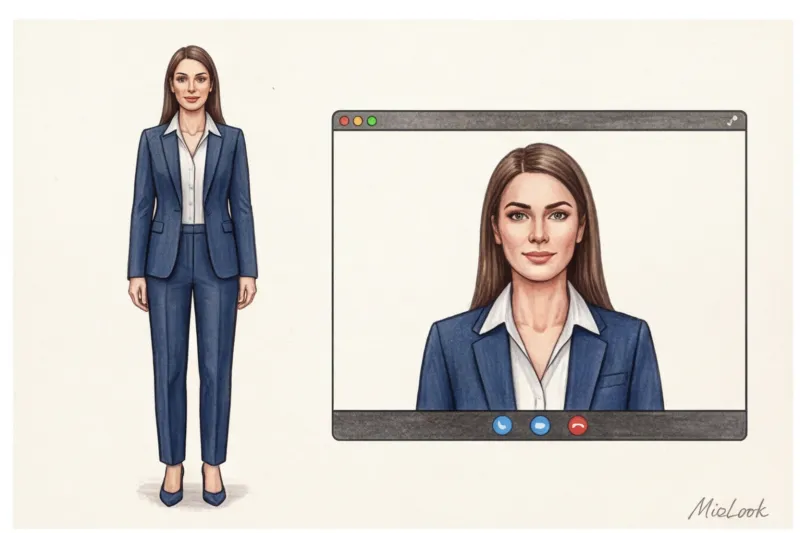
Remember 2020, when every other fashion blogger was recommending buying huge, flashy plastic earrings specifically for Zoom? The idea seemed logical: if we're only seen from the shoulders up, we need to maximize the focus on our faces. But a few years have passed, and this advice is hopelessly outdated. Today, cheap, oversized "screen-only" jewelry not only harms the environment but also downright cheapens your look, betraying your insecurity.

Working with clients, I realized one important thing: quality accessories for video calls should obey the laws of webcam optics, not glossy magazines. What looks stunning in person can turn into visual garbage in 720p resolution. We've covered the basic principles of a home office in more detail in our complete guide to The Perfect Freelancer's Wardrobe: A Hybrid Capsule , and today let's look at accessories through the lens of pixels, glare, and video compression algorithms.
Optics and Style: How a Webcam Changes the Perception of Your Jewelry
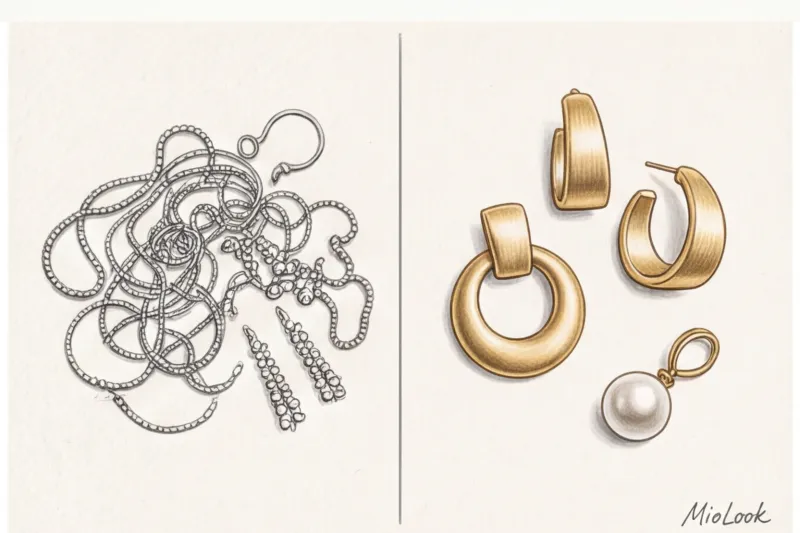
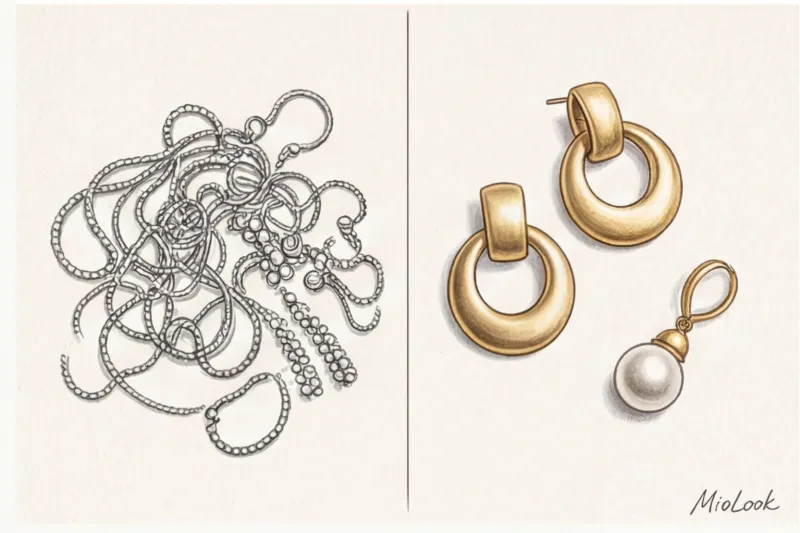
The difference between the human eye and the compression algorithms of Zoom, Teams, or Google Meet is colossal. The human eye easily perceives complex textures and the play of light. But the H.264 codec, used by most video conferencing platforms, begins to "simplify" the image at the slightest drop in internet speed, gluing small details into coherent blocks.
"Video compression algorithms hate fine contrast patterns. Any scattering of small stones (cubic zirconia, micro-diamonds) or complex filigree at bitrates below 1.5 Mbps turns into a pulsating blur on the screen—so-called digital noise."
I had a revealing case with a top manager at an IT company. For important online meetings, she wore her favorite statement chandelier earrings with dozens of tiny pendants. In the mirror, it looked classy. But in the recording of the call, we saw a disaster: with every head movement, the camera's algorithm couldn't process the glare from dozens of tiny details, creating a pixelated "cloud" around her ears that was incredibly distracting.
The second problem is lighting. If you use a ring light or sit facing a bright window, highly polished gold or silver acts like a mirror. It reflects light directly into the camera lens, creating harsh white highlights on the screen.
Practical solution: Choose matte textures, brushed (scratched) metal, and satin surfaces. They absorb and softly diffuse the light from the ring light, creating a sophisticated volume without glare. Satin-finished recycled silver earrings in the €60–€120 price range will look significantly more expensive on camera than polished luxury earrings costing a thousand euros, which will simply "dazzle" your webcam.
Access to MioLook for €0.99 — one-time payment
A smart AI stylist will select the perfect look for video calls and meetings.
Get access — €0.99 onceThe Framing Rule: Accessories That Ruin the Shot
Typically, the distance from your laptop camera to your face is 50–70 cm. This creates a rigid frame for the "portrait zone." This is where the cutting line rule, which few people consider, comes into play.
If you wear a pendant on a long chain and it's cut off by the bottom edge of the Zoom frame, you create visual tension. Subconsciously, your interviewer will feel like you're "cut off" from the table. Any pendant should either fit entirely within the frame with a few centimeters to spare, or not be used at all.
Another invisible enemy of hybrid meetings is audio noise. A couple of months ago, I was coaching a speaker before an online conference. The speaker was actively gesturing and typing on the keyboard while speaking. She was wearing a charm bracelet. The problem is that modern microphones with active noise cancellation interpret the clanging metal as parasitic noise and begin to aggressively muffle the sound, swallowing the speaker's words.
That's why I always recommend: if you're typing during a call, remove all bracelets and watches with metal straps. Keep only leather or fabric straps. How to wear large jewelry and not disturb others (and yourself), you could write a separate book, but for online meetings there is one rule - absolute silence.
Hybrid Capsule: 4 Accents for the Screen and the Office
Sustainable fashion teaches us that a piece shouldn't serve a single, narrow purpose. Buying plastic jewelry just for Zoom is unsustainable and pointless. The future belongs to hybrid mini capsules that look equally classy in 1080p and in person at a coffee shop.
1. Architectural Geometry
Wide hoop rings, smooth metal spheres, crisp rectangles. Clean geometric lines survive even the worst internet connections. They don't distort or pixelate.
In terms of ethics and trends, look for brands that work with recycled metals (recycled silver and gold) or Fairmined gold. This is a great investment in basic jewelry wardrobe High-quality, minimalist chuppahs made from recycled silver (for example, from Scandinavian or local sustainable brands) typically cost between €80 and €150 and last for decades.

2. Modern pearls
Pearls are a brilliant optical instrument. Their smooth, mother-of-pearl surface acts as a miniature softbox, gently reflecting light from your monitor and illuminating your face from below, blurring shadows under your eyes.

To avoid looking like a conservative librarian, choose baroque pearls with irregular shapes. Their asymmetry softens the formality, making them ideal for the casual style of modern IT companies and creative agencies.
3. Optics as a status marker
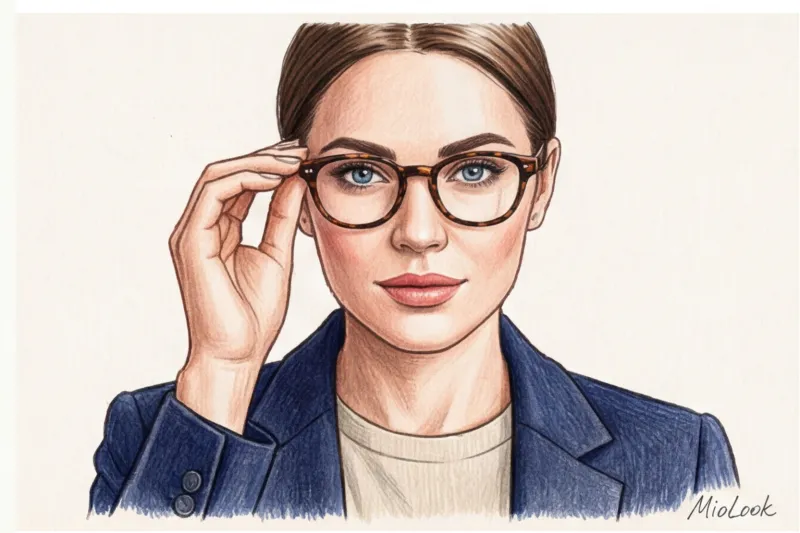
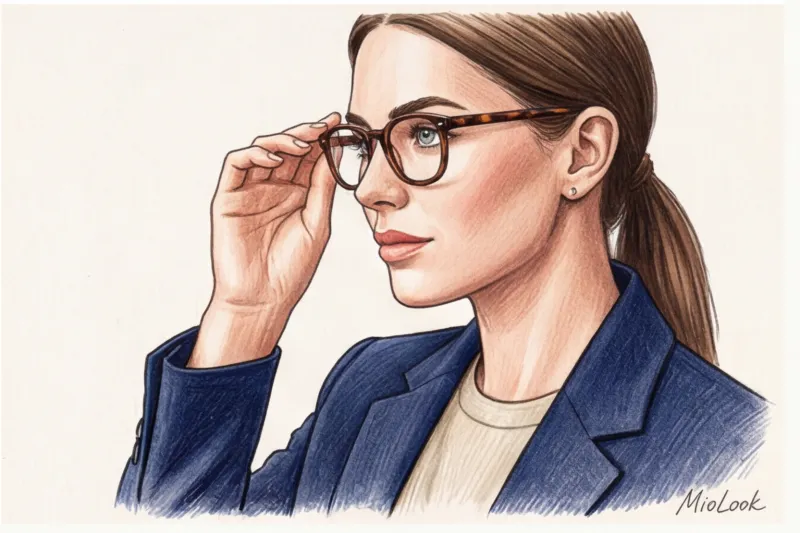
If you have poor eyesight, your glasses are a key accessory for the portrait area. But for video calls, there's one critical requirement: a high-quality anti-reflective coating (anti-glare).
Without it, your interlocutor will see their own face reflected in a Zoom window, a blinking cursor in Word, or a messenger window in your lenses. This ruins eye contact. Invest in good lenses—they're more important than the logo on the frame.
4. Organic silk scarves
When wearing basic T-shirts or turtlenecks around the house, a silk scarf (or scarf) is a lifesaver. It adds a pop of color to a portrait without any risk of glare.
Pay attention to vintage scarves or items made from peace silk (ethical silk, produced without the harm of silkworms). A scarf draped around the neck for €70–120 instantly elevates a plain white T-shirt from "loungewear" to "boardroom-ready."
Your ideal image begins Here
Join thousands of users who look flawless every day with MioLook. Digitize your accessory collection!
Get access — €0.99 onceStyle Psychology: Switching Tactics for a Hybrid Schedule
The WGSN 2024 study confirms what psychologists have been saying for several years: the main problem with remote work is the blurring of boundaries between personal and work time. We wake up, take our laptop to bed, and are already at work.
This is where the phenomenon comes into play Enclothed Cognition (embodied cognition) is the influence of the physical ritual of putting on certain items on our brain's tuning. A classic study by Adam and Galinsky (2012) demonstrated that our brains internalize the symbolic meaning of the clothes we wear.
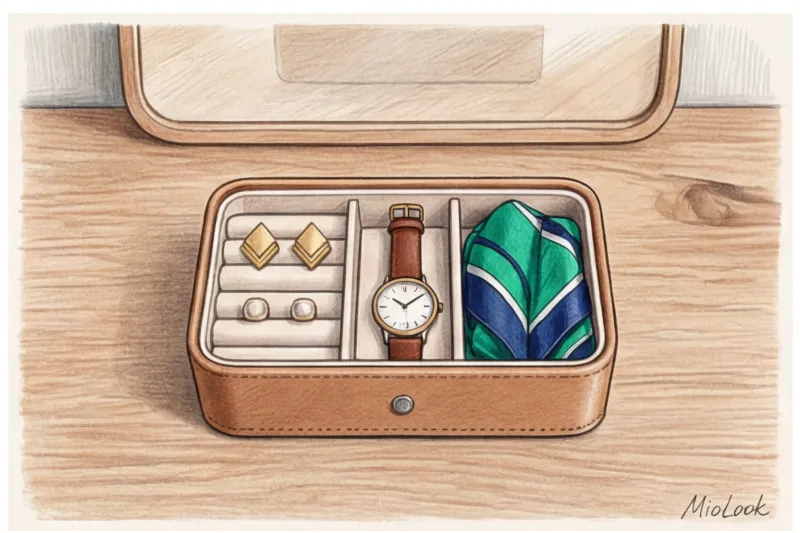
Accessories are the perfect trigger for the brain. When you put on a watch (even if you can check the time on your monitor) or put on hoops before a call, you're sending a message to your mind: "I'm at work. I'm focused."
But even more important is the ritual of taking off your laptop. At 6:00 PM, you close the lid of your laptop, take off your watch, take out your earrings, and put them in a jewelry box. That's it, the workday is over. This micro-ritual is a better preventative against burnout than any time management app.
Fair limitation: This minimalist approach won't work for everyone. If you're an art director, a stylist for an extravagant brand, or a creative freelancer whose personal brand is built on maximalism and eclecticism, you CAN and SHOULD wear complex, multi-layered jewelry on camera, sacrificing pixel quality to convey your DNA. But for 90% of experts in the corporate and consulting sectors, architectural minimalism is the gold standard.
Checklist: Testing Accessories Before Broadcast
Before you invest in new video calling accessories or put together a look for smart wardrobe MioLook , run your current jewelry through this one-minute stylist checklist:
- Screenshot Test: Open Zoom or your laptop camera in the light you normally work in. Sit in your usual position and take a screenshot. Open the image and check the proportions. Is your pendant cutting off the edge of the frame? Are your earrings blending in with the wall?
- Squint Test: Open the same screenshot and squint hard at it. If your jewelry has turned into a smudged, indistinct smudge, it's too small and complex for the camera. If the shape (circle, line, oval) is still legible, it's perfect.
- Audio test: Call a colleague (or play a test recording with a microphone), place your hands on the table, and actively type for 15-20 seconds. Ask if you can hear the jingle of your rings or bracelets against the laptop.
Your laptop screen is a very specific display case. It doesn't tolerate fuss, excessive glitz, or small details. By choosing large, clean shapes, matte textures, and natural light reflectors like pearls, you're not just "dressing up for a call." You're demonstrating digital etiquette and the status of someone who understands that professionalism today depends on respect for the eyesight and hearing of your interlocutor.