What is emotional shopping and why do we fall into this cycle?
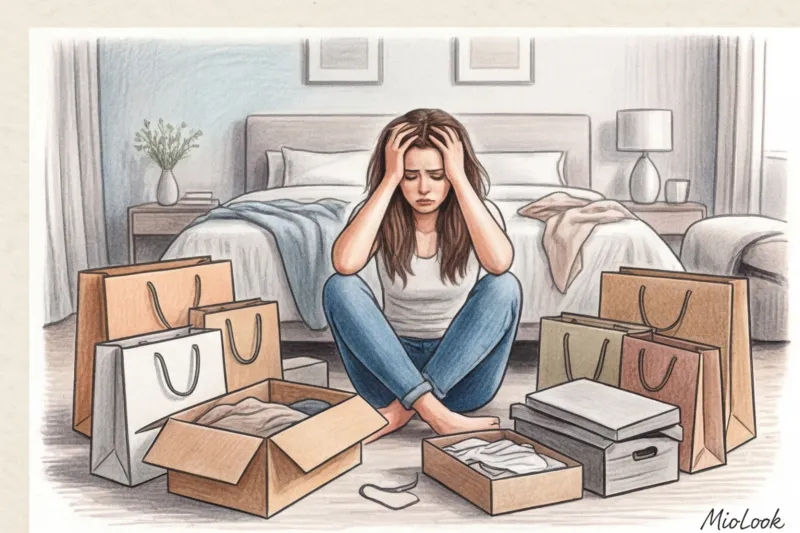
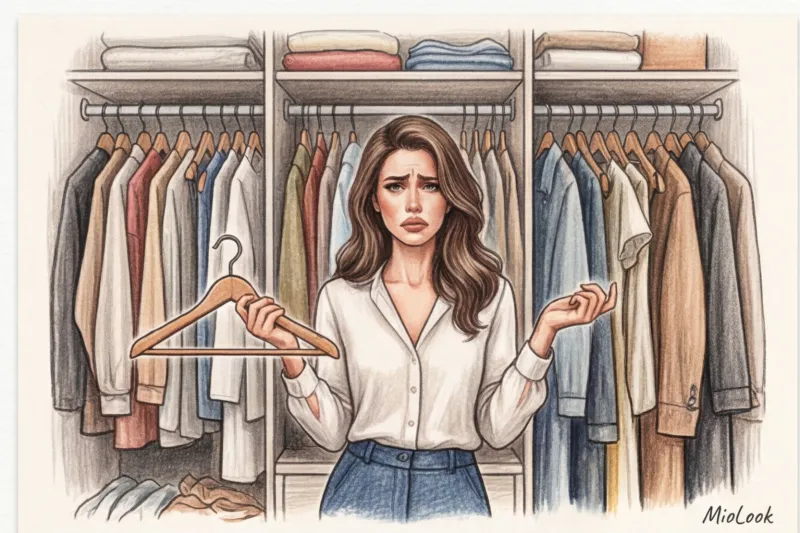
Last Tuesday, Anna came to me for a wardrobe review. We opened the doors of her enormous closet, and clothes literally rained down on us. Silk blouses with the tags still attached, three nearly identical black jackets, dresses she'd never worn. Anna looked at this mountain of textiles with despair and uttered a phrase I've heard from eight out of ten clients in my 12 years as a stylist: "My closet is bursting with clothes, but I have absolutely nothing to wear." That's exactly what they look like in reality. emotional purchases — when we pay not for physical clothing, but for a short-term illusion of happiness.
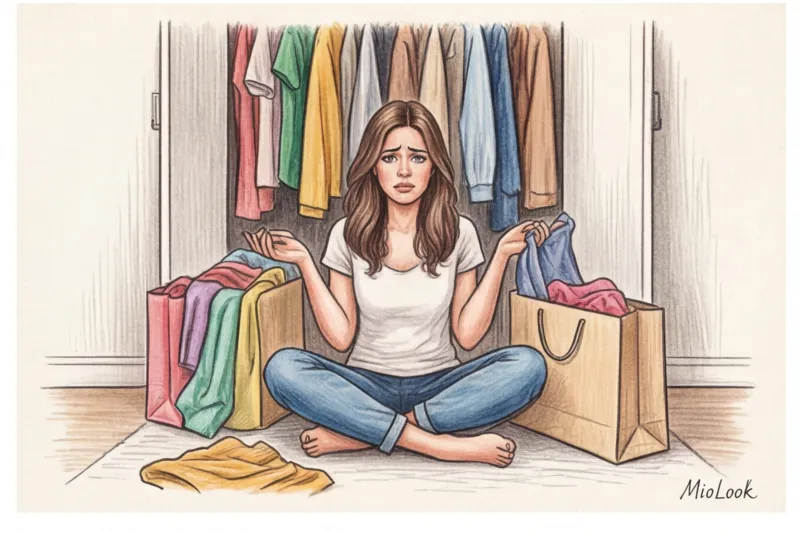
At its core, emotional shopping is buying things not for their functionality, quality, or actual necessity, but solely to change your inner state. At this point, the focus shifts from the object (the item) to the subject (your emotions). You're not buying a cashmere sweater, but a feeling of comfort after a hard day at work.
The foundation of this process is the classic dopamine loop, which works like a Swiss watch:
- Waiting (trigger). You're feeling tired or anxious, so you open your favorite brand's app. Your brain is already producing dopamine, the hormone that anticipates pleasure.
- Purchase (climax). You press the "Pay" button or swipe your card at the checkout. That's when your endorphins hit their peak. You feel like a winner.
- Short euphoria. Unpacking the rustling paper and trying it on in front of a mirror at home. This stage lasts anywhere from 15 minutes to a couple of days.
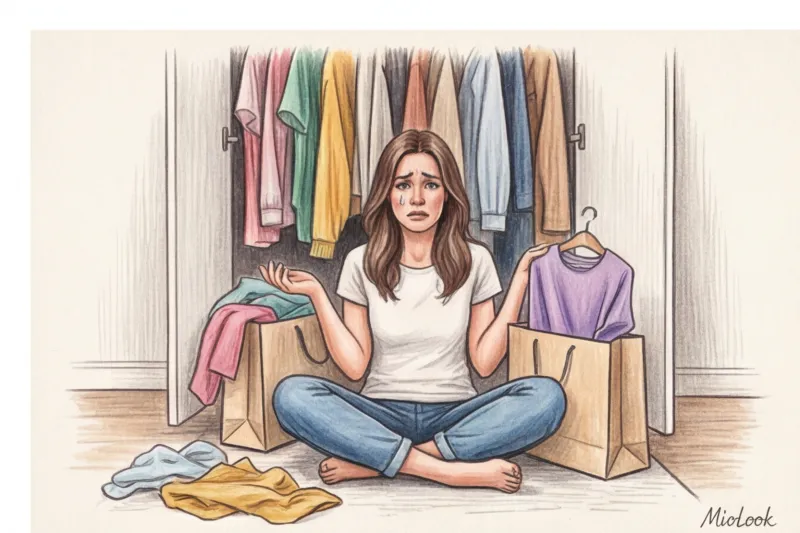
- Feelings of guilt (recession). The euphoria dissipates, and you're left alone with an empty bank account and an item that doesn't fit into your life at all. Disappointment sets in, triggering a new round of anxiety, which you'll once again seek to "cure" with shopping.
Why do these things always sit in your closet like dead weight? Because they're bought without any real connection to your wardrobe. You don't analyze what you'll wear with that neon pink top, and you don't think about What fabrics look expensive? and last a long time. Something bought on impulse almost never works with your basics.
According to a large-scale study by the Ellen MacArthur Foundation (2020), over the past 15 years, the average lifespan of clothing has decreased by 36%, and the number of times a piece is worn has halved. We've started buying more and wearing dramatically less.
The Psychology of Retail Therapy: When Shopping Becomes an Antidepressant
The term "retail therapy" has long been commonplace, but we rarely consider its true drivers. Spontaneous spending is most often driven by the three horsemen of burnout: stress, chronic anxiety, and an acute need for control. Have you ever noticed how after a bad meeting or an argument with your partner, your hand automatically reaches for online catalogs? When we can't control global events or the behavior of others, buying a new pair of shoes gives us a quick, tangible illusion of control over our lives. "I decide I can afford it."
But the most insidious thing about emotional shopping is the illusion of a "new life." When we buy something, we often buy not the fabric or the cut, but the image of the woman we want to be.
In my practice, clients regularly buy formal three-piece suits while working freelance in pajamas, wanting to feel like a put-together businesswoman. Or they buy sparkly evening dresses, even though they spend all their weekends out of town—buying a fantasy of a vibrant social life. To break this pattern, I always recommend first digitizing your real-life everyday life. For example, by transferring your belongings into an app. MioLook , you'll clearly see what your real life consists of, and you'll be able to create new looks from what you already have, without having to buy another "dress of hope."
Marketing Traps: How Brands Trick Us into Spending
The problem is compounded by the fact that we're battling not only our own neurobiology but also the multi-million dollar marketing budgets of corporations. Fast fashion brands hire top psychologists to get you to buy faster, more, and without thinking.
Retail's main weapon is artificial scarcity. Red "Only 1 left in your size" signs, countdown timers in your shopping cart, and "Limited Edition" labels strike right at our ancient survival instincts. Fear of missing out (FOMO) shuts down the rational part of your brain (the prefrontal cortex), and you buy a sweater simply because someone else might take it.
Add to this the gamification of discounts. You go to buy a basic T-shirt for €20, but you see a progress bar: "Add another €15 worth of items to get free shipping." And so you're throwing unnecessary socks and hairpins into your cart, wasting money for the sake of illusory savings. It's much more environmentally friendly and cost-effective to explore... How to look expensive on a budget , building a capsule, and not chasing imaginary shares.
And if you do manage to close the tab, you'll be hit with aggressive retargeting. Abandoned carts will haunt you on social media, news sites, and in your inbox. Notifications like "Your dress is missing you" or "We saved your cart and are giving you a personalized 10% discount for 2 hours" are designed to trigger your dopamine loop at its most vulnerable point. Understanding these mechanisms is the first and most important step to regaining control of your style and wallet.
How to Recognize Your Emotional Shopping: A Wardrobe Habit Checkup
Statistics are merciless: according to the classic Pareto principle, most people wear only 20% of their wardrobe 80% of the time. But when I begin auditing new clients' closets, the reality is often even more depressing. In practice, this ratio often shifts to 10/90. And that 90% "dead weight" is almost always emotional purchases , committed under stress, fatigue or under the influence of aggressive marketing.
Symptoms: What identifies an impulsive shopaholic?
How can you tell if your shopping has gotten out of control? Over 12 years in the profession, I've compiled a stylist's checklist for identifying wardrobe blind spots. If you notice at least two of these three symptoms, it's time to sound the alarm:
- Clones of things. A fifth basic white T-shirt, another pair of black trousers that "only differ in the width of the hem." We buy duplicates unconsciously: when the brain is overwhelmed by anxiety, it seeks comfort in a familiar and safe pattern.
- Clothes with tags. Bought during the seasonal sales rush. A classic trap: "70% off, it would be a sin not to get Italian silk for €45!" As a result, the item ends up waiting for years for a "special occasion" because it doesn't fit your climate or lifestyle at all.
- Size "for the future". Motivational jeans that are two sizes too small are supposed to motivate you to lose weight. In reality, they don't motivate you; they just serve as a guilt generator every time you open the closet door.
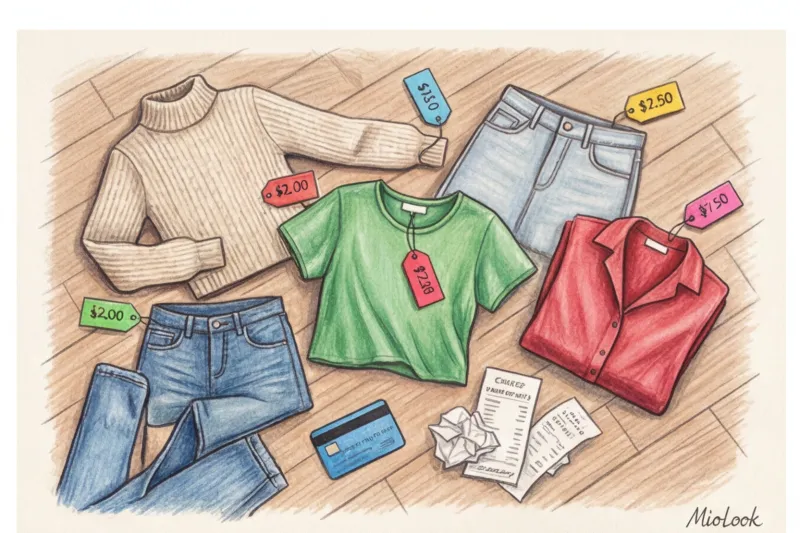
Trigger Analysis: When Your Hand Reaches for the Basket
Symptoms are just a consequence. To break this cycle, you need to find the root cause. Ask yourself: when exactly do you open branded apps? We often try to "buy" solutions to problems that have nothing to do with clothing.
The most dangerous time for your wallet is between 9:00 PM and 11:00 PM. Due to the phenomenon of "decision fatigue," our self-control is depleted by the evening. This is why late-night doomscrolling of marketplaces after a hard day at work so often results in pointless orders.
Other common triggers include pre-period hormonal surges (seeking a quick dopamine hit) and FOMO (fog of missing out) when you see the "2 hours left on a deal" timer. To prevent these urges from happening, I recommend digitizing your wardrobe. By uploading your database to MioLook , you'll see all the statistics clearly. The need to buy a sixth gray cardigan will disappear automatically when the AI shows you already have enough.
Access to MioLook for €0.99 — one-time payment
A smart AI stylist will select the perfect look.
Get access — €0.99 oncePractical exercise: auditing the last 5 purchases
Let's conduct a tough but fair test of real-world usefulness right now. Open your banking app or order history and write down the last five items you purchased.
Now ask each of them three questions:
- Have you worn this item more than three times since the tag was removed?
- Were you able to make at least three sets with her from what it already happened in your wardrobe without buying anything else?
- Do you remember, what emotion Did you experience anxiety, boredom, or a desire to reward yourself for a difficult project when you pressed the “Pay” button?
In my experience, this simple audit is more sobering than any lecture on sustainable consumption. One of my clients, after analyzing her statements for six months, realized with horror that she had spent over €1,200 on trendy, one-time-only items simply because she was burnt out at work. If most of your answers are negative, your shopping strategy needs to be recalibrated.
Busting the Myths: Why Retail Therapy Works, But We're Using It Wrong
Have you ever noticed how after a tough work week or an unpleasant conversation, the thought "I'll go buy myself something" arises almost reflexively? Popular self-improvement articles tend to demonize this impulse, calling for strict asceticism and a complete abstinence from spending. But I want to tell you something completely counterintuitive: you can't deny yourself joy. By trying to suppress the natural desire to relieve stress, we only paint ourselves into a corner, which inevitably leads to even more serious breakdowns.
Moreover, science proves that the concept of "Retail Therapy" has a strong biological basis. In the authoritative publication Journal of Consumer Psychology (2014) published a study that dotted the i's. Scientists proved that the very process of choosing and making a purchase actually helps cope with sadness. The reason lies in basic psychology: when we make a purchasing decision, we regain a lost sense of personal control over our lives and the environment. The problem lies not in the act of shopping itself, but in the "currency of joy" we choose for it.
In the neuroscience of mindful consumption, I distinguish two types of dopamine: "toxic" and "green." We get the toxic pleasure hormone from fast fashion: the flashing discount timer, the red "Buy" button, the instant debit. The euphoria of such a transaction lasts only until the moment you unpack the package. As soon as you touch the hard acrylic or see crooked stitching, the brain registers disappointment.
Eco-friendly dopamine works differently. It's a deep, sustained pleasure from the search for a truly high-quality item. The joy here is based on aesthetic and tactile satisfaction, not the adrenaline rush of speed.
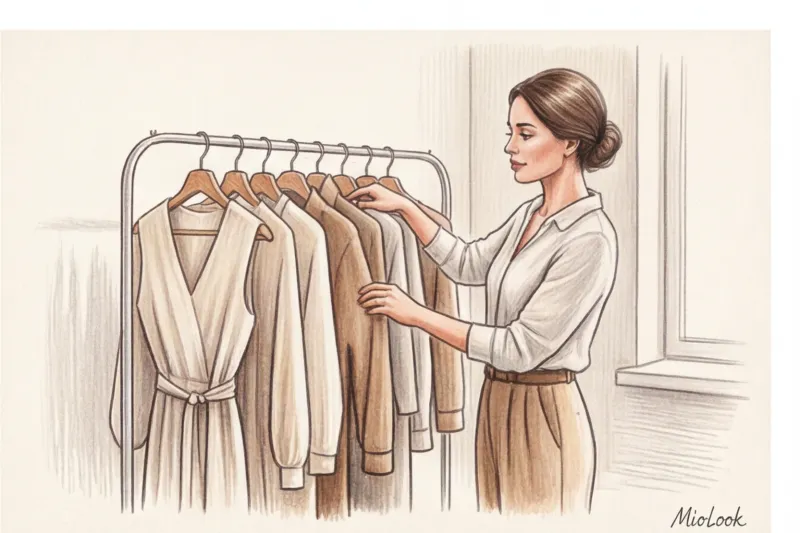
My position as a fabric expert is that using clothing as an antidepressant is perfectly fine. We just need to up the ante and change the quality of the "medicine."
Consider the classic scenario: A stressed woman walks into a fast fashion store and impulsively buys five trendy but dubious tops for €30 each. She spends a total of €150. The next morning, looking at this pile of thin polyester with nothing to wear, she experiences a sharp, gnawing feeling of guilt. The clothes settle in her closet like dead weight, a reminder of a moment of weakness.
Now imagine a completely different situation. You invest the same €150 in a single investment—for example, an impeccably tailored jacket made of a dense wool blend or the perfect basic cashmere sweater. You've been anticipating this purchase, weighing the fabric in your hands, checking the finish of the back seams. This item brings deep, lasting satisfaction. A single, well-thought-out investment never evokes guilt, because you're not buying a momentary impulse, but real physical comfort and durability.
To switch your brain to the right dopamine scenario, I advise my clients not to rush to the checkout, but to "live" with the desired item virtually. Save a photo of that investment jacket and upload it to MioLook smart wardrobe Check if the algorithm with this new feature collects at least three fresh images from your current database. This process of visualization and planning itself produces a powerful dopamine response and calms the mind, giving that same feeling of control—but in a completely eco-friendly way.
Textile Mindfulness: How Fabric Quality Stops Momentum
When our heart rate quickens at the sight of a neon "70% Sale" sign or a "last size left" sign, our brain completely switches off analytical thinking. The amygdala—the emotional center that demands immediate dopamine reward—takes over. We're in a state of mild affect, where logical arguments like "I already have something similar" simply don't work. And the fastest, physiologically sound way to regain control is to engage tactile sensations.
A sensory approach to shopping works like an ice-cold shower. According to research in the field of consumer neuroscience (Journal of Consumer Research, 2023), conscious touch redirects neural activity back to the prefrontal cortex, which is responsible for logic and risk assessment. In psychology, this technique is called grounding: we shift our focus from the abstract fantasy of "a new life in a new dress" to the physical properties of an object in the here and now. As soon as we stop simply looking at an object and start analyzing it with our hands, the brain instantly sobers up.
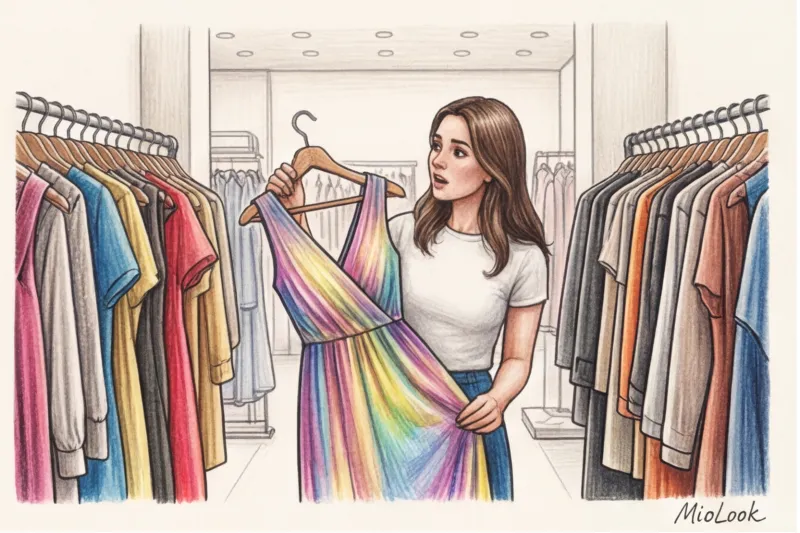
In my practice I use a technique that I call blind test If I see a client grabbing a brightly colored but questionable item from the rail with sparkling eyes, I ask her to close her eyes. Then she should take the edge of the fabric and squeeze it tightly in her fist for 20-30 seconds. Without visual noise—a brand logo, a tempting price tag, the magic of store lighting—her fingers become impartial critics. You begin to notice the glassy squeak of cheap synthetics, the looseness of the threads, or the unpleasant scratchiness of the dye. If, after opening her hand, the fabric remains chewed up like paper, it's a sure sign: in real life, the item will behave just as badly, requiring constant steaming.
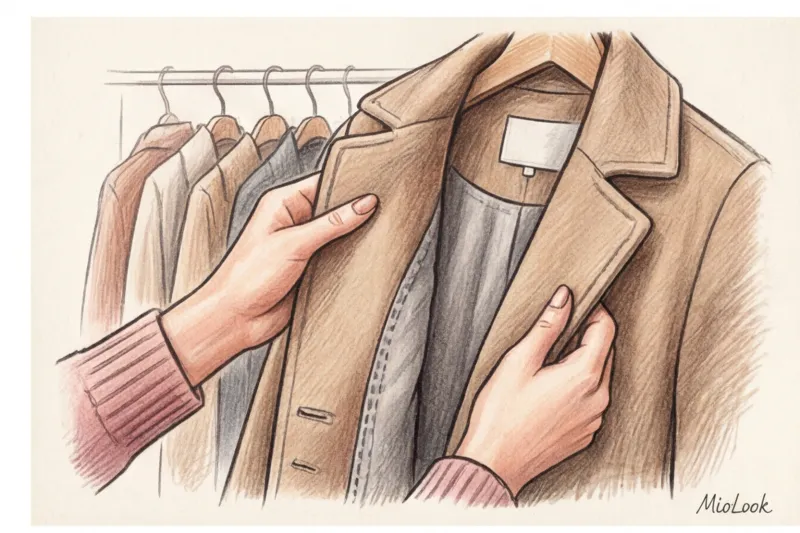
The second step in my method is a mandatory inspection of the back seams. The back side is the true identity of the product, which the manufacturer cannot falsify using social media filters. Turn the item inside out and pay attention to three quality indicators:
- Allowance width: A quality garment has a seam allowance of 1.5–2 cm. If it's cut right down to 3–5 mm, it means the factory was saving every millimeter of fabric. The slightest tension will cause such a garment to come undone at the seams.
- Stitch Density (SPI): In the fast-fashion industry, equipment is set to long, sparse stitches to speed up the sewing process. Gently tug the seam sideways—if you see any obvious gaps or taut threads, return the hanger to its original position.
- Edge treatment: A loose overlock with loose threads makes a garment look like it's going to be worn out. A quality seam should be tight, and ideally, bound with bias binding or closed (lapped).
The ability to "read" a garment with your hands in 30 seconds is guaranteed to relieve the emotional tension. You suddenly realize that you're not holding the "dress of your dreams," but a piece of poorly crafted plastic that the brand is trying to sell you at a colossal markup.
Understanding the basic properties of fibers is your main defense against reckless spending when trying them on. Let's compare two typical fall sweaters. If the tag says 100% polyester or acrylic, you should clearly understand the physics of the material. Polyester, being a petroleum derivative, creates a sauna-like effect: it's impermeable, causing you to sweat instantly indoors, but offers no warmth in a cold wind. Acrylic, on the other hand, tends to pill after just three wears due to its short, smooth fibers that easily unravel.
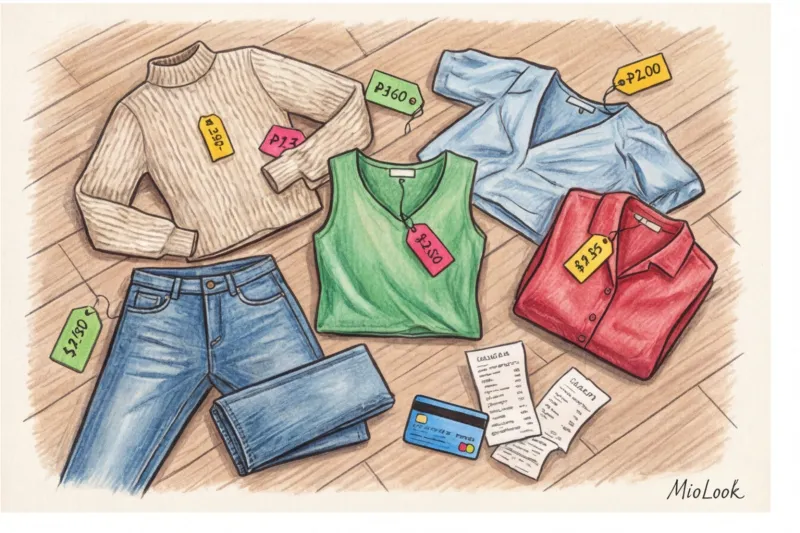
In contrast, wool blends—for example, 70% merino and 30% polyamide (the addition of up to 30% synthetics is technologically justified for durability)—work differently. Merino fibers are porous, they breathe, wick away moisture, and adapt to body temperature. Such a garment is flexible and drapes beautifully. If you see a thin acrylic cardigan for €80, you realize it's pure marketing ripoff. Understanding the textile base instantly eliminates the urge to buy something "just because it's pretty."
Wardrobe Math: Calculating Cost Per Wear
Emotional purchases often disguise themselves as bargains. Our brains readily offer excuses: "It's just a blouse on sale, it won't break the bank." To dispel this dangerous illusion, I teach my clients to use the CPW (Cost Per Wear) formula. It translates an item's abstract appeal into hard, sobering numbers, revealing the true cost of ownership.
The calculation formula is extremely logical: Cost of the item / Number of wears = Actual price.
Let's compare two situations. Let's say, succumbing to Friday fatigue, you bought an ultra-fashionable but cheap thin polyester top for €35. You wore it to a party, then again to meet up with friends. After washing, the fabric has become misshapen and the seams have become crooked. Result: the top is settling at the bottom of the closet. Calculating the CPW: €35 / 2 wears = €17.50 per wear.
On the other hand, you've consciously invested in a basic heavy wool suit jacket that costs €250. At first glance, the price seems a bit hesitant. But the fit is perfect, the fabric doesn't wrinkle, and the jacket pairs well with both formal and casual looks with jeans. You've worn it at least 100 times a year. Calculating the CPW: €250 / 100 times = €2.50 per outfit.
The paradox of wardrobe mathematics is that a "cheap" top costs you seven times more to wear than an expensive, premium jacket. Once you start evaluating every impulsive desire through the prism of the price per item, your approach to shopping will transform. Numbers aren't subject to emotion—they'll unmistakably tell you when it's time to leave an item in the store.
Try MioLook
for free
Start creating your perfect looks with AI and build a conscious wardrobe without breaking the bank.
Get access — €0.99 onceA Mindful Wardrobe Strategy: From Impulsive to Systematic
According to the WGSN Global Consumer Behavior Report (2023), over 70% of impulse purchases occur within the first 10 minutes of seeing an item. At this point, we're driven by pure dopamine, not genuine need. To break this cycle, willpower alone isn't enough—you need a functioning system that transforms chaos into a manageable process.
The "Quarantine of Desires" Method and the 48-Hour Rule
Your first line of defense is creating an artificial pause between stimulus and response. The essence of the "Desire Quarantine" method boils down to a strict 48-hour rule: exactly two days must pass between the moment you add an item to your cart and the moment you pay for it. During this time, neurotransmitter levels stabilize, and the prefrontal cortex, responsible for cold, analytical thinking, kicks into gear.
As behavioral economists note, the mere act of adding something to a wishlist gives us up to 80% of the same neurochemical pleasure as a physical purchase, but without the subsequent financial hangover.
Instead of paying for a €250 silk dress right away, put it on a special wishlist. Create a separate note on your phone or a folder in your browser. My experience auditing wardrobes shows that within 48 hours, 8 out of 10 items are removed from this list simply because clients have conveniently forgotten about them.
Spatial Boundaries: The One In, One Out Concept
When building a conscious wardrobe, the physical space of your closet should become a natural boundary for new purchases. The "One In, One Out" concept works flawlessly here. The idea is simple: if you buy a new cashmere jumper, exactly one old sweater or hoodie should leave your closet—either for recycling, resale, or donation.
This approach shifts the focus from mindless hoarding to thoughtful curation. You begin to evaluate a potential purchase in a completely different way: "Am I willing to part with my beloved but already worn merino cardigan for this trendy but synthetic T-shirt for €40?" If the answer is no, then you're looking at a classic emotional purchase that's best avoided.
Digitization: How AI Meets the Need for Innovation
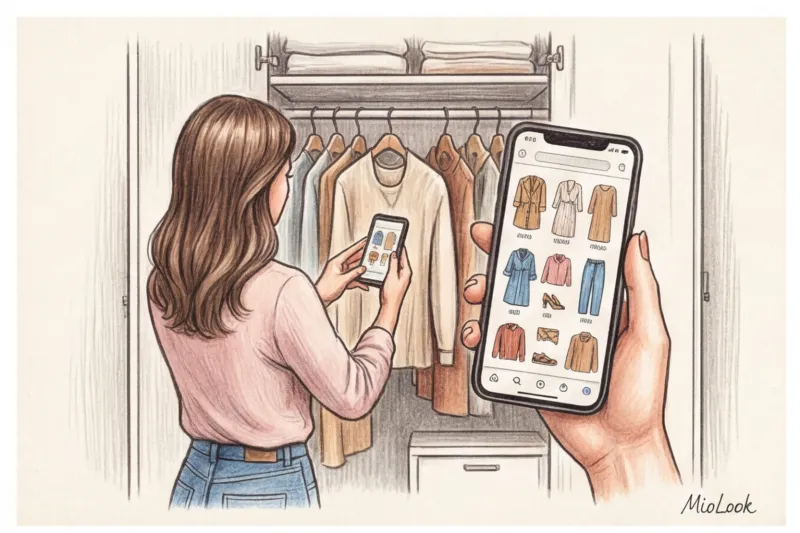
But what do you do when your brain literally physically demands a sense of novelty? The paradox is that we rarely need new clothes—we need new emotions From a fresh look. Digitizing your wardrobe has become a real technological breakthrough for those who want to stop the flow of unnecessary spending.
Instead of heading to the mall for another dose of endorphins, I highly recommend using specialized AI tools. For example, by integrating MioLook In your daily routine, you delegate the task of styling to artificial intelligence. It's a modern solution to the problem of "a full closet, but nothing to wear." By uploading your basic and accent pieces into a virtual wardrobe, you get dozens of new, unobvious combinations from what you already have. already belongs to you.
Smart management, instead of chaos, also works during the pre-shopping phase. Seen a stunning jacket in the store? Take a photo and add it to the app's virtual fitting room. Often, the algorithm clearly shows that this potential new item, stylistically or colorwise, clashes with 90% of your pants and skirts. Using such technologies satisfies the psychological need for novelty through fresh styling, preserving your budget and preventing clutter.
A Stylist's Practical Checklist: 5 Questions to Ask Before Checking Out
The moment of truth always comes one step before the payment terminal or the "Place Order" button. Cortisol levels drop in anticipation of a quick dopamine rush, and this is precisely where we need a powerful emergency stopcock. I've consulted with hundreds of women, and for each of them, I implement a rigorous yet sobering shopping cart auditing algorithm. This isn't just philosophical musings, but a practical filter guaranteed to weed out unnecessary spending.
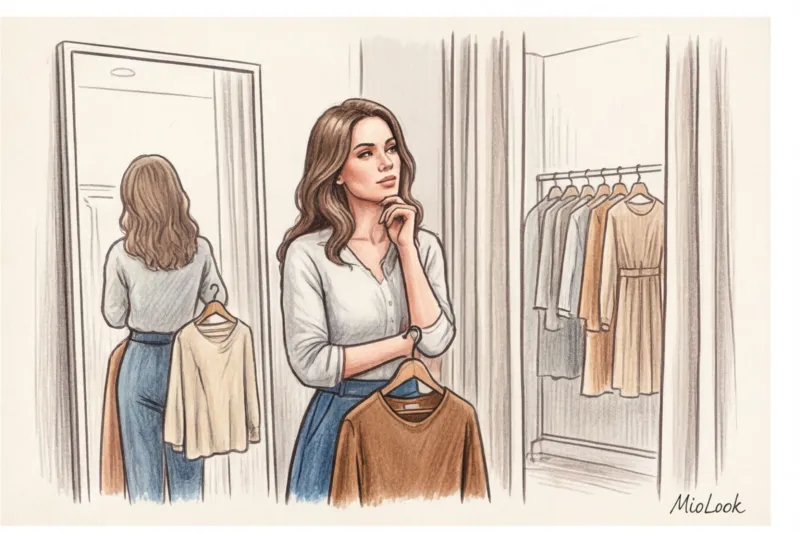
Ask yourself these five questions while you're standing in line at the fitting room or hovering your finger over the Apple Pay button:
1. What will I wear this with tomorrow? (The 3-Pair Rule)
The key word here is "Tomorrow" Not at some abstract party in six months, or when you've lost three kilos. In professional styling, there's a golden "Rule of 3 Pairings": any new item should pair immediately with at least three items already in your closet. If you need to buy a special seamless top, new tights, and ankle boots of the right height to go with a striking asymmetrical skirt, that's not a new outfit. It's a financial black hole masquerading as a bargain.
2. Is this my thing or the thing of “the woman I want to be”?
The most insidious trap of our perception. We often buy not clothes, but a fantasy of a different life. A strict three-piece pantsuit gets consigned to the bin for the illusory role of an ironclad businesswoman, even though in reality you work remotely. One of my clients bought a collection of sequined evening dresses this way, even though her real routine consists of trips out of town and quiet dinners in the neighborhood. Always separate your actual lifestyle from the aesthetic fantasies you see on Pinterest.
3. Would I buy this if there was no 50% discount?
A classic behavioral economics trick. Remove the red "Sale" sticker from your mind. Imagine that neon jacket costs its full €120, not the sale price of €60. Do you still want to take it home? If the answer is no, then you're not buying the item itself, but the feeling of a fleeting victory over the system and the adrenaline rush of a "good deal."
4. How will this item behave after 5 washes?
At this stage, we turn on our inner technologist. Emotional purchases rarely pass the quality check because we look at the color, not the inside. Thin viscose without added elastane will almost certainly shrink significantly and become warped at the side seam after machine washing. A 100% acrylic jumper will become covered in pilling after just three wears. Ask yourself: are you ready to dry clean this item or hand wash it in cool water? If you're looking for an easy-care item, leave that fickle polyester at the store.
5. Do I already have something similar?
In the heat of the moment, we tend to create clones. In the fitting room, we genuinely feel like this dark blue sweater is completely different from the black and graphite ones already on the shelf. In such moments, ruthless digitalization saves the day. Instead of painfully remembering the contents of the shelves, I recommend opening MioLook Right at the checkout. One glance at your visualized wardrobe on your phone, and you instantly realize you don't need a seventh basic turtleneck.
Your ideal image
it begins Here
Join thousands of users who look flawless every day with MioLook.
Get access — €0.99 onceEmotional Reset: Green Alternatives to Shopping
There's an immutable rule in neuroscience, brilliantly described by Charles Duhigg in his research on behavioral patterns (2012): an ingrained habit can't simply be "removed"; it can only be replaced, preserving the familiar trigger and reward. If your trigger is stress, and your reward is the dopamine rush of novelty and a restored sense of control, our task is to find an eco-friendly alternative to the transaction process itself. As a proponent of sustainable fashion, I always emphasize: the most ethical, stylish, and affordable wardrobe is the one already hanging in your bedroom.
Shopping in your own closet: reassembling capsules and trying on forgotten items
Our brain craves visual stimuli, but it's surprisingly susceptible to positive illusions. You don't have to carry rustling new bags home from the mall to experience the thrill of a new purchase. Take a full-blown shopping tour through the depths of your closet. Set aside a free evening, put on some soft music, and bring out those items that have been gathering dust on the back shelves for over six months.
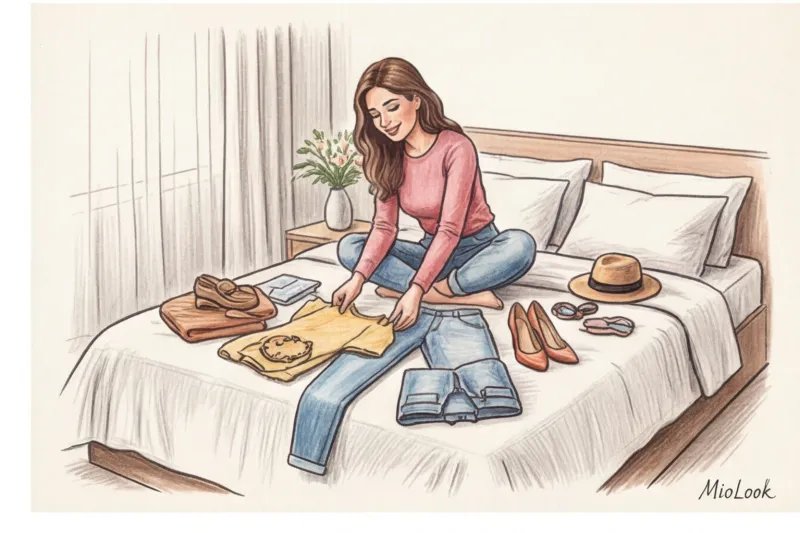
The secret lies in changing the context. Try on that same silk blouse you wore only once to a corporate event, but now pair it not with a strict pencil skirt, but with worn-out wide jeans and chunky boots. Reassembling capsules has a tremendous therapeutic effect. To enhance this, I highly recommend digitizing your items. By uploading your database to MioLook , you can visually design dozens of fresh outfits simply by dragging and dropping elements on the screen. You'll satisfy your aesthetic needs, play with form, and avoid adding textile waste to the world's landfills.
Customization and Upcycling: The Magic of Tailoring
One of my favorite tactics I advise my clients during times of intense spending urge is to invest in upgrading an existing item rather than buying a new one. Repairs and customizations do wonders for the way we perceive old clothes.
Instead of buying another basic mass-market jacket for €80, take your old but high-quality wool jacket to a reputable tailor. Adjusting the darts to your current figure will cost around €20-30, but the garment will fit as if it were custom-made. Replace cheap plastic buttons with vintage brass, heavy horn, or mother-of-pearl ones. This micro-step, costing €10-15, instantly elevates the garment visually to a premium level. You spend a small amount of money, anticipate the results, and pick up your updated garment—the entire shopping cycle is complete, but without cluttering your space.
Other ways to get endorphins and take control of the situation
Let's face it: emotional shopping often masks a fundamental need for control over one's life. When the workday has been chaotic, buying a sweater is a micro-decision whose outcome we control completely.
Redirect this impulse toward tidying up. Physically sorting clothes by color (gradient from light to dark) or replacing mismatched hangers with identical wooden ones reduces visual noise and restores a sense of complete control. If you're looking for a pure, powerful endorphin rush without being tied to your wardrobe, intense cardio, deep cleaning and decluttering, or creative hobbies that engage fine motor skills are all effective.
Conclusion: Freedom instead of restrictions
Many people mistakenly perceive the path to mindful consumption as a lifelong financial diet or a dreary asceticism. This is a fundamentally destructive mindset. By abandoning the endless pursuit of trends, we don't punish ourselves; on the contrary, we protect our personal boundaries.
By processing your emotional purchases, you'll see a tremendous amount of resources freed up. Those €150-200 that used to disappear unnoticed every month into the depths of seasonal sales turn into a substantial budget within a year. This money can be used for a dream trip, education, or the purchase of a single, truly iconic investment piece (like an impeccable cashmere coat) that will last for decades. Ultimately, conscious style is always a choice in favor of the real you, your true goals, and the freedom to live, not to hoard things.
Guide Chapters
Conscious consumption in clothing: where to start?
The most eco-friendly item is the one already hanging in your closet. We'll show you how to transition to a sustainable wardrobe without spending a fortune on eco-brands.
Dopamine Wardrobe: How to Get Joy Without Spending
Have a full closet but nothing to wear? Learn how to turn your clothes into a source of joy and stop wasting money on impulse purchases.
Shopping Detox: A Month Without Shopping for a Stylish Wardrobe
Is your closet overflowing with clothes and nothing to wear? Find out how a radical shopping break can help you refine your style and rediscover your love for clothes.
How to Plan a Clothing Budget Without Spending Extra
Full closet, but nothing to wear? Learn how to build a stylish wardrobe without breaking the bank, using wardrobe depreciation instead of strict limits.
Secret: How to Avoid Buying Everything on Black Friday Sales
Black Friday is just around the corner, and your closet is overflowing with clothes with tags still attached? An image consultant explains how to overcome the discount craze using math and color.
Clothes with tags in your closet: what to do with them
Opening your closet and seeing unworn purchases with price tags? Learn how to stop blaming yourself for emotional shopping and purify your closet.
The 24-Hour Shopping Rule: How to Avoid Overspending
Tired of impulse purchases and a cluttered closet? Find out how a simple pause at the checkout can help you stay on budget and build the perfect wardrobe.
Digitizing your wardrobe to avoid impulse purchases and unnecessary spending
Is your closet overflowing with clothes, but you still have nothing to wear? We'll tell you how a digital wardrobe can help you stop spending money on emotions.