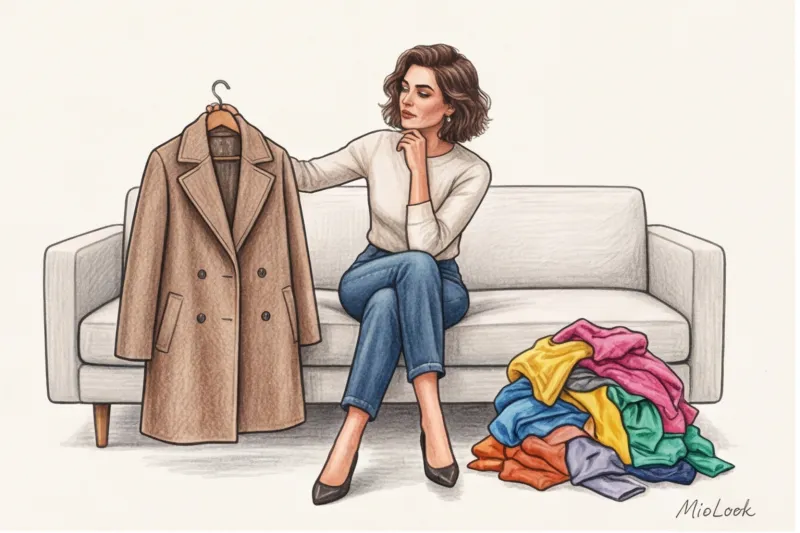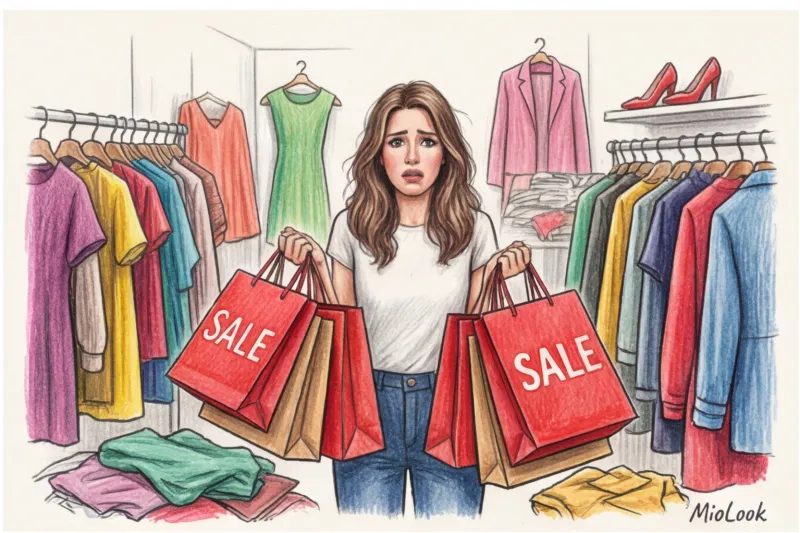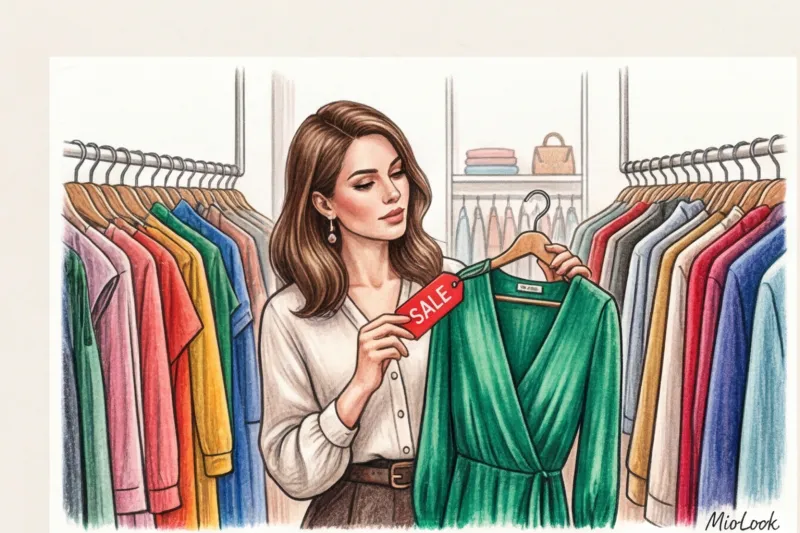
Have you ever noticed what happens at the end of November? You open your closet, a ton of clothes spills out, and you still have nothing to wear, but your hand already reaches for your smartphone because your favorite brand has sent you a push notification: "Only 24 hours! Up to 70% off." Sound familiar? In 12 years of working as an image consultant and colorist, I've seen hundreds of closets like this—overflowing with items still bearing tags, bought in a frenzy of bargain shopping.

We have already discussed the psychology of such breakdowns in more detail in our The complete guide to combating emotional shopping But today I want to look at the problem from a different angle. If you're looking for an answer to the question, How to avoid buying everything on sales The standard advice of "write a list" won't work. I'll show you Black Friday through the lens of color, cut architecture, and ruthless mathematics. Believe me, after reading this article, your view of red price tags will change forever.
The Anatomy of a Discount: Why Our Brains Disable Logic and Taste
Let's be honest: during sales, we don't buy clothes. We buy the dopamine rush of "I beat the system." Behavioral economics research (in particular, Dan Ariely's classic work on the price anchoring effect) proves that when we see a crossed-out €300 and a new price of €80, our brain values the benefit at €220, completely ignoring the fact that we're currently spending €80 on something we don't need.
One of my clients, Anna (I've mentioned her story in previous articles), once bought five silk blouses from Massimo Dutti. They were incredibly cheap. But there was one problem: Anna works from home and wears oversized hoodies and jeans in real life. The blouses hung in her closet for two years.
"As a colorist, I constantly observe the phenomenon of 'discount blindness.' In the fitting room, a dress that seemed 'too pale' at full price suddenly appears 'an interesting nude' when 50% off. The brain physically distorts the perception of color and fit to justify the bargain."
The biggest myth of Black Friday: "I'll save on the basics."
This is the most common misconception I hear from people during consultations. Women wait until November to buy "the perfect white top" or "those blue jeans." But here's some industry insider information: brands rarely offer high-quality, perfectly tailored basics at a fair discount.
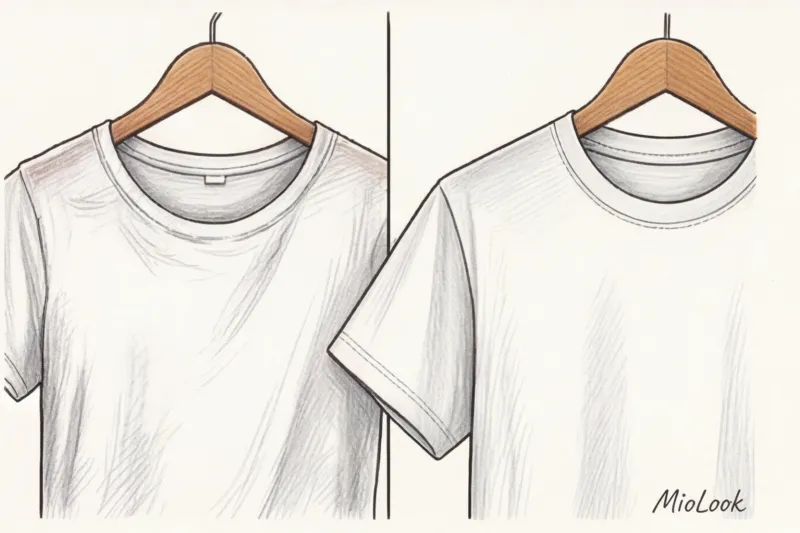
Basic items are the driving force behind sales. Why would a store discount a thick white cotton T-shirt (180 g/m² and above) that's already sold year-round? Items sold in the basics section are often either poorly cut or made from low-quality fabric.
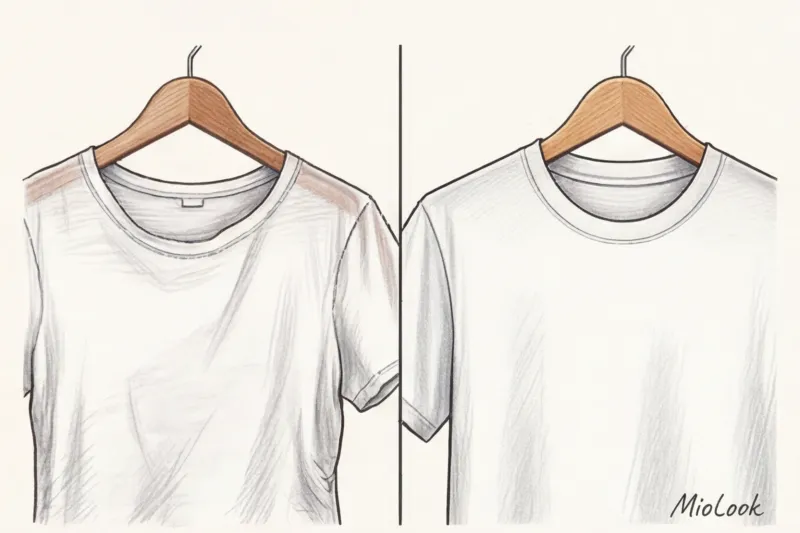
Many mass-market and mid-market brands produce special "made for outlet" batches specifically for sale periods. These are the same jumpers, but instead of a 20% cashmere blend, they're made of 100% creaky acrylic. Sale periods are a time to buy a complex, statement piece that the brand couldn't sell due to its extravagance, not to invest in "timeless classics."
Your perfect look starts here
Join thousands of users who look flawless every day with MioLook. Digitize your wardrobe before the sales!
Get access — €0.99 onceThree sales traps that even rational girls fall into
While sorting through the clutter in my clients' closets, I've categorized typical "tag mistakes." They generally fall into three categories.
The compromise trap of color and size
"I only have size S left, but I'll lose weight by summer" or "This isn't quite my shade of green, but it's premium wool for pennies!" - sound familiar?
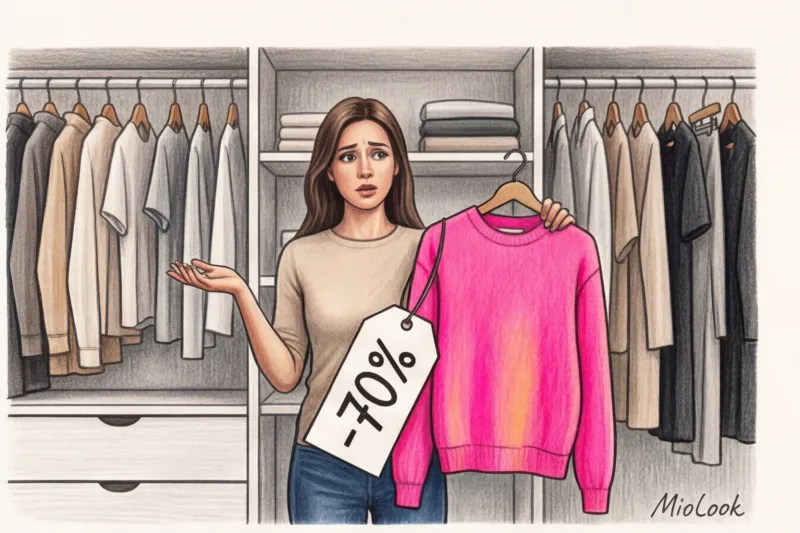
As a color expert, I can tell you: even the slightest deviation from your palette can ruin your entire look. If your color type calls for cool, contrasting shades, and you buy a warm fuchsia sweater (just because it was €30 instead of €120), your face will look tired, and the dark circles under your eyes will become more noticeable. Ultimately, you won't wear it, and it will become "dead weight."
The "get to the free shipping" trap
To save €5 on courier fees, we add €15 worth of basic, ephemeral t-shirts or unwanted hair clips to our cart. It's mathematically absurd. You haven't saved €5; you've wasted €15 on trash you'll throw out next month. These small, impulsive purchases, over the course of a year, quietly eat into your budget, which could have bought you one perfect, perfectly cut pair of trousers.
The Artificial Scarcity Trap (Timers and "Only 1 Left")
Dark patterns work flawlessly in online stores. Fear of missing out (FOMO) makes us rush to checkout without thinking. But if you know exactly what's hanging in your closet, you won't be intimidated by a timer. That's why I always recommend my clients use MioLook — when your entire wardrobe is digitized and stored on your phone, you see that you already have three similar black dresses, and the "Only 1 left" sign loses its power.
CPW (Cost Per Wear) formula: the mathematics of a stylish wardrobe
If you want to understand, How to avoid buying everything on sales , start calculating clothing costs like professional buyers. Forget the price tag. Only Cost Per Wear (CPW) matters—the cost of one outfit.
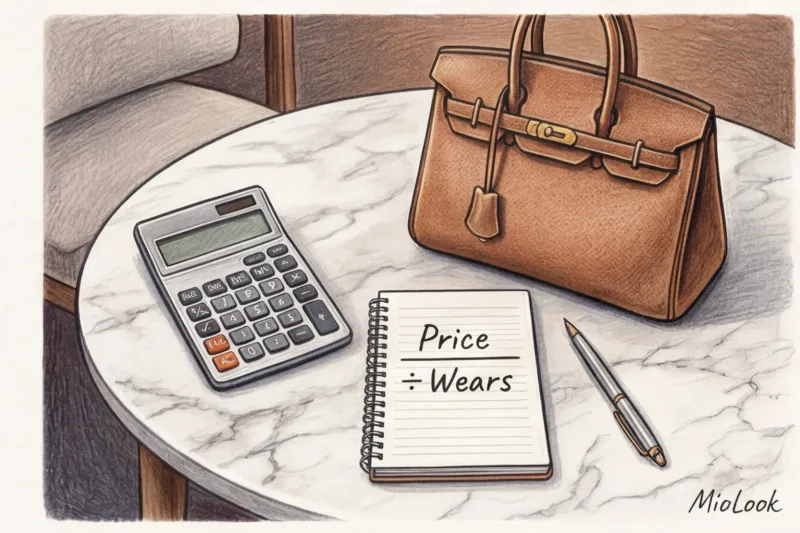
Let's compare two purchases:
- Purchase A: This ultra-fashionable sequin top is 80% off. It's only €20. You wore it once to a corporate event. CPW = 20 € / exit.
- Purchase B: A perfectly fitting jacket made of thick viscose costs €200 at full price. You wear it to the office twice a week for six months (approximately 50 times). CPW = 4 € / exit.
According to a large-scale 2024 WGSN report, up to 80% of items purchased during emotional sales are worn by consumers less than three times. A cheap item that hangs in your closet costs you more than an expensive one you wear constantly. This calculation immediately sobers you up at the checkout.
Ready to start smart shopping?
Try MioLook's free plan—no commitments required. Calculate your CPW and create capsules right in the app.
Get access — €0.99 onceSmart Shopping Strategy: How to Avoid Bought Sales
Let's move from psychology to practice. To make a sale work for you, you need to prepare for it.
Inventory and the "Blind Spot List"
You can't open a store website on Black Friday without a closet audit. But we're not making a list of what you "want" (usually that tenth dress). We're looking for "blind spots."
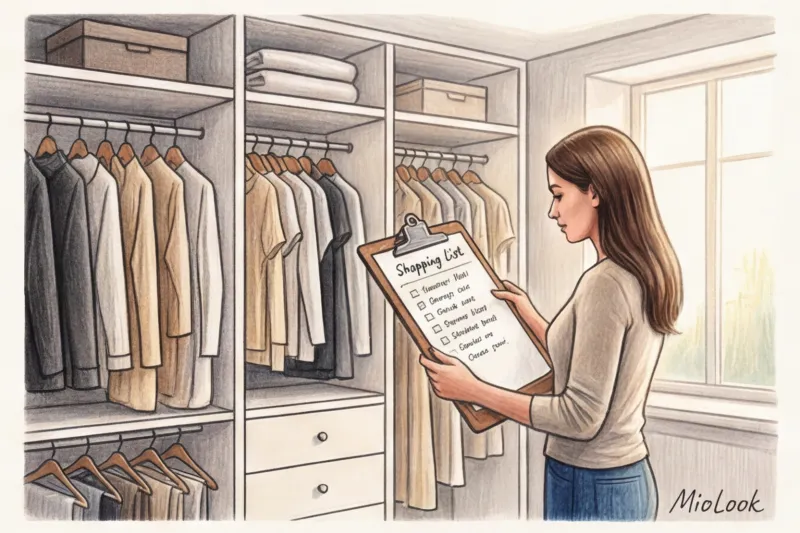
For example, you have a great silk skirt, but you don't wear it because none of your tops go with it. Your blind spot is a chunky cashmere sweater in a neutral shade that would complement the skirt. Write it down.
The rule of three images
Never buy something unless you can mentally create at least three outfits with it from what's ALREADY in your closet. Not "I'll buy pants to go with this blouse later," but right now, with your favorite jeans, skirt, and pants. If a new item requires two more items to be worn, it's not a good buy; it's a financial black hole.
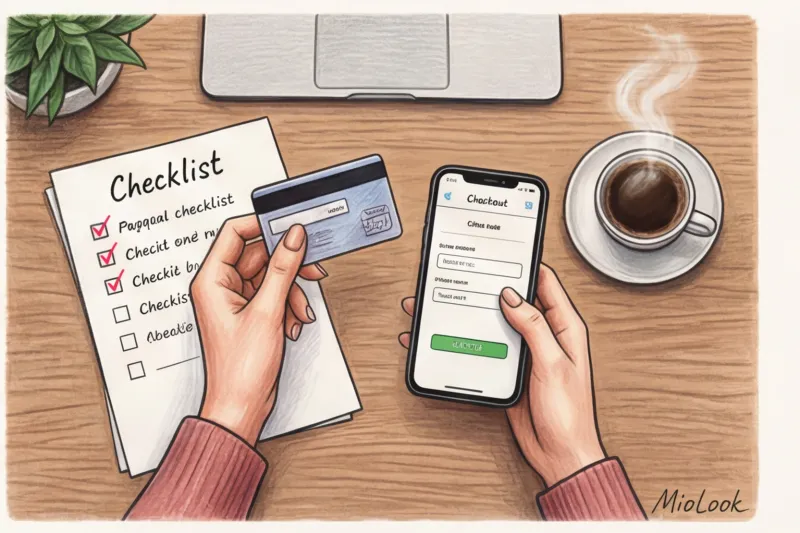
Checklist: 5 Tough Questions Before Hitting "Pay"
To be fair, I should point out that this strict checklist does NOT apply if your clothing size has changed dramatically or you've moved to a different climate and have no clothes to wear outside. In such emergency situations, sales are truly a lifesaver. In all other situations, before tapping your card at the terminal, ask yourself these questions:
- Would I buy this at full price right now? (If the answer is “no,” you are buying a discount, not an item.)
- Does this item solve a problem in my wardrobe or create a new one?
- Does it match my portrait zone in color 100%?
- Am I ready to wear this tomorrow morning? (Without the need to lose 3 kg or wait for a special occasion).
- Where exactly am I going to wear this in the next 2 weeks?
Conclusion: From a closet that's bursting at the seams to a wardrobe that works
A sale isn't a celebration of unprecedented generosity; it's a test of your style. Brands are counting on your impulsiveness, but now you have the tools to play by your own rules.
Getting back to Anna's story with her silk blouses: last year before Black Friday, she and I completely digitized her wardrobe through MioLook When the November sales started, she opened the app, looked at 14 sweaters, 8 pairs of jeans, and 5 perfectly fitting jackets... and for the first time in five years, she didn't buy anything. She realized she already had absolutely everything she needed to be happy and comfortable.

A conscious approach to discounts frees up not only shelf space but also a huge amount of energy and money. Don't let red price tags turn off your taste. Shop infrequently, choose carefully, and wear your items with pleasure!