Why Old Methods Don't Work (And How to Determine Your Face Shape Correctly)
Have you ever noticed how often glossy magazine advice backfires in real life? You buy trendy €250 sunglasses that fit perfectly on a model with the "same face shape" as you, but in the mirror you see a completely different person. Over 12 years of working as a personal stylist, I've thrown out dozens of classic cheat sheets for choosing necklines and frames. Do you know why? Because pure "squares," "circles," or "hearts" practically don't exist in nature.
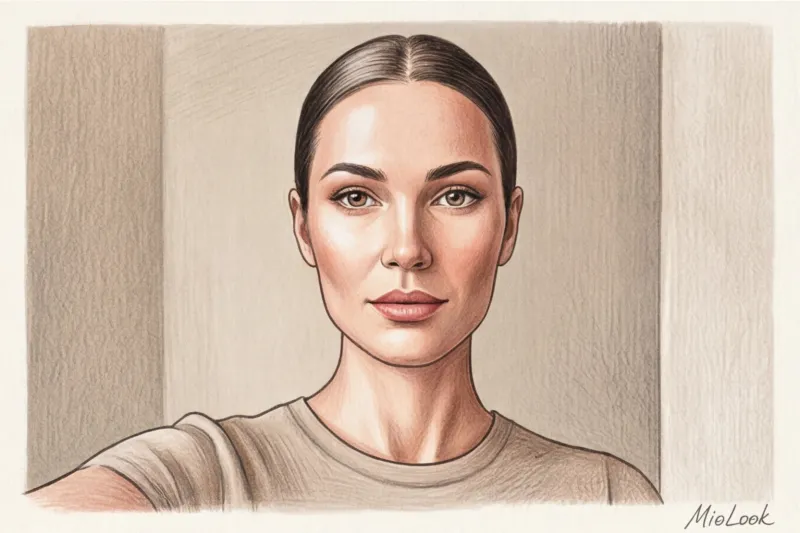
Traditional geometric classification is hopelessly outdated. It views our face as a flat drawing on a sheet of paper, completely ignoring volume. Today, professional stylists and portrait photographers have adopted an architectural approach: we analyze not contour, but the relationship between bone structure and soft tissue. The protrusion of the cheekbone above the cheek, or the degree of definition of the angle of the mandible beneath the subcutaneous fat, dictates the choice of facial texture.
Moreover, it's high time we abandoned the toxic '90s stereotype that "an oval face is the absolute ideal to be achieved at any cost." For decades, women were taught that any structured or round shape should be mercilessly contoured with dark powders, in an attempt to visually soften the corners and get closer to the coveted oval. This is fundamentally wrong. A defined, graphic jawline (like that of "square" and "rectangle" faces) is today considered a sign of aristocracy and a powerful tool for creating luxurious, minimalist looks. We don't hide our natural geometry—we learn to frame it.
When new clients ask me, How to determine your face shape , they've usually already made one or more classic beginner mistakes. They come with a ready-made, but fundamentally incorrect, diagnosis, made using improvised means. Let's explore why popular home remedies categorically fail and how to truly "read" your face.
The Myth of Lipstick on the Mirror and the Selfie Camera
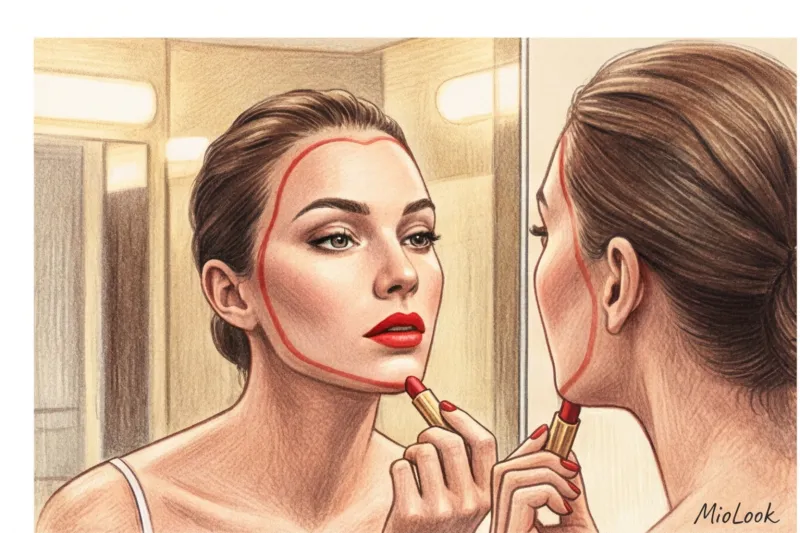
Remember that popular advice: "Stand in front of a mirror, close one eye, and outline your face with lipstick"? This is perhaps the most harmful life hack in the history of home styling. From a simple physics and optics perspective, this method is 100% inaccurate.
It's all about the parallax effect and micro-movements. As you reach toward the mirror, you inevitably shift your center of gravity, tilt your head slightly back or forward, and shift your shoulders slightly. Your angle of view constantly shifts as you draw. The result is a shapeless blob on the glass that bears no resemblance to your actual bone structure. One of my clients "diagnosed" herself with an elongated oval face this way and wore turtlenecks for years, even though she actually possessed a stunningly rectangular figure that was simply ruined by such collars.
"The face is not a flat projection. Trying to trace it on a mirror is like trying to draw a 3D model of a building by looking at it through a keyhole."
The second, even more common mistake is trying to judge a person's shape based on a selfie. Modern smartphone front cameras are equipped with wide-angle lenses (usually with a focal length of around 24–28 mm). According to research in portrait photography, wide-angle lenses mercilessly distort perspective: they visually stretch and enlarge central objects (the nose, the central part of the forehead) and push back the edges (cheekbones, jawline, ears).
In an arm's length selfie, almost any face appears narrower, the chin sharper, and the cheekbones flatter. You look at the photo and see an "inverted triangle," buy matching drop earrings, but in reality, they clash with your actual, wider shape.
Stylist's Algorithm: Determine Proportions Along 3 Axes
To see your face as others (and a professional photographer's lens) see it, you need to eliminate optical distortions. To do this, I use a simple yet geometrically precise algorithm.
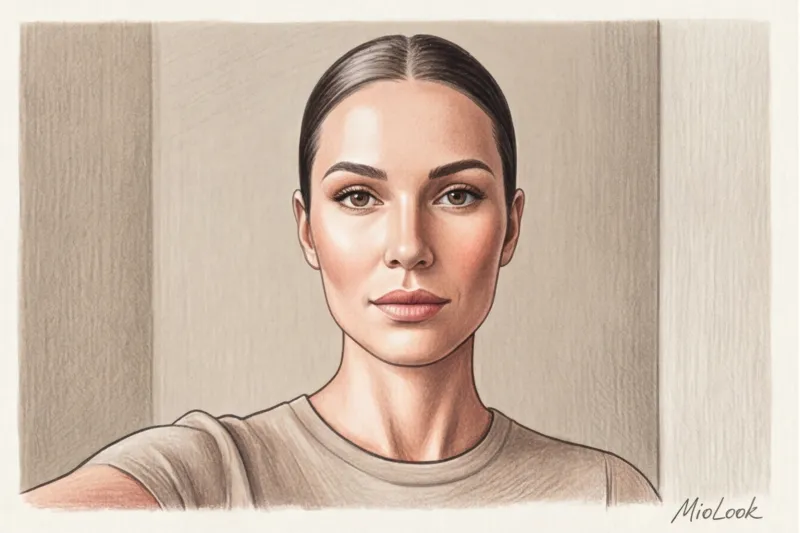
Step 1: Proper fixation. You'll need an assistant or a tripod. Sit up straight, looking straight ahead. The lighting should be even and fall directly on your face (ideally, daylight from a window) so that shadows from your nose or brow ridges don't disrupt the contours. Ask your assistant to stand 1.5–2 meters away from you. Be sure to turn on optical zoom on your smartphone camera (2x or 3x zoom)—this mimics a portrait lens with a focal length of 50–85 mm and completely eliminates the fisheye effect.
Step 2: Reading the stress points. Once the correct, distortion-free photograph is obtained, stylists begin to analyze the face along three key axes, paying attention to so-called "tension points"—the places where the bones stretch the skin the most.
- Axis 1: Forehead width. It is measured not along the hairline, but from temple to temple, where the frontal bone begins to transition into the lateral plane.
- Axis 2: Cheek width. The most prominent part of the face. We look for the widest point under the outer corner of the eye. Note: you can have full, soft cheeks (soft tissue), but a rather narrow cheekbone, and vice versa.
- Axis 3: Jaw line and angle. This is the most important parameter for choosing a collar. We evaluate the distance between the angles of the lower jaw and the nature of the angle itself. Is it hard, almost 90 degrees? Or soft, smoothly transitioning into the chin?
By comparing the length of these three axes with the overall height of the face (from the hairline to the bottom of the chin), we obtain the actual architecture. For example, if all three axes are approximately equal in width, and the face is elongated, we have a rectangular structure. This analysis not only provides clues for choosing jewelry but also influences How to visually lengthen your neck with the help of the correct neckline, since the geometry of the jaw directly interacts with the line of the shoulders and collarbones.
By the way, understanding your bone structure in the portrait zone is just as important for building a harmonious silhouette as knowing that How to hide broad shoulders or adjust the proportions of the figure. All these parameters should work in synergy. To avoid having to keep all these formulas in mind, I recommend my clients use smart analysis feature in the MioLook app Simply set your parameters correctly once, including your facial features, and the algorithm will automatically filter out collars, glasses, and jewelry that clash with your natural geometry, suggesting only those items that will highlight your uniqueness.
Now that we've thrown out the old templates and learned to look at our faces as volumetric architectural objects, let's look at six real structures we encounter in practice and see how they dictate style rules.
6 Basic Facial Architectures: From Geometry to Harmony
In 2022, at a closed masterclass on portrait architecture in Milan, a brilliant idea emerged: the fashion industry has for too long tried to fit living, three-dimensional faces into the primitive two-dimensional shapes of school geometry textbooks. In reality, facial architecture is formed from a constant, dynamic conflict between two elements: the rigid bone structure and the volume of soft tissue.
The bone structure defines the framework—the very same angles of the jaw, the protrusions of the cheekbones, and the brow ridges. Soft tissues (subcutaneous fat, muscles, and even the usual tendency to morning swelling) envelop and smooth this framework. Many women, trying to understand, How to determine your face shape , make the same mistake: they analyze only the outer contour, completely ignoring the relief.
It's precisely because of the balance of bones and tissues that our facial shape isn't fixed—it inevitably changes with age. During a wardrobe review with one of my clients, we discovered that her beloved deep V-necklines, which had made her irresistible at 30, had begun to make her look haggard by 45. Why? Due to a natural decline in collagen production, the youthful plumpness of her cheeks (those soft tissues) had disappeared. The bone structure was exposed, and her soft oval shape was transformed into a sharp rectangle with a sharp jawline. In other cases, gravitational ptosis shifts volume downward, weighing down the chin and transforming a "heart" shape into a "pear." This is a completely normal physiological process that simply requires a refresher in styling.
Today, when working with portraits, I focus not on dry measurements of width and height, but on the visual impression: how light and shadow fall on the face. What catches the eye first—the diffused, smooth cheeks or the deep, graphic shadows under the cheekbones? It's important to understand: pure, 100% types are as rare in nature as perfectly symmetrical people. In 90% of cases, we work with mixed architectures. You might have a basic oval shape, but with hard jaw angles (influenced by a square), or a round face with an unexpectedly pointed chin.
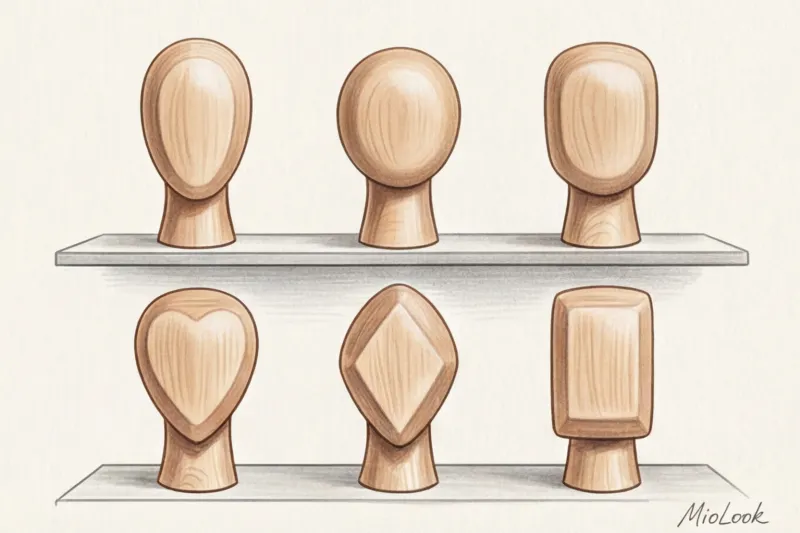
Soft Shapes: Oval, Circle, and Soft Square
This group is united by the clear dominance of soft tissue over the bone framework. The lines here are smooth, fluid, and the transitions are subtle. Light falls on these faces in soft, broad highlights, without creating harsh, contrasting shadows in the cheekbone area.
- Oval: Traditionally called the "gold standard," in modern, conscious fashion we're moving away from this stereotype. The oval shape is a harmonious balance of length (slightly longer than wide) and a gentle taper toward the chin. It lacks a dominant, aggressive feature, so it's visually perceived as the most relaxed. However, this "correctness" conceals a danger: the oval shape can appear boring unless the portrait area is energized with asymmetrical necklines or accentuated, textured jewelry.
- Circle: The width of the face here is almost equal to its length, and the main visual focus is always on the apples of the cheeks. The angles of the jaw are completely unreadable. The main mistake women with round faces make is trying to aggressively "slim" it with harsh contouring or tiny, narrow glasses. It's much more effective to emphasize vertical lines in clothing, preserving the natural, very attractive softness of the features.
- Soft square: A fundamental yet unassuming architecture. The bone structure creates a wide, confident jawline (the width of the forehead and jawline visually match), but the volume of soft tissue delicately softens the angles themselves. This face gives the impression of reliability and staticity. Flowing fabrics, contrasting with their firm form, are stunning.
Structural shapes: Rectangle, Sharp Square, Diamond and Heart
In this group, the bone structure reigns supreme. The tissues tightly hug the framework, creating pronounced depressions and sharp, narrow highlights on the protruding parts. These faces are often called "sculpted" or "model-like."
- Rectangle and Square: Their main characteristic is a graphic, strong jawline. According to reports from the analytical agency WGSN, it is precisely the pronounced angles of the jaw that are now considered the main marker of "aristocratic" status and the most sought-after feature in commercial modeling. The only difference is in the proportions: the rectangle is elongated vertically. Both types perfectly withstand the most complex, avant-garde architectural clothing—from stiff, starched stand-up collars to massive metal chokers.
- Rhombus (Diamond): The widest, highest, and most active cheekbones are paired with a narrow forehead and a delicate, often pointed chin. This face shape is built on a dynamic diamond shape and sharp angles. I often notice that women with this shape intuitively try to hide their magnificent cheekbones with their hair. The diamond shape, on the other hand, demands openness and support through boat necklines, which visually broaden the shoulders and balance the narrow forehead.
- Heart (Inverted Triangle): A broad, dominant forehead tapers sharply to a graceful, pointed chin. All the visual weight is concentrated in the upper third of the face. Have you ever noticed that voluminous winter hats or overly voluminous hairstyles make your head appear disproportionately large compared to your neck? If so, this is a sure sign of a heart-shaped face. Your strategic goal is to shift the visual volume downwards, using, for example, cowl necks or large drop earrings that end at the jawline.
Access to MioLook for €0.99 — one-time payment
A smart AI stylist will analyze your parameters and select the perfect look based on your facial structure and personal preferences.
Get access — €0.99 oncePortrait Art: How to Choose Necklines and Collars
When I'm reviewing wardrobes, I constantly encounter the same optical error. Women meticulously select tops based on their color type, but completely ignore how the neckline interacts with their chin. After all, the neckline is the architectural foundation of your portrait area. Any neckline creates guiding vectors that can either harmonize your bone structure or clash with it.
According to research by the PANTONE Color Institute and visual sociology experts (2023), the top 15 centimeters of our clothing shape up to 80% of the initial impression of facial geometry. And here, not only the neckline but also the materials used play a key role.
"Fabric acts as a filter for our facial features. What we perceive as a flaw in shape is often simply an incorrectly chosen texture for the face."
Let's look at this through the lens of textiles. Dense, shape-stabilizing cotton (such as poplin with a weight of 120 to 150 g/m²) acts as a rigid "frame" for the face. A stiff, starched collar creates straight, uncompromising lines and shadows. If you have a round or soft face, such a collar will add the necessary structure and pull the look together. But if you have a sharp square or rectangle shape with a strong jawline, dense cotton will mercilessly replicate and enhance this angularity, making your features appear harsh.
Conversely, soft viscose, cupra, or flowing silk shawls offer a high degree of drape. The fabric falls in dynamic, fluid folds, creating a visual counterbalance. For those with a pronounced bone structure, a high-quality silk blouse (which is now readily available in the basics for €80–€120) is the best way to soften the look.
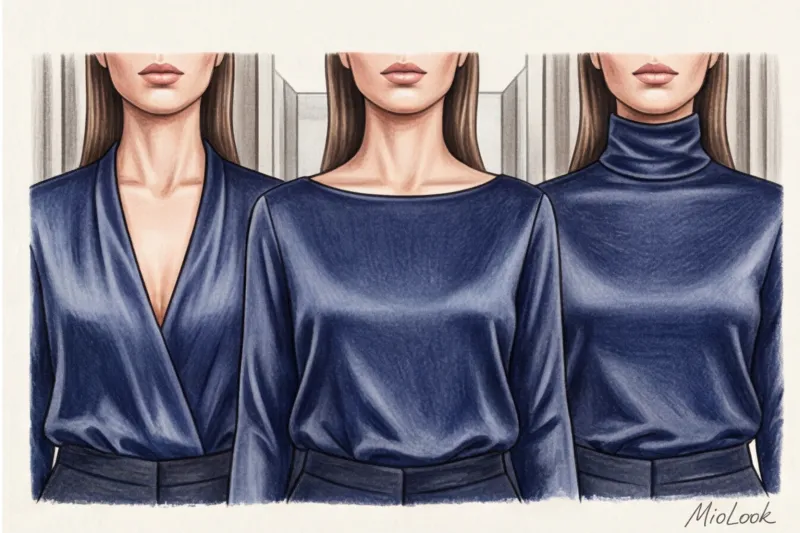
V-neck, U-neck and boat neck
For years, glossy magazines have been perpetuating the myth that a V-neckline flatters everyone. In practice, this is mathematically incorrect. Geometry operates according to its own laws, and each neckline serves a specific function.
- V-neck: Yes, it beautifully elongates the neck and visually narrows a round or full face due to the vertical axis. But it also poses a danger for diamond- or heart-shaped faces. The deep angle of the neckline perfectly matches the sharp chin. As a result, the lower third of the face appears overly elongated and sharp.
- U-shaped neckline (oval): This is a real lifesaver for sharp square and rectangular shapes. A deep, smooth neckline neutralizes a heavy, wide jawline, adding softness to the portrait area. The wider your jawline, the deeper and wider the neckline should be.
- Bateau neckline: This cut creates a clear horizontal line that visually broadens the shoulders. It's the perfect balancer for heart-shaped (inverted triangle) faces. When the shoulders appear wider, the wide forehead and narrow chin appear perfectly proportional.
Shirt collars and turtlenecks
While necklines work with the lower contour of the face, collars and stand-up collars directly influence the length of the neck, dramatically altering the proportions of the entire head. One of the most insidious items in the fall-winter wardrobe is the classic turtleneck with a turn-up.
A high, tight-fitting stand-up collar literally "eats" the neck. For a round face or a soft square shape with a nondescript chin, this is a visual disaster—the face appears to rest directly on the shoulders, and the cheeks appear wider. If you love knitwear but your overall appearance requires some room, choose a half-stand (3-4 cm) or a loose funnel collar that leaves at least the jugular notch exposed.
The classic rule of contrast applies to shirts. Pointed, masculine collars (like Kent or shark) add the necessary graphic appeal to round and oval faces. But if you have prominent cheekbones and a sharp chin, consider collars with rounded edges (the "Peter Pan" style is a frequent feature in the collections of Miu Miu and mass-market brands like COS) or neat stand-up collars (like mandarin). They tone down the severity and make the face appear more open.
Keeping all these details in mind while shopping or getting ready in the morning can be difficult. To avoid wasting time on lengthy fittings, I advise my clients to download the database to the "smart wardrobe" feature in MioLook The app allows you to create an outfit on your smartphone screen and preview how the texture of a thick cotton fabric or a crew neck sweater will complement your outfit today and whether they will accentuate your natural curves.
Micro-conclusion: Always evaluate your face shape from the opposite direction. If your face has soft, rounded contours, frame it with structured fabrics and V-shaped lines. If your face is defined by sharp angles, soften it with flowing materials and U-shaped necklines.
Jewelry Geometry: Earrings and Necklaces as Correction Tools
According to statistics from the global search platform Lyst (2023), more than 60% of purchased jewelry is worn less than three times a year. Why do we spend hundreds of euros on luxury accessories only to tuck them away in a jewelry box forever? The answer lies not in design, but in geometric clashes.
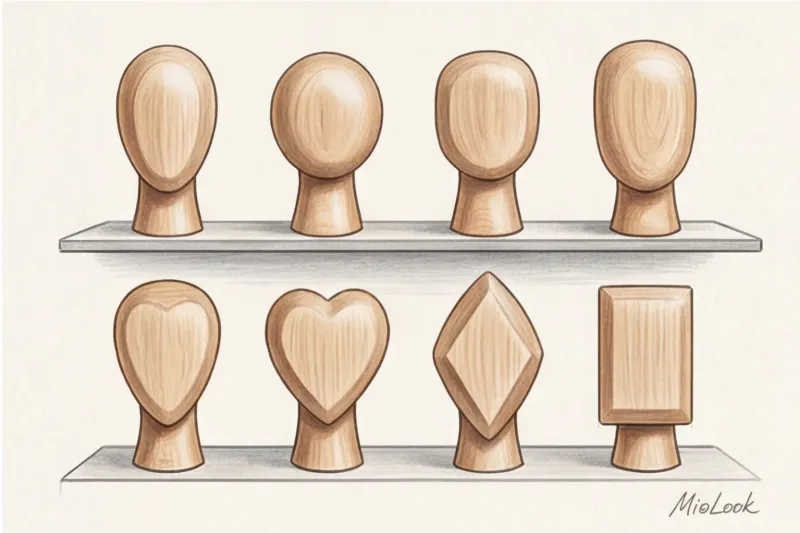
As a sustainable fashion researcher and advocate for a conscious wardrobe, I always emphasize: knowing your proportions is not just a styling trick, but your main saving tool. Understanding How to determine your face shape and which lines complement it, allows you to invest in 2-3 expensive, high-quality bases (for example, made from recycled gold in the range of 150-300 €) that you will actually wear every day.
Jewelry correction is based on the basic principle of contrast. Jewelry shouldn't duplicate your overall appearance; it's meant to balance it. If your portrait area is dominated by soft, rounded shapes (circles, ovals, or soft squares), avoid hoop earrings or round clip-on earrings. Instead, choose sharp geometric shapes: rectangles, diamonds, and crisp, straight lines. Conversely, bold cheekbones and a strong jawline (rectangles or sharp squares) are ideally softened by drop earrings and classic rings.
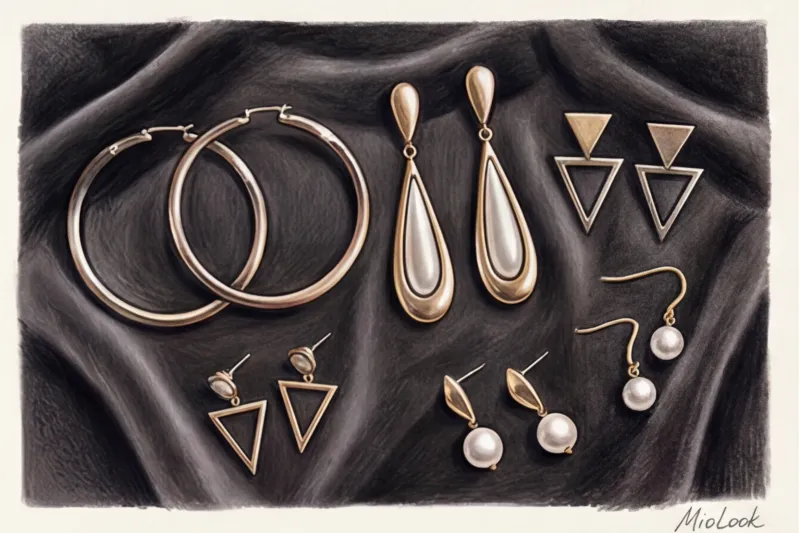
When choosing necklaces, we directly draw attention to the jawline. The length of the necklace is a powerful optical marker, which can either accentuate grace or add weight to the chin:
- Chokers (35–40 cm): They create a strong horizontal line just under the chin. They are absolutely contraindicated for wide faces and short necks, but they beautifully widen a narrow, elongated oval face, restoring balance.
- Princess (43–48 cm): A classic that sits squarely on the collarbone. It's an ideal base for most hairstyles, but if you have a heart shape, choose pendants with visual weight at the bottom to offset a narrow chin.
- Matinee (50–60 cm): It falls toward the bustline. By creating an elongated V-shape, this length is a real lifesaver for those with round and square faces. The matinee visually elongates the neck and makes a massive jaw appear lighter.
Access to MioLook for €0.99 — one-time payment
Start creating perfect looks with the help of artificial intelligence and select jewelry to match your facial architecture.
Get access — €0.99 onceScale matters: the size of facial features and the weight of jewelry
Beyond shape, proportionality is crucial. One of my London clients with prominent, large features constantly wore micro-studs, considering them the epitome of basic minimalism. In reality, however, the miniature jewelry is simply lost against the grand architecture, and the face itself appears even more massive due to the colossal dissonance in scale.
The opposite is equally merciless: if you have fine, delicate features and a small face, massive chandeliers (chandelier earrings) or heavy, grunge-style chains will literally crush your natural fragility. The other person's gaze will be drawn to the metal, completely ignoring your eyes. The golden rule of style is: the weight and volume of jewelry should be directly proportional to the scale of your features.
Don't forget about optical illusions. Drop earrings or thin strand pendants (5 to 8 centimeters long) act as an invisible corset for the neck—they vertically elongate the silhouette and brilliantly balance out overly broad cheekbones. A 2021 study on visual perception from the London College of Fashion confirmed an interesting fact: elongated earrings ending just above the jawline draw the viewer's eye downwards, making the lower third of the face appear significantly more graceful.
When choosing accessories, always think back to architecture. Jewelry isn't just a sparkling decoration, but an independent, supporting structure for your look.
Optics and Style: Choosing the Perfect Glasses (Sunglasses and Prescription Glasses)
A few years ago, while consulting for an independent craft eyewear brand in Berlin, I discovered a key mistake stylists make. We're accustomed to giving flat recommendations like, "A round face needs a square frame." But the optometrist we were working with quickly brought me back down to earth. Frames chosen solely based on the contours of the chin and cheekbones are often a waste of money.
It turns out that a perfect fit depends on technical parameters that fashion magazines tactfully gloss over. First, there's the distance between your pupils. A perfect fit means your pupil is exactly centered horizontally across the lens and in the upper third vertically. If your eyes are close together and you choose a large, wide frame, this will create the optical effect of strabismus. Second, there's the length of the temples. If they're even a few millimeters shorter than needed, the glasses will dig into your temples, impairing circulation and triggering migraines. Therefore, before searching for information on how to determine your face shape for sunglasses, make sure the frame size physically matches your anatomy. Incidentally, a high-quality basic cellulose acetate frame today will cost an average of €150-€250, and this is, first and foremost, an investment in your health.
Now let's move on to visual aesthetics. Glasses are more than just a sunscreen or a vision correction tool. They're a powerful architectural element that literally reshapes the proportions of your face.
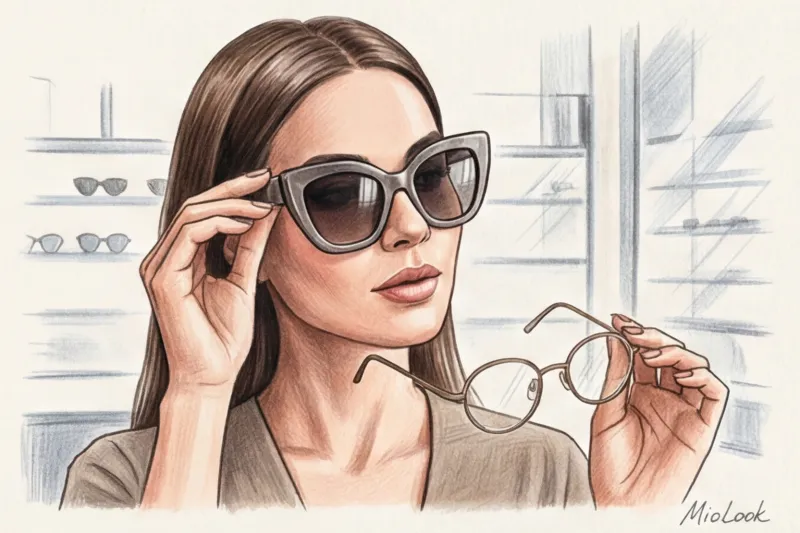
The main rule that I ask you to strictly follow: the top line of the frame should repeat or harmoniously emphasize the line of your eyebrows The brow should either run parallel to the top edge of the glasses or protrude slightly beyond it. If the frame crosses the brow sharply or creates a second, contrasting arch (for example, a completely straight frame over a pronounced arch), the face will acquire a permanently frowning or surprised expression. You literally ruin the natural harmony.
The second critical detail is the bridge. The bridge design works as a reliable optical illusion for your nose. A high, thin metal bridge visually lengthens the nose, making it appear more graceful and elongated. If your goal is to make a prominent or long nose appear shorter, choose a low, chunky plastic bridge (especially one with a keyhole effect). It breaks up the length of the bridge, creating a neater profile.
An analysis of popular frames for facial architecture
Let's take a look at how iconic shapes work in practice. Understanding these mechanisms will save you from dozens of pointless fittings.
Aviators. The distinctive teardrop-shaped lenses are all about descending diagonals. Who do they suit? They're ideal for a sharp, soft square face: the teardrop shape visually softens a heavy jawline and draws attention away from the harsh angles. But they're a downright dangerous choice for an elongated oval face or one with drooping corners (ptosis). Aviators will mercilessly pull all your facial features downward, visually accentuating nasolabial folds and adding years to your appearance.
Cat-eye. This is perhaps the most effective tool for visually lifting the face. With the outer corners upturned toward the temples, this shape creates a powerful lifting effect. The "cat eye" masterfully balances a wide jawline (diamond, pear, or soft square) and draws attention to the upper third of the face. The main rule: the wider the jaw, the more massive the top line of the frames should be.
Wayfarer and round optics (tishades). The law of contrasts is at work here. Iconic Wayfarers, with their rigid trapezoidal geometry, are a true salvation for round and soft oval faces. Right angles structure soft cheeks, giving the face a clear frame. Meanwhile, tishades (the famous round glasses in the style of John Lennon) are designed for faces with a dominant bone structure. An angular rectangle or a sharp square instantly becomes softer and friendlier when framed by perfect circles.
To avoid getting lost in the optics department, I recommend documenting successful fittings in advance. You can take photos of yourself in different frames and upload them to MioLook To analyze how the geometry of your glasses complements your portrait zone and wardrobe in a relaxed atmosphere at home. After all, massive horn-trimmed Wayfarers require a completely different fabric density than lightweight titanium aviators.
Facial Asymmetry Is Normal (How to Style It)
Have you ever wondered why we so often dislike our own ID photos? It's not because of poor lighting or the focal length of the lens. In a static photo, we suddenly notice what our own brain carefully ignores in motion—our natural asymmetry. One in three women in my individual consultations nervously point out the "working" and "unworking" sides, asking me to choose a wardrobe that conceals the difference in cheekbone height, eyebrow height, or cheek volume. Psychologically, this is a huge barrier, forcing us to hide from the camera.
Let's turn to science. A 2023 study by the University of Munich's Department of Psychology proved an undeniable biological fact: perfectly symmetrical faces do not exist in nature. Moreover, when scientists used algorithms to create perfectly mirrored copies of volunteers' faces, these portraits evoked an "uncanny valley" effect in viewers—they appeared plastic, frightening, and emotionless. Our slight unevenness in features is not a defect, but a key marker of humanity.
However, at the moment when we figure it out, How to determine your face shape The difference in proportions between the left and right halves of the face is often confusing. Instead of panicking and trying to visually "align" the bone structure with rigid lines, I suggest using asymmetry as a basis for intelligent styling.
If uneven features make you uncomfortable, the first rule of working with the portrait area is to avoid strict alignment. A straight parting, glasses with a thick accent bridge, and perfectly round, closed collars act as a merciless frame-guide. They literally scream, "Look here, there's a deviation from the central axis!"
Shift the focus. A deep side part or textured side bangs instantly break up that rigid geometry. The same principle works brilliantly in clothing: asymmetrical one-shoulder cuts ( one-shoulder ) or tops with complex diagonal draping from shoulder to waist visually reshape the entire silhouette. The person's gaze begins to glide along the diagonal of the fabric, capturing the dynamic of the look, rather than scanning your face for millimeter-sized irregularities.
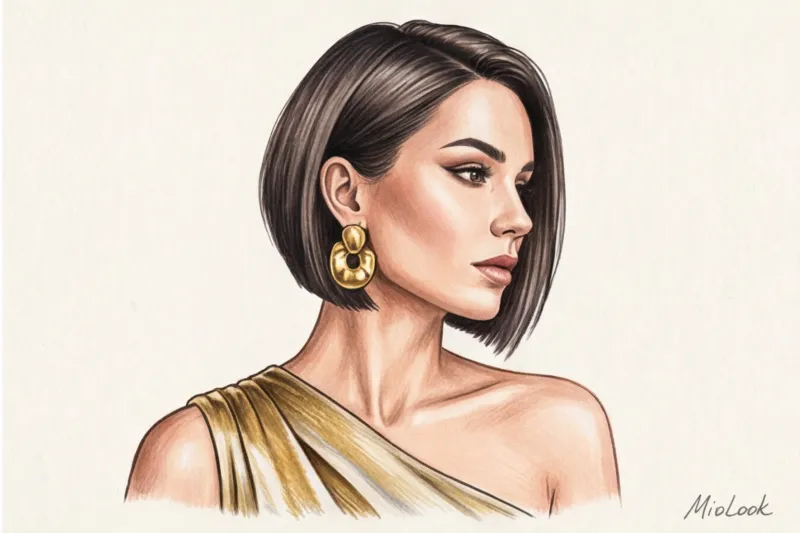
Another of my favorite styling tricks that works without fail is the mono-earring. Today, it's no longer just a flamboyant catwalk gimmick in the spirit of Alexander McQueen's early collections, but a completely practical optical correction tool.
The mechanics of the process are simple: place a large, statement earring on the side of your face that feels heavier or wider. This could be a sculpted, crumpled metal or a large baroque pearl. This creates an unexpected optical illusion: the large piece draws the visual weight toward itself, breaking up the monolithic appearance of your cheek or jawline and balancing your proportions. The other earlobe is left completely free or adorned with a subtle stud. To ensure this look is both classy and eco-friendly, choose high-quality pieces—excellent asymmetrical sets made from recycled silver can now be found from ethical European brands in the €80–€150 price range.
Don't try to force a lively, dynamic face into a strict mold. Your uniqueness lies in these tiny millimeters of variation, and the right accessories can turn them into your calling card.
Your perfect look starts here
Join thousands of users who look flawless every day with MioLook. Analyze your proportions and choose harmonious looks that take into account your unique facial structure.
Get access — €0.99 onceSmart Wardrobe: A Shopping Checklist for Your Face Shape
We're used to investing hundreds of euros in the perfect pair of jeans or a solid basic coat, often overlooking a crucial detail. According to a 2023 study in behavioral psychology at Cornell University, during personal or professional interactions, the person we're talking to spend 85% of their time looking at the so-called "communication triangle": the eyes, nose, and chin, merging into the neck. Therefore, how you frame your portrait area determines the success of your overall look.
The secret to a truly sophisticated and sophisticated style lies in synergy. Neckline, jewelry, and eyewear should never clash. In my consultations, I teach how to create a cohesive ensemble using this golden formula: neckline + jewelry + glasses = harmonious balance If you have a naturally sharp jawline and wear a shirt with a stiff, masculine collar, pairing it with angular wayfarer glasses and diamond earrings will transform your face into a spiky, abstract sculpture. At least one element in this equation should soften the natural geometry, not exaggerate it.
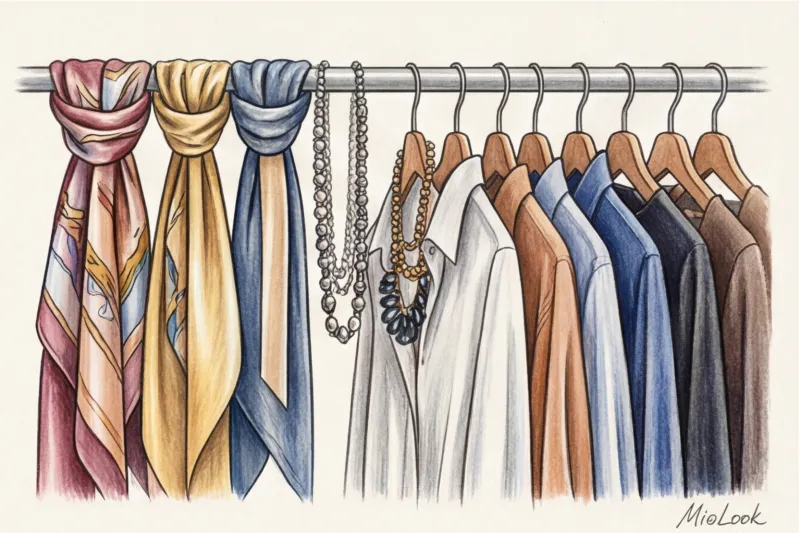
So, now that you understand how to correctly determine your face shape, it's time to put theory into practice. Here's a basic checklist for mindful shopping, based on the principle of compensation:
- For soft architectures (circle, oval, soft square): Your goal is to add subtle structure to the portrait area. Replace a basic knit top (from €25) with a shirt made of shape-resistant poplin or thick linen with a distinct V- or U-neck (excellent options can be found at brands like COS or Arket for €70-100). For jewelry, invest in elongated pendants on snake chains and earrings with clear geometric shapes (elongated rectangles, graphic teardrops). Look for frames with pronounced angles in eyewear.
- For structural architectures (square, rectangle, diamond, heart): Your goal is to soften sharp angles and add flow to the lines. As a textile expert, I recommend looking for textures that drape beautifully: silk blouses with ascot collars (from €120), tops made of thick viscose or fine cashmere with a soft round or boat neckline. Ideal jewelry: hoop earrings, irregular baroque pearls, and rounded, voluminous studs. In terms of eyewear, your best friends will be smooth aviators or a soft, not too upturned cat-eye.
"The fastest way to transform your style is to ruthlessly overhaul your portrait area. Anything near your face acts as either a good reflector or a distorting mirror, ruining your natural proportions."
Your practical action plan for the coming weekend: get out all your scarves, necklaces, earrings, and glasses. Put on a simple, plain T-shirt, sit in front of a window (with natural light, of course), and take a series of selfies with each accessory, holding the camera exactly at eye level. Divide items into three categories: "obviously highlights the face," "doesn't have any effect," and "makes the face look heavy/bulky/tired." The last category (even if it's a designer frame for €300) should be discarded without regret—sell it on a resale platform or give it away.
To avoid impulse purchases that will end up as dead weight in your closet in the future, I strongly recommend converting your arsenal to digital format. Use the "smart wardrobe" feature in the MioLook app Upload your ideal tops, favorite jewelry, and eyewear. The app helps you create and analyze looks holistically, taking into account not only your body type but also your individual facial geometry. You can even preview how a new statement necklace will pair with your favorite jacket before you even reach the checkout.
In closing this guide, I want to emphasize the most important thing: proper styling doesn't require surgical alterations. Your natural, even slightly asymmetrical, appearance is a beautiful canvas. Once you learn how to frame it properly, your wardrobe will begin to work perfectly for you.
Guide Chapters
The Perfect Hat for Your Face Shape: Styling Tips
Stylist Darina Marchenko debunks myths about classic face shapes. Discover a new 3D method for choosing the perfect summer hat.
Diamond Face Shape: Which Glasses and Earrings to Choose
Stop hiding your gorgeous cheekbones behind bulky frames. Learn how to choose the perfect glasses and earrings for a diamond-shaped face.
Heart-Shaped Face: Which Glasses to Choose? Styling Tips
Forget outdated methods of determining your face shape in the mirror. Let's explore the architecture of the heart-shaped face and learn how to choose the perfect frame.
Contouring by face shape: patterns for oval, round, and square faces
Modern contouring is about the architecture of light, not the concealment of imperfections. We explore current makeup schemes that will highlight your uniqueness.
Rectangular Face Shape: What to Wear? Styling Tips
A rectangular face is a sign of status and aristocratic appearance that doesn't need to be hidden. Learn how to use the right cuts and accessories to turn your facial geometry into your greatest asset.
Guide: Which Bangs Suit My Face Shape?
Find out how to choose the right bangs to highlight your unique face rather than hide it. Let's debunk old haircut myths with a stylist!
What suits an oval face shape: accessories and neckline
Forget the myth that everything suits an oval face shape. Learn the professional secrets for choosing the right accessories and necklines for your face shape.
Square face: what glasses and earrings to choose?
A defined jawline is a sign of aristocracy. Learn how to frame your face with stylish accessories and necklines.
How to choose the right neckline for your face shape
Stop hiding behind V-necklines. Discover how an architectural approach to styling can help you find the perfect neckline for any face shape.
What suits a round face: glasses, earrings, and cutouts
Are you sure you have a round face? We'll explain how smartphone cameras distort proportions and how to choose the perfect accessories for your face shape.
Ideal eyebrow shape for your face type: diagrams and rules
Forget rigid stencils and outdated makeup rules. Learn how to choose the perfect eyebrows based on your unique facial anatomy.
Women's Haircuts for Face Shapes: A New 3D Approach
Forget about drawing lipstick contours on a mirror. We'll show you how to choose the perfect women's haircut using a modern 3D architectural approach.
What earrings suit your face shape: stylist tips
Tired of wearing the same stud earrings because of outdated style rules? We'll tell you how to choose earrings that will highlight your unique appearance.