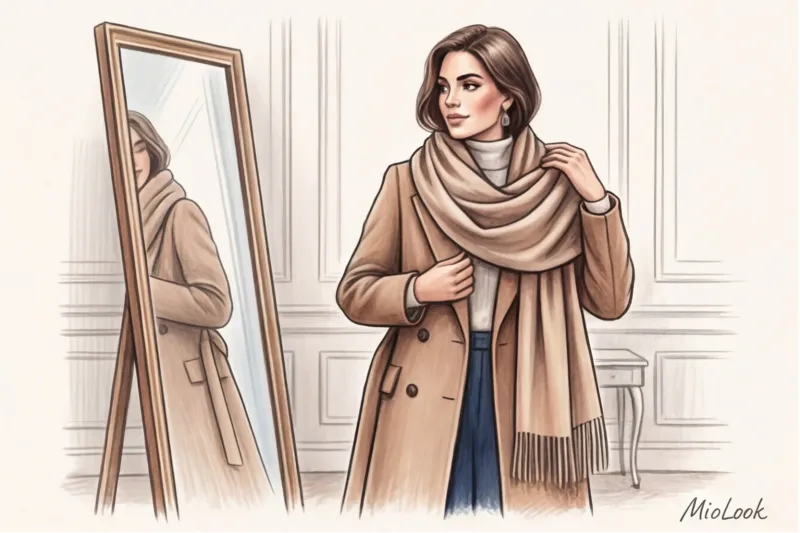
I once had a client who, for five years, had methodically hidden her luxurious, sculpted cheekbones behind massive rectangular frames. "I need to visually cut off the corners and make my face a perfect oval," she confidently declared, citing advice from glossy magazines of the 1990s. And this is the main styling mistake I regularly see in fitting rooms. Why disguise the aristocratic architecture of your bone structure when you can turn it into your greatest asset?

When discussing which glasses to choose if you have a diamond-shaped face, the first thing to do is forget about the rules of flat 2D contouring. We've covered why old face-typing systems are outdated in more detail in our the complete guide to determining your face shape In this article, I'll show you how to use the laws of optics, the properties of eco-friendly materials, and the correct weighting of jewelry to properly design the geometry of a diamond.
The Anatomy of a Diamond: Why Old Eyeglass Rules Don't Work
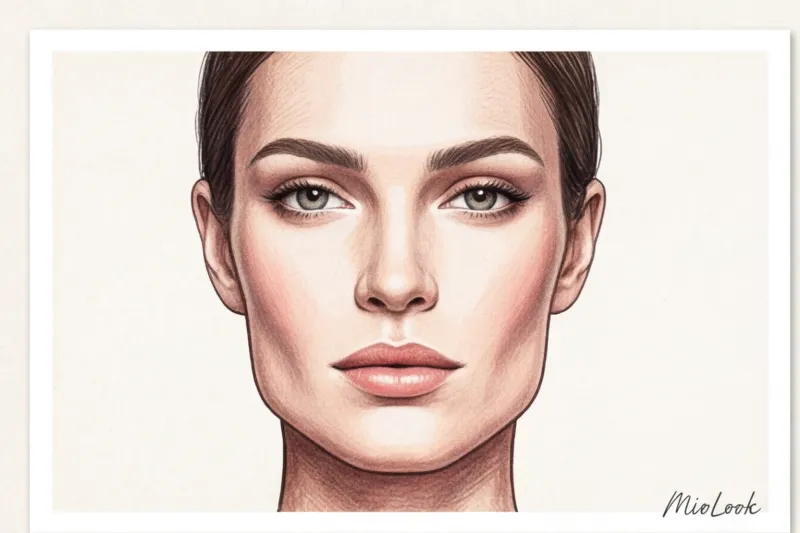
With a diamond-shaped face, the cheekbones account for approximately 70–80% of the overall visual width of the face, while the forehead and chin are significantly narrower. For years, stylists have tried to "draw" this shape into a boring oval, ignoring the true volume of soft tissue and bone structure.
"Your face isn't a canvas for fixing imaginary flaws. It's an architectural project that requires a well-designed frame." This is how I explain this new approach to portraiture during my consultations.
Modern styling considers high cheekbones a sign of pedigree. Our goal is not to visually compress them, but to create the right frame around them. If you wear glasses that clash with this natural width, your face will appear puffy and your accessory will look out of place.
Diamond Face Shape: Which Glasses to Choose for Vision and Sun Protection
The basic rule of eyewear for diamond-shaped frames is this: the width of your frames should be millimeter-for-millimeter the same as the widest part of your cheekbones, or literally 2-3 millimeters wider. If the frames are narrower, your face will instantly "bleed" beyond them. If they're significantly wider, you'll create an alien-like effect.

According to the recommendations of the European Academy of Optometry and Optics (EAOO), the bridge width of the frame plays a crucial role. For faces with a narrow forehead and wide cheekbones, I always choose frames with a bridge width of 18 to 21 mm. This visually widens the eyes, compensating for the narrowness of the upper third of the face.
Frames that act as an architectural framework
What really saves "diamond" frames is the play with accents. Rimless and semi-rimless frames (the famous browline frames, where only the upper arch is emphasized) are the perfect balance. They weigh down a narrow forehead, creating harmony, but leave the cheekbones exposed.
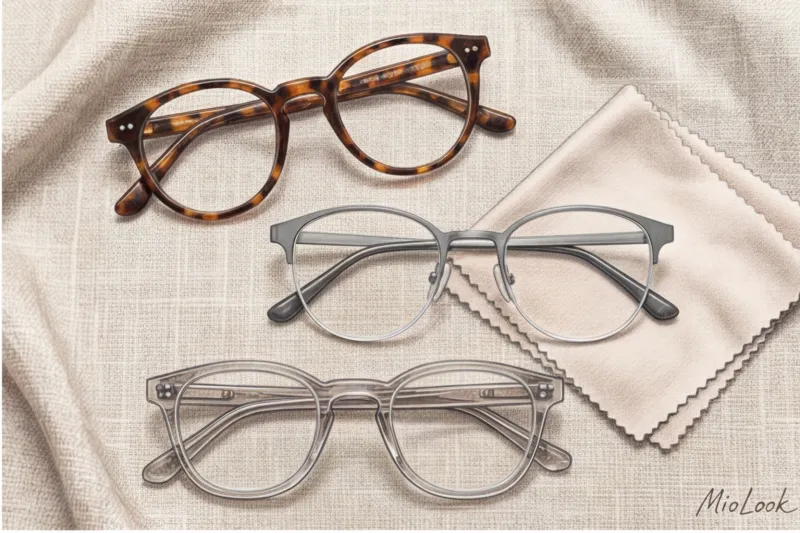
For everyday wear, soft ovals and classic pantos (a shape with a straighter top line and a rounded bottom) work great. But as a stylist, I always have my clients do the "smile test." Put on the frames and smile broadly: the soft tissues of your cheekbones will lift. If the glasses sit on your cheeks and bounce, it's not the right shape for you. The frames should float above the skin.
Dangerous Trends: Why the Exaggerated Cat Eye Is a Bad Idea
Open any basic article online, and you'll read: "Rhombuses need a cat eye to widen the forehead." I strongly disagree with this outdated trope. The sharp, aggressively upward and sideways angles of an extreme cat eye duplicate your already wide cheekbones. The optical illusion works against you, making your face appear disproportionately wide in the center.
One of my clients complained that she looked older than her age. It turned out she was wearing a harsh, geometric cat-eye in black plastic. We replaced it with a soft, slightly rounded oval in a tortoiseshell shade. The difference was phenomenal—her face looked five years younger simply by softening the sharp, natural angles.
Access to MioLook for €0.99 — one-time payment
A smart AI stylist will create the perfect look and help you integrate your new glasses into your everyday wardrobe.
Get access — €0.99 onceSelecting materials: investing in quality and sustainability
In addition to shape, the weight and density of the material are crucial. Heavy, dull plastic (especially black) is contraindicated for those with pronounced cheekbones. It creates an optical overload in the very center of the face.
As a sustainable fashion expert, I highly recommend looking at eco-friendly acetate. For example, biodegradable cellulose acetate from the Italian manufacturer Mazzucchelli. It's incredibly lightweight, doesn't release phthalates when exposed to sunlight, and offers deep, multifaceted textures. A high-quality frame made from this material will cost between €150 and €250 but will last for a decade.
The second ideal option is medical-grade titanium. It's an absolute must-have for high-end rimless frames. It weighs just a few grams, has a zero allergy risk (which is crucial, as the frame is in constant contact with the sensitive skin of the temples), and doesn't oxidize under makeup.

Ear Geometry: Which Earrings Balance a Narrow Chin?
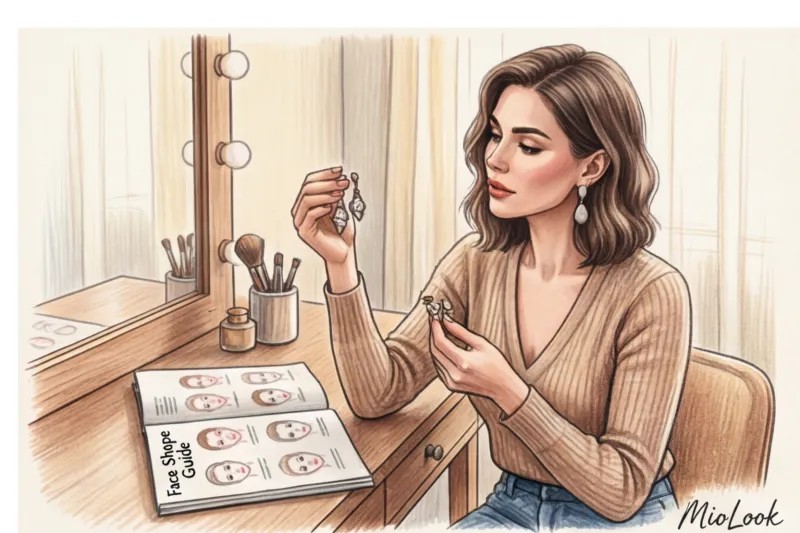
Let's move on to jewelry. The purpose of earrings for a diamond-shaped face is to add visual volume to a sharp, narrow chin without making the cheekbones appear wider.
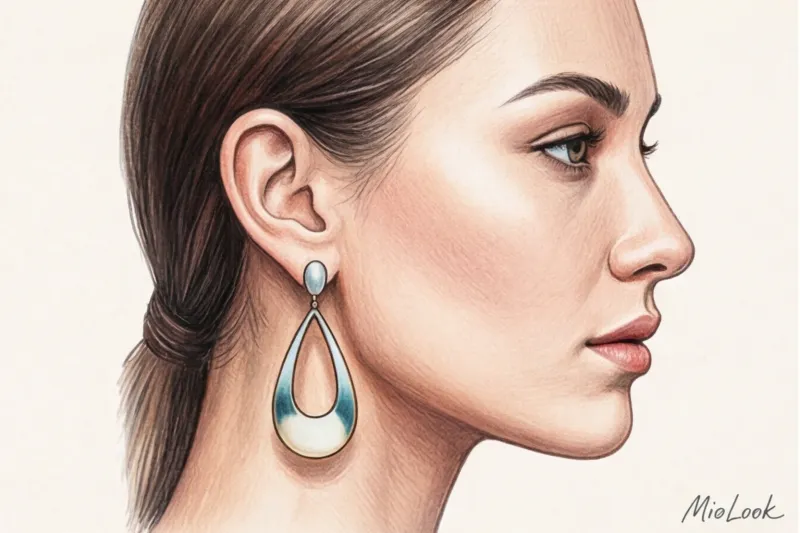
This is where the Müller-Lyer laws (optical illusions of size distortion) come into play. The best shapes for you are teardrops, complex chandeliers that widen toward the bottom, and triangles with the apex pointing up and the base pointing down.
But stud earrings are a no-no. They'll simply disappear against prominent cheekbones. Massive hoops (hoops) are also off-limits: their roundness disrupts the natural geometry and adds unnecessary width where it already exists.
Length Matters: The Jawline Rule
The ideal length for statement earrings is right at your jawline or 1-2 centimeters below. If your earrings end right at the highest point of your cheekbones, they will act as a horizontal line, adding unnecessary width to your face.
There's one exception, though: this advice doesn't work if you have an ultra-short pixie cut with shaved sides. In this case, the facial geometry is perceived differently, and you can embrace shorter, more voluminous shapes.
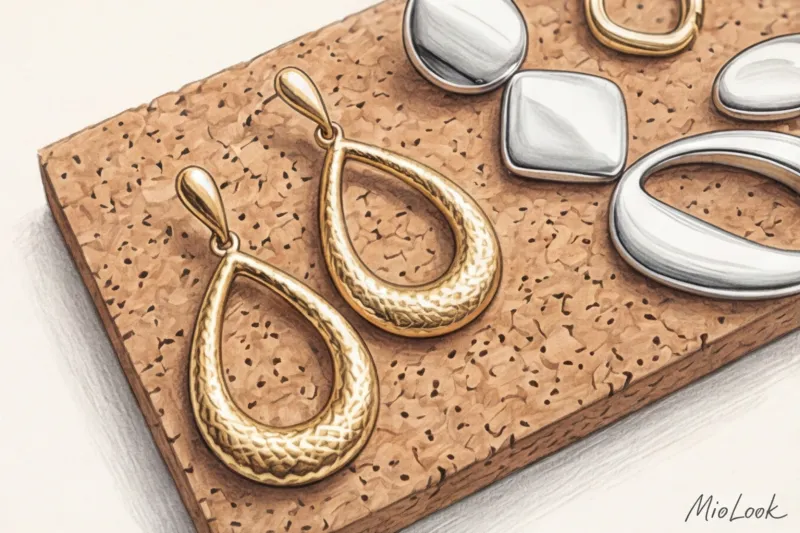
Metals and Textures: A Quality Expert's View
When working with textiles and accessories, I always test them for wear. According to medical statistics (and dermatologists), every extra 5 grams of weight in large earrings increases the risk of permanent earlobe deformity by 15% with regular wear. Heavy jewelry not only damages your health but also betrays the cheapness of the item—a pulled-down earlobe instantly cheapens the look.
What's the solution? Look for hollow jewelry. This is a complex jewelry technique that allows you to create massive visual volume with minimal weight. These earrings look like a million dollars, but weigh as little as a feather. I wrote more about how to invest wisely in such pieces in my article about basic jewelry wardrobe.
Also, pay attention to the origin of the metals. Recycled silver and ethically sourced gold are becoming a sign of conscious status today. By choosing such jewelry, you're voting for a cleaner future for the fashion industry.
Your perfect look starts here
Join thousands of users who look flawless every day with intelligent wardrobe selection.
Get access — €0.99 onceStylist checklist: trying on glasses and earrings before buying
Never rush your facial accessories. I've developed a process that saves my clients 10 minutes in the fitting room but eliminates frustration at home. Here's what to do right at the optician or jewelry boutique:
- Step 1: Facial expression test. Take a selfie from the front with a neutral face, and then with a wide smile. Glasses shouldn't sit on your cheeks.
- Step 2: Tilt Test. Put on the frames and tilt your head down sharply, as if looking at a smartphone. If the glasses slide down your nose, the bridge is too big for you; look for a different size.
- Step 3: Hair up. When trying on earrings, be sure to tie your hair up with your hands, even if you usually wear it loose. Consider where the widest part of the jewelry is in relation to your chin.
- Step 4: Weight test. Walk around the room wearing your earrings for 5 minutes. If you can physically feel their weight now, by evening they'll become unbearable torture.
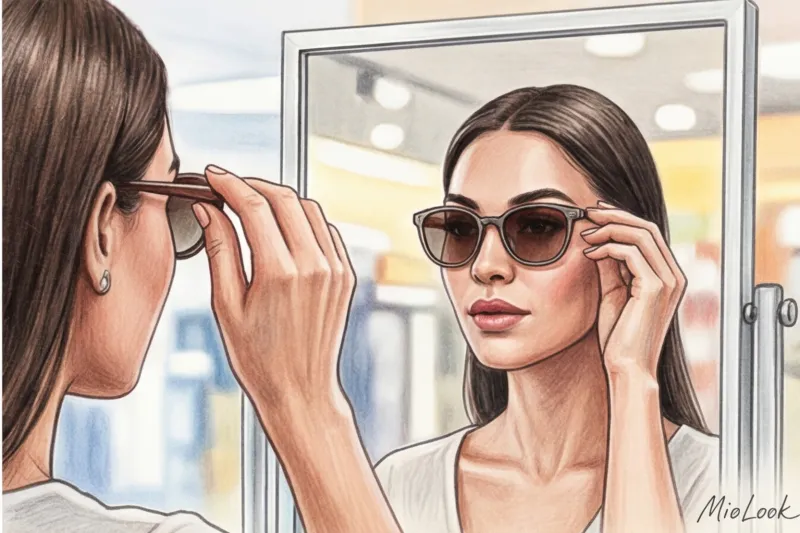
By the way, to understand how the new frame will fit into your current image, just take a photo of yourself in the store and upload the photo to MioLook app Artificial intelligence will instantly analyze the accessory's compatibility with items in your virtual closet.
Conclusion: Celebrating Natural Geometry
The diamond-shaped face is a stunning natural feature, characteristic of many style icons, from the legendary Sophia Loren to today's top models. Stop trying to average out your appearance with contouring and ill-fitting frames.

The right glasses and earrings aren't just tools for disguise. They're a meticulously crafted frame for your personal work of art. Invest in one perfect pair of lightweight titanium frames for €200 and a pair of weightless, geometrically-shaped puff earrings. They'll enhance your style a thousand times more effectively than a pile of cheap, heavy plastic bought at a yard sale.