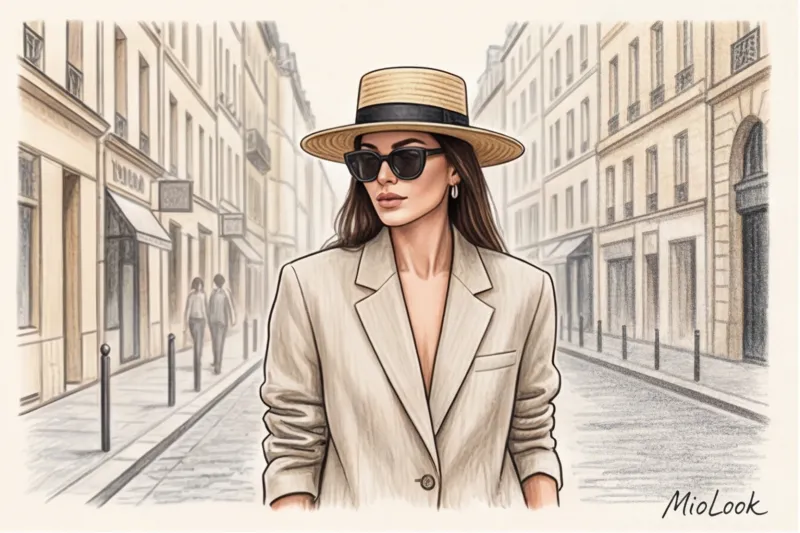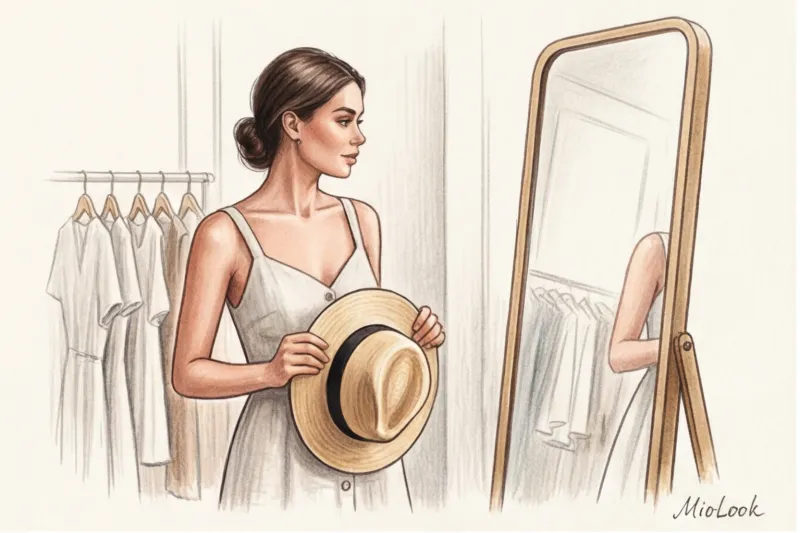
Have you ever noticed how the same trendy straw hat can transform one woman into a sophisticated French film heroine and another into a tired country dweller? For years, glossy magazines have been teaching us to draw the outline of our faces on the mirror with lipstick to determine whether we're oval, square, or heart-shaped. Spoiler alert: you can safely forget this method before buying a hat.
Hi! I'm Darina Marchenko, a stylist and colorist. Over 12 years of experience, I've curated hundreds of summer accessories and can confidently say: the choice hats by face shape — this isn't flat geometry. It's real architecture. It's important to consider not only the contours, but also the volume of your bone structure, the stiffness of the straw, and even how the shadows from the fields change your skin tone.
In this article, we'll put flat templates to rest once and for all. I'll show you a new, three-dimensional method for choosing a summer hat that really works and saves time.
Why the old rules for choosing a hat based on your face shape no longer apply
Imagine a 3D model. Your face has contours: prominent cheekbones, the depth of your eyes, the angle of your jaw. But the classic system of dividing you into "circles" and "squares" views you as a 2D image. When you put on a hat, you add an architectural structure to your appearance. Relying solely on a flat outline ignores the most important aspects—volume and proportion.
Modern image architects analyze the relationship between the zygomatic bone and soft tissue. We discussed this in more detail in our the complete guide to determining your face shape , where we discussed in detail why abandoning the search for the mythical "perfect oval" is the best step toward personal style.
"A hat is not a picture frame. It is the roof of a building. Its proportions must be in keeping with the foundation," state the Millinery Design Principles taught at the London College of Fashion.
One of the most pernicious myths is that a floppy hat "flatters everyone," adds femininity, and saves any summer look. This is a colossal misconception. In practice, its drooping, shapeless lines visually pull down soft facial features, accentuate nasolabial folds, and add age. If you want to look fresh, you need a structured brim, not a flowing shape.
Facial architecture and hat texture: the stylist's main secret
Most women in stores look only at the style (boater, fedora, Panama hat), completely ignoring the texture. Yet it is the texture—raffia, stiff sisal, or soft cotton—that plays a decisive role in the fit.
It's tough here rule of similarity of textures: the density of the material should match the density of your face.
- Structural persons: If you have prominent cheekbones, a well-defined jawline, and minimal subcutaneous fat, you're suited to a more defined shape. A tight boater or a stiff, almost wooden-looking fedora will elongate your face.
- Soft faces: If you have full cheeks, soft lines, and a subtle bone structure, avoid extremes. A hat that's too stiff will create a harsh contrast (your head will appear separate from the hat), while one that's too soft will make your face look like a shapeless pancake. A medium-stiff hat, such as tightly woven, flexible raffia, is your best bet.
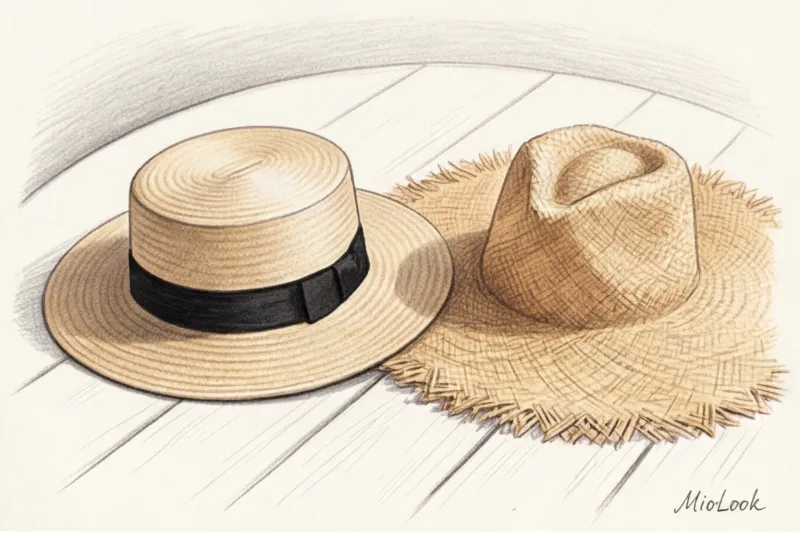
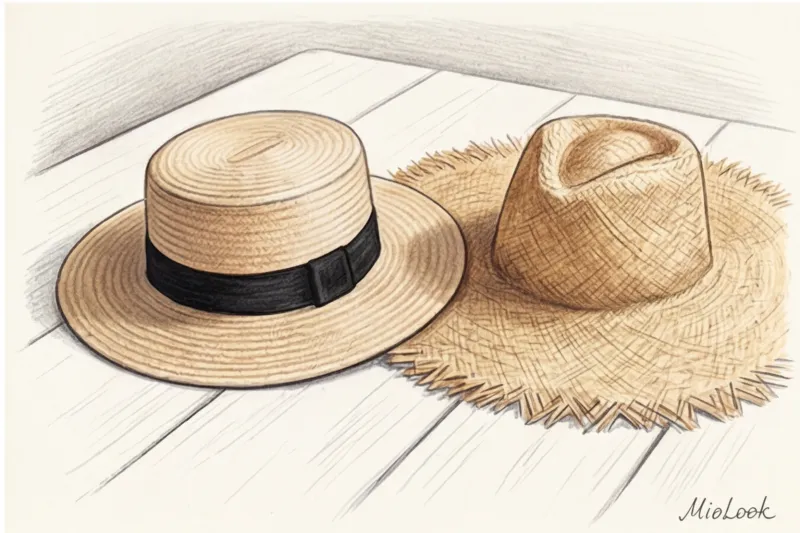
Hard boater vs. soft raffia
Let's look at some specific examples. A classic, stiff boater hat with a flat crown and straight brim is a celebration of horizontal lines. It's ideal for women with long faces, as it visually cuts down on the vertical line and balances the proportions.
On the other hand, a floppy hat (with a soft, wavy brim) is absolutely contraindicated for those with a tired aging pattern or puffy eyes. The sloping brim acts like a downward-pointing arrow, accentuating under-eye shadows and drooping corners of the mouth.
Access to MioLook for €0.99 — one-time payment
A smart AI stylist will select the perfect look based on your proportions and shape.
Get access — €0.99 onceHow to Choose a Summer Hat Based on Your Face Shape: A New Volumetric Method
To make the method work, let's synchronize the terminology: crown - this is the part in which the head is placed; fields - visor all around; band - decoration at the base of the crown.
The most common optical mistake: buying a hat that's too small at the crown. If the crown is visually narrower than your cheekbones, your face instantly appears enormous, even if you're wearing a size XS. The crown should be equal to or slightly wider than your face from the front.
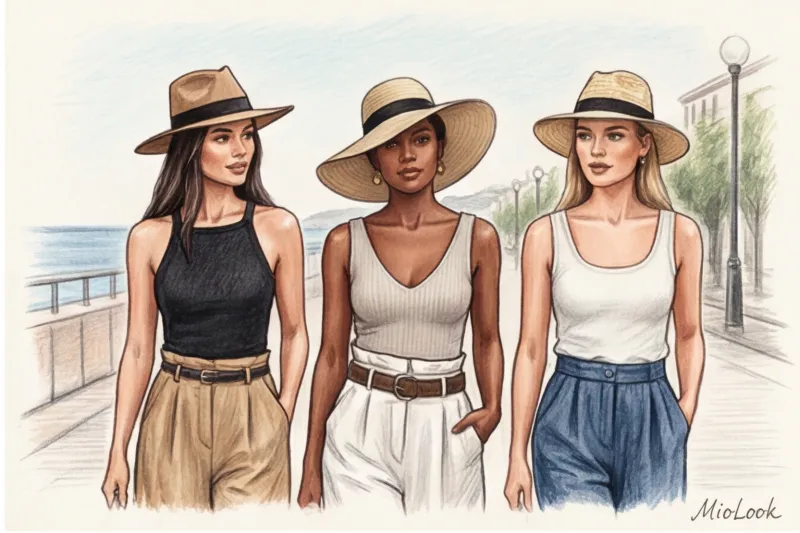
For faces with a pronounced jawline (former "squares" and "rectangles")
The main mistake girls with a prominent lower face make is trying to "hide" the angles behind shapeless, gigantic brows. Forget about concealing them. asymmetry.
- Best choice: Hats with asymmetrical brims or a classic fedora with a medium brim, worn diagonally (slightly to the side).
- Field width: Strictly from 7 to 10 cm. Any smaller and the jaw will appear larger. Any larger and you'll overload the silhouette.
For individuals with soft tissue dominance (former "circles")
Your goal is to create the illusion of angles that are naturally missing. Look for hats with geometric crowns, especially those with distinctive indentations on the sides and top (teardrop crowns).
Cloche hats (1920s-style) and tight-fitting round Panama hats are a total no-no. They merely replicate your natural geometry, turning your head into a perfect sphere. Wear your hat to one side: the diagonal line breaks the circle.
For faces with wide cheekbones and a narrow chin (former "hearts")
If you have a broad forehead and a delicate, pointed chin, your goal is to avoid overloading the top of your head. Avoid hats with a crown that flares out at the top (like a bucket).
It will suit you perfectly tapered crown — a crown that tapers slightly toward the top. The brim should be medium. Oversized sombreros will make you look like a mushroom, visually squashing a narrow chin.
The Panama Hat Trend: Who Does It Really Suit and How to Wear Them
For the past few years, designers have been promoting bucket hats. Marketers claim they're a universal headwear option. As a practical person, I have to disappoint you: bucket hats don't suit everyone.

The tricky thing about Panama hats is that their brim points sharply downwards. Optically, they "eat" your neck and make you look shorter. If you short stature and a short neck, the classic Panama hat will make you look like an overgrown teenager.
A story from practice: Last June, a client came to me with a hit cotton bucket hat, the Le Bob, by Jacquemus (priced at around €120). It looked bold in Bella Hadid's promotional photos, but in real life, the soft cotton felt loose, weighing down her jawline. We replaced it with a similarly cut bucket hat made from rigid, molded raffia by Lack of Color. The shape is the same, but the texture is different. Her face immediately felt lifted, and her contours were defined.
Styling rule: A Panama hat requires air. Wear it only with an exposed neckline or collarbone (like tank tops, unbuttoned linen shirts, or bandeau tops). A closed turtleneck paired with a Panama hat visually amputates the neck.
Your perfect look starts here
Join thousands of users who look flawless every day with MioLook, choosing clothes to suit their appearance type.
Get access — €0.99 onceHats and Color Type: How Brims Affect Your Skin Tone
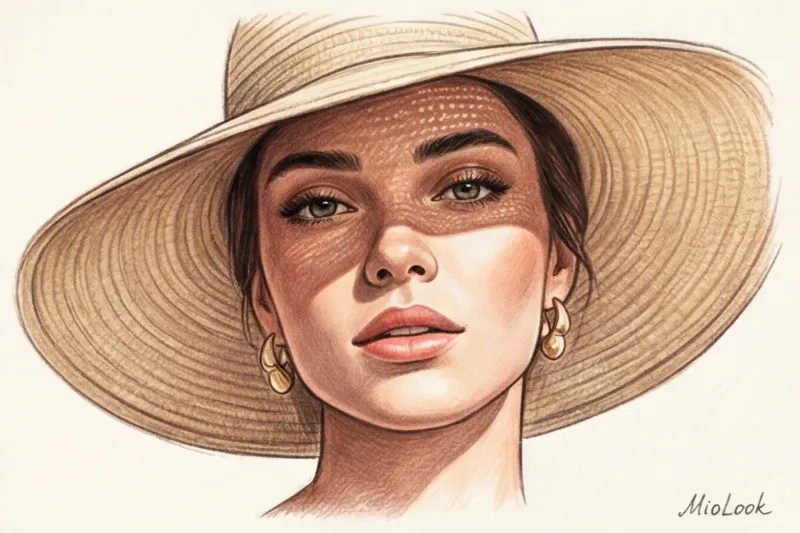
As a certified colorist, I often encounter women choosing hats solely based on their shape, ignoring the laws of optics. A wide brim casts a shadow on your face, while the inside of the brim acts as a reflector.
Light passing through the texture or reflecting off it illuminates the face with the shade of the hat.
- Warm, yellow straw: If you have cool or olive skin (with a greenish undertone), natural straw, the color of ripe wheat, will cast a sickly gray-green cast on your face. You'll look like you haven't slept in a week.
- Undertone selection: Cool-toned women should choose bleached straw, taupe raffia, or black. Golden, honey, and caramel raffia will complement warm-toned women (spring and fall).
Life hack from a stylist: If you've already bought a hat that's the wrong shade, don't rush to throw it away. A wide band in your ideal color tied at the base of the crown, or a bright silk scarf draped around your neck, will save the situation. The contrasting color will offset the negative effects of the straw on your face.
Incidentally, according to the European Society of Dermatology (2024), to fully protect the face from ultraviolet radiation (UPF 50+), the brim of a hat should be at least 7 cm wide. Caps and short-brimmed Panama hats only protect the nose and forehead, leaving the cheeks and lower jaw exposed to the sun.
A practical checklist: how to try on a summer hat in a store
To avoid disappointment, keep this fitting room routine in mind. I make every client go through these four steps.
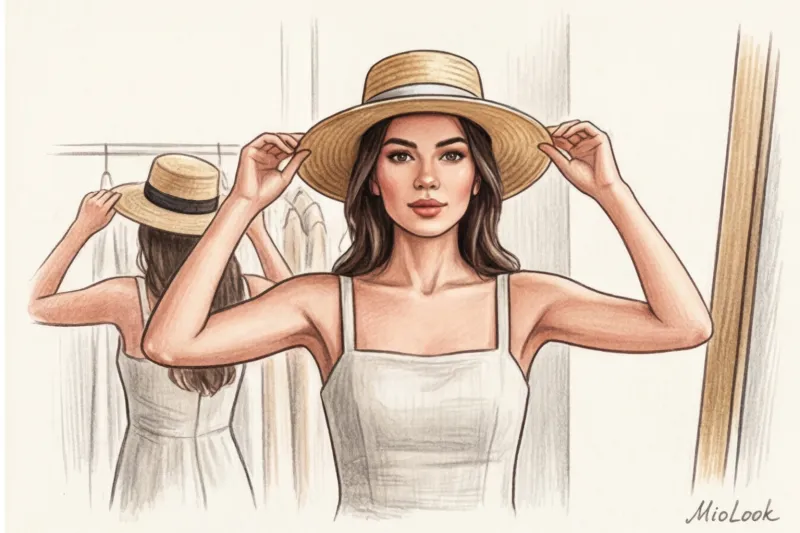
- Full-length fitting. Never judge a hat by looking only in a chest-high table mirror. A hat affects the proportions of the entire body. One of the golden rules visual correction of the figure: the brim of the hat should not be wider than your shoulder line (unless you are going to a beach photo shoot, where theatricality is appropriate).
- Finger test. Put on your hat. You should be able to fit your index finger comfortably between the crown and your temples. If the hat fits too tightly, your scalp will swell slightly in the heat, and you're guaranteed to get a headache.
- Shadow test under overhead light. Move away from the backlit mirror and stand under a regular overhead lamp in the store. Look at where the brim's shadow falls. Does it create harsh, dark circles under your eyes?
- The hairstyle factor. Always try on a hat with the hairstyle you plan to wear it with. Loose, voluminous hair visually widens the face and requires a wider brim. A sleek, low bun, on the other hand, removes volume, and the same hat can appear bulky.
Summary: Investing wisely in summer headwear
Choosing the perfect hat comes down to analyzing four factors: shape, texture density, color reflection, and scale relative to your figure. Stop looking for yourself in "oval-square" charts and start analyzing your appearance as a three-dimensional architecture.
Remember that a quality hat made of natural Ecuadorian straw (toquilla) or tightly woven raffia is a status accessory that brings the whole look together, like basic jewelry wardrobe There's no point in skimping on it. Today, a good basic model from mid-range brands will cost between €80 and €150.
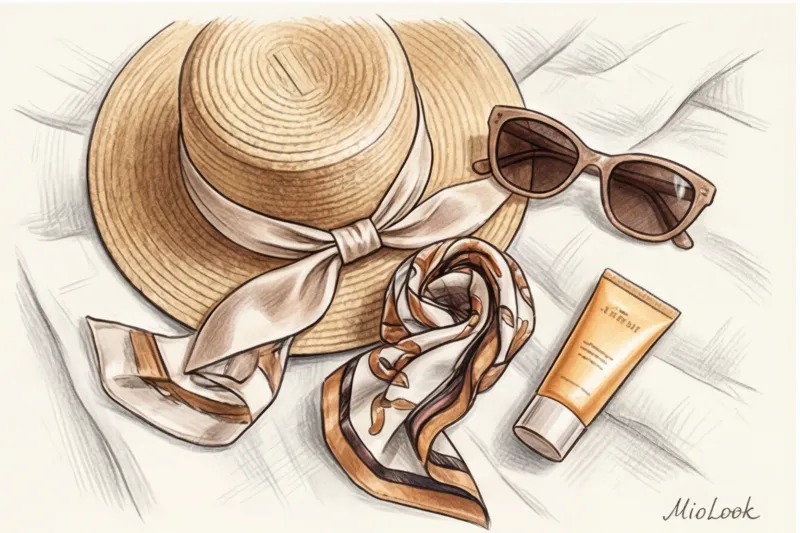
Cheap, fluffy paper straw (cellulose) from the mass market for €15 not only loses its shape after the first light summer rain, but also visually cheapens even the most expensive linen suit.
Your key insight for today: a hat isn't a way to hide your face from the world or disguise an "imperfect" shape. It's a tool that should rhythmically follow your best natural curves. If a hat clashes with your bone structure, take it off without regret.
Ready to start taking a conscious approach to style?
Upload your items to the MioLook virtual wardrobe and let AI create flawless looks for you every day.
Get access — €0.99 once