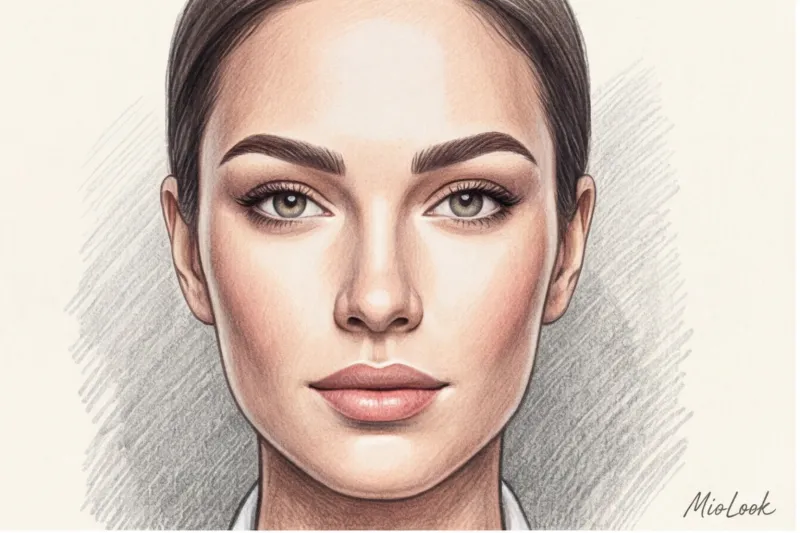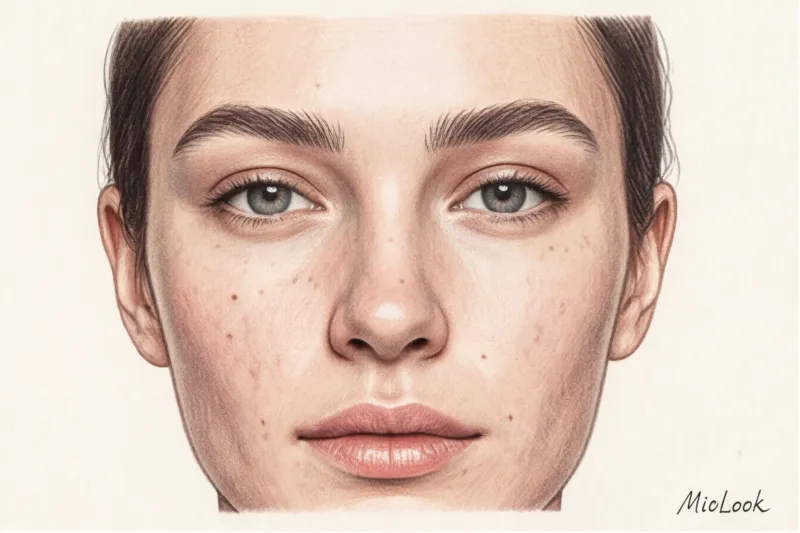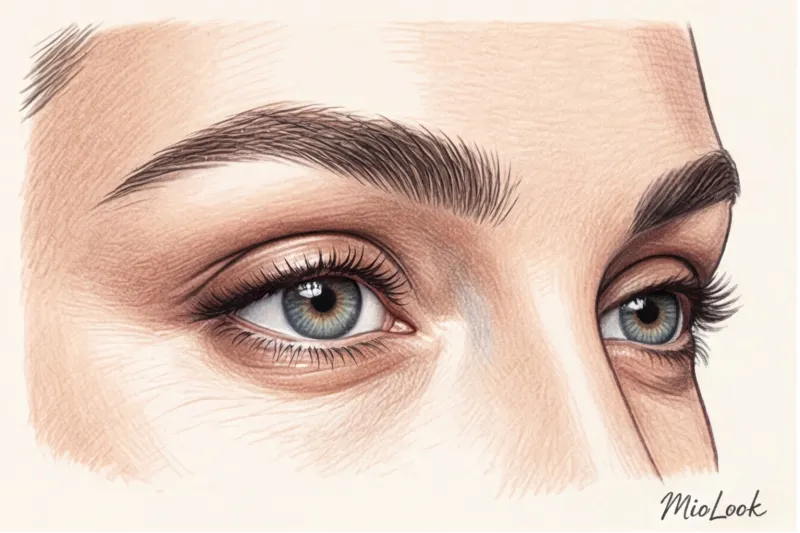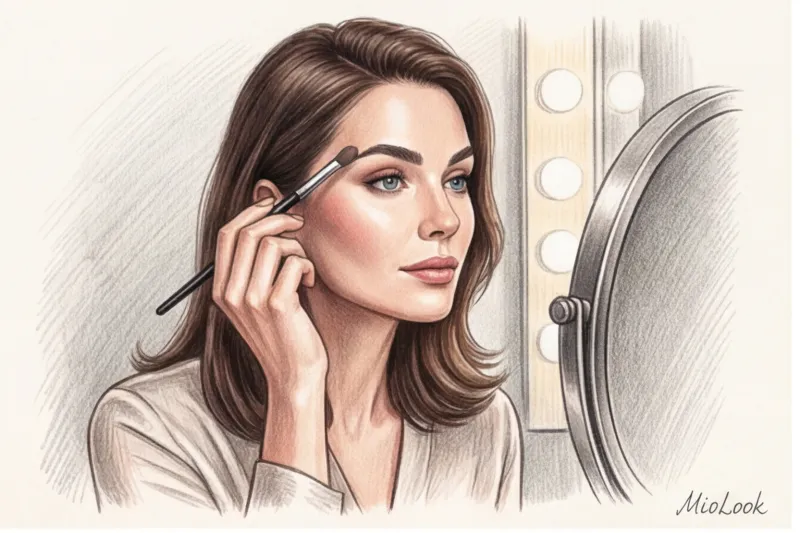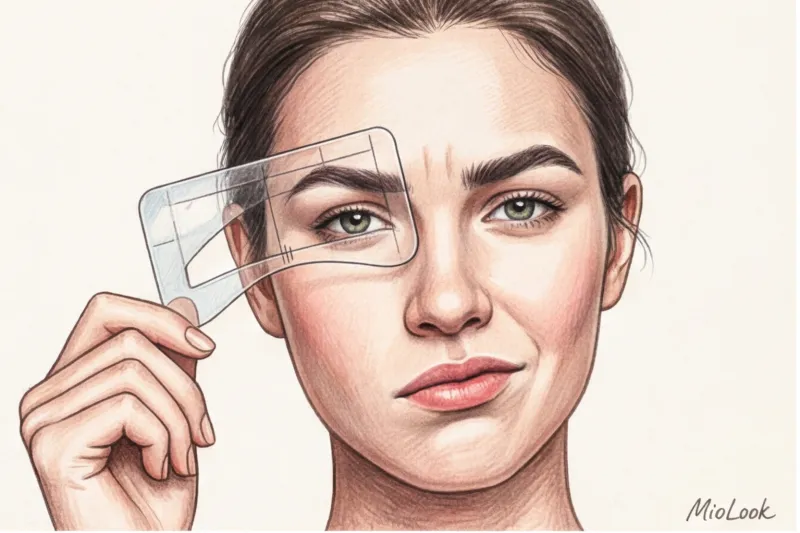
I still shudder when I see those hard plastic makeup stencils in beauty stores. Clients regularly come to me with requests like, "Sofia, give me eyebrows like Bella Hadid's—we have similar oval shapes." And every time, I have to start with the same hard truth: your face isn't a flat sheet of paper, but a complex 3D construct.
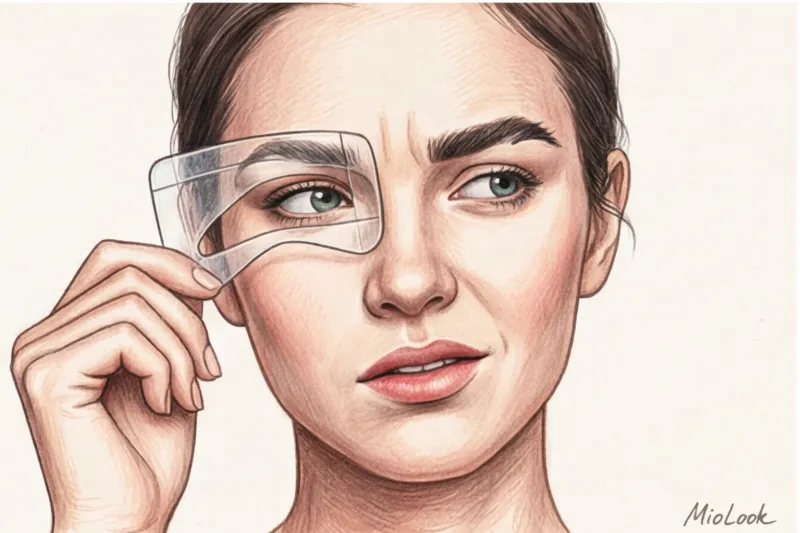
The ideal eyebrow shape for any face shape isn't calculated using magazine charts from the early 2000s. What we're accustomed to considering an immutable rule (for example, "a round face requires angular eyebrows") often results in the appearance of an angry cartoon villain. We've covered more about how to properly analyze your proportions in our the complete guide to determining your face shape.
Today, we'll move beyond flat geometry and embrace an architectural approach. We'll evaluate bone structure, soft tissue volume, and—most importantly—the natural texture of the hair itself.
Why the old formula of "eyebrow shape according to face type" no longer works
For decades, the beauty industry has been pushing the toxic stereotype of the "perfect oval." All other shapes (square, circle, diamond) were assumed to be deviations from the norm, desperately needed to be corrected by visually rounding or elongating them.
Blindly following these rules destroys natural harmony. Imagine a girl with a strong, defined jawline. A magazine advises her to create soft, arched eyebrows to "soften the angles." The result is two forlorn, semicircular commas, completely disconnected from her strong, beautiful architecture. The face becomes disharmonious.
The modern trend is all about absolute individuality. A pronounced jawline or high, sharp cheekbones are a sign of aristocracy, features that should be emphasized, not hidden behind unnaturally soft lines.
An architectural approach: analyzing the bone structure
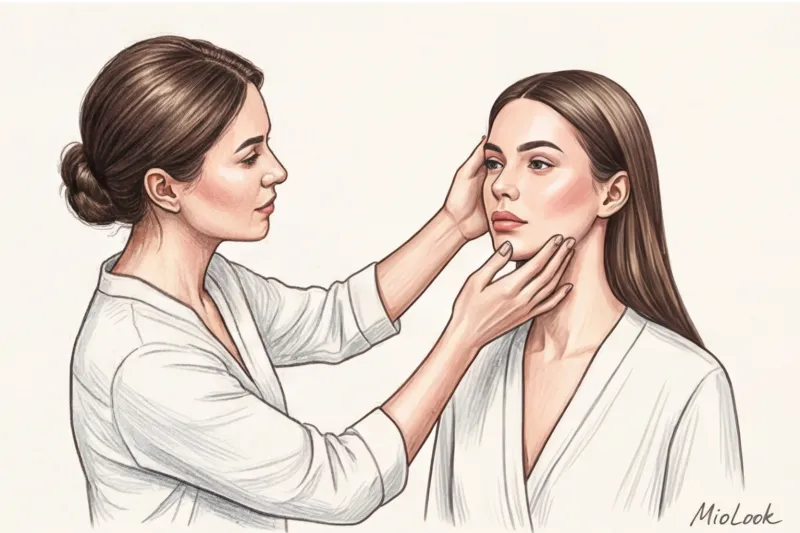
To understand exactly where the eyebrow should be, you need to literally feel your skull. We look for three key landmarks: the brow ridges, the orbital bone, and the temporal fossa. The eyebrow cannot exist separately from these bony protrusions.
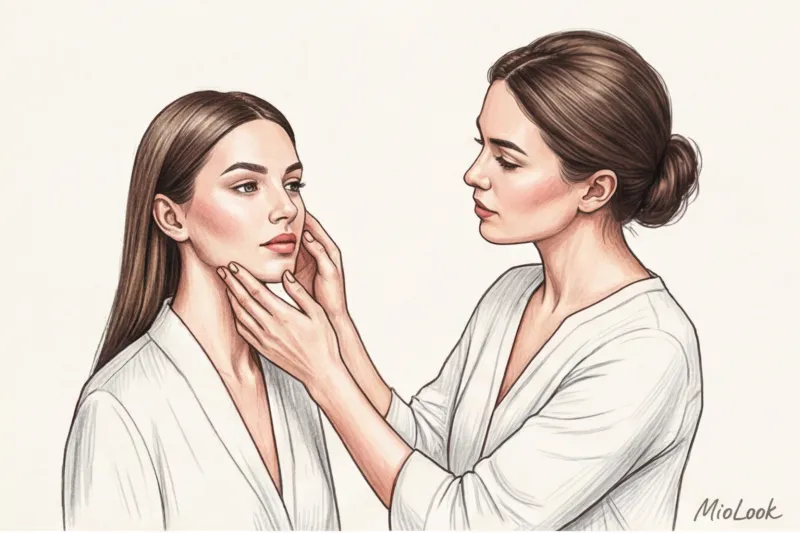
Few people take into account the anatomy of facial expressions. Under our eyebrows is musculus corrugator supercilii — the muscle that corrugates the supercilium. According to studies of facial anatomy, its tone determines how the eyebrow lies at rest. If you aggressively pluck hairs against the line of tension of this muscle, your face will acquire a permanently tense or mournful expression.
Lines, volumes and soft fabrics
Bone structure (angles) is only half the story. The other half is subcutaneous fat. The fullness or hollowness of your cheeks directly dictates the width and density of your eyebrows.
The golden rule of contrast applies here: a face with pronounced, full cheeks requires more structured, defined brows. They tie the entire look together. Conversely, with hollow cheeks and sharp cheekbones, bold black brows will make the face appear gaunt—a soft, powdery blend is needed.
Your ideal image
it begins Here
Join thousands of users who look flawless every day with MioLook. Smart appearance analysis and detail selection.
Get access — €0.99 onceIdeal eyebrow shape for your face type: modern schemes
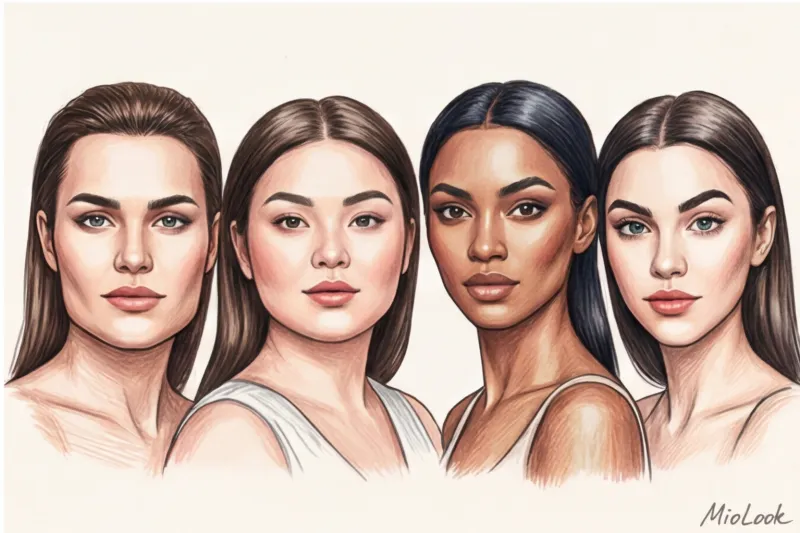
We reject "comma-shaped brows" and unnatural arches. The modern framework is based on smooth, upward lines. However, each face type has its own nuances that act as a subtle filter rather than a harsh mask.
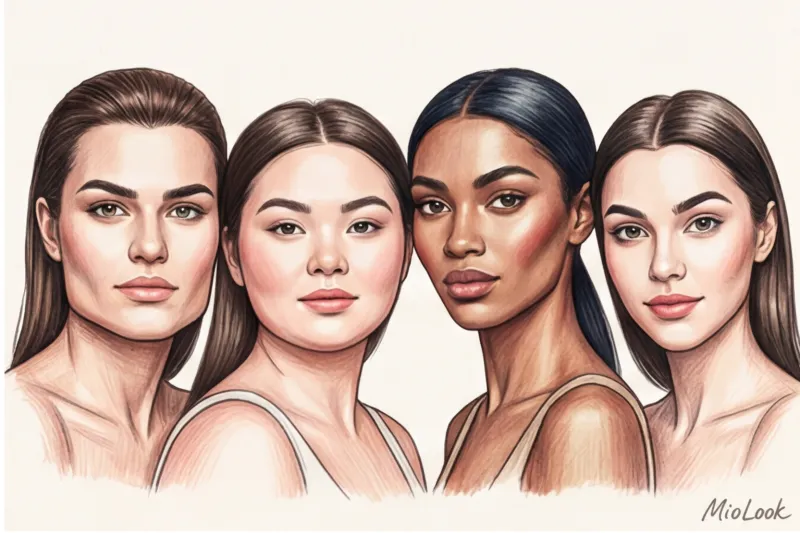
Square and Rectangle: Framing Aristocratic Angles
I had a client in my practice who had been trying for years to soften her luxurious square jaw. The stylists were giving her round, surprised eyebrows. This made the lower third of her face appear even heavier and more massive.
What to do: A square face needs a soft but distinct arch. The tail of the eyebrow should be slightly longer than usual—this draws attention to the temples and balances the wide jawline. Only medium or wide eyebrow width is acceptable. Thin "threads" will instantly make the face appear larger.
Circle: Creating Structure Without Aggression
The main mistake girls with round faces make is drawing straight horizontal eyebrows (a Korean trend) or, even worse, perfect semi-circular arches.
What to do: Diagonal upward strokes with a defined, but not sharp, apex (highest point). This visually elongates the face. Texture is crucial here: the hairs, brushed upward with clear gel, add the necessary vertical lines to the face.
Oval and Rhombus: Balancing Proportions
Oval is often considered the ideal shape, but that's no reason to relax. Overloading the harmonious proportions with overly dark, graphic brows will ruin the delicate look.
But the diamond shape (wide cheekbones with a narrow forehead and chin) requires a special dynamic. A classic upward brow with a smooth, slightly rounded arch beautifully distracts attention from excessive cheekbones, creating the illusion of a wider forehead.
Heart and Triangle: Softening the Top Third
Here we are dealing with a wide forehead and a narrow, often pointed chin.
What to do: Choose straight or slightly rounded shapes. What you should definitely avoid are high, sharp breaks. They will make an already wide forehead appear immense, and your gaze will take on a predatory, bitchy expression.
Texture over contour: a "fabric" approach to brows
As a fabric specialist, I always draw a parallel between my clients' wardrobe and hair. Eyebrow hair has its own porosity, stiffness, and growth direction—just like the fibers of silk, linen, or sheep's wool.
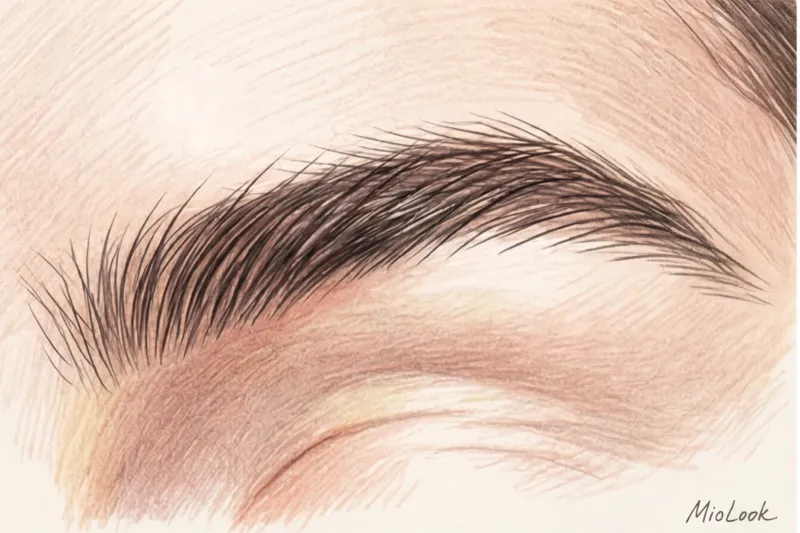
If you have coarse, unruly, and thick brows (similar to a thick drape), don't fill them in with a thick fixing gel or pomade. This will create a plasticky, cheap-looking effect. For this texture, a light tint or highlighter that fills in the gaps is sufficient. You can now find a quality highlighter even in the €15-€25 range.
If your eyebrows are thin and vellus-like (like delicate silk), heavy wax pencils will simply stick them together into messy streaks. Your choice is dry shadows and light hold.
I often encounter victims of the lamination craze. This is an honest limitation that hairstylists often keep quiet about: long-term styling is NOT suitable for everyone. If you have fine, weakened hair, harsh lamination solutions (costing from €40 per procedure) won't make it sable-like, but will turn it into broken, dry straw within three weeks.
Try MioLook
for free
Start creating your perfect look with artificial intelligence. Upload a photo and get personalized makeup and style recommendations.
Get access — €0.99 onceCommon correction mistakes that cheapen the image
There's a popular myth that eyebrows should be aligned according to the golden ratio (1.618) using Leonardo's compass. This is fundamentally wrong. Natural asymmetry is normal. Obsessively trying to align eyebrows with a ruler on an asymmetrical face (like all of us) results in a tense expression.
Here are three more things that kill the status of your face:
- The beginning of the eyebrow (head) is too dark. If you heavily fill in the brow bone at the bridge of your nose, your eyes will appear closer together, and your face will appear frowning and heavy. The beginning should always be translucent.
- "Falling" tail. When the tip of the eyebrow drops below its base, it visually pulls the outer corners of the eyes down. This instantly adds 5-7 years to your age.
- Removal of vellus hair above the eyebrow. Women often brush away the fluff on top to create a more defined outline. In reality, this destroys the natural 3D volume, leaving a flat, drawn-on line.
And most importantly: according to the data International Journal of Trichology (2022), the complete eyebrow renewal cycle (including the anagen, catagen, and telogen phases) takes 3 to 4 months. You can't "pluck today and have it grow back differently tomorrow." One careless tweezer move, and you'll be walking around with a bald spot for a third of the year.
A step-by-step checklist: how to find your ideal shape at home
If you decide to do the correction yourself, first throw away the magnifying mirror. It allows you to see individual hairs, but misses the entire face. Sit by a window in good daylight with a regular mirror.
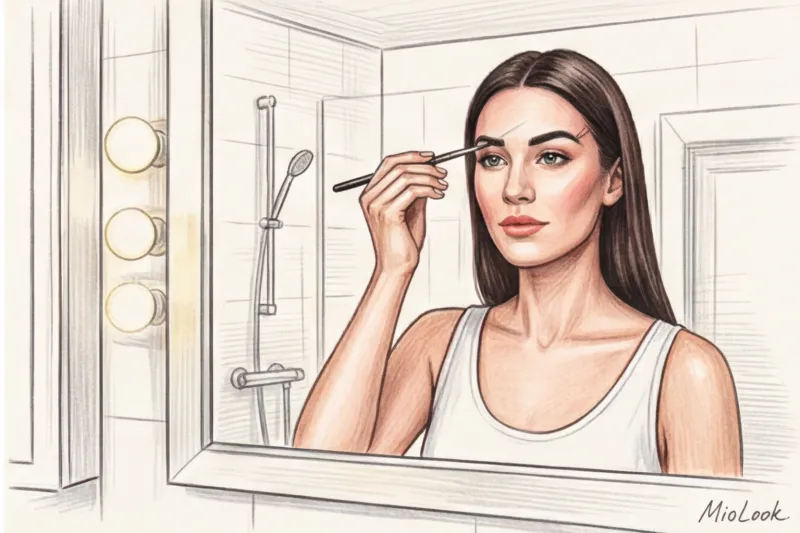
The current marking scheme, valid as of 2024, looks like this:
- Step 1: Finding the beginning. Place the brush vertically from the side of your nose upward. If you have a wide bridge or wide-set eyes, move the base of your brow slightly closer to the center—this will visually balance the proportions.
- Step 2: Apex (highest point). Forget the old "through the center of the pupil" rule. The modern apex is constructed diagonally from the ala of the nose through outer edge of the iris This makes the break smoother and opens up the look.
- Step 3: Ponytail length. Draw a line from the side of your nose through the outer corner of your eye. Make sure the end doesn't curve downward.
- Step 4: Lower Limit. It should be perfectly straight, without any dips or zigzags. It is the bottom line that defines the purity of the form.
The main rule for at-home shaping: remove only those hairs that clearly extend beyond the desired shape (2-3 millimeters below the main mass). Leave all work within the shape, creating bends, and thinning the thickness to the professionals.
Your eyebrows are a defining feature of your face. Don't try to force them to fit someone else's standards or standard geometric shapes. Embrace your natural architecture, work with texture, and your face will acquire that luster that no amount of money can buy.