Geometry or Psychology? Why Old Eyeglass Selection Rules No Longer Work
Have you ever wondered why geometrically perfect frames often look like they're borrowed from a stranger? When people ask me, How to choose glasses according to your face shape , I always start with an unexpected answer: first, forget everything you read about it in the glossy magazines of the 2000s.

Glasses are no longer just a utilitarian device for vision correction. They're your most important and influential accessory. They're positioned in the absolute center of your subject's gaze—where your conversation partner looks 90% of the time. According to behavioral psychology research, we form a first impression of someone within three seconds of eye contact. And in this micro-moment, your frames act as your personal PR manager, communicating your status, creativity, or meticulousness.
For decades, stylists and opticians have been hammering home the hard math: "a round face should wear strict rectangles," "a square face should wear soft ovals." In practice, this straightforward online advice inevitably leads to the purchase of painfully boring, compromised glasses that rob the face of any charm.
Today, the fashion paradigm has changed dramatically. According to the WGSN trend bureau's analysis (2024), the focus has finally shifted from the outdated idea of "correcting natural flaws" to "expressing individuality."
We no longer hide chubby cheeks or try to visually narrow a wide forehead - we emphasize our character.
Over 14 years of styling, I've seen hundreds of women stuck within these conservative boundaries. One of my clients, Anna, was convinced that "no glasses suit her at all." We spent three grueling hours at the optician's trying to find the perfect pair of glasses for her triangular face, frantically measuring the proportions of her narrow chin and deliberately avoiding accentuated top lines.
Do you know when the breakthrough happened? When we stopped looking at the geometry of her jaw and noticed her bold, creative character. It turned out the problem wasn't her face shape. We simply changed her haircut (by the way, if you're also looking for a balance between your hair and overall style, check out our article about perfect hairstyle and image architecture ) and tried on chunky, graphic acetate. The frame, which by all the old rules should have "weighted down" the upper part of the face, suddenly made the look incredibly stylish and cohesive.
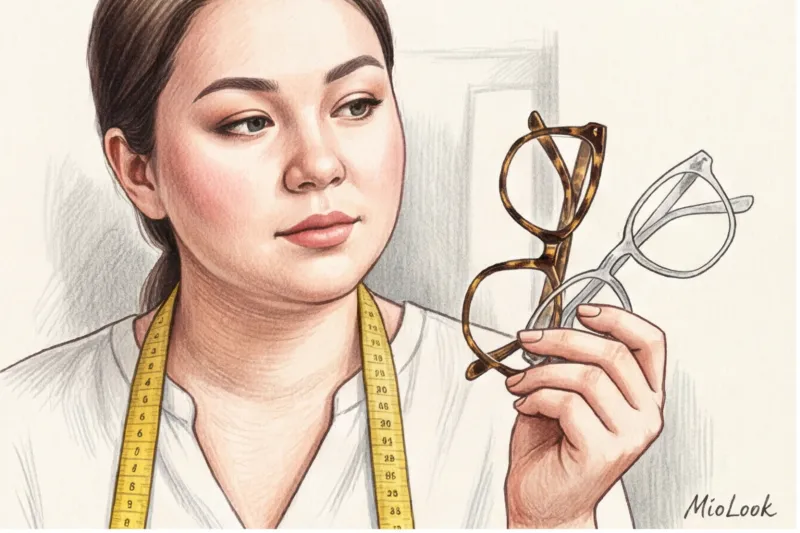
To avoid wasting hours on blind fittings, I always recommend testing ideas beforehand. Upload your photo to MioLook And see how different frame shapes and styles work with your current hairstyle and wardrobe. Trust me: psychology, personal style, and a keen eye are far more effective when choosing glasses than any tailor's tape measure.
How to Choose Glasses for Your Face Shape: A Modern Stylist's Approach
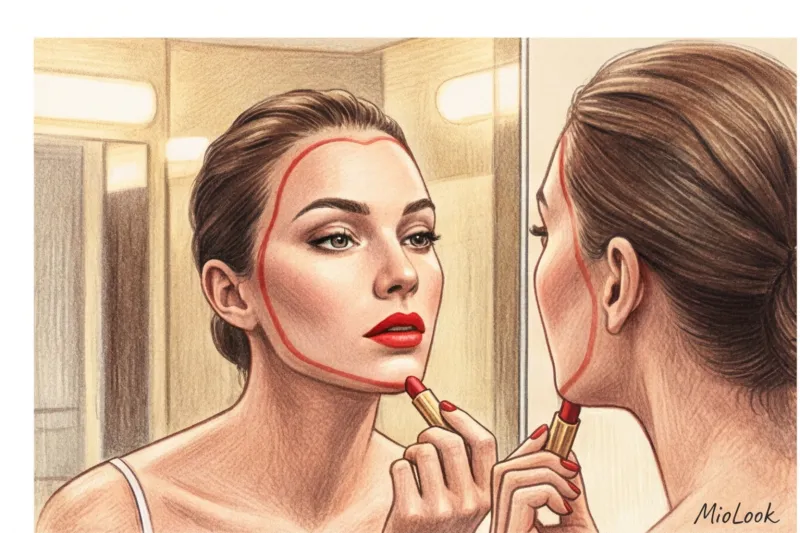
Have you ever stood in front of a mirror with your hair pulled back, trying to trace the contours of your face with lipstick to figure out whether you're square, oval, or perhaps an inverted triangle? If so, you know how frustrating this process can be. In my 14 years as a stylist, I've seen dozens of women despair in the fitting rooms of optical shops simply because their features refused to fit the molds of glossy magazines of the 2000s.
When clients ask me, How to choose glasses according to your face shape I always start by breaking down the main stereotype. Face shape isn't like school math with clear formulas. It's a complex optical illusion. Let me explain my professional perspective on typing: don't try to force yourself into a rigid framework, because 90% of individuals have a mixed type You may have a square jawline but perfectly soft, rounded cheeks. Or an elongated oval shape with a sharp, triangular chin. The face is living architecture, not a flat blueprint.
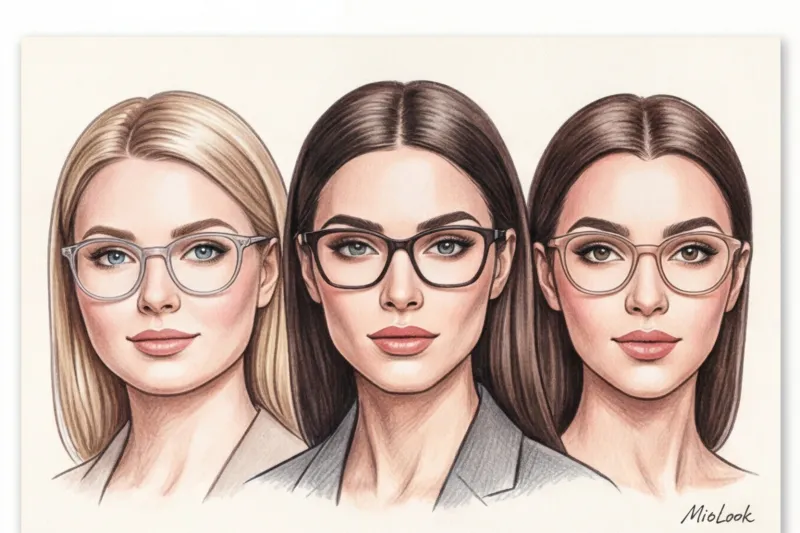
To avoid making mistakes in choosing, we need a different algorithm—identifying dominant lines. Take a photo of yourself from the front, without smiling, and look at three areas: your hairline, cheekbones, and jawline. Which do you have more of? soft (smooth, rounded, arched) or tough (angular, straight, graphic) lines?
- If soft lines dominate: Your face reads as smooth. It lacks a natural "framework."
- If hard lines dominate: Your face is naturally sculpted and structured.
This is where the basic rule of contrast comes into play. We're still looking for visual balance, but we're doing it much more intelligently than before. We're not simply stacking square on round. We're working with the visual weight of the frame. We soften the hard lines of the face with gentle curves to avoid looking too aggressive. And we add a graphic touch to the soft lines to bring the face together and give it character. Let's explore how this works in practice for different anatomical scenarios.
Oval Face: Debunking the Myth of the "Ideal Shape"
In any classic article on style, you'll read: "Absolutely everything suits an oval face! You're lucky." As a practicing specialist, I can confidently say that this is the most insidious trap of all. It's women with oval faces who most often leave the opticians with the most bland, boring frames, losing their individuality.
When everything suits a face, there's no need to search for a unique style through correction. Ultimately, a basic rectangular frame for €50 transforms an otherwise interesting appearance into a drab mousy one.
In addition, there is a specific problem elongated oval If the distance from your hairline to your chin significantly exceeds the width of your face, the wrong glasses can make your face appear endless. If you wear narrow, micro-sized glasses, you'll create a horizontal stripe effect that will cut into your face and only emphasize its length.
"Oval faces need glasses that don't just 'don't spoil' them, but add character. Don't be afraid to mess with proportions for the sake of style—that's the modern approach to optics."
The best solutions for an elongated oval face shape are to intentionally shorten the proportions using the correct shapes:
- Oversized: Large frames that cover almost a third of the face visually reduce length. This creates a bohemian and modern look.
- Aviators (drops): Their elongated downward shape perfectly fills the space on the cheeks, harmonizing the proportions.
- Accent Top Line (clubmaster): Frames with a massive plastic top and invisible metal bottom (browliners) create a strong horizontal line, widening the face in the desired area.
Round Face: How to Add Structure Without the "Stern Teacher" Look
A round face is characterized by equal width and length, as well as smooth, full cheeks even with a lighter frame. The key here is to elongate the silhouette and add sculpting to the face.
The most disastrous mistake I still see on the street is the choice of micro-rectangles from the early 2000s (the so-called Bayonetta glasses). Women think the narrow, geometric shape will elongate their round faces. In reality, it creates a "stern head teacher" effect: the tiny, rigid shape against the full cheekbones creates a crazy contrast, making the face appear even rounder and larger than it actually is.
As a stylist, I always point out to my clients that How does frame thickness work? For a round face, heavy acetate always beats thin metal. Why? A thin metal wire is simply lost against the soft tissue. But dense, thick acetate creates the necessary rigid "exoskeleton."
Ideal shapes for creating a “lifting effect”:
- Cat-eye: The corners of the face, drawn upward and toward the temples, draw the viewer's gaze diagonally, visually lifting the oval of the face. This is an instant, non-surgical lift.
- Wayfarer (wayfarers): The trapezoid shape, slightly flared at the top, provides the missing geometry without going to the extreme of micro-rectangles.
Advice from practice: Make sure the frame width is slightly wider than the widest part of your face. If the temples press into your cheeks, even the most perfect shape will visually overweight you.
Square and Rectangular Faces: The Art of Softening Angles
If you have a defined jawline, wide cheekbones, and a straight forehead, your natural geometry is already very strong. The goal of glasses here is not to counteract this strength, but to subtly soften it. We avoid any styles with a flat bottom edge, otherwise we risk creating a "heavy jaw" and overly masculine appearance.
It would seem that, according to the rule of contrast, the ideal choice for a square is perfectly round glasses, a la John Lennon. But there's a catch. Round glasses don't suit all squares, and the critical factor is lens diameter According to the laws of optical design (which are taught, for example, at the Safilo Group Academy), if a small round lens ends far from the cheekbone, the face appears twice as wide. The circles should be large enough to fit comfortably against a strong jawline.
Not sure about your face shape?
Upload your photo to MioLook, and a smart algorithm will help identify your dominant features and suggest optimal styling options.
Get access — €0.99 onceTo shift the focus to the upper third of your face and draw attention away from a heavy bottom, use the following solutions:
- Panto frames: An absolute favorite among intellectuals, this shape combines a rounded bottom with a straighter, higher topline, with the temples attached in the upper third. It softens the angles but looks more serious than a standard circle.
- Oval frames: Soft, horizontally elongated ovals (especially in medium-thickness plastic) neutralize the sharpness of the cheekbones.
- Semi-rimmed models: When the lower part of the lens is held in place by a transparent wire, the visual weight of the frame is concentrated at the eyebrow level, completely relieving the jaw area.
Triangular and heart-shaped faces: balancing proportions
It's important to understand the difference between these two shapes, although they both have a wide forehead and a narrow chin. The heart-shaped face has a "tip" (triangle) at the hairline and typically softer cheekbones. But the optical challenges are similar: we need to balance a massive top with a graceful bottom.
The main danger for such individuals lies in aggressive forms with "heavy on top" If a woman with an inverted triangle face shape wears a massive black cat-eye with a thick top line, she visually widens her forehead by a couple of centimeters. The face begins to resemble a mushroom on a thin stem: a huge top and a receding, pointed chin.
How do we balance such proportions?
First, we shift the visual weight downwards or make the frame as weightless as possible. Second, we pay attention to color and material. Light, translucent (crystal) acetate frames from modern indie brands, priced at €150–€200, are the perfect choice. They maintain a contemporary volume without overloading the face.
Rimless designs, where the temples are attached directly to the lenses with screws, are another chic option. Today, they're not just a staple of aging professors, but a genuine trend (remember the office core style). These glasses delicately fit a heart-shaped face without disturbing its delicate natural harmony.
3 Secret Parameters That Are More Important Than Face Shape
Imagine a typical situation: you find a luxurious pair of frames at the optician's, say, from Celine, for €350. You know your exact frame size, and the salesperson nods confidently—yes, the rectangular shape perfectly balances your round cheeks. You buy them, come home, put them on, and realize something's wrong. Your face looks tired, your gaze seems heavy, and the glasses themselves feel out of place. What's the catch?
The fact is, a perfectly shaped frame can look completely out of place due to subtle anatomical details. Information on how to choose glasses for your face shape can be found on any glossy website, but practicing stylists have long been working at a deeper level. In 2018, during an internship in Milan, I was fortunate to speak with a hereditary optometrist who shared his professional secrets. He proved to me firsthand: millimeters of fit matter more than the overall geometry of the frame.
The Brow Line: The Architecture of Your Face
Eyebrows are the natural roof of our face, its main architectural line. They define character, emotion, and micro-expressions. That's why the main rule of an eyewear stylist is: the top edge of the frame should match or harmoniously accentuate the arch of your eyebrow. If the frame clashes with this line, the entire harmony of the portrait area is destroyed.
The most common and insidious mistake is the "double brow" effect. It occurs when the top of the frame is too straight, thick, and dark, and your own brow arches high above it. Visually, you have four eyebrows on your face. This incredibly cheapens the look and gives the face a perpetually surprised or slightly silly expression. And believe me, even a handcrafted frame made from premium Japanese acetate won't save the situation if it cuts your eyebrow in half.
"Your frame should work as a perfect dance partner with your eyebrows: either they move in sync, or the frame gently gives way, remaining slightly lower, but never overshadowing the soloist."
What if your eyebrows are naturally perfectly straight, but you dream of wearing round, preppy-style glasses? I have a harsh but honest answer for you: spoiler alert: you'll either have to change your glasses (look for a panto shape with a straighter top edge) or draw on different eyebrows. There's no middle ground. The contrast between the straight hairline and the rounded plastic line creates visual chaos. When my clients test out new portrait looks and upload selfies to MioLook , we first analyze this architectural junction - if the eyebrows and glasses "argue", the image is immediately rejected.
Bridge of the nose: how to visually change your nose
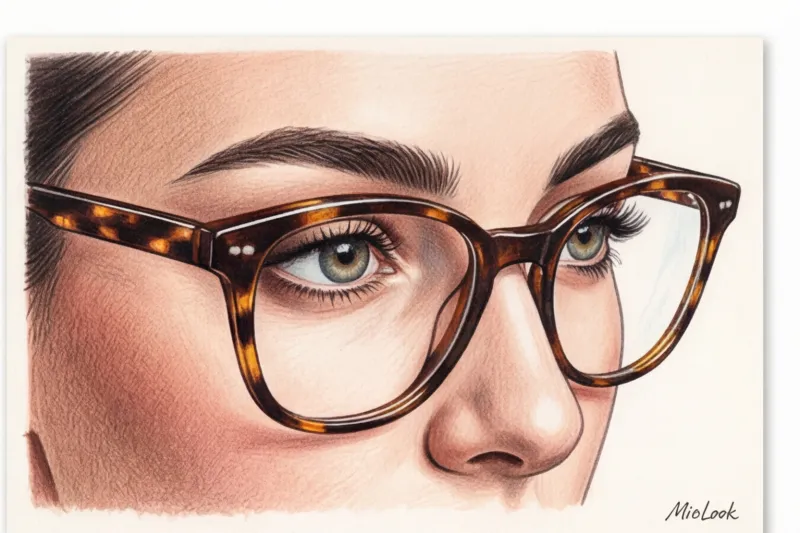
You wouldn't believe how many times I've heard women say, "Glasses don't suit me; my nose is too big/long/wide." The truth is, glasses are the most affordable and painless alternative to rhinoplasty if you understand how the bridges work.
The height and shape of the bridge between the lenses plays a key role. A low bridge (especially the popular "keyhole" shape) artificially divides the bridge of the nose. It visually "cuts" the vertical line, making a long or prominent nose instantly appear shorter and more streamlined. Conversely, if you have a short or wide nose and want to add grace, choose a high, thin bridge (often found in metal frames). It elevates the optical center and visually lengthens the line of the nose.
But aesthetics aren't everything. There's a critical technical parameter—Dbl (Distance between lenses), or the width of the bridge of your nose. Look at the inside of the left temple of your current glasses. There are always numbers there, for example: 52 □ 18 The second number (18) is the Dbl in millimeters. How can you avoid deep red marks and constantly slipping glasses? Know your size! If your bridge is 15 mm wide, and you bought a fashionable frame with a Dbl of 21 mm, it will slide down to the tip of your nose every minute, even if the temples are perfectly curved. If the opposite is true, the frame will dig into your skin, disrupting microcirculation.
Pupil position and face width: why glasses look small
Another secret rarely discussed by consultants at mass-market opticians is the position of the eye within the lens. The rule is: the pupil should be exactly centered horizontally and centered (or slightly above center) vertically. This isn't just a doctor's requirement for proper focusing; it's a crucial aesthetic marker.
What happens when you embrace the oversized trend and your interpupillary distance (PD) is quite narrow? Your eyes end up shifted toward the inner edges of the lenses, creating the visual effect of your eyes "running toward the bridge of your nose." Your face immediately takes on a comical, slightly childish expression, and the glasses themselves look like you're wearing a pair left over from your older brother. If you see this effect in the mirror, the frames are too wide for you; take them off immediately.
But how do you check the width of the frame relative to your face? Stylists use the simple and foolproof "one-finger rule." After putting on your glasses, try sliding your index finger between the frame and your temple (just above your cheekbone).
- If your finger won't fit through the frame and the temples are digging into your temples, the frame is too small. It will fold your skin, cause headaches, and make your face appear wider than it actually is.
- If two fingers can easily fit between your temple and the frame, the frame is too big.
- The ideal fit is when one finger fits in with a light touch.
These three anatomical parameters completely revolutionize the approach to choosing eyeglasses. Once you learn to pay attention to your brow line, bridge height, and pupil position, you'll understand why some inexpensive €50 frames look like couture exclusives, while luxury models can look like cheap knockoffs simply because of the poor fit.
Glasses and Your Personal Brand: Choosing Frames to Match Your Archetype and Profession
A 2023 study by the British College of Optometrists revealed a curious statistic: 43% of people subconsciously perceive someone wearing glasses as more intelligent and professional. In psychology, this is called the "halo effect." As a stylist, I often use this tool to create the right impression at work and in business. Glasses are your personal PR agent, working even before you utter your first word.
Recently, the CFO of a large IT company contacted me. During negotiations with new partners, she constantly had to "prove" her rigor and expertise. We analyzed her profile and quickly identified the culprit: she was wearing soft, pinkish frames with round lenses, which made her face appear too naive. We replaced these frames with rimless matte titanium frames costing around €280. The effect was stunning: trust levels instantly increased, and the client herself noted that her partners began communicating with her in a completely different tone. The change in glasses literally elevated her status.
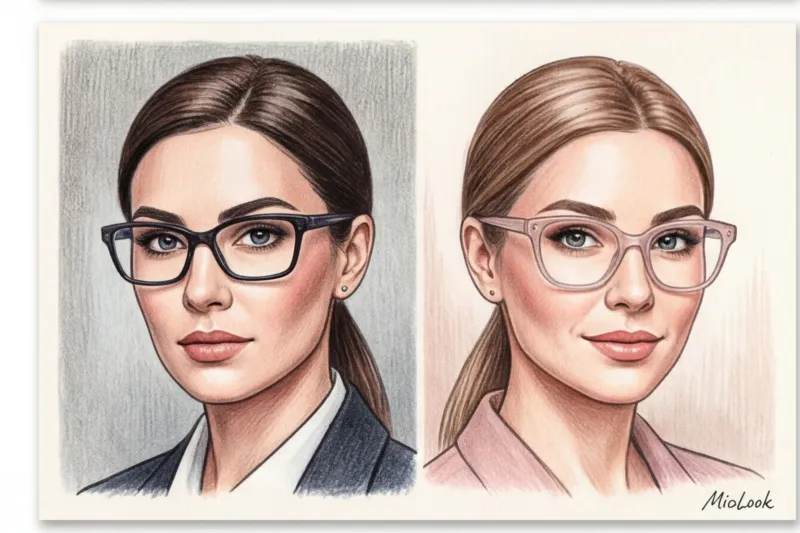
We often underestimate how accessories convey our inner roles. I discussed how this system works in more detail in the article "Archetypes in Style." But let's look at how this is applied in practice in optics.
Points for "Ruler" and "Sage"
If your goal is to project stability, profound intellect, and power, opt for uncompromising minimalism. Ideal choices: thin titanium, classic tortoiseshell (havana) color, and strict geometric shapes (clear rectangles or precise pantos). These frames don't draw attention to themselves. They say, "I know what I'm doing, and I don't need to shout about it."
Points for "Mage" and "Creator"
Here, the rules are radically different. Creative directors, architects, and marketers must assert their unconventional thinking from the outset. Unconventional shapes, bold, colorful acetates (such as deep wine, emerald, or even cobalt), and subtle asymmetry in design will be your best allies. Brands like Theo and Anne et Valentin masterfully address these needs.
But how do you adapt your frames to a strict business dress code if you're a true "Creator" inside? My favorite styling trick: choose the most conservative shape (like a classic Wayfarer or a soft square), but play with the material. Translucent matte plastic in gray, olive, or dusty blue won't violate corporate etiquette, but will showcase your individuality.
To avoid making a mistake with your choice, I always recommend trying new lenses on with your usual work capsule. Load up your basic jackets and shirts MioLook Take a selfie with your new frames and see how they fit together. Artificial intelligence will immediately show you whether the complex design of your glasses clashes with your formal business attire.
Access to MioLook for €0.99 — one-time payment
Start creating perfect images with the help of artificial intelligence
Get access — €0.99 onceColor type and frame: how to choose a shade that refreshes
Nine out of ten clients, when they come to me for an accessory collection review, pull out a pair of massive black glasses. It's considered a "safe base" that goes with everything. But let's face it: based on the theory of 12 color types, I can confidently say that deep black flatters at most 15% of Slavic and European faces.
If you have a low-contrast appearance—for example, light-brown hair, light eyes, and translucent skin (a typical "Soft Summer" coloring)—black frames will simply "kill" your face. They'll steal all the attention, highlight even the slightest under-eye circles, and visually age you, creating the effect of a heavy mask.
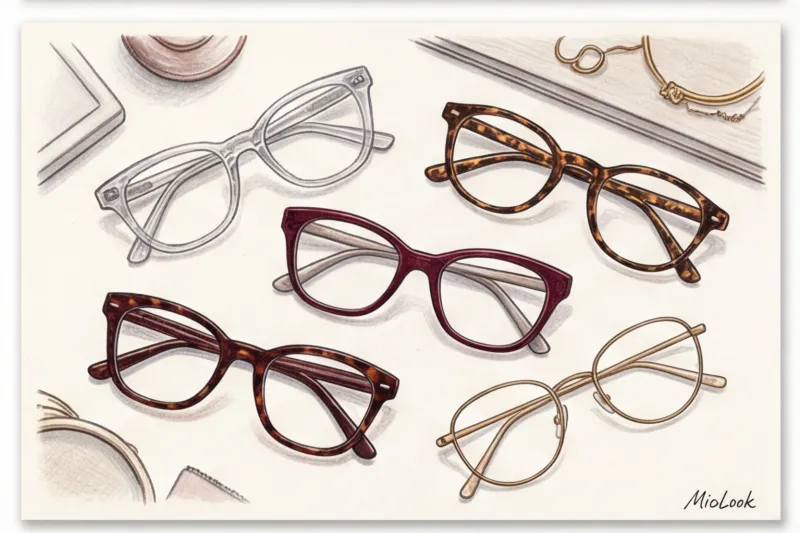
What to do? Look for your perfect alternative. Tortoiseshell print, or shade Havana — a true optical chameleon and the best alternative to black. With its uneven flecks of caramel, amber, brown, and olive, this pattern adapts to your natural contrast levels. For "Warm Autumn" or "Spring," I always look for a light, honey-toned "tortoiseshell" from mid-up brands (a high-quality Mazzucchelli acetate frame will cost around €180-€250). For cooler complexions ("Winter," "Cold Summer"), a dark option with burgundy or graphite highlights works beautifully.
For the past few seasons, transparent frames have dominated at optical trade fairs such as MIDO in Milan. crystal This is a stunning trend that creates the "glasses without glasses" effect and suits everyone, as it complements natural colors. However, there's a professional catch. Crystal plastic literally blurs the boundaries of the eyes, making the face appear slightly flat. To avoid a tired look, clear frames always call for bolder eye makeup: a strong winged line or heavily mascaraed lashes.
What about metallic frames? The basic law of skin temperature governs here. If your undertone is warm (skin tans easily, has a peachy hue), your choice is classic yellow gold, bronze, or brass. If your undertone is cool (porcelain skin, prone to redness), silver, platinum, or white gold will instantly brighten you up. Rose gold deserves a special mention. In my experience, it's the safest compromise for mixed complexions: it blends beautifully with a natural flush and doesn't create harsh shadows on the cheekbones. If you're unsure about your choice, upload selfies in different frames to MioLook — Portrait zone analysis will help you clearly compare which metal makes your eyes look rested and which highlights fatigue.
Optics Trends 2024-2025: What to Invest in and What to Skip
Last fall, at the leading optical fair SILMO in Paris, it became crystal clear: safe minimalism is giving way to expressiveness. Strolling among the independent brands' booths, I noted a clear focus on retro aesthetics and technological advancements. But as a stylist with many years of experience, I always divide runway fantasies into two categories: "a reliable investment for years to come" and "a one-season toy."
The main long-lasting trend that is guaranteed to stay in our wardrobes for the next five years is thick colored acetate in 70s style Forget boring and often harsh black. Complex, deep shades are in fashion: burnt orange, emerald, translucent mustard, and wine. However, the industry has moved beyond simple visual aesthetics. At the exhibition, every other premium brand presented eco-materials Frames made from recycled plastic, biodegradable cotton, and even pressed wood are all the rage these days. The base price for these high-tech models typically ranges from €150–€300, but in this case, you're paying not only for a statement piece but also for a responsible approach to the planet.
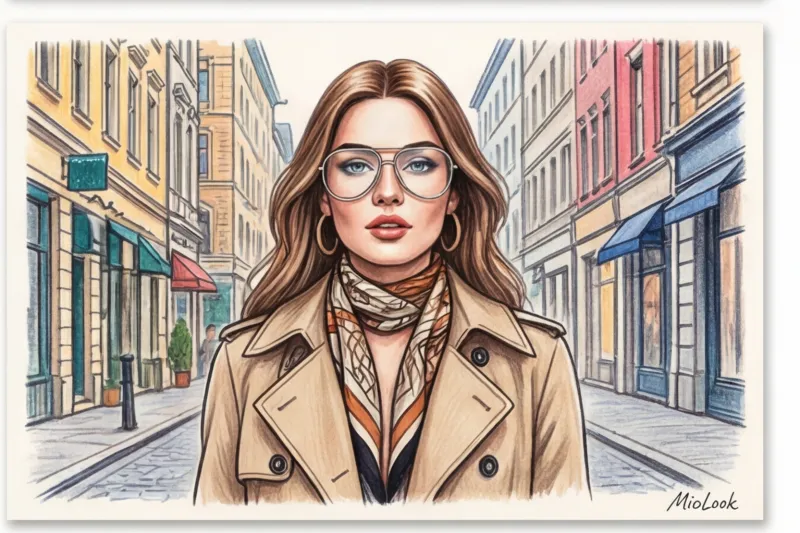
If chunky plastic seems too theatrical to you, take a look at the absolute street style hit - Oversized metallic aviators in a librarian style (Librarian core). These are thin, exaggeratedly large designs, often crafted in matte gold or aged bronze. They brilliantly contrast with formal office jackets, adding a touch of intellectual irony and a relaxed feel to everyday looks.
Another micro-trend that works amazingly with these frames is gradient lenses in fashion glasses Even if you have perfect vision and order lenses without prescription (for example, simply for style or to block blue light from your monitor), a subtle transition from smoky gray or warm peach on top to a clear bottom works like a salon-quality lift. This technique masterfully conceals signs of sleep deprivation and dark circles under the eyes better than a thick concealer. Of course, basic knowledge about How to choose glasses according to your face shape , remain the foundation, but it is precisely these modern details that make the portrait area truly lively and relevant.
But what we need to decisively get rid of are the obvious anti-trends. Skinny striped glasses from the 90s (So-called sci-fi glasses) have officially left the fashion radar—this fleeting microtrend is dead, as in real life it mercilessly cuts facial proportions in half. Also permanently on my professional "black list" are frames with an abundance of rhinestones on the temples and flashy logomania. Today, luxury should be quiet, and the emphasis should be architectural, not decorative.
Create the perfect accessory capsule
Not sure if trendy aviators or colored acetate will fit into your current wardrobe? Upload your everyday looks to your smart wardrobe and try new combinations with just one click.
Get access — €0.99 onceOptical wardrobe: how many pairs of glasses do you need to be happy?
Wearing the same glasses every day is like trying to wear classic leather pumps to both a business meeting and a Sunday jog. For a long time, it was considered the norm to invest in one expensive frame and wear it for years. But as a stylist who has been building functional wardrobes for years, I officially declare: glasses alone are not enough The capsule wardrobe concept works with eyewear just as it does with shoes or bags.
We often spend hours trying to understand, How to choose glasses according to your face shape , but we completely forget about the context of the situation. Your face is a canvas, and glasses are a powerful tool for impression management. If you wear glasses regularly, you need a well-thought-out optical wardrobe consisting of at least two or three items.
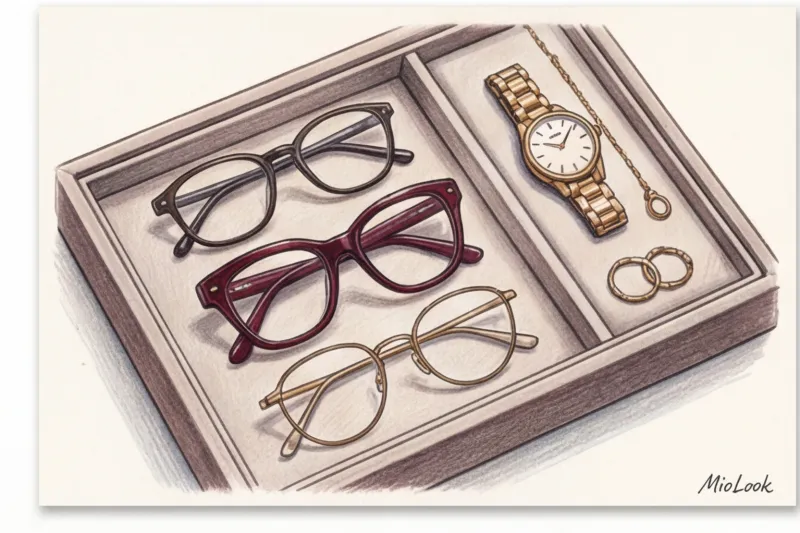
My signature approach to creating an accessory capsule is based on the 80/20 rule. In the appendix MioLook When we digitize our clients' shelves, we always divide optics into two clear categories:
- Basic pair: Your reliable everyday casual. These are neutral frames that don't overpower and blend perfectly with any color scheme (office suit, trench coat, sports sweatshirt). They're typically made of thin metal, translucent acetate, or muted tortoiseshell. Invest the bulk of your budget here (in the range of €150-€300), as you'll be wearing them most of the week.
- Accent pair ("statement glasses"): Your style statement. Designed for creative gatherings, parties, or days when you're wearing simple jeans and a white shirt and need to elevate your look with just one accessory. Chunky colored plastic, unusual geometric patterns, or oversized pieces are all appropriate here.
And here lies a subtle but critically important stylistic nuance: sometimes the best glasses are no glasses at all. The Role of Contact Lenses in Your Style It's impossible to overstate the importance of this conscious "break from glasses." Contact lenses are essential when you're wearing complex evening makeup (a bold smokey eye always clashes with thick frames), wearing massive chandelier earrings, or choosing a blouse with a complex architectural collar.
"An overly detailed portrait area visually adds age and creates the 'all-you-have-gotten-all' effect. Alternating between glasses and contact lenses gives you the freedom to control the focal point."
Checklist: 5 steps before buying glasses at the optician
The final stage is always a reality check. Over the years of shopping with customers, I've learned one hard and fast rule: quality optics don't forgive rushing. The average bill for a good basic frame with lenses these days easily exceeds €200-400, and the cost of a mistake in this category is too high. Even if you've mastered the art of choosing glasses for your face shape, in practice, the fit and the dynamics of your body make all the difference.
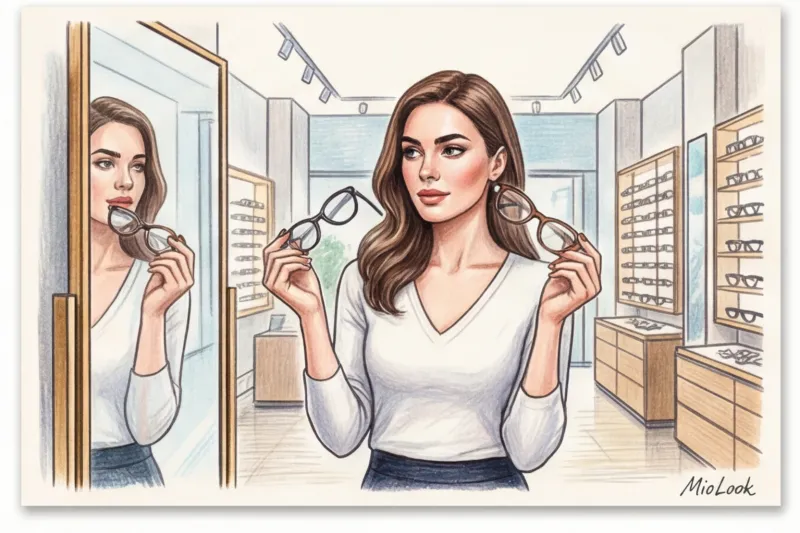
To protect your investment and your nerves, I've created a strict fitting protocol. I make every client try on the chosen style through these five steps before we go to the checkout.
1. Take a photo of yourself in frames (don’t just look in the mirror, the camera will show your real proportions). A mirror in an optical store that you stand close to mercilessly distorts the focal length. Your nose appears larger, and your face narrower. Ask a consultant or a companion to take a photo of you from a distance of 1.5–2 meters. Remember that a selfie taken at arm's length will also be distorted by the wide-angle lens. Only a photo from the side, or even better, a short video of you talking, will truly show you. This is how others see you in three dimensions. You'll be surprised how dramatically the image on your smartphone screen differs from your reflection.
2. Smile: your cheeks should not lift the frames. Our faces aren't static masks. While your frames may fit perfectly at rest, the moment you laugh, the apples of your cheeks pop. If the bottom edge of the frames rests on your cheeks and lifts when you smile broadly, it's time to put those glasses down. Otherwise, they'll bounce with every word, irritate your skin, and rub off your concealer under your eyes.
3. Turn your head: the glasses should not slide off your nose. Look down, as if reading a message on your phone, and shake your head vigorously. Do the frames instantly slip down to the tip of your nose? That's a red flag. It means the bridge is too wide for you. Consultants often promise to "bend the temples behind your ears," but if the bridge itself doesn't fit your anatomy to begin with, the glasses will still slide under their own weight, causing discomfort all day long.
4. Consider the weight: with lenses the frame will become heavier. What you're trying on in the display case are lightweight plastic demo lenses. Real optical lenses, especially if you have a complex prescription (such as severe astigmatism) or high prescriptions, will add significant weight. If a chunky acetate frame already feels a bit heavy, imagine the deep red dents it will leave on your nose after eight hours of laptop work. For those with complex vision, I always recommend considering lightweight titanium or high-tech plastics like Grilamid (TR-90).
5. Apply full makeup and come with the hairstyle you wear most often. Never buy everyday glasses on a lazy Sunday morning if you're out for coffee with a loose bun and no makeup (assuming you wear a sleek hairstyle and mascara on weekdays). Dark frames on a bare face can look harsh and outlandish, but add your usual even foundation and mascara—they'll blend harmoniously into the look. Hair also plays a huge role: loose curls visually conceal the width of the frames, while a sleek ponytail reveals every nuance of the temples.
To avoid making a mistake with your purchase, it's incredibly helpful to understand your wardrobe context in advance. In the app MioLook We create mood boards with our clients using their real, everyday items. By opening such a visual database right in the store, you'll instantly understand whether that bold tortoiseshell frame fits into your work wardrobe or if it'll become an expensive toy for the glove compartment of your car.
"Glasses are the only accessory people look at while talking to you. They deserve the most careful selection."
Don't compromise. Find the perfect shape that will highlight your individuality, won't cause physical discomfort, and will become your favorite style statement.
Guide Chapters
Hairstyles for glasses: combining frames and styling
Hair and frames are a unified architectural feature of the face. Discover stylist secrets on how to harmoniously combine your favorite hairstyle with your new glasses.
How to Pair Glasses with Clothes: A Style Guide
Glasses are more than just optical accessories; they're a powerful tool for impression management. Learn how to choose the right frames for any look to always look classy.
Frames for Large Women's Faces: Tips for Choosing
A large face isn't a problem—it's a perfect canvas for optical design. Learn how to choose glasses that will accentuate your status, not hide you.
What glasses hide a large nose: stylist's advice
Why do massive, oversized masks only accentuate a large nose? We reveal the secrets of optical illusions and teach you how to choose the right frames.
Glasses for a Small Narrow Face: Styling Tips
Are adult frames slipping down, and children's frames looking awkward? We explore the engineering approach to choosing glasses for petite women with a personal stylist.
Makeup for glasses: rules and common mistakes
Glasses alter the geometry of the face and can distort the size of the eyes, so traditional makeup often doesn't work. Learn how to create the perfect look for your frames.
How to Choose the Color of Eyeglass Frames: Stylist Tips
Black frames aren't always the best choice. Discover the stylists' secrets: how eyeglass color can brighten your face and work like an expensive concealer.
Trying on glasses online from a photo: how to find the perfect frame
Virtual fittings often distort the actual proportions of frames. We'll explain how to buy glasses online to ensure they fit your face perfectly.
Glasses for an Elongated Face: How to Balance Proportions
An elongated face isn't a flaw, but an aristocratic feature. Learn how to turn it into your greatest asset with the right frame.
Basic sunglasses: timeless styles
Stop wasting money on impulse purchases. Learn how to choose the perfect eyewear that will become an architectural element of your style for years to come.
Heart-Shaped Glasses: Choosing a Stylish Frame
Outdated frame selection rules visually age and weigh down the face. We'll explain how to choose stylish glasses for a heart-shaped face and make a narrow chin look elegant.
Fashionable women's prescription frames: trends for 2024-2025
Forget the outdated rules about choosing glasses based on your face shape. Learn how to choose stylish frames based on color and contrast.
Glasses shape for an oval face: how to choose
Dispelling the biggest myth among opticians: not all frames suit an oval face. Learn how to choose the perfect glasses based on your facial size and architecture.
Glasses for women with a square face: how to choose?
A square face shape is a sign of aristocratic appearance. Learn how to choose the right frames to soften your features and create harmony.
Fashionable women's sunglasses: the main trends of the season
Glasses are a key accessory that can elevate any basic look to a premium level. Find out which frames are trending this season and how to choose them.
What glasses are suitable for women with a round face: tips
Forget outdated optics rules! We'll show you how to choose stylish frames that will accentuate your proportions and visually elongate a round face.
How to Determine the Right Face Shape for Glasses: Stylist Tips
Forget about lipstick and mirrors—this method has a huge margin of error. Learn a professional way to determine your face shape and choose the perfect glasses.