
Facial Geometry: Why Old Advice Doesn't Work and Which Glasses Hide a Large Nose
Recently, a woman came to me for a consultation after a grueling two-hour trip to the opticians. Her bag contained three pairs of enormous black frames that covered half her face, bought out of desperation, and her eyes were filled with tears. The salespeople kept telling her the same thing: "To hide a large nose, you need massive, oversized glasses." This is the most common and most damaging mistake in optical styling.

When people ask me what glasses can hide a large nose, the first thing I tell them to do is forget about giant "masks." Why? The physics of optical illusions kicks in. Enormous lenses with a low, heavy bridge visually cut the upper part of the nose horizontally. Because of this, the tip of the nose, remaining under the frames, appears as a separate, more massive and wider feature of the face.
According to the analytical agency WGSN (2024), the global trend in portrait aesthetics has finally shifted from the "erasure" of individual features to their intelligent architectural design. A prominent nose is a sign of aristocracy, a strong vertical line of the face. We don't hide it, but rather balance proportions using the classic Müller-Lyer illusion: the correct direction of the frame's lines tricks the brain into perceiving the length and width of an object differently.
We have already discussed the basic principles of the golden ratio in more detail in our a complete guide to choosing glasses for your face shape Today we'll delve into micro-architecture: those life-saving millimeters on the bridge of the nose that change everything.
Secret Detail: How the Shape of the Bridge Changes the Size of the Nose
I'll let you in on a professional secret. When I'm choosing frames for a client, I look not at the lens shape, but at the bridge of their nose. In optics, this measurement is called DBL (Distance Between Lenses). If you look at the inside of your glasses' temples, you'll see three numbers, for example: 52-18-140. The middle number (18) is the DBL, the bridge width in millimeters.
The standard bridge size ranges from 14 to 24 mm. An error of just 2 millimeters can dramatically alter facial proportions. If the bridge is too high, the nose appears longer. If it's too low, it appears shorter, but may also appear wider.

A keyhole bridge is a real lifesaver for 8 out of 10 of my clients with prominent noses. Unlike a classic saddle bridge, which sits firmly on the bone, a keyhole bridge only touches the sides of the nose. It leaves a small empty space at the top, creating the illusion of lightness without cutting the profile line with a harsh horizontal line.
Access to MioLook for €0.99 — one-time payment
A smart AI stylist will select the perfect look based on your individual facial features.
Get access — €0.99 onceSelecting a frame for specific features: hump, length, width
The main problem with generic online advice is that it treats a "big nose" as a universal shape. But in styling, there are no abstractions. Whether it's long, wide, or has a pronounced hump, each of these features requires its own frame geometry.
What glasses hide a humped nose (Roman profile)
For those with a Roman profile, a full-face view is usually uncomplicated; any concerns center on the profile. This is where the thickness of the temples (temples) comes into play.

If you wear glasses made of thin metal, they will "disappear" from the side of your face, leaving the only dominant line to be the prominent bridge of your nose. We need a counterbalance. Choose frames made of thick acetate with wide temples. They create a strong vertical line at the temple, which balances the profile.

"The best solution for a nose with a hump is frames with a lower bridge, which doesn't sit directly on the most prominent part of the bridge, but goes slightly lower, smoothing the transition."
How to visually narrow a wide nose
If the nose is quite wide at the base (wing area), our goal is to draw the eye to the outer edges of the face. Frames with accentuated outer corners are ideal for this: classic cat-eye or Wayfarer frames.
One thing you should definitely avoid are small, round, John Lennon-style glasses. The contrast with the tiny lenses will double the width of your nose. Another great trick is a clear plastic bridge with a composite frame. It doesn't create a dark barrier between your eyes, which visually flattens and widens the center of your face.
Important limitation: Cat-eye frames with strongly upward-pointing corners won't work if you have a very narrow, elongated face—they'll throw off the overall proportions, making your cheekbones appear hollow.
Ideal glasses for a long nose
As we've already established, a long prow requires visual shortening. Have you ever noticed how the perception of a room changes when you hang a chandelier on a long cord? The ceiling immediately appears lower. The same principle applies here.
You need glasses with a low, dark bridge. This will cut off the upper third of your nose, making it appear more compact. Aviators with a double bridge (two bars between the lenses) work great—they create a strong horizontal block that breaks up the length. Also consider browliners (like the Clubmaster model) with a bold top line—they draw the eye to the brow line, leaving the lower part of the face in shadow.

The Influence of Color: Coloristics as a Correction Tool
As a certified colorist, I often see perfectly shaped frames ruin a look simply because of the wrong color. Frame color is like contouring you wear all day. You can spend €200 on high-quality Italian frames, but if they clash with your skin tone in a problem area, it's a waste of money.
The best tool for correcting large facial features is gradient frames. The upper part of the frame is a rich dark color (blue, burgundy, black), and towards the bottom, it gradually transitions to completely transparent plastic.
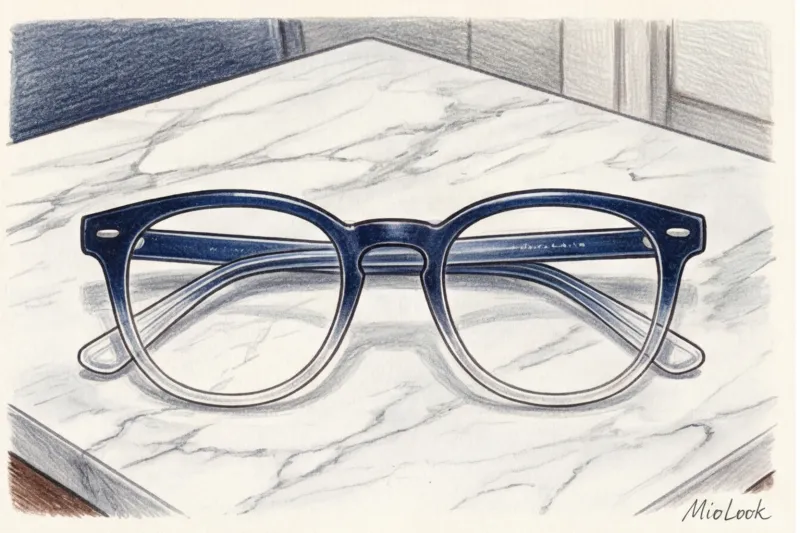
Why does it work? The sheer bottom literally melts into the skin, without emphasizing the line down the middle of the cheek or drawing attention to the sides of the nose. All the emphasis moves upward, toward the eyes.
The second rule: avoid solid black plastic if you have a low-contrast appearance. Tortoiseshell is a much more elegant choice. A mottled, uneven pattern with splashes of amber and brown breaks up the massiveness of the frame. If you're unsure which palette is right for you, the smart wardrobe feature in MioLook It's a great way to analyze contrast and choose harmonious accessories to complement your looks.
Your perfect look starts here
Join thousands of users who look flawless every day with the help of smart analysis from MioLook.
Get access — €0.99 onceFatal Mistakes: Which Frames Will Instantly Make Your Nose Look Bigger
A client once came to me, convinced her nose had gotten bigger with age. The problem turned out to be much more trivial: her glasses were constantly slipping down the middle of her nose due to loose nose pads. When glasses slide down, they leave a gap of skin between the brow and the frame. Your brain automatically adds this distance to your nose's length. An instant extra two centimeters!
Here are the top 4 fatal landing mistakes that should be avoided at all costs:
- Bridge too narrow (pinched). If the frame is too small across the bridge of the nose, it literally squeezes it. This makes the lower part of the nose appear puffy and twice as wide by contrast.
- Magnifying glass effect. Very light monolithic frames (white, light gray, powder) made of thick plastic on a contrasting face act as a magnifying glass, drawing maximum attention to the center of the face.
- The lower edge of the frame follows the wings of the nose. If the lens shape at the bottom has the same curve as your nostrils, you get a "double circle" effect that doubles the volume.
- The frame sits on the cheeks. Do your glasses rise when you smile? Then they're the wrong size and disrupt the overall architecture of your face.

Stylist Checklist: Checking the Fit of Glasses Before Buying
A good basic frame made of high-quality acetate (for example, from Mazzucchelli) will cost you between €100 and €250 these days. This is an investment in your face for the next couple of years. To avoid making a mistake at the optician's, take this short fit test.
- Smile test. Put on your glasses and smile broadly in front of the mirror. The bottom edge of the frames shouldn't touch your cheeks and should move upward.
- Profile verification. Ask the consultant to provide you with a hand mirror. Stand in profile. Your eye should be centered directly on the lens (or slightly closer to the bridge of your nose), and the temple should not press against your temple.
- Tilt test. Tilt your head down and shake it slightly. If your glasses slide down the tip of your nose, the frames are too big or require tighter adjustment of the nose pads.
- Eyebrow sync. The top line of the frames should either follow the curve of your eyebrow or sit slightly lower. The glasses shouldn't cross the middle of your eyebrow.
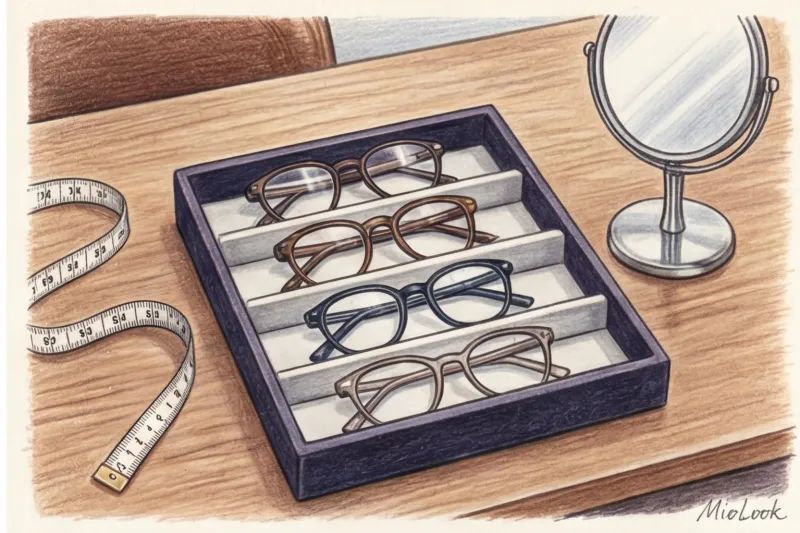
Finding the perfect glasses isn't a matter of luck, but rather knowing your proportions. Stop trying to "hide" your nose behind shapeless masks. Instead, use the mathematics of line and color: choose a keyhole bridge shape, add the right gradient, and pay attention to the temple width. Once you find the right DBL frames, you'll see a completely different, harmonious, and aristocratic profile in the mirror.