
Did you know that when you make eye contact, your glasses frames take up about 70% of your portrait area? The shape is certainly important—it adjusts your proportions. We covered this in more detail in our a complete guide to choosing glasses for your face shape But it's the color that decides whether you'll look rested after a sleepless night, or whether your dark circles under your eyes will become the main accent of your look.

For decades, many women have been buying black frames, believing them to be a "universal staple." As a practicing stylist, I see the consequences of this myth every day. For 60% of women with European complexions, a heavy black face is a death sentence. It creates a "heavy gaze," accentuates nasolabial folds, and visually ages you. If you want to know how to choose the color of your eyeglass frames so they work like an expensive concealer, we'll have to forget the old rules and treat your face like a canvas.
Geometry or color? Why the old rules of color types no longer apply
Over 14 years of working with clients' wardrobes, I've completely abandoned the classical theory of color types. The rigid division into "Winter, Spring, Summer, and Fall" only complicates life when choosing glasses. You stand in the optician's office, trying to remember whether you're a "Soft," "Summer," or "Cool," and end up panicking and picking up that notorious black frame.
According to the analytical agency WGSN (2024/2025 Eyewear Trends Report), the main trend is moving away from templates in favor of individualization. The focus has shifted to colored, transparent acetate that adapts to skin tone. Today, professional colorists and stylists use only two modern criteria: contrast level And external temperature.
You no longer need to memorize lists of "approved" shades. Simply understand the contrast between your own facial features.
How to choose the right eyeglass frame color based on your face's contrast level
Contrast is the difference in saturation between the colors of your skin, hair, and eyes. A golden rule of eyewear that sales associates rarely mention: the frame should not be more contrasting than your eyebrows and eyelashes Otherwise, your interlocutor will see your glasses, not you.
I have a great practical tip: Take a makeup-free selfie in daylight right now and apply a black-and-white filter on your smartphone.

If your hair, eyes, and skin blend into a single light gray in a photo, you have low contrast. If your skin is paper white and your hair and eyes look almost black, you have high contrast. Disclaimer: This test may fail if you have severe rosacea or couperose—red cheeks will appear as dark spots in the black and white filter, artificially increasing the contrast.
Low contrast (light hair, light eyes, light brown shades)
For the Slavic appearance type (light brown hair, fair skin, gray or green eyes), dark, heavy frames are the worst enemy. It creates the effect of "the glasses just sit there." The face disappears against the massive plastic frame.

Your best bet is a translucent acetate. Consider shades of champagne, powdery pink, light olive, or subtle matte gold metallics. They create structure without overpowering your natural softness.
High contrast (dark hair, bright eyes, porcelain or dark skin)
Here, the situation is reversed. Today's ultra-fashionable, completely transparent frames will simply "disappear" on a high-contrast face, making the facial features dull and pale. A face with strong, natural dynamism requires a frame that can support this dynamism.
Ideal options: rich emerald, deep ruby, tortoiseshell pattern with a predominance of dark, bright metal or that same dense black (you are one of the few who really suits it).
Access to MioLook for €0.99 — one-time payment
A smart AI stylist will select the perfect look based on your glasses and skin tone in just a couple of clicks.
Get access — €0.99 onceAppearance Temperature: Warm vs. Cool Hair Tones
The second step is to determine the temperature. Your skin tone and, more importantly, your hair color (ash blonde vs. honey) dictate the frame's temperature.
Recently, a client with a luxurious head of warm red hair and lovely freckles came to me. She stubbornly tried to wear cool silver metal frames because "the internet said metal goes with everything." The temperature clash made the skin around her eyes look sickly yellowish. As soon as we swapped the silver for warm copper, her face instantly brightened.

- Warm shades: Gold, copper, classic tortoiseshell, peach, caramel, and warm brown. This is a perfect choice for redheads, those with chestnut-colored hair with golden highlights, and honey blondes.
- Cool shades: Silver, gunmetal (graphite), icy blue, plum, and cool pink. They work perfectly with ash blondes, sultry brunettes, and those with prematurely gray hair.
The Magic of Eye Color: Choosing Frames Based on Complementarity
Eyeglass frames are the only accessory that sits millimeters from your eyes. This is where basic color theory comes into play, specifically Johannes Itten's color wheel. The scientific rationale is simple: complementary colors (those opposite each other on the wheel) visually enhance and intensify each other.
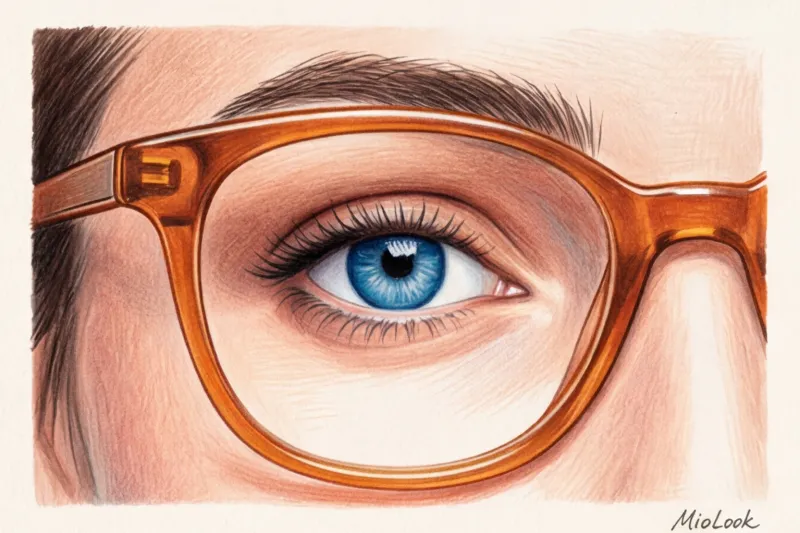
"If you want the person you're talking to to look you straight in the eye, don't choose frames that match your iris. Opt for contrast."
For blue and gray eyes: Forget blue frames—they'll make your eyes look watery. Your secret tool is warm brown, copper, and orange-tortoiseshell frames. Against the orange undertone, blue irises literally glow.
For brown and green eyes: Your complementary colors are deep navy, violet, eggplant, or burgundy. The blue frame next to brown eyes creates a very deep, elegant, and luxurious contrast.
Your perfect look starts here
Join thousands of users who look flawless every day with MioLook. Upload your photos, and the AI will assemble a capsule.
Get access — €0.99 onceBlack Isn't Universal: 5 Stylish Alternatives to Basic Frames
Let's get back to the main problem. I had a client, Anna, a department manager. At work, she wore black plastic frames that cast harsh shadows on her cheekbones, exacerbating morning puffiness. We replaced them with olive-colored translucent acetate glasses from COS for €89, and her colleagues started asking if she was back from vacation. That's the magic of the right color.
You don't have to buy a €400 luxury shade to get a beautiful shade. European mid-market brands (COS, Massimo Dutti, & Other Stories) offer luxurious acetate in the €60-120 range. Here are 5 truly basic alternatives to black:
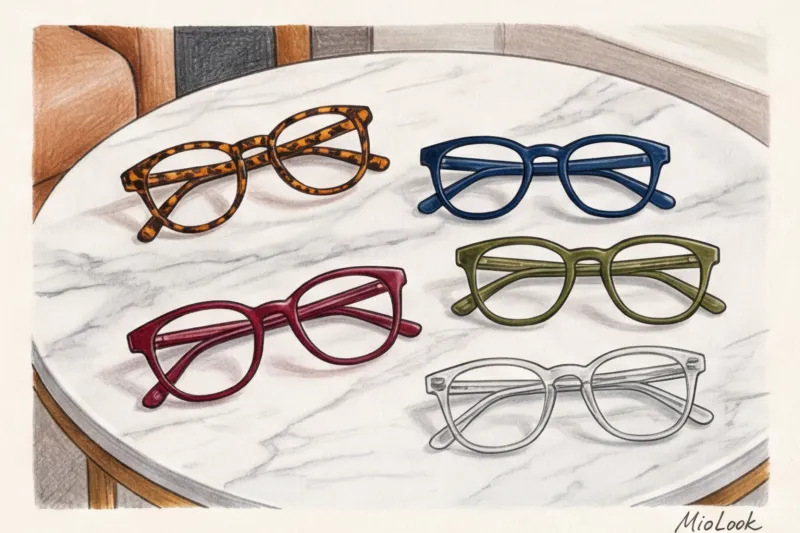
- Tortoiseshell: Suitable for 90% of women. Its mix of light and dark highlights adapts to almost any contrast and looks softer than black.
- Dark blue (Navy): It looks classy and formal (a great choice for business), but doesn't create a "mourning frame" around the eyes. I especially recommend looking for a matte navy shade.
- Olive / Khaki: A new base for light brown hair and green eyes. Olive acetate looks incredibly luxurious and pairs perfectly with wardrobe staples (beige, denim, white).
- Bordeaux / Wine: A lifesaver for pale skin, burgundy adds a subtle glow to the cheeks, creating the illusion of a natural flush.
- Smokey Grey Clear Acetate: An alternative for lovers of Scandinavian minimalism. It doesn't overwhelm the face, but creates clear boundaries.
Glasses as "lazy makeup": the secret to a fresh look on a morning Zoom call
How often have you connected to a video call from home without even putting on makeup? In my experience, colored frames (especially warm, reddish, or tortoiseshell tones) can visually "erase" up to 30% of the appearance of fatigue. The colored plastic acts as a reflector, highlighting the skin around the eyes and distracting from fine lines and dark circles.

But it's important to stick to the "one accent" rule. If you've chosen a striking ruby or emerald frame, keep your eye makeup minimal—a touch of mascara is enough. Lips can be enhanced with a lipstick that matches the frame's tone. For these work calls, it's best to choose basic tones—a white shirt or a gray cashmere sweater. The bold frames will do all the work for you.
Ready to get started?
Try the MioLook plan for free—no commitments required. Organize your smart wardrobe and plan looks with accessories.
Get access — €0.99 onceChecklist: 4 Steps to Check Color Before Buying Frames
To avoid spending €150–200 on glasses that will only be stored in a case, use my professional testing algorithm. Feel free to conduct these tests right at the optician's.
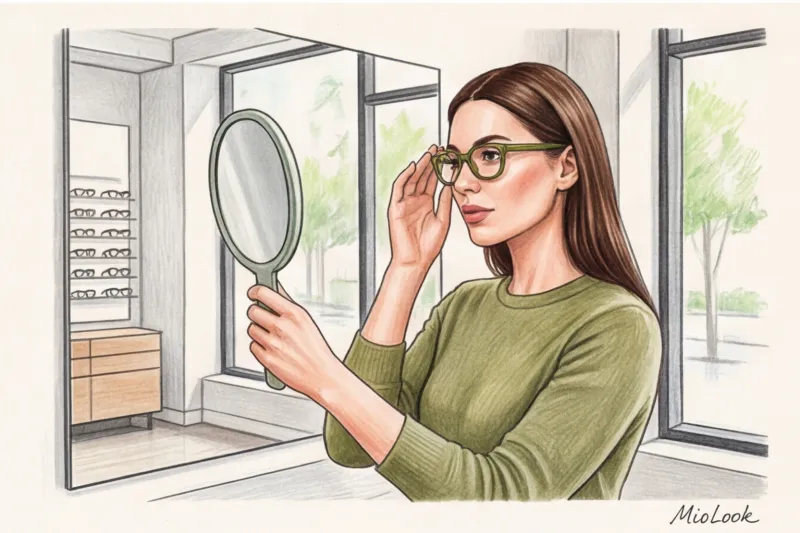
- Step 1: Check in daylight. The bulbs in optical stores often have a cool blue or aggressive yellow undertone. This distorts the color of the acetate. Be sure to take a mirror and go to a window.
- Step 2: Wardrobe test. Ask yourself: "Can I wear these glasses with my favorite beige trench coat, blue sweater, and white T-shirt?" If the frames pair with at least three basic items, go for it. To make things easier, you can pre-load your items into MioLook app and virtually imagine the capsule's color palette.
- Step 3: Check for the "panda effect". Put on the frames, stand under overhead lighting, and look directly into the mirror. Does the bottom edge of the frame cast a dark shadow on your cheekbones and under-eye circles? If so, the color is too intense for you.
- Step 4: Selfie test. We perceive ourselves in the mirror in a distorted way. Take a photo in the mirror (at chest level) and look at the image. This way, you'll appreciate the contrast between yourself and others.
The right frame color is like makeup you can wear every night. Don't be afraid to experiment with translucent acetate, try deep blue or warm tortoiseshell instead of the usual black. Give color a chance to work its magic on your appearance, and the results, in the form of daily compliments, won't be long in coming.