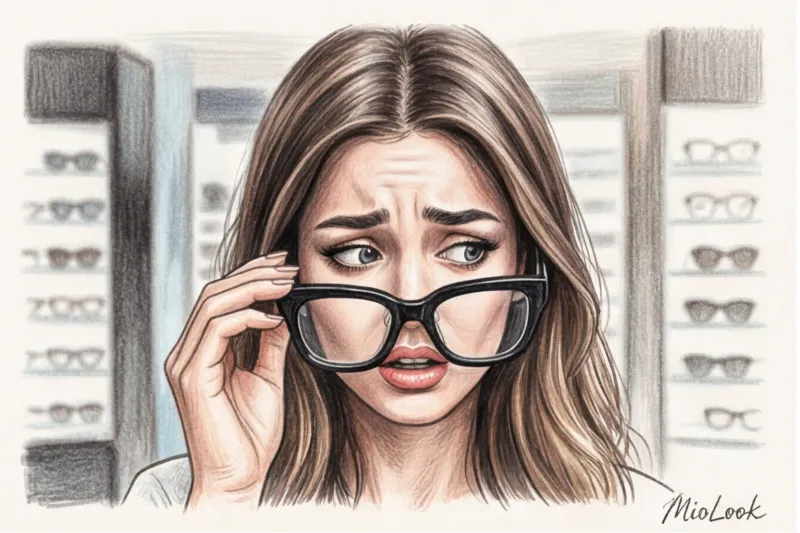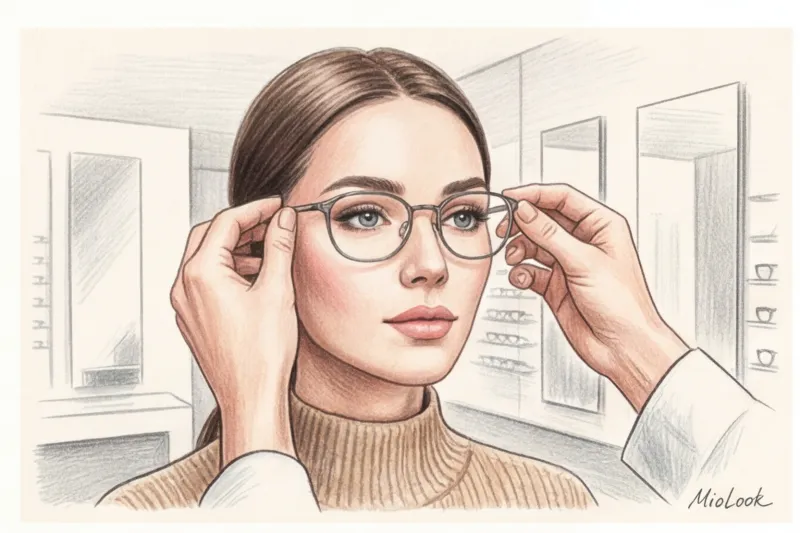
In my twelve years as a personal stylist, I've heard this phrase dozens of times: "Katarzyna, the consultant at the optician sighed and sent me to the children's department again." Petite women often feel like the fashion industry has simply forgotten they exist. Adult frames slide down their noses, cover their eyebrows, and make their faces look like a frightened lemur, while children's frames betray themselves with their infantile design and overly short temples.
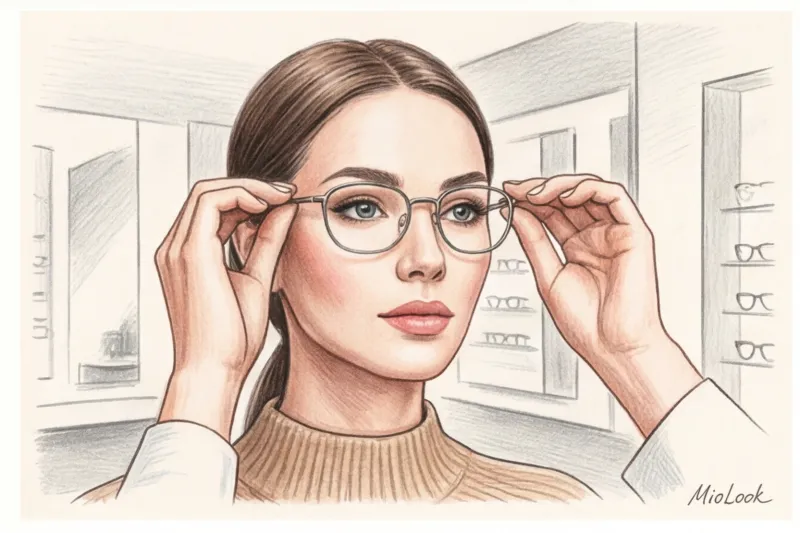
Let's be honest: finding the perfect glasses for a small narrow face — this is a challenge with a twist. The standard glossy advice from the 2000s, like "a round face requires a square frame," doesn't work here. Facial geometry is much more complex. We've already discussed the architectural approach and the rejection of outdated rules in more detail in our The Complete Guide to Choosing Glasses for Your Face Shape: A Modern Guide Today we'll go further and apply a purely engineering approach.
You'll no longer have to randomly browse through optical stands. I'll teach you how to read labels, understand micro-proportions, and choose an accessory that will highlight your sophistication, not hide it.
The Anatomy of a Perfect Fit: Why Glasses for a Small, Narrow Face Are About Math, Not Shape
According to international optometry standards (ISO 8624:2020), every quality frame has its own "passport." Look at the inside of the left temple (bow). You'll see a series of numbers, for example: 48-18-140 This is your key to a perfect fit, where millimetres matter.
- Lens width (first number, 45–50 mm): For a narrow face, it's critical to stay within 50mm. The ideal range is between 45mm and 48mm. A wider lens will inevitably create empty space on the sides of the eyes.
- Bridge width (second number, 15–18 mm): This is the distance between the lenses above your nose. If you have a thin bridge, look for a bridge of 15–16 mm. A 20 mm bridge will cause the glasses to simply fall onto your cheeks.
- Temple length (third digit, 135–140 mm): This is the characteristic that distinguishes adult frames from children's frames. Children's models typically have a temple length of 125–130 mm. On an adult, such a temple would begin to dig into the ears, causing headaches after just an hour of wear.
"The balance rule states that the overall width of the frame should not exceed the width of your face at the cheekbones by more than 2-3 millimeters on each side. If the gap is wider, the frame will visually narrow your face even further, throwing it out of proportion," notes the Vision Council (2023 report).
In practice, I always use the "two-finger test." Put on your glasses. If you can easily fit your index and middle fingers between the temple and the frame, the frames are too big. Period.
The Main Mistakes When Choosing Frames for a Narrow Face (and Why We Make Them)
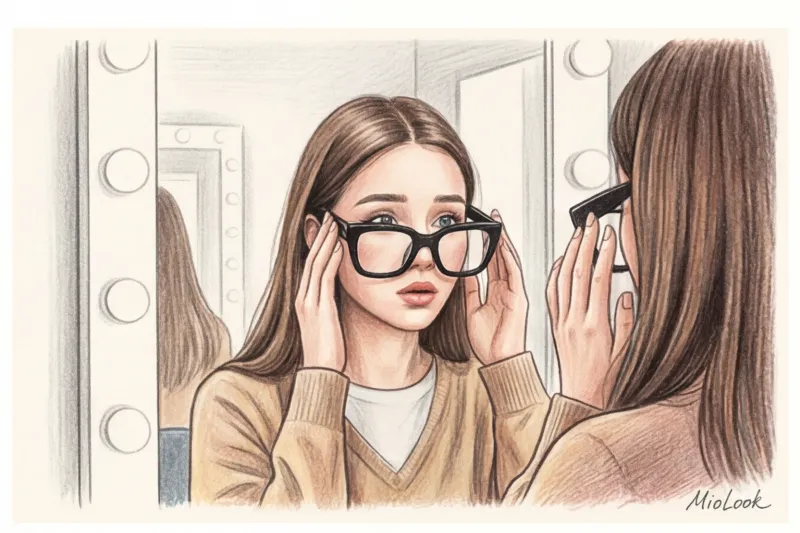
One of my clients, a marketer from Berlin, wore trendy, transparent, oversized glasses for five years. She complained that her colleagues were constantly asking if she was sick and sleeping well. The reason wasn't fatigue, but the optical illusion created by the poorly chosen frames.
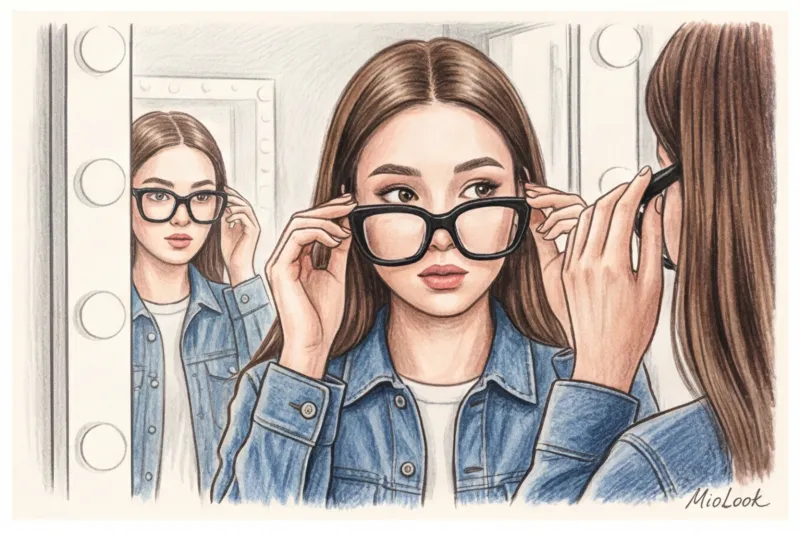
Let's look at the three main traps that those with petite faces fall into.
1. Blindly following the hyper-oversized trend
The myth is that oversized glasses make a face look prettier by emphasizing its fragility. The reality is harsher: on a narrow face, gigantic black frames made of thick acetate create an "insect eye" effect. The lower edge of the lens rests on the cheekbones, visually pulling the facial features downward. This instantly adds age and makes the face look tired. According to the analytical agency WGSN (2024), the era of total hyper-oversize glasses is already over, giving way to anatomical tailoring (custom fit).
2. The "Children's Department" Trap
Out of desperation, many people buy frames for teenagers. Yes, the lens width is just right. But, as we've already established, the temple length is a letdown. Furthermore, the designs in children's lines are always simplified: you won't find intricate tortoiseshell patterns, high-quality Japanese titanium, or elegant matte textures. This is detrimental to your image. If you want to know, How to look expensive: secrets of a status wardrobe are hidden precisely in adult, high-quality accessories.
3. The illusion of transparent frames
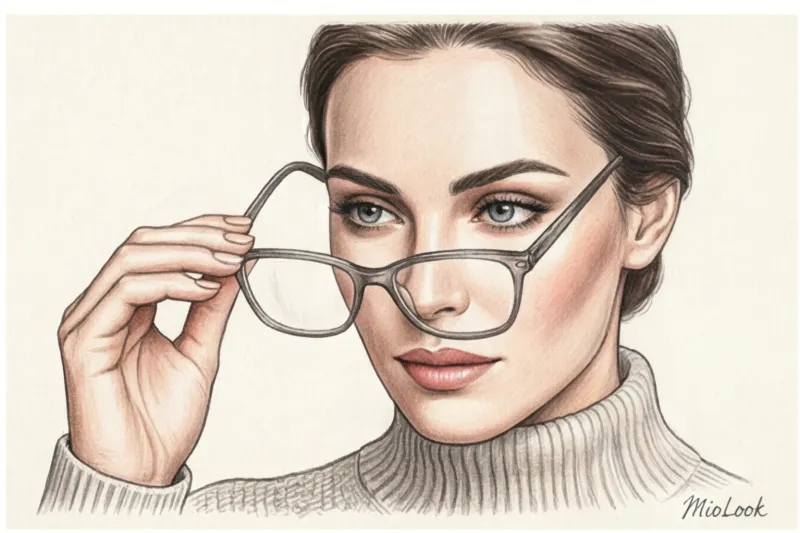
This is the most counterintuitive aspect. It's believed that completely transparent plastic doesn't overwhelm the face. But on pale, narrow skin, a transparent oversized model blends into the contours of the face and begins to look suspiciously like protective construction goggles. Instead of a lighter, more technical, sloppy look.
Unsure about choosing a frame?
Take a photo wearing your new glasses and upload the image to MioLook. Our smart AI stylist will analyze your facial proportions and suggest how well the accessory complements your style.
Get access — €0.99 onceWhich frames really work for petite faces?
During Copenhagen Fashion Week, I always notice Scandinavian women. Many of them have thin, elongated faces, but they masterfully wear statement eyewear. Their secret lies in the balance of weight and frame thickness.

Metal frames and thin acetate: a balance of weight
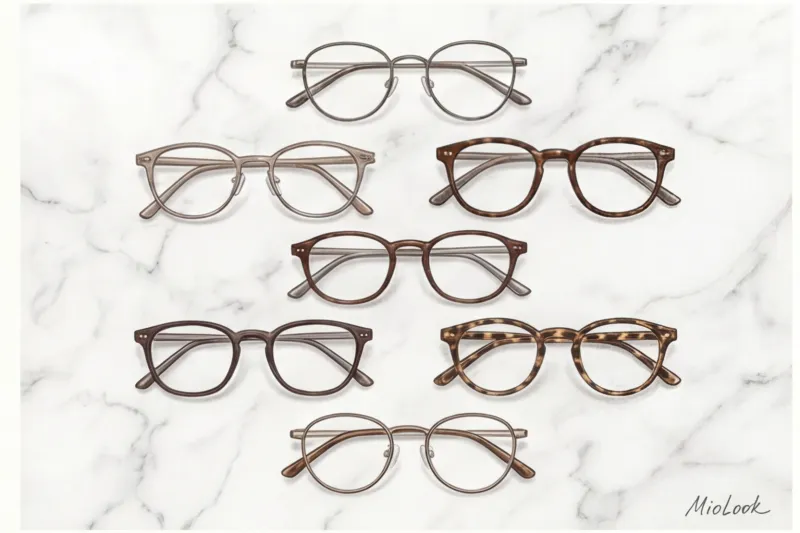
If your budget allows, invest in ultra-thin, high-density acetate. It's stronger than regular plastic, allowing for a slimmer frame without sacrificing durability. Premium frames cost between €150 and €300, but excellent high-density acetate models can now be found from independent European brands for €80–€120. Metal also works well, especially matte graphite or satin gold—they don't glare and look elegant.
Cat-eye: lifting effect without weighing down
This is the perfect choice for a narrow face. The upward and sideways elongation of the outer corners creates horizontal movement. They visually widen the cheekbones slightly and provide an immediate lifting effect. The key is to pay attention to the angle. Overly aggressive, sharp corners, reminiscent of the 1950s, will make you look like a retro caricature. Opt for a soft, subtle lift.

Panto and the Soft Square: Modern Classics
The panto (a shape slightly flattened at the top and rounded at the bottom) is a boon for faces with fine features. It complements the architecture of the cheekbones. If you're looking to add a more formal and formal look for business meetings, choose a soft square with rounded corners. The strict, sharp rectangle that stylists favored fifteen years ago looks harsh and outdated today.
Focus on Color: How Frame Shade Visually Changes Proportions
The frame color acts as a contouring tool. A thick, stark black frame creates an optical black hole on a small face. It draws all the attention. People see your glasses first, and only then you.
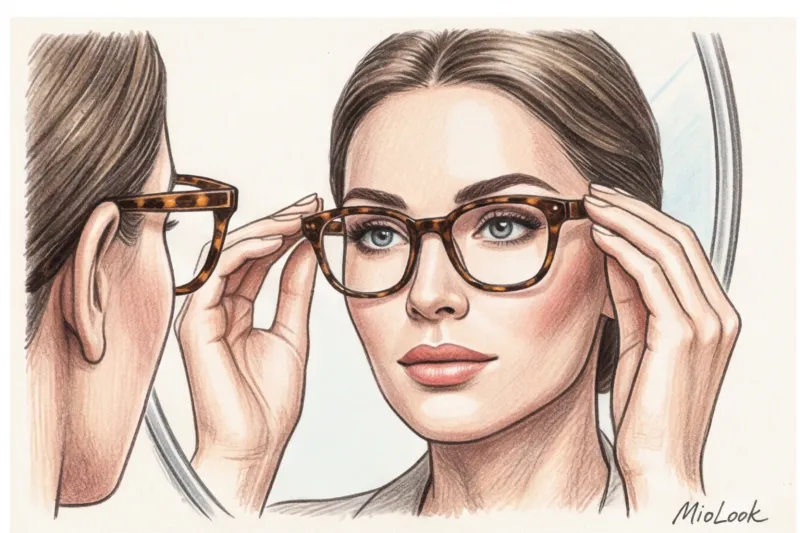
In its 2024–2025 color reports, the Pantone Color Institute emphasizes the importance of natural, complex hues. Replace black with dark Havana (tortoiseshell with caramel highlights), deep burgundy, or pine green. These colors create the necessary contrast, flattering a narrow face without appearing overwhelming.
A secret trick of personal shoppers: gradient frames (dark at the top and gradually lighter towards the bottom). The dark top accentuates the brow line, while the light bottom blends into the cheeks without weighing down the lower half of the face. This is a brilliant solution for those who want to wear expressive glasses but are wary of the mask-like effect.
However, there is one honest limitation I must mention. If you have high myopia (-5 diopters and above), the lens will be quite thick at the edges. A thin metal frame simply won't hide this edge. In this case, a delicate yet dense dark acetate is your only stylish option.
Stylist Checklist: 5 Steps to Buying Glasses
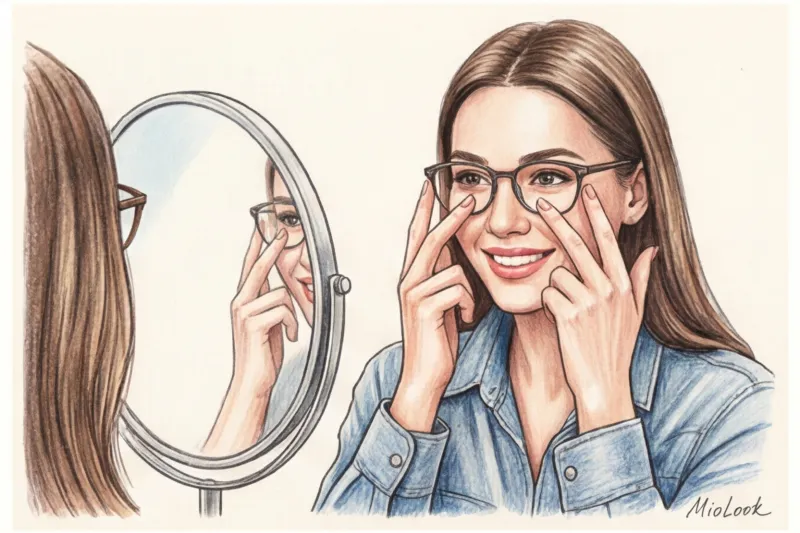
To avoid relying on the sales assistant's opinion, save this checklist and use it right in the fitting room.
- Eyebrow test: The top line of the frame should match the arch of your brow. Ideally, glasses should be parallel to your brow or cover no more than a third of it. If glasses completely cover your brow, your face will lose its expression.
- Smile test: Smile broadly. If your glasses bounce as they rest on your cheeks, the bridge is too wide or the lens shape is too deep. This may look fine when you're standing still, but it can be annoying when you're talking.
- Centering test: Look straight ahead in the mirror. Your pupil should be exactly in the center of the lens horizontally and slightly above the center vertically. Eyes that are drawn toward the bridge of your nose (squinting) are a sure sign that your frames are too big.
- Temple test: Check the temple pressure. They shouldn't press into your temples, leaving red marks, but they shouldn't stick out more than a centimeter from your head.
- Tilt test (pantoscopic angle): The bottom of the frame should be slightly closer to your cheeks than the top of the frame is to your forehead. The correct angle is between 8 and 12 degrees. If the glasses are positioned strictly vertically or tilted forward, this will distort your vision and ruin your profile.
Organize your accessories
Add your sunglasses, scarves, and jewelry to the MioLook smart wardrobe. Create ready-to-wear looks for every day in one click and save time in the morning.
Get access — €0.99 onceSummary: How to Make Glasses Your Ultimate Status Accessory

Glasses aren't just a medical device. They're your personal PR manager, front and center in your portrait zone 100% of the time. The right size is the foundation without which even the most expensive look will fall apart. As a stylist who works with business wardrobes, I explored this phenomenon in detail in an article. "Expert Image: A Wardrobe for Your Personal Brand".
Instead of spending years searching for "those one and only" glasses, try building a mini-wardrobe. Two or three quality frames: a sleek metal panto for work meetings, a delicate acetate cat-eye for casual looks, and perhaps one statement piece in a wine shade. If you want to delve deeper, be sure to read our article. "Status Accessories: What Marks a Successful Expert".
Your key insight for today: stop focusing solely on shape. Arm yourself with millimeters, look for markings on the temples, and remember: frames should frame your face, not dominate it.