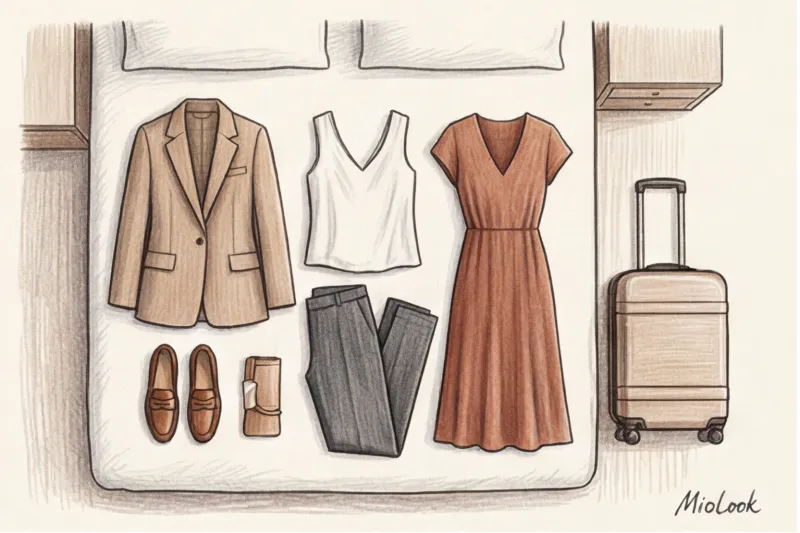
What is a microcapsule clothing and why is it more than just a vacation wardrobe?
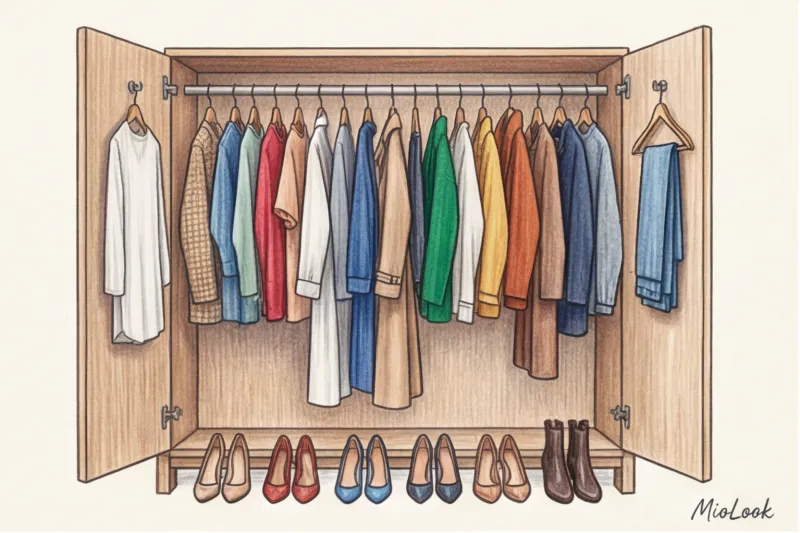
Have you ever noticed how every morning you reach for the same pair of jeans and trusty jacket, even though your closet doors are barely closing? Statistically, the classic Pareto principle works flawlessly in your wardrobe: we wear only 20% of our clothes 80% of the time. The rest is visual noise, stealing time and energy in the morning. That's why a full closet, but nothing to wear — is one of the most common complaints from my clients. And the solution lies not in endless decluttering, but in a concept called clothing microcapsule.
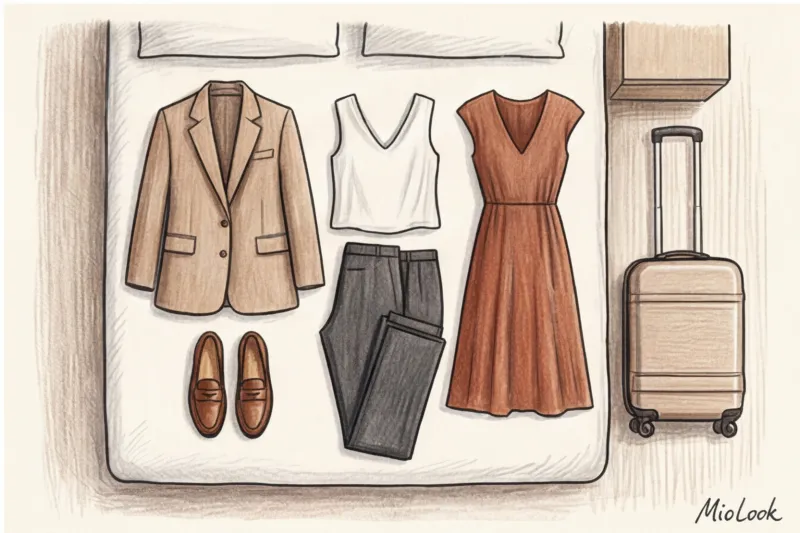
How does it differ from a traditional capsule wardrobe? A classic capsule wardrobe (like the popular international Project 333 challenge) typically consists of 20–37 items for an entire season. This is a complete base. A microcapsule wardrobe, on the other hand, is a radical, ultra-short format. Strictly 5 to 10 items, including shoes, form your 100% work zone for the coming week, a short trip, or a specific life task.
The "fashion detox" trend is rapidly gaining momentum in styling today. People make approximately 35,000 different decisions daily. Decision fatigue is a scientifically proven fact. Dilemmas in front of the mirror drain precious cognitive resources that could be useful at work.
Micro-format reduces morning stress to zero. No more frantically trying to figure out whether that voluminous skirt will balance out that fitted blouse. With just seven well-chosen pieces, they're guaranteed to go together. You can pick two pieces and look flawless.
But the main advantage of the mini-format lies elsewhere. Over 12 years of practice, I've come to the conclusion that a microcapsule is the best and safest testing ground for stylistic experiments.
Let's say you've always worn exclusively neutral tones (beige, gray, black), but suddenly want to add a pop of color. Or you've decided to test a complex complementary scheme (for example, pairing terracotta with deep indigo). Buying a whole new wardrobe at once with a bill of €500 to €1,000 is a huge risk. There's a high chance the items will remain hanging with the tags. But putting together a capsule wardrobe of just 6-7 items and living in it for a work week is the perfect test drive. You'll get a feel for how comfortable you feel in the new silhouettes and how the colors react to your skin tone in different lighting, and only then will you move on to a full-scale shopping spree.
Anatomy of the Ideal Microcapsule: The 'Bottoms-Uppers-Ligaments' Formula
Ask any woman where she begins packing her suitcase for the weekend or planning her outfits for the workweek. Nine times out of ten, the answer will be, "Choosing pants or a skirt." It seems logical, but from the perspective of proper image-building, it's a fatal mistake. A true, work-ready microcapsule of clothing is always built from the bottom up—starting with shoes.
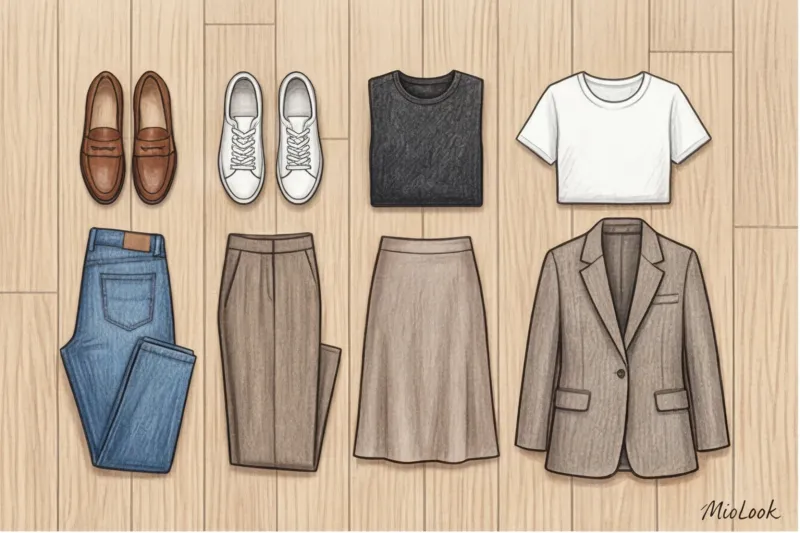
Why are shoes the foundation? They dictate proportions, hem length, and the overall level of formality. You can't wear flowing palazzo pants with chunky-soled sneakers if you originally planned to pair them with dainty pumps—their legs will simply drag along the ground. I always recommend building a foundation of one or two pairs of shoes with different moods. For example, structured leather loafers (good quality ones will cost between €120 and €180) and minimalist light-colored sneakers. We'll build the entire look around these two pairs.
Once the foundation is laid, the main mathematical rule of the stylist comes into force: ratio of 1 bottom to 2-3 tops.
The psychology of perception works in such a way that people around us primarily read and remember our body's profile—what's above our chest. You can wear the same perfectly fitting dark blue jeans three days in a row, and no one will notice. But if you show up in the same blouse three days in a row, it will be instantly remembered. That's why, for every pair of trousers or skirt in your capsule wardrobe, there should be at least two, and preferably three, tops (a T-shirt, a shirt, a light sweater).
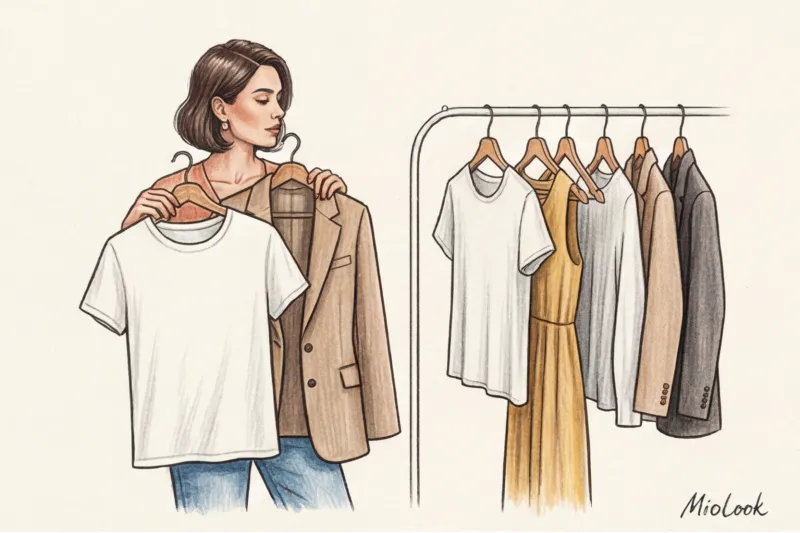
But simply picking up random tops and pants isn't enough. This is where the concept comes into play. bridging piece As a colorist, I often see a problem: a client buys emerald pants and a terracotta sweater. Individually, they're beautiful pieces, but together, they create a visual clash. The tie-in piece is the element that unites disparate colors and textures into a harmonious whole.
A tweed jacket with both green and red threads in its weave could serve as this bridge. It could be a silk scarf with a print that replicates both shades, or even a pinstriped shirt. Without a "linking piece," your microcapsule will disintegrate into separate, disconnected blocks.
In a professional environment we use a hard filter - The Rule of Three Stylistic Vectors Before adding an item to your mini-wardrobe, ask yourself: "Will I be able to wear this to work, on a long walk, and for an evening out, changing only the shoes and accessories?" If the answer is "no" to even one point, leave the item at home.
Take, for example, a basic satin midi skirt (excellent basic options from COS or Massimo Dutti cost around €80-100). Vector one (work): wear it with a voluminous jacket and loafers. Vector two (outing): pair it with a thick oversized hoodie and sneakers. Vector three (evening): add a silk top with thin straps, statement earrings, and bright lipstick.
The Mathematics of Imagery: How 7 Items Transform into 14 Outfits
Many people think seven items is critically few. Let's use some simple combinatorics. Imagine your wardrobe includes two bottoms (jeans and a skirt), three tops (a white shirt, a basic T-shirt, and a silk long-sleeve), and two layers (a jacket and a voluminous cardigan). That's seven pieces total.
Even just multiplying the bottoms by the tops gives us six completely different basic outfits (2 x 3). But the secret to an endless wardrobe is layering. Wearing a shirt unbuttoned over a T-shirt is the seventh look. Wearing a cardigan over a shirt is the eighth. Wearing a cardigan as a standalone top (worn barefoot with a skirt) is the ninth. Throwing a jacket over a long sleeve top is the tenth.
Layering works as a multiplier. A thin merino wool turtleneck (around €40 in a mass-market store), worn under a classic cotton shirt, not only protects against temperature fluctuations but also creates a complex, sophisticated silhouette.
Accessories provide the final transformation. Belts, structured bags, chunky metal jewelry, and scarves take up exactly zero space in your luggage or closet, yet they can completely alter the DNA of an outfit, transforming daytime casual into evening chic in a matter of minutes.
Create your capsule in one click
Upload a photo of your items, and MioLook's smart AI stylist will show you all the possible combinations you never even thought of. Fewer items, more stylish looks.
Get access — €0.99 onceThe main myth: 'Microcapsule clothing should be boring and neutral'
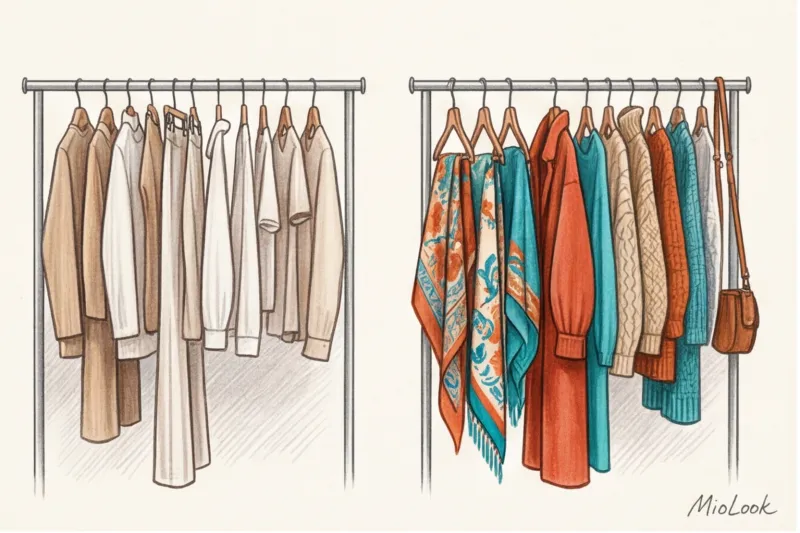
Open Pinterest or any social media site and search for "microcapsule wardrobe," and the algorithm will inevitably return an endless stream of beige trench coats, gray cashmere sweaters, and black trousers. This has given rise to the most persistent and destructive fashion illusion: that versatility is achieved solely by eliminating color. Many women sincerely believe that if they add bright colors to their mini-wardrobe, their outfits will instantly become uncoordinated.
I regularly encounter this fear in my personal coloristics sessions. But let's be honest: wearing only a "safe" achromatic base is a sure path to stylistic apathy. Moreover, all-black or classic beige don't suit every complexion. True versatility is built not on the absence of color, but on the rigorous mathematics of its combinations.
In a limited format of 7-10 pieces, two classic color theory schemes work flawlessly: analogous and split-complementary.
- Analog circuit — is the use of three shades side by side on Itten's color wheel. Imagine a palette of deep navy, azure, and cool pine green. All items in this palette will flow seamlessly into one another. You get a luxurious, refined look without harsh contrasts, which is much more sophisticated than a standard black-and-white outfit.
- Split-complementary scheme Created for those who crave dynamism, we take one base color and add two shades that lie opposite it on the color wheel. A classic and very elegant example: a rich dark brown base (replacing black) paired with muted blue and soft lilac. It looks unconventional, but it creates a complete outfit in a flash.
But what if your personal style calls for drama and you adore pure, punchy colors? How do you incorporate, say, a rich fuchsia or a deep emerald into your capsule collection without it looking out of place?
The secret lies in the technique that we in the professional community call color bridge The most common mistake when adding a bright accent is buying a fuchsia jacket and hoping it will liven up basic graphite trousers on its own. Without visual support, the jacket will look like you borrowed it from a friend for an evening out.
For a bold accent to work, it needs a physical connection to the base. The ideal "color bridge" is a printed piece whose design combines both your calm background shade and that bold, vibrant color.
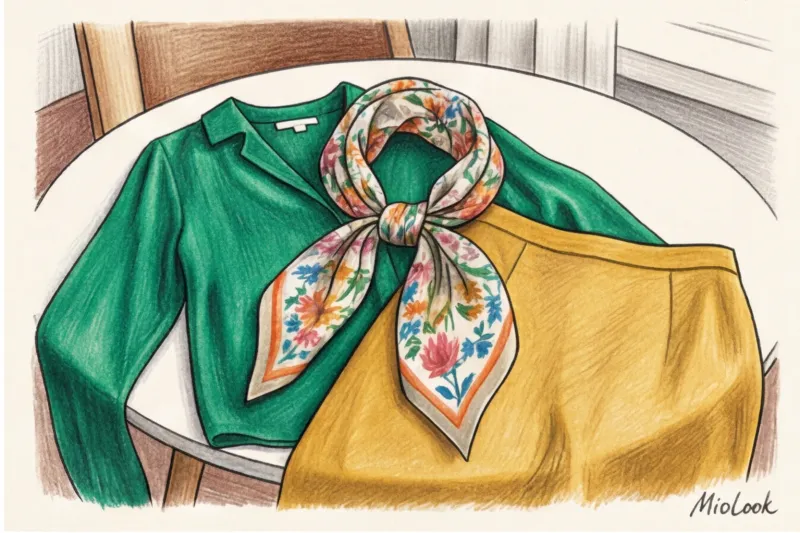
Imagine a work microcapsule, with a base of camel (sand) and navy blue, and a starring accent of emerald. To combine a sand-colored midi skirt and an emerald silk top, you'll need a connecting element. This could be a scarf, a tweed vest with a mix of threads, or even a bag with a geometric pattern featuring both camel and emerald. This small but strategically important element literally "explains" to our eyes why such disparate colors are included in the same ensemble.
Moreover, even embroidery or fabric texture (for example, melange) can serve as a color bridge. If you have trouble assessing the harmony of shades by eye, try digitizing your items: upload a photo of a printed blouse and bright trousers to MioLook The AI stylist will analyze the micro-shades in a print and instantly show how well they match your accent color, creating the perfect combination without the hassle of trying them on.
Remember: color doesn't make your wardrobe complicated if you know how to create the right balance between shades. A palette with one bold accent makes your everyday looks memorable and eliminates the feeling of wearing a bland "uniform."
Putting together a microcapsule for the work week (Smart Casual)
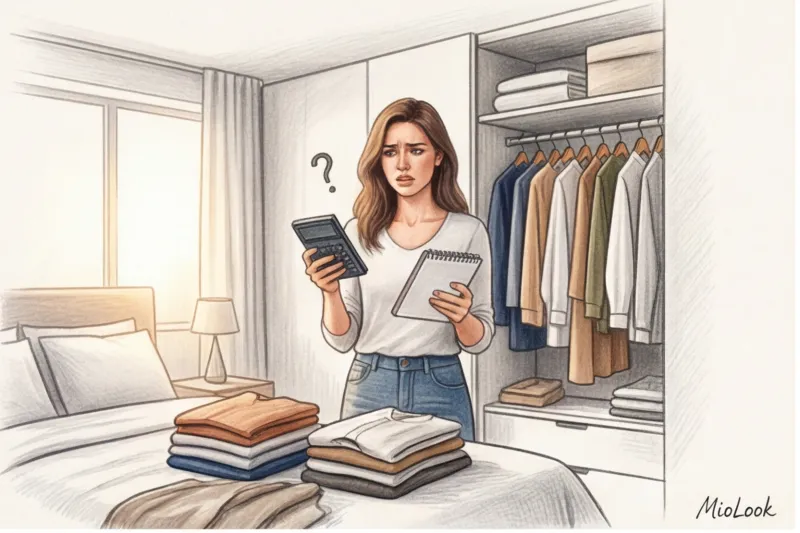
One of my clients, a top manager at an IT corporation, once came in for a consultation with a typical problem. Her morning routine before heading to the office took at least 40 minutes to try on clothes, and by Friday, her imagination was completely exhausted. We solved this problem by implementing rigorous wardrobe math, where the clothing microcapsule functions like a fail-safe algorithm.
We had a clear task: 5 working days - 5 different looks without repetitions At the same time, the outfits had to comply with the modern smart casual dress code, which requires a masterful balance between authority and comfort.
Let's look at an example of an ideal list of 7 things for a productive office week:
- Structured high waist palazzo pants;
- Midi skirt (ideally A-line or bias-cut);
- 3 shirts or blouses of different cuts (for example: a formal men's shirt, a flowing silk blouse and a cotton model with a thin stripe);
- 1 architectural jacket with a clear shoulder line;
- 1 knitted vest made of thick merino wool.
As a colorist, I'd like to add an important touch: to prevent these pieces from blending into a dull monochrome blob, make the vest and one of the blouses the focal points. Keep the suit elements basic (good trousers and a jacket can currently be found for €100-€150), and let the vest take on the role of an accent—choose a deep emerald, sapphire, or complex wine shade.
The physicality of the fabric is critical here. According to the unspoken rule of business dress code, neatness always trumps trendiness. We discussed the boundaries of corporate style in more detail in our article on business casual, but the main rule for a mini wardrobe is as follows: choose wrinkle-resistant fabrics A 100% linen item, no matter how high-end (even a €300 designer brand), will fall apart on the way to the office. Consider high-tech blends: high-quality viscose with added polyester (up to 30%), dense Tencel, modal, or triacetate. They remain in perfect condition even after eight hours in your work chair.
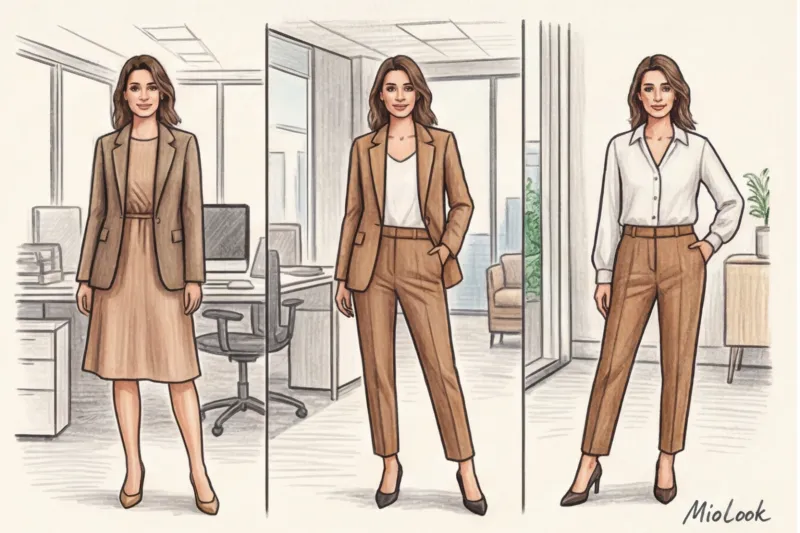
The beauty of this set lies in its flexibility. How do you adapt the level of rigor from a morning meeting to an evening networking session? Only by juggling layers.
In the morning, when you have a project presentation or an important meeting ahead of you, you put on palazzo pants, a white button-down shirt, and a jacket. The silhouette, with its accentuated shoulder line, subconsciously conveys control and discipline—a classic trope in the psychology of perception. But when heading out for an informal networking event with partners after 6:00 PM, you simply leave the jacket on the back of your office chair. You unbutton the top button of your shirt and slip on a knit vest over it. The formality is instantly reduced, and your look becomes more inviting and relaxed, without straying beyond the bounds of professional etiquette.
You don't need a huge closet to look different. You need pieces that can "speak" to each other using the same language of texture and proportions.
To avoid having to keep all 5 combinations in your head the night before a busy week, I recommend digitizing these items. After uploading your set to MioLook , you will be able to visually plan each day and forget about the phrase “I have nothing to wear to the office” forever.
Access to MioLook for €0.99 — one-time payment
Start creating perfect images with the help of artificial intelligence
Get access — €0.99 onceWeekend Microcapsule: Packing in your carry-on
Today, baggage allowances on European low-cost airlines often exceed the cost of the ticket itself. Purchasing a separate baggage allowance for €80–€120 just to buy a couple of sweaters for the weekend is completely irrational. The strict 40x30x20 cm limit set by airlines for free carry-on baggage (equivalent to a typical city backpack) seems like a death sentence for a stylish vacation. Many believe that only sweatpants and a toothbrush can fit in such a space. But this is where microcapsules of clothing truly reveal their potential.
Recently, my client Anna was embarking on an intensive four-day trip to Europe. Her goal was ambitious: fly with only a small backpack, without a single kilogram of excess baggage, yet feel confident in restaurants and excursions. In her photos from the trip, Anna looked as if she had a full suitcase. The trick was carefully chosen tops. Her backpack contained only a dressy silk blouse, a basic cotton long-sleeve, a statement cardigan, and a printed T-shirt. Her bottoms—a pair of thick jeans and a flowing skirt—remained the same. But since people primarily focus on the portrait area in photographs, and even in person, this created the illusion of a vast and varied wardrobe.
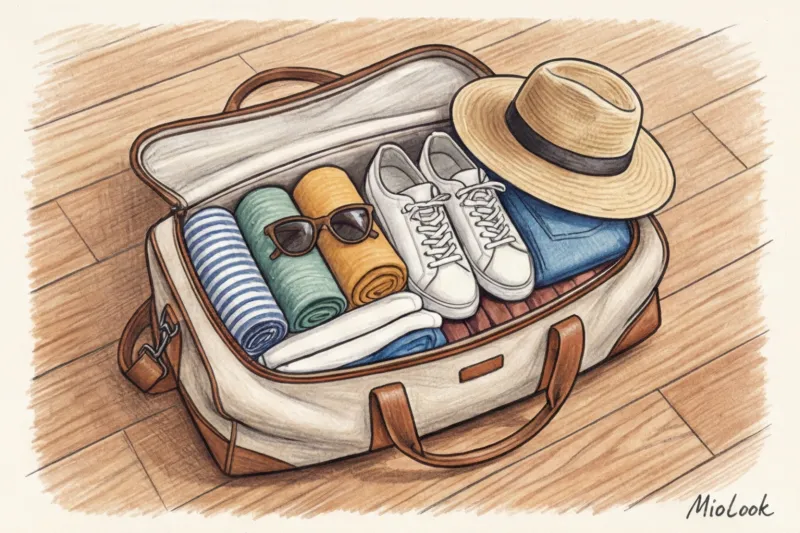
To fit everything you need for 3-4 days into such modest dimensions, we used an indestructible "the rule of the bulkiest thing" The logic behind this technique is ingenious in its simplicity: you put everything that takes up the most space on the plane or train. If your microcapsule includes chunky leather boots, a bulky hoodie, a heavy trench coat, or heavy jeans, they all go on top. This approach instantly frees up to 60% of the usable space in your bag. Only compact, tightly rolled items should be included in your carry-on: lightweight T-shirts, thin knitwear, underwear, and a travel cosmetic bag.
The texture of the fabric is crucial for a travel microcapsule. Save linen, pure viscose, and thin cotton for large suitcases—they'll inevitably turn into a wrinkled nightmare in a tightly packed backpack, and you definitely don't want to waste time searching for an iron on vacation. The ideal textures for short trips are high-quality knits and heavy denim.
Jeans with 2-3% elastane won't stretch out at the knees after a long flight and sitting in the airport. As for knitwear, I highly recommend choosing merino wool. Merino has unique properties—it's virtually odor-resistant, wrinkle-resistant, and regulates body temperature perfectly. A chunky knit cardigan paired with high-quality denim works like a versatile suit: stylish, comfortable, and extremely practical.
City Break vs. Outdoor Recreation
Often, a weekend trip isn't limited to a single scenario. Imagine this: on Saturday, you plan to leisurely stroll along the cobblestones of the old town, visiting museums and sipping coffee on terraces, and on Sunday, you head out of town to explore forest trails or stroll along the windy coast. You don't need two different microcapsules. The magic of stylistic adaptation lies solely in the swapping of peripheral elements. A difference in footwear and outerwear makes all the difference.
Your basics can remain the same: for example, the same straight jeans and a thick cashmere or merino sweater. For the format city break (Urban tourism) complement this basic look with a structured crossbody bag, which visually ties together the relaxed look and adds geometric detail. On your feet, wear elegant loafers or neat ankle boots, and top it off with a classic trench coat or wool jacket. You'll look appropriate even in an upscale restaurant.
The next day, heading out into nature, you swap your loafers for technical trekking sneakers with chunky soles. You swap your trench coat for a windproof storm jacket or a cropped down jacket, and replace your hard leather bag with a soft nylon backpack. The basics (sweater and jeans) haven't changed one iota, but the change in accessories completely changes the mood of your outfit.
Also, don't forget about layering, which is essential during sudden weather changes, which is typical for country trips. While a T-shirt and a sweater draped over your shoulders are sufficient in the city, in the countryside, the same sweater is worn over a long-sleeved shirt, and the jacket is zipped up tight. The same microcapsule, layered like a cabbage, provides you with thermal comfort and stylistic depth without adding extra weight.
It is for such multi-format trips that I recommend using MioLook You can digitize 5-7 items you plan to pack and pre-create outfits for both the city and the woods in the app. This allows you to clearly see that your single midi skirt looks equally good with hiking boots and elegant city shoes, eliminating any doubts when packing your backpack.
Mistakes When Building a Mini Wardrobe: What Will Ruin Your Wardrobe
A consumer behavior study published by Fashion Revolution in 2023 revealed a curious fact: over 60% of women regularly pack clothes on short trips or put them away for the workweek that they never wear. A theoretically perfect wardrobe microcapsule often crumbles in the harsh reality of three subtle styling flaws. Let's explore the pitfalls that turn functional wardrobe essentials into useless baggage.
Mistake 1: Sneaky "Single Things"
Many of us have that same luxurious sequin top or intricate asymmetrical skirt, bought on impulse at a sale for a mere €80. When putting together a mini-wardrobe, we stubbornly try to squeeze this statement piece into a basic outfit, hoping it will be the one that makes the look more interesting. The problem is that this "single item" dictates too many rigid rules: it requires specific footwear, a specific cut of underwear, and visually pairs perfectly with just one bottom.
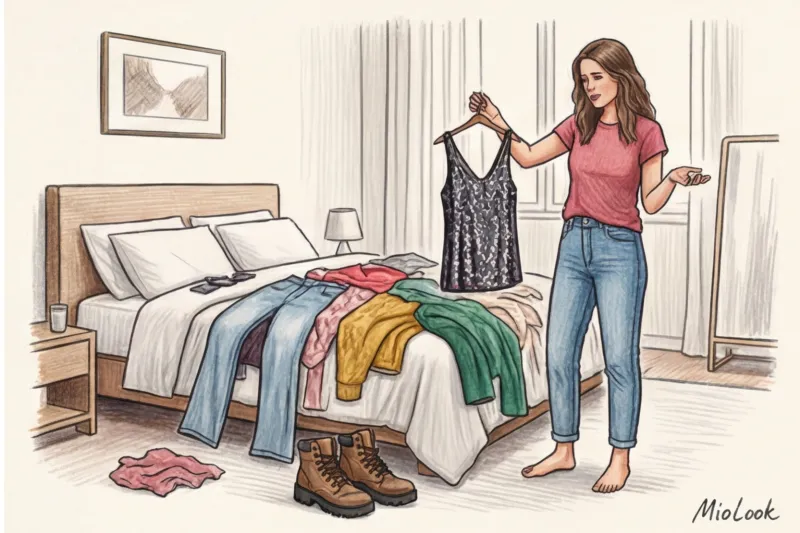
If an item can't be worn with at least three others in this microcapsule, ruthlessly remove it from the list.
Instead of universality, you get a stylistic anchor. To check the compatibility matrix in advance, I always recommend uploading the selected elements to MioLook — the algorithm will instantly highlight the “single” who does not create pairs.
Mistake 2: Too similar tops (cloning syndrome)
A typical scene: a girl carefully folds three identical basic T-shirts in different colors—white, gray, and powder blue. They appear to be three different options, but in practice, the silhouette remains the same. People around you read shape faster than color, so all three looks will be stylistically identical.
Instead of cloning identical styles, focus on contrasting textures and volumes. Swap three T-shirts for a diverse trio: a crisp, structured T-shirt, a flowing silk blouse, and a fitted ribbed long-sleeve top. Even paired with the same jeans, they'll create a completely different vibe—from relaxed casual to architecturally rigorous.
Your ideal image begins Here
Join thousands of users who look flawless every day with MioLook.
Get access — €0.99 onceMistake 3: Complex care and capricious fabrics
There's nothing more frustrating than taking something out of your suitcase (or off your chair in the morning) that looks like it's been chewed on. When choosing clothes for a short trip or a busy workweek, we often forget about the physics of fabrics.
Thin 100% linen, low-density viscose, or dry-clean-only items are your worst enemies. Hotels don't always have a good steamer, and spending 40 minutes ironing before heading to the office is a waste of time. Furthermore, if you spill coffee on a blouse that can't be hand-washed, you'll instantly lose 20% of the possible combinations in your capsule.
My advice: opt for blended materials. Heavyweight cotton with elastane, Tencel, cupro, or high-tech fabrics work great. These days, wrinkle-resistant fabrics are excellent. travel collections can be found at mid-range brands, from COS to Massimo Dutti, in the €70–€150 price range. They retain a presentable appearance even after a day of flights or meetings.
Checklist: How to test a microcapsule before launch
Do you know at what point a perfectly planned wardrobe microcapsule falls apart? Five minutes before leaving the house, when you suddenly realize the stiff collar of your shirt doesn't fit under the neckline of your jumper. According to a WGSN study (2024) on consumption habits, about 40% of so-called "nothing to wear" situations arise not from a lack of items, but from the fact that their compatibility has never been tested in practice.
To ensure your mini wardrobe works flawlessly, you need to test it. My background in design has taught me to test prototypes before launching a product, and I apply the same approach to my wardrobe. Here's a mandatory three-step checklist.
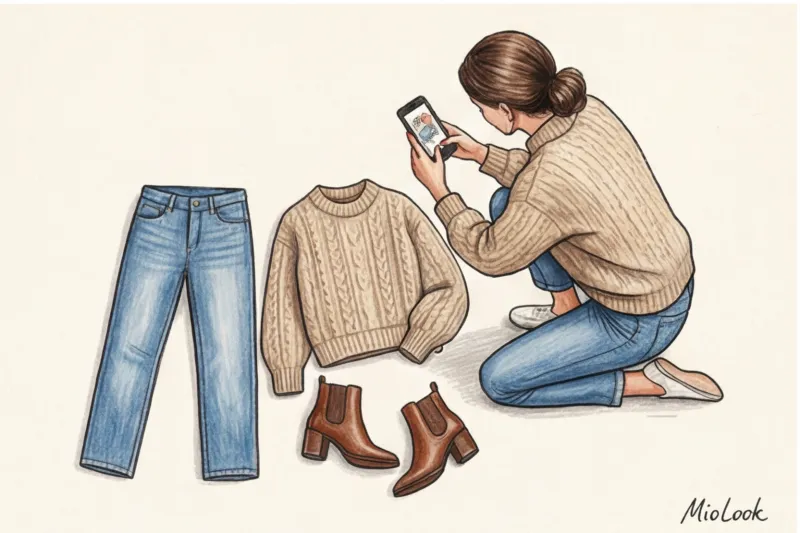
Step 1: Lay things out on the bed and take photos
This isn't just a nod to social media aesthetics, but a professional visual merchandising tool. Our brains tend to idealize objects in isolation. Lay out all your selected items horizontally and take a photo. The camera lens is devoid of emotion—you'll instantly notice if two prints clash or if the overall color scheme leans too dark.
Step 2: Try on each of the planned 5-10 looks
Never trust your imagination alone. A voluminous blouse that looked stunning paired with trousers on the bed might throw off your proportions and require a French tuck, which you might hate. Your goal is to physically try on all 5-10 combinations you've come up with. Button up, walk around the room, sit down. If a piece restricts your movement or requires constant tugging, it doesn't belong in your collection.
Step 3: Check the "temperature mode" and layers
I call this the "cabbage stress test." Can you wear everything together if it gets really cold? Check if the armholes of your base layer jacket allow you to layer a thick long-sleeved top underneath. Consider the physics of fabric friction: a silk top slides easily under a wool cardigan, but a cotton shirt can bunch up like a stiff accordion. Even expensive €200 cashmere will lose its luster if you feel constricted under a tight top layer.
Digital Fitting Room: How to Simplify the Task
Trying on a dozen outfits can be extremely physically exhausting. To save yourself the hassle of time-consuming outfit changes, I recommend moving the process digitally with MioLook The process is simple: you digitally capture seven items using your smartphone camera, and the AI stylist automatically generates ready-made looks. It's the perfect solution for visualization: the algorithm will automatically combine tops and bottoms, showing you unobvious combinations you might not have even considered, saving you a ton of energy before you start.
Microsteps to Great Style: Instead of a Conclusion
In 2004, psychologist Barry Schwartz published a seminal paper, "The Paradox of Choice," proving that the more options we have, the less satisfied we are with the final decision and the faster cognitive fatigue sets in. This law works reliably in our closets. Dozens of blouses vying for your attention steal valuable energy every morning. That's why a well-designed wardrobe microcapsule isn't just a way to quickly pack a suitcase; it's a powerful tool for transforming your personal style.
My background in painting and design has taught me one golden rule: the most brilliant creative solutions are born only under strict constraints. Treat this mini-wardrobe as an elite training ground for your stylistic acumen. When you only have a pair of pants and three tops at your disposal, you're physically deprived of the opportunity to hide behind the excuse "I'm just going to wear something new." You're forced to start see You notice how the smooth texture of the silk shirt contrasts with the rough wool of the jacket, how the casually rolled sleeves change the proportions of the silhouette, and how a single structured belt can save even the most relaxed look.
In a wardrobe, as in good architecture, emptiness plays no less a role than the object itself. By removing the unnecessary, we give the remaining items space to finally reveal their character.
I'm challenging you to a practical challenge. This coming Sunday, choose exactly seven items (excluding underwear, loungewear, and gym clothes) for the entire week. But there's one crucial requirement: physically remove the remaining clothing from view Hide it in thick cases (even the simplest fabric covers for €5–15 will do a great job of solving the visual noise problem), move it to a far pole, or lock it in another room. If you leave backup options in plain sight, on Wednesday morning your brain will inevitably take the path of least resistance and force you to break the rules of the experiment.
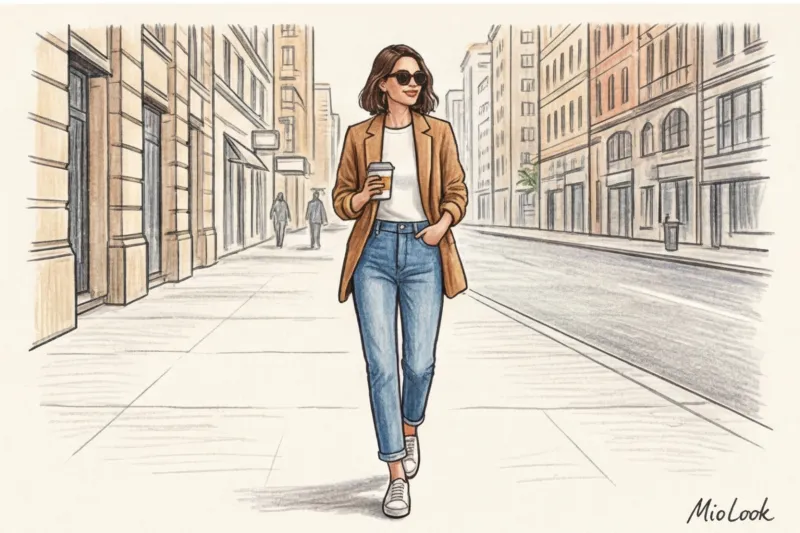
As an image consultant, I tirelessly repeat to my clients: true style is built not on the quantity of items, but solely on the quality of their connections. After living in the created aesthetic for five to seven days, you'll clearly understand which styles truly flatter your figure and which are just taking up space.
What's next? Once you feel like your seven-piece test formula is working flawlessly, it's time to scale up. A successful microcapsule is the perfect core, the inviolable DNA of your future full-fledged seasonal wardrobe. To expand it to, say, 25-30 pieces for the entire fall, you no longer have to start from scratch or make impulsive purchases. We simply take this proven core and build it up layer by layer: adding a warm top layer (for example, a quality alpaca coat in the €250-€400 range), introducing a couple of sophisticated accent accessories, or deepening the color scheme by one or two tones. We'll discuss in detail how to transform a basic core into a full-fledged seasonal capsule in our upcoming articles.
In the meantime, give yourself a chance to relax. To capture your daily looks as part of a week-long experiment and avoid having to keep them in your head, use the "smart wardrobe" feature in MioLook This will allow us to clearly assess which stylistic combinations were the most successful and preserve them for future seasons.
Guide Chapters
The perfect maternity capsule wardrobe without breaking the bank
Don't spend a fortune on clothes labeled "for expectant mothers." Learn how to create a smart mini wardrobe that will last through pregnancy and beyond.
Accessories for a Capsule Wardrobe: How to Change Up Your Looks
Basic clothes are just a canvas, and shoes and details are your paint. Learn how to dramatically change your look every day without changing.
Sports capsule clothing: packing for a fitness tour
How to pack a compact wardrobe for a fitness trip so you look appropriate both at the gym and at a restaurant? We'll share the secrets of a sports microcapsule.
Summer Mini Capsule: 5 Essentials for the City
How to put together the perfect wardrobe for a hot city and stop packing too much? We're sharing a tried-and-true "3+2" formula of five items for a summer microcapsule.
Capsule Wardrobe Colors: Secrets of the Microcapsule
Tired of racking your brain every morning over what to wear? Discover how a precise, mathematical approach to color can help you create the perfect microcapsule of 5–7 items.
Mini Capsule for Fall: A 7-Piece Wardrobe for the Off-Season
Morning chills and afternoon sun are no longer a problem. Learn how to create a stylish and functional transitional wardrobe with just 7 pieces.
Winter Travel Capsule: Packing Without Overweight
Winter travel often turns into a logistical nightmare due to bulky clothing. We reveal the secrets to creating the perfect winter microcapsule for carry-on luggage.
MioLook: An app for creating capsules in 5 minutes
Tired of digitizing your entire closet just for a couple of looks? Learn how to put together a stylish weekly microcapsule from just 7 items using artificial intelligence.
Weekend Outfits: A Stylish Capsule Collection
Forget about old sweatpants and uncomfortable street clothes. Learn how to create a stylish, warm, and practical microcapsule from just 7 items.
10x10 Challenge: A 10-piece wardrobe for 10 days
Got a closet full of clothes, but nothing to wear? This 10-piece, 10-day style diet will help you identify the perfect pieces and build a smart wardrobe without breaking the bank.
Capsule wardrobe formula: the "3 tops, 2 bottoms" rule
How to stop wasting money and wearing the same things? The mathematical rule "3 tops, 2 bottoms" will help you create the perfect microcapsule.
Seaside Capsule: 7-Piece Carry-On for Vacation
How to pack the perfect vacation wardrobe in a small bag? We reveal the secrets of a stylish micro-capsule of 7 items for traveling light.
A clothing capsule for a business trip: a wardrobe in your carry-on
Tired of packing huge suitcases for business trips? Learn how to create a compact and stylish mini capsule that fits easily into your carry-on.