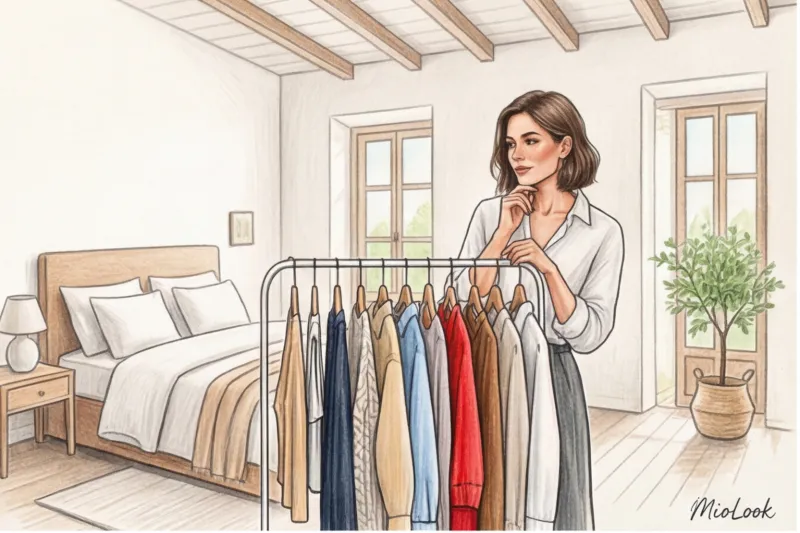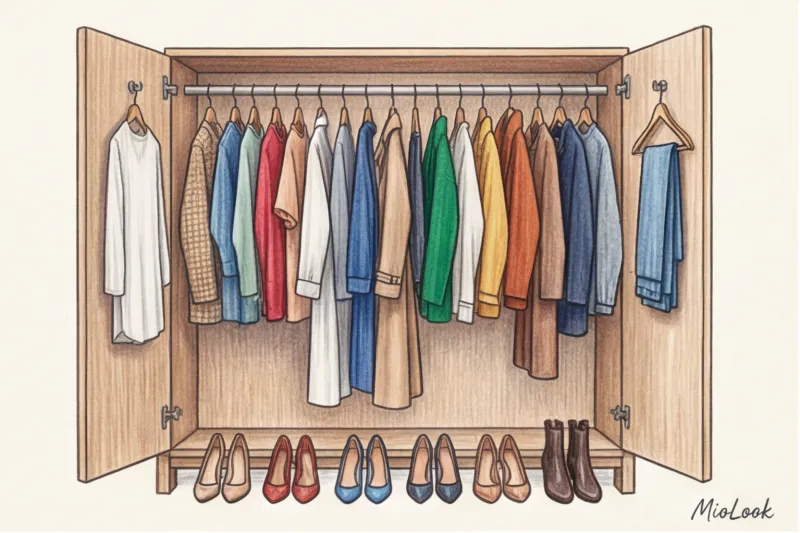
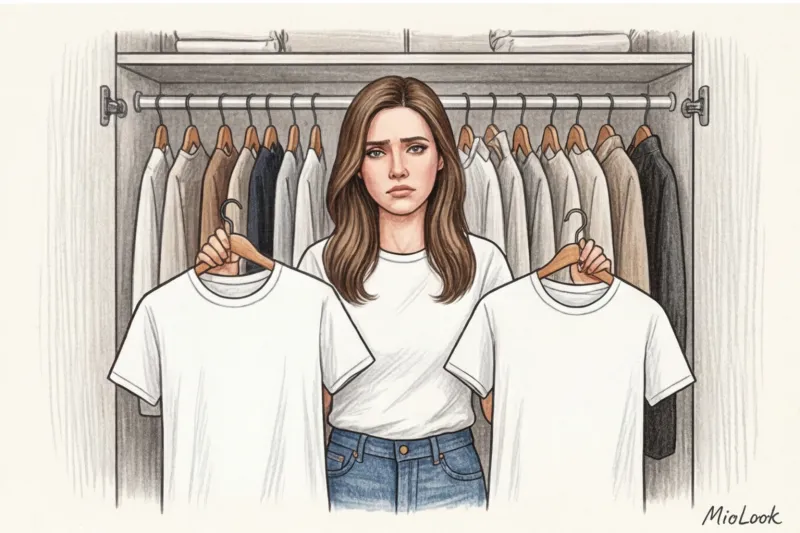
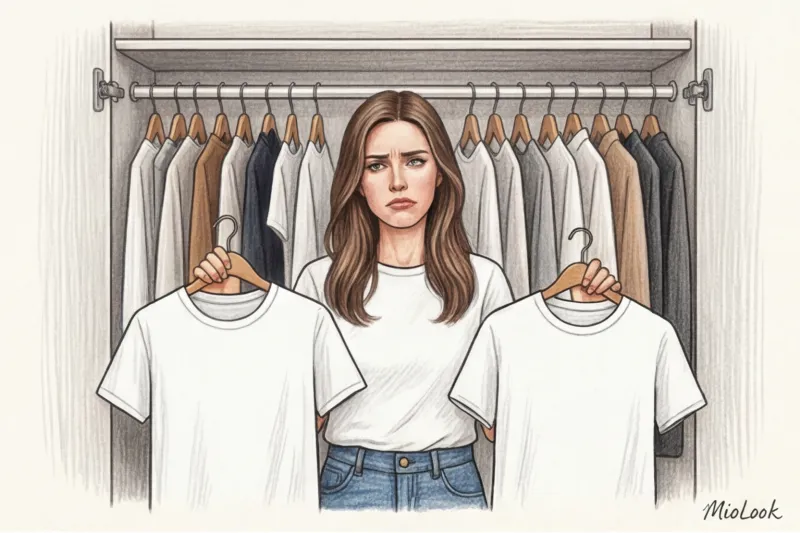
One day, Anna, the HR director of a large European IT company, came to see me. We opened her closet, and I counted fifteen white shirts. Fifteen! Anna honestly admitted that she felt confident in exactly two of them. The other thirteen simply created the illusion of choice, eating up her morning time and mental energy.
It's in situations like these that I prescribe a strict but incredibly effective style diet to my clients—the 10 by 10 Wardrobe Challenge. This experiment works like a litmus test: it instantly reveals which items are truly worth their price and which are just dead weight.
Essentially, it's the perfect training ground before investing in new things. We covered this in more detail in our The complete guide to microcapsules in clothing But today I offer you a practical test drive.
What is the 10 vs. 10 challenge and why does your wardrobe need it?
In 2015, Canadian designer and blogger Lee Vosburgh launched an online experiment that quickly became a worldwide hit. The rules are simple: you choose exactly 10 items from your closet (including shoes!) and wear only those for 10 days. Underwear, loungewear, bags, and accessories are not included.
Why voluntarily force ourselves into a box? The answer lies in psychology. According to Cornell University researchers, an adult makes approximately 35,000 decisions a day. Choosing clothes in the morning is one of the first tasks that drains our cognitive resources, causing so-called "decision fatigue."
By limiting your choice to just ten items, you gain back at least 15 minutes of quiet time in the morning. You no longer have to stand in front of an open closet and feel like you've got a full closet and nothing to wear.
It's also a financially sobering practice. Over 12 years as a stylist, I've learned that the Pareto principle works flawlessly in our closets. We truly do wear 20% of our clothes 80% of the time. This challenge forces you to identify that 20%.
Access to MioLook for €0.99 — one-time payment
A smart AI stylist will select the perfect look from your items in just a few seconds.
Get access — €0.99 onceThe biggest mistake beginners make: why a basic wardrobe makes a challenge boring
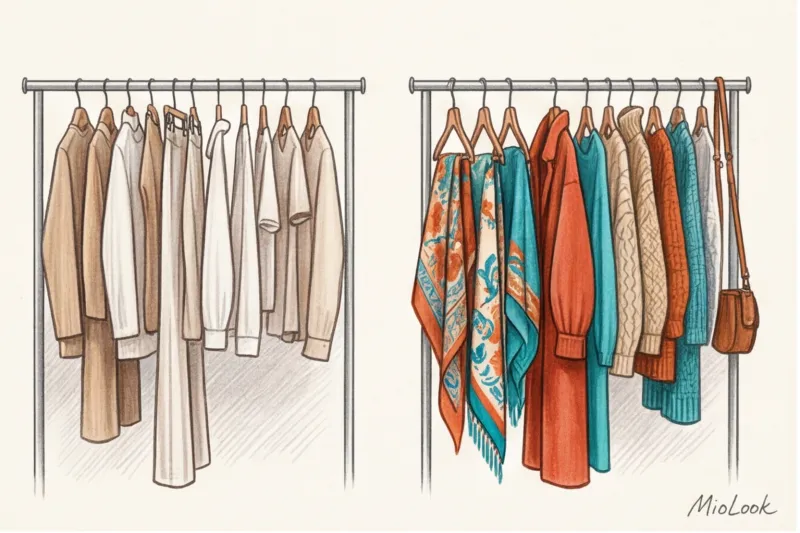
If you Google "10 by 10 wardrobe challenge," you'll see hundreds of identical photos: black pants, white T-shirt, gray sweater, beige trench coat. This is the main pitfall of minimalism.
A client of mine from Warsaw once decided to play this "safe game." She chose 10 completely neutral, plain basics. On the fourth day, she became physically bored. She gave up, went to the mall after work, and impulsively bought a neon-green sweater at Zara for €50, which she never wore again. Boredom is the main enemy of discipline.
To make the experiment a success, I recommend using 8/2 rule:
- 8 basic things - perfect cut, neutral shades that fit your figure perfectly.
- 2 accent pieces — a complex cut, a bright color or an active print (for example, a leopard skirt or a blouse in a rich burgundy shade).
These two accents will keep you from getting bored and will allow you to create not only utilitarian, but also truly stylish looks.
The Perfect Ten Formula: How to Choose Items (Step-by-Step Checklist)
Before you take your clothes out of your closet, open your calendar. What events await you in the next 10 days? Work in an office with a strict dress code? Meetings with friends? Trips out of town? Your 10 days should strictly adhere to your schedule, not abstract fashion rules.
Fair Limit: This challenge doesn't work well during periods of extreme climate change. If it's 0°C in the morning and 15°C during the day, you'll have a hard time meeting the limit without harming your health. The best time to start is during the stable off-season or summer.
Proportions of clothes and shoes for maximum combinations
To ensure the image mathematics converges, forget about random selection. Over the years of practice, I've developed the perfect formula for the functional ten:
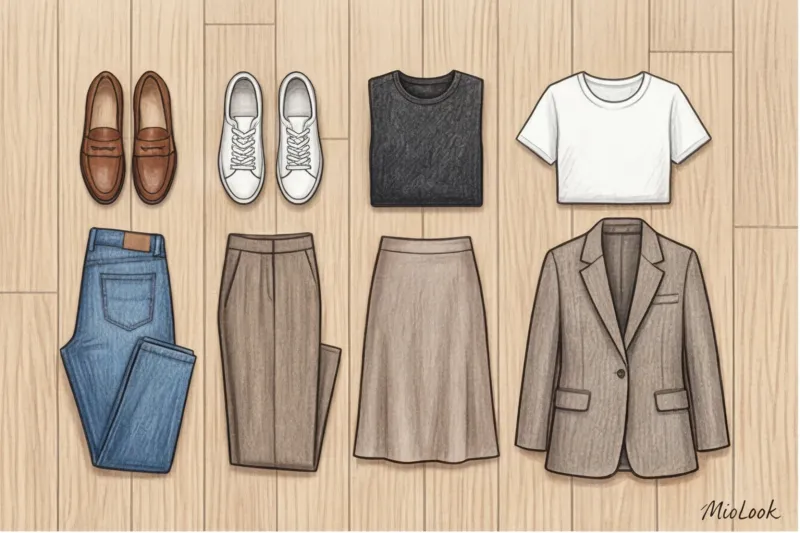
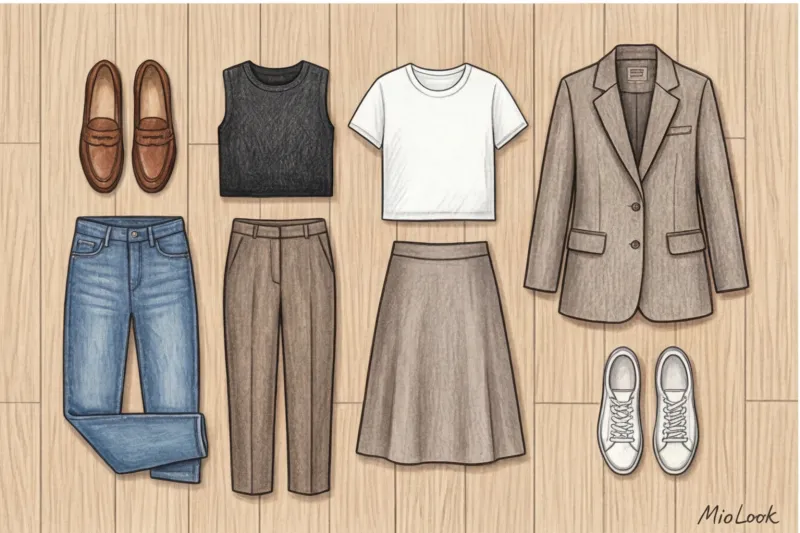
- 2 pairs of shoes (shoes radically change the degree of formality of an outfit).
- 3 bottoms (for example: trousers, jeans, skirt).
- 4 tops (T-shirt, shirt, long sleeve, thin turtleneck).
- 1 second layer (jacket, thick cardigan or coat).
Why so few bottoms and so many tops? People read our facial features—what's around our face. You can wear the same black pants three days in a row, and no one will notice if you change your tops and shirts.
Color palette and textures
To create blind pairing, use the rule of three colors: two neutrals (such as graphite and camel) and one accent color (deep emerald or burgundy).
But the real secret to an "expensive" wardrobe is texture. Pairing smooth poplin with loose wool or flowing silk with rough denim creates a visually complex look. If all 10 items are made of the same smooth, matte fabric, the wardrobe will look flat.
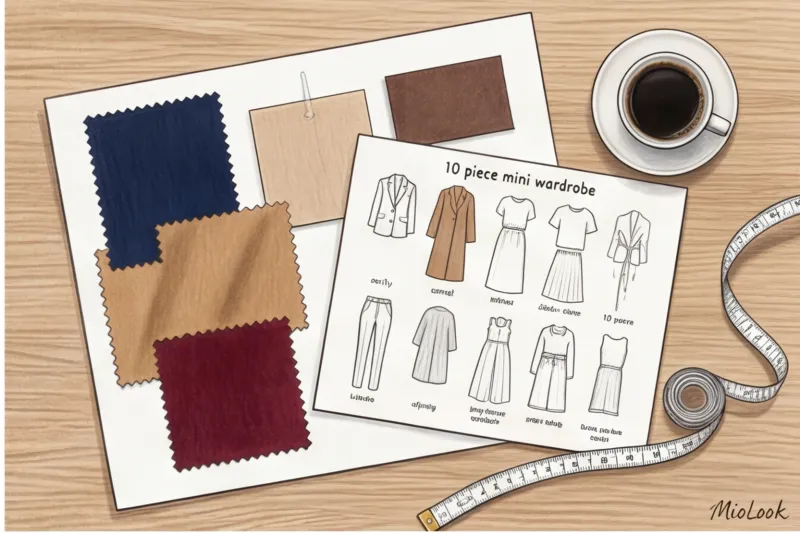
A case in point: We're putting together a 10x10 challenge for the office and the city.
Let's move from theory to practice. I'll show you what the ideal basic outfit looks like for a woman in a European metropolis with a smart casual dress code. We'll be using items in the €40–€150 price range.
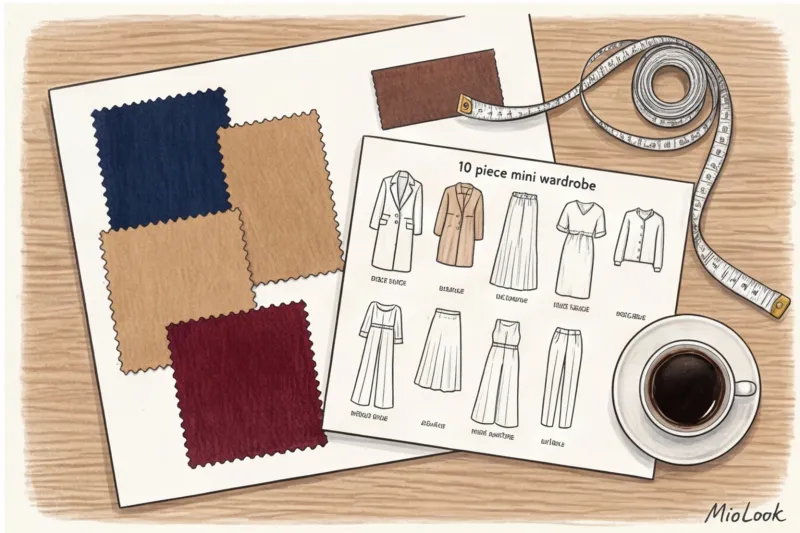
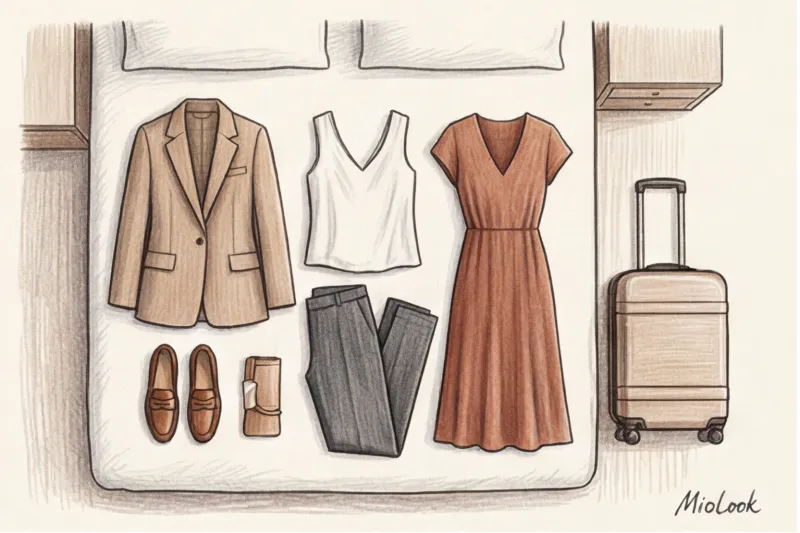
Here are my top ten:
- Second layer: Structured straight-cut jacket COS (approx. 150 €).
- Bottom: Zara straight blue jeans made of 100% cotton (40 €), wool palazzo trousers with creases (100 €), midi skirt made of thick matte satin (60 €).
- Tops: An oversized white shirt made of thick cotton from 180 g/m², a silk blouse by Massimo Dutti in a beautiful emerald shade (80 €), a basic white T-shirt, a thin cashmere turtleneck in a camel color.
- Shoes: Leather loafers with thick soles, minimalist white sneakers.
Pay attention to the details: why am I choosing an oversized shirt instead of a classic fitted one? It's a stylist's secret. A fitted shirt only works as a first layer. An oversized shirt can be worn solo, layered over a T-shirt as a light jacket, or layered under a turtleneck with the cuffs and collar exposed. One piece, three functions.
Your perfect look starts here
Join thousands of users who look flawless every day with MioLook.
Get access — €0.99 onceThe Magic of Styling: How to Look Different in the Same Clothes
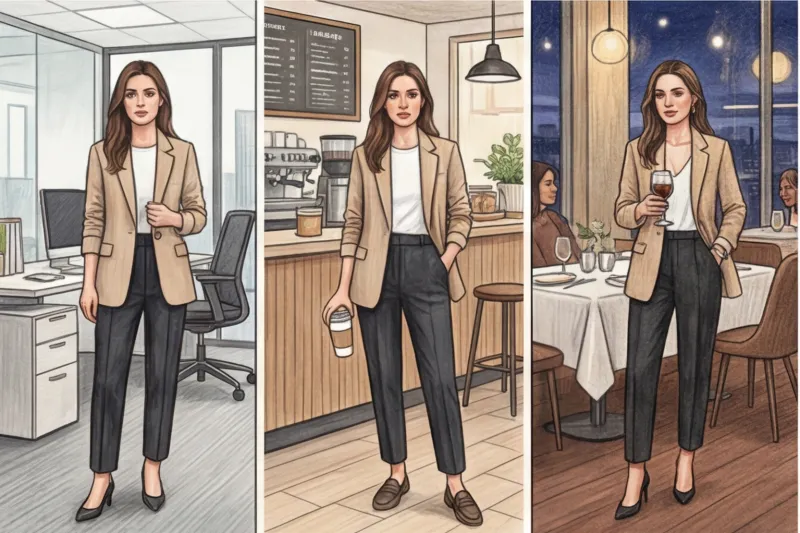
Ten items don't equal 10 looks. With the right styling, you can squeeze up to 30 combinations out of this set. How you wear a piece is more important than what it is.
First, layer. Wear a silk blouse, an unbuttoned white shirt over it, and then throw on a jacket. Second, vary the silhouette: tuck your sweater into your skirt only at the front (a French trick that elongates your legs), or roll up your jacket sleeves to reveal slender wrists.
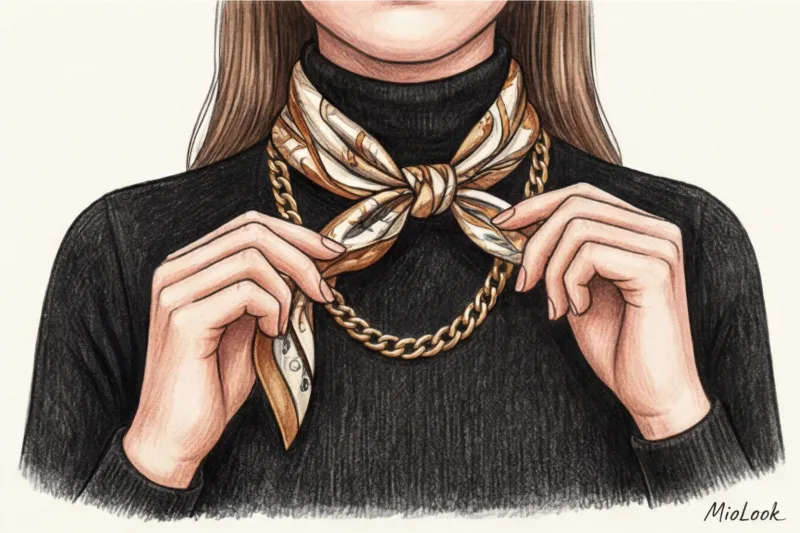
The main cheat code for the challenge is accessories. They don't count towards the limit!
A silk scarf around the neck, an accent belt over a jacket, a chunky chain, or a change of bag can transform a daytime jeans and T-shirt outfit into an evening cocktail outfit.
If you have trouble visualizing these combinations in your head, I recommend writing down your top ten MioLook The app's artificial intelligence will automatically generate dozens of non-obvious combinations based on the photos you upload of your items.
Results and analysis: how a 10-day experiment will change your shopping experience
By day ten, you'll learn more about yourself and your habits than you would in a year of regular shopping. You'll realize you're desperately lacking comfortable shoes, or that that jacket feels too tight in the shoulders when worn over a turtleneck.
This brings us to the most important concept of a smart wardrobe - Cost Per Wear (CPW) The formula is simple: divide the cost of the item by the number of days you wore it.
Investing in the perfect pair of €120 thick jeans that you'll wear 100 times (CPW = €1.20) is mathematically and logically more profitable than buying three pairs of compromised jeans for €40, two of which will sit on the shelf and irritate you. The challenge clearly demonstrates this math in practice.
Your action plan for tomorrow:
- Choose your 10 items using the 2-3-4-1 formula.
- Hang them on a separate open rail or make a central space for them in a closet.
- Put the rest of the things out of sight (this is critical for the purity of the experiment).
- Take a photo of each of your looks in the mirror for 10 days.
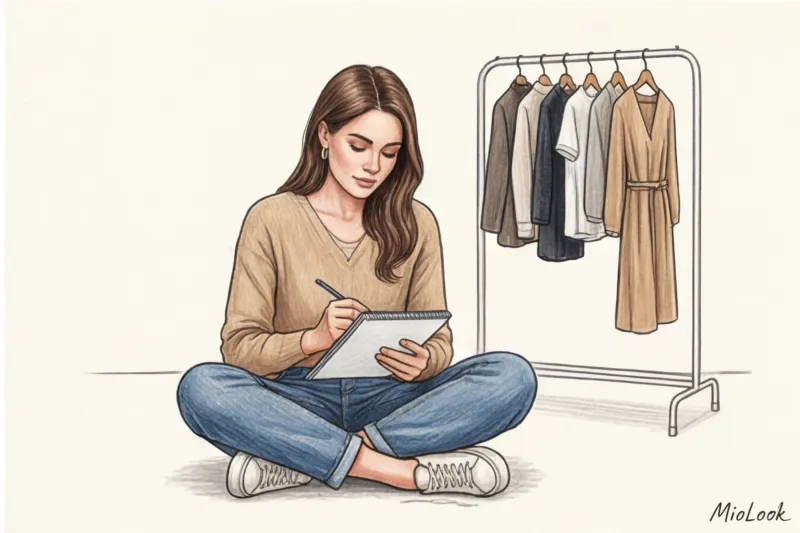
To consolidate the results and not lose the successful formulas you have found, digitize the resulting database. MioLook will help you track how often you wear your clothes and plan your future purchases so that each new item fits into your wardrobe 100%.
Remember: clothing restrictions don't deprive you of freedom. On the contrary, they free your creativity from visual noise. Keep in your closet only those items that work for you, not against you.