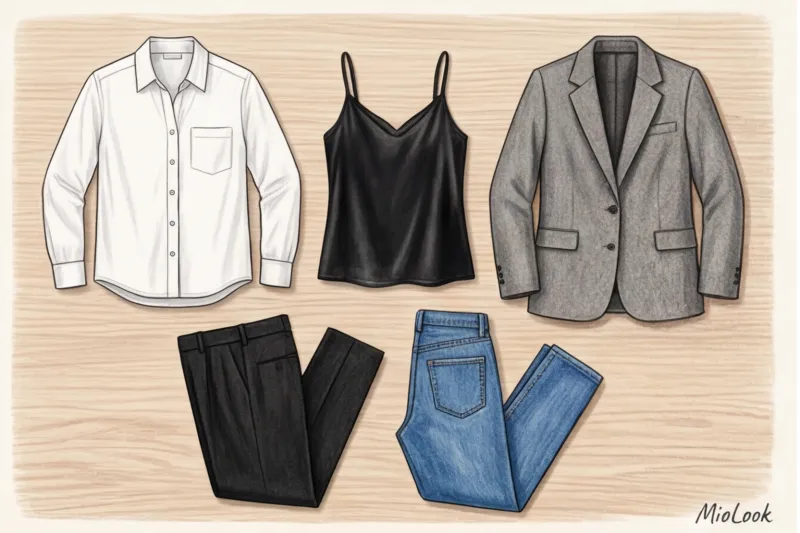
I tracked my daily outfits for six months straight and made a terrifying discovery: 82% of the time, I wore the same five to seven items. Meanwhile, the remaining forty-odd hangers in my closet simply collected dust and made me feel guilty about wasting money. Sound familiar?
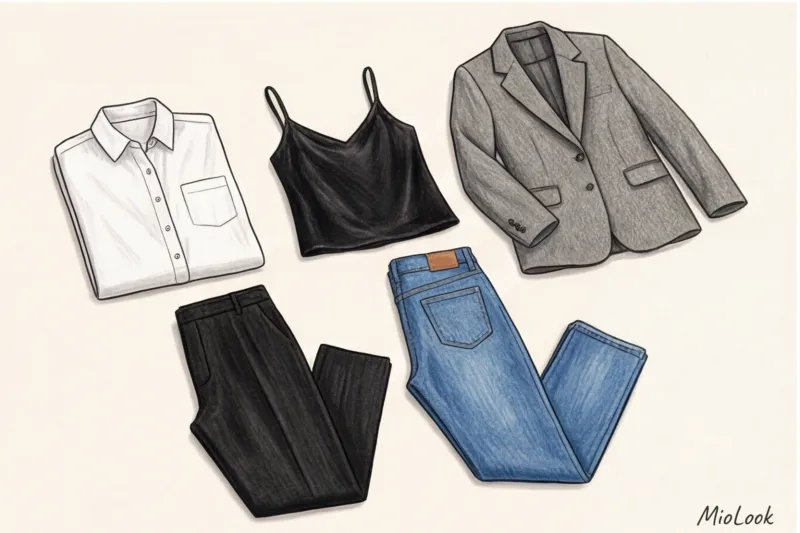
Instead of a Marie Kondo-style decluttering and throwing out half your apartment, I suggest taking a mathematical approach. Over 12 years of working as a stylist, I've learned: the correct formula for a capsule wardrobe Five well-chosen items will give you more wearable looks than thirty random emotional purchases.
We discussed the philosophy of this approach in more detail in our complete guide to creating a microcapsule of clothing for a week , but today I want to give you a rigorous algorithm, tested on hundreds of clients. We'll explore the "3x2" mathematical model.
Anatomy of a Rule: How This Capsule Wardrobe Formula Works
According to research by psychologists at Cornell University, an adult makes approximately 35,000 decisions every day. By the time you open your closet at 7:30 a.m., your brain has already begun to use up its limited concentration resources. In psychology, this is called "decision fatigue." decision fatigue Wasting this precious resource on choosing between a blue and a black skirt is an unaffordable luxury for a busy professional.
This is where the mathematics of style comes into play. The "3 highs, 2 lows" formula solves the problem of visual noise. But why are there more highs?
A stylist's secret, rarely mentioned in glossy magazines: people remember only your profile picture. You can wear the same perfect pair of jeans three days in a row, changing only your shirts and T-shirts, and your colleagues will be convinced you're wearing something new every day.
Why not 2x2 or 4x2? The secret of proportion
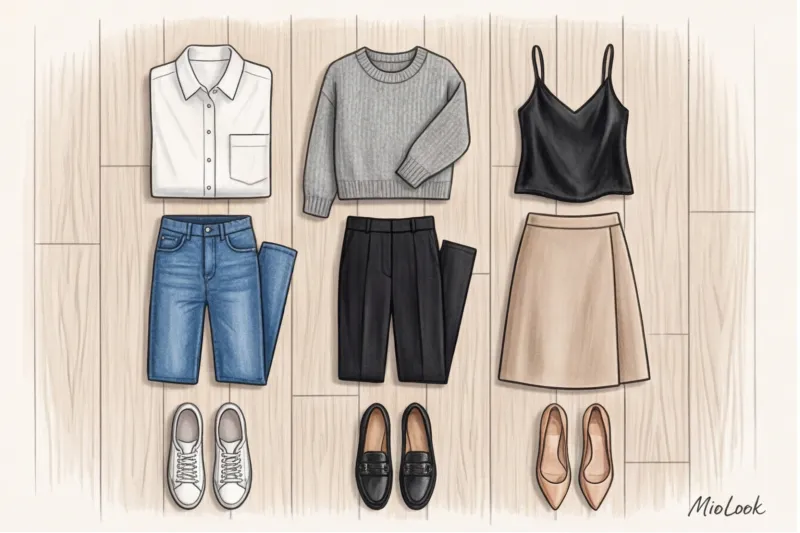
3x2 combinatorics is ideal in its efficiency. Three times two equals six. This means six guaranteed, unique sets , which are more than enough for a classic five-day work week, plus one spare look for Friday night.
Two bottoms give you the necessary balance between formal and relaxed. And three tops completely cover your need for a base layer, an accent piece, and layering. Add more, and the choice problem returns. Add fewer, and you'll feel bored.
Your perfect look starts here
Join thousands of users who look flawless every day with intelligent image selection.
Get access — €0.99 onceAssembling the "3 Tops, 2 Bottoms" Microcapsule: A Step-by-Step Guide
The most common mistake beginners make is buying five boring basics. A white T-shirt, a gray turtleneck, black pants... It sounds like a cashier's uniform, not a stylish wardrobe. For the microcapsule to heal, we need contrast.
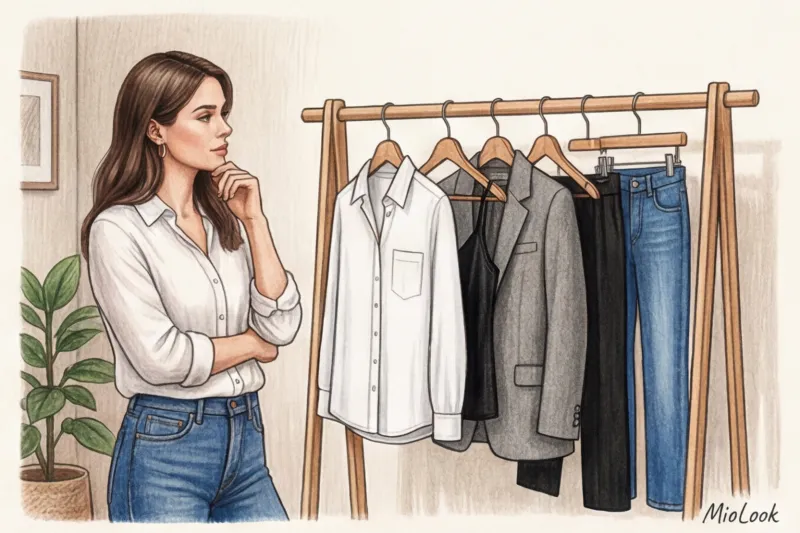
In mini capsule collections, the texture of the fabric is always more important than the color. It's the difference in texture that makes a look luxurious. Smooth, cool silk paired with rough, heavy denim looks far more appealing than a cotton T-shirt paired with cotton jeans.
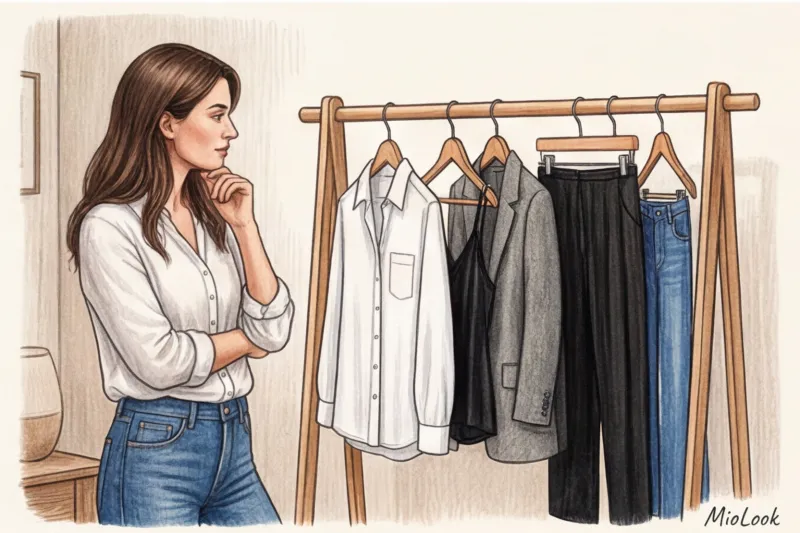
Step 1: Two-Bottom Foundation
Start building your wardrobe from the bottom. This is your anchor. Ideally, both items should be in the slightly above-average price range (between €80 and €150), as they bear the most physical wear.
- Bottom #1: Structured. For example, wool-blend palazzo pants or a thick midi skirt. This item is perfect for business meetings and other occasions when you need to look put together.
- Bottom #2: Relaxed. High-quality straight-leg jeans with no rips or holes (like Levi's 501s or classic COS jeans). No elastane, just 100% cotton, 12-14 oz.
Step 2: Three tops for any task
Now let's choose the tops. The main rule: each of them must look perfect with both of them bottoms.
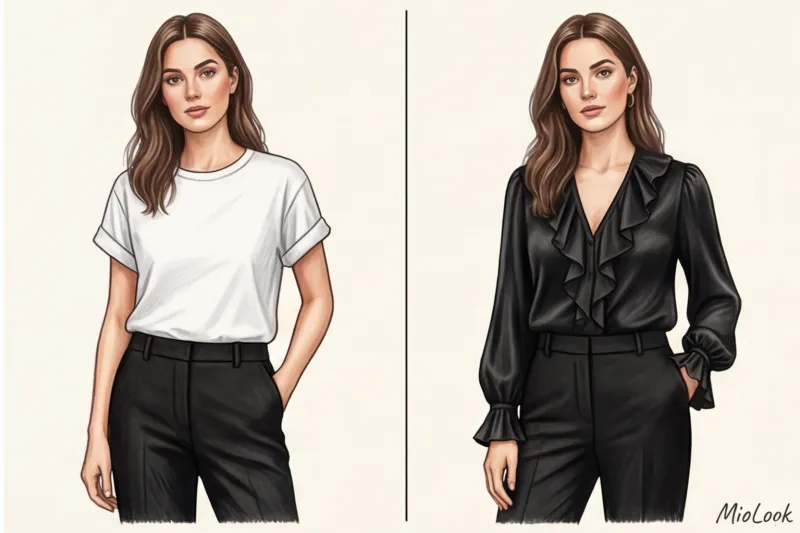
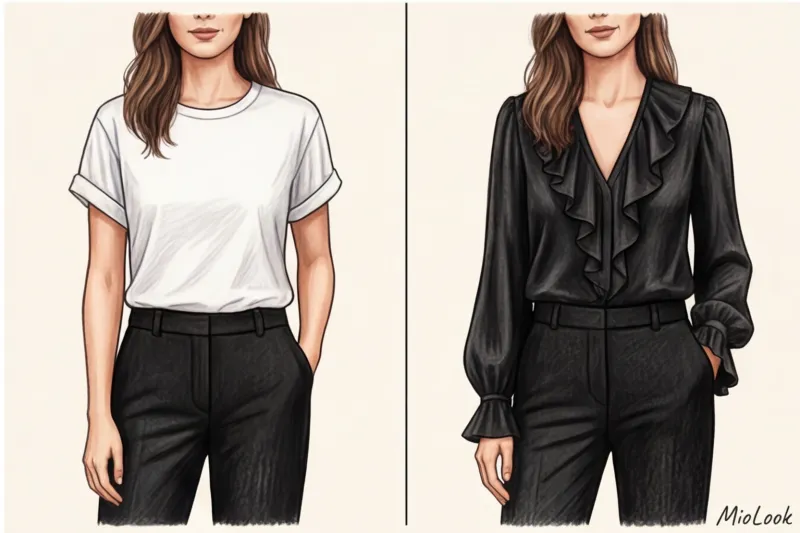
- Top 1: Absolute base. A thick white T-shirt (at least 180 g/m²) or a cashmere long sleeve. Canvas item.
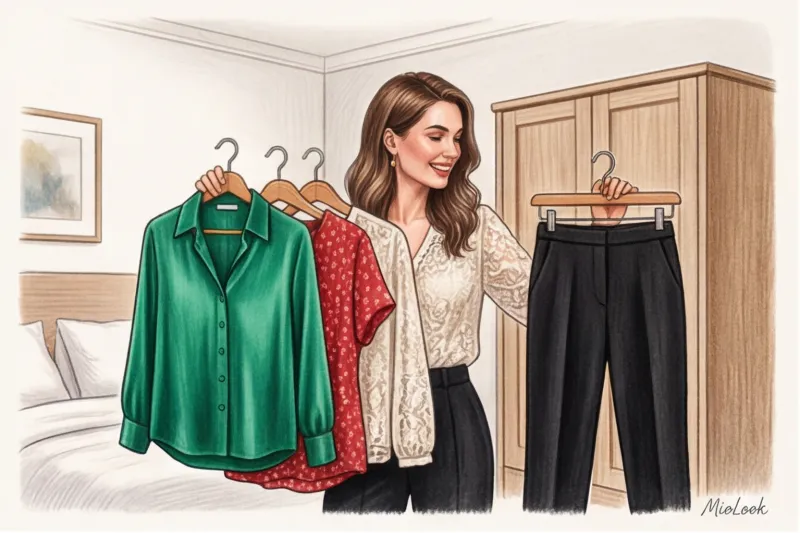
- Top 2: Accent. A silk blouse with a delicate sheen or a shirt with a complex but not flashy print. This is your "dressy" piece.
- Top 3: Third layer. The third layer rule works wonders. It could be a structured men's-cut jacket (great for gathering up soft jeans) or a chunky knit cardigan (softens tailored trousers).
The Myth of Boring Minimalism: Why 5 Things Isn't a Limitation
There's a counterintuitive paradox in the fashion industry. Popular challenges like Project 333 (which involves wearing 33 items for three months) are incredibly harmful to beginners. From my experience, when a woman accustomed to a chaotic wardrobe tries to assemble the perfect 33 items at once, she panics. It's too much to analyze. This often results in a breakdown and compulsive shopping.
A microcapsule of 5 items is a safe sandbox, a testing ground for your personal style. And no, it doesn't have to be just beige, gray, and black.
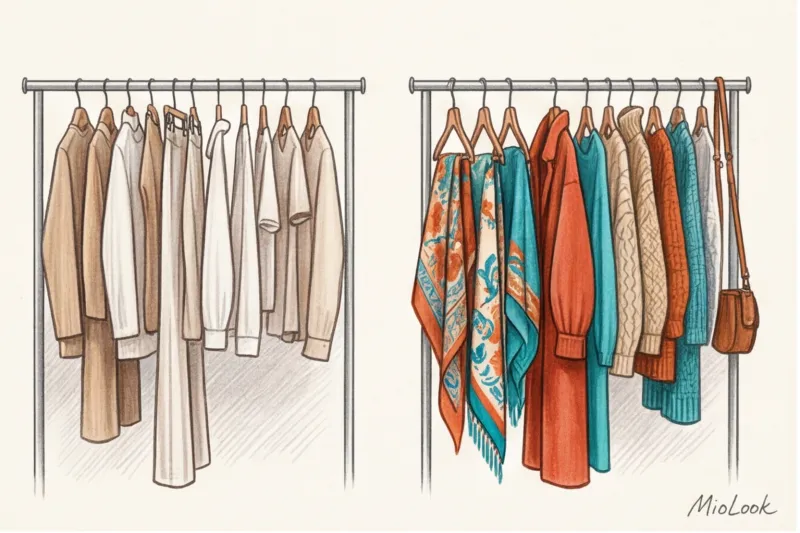
According to a 2024 report from analytics agency WGSN, modular wardrobes will evolve towards "dopamine minimalism." You can use bright colors if you follow one print per capsule rule If your blouse has a leopard print, the other four items should be solid colors, but their colors can overlap with the print. For example, terracotta pants and a beige jacket.
The Power of Detail: Integrating Shoes and Accessories
One of my clients, a product manager at an IT company, complained about her morning get-ready routine, which took 25 minutes. We implemented the 3x2 formula, and it dropped to 3 minutes. Do you know what made her looks truly classy? Not the pants. But the accessories.
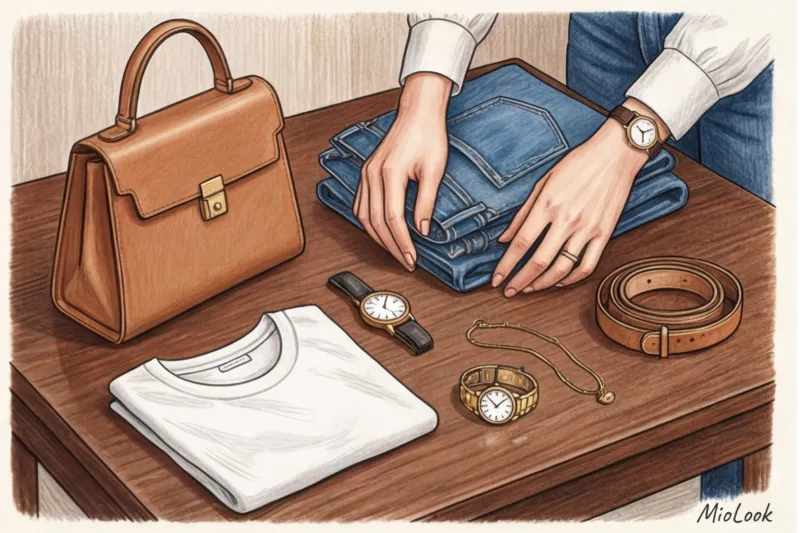
For five things you need exactly two pairs of shoes: for comfort (white leather sneakers or minimalist trainers) and for status (loafers, brogues, or kitten heels). By changing your shoes, you change the polarity of your look.
The same pair of straight-leg jeans and a white T-shirt looks like a weekend getaway outfit without any accessories. But add a leather belt with a simple buckle (like this one from Massimo Dutti), a watch with a metal bracelet, and a geometric bag—and the look instantly becomes casual chic. A good leather belt for €50 can visually elevate a basic €15 T-shirt.
Digitizing Your Wardrobe: How Technology Multiplies Your Looks
Keeping all the combinations in mind is difficult even for stylists. The future of personal style lies in data. When I first digitized my looks, I was shocked by the Cost Per Wear metric.
Imagine you bought a fancy sequin dress for €200 and wore it once. Your CPW is €200. But a basic jacket for €150, worn 50 times per season, has a CPW of only €3. The math of microcapsules always works to reduce this cost.
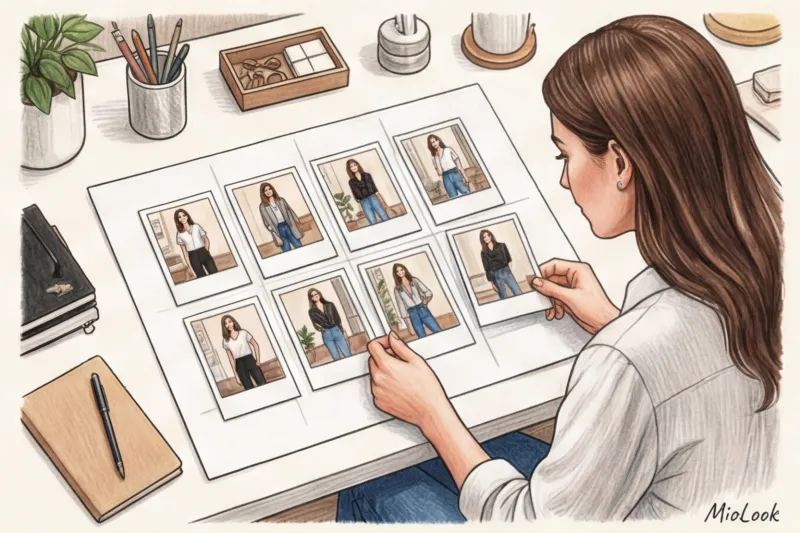
This is where technology comes in. I recommend using the "smart wardrobe" feature in MioLook You simply upload photos of your five basic items, and the algorithm automatically creates mood boards for the week. This eliminates the need to stand in front of a mirror—you open your phone over a cup of coffee and already know what you'll wear.
Try MioLook
A smart AI stylist will select the perfect look for you and digitize your wardrobe in a couple of clicks.
Get access — €0.99 onceChecklist: Assemble your first formula in 15 minutes
To be fair, I have to say when this formula It doesn't work If your profession requires radical image changes every day (you're an actress, TV presenter, or work in the fashion avant-garde) or if in your climate the temperature fluctuates between +20°C and 0°C during the week, you'll need an extended base.
But for 90% of office workers, freelancers, and mothers on maternity leave, it's a lifesaver. Let's move from theory to practice right now.
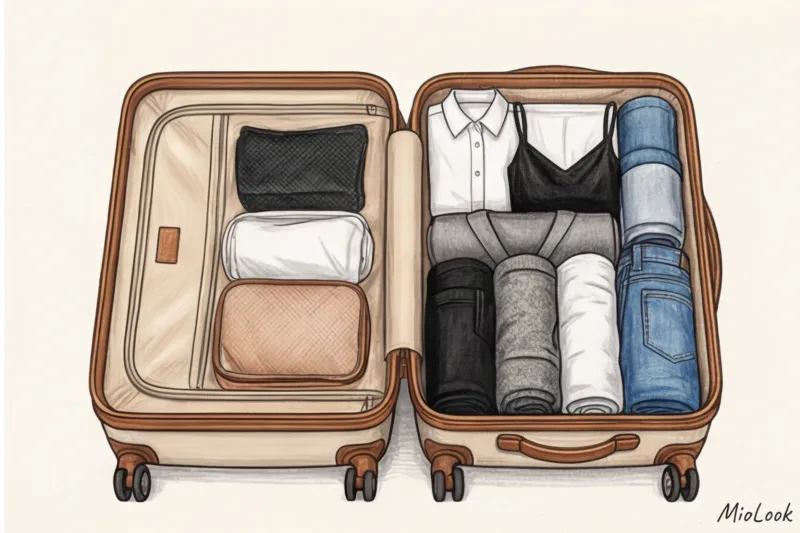
Here is your assignment for today:
- Go to your closet and pull out five specific items according to the diagram above (2 bottoms, 3 tops). No "maybe this blouse too." Exactly five.
- Try a blindfold test: close your eyes and imagine any top and bottom from the selected list. Do they match? If not, change the top until the matrix matches.
- Put the rest of your things in a far corner or in a suitcase.
Live with this mini-capsule for exactly one week, from Monday to Sunday. Write down your feelings. I guarantee: by Wednesday, you'll feel incredibly light in the morning, and your colleagues will compliment you on your impeccable style. Start small, and you'll see how limitations transform into absolute freedom.