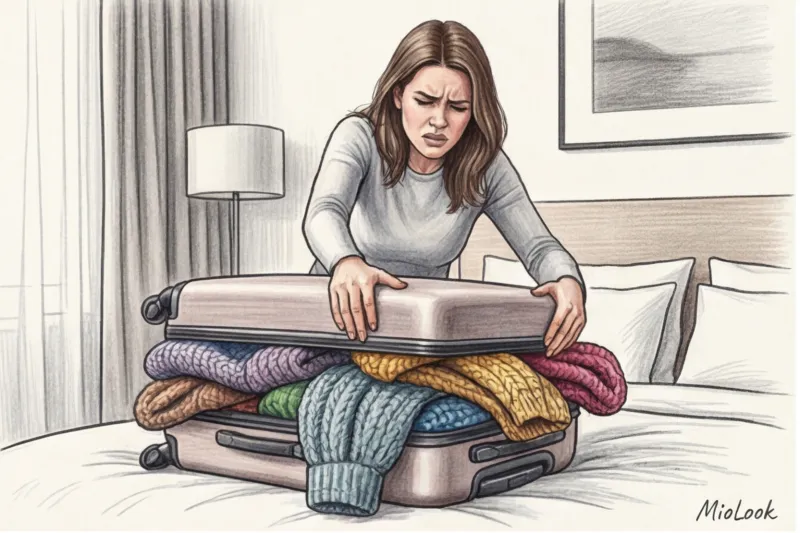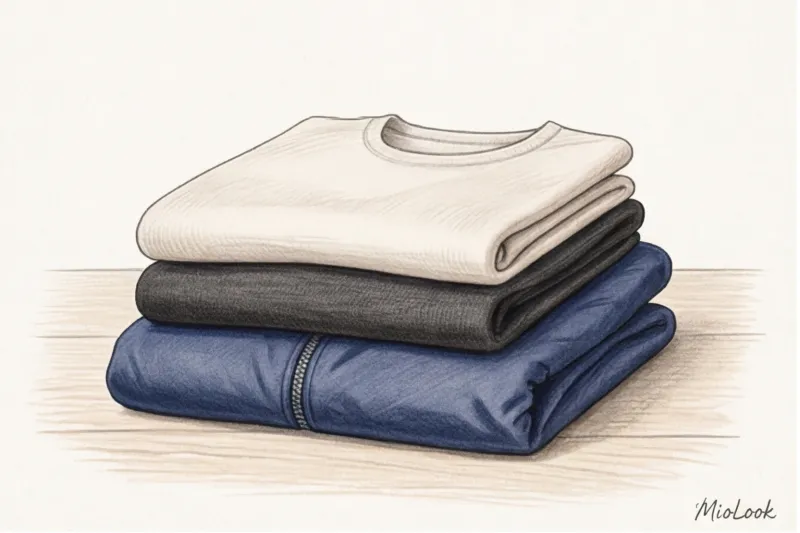
It's a familiar scene: you're sitting on top of a cabin-size suitcase, desperately trying to zip it up, with nothing inside but two "cozy" chunky knit sweaters, a pair of jeans, and a makeup bag. The suitcase is bursting at the seams, and you're already feeling tired from a trip that hasn't even begun.
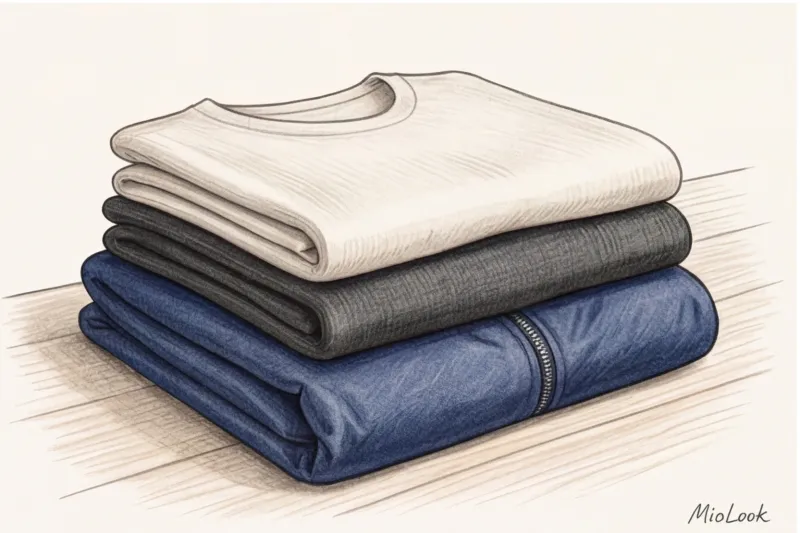
As a digital stylist and minimalist, I constantly encounter winter travel as a logistical nightmare for my clients. We're used to thinking that cold equals volume. But smart capsule for a winter trip is built on completely different principles.
We have described the architecture of a compact wardrobe in more detail in our The complete guide to microcapsule clothing However, subzero temperatures require a separate, almost mathematical approach. Forget the "wear your heaviest clothes" rule—today we'll use thermoregulation algorithms that will allow you to fly away for a week with just a city backpack.
The Mathematics of Layers: Why a Winter Travel Capsule Can't Stand Thick Sweaters
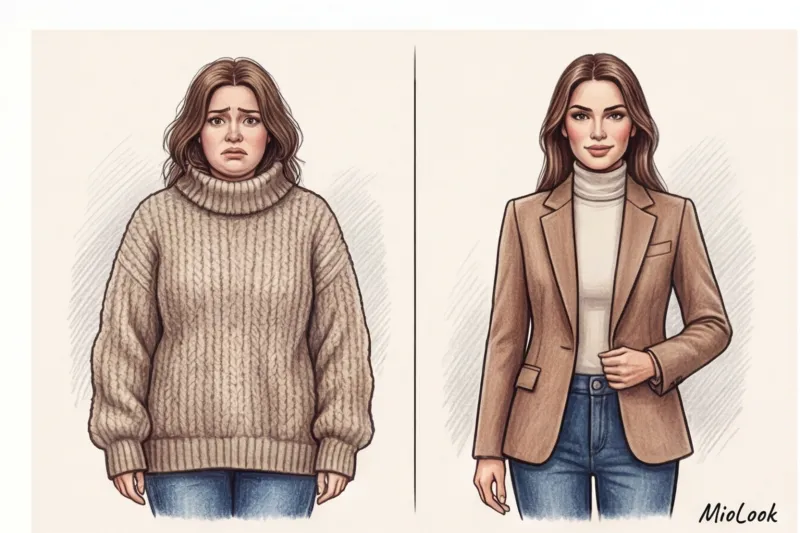
Let's start with the biggest myth: to stay warm, you need thick clothes. This is untrue. Bulky knits don't provide warmth—they just create visual noise and eat up precious inches in your carry-on. Statistically, a classic chunky knit sweater (the same "granny sweater" or oversized hoodie) takes up up to 30% of a standard carry-on suitcase.
Last December, I conducted a personal experiment: I went to Stockholm for five days with only a 20-liter backpack. It was -8°C, high humidity, and a piercing wind. I didn't bring a single thick sweater—and I didn't feel cold even once.
The secret lies in a principle we borrowed from professional mountaineers and adapted for urban style. Warmth comes not from the thickness of the fabric, but from the air trapped between thin, tightly fitting layers.
The ideal system consists of three levels:
- Base layer: wicks away moisture (after all, we sweat when we go from the cold into a warm metro or museum).
- Middle layer: works as a heat insulator (retains body heat).
- Outer layer: protects from wind and precipitation.
Three thin layers layered on top of each other provide 40% more warmth than one giant jumper and take up half the space in your luggage. Plus, it eliminates decision fatigue. You can easily remove your mid-layer in a hot café and avoid sitting sweating in your only thick hoodie.
Your perfect look starts here
Join thousands of users who look flawless every day and save time on getting ready with MioLook.
Get access — €0.99 onceWinter Microcapsule Formula: 7 Things for 100% Preparedness
Recently, a client and I were sorting through her luggage before a trip to Vienna. She was trying to squeeze three bulky hoodies into her suitcase. We replaced them with two thin merino turtlenecks and a cashmere cardigan. The result? We saved 40% of the suitcase space, and the variety of outfits tripled.
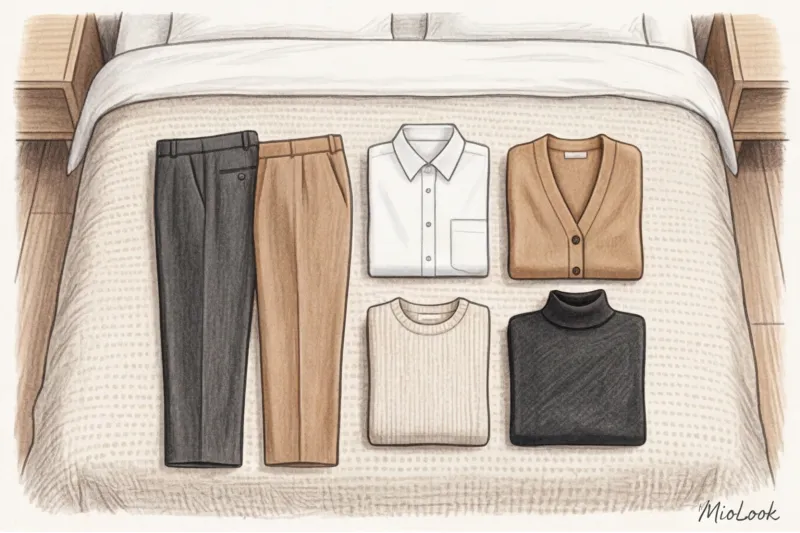
A microcapsule is a strictly limited set (strictly 5-10 items), where each element is worth 200% of its cost and weight. Here's my proven formula of 7 items:
- Trousers made of thick wool (a base that looks more elegant than jeans, but keeps you warmer).
- Dark jeans or a thick midi skirt (for replacement).
- Thin cashmere jumper (weighs grams, heats like a stove).
- Thick oversized cotton shirt (perfect mid-layer, can be worn unbuttoned over a turtleneck).
- A wool cardigan or jacket with a structured cut.
*Note: Two sets of thermal underwear made from 100% merino wool or silk are not included in these 7 positions, as they are considered underwear and take up no more space than a pair of socks.
Research into the properties of natural fibres (specifically, the 2023 Textile Exchange report) confirms that merino wool is thinner than cotton, but retains heat 30% more effectively thanks to microscopic air pockets within the fibre structure.
How to distribute volume to avoid looking like a cabbage
Layering can visually add 5 kilograms if used thoughtlessly. To avoid this, adopt the "one accent layer" rule. Only one piece in your outfit should be textured or voluminous.
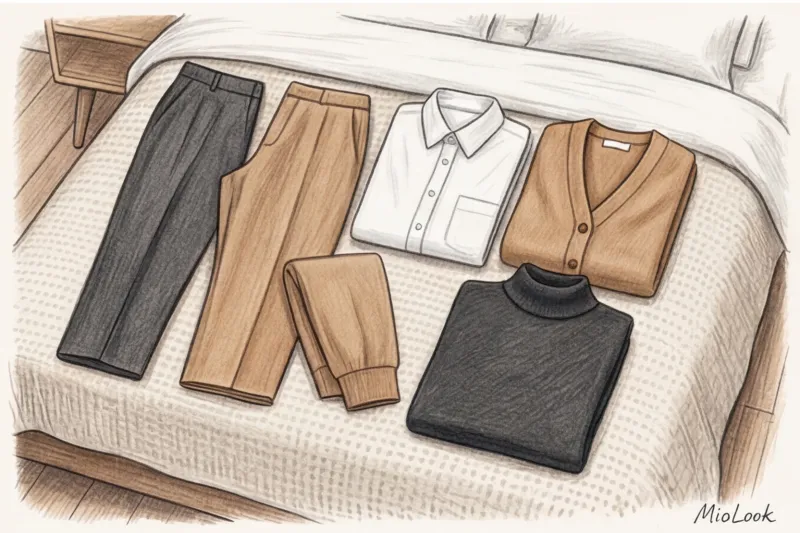
For example, if you're wearing a smooth turtleneck and a thin shirt, you can layer a slightly fuzzy cardigan over it. But if the shirt is corduroy, the cardigan should be completely smooth. And be sure to pay attention to the texture of the inner layers: choose viscose or silk to prevent the sleeves from getting caught or pulling on the outerwear lining.
Outerwear and footwear: the foundation that sets the tone
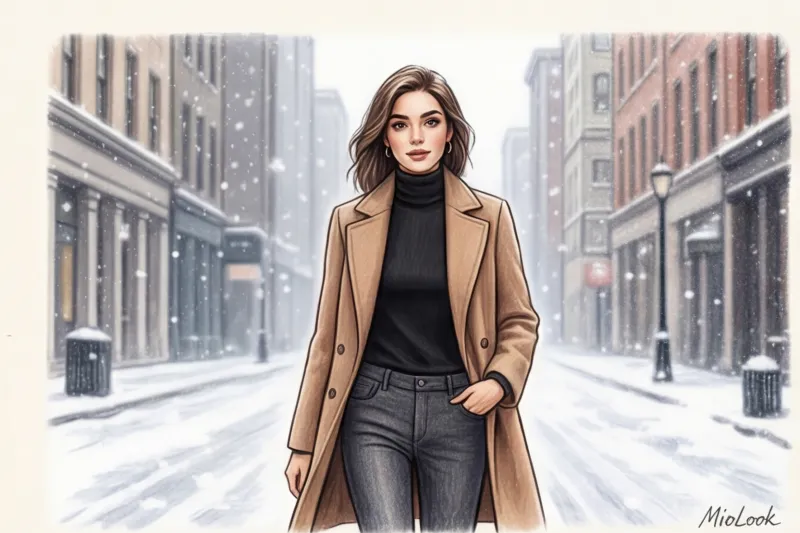
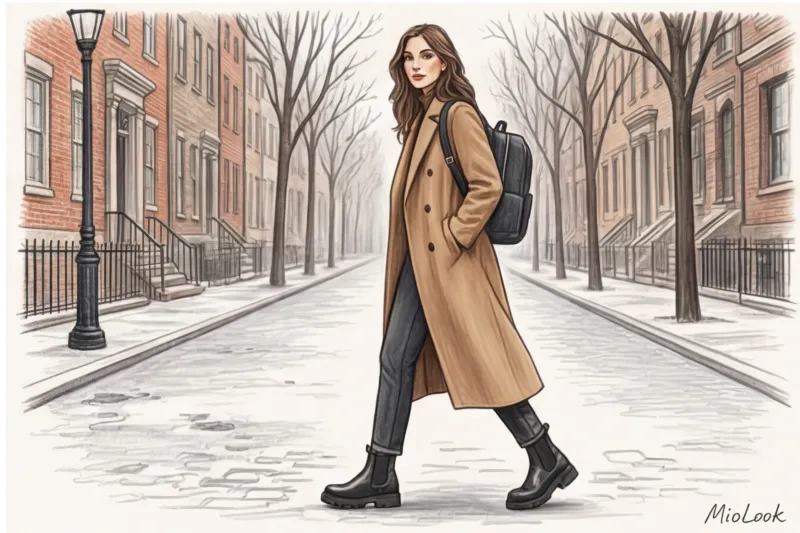
Let's be honest: on a winter trip, your outerwear is your most important outfit. The 80/20 rule is ruthless: 80% of the time (and in 80% of the photos), you'll be wearing the same coat and boots.
That's why outerwear must be perfect. Choose a straight-cut coat or a technical, minimalist down jacket (without unnecessary embellishments, fur, or logos). The most important criterion is sufficient looseness. If a jacket can't fit underneath, it's not a good winter coat.
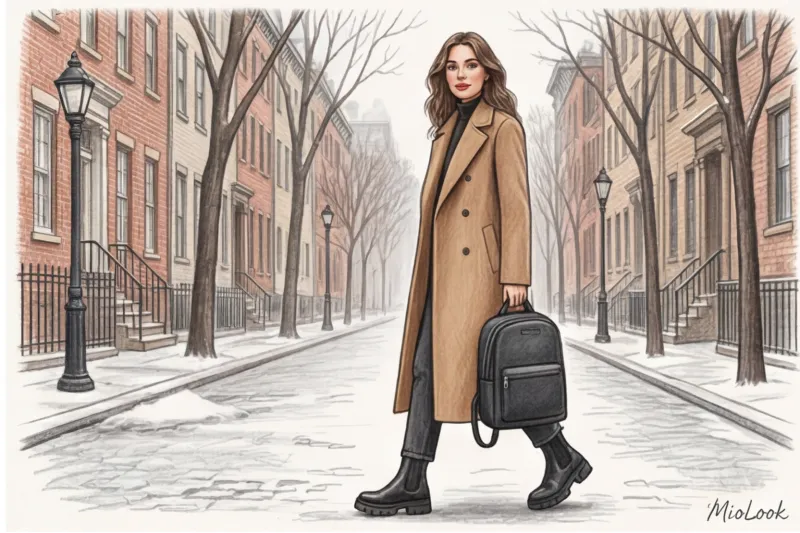
The situation with footwear is even more strict. We only take the following into the microcapsule: one pair of shoes (Maximum two if the trip lasts longer than a week and includes evening outings). According to research in outdoor gear, up to 40% of heat loss in urban conditions occurs through freezing of the sole.
Your hiking boots should have thick polyurethane or rubber soles (at least 3 cm) and a water-repellent finish. High-quality Chelsea boots with a traction sole (€150–€250) will pay for themselves on your very first trip, saving you the trouble of carrying a change of shoes in case of slush.
Accessories: How to Change Up Your Looks Without Adding Baggage
I have a client who adores black. On her trip to Paris, she packed an all-black capsule wardrobe: black trousers, a black turtleneck, and a black coat. But she looked different in each photo. Her secret? Three vibrant cashmere stoles.
Accessories weigh next to nothing, but pack a huge stylistic punch. My travel accessory formula:
- 1 voluminous bright scarf (for accent and photo).
- 1 neutral cashmere scarf (for basic combinations).
- 2 pairs of gloves (elegant leather and warm knitted).
- 2 pieces of headwear (e.g. a structured beanie and a wool cap or bonnet).
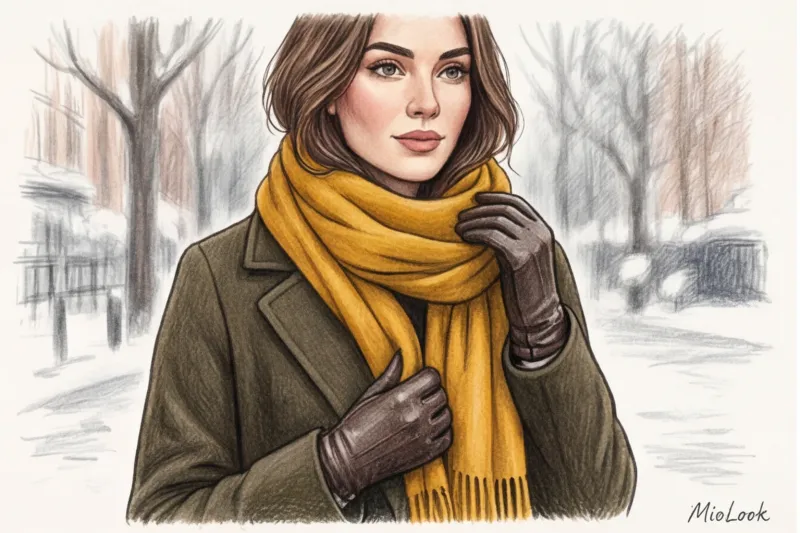
Bags are also worth optimizing. The ideal scenario: a roomy crossbody bag for daytime excursions (enough to hold a power bank and water bottle) and a micro-bag on a chain for evening outings. When flying, the micro-bag simply tucks inside the larger bag.
Access to MioLook for €0.99 — one-time payment
A smart AI stylist will digitize your wardrobe and select the perfect looks for any trip in just a few clicks.
Get access — €0.99 onceDigital Packaging: Packing Smarter
Nothing ruins the start of a vacation more than a panicked thought on the way to the airport: "I don't think I have anything to wear with this skirt." To avoid this, I've long ago transitioned my packing to a digital format.
Using the application MioLook For digitizing your wardrobe, it's a game changer. You simply photograph (or download from the internet) the items you plan to pack and pre-organize them into ready-made outfits on your smartphone screen. If an item only fits into one outfit, it's ruthlessly removed from your suitcase.
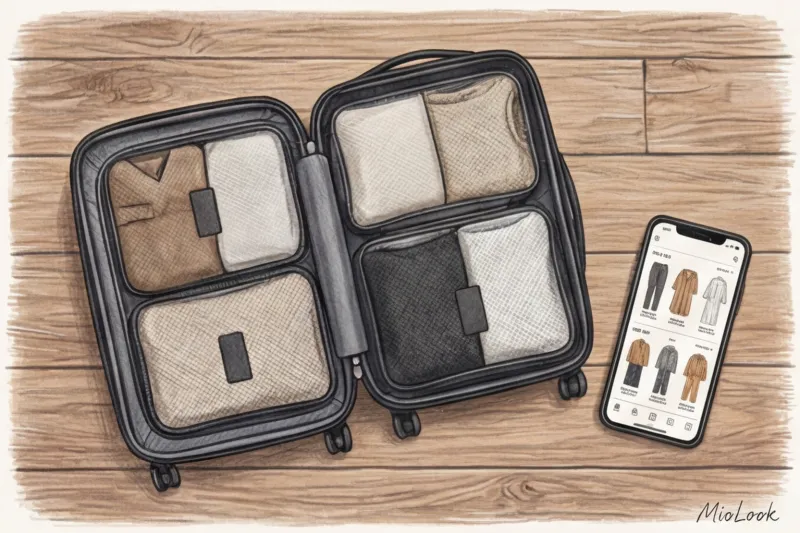
Technology is changing the very routine of traveling: you wake up in the hotel, check the weather forecast, open a saved collection on your phone, and your look is ready in a minute. No more clothes scattered around the room.
To be fair, this method doesn't work if you're going on an expedition with unpredictable conditions that requires specific skills (fishing, freeriding). But for a city-break format, it's perfect.
Checklist: Your Perfect 5-Day Winter Travel Capsule
To put theory into practice, here's a concrete plan for distributing our 7-component capsule.
On the plane (we put on the heaviest and bulkiest):
- Coat or down jacket.
- Boots with thick soles.
- Dark jeans.
- A voluminous scarf (you can use it to cover yourself on a plane).
- Cotton shirt + cashmere jumper.
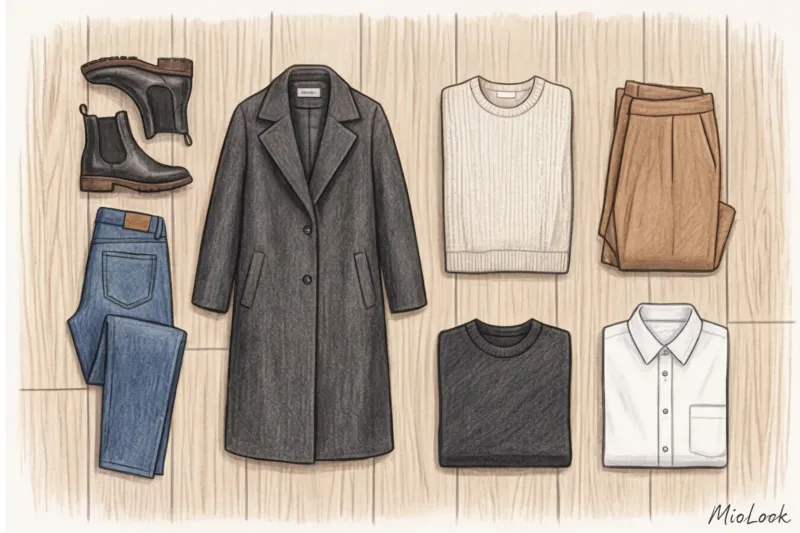
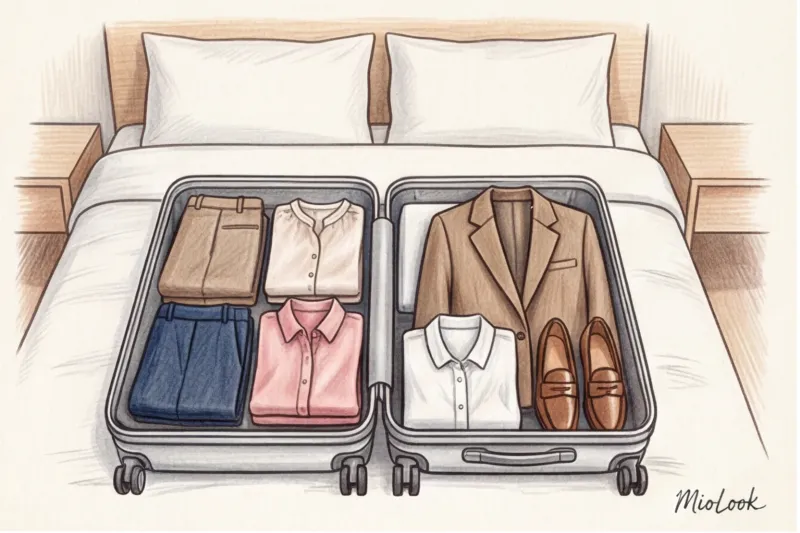
In carry-on luggage (we use the rolling technique and compression cubes):
- 2 sets of thermal underwear.
- 1 pair of wool trousers.
- 1 thin cashmere turtleneck.
- 1 cardigan or jacket.
- Underwear, socks/tights.
- Accessories (hats, gloves, spare scarf, evening micro-bag).
- A spare pair of lightweight shoes (flat loafers or ballet flats - only for going to hotel breakfast or an evening bar).
The total weight of such a set in a suitcase will be about 5-6 kg, which is more than enough to fit into the carry-on baggage allowance of absolutely any airline.
Packing a suitcase in winter isn't about compromising warmth and style. It's about rejecting stereotypes in favor of modern materials and clever combinations. Trade bulk for technology, digitize your looks in advance, and your next trip will begin not with a struggle with the suitcase zipper, but with the anticipation of a wonderful vacation.