Closet chaos or a smart system: why does a family need a virtual wardrobe (app)?
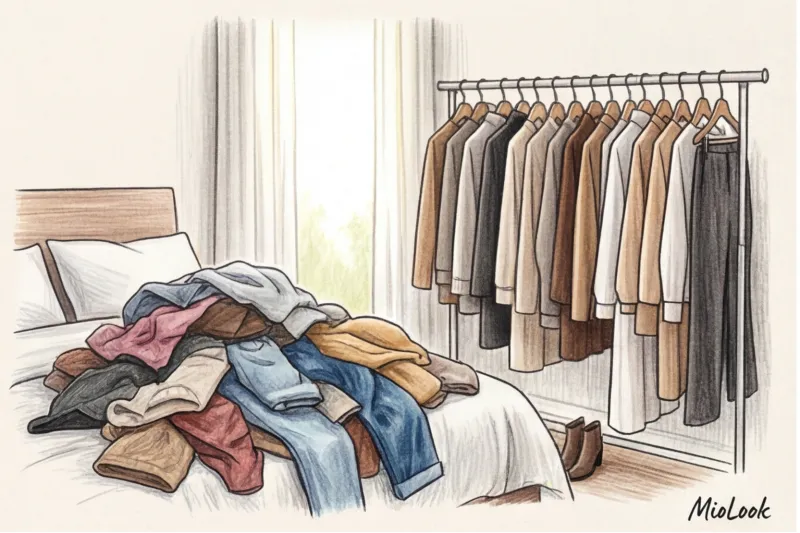
In my experience, cleaning out family closets always begins the same way. We open the doors, and an avalanche of textiles literally falls upon us. One of my recent clients, a mother of two, tearfully pulled three brand-new winter membrane overalls with tags from the depths of a shelf. The children had hopelessly outgrown them while they were stored in an opaque "seasonal bag." And her husband, that same evening, brought home a fifth, identical blue Oxford shirt because he "couldn't find a single clean and ironed one" in the morning. It was at that moment that I realized: the family urgently needs to implement virtual wardrobe (app) to stop this debilitating cycle of blind shopping once and for all.
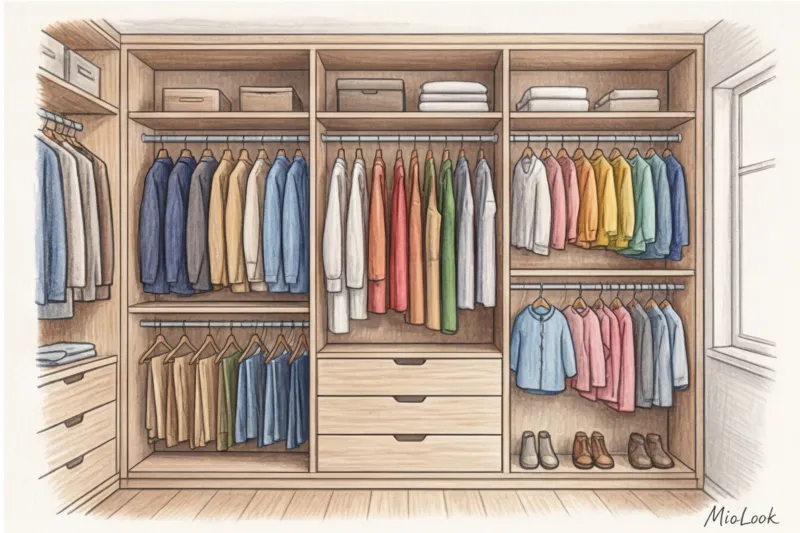
The invisible problem with family wardrobes isn't a physical lack of space, but a blind spot in our perception. Items are bought on impulse or during seasonal sales, then lost on back shelves and languish in the dark depths of dressers. Children quickly outgrow bright sweatshirts worn only a few times, while adults accumulate pointless duplicates. As a textile expert and practicing stylist, I always say: closet chaos is a huge black hole in the family budget. But once you digitalize physical items, spontaneous consumption transforms into conscious management of family assets. By establishing MioLook , you begin to see a complete, transparent picture of what your family actually owns, right on your smartphone.
Let's look at some objective figures. According to a 2023 report by the respected British organization WRAP (Waste and Resources Action Programme), the average family actively uses only 20-30% of their clothing each year. The rest hangs as dead weight, deforming on hangers. The environmental aspect is most alarming: children's fast-fashion clothing is now recognized as one of the main sources of global textile waste. We buy children cheap, low-quality polyester clothes by the bagful, justifying it by saying, "They'll rip and outgrow them anyway." As a result, mountains of synthetics end up in landfills, barely surviving three or four washing cycles. I encourage my clients to shift this paradigm and embrace the concept of "wardrobe as an asset"—treating clothing purchases like financial investments, assessing the durability of the fibers and the actual frequency of use of each item.
The Hidden Cost of Lost Items
If you think a couple of extra T-shirts don't make a difference, consider the hidden cost of storing them in different places. A thorough analysis of my clients' budgets shows that a family of four loses an average of €400 to €900 annually on impulse purchases, unworn duplicates, and emergency replacements. We rush to buy new jeans for our son for €45 because we completely forgot about a great pair of heavy denim that a cousin gave us and tucked away in the top shelf.
The problem is compounded by complex home logistics. Winter down jackets are compressed in vacuum-sealed bags under the bed, spring boots are folded into bland cardboard seasonal boxes in the hallway, and children's everyday clothes are haphazardly stuffed into dressers. Under such conditions, our brains are physically unable to retain the entire volume of textiles in our memory. Before moving on to digital inventory, I strongly recommend conducting an honest physical inventory. How to do this without stress and frustration is described in detail in our article about preparing your closet for wardrobe digitalization.
"You can't manage what you can't measure. As soon as we digitized our family closet, I was horrified by how much money was sitting in forgotten items. Now, before going to the store, I just open my phone." This insight is shared by almost every client after a month of working with a digital wardrobe.
Men's Wardrobe: How to Save Your Partner from the "Nothing to Wear" Problem
Have you ever wondered why Mark Zuckerberg or Steve Jobs wore the same clothes for years? It's not a lack of taste or self-neglect. According to research agency Mintel (2023), over 65% of men admit to experiencing classic "decision fatigue" as early as choosing a shirt in the morning. The psychology of men's style is based on strict logic: men prefer an algorithmic approach to clothing. They generally don't need the emotional experience of trying on clothes—they need a functioning, predictable system that doesn't fail.
One of my recent clients, the IT director of a large company, complained that he consistently spent 20 minutes before every business trip trying to pack his suitcase, and upon arrival, he frantically searched for a steamer in the hotel. We solved this problem by putting together a compact smart-casual capsule of 14 items. The most important step was replacing base layers. I strongly recommended removing all thin poplin office shirts—they wrinkle even just from fastening your seatbelt in a taxi. Instead, we purchased twill shirts with a cotton weight of at least 130 g/m².
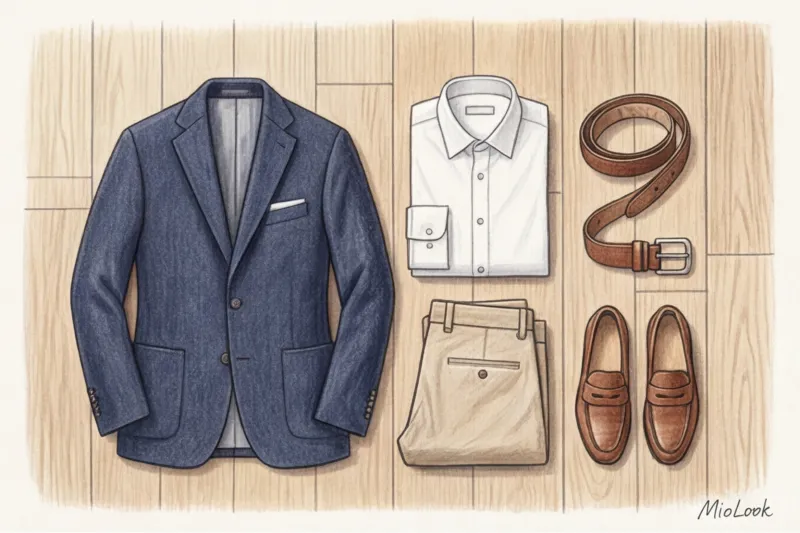
Thanks to its distinctive diagonal ribbing, Twill fabric has a natural elasticity: it practically doesn't wrinkle in a travel case and regains its smoothness simply by hanging it on a hanger in a damp bathroom. We photographed all the updated items and uploaded them to virtual wardrobe (app) , creating ready-made look formulas. Now the client has clear presets on their phone: "Office without a tie," "Flight," "Dinner with investors." Getting ready takes exactly three minutes—they simply open the lookbook and pick out what the algorithm dictates.
Another powerful tool offered by digitalization is style synchronization. Have you ever noticed how often dissonance arises during outings together? You spend half the day getting ready for a friend's wedding, choosing an elegant slip dress in thick silk, while your partner walks out the door in their favorite, but completely inappropriate, pair of distressed jeans. With family access to a database of items, you can plan couple looks right on the screen. The app allows you to visually compare textures: for example, to ensure that the matte wool of their jacket complements the sheen of your dress, without resorting to exhausting joint fittings in front of a mirror.
Access to MioLook for €0.99 — one-time payment
A smart AI stylist will select the perfect paired looks and help you digitize your men's wardrobe in just a few clicks.
Get access — €0.99 onceWear tracking: when is it really time to buy new jeans?
Men's basics are typically worn more heavily and washed more harshly than women's. To convince my partner to invest in quality rather than buying fast fashion every season, I use the Cost-Per-Wear (CPW) metric—the price per garment.
Let's say a pair of high-quality selvedge jeans made of heavy denim costs €150. If a man wears them 100 times over a year and a half, the cost per wear will be only €1.50. Meanwhile, a pair of mass-market jeans that costs €40 and will lose their shape after 15 wears will cost €2.60 per wear. The math speaks for itself, and the app makes it very convenient to track the actual frequency of wear for each item.
But how can you physically tell when it's time to replace a garment? Pay attention to the "fabric fatigue" markers. If jeans contain elastane (even 2-3%), the polymer fibers degrade with regular washing at temperatures above 40°C. This visually manifests as "bubble" on the knees that no longer disappear after ironing. Fiber deformation, pigment fading in the folds, thinning of the back seam, and micro-tears near the pockets are objective signs that trousers have exhausted their urban lifespan. They should be reclassified as "outdoor wear" or recycled.
Children's clothing: managing growth and seasonality without stress
Have you ever noticed that a child's growth spurt always happens suddenly, literally a week before the first serious cold weather? March and November are the two months when parents buy up outerwear in large quantities, out of sheer desperation. Managing a child's closet requires the skills of a true crisis manager, especially when their anthropometric measurements fluctuate every three to four months.
Size prediction is the very function for which families need virtual wardrobe (app) Instead of frantically searching for winter overalls during peak season, when prices on quality brands soar to €150–200, you can calmly plan your purchases during the final sales in February. By creating a tag like "Winter 2025_Height 116," you can pre-create your virtual shopping cart for next year, taking into account standard pediatric growth charts.
This systematic approach automatically solves a second, equally pressing problem: tracking your wardrobe. No more mornings getting ready for kindergarten accompanied by the phrase, "We have winter pants, but we don't have a matching jacket." A visual grid on your phone allows you to instantly assemble complete outfits. You see a pair of overalls, choose a parka with the right temperature rating, and check the hat color and whether or not it has waterproof gloves. If an item is missing, a visual "hole" appears in your wardrobe, easily filled with a targeted online purchase.
Now imagine packing for the beach. One-click seasonal sorting transforms virtual vacation planning with kids from a chaotic rummaging through suitcases into a clear plan. Flying from winter to the tropics? Filter your summer essentials, check that the kids haven't outgrown UV-resistant swimsuits, and buy only the essential items, avoiding duplicates of the same sunhats.
"As a textile specialist, I regularly see parents trying to save on a midlayer by buying cheap fleece from the mass market. This is a critical mistake for an active child's thermoregulation. Cheap polyester traps moisture: the child sweats, instantly cools down in the wind, and gets sick."
If you're building a long-lasting base, invest in high-tech fabrics. Membrane level Gore-Tex or Sympatex With a waterproof rating of at least 10,000 mm and a vapor permeability rating of at least 8,000 g/m²/24h, this guarantees that your child will stay dry even when sitting in a spring puddle. And the ideal base layer should always be 100% merino wool. Unlike cotton, which absorbs sweat and feels like a cold compress, merino wicks away moisture and maintains warmth even when damp. A high-quality merino longsleeve starts at €50–€70, but the natural elasticity of the fiber allows you to wear it for two or three seasons in a row.
Rookie Mistake: Don't Digitize Sandbox T-Shirts
There's a counterintuitive piece of advice I give in my consultations: when families first set up a digital organizer, there's a temptation to photograph absolutely everything, right down to the pair of leggings they wear at home. Trust the statistics from my audits—total digitalization kills motivation after exactly 30 items.
To MioLook To ensure your smart assistant works for you and doesn't become a second unpaid job, follow the strict "Investment Wardrobe" rule. We only include items in our catalog that are expensive, complex, or seasonally specific.
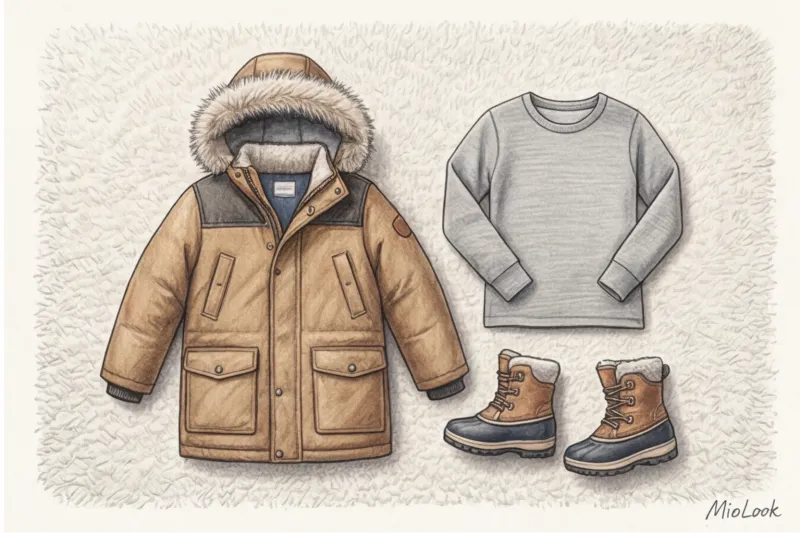
What really needs to be added to the system:
- Outerwear (winter parkas, demi-season jackets, membrane windbreakers);
- Technological thermal underwear and high-quality midlayer;
- Shoes (here it is critically important to ensure that the millimeters on the insole match);
- School uniform (helps you keep track of how many shirts you actually need for a five-day week without daily washing);
- Dressy clothes (dresses and suits for matinees, which are easy to forget about within a year).
Regular basic long sleeves, knit shorts, and the notorious "sandbox T-shirts" are consumables. Store them vertically in a dresser, KonMari style. Wasting time cataloging them is pointless: after a month of active play, they'll inevitably become stained with grass or gouache and be relegated to the textile recycling category.
Archiving and inheritance: passing things on to younger siblings wisely
According to a 2023 report by the Ellen MacArthur Foundation, quality clothing is worn 36% less often today than it was fifteen years ago. This is especially true for children's clothing, where items often simply "hang" in the blind spot between older and younger children. To prevent sweaters and jackets from becoming dead weight, the virtual wardrobe app allows you to elegantly reassign them to the "Archived" status. This is a brilliantly simple function: the clothing is excluded from the daily selection of looks for the older child, but a digital copy of it is stored in the database. Children grow non-linearly, in spurts. A digital item card with notes on the actual sleeve length or inseam measurements (not just an abstract "4Y" tag) allows you to know exactly when the younger child will grow into these pants. As soon as this happens, you can filter the archive with one click and return the desired items to active rotation.
The next level of organization is the so-called virtual boxes. Consider the classic situation: a sudden cold snap hits, and you're trying to remember which vacuum-sealed bag you put your winter overalls in on the attic last March. Digitization allows you to assign location tags to archived items, for example, #Box_Mezzanine_Winter You know exactly what's inside the opaque bag without even opening it. This saves hours of time and stress during seasonal wardrobe changes.
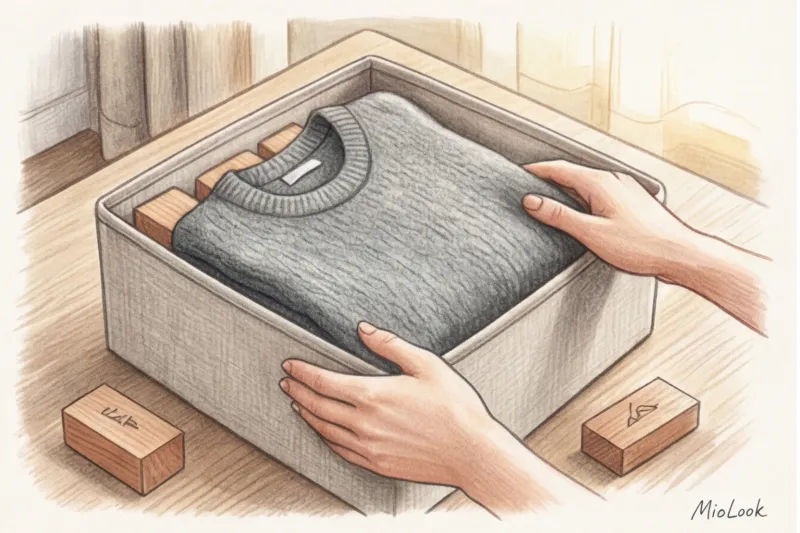
"Hiding an expensive item out of sight doesn't preserve it. Improper packaging destroys the fabric's structure faster than active daily wear."
As a textile technologist, I must issue an important warning here. Long-term storage of natural fabrics (alpaca, merino, and organic cotton) requires adherence to strict physical parameters. One of my clients once ruined children's cashmere sweaters worth approximately €250 simply by leaving them in thick plastic bags from a dry cleaner for two years. Plastic doesn't allow air to pass through, which inevitably leads to the accumulation of microscopic residual moisture, yellowing of the fibers, and the development of a persistent musty odor.
Secrets to proper storage that will extend the life of children's clothes:
- Give up plastic. Use only breathable cotton covers or spunbond cases.
- Use pH neutral paper. Line delicate items with acid-free paper—it prevents dye migration, absorbs excess moisture, and protects light-colored fabrics from yellowing.
- Natural protection. Forget about the chemical mothballs, whose harsh molecules eat into the fiber structure. Place polished cedar blocks or sachets of dried lavender between your garments—they gently repel moths without damaging the wool's lipid layer.
Try MioLook
for free
Start creating perfect images with the help of artificial intelligence
Get access — €0.99 onceFinally, the ethics of hand-me-downs can't be overlooked. If a younger child's clothes aren't the right gender, size, or simply don't fit their lifestyle, it's logical to give them to family friends. But bringing acquaintances an unmarked bag of wrinkled clothes is an outdated approach that often puts the recipient in an awkward position. A virtual wardrobe changes this game. You create a small collection in an app, for example, "Fall Essentials for a 5-Year-Old Boy," and send your friends screenshots of the finished capsule collection. The recipient immediately sees the color scheme, brands, condition, and ready-made combinations: "Aha, here are 6 great items that can be combined into 10 looks." This approach demonstrates respect for others' time and turns getting rid of excess into a beautiful, aesthetically pleasing, and truly useful gesture.
Step-by-step instructions: implementing a virtual wardrobe (app) over the weekend
A study by The Wardrobe Crisis Institute (2024) reveals a curious paradox: people are willing to spend up to 15 hours a month searching for new clothes online, but they're reluctant to spend a day organizing what they've already bought. Digitizing your entire family's closets sounds like an overwhelming IT project, but in reality, it's a carefully planned two-day sprint. Your goal is to transform the chaos of clothes into a manageable database, where your virtual wardrobe (app) becomes the primary logistical resource. I suggest you clear off the next weekend and do this once and for all.
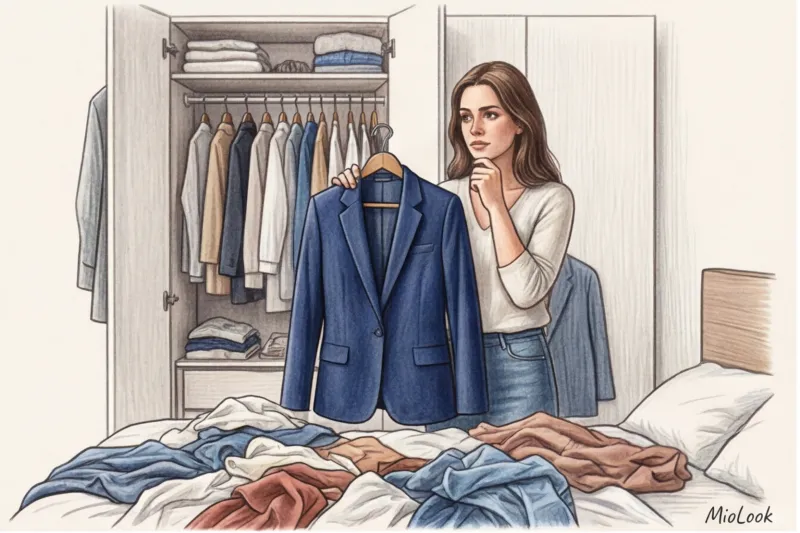
We start Saturday mornings not with a smartphone, but with a physical preparatory stage—a thorough audit. Unload absolutely everything onto the bed or a clean floor. First rule: don't try to upload items that are long overdue for recycling. Divide your clothes into three neat piles: "actively worn," "needs repair or dry cleaning," and "to recycle/donate."

Every item in the "questionable" category must be ruthlessly discarded. If your husband's shirt won't wash out yellow deodorant stains, or your kids' jeans are threadbare, they don't deserve a place in your new system.
Evaluation of fabric resource during sorting
How can you accurately determine whether an item is worth leaving to a younger child or whether it won't survive another season? This is where tactile testing comes into play. Before consigning a sweater to the "heirloom" category, I always ask my clients to tactilely inspect the twist and density of the fabric.
Place the fabric between your thumb and index finger and rub gently. If the fibers easily separate, leaving visible gaps, the fabric has lost its structural integrity. High-quality cotton or merino wool should have a tight, slightly springy twist. If the fabric feels like a loose sponge, it's worn out.
Be sure to perform a pilling test. If a children's hoodie costing around €40 has formed hard, machine-resistant pilling after just five washes (especially in the friction areas on the sides), the manufacturer used the cheapest short-staple fiber. It's not a good idea to pass it on to a younger sibling; it will look untidy. Finally, perform a seam stretch test: gently pull the fabric across the stitching at the hips or elbows. If the threads crackle alarmingly and the elastane doesn't return the fabric to its original state, the garment is sent for textile recycling.
Once the selection process is complete, we move on to the digitalization stage. My clients' biggest fear is the need for professional photos. As a stylist, I can assure you: you won't need softboxes or studio backdrops to create the perfect "catalog" shot at home.
My secret: use only diffused daylight from a window, preferably in the morning. Never shoot in direct sunlight (it creates harsh shadows) or under a yellow ceiling light (the AI misinterprets the color temperature). Lay your items out on a flat, contrasting background—a light, wrinkle-free sheet or a piece of basic poster board. This will make it much easier for the app's algorithms to accurately crop out the background.
Straighten the collars and sleeves so the camera captures a clear silhouette. Focus especially on the texture of the fabric. Make sure the photo clearly shows whether it's smooth poplin, chunky cable knit, or stiff denim. If the garment has a complex ribbing (like corduroy) or a specific print, zoom in on that area. Artificial intelligence needs this information to create the right textural contrasts in future looks.
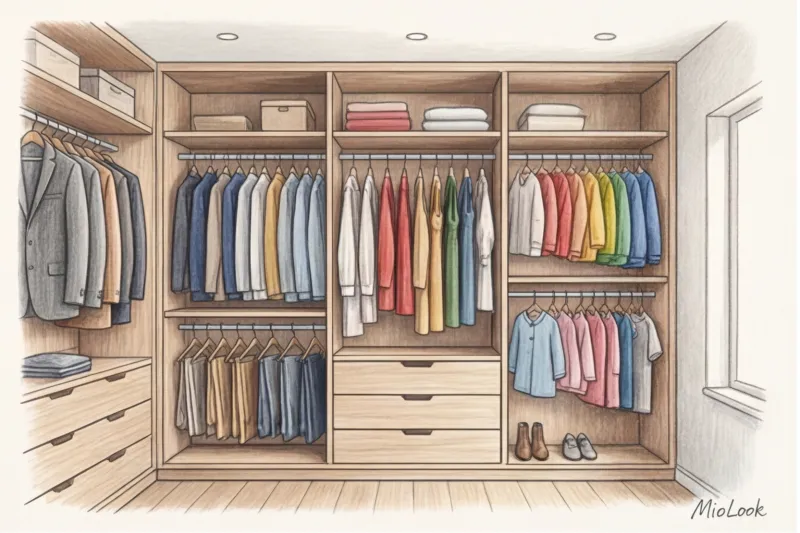
Sunday is the time to create profiles and data architecture. If you simply dump hundreds of photos into one account, you'll end up with the same unmanageable pile of clothes, only on your phone screen. Be sure to separate your family account into tags.
Instead of faceless "Men's" folders, use micro-categories for specific partner needs. Tags like #Daddy_Office (for a strict base), #Daddy_Sport or #Business trip For children, it's crucial to be consistent with growing sizes and seasons. #Misha_Winter2025 will help you instantly filter out the latest insulated trousers and down jackets from the virtual mass.
Tagging functionality, for example, when using MioLook , turns packing for school or vacation into a three-minute task. You simply select the necessary filters, and the system displays only the items that are appropriate by size, season, and purpose for a specific family member right now. This is true automation of routine.
The Economics of a Smart Family Wardrobe: Calculating ROI
Behavioral economics is ruthless: we spend the most money on clothes we simply forget we have. This problem is especially acute in children's departments. A parent's brain is easily swayed by bright prints and seasonal sales, but when you have something on hand virtual wardrobe (app) The magic of spontaneous spending instantly dissipates. The sobering effect of "I know we already have three sweatshirts" sets in. You open your smartphone right before the checkout, see your child's digital capsule, and realize that a fourth sweatshirt isn't a bargain, but future textile waste.
A similar principle applies to men's business suits, but here, proper use, rather than limiting the quantity, is paramount. Wool fibers are hygroscopic—they actively absorb body moisture and odors. A men's suit made of 100% high-quality wool (for example, with a Super 120s twist index) should be left to rest on a wide wooden hanger for at least 24 hours between wears. This allows the fibers to naturally release moisture and restore their original shape. Alternating between two work suits increases their combined lifespan not by two, but almost three times. A smart app helps you create a wearing schedule, signaling which trousers should be retired.
To finally address the issue of profitability, let's look at how AI-powered shopping analytics can help calculate the true value of brands by comparing an expensive but durable down jacket with a cheap seasonal jacket. To do this, we'll use the Cost-Per-Wear (CPW) metric—the cost per item.
Let's calculate the CPW of a premium brand children's winter overalls priced at €180 (with a membrane rated at 10,000 mm H2O and a wear resistance of 50,000 Martindale cycles). Thanks to the durable fabrics, it can reliably serve an older child for two seasons, and then be passed on to a younger child for two more. Total: 4 seasons of active wear (an average of 480 days). Your actual consumption is only €0.37 per day of wear.
Now let's take a mass-market alternative for €60. The synthetic insulation clumps after three washes, and the knees are worn through by March. To cover the same four seasons for two children, you'd have to buy four of these jackets. Bottom line: €240 spent, the children regularly froze in half-worn clothes, and the cost per outing was €0.50. Digital accounting makes these calculations completely transparent, proving in practice that investing in high-tech fabrics always protects the family budget.
Your ideal image
it begins Here
Join thousands of users who look flawless every day with MioLook.
Get access — €0.99 onceAI-powered shopping: ending dressing room arguments
Have you ever seen that scene: you're standing in a fitting room at a shopping mall, and your partner, with growing irritation, refuses to try on the next item, arguing that "I already have normal jeans"? Over 12 years of styling, I've discovered an interesting pattern: men's resistance to updating their wardrobe is most often driven not by stubbornness, but by a lack of a clear visual context.
The male brain prefers a systematic approach. It's one thing to suggest trying on a pair of abstract wool chinos for €120, and quite another to show a working scheme. My personal observation: visualizing the finished look directly on a smartphone screen instantly removes men's objections to new purchases. When they see how a specific detail fits into the overall puzzle, the process no longer seems a pointless waste of time.
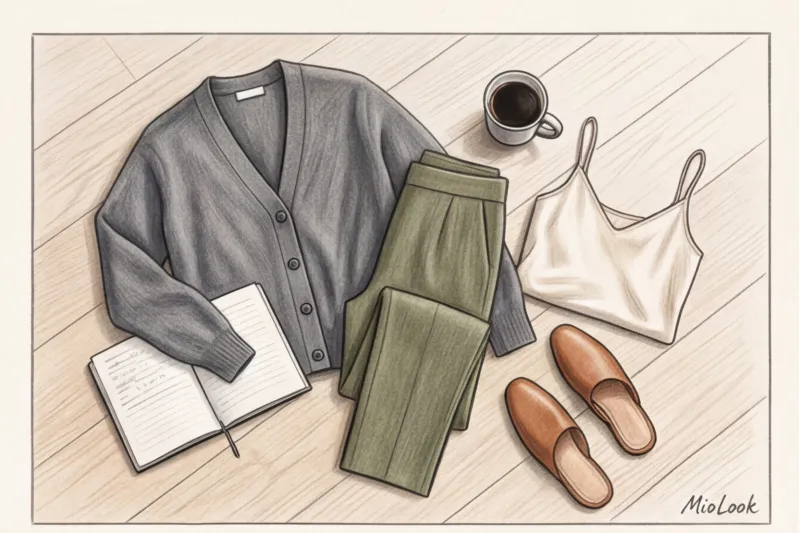
It is in such situations that the purchase planning function in MioLook Saves stress for the whole family. By uploading your current list to the app, you can virtually "try on" a potential new item alongside your existing items. Your partner can see in advance how perfectly these olive trousers will pair with their favorite jackets or textured cardigans. Arguments in the store simply don't arise—you're focused on getting the item you want.
This same algorithm is incredibly useful for creating family wish lists. Before Black Friday or major seasonal sales, spontaneous shopping can wreak havoc on your budget. My clients and I always create a digital wish list: from children's membrane shoes in the right size to basic turtlenecks for their husband. The AI assistant helps identify real gaps in your wish list before you're swayed by the red price tags.
Another bonus of a smart approach is seamless remote shopping. If only your partner is going to the store, you no longer have to try to explain a color or texture simply by hand. A wife can send her husband a precise visual request with a ready-made reference in one click. Instead of a vague "buy dark gray pants," he receives a clear technical specification: "Straight-fit trousers, graphite color, fabric parameters: worsted wool, fabric density of at least 250 g/m²" Men are very receptive to these types of technical specifications, and this level of specificity ensures that the item you buy won't end up gathering dust on a back shelf.
Checklist: 10 Rules for a Long-Lasting Family Wardrobe
We tend to think that a sustainable approach to clothing is necessarily expensive and difficult. However, research Global Fashion Agenda (2024) proves the opposite: smart textile management within a family saves households up to €450 per year. As an author and ambassador of smart consumption, I've developed my own formula for the ideal closet. It's a balance between caring for the planet, daily comfort, and high technology, where an algorithm takes care of the routine, leaving you free to be creative.
To solidify everything we've covered in this guide, I've put together a final checklist. These 10 principles will help you transform your impromptu shelving into a working system.
- Buy a base in neutral shades. This is crucial for children's clothing, as it facilitates the passing down of items from sibling to sibling. Oat-colored sweatshirts, classic blue denim, terracotta jackets, and khaki parkas transcend gender stereotypes.
- Look at the composition: at least 70% natural fibers for children's first layer clothing. If a T-shirt, thermal underwear, or long-sleeved top fits snugly, avoid too many synthetics. Polyester blocks moisture wicking, causing children to quickly become chilled on the playground.
- Update item statuses regularly. Your virtual wardrobe (app) It should reflect reality. Make it a habit to tag items once a week: "in the wash," "in need of repair," or "worn out." This will eliminate morning arguments when your husband tries to find a shirt that's been at the dry cleaners for two days.
- Use size tags that indicate actual centimeters, not arbitrary years (3Y, 4Y). Brand patterns vary dramatically: a 4-year-old sweatshirt from one manufacturer may be hopelessly small compared to the same size from another. Create precise tags in the app: #StepSeam_42cm or #Sleeve_35cm.
- Invest in outerwear accessories. A €150 winter parka with a YKK tractor zipper and reinforced seams will easily last three kids in a row, while a cheaper alternative will tear on a slide within the first month.
- Repair before throwing away. Applying new patches to worn-out knees or artistic darning using the sashiko technique is a modern trend for mindfulness.
- Sort by texture, not just by season. In the app's family profile, group corduroy, heavy cotton, and wool items into separate visual boards. This helps you quickly assemble layered looks for family photo shoots.
- Introduce a quarantine on spontaneous purchases. The 24-hour rule works great when shopping online. Add a screenshot of your desired item to the digital fitting room and see if it matches your existing wardrobe.
- Wash men's denim and children's knitwear at 30°C. Using liquid enzyme products at low temperatures prevents fibre thinning and pilling.
- Follow the "One in, one out" principle. Every new, bulky item purchased for an adult family member should physically replace one old one. Otherwise, digital order will quickly be shattered by the real-life lack of hangers in the closet.
Managing your family style no longer has to be a daunting task. Take the first practical step today: identify the biggest problem area—for example, a drawer full of children's T-shirts or a shelf full of men's knitwear. Eliminate worn-out items, check the labels, and photograph the remaining essentials. You'll be surprised how much more your home will breathe when things stop managing you and you start managing them.
Guide Chapters
Sorting out a child's wardrobe: what to do with small items
Are you buying clothes "to grow into," but your child doesn't have time to wear them? Learn how to properly declutter your closet and find a place for clothes that are too small.
Seasonal wardrobe change: how to quickly sort through your clothes
Packing for winter doesn't have to be a disaster. A practicing stylist shares her secrets for smartly auditing and organizing a family's wardrobe.
Smart Packing List for Vacation with Kids: A Family Capsule
Forget about excess baggage and packing chaos. Our stylist's tips will help you assemble the perfect vacation capsule for the whole family, so you can travel light.
Capsule Wardrobe for Schoolchildren: A Smart Approach
How to put the "nothing to wear" problem behind you before school? Practical tips from a stylist on creating a comfortable and affordable capsule wardrobe for your child.
How to build a man's wardrobe without shopping
Shopping together is the worst way to improve your partner's style. Learn how to update your man's wardrobe without stress, using logic and a systematic approach.
Perfect family look images without matching clothes
Forget about buying identical items only once. We'll show you how to create harmonious family looks that highlight each person's individuality.
How to organize a child's wardrobe: tracking in an app
Kids are growing fast, and simply piling clothes on shelves no longer works. Find out how a virtual clothing management system can save you from unnecessary spending.
How to plan clothing purchases profitably and without mistakes
Forgotten clothes with tags and a fifth identical shirt are symptoms of a lack of system. Discover an expert's approach to smart family wardrobe planning.