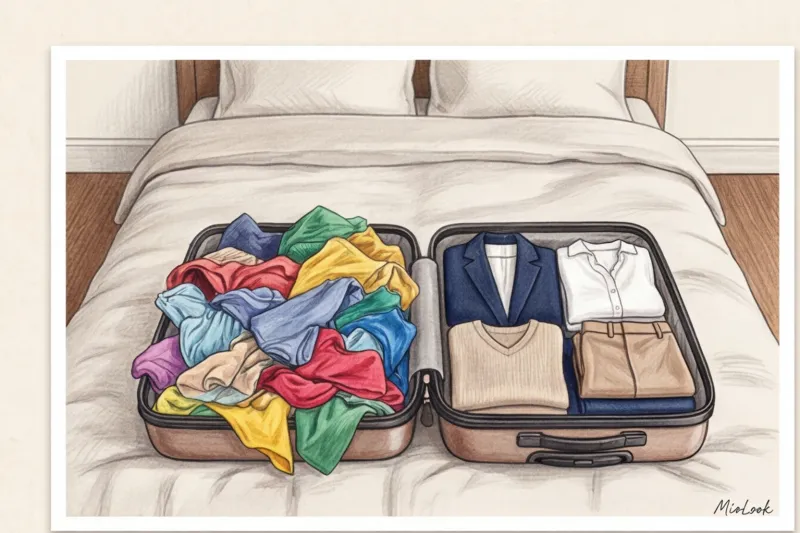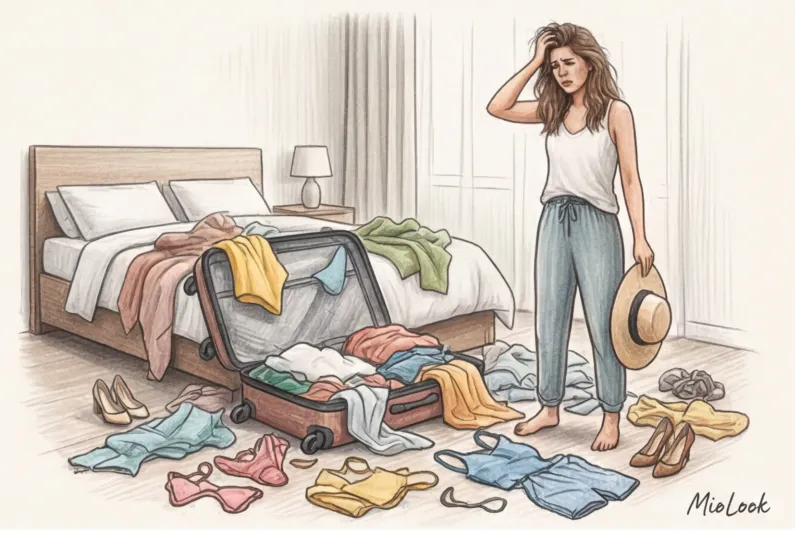
Two years ago, I was standing in the middle of Tokyo's Narita Airport with a tiny carry-on suitcase. The customs officer looked at my immigration card in surprise, which stated: 14-day stay. "Where's your main luggage?" he asked politely. But there was no main luggage. I'd brought just 12 items of clothing, from which I'd previously created 42 unique looks. It was then that I finally realized: to travel light, you need to pack ready-made outfits, not just clothes. And the best suitcase packing app — this is not another list with checkboxes, but an algorithm that analyzes your wardrobe based on data.
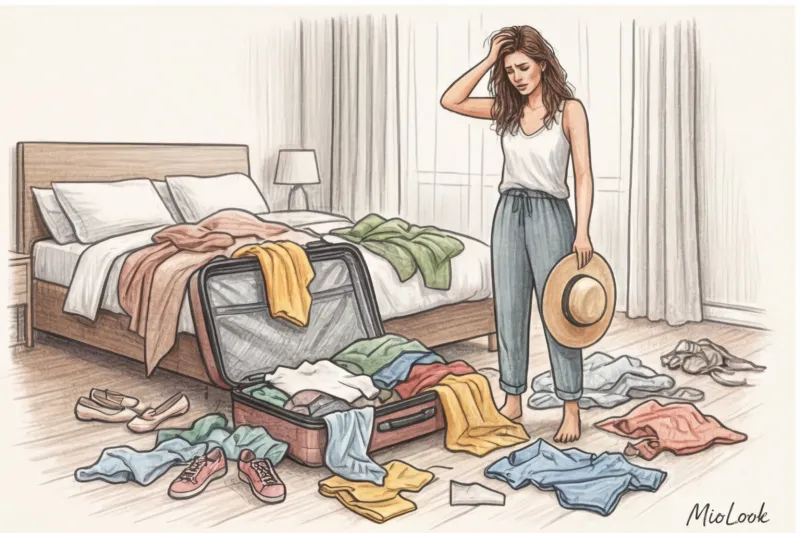
The "What if it comes in handy?" Syndrome: Why We Pack Excess (and How a Suitcase Packing App Solves It)
According to a large-scale study by the travel platform OnePoll (2023), the average traveler returns home without wearing 20% to 30% of their luggage. Why do we continue to lug around extra pounds, paying for excess baggage? The answer lies in simple psychology.
Fear of the unexpected makes us throw things in our bags, thinking, "What if we get invited on a yacht?" or "What if it suddenly gets cold?" We try to control the unknown through excess clothing. Before I digitalized my wardrobe, I was guilty of this myself. I once managed to pack five evening dresses for a seven-day beach holiday in Cyprus. I wore exactly one. The rest just sat in my room, taking up space I could have spent on local ceramics.
A paradigm shift occurs when you stop viewing clothes as discrete units. The AI stylist shifts focus: you plan outfits, not stack T-shirts. When you know exactly what you'll wear on Tuesday morning, anxiety subsides, and the need to grab a spare pair of jeans disappears.
How technology is changing the way we handle luggage
The difference between a simple list in your phone's notes and a smart suitcase-packing app is colossal. Notes will tolerate everything. They won't tell you that that linen skirt doesn't go with any of your three chosen tops because of a texture clash.
Technology allows you to visualize your luggage before you even pull your dusty suitcase from the attic. You see a grid of ready-made outfits on your smartphone screen, you can evaluate the color scheme as a whole, and your mind reassures you: "I have something I can wear every day, and it all goes together perfectly."
Access to MioLook for €0.99 — one-time payment
A smart AI stylist will select the perfect look.
Get access — €0.99 onceFrom chaos to capsule: how virtual stylist MioLook works before vacation
Digitizing your clothes sounds like a tedious weekend task, but modern algorithms can do it in seconds. You simply take a photo of the item (even right on the hanger), and the neural network automatically removes the background and identifies the category, color, and seasonality. No manual data entry required.
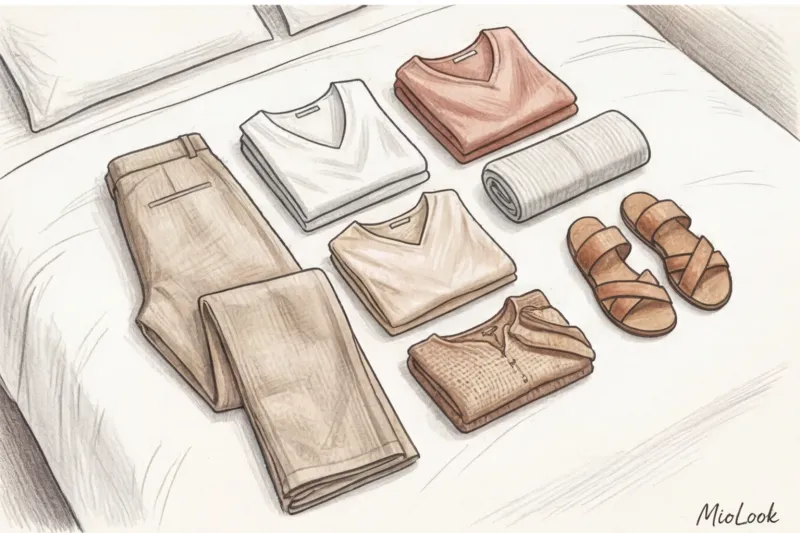
My client Anna used to regularly pay an extra 50 euros for excess baggage on European flights. Before her trip to Italy, she decided to try a new approach. In 20 minutes, while drinking her morning coffee, she photographed 15 summer items and loaded them into MioLook The app instantly created a separate "vacation capsule" for her within the shared virtual wardrobe.
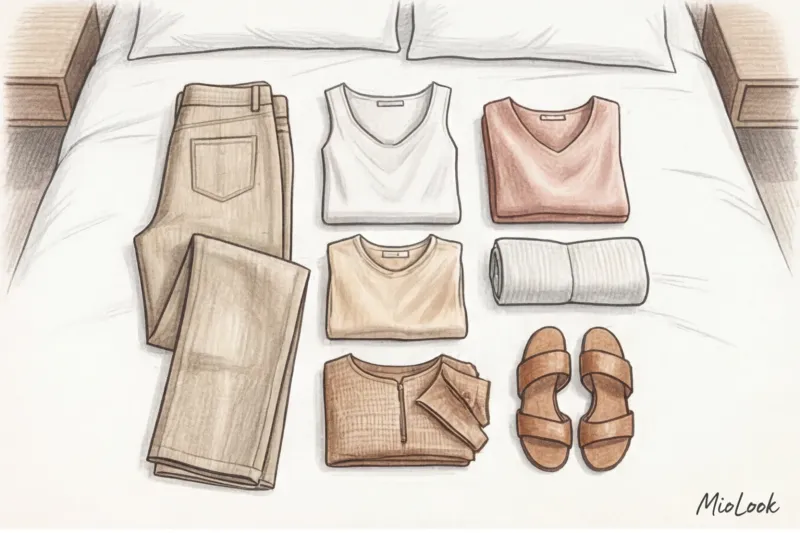
The most valuable thing here is the impartial pairing analysis. The AI objectively shows: these basic shorts work with four tops—take them. But this bright blouse with a complex print requires separate bottoms and special shoes—leave it at home, otherwise it will ruin the whole compact luggage concept.
Integration with route and weather
Smart luggage is always context-specific. You plan outfits for specific activities: comfortable casual for a ruins tour, relaxed chic for a coastal dinner, or a practical look for a flight.
Algorithms take temperature conditions into account, helping to avoid common mistakes. For example, the AI will suggest replacing dense polyester with breathable fabrics (cotton up to 150 g/m² or viscose). We discussed in more detail how to choose the right textures for high temperatures in our article about Summer business style clothing for women in the heat.
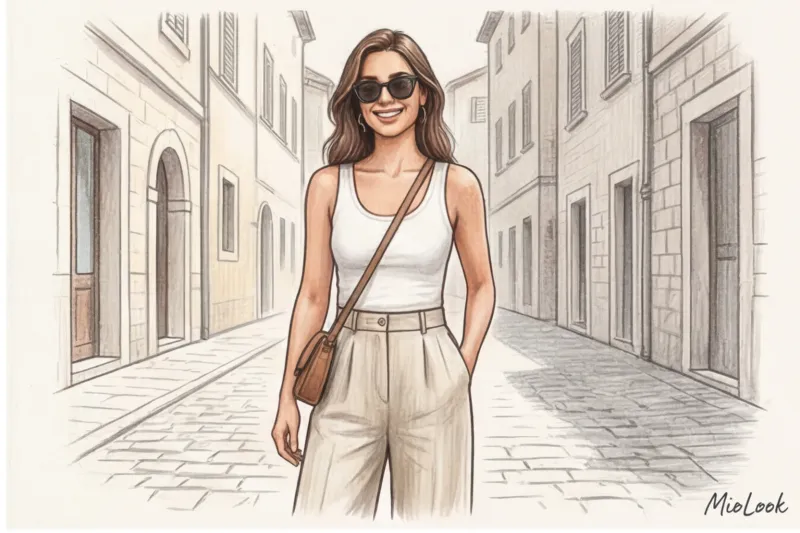
Your ideal image
it begins Here
Join thousands of users who look flawless every day with MioLook.
Get access — €0.99 onceSmart Luggage Math: The 5-4-3-2-1 Method in an App
The 5-4-3-2-1 method has long been popular among professional stylists. The classic formula for the perfect carry-on looks like this: 5 tops, 4 bottoms, 3 dresses (or rompers), 2 pairs of shoes, and 1 bag/accessory. That's 15 items in total.
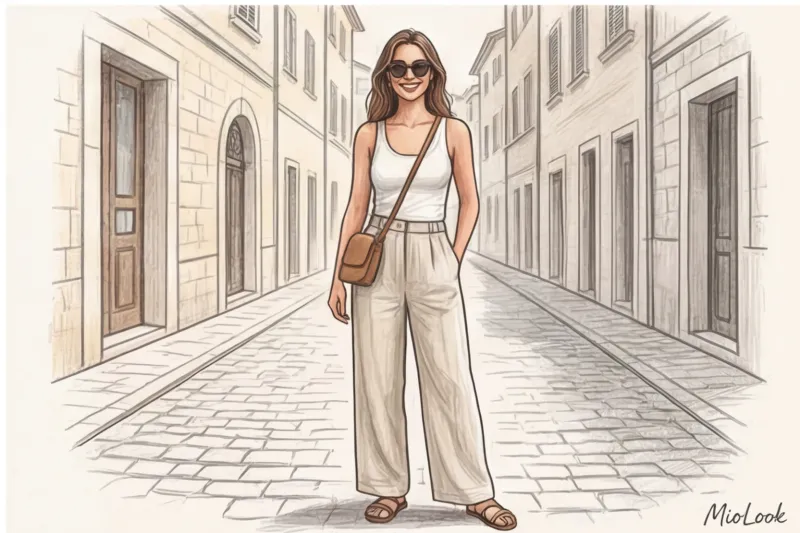
Sounds dauntingly small? Let's do the math. Five tops multiplied by four bottoms instantly yields 20 basic combinations. Add three dresses, and you get 23 distinct looks. Factor in changes in footwear (for example, sneakers during the day and sandals in the evening) and the addition of accessories, and you can mathematically generate over 40 unique looks from these 15 items. That's enough for a month of nonstop travel!
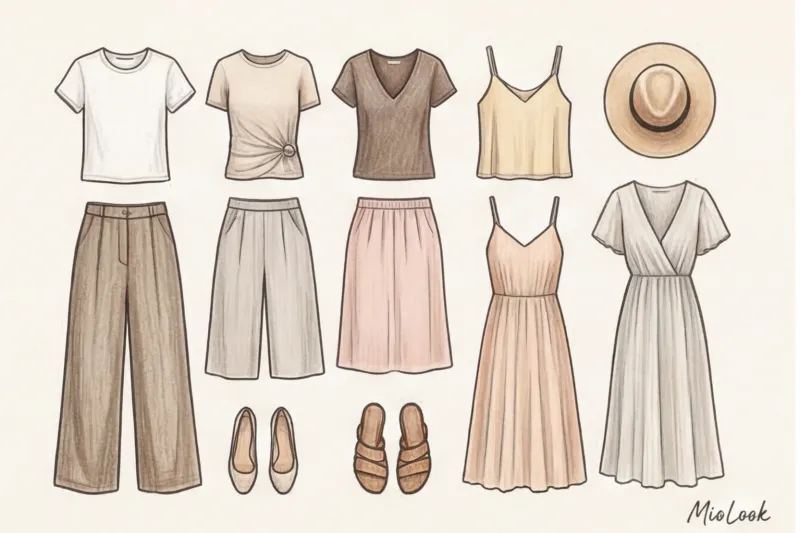
You don't even need to keep this combination in your head or draw diagrams on paper. You simply mark the 15 items you need in the app, and it automatically produces a ready-made lookbook. This saves hours of trying on in front of the mirror trying to figure out How to find your clothing style under conditions of strictly limited suitcase weight.
The Space-Saving Myth: Why Rolling Up Clothes Doesn't Save You
Open YouTube before vacation, and you'll see hundreds of videos on how to roll up t-shirts like Marie Kondo or use vacuum bags to squeeze in the unsqueezable. As a practicing stylist, I'll tell you something counterintuitive: this is the worst thing you can do to your wardrobe.
Vacuum-sealed bags and tight rolling solve the volume problem, but they dramatically exacerbate the weight and selection issues. You're masking the symptom (lack of space) instead of addressing the cause (lack of discipline). The biggest mistake beginners make is trying to pack in more random items because "there's still room."
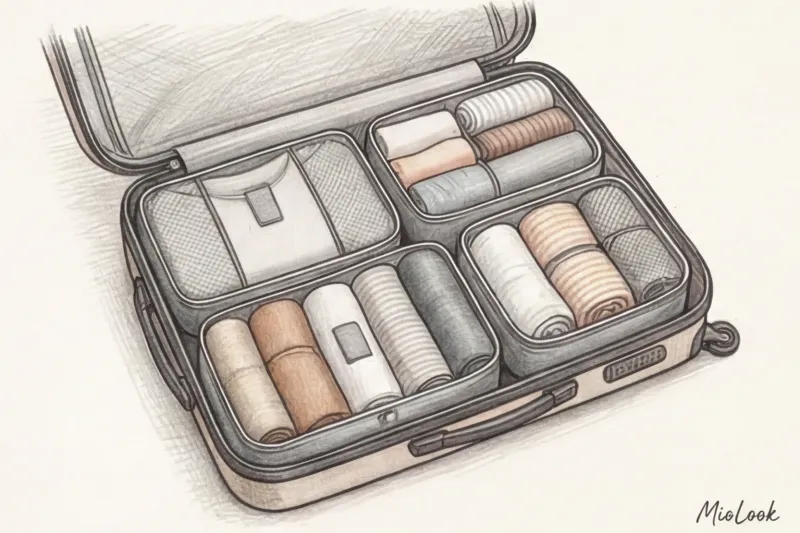
True space saving means each item in your suitcase can be worn in at least three or four outfits. If an item of clothing can only be worn once and only with one specific skirt, it absolutely doesn't belong in your luggage. The only exceptions are swimsuits and underwear.
"The secret to a lightweight suitcase isn't learning how to pack things masterfully, but learning how to masterfully exclude things at the planning stage."
To be fair, this digital minimalism doesn't work if you're going on a complex, specialized tour. For example, if you're planning a mountain trek that seamlessly transitions into a social wedding at a chateau, you'll need a full-size suitcase and two completely different capsules. But for 90% of standard vacations, carry-on luggage is more than enough.
Checklist: Packing a Suitcase with MioLook in 3 Easy Steps
Ready to try a modern approach? Here's the algorithm I teach my clients. It works like a charm, transforming getting ready from a chaotic, stressful experience into a pleasant, controlled ritual.
- Step 1: Create a mood board and choose a palette. Establish a three-color rule: two base colors (such as sand and off-white) and one accent color (terracotta or emerald). All 15 items should adhere to this rule. If you want to delve deeper into this topic, I recommend checking out our guide. capsule wardrobe.
- Step 2: Image generation by AI stylist. Open your virtual closet and let the neural network assemble outfits for each day of your trip, based on your palette and the weather forecast. Save your favorites in a separate album, "Vacation 2024."
- Step 3: Assembly strictly according to the lookbook. The most important step: Open your empty suitcase and pack ONLY the items approved in the generated lookbook. No "I'll throw in these jeans just in case." If they're not in the system, they stay at home.
Bottom Line: Travel Light and in Style
A digital approach to luggage gives you an incredible sense of freedom. You'll be freed from packing stress forever.