The Death of Subjectivity: Why a Neural Network Can Determine a Person's Color Type More Accurately Than a Stylist
A few years ago, backstage at the Max Mara show in Milan, I witnessed a surprising, yet quite typical, scene. Two celebrity stylists, whose fees start at €5,000 per shoot day, were practically shouting at each other over the new model's skin undertone. Under the makeup artists' aggressive ring lights, one insisted she was a "Soft Autumn" and desperately needed a warm terracotta jacket. The other swore with his professional scissors that she was a "Pure Spring." The irony was that both were wrong: later, in natural daylight outside, the model turned out to be a classic, chilly "Winter."
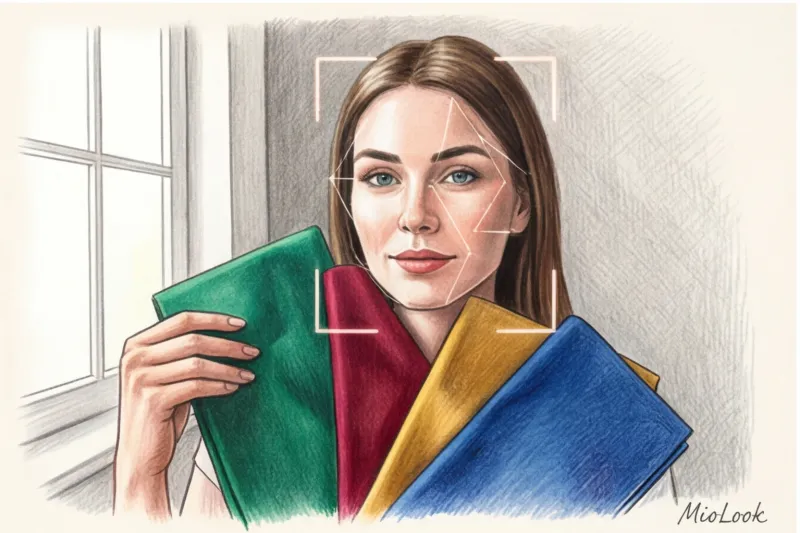
This incident forever changed my attitude toward traditional coloristics. The human eye, even the most trained by years of observation, is phenomenally biased and vulnerable to external factors. That's why today's demand neural network to determine color type of appearance has become the new gold standard not only for those looking to declutter their closets but also for professional stylists. We've finally admitted defeat to the dispassionate mathematics of color.
The fact is, our color perception isn't an objective camera, but a complex psychological and physiological filter. Back in 1963, Josef Albers, in his seminal work "The Interaction of Color," demonstrated that we almost never see color as it physically is. Have you ever noticed how after a long day of working at a computer, shades appear duller? A live stylist's assessment is influenced by their own mood, retinal fatigue, and even banal personal preferences. If a consultant adores minimalism and Scandinavian beige aesthetics, they will subconsciously "pull" your appearance toward a warm, muted palette, simply because that's what they prefer. like.
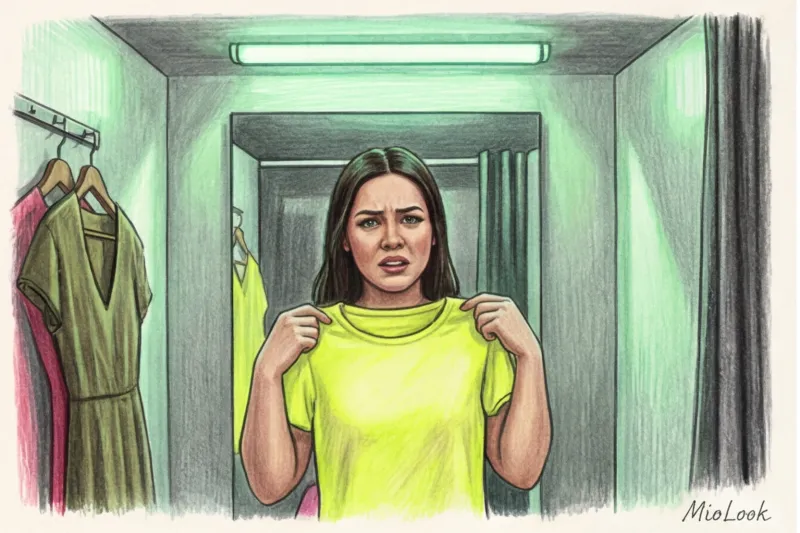
Added to this is the physics of light, or more precisely, the insidious phenomenon of metamerism. This is the same optical trick that makes a €250 silk blouse look luxuriously emerald in a department store fitting room (with 3000K, low-CRI lamps), but turns a sickly swampy color the moment you step outside.
Algorithmic objectivity is free of these human weaknesses. A machine knows no fatigue, it has no "favorite" shades, and it doesn't try to sell you a stale sweater from the new collection. It only wants a pure color.
How the MioLook neural network analyzes pixels
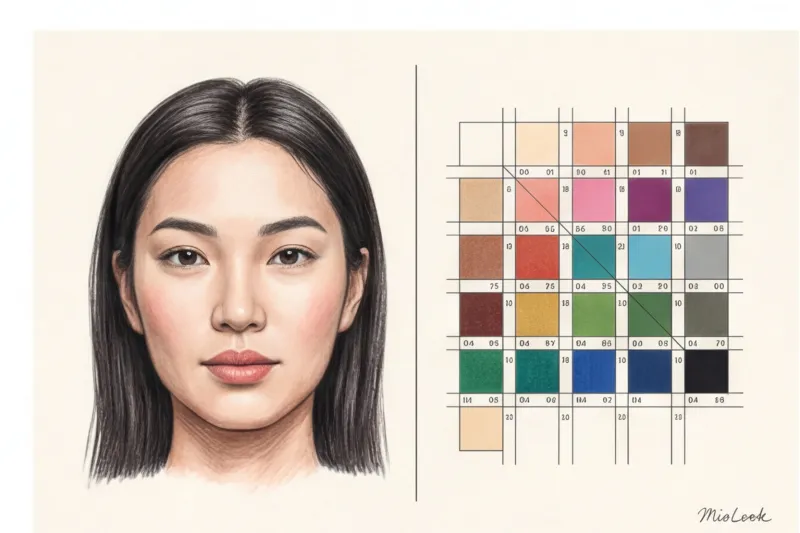
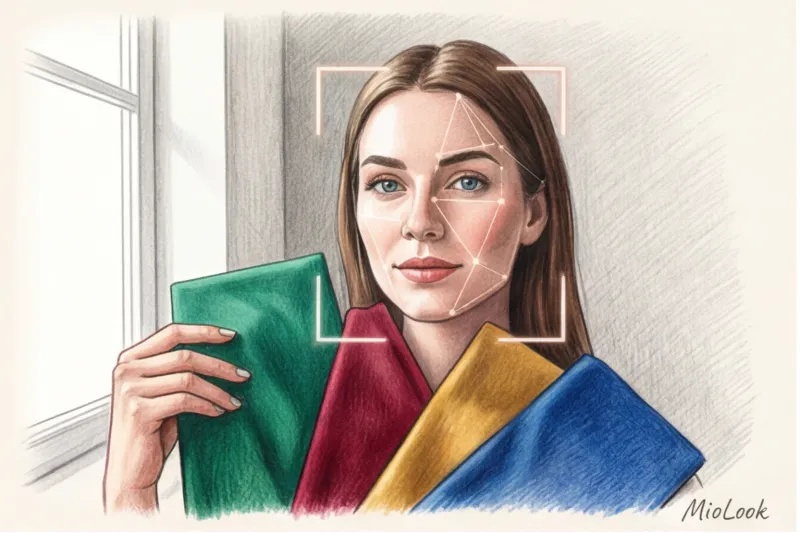
When you upload your photo in the MioLook app A computer vision algorithm doesn't see you as "a girl with light-brown hair and fair skin." It sees a detailed data map. Instead of subjectively applying colored scarves, the neural network decomposes your face into thousands of microzones and extracts precise HEX codes (hexadecimal values) for your skin, hair, and iris. For the AI, your hair color isn't an abstract "honey blonde," but a strict code like #C1B6A9.
Then comes the magic, beyond human perception: microcontrast calculation. The system calculates the mathematical difference in lightness and saturation between the white of the eye and the iris, and between the pigment of the lips and the undertone of the skin around them. According to research by color theory labs, it is this microcontrast that determines whether you'll look fresh in a graphite jacket or your face will take on a sallow hue.
"The algorithm doesn't evaluate your beauty. It measures your skin's reflectivity when exposed to specific color wavelengths. It's pure physics translated into the language of wardrobe," I often repeat in my masterclasses on integrating technology into fashion.
But the most valuable thing about computer vision is the complete elimination of "trend blindness." Human experts regularly become hostage to fashion. Now the "mob wife" aesthetic or neon "brat green" are trending—and suddenly stylists start recommending these elements to clients, ignoring their true natural features. Machine learning, on the other hand, isolates your facial features from the current cultural context.
Understanding how the algorithm works removes a lot of stylistic inhibitions. You no longer have to confine yourself to outdated theories or depend on the lighting in the boutique. Incidentally, this mathematical precision applies to more than just clothing: if you want to know... How to choose makeup based on your color type online using AI , or Determine color type from a photo: neural network for style analysis will impartially show you the very shades that will make your skin glow from within without a single gram of highlighter.
Coloristics Algorithm: From Munsell Theory to Machine Learning
In 1905, American artist and educator Albert Munsell launched a quiet conceptual revolution. He was thoroughly tired of colors being described with abstract, poetic, yet utterly imprecise terms like "the color of a frightened nymph's thigh." In response, he created the world's first rigorous mathematical system for describing color. Who would have thought that a century later, his physical color models would become the ideal foundation for the architecture of modern neural networks in the fashion industry?
Today, when we trust technology to analyze our style, neural network to determine color type of appearance It can be many times more accurate than a human thanks to the digitization of Munsell's theory. The algorithm doesn't think in terms of the stereotypical associations found in glossy magazines. It breaks down your appearance into three fundamental pillars of coloristics:
- Hue (Tint or Temperature): Is your skin's undertone in the warm, cool, or neutral zone?
- Value (Tone or Depth): How light or dark are your natural colors on a scale from white to black?
- Chroma (Purity or Saturation): Is your coloring clear and icy, or is it muted, as if dusted with gray powder?
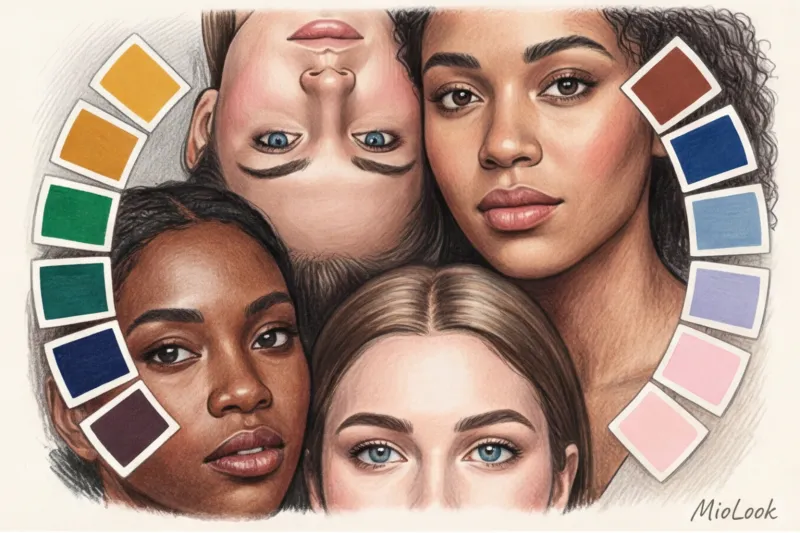
For the human brain, the 12 seasons system is a cumbersome set of palettes that need to be memorized. But for the algorithm MioLook It's a rigorous 3D digital color cosmos. Imagine a spatial map: for example, "True Winter" exists in the extreme corner of maximum depth, absolute cold, and extreme purity. When the AI scans your face, it extracts pixel values without accounting for shadows and highlights, calculates the mathematical median, and places your data as precise coordinates (X, Y, Z) into this 3D space.
This is where the answer to the question of why borderline seasonal types drive stylists so crazy and ruin clients' wardrobes lies. Let's take the most common dilemma: Soft Autumn (Soft Autumn) vs. Soft Summer (Soft Summer). Both colorways have low saturation (Chroma) and midtone (Value). The only difference is a microscopic shift along the temperature axis (Hue).
One of my Parisian clients spent years trying to solve this riddle. She spent between €300 and €400 on consultations with three different experts. Two confidently declared her a "Soft Summer," while the third categorically diagnosed her as a "Soft Autumn." As a result, her wardrobe turned into an expensive but completely dysfunctional mess of cool dusty rose and warm terracotta.
"The problem is that the human eye, even the eye of a seasoned professional, is easily deceived. The lighting in the studio, the color of the walls, a slight rosacea on the cheeks, or the stylist's simple fatigue by the end of the day—all of these distort perception. What's a gray area of guesswork for humans is a mathematical inevitability for AI."
The algorithm has no doubts. If your pixel temperature vector crosses the threshold of exactly 51% warmth with low saturation, the system classifies you as "Soft Autumn." No hesitation, no subjective preferences for specific shades, or errors due to the yellow lamp above the fitting room mirror.
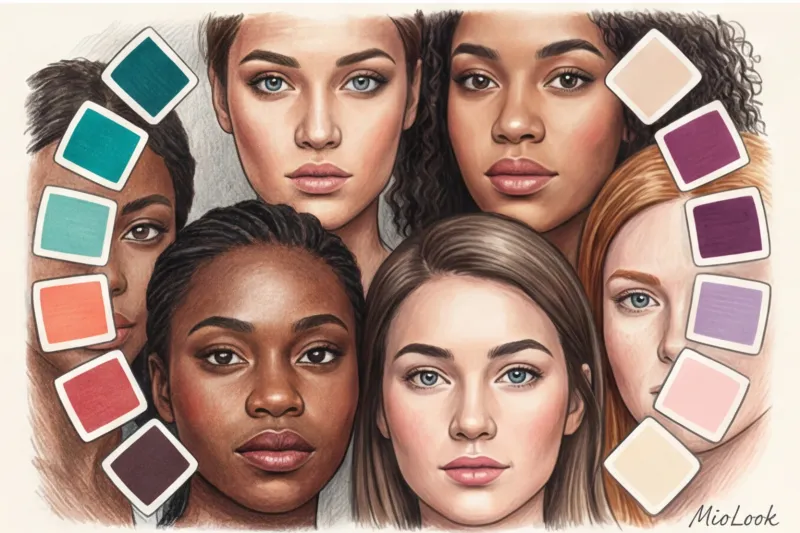
Practical advice: Forget about hours-long tests with dozens of colored drapes applied to your face. If you've been undecided between silver and gold for years and feel overwhelmed by pure colors, you're definitely on the borderline between the two seasons (Soft or Deep). This is exactly the case when it's worth delegating the task to an impartial coder and getting a final answer in the form of precise numbers.
Access to MioLook for €0.99 — one-time payment
A smart AI stylist will select the perfect look based on your unique parameters.
Get access — €0.99 onceBody Architecture: How AI Scans Body Type Without Stereotypes
In 12 years of private styling practice, I've never met a woman who would be flattered by being compared to a piece of fruit. The glossy fashion of the 2000s left us with a painful legacy: entire generations grew up believing their figures were pear-shaped, apple-shaped, or, at best, hourglass-shaped. This approach is not only hopelessly outdated, it's psychologically damaging. It reduces the complex, beautiful female anatomy to a grocery basket and forces us to focus exclusively on "problem areas" that must be hidden under shapeless robes.
Modern fashion analysis has forever abandoned fruit typology in favor of morphological analysis This shift first became evident in 1987, when stylist David Kibby published his fundamental theory of body types, based on the balance of yin (soft, rounded lines) and yang (sharp, angular bone structure). Kibby shifted the conversation about the body from the realm of "how to hide your hips" to the realm of "sartorial architecture."
Today, this philosophy has been taken up by machine learning. Just like today neural network to determine color type of appearance Perhaps much more accurately than the eyes of a tired salesperson under the artificial light of a shopping mall, algorithms have learned to flawlessly read your physical body parameters. Artificial intelligence doesn't look for flaws in you—it analyzes your geometry.
Machine analysis is based on three pillars: bone structure (ribcage width and shape, shoulder girdle geometry), dynamic shoulder-to-hip ratio, and waist definition. For the algorithm, the waist is more than just the narrowest point on the torso. The AI calculates whether the curve is caused by the muscular corset, the structure of the pelvic bones, or the distribution of soft tissue. This is precisely why a tight corset fits some women like a glove, while it makes others appear wider.
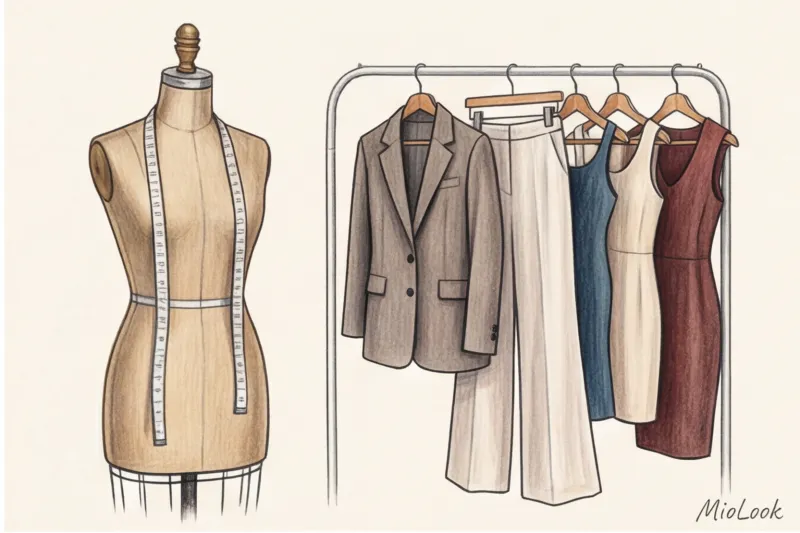
Vector analysis of proportions in the application
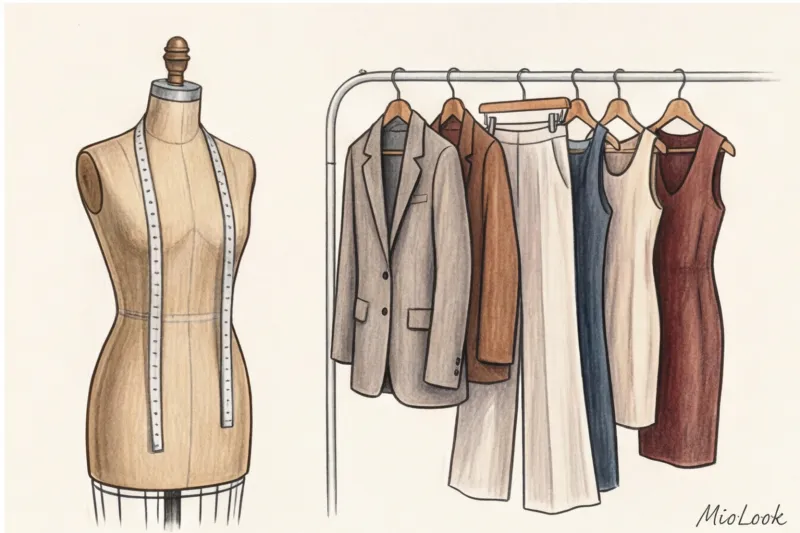
The biggest lie in the fashion industry is the blind faith in the measuring tape. The infamous 90-60-90 measurements are purely 2D, saying absolutely nothing about visual weight distribution. A woman with 100 cm hips and a height of 160 cm and a woman with the same measurements and a height of 178 cm are two completely different challenges for a clothing designer. Moreover, two women with the same hip measurements can look completely different: one woman's hips may be concentrated in the buttocks (high center of gravity), while the other's hips may be concentrated in the breeches (low center of gravity).
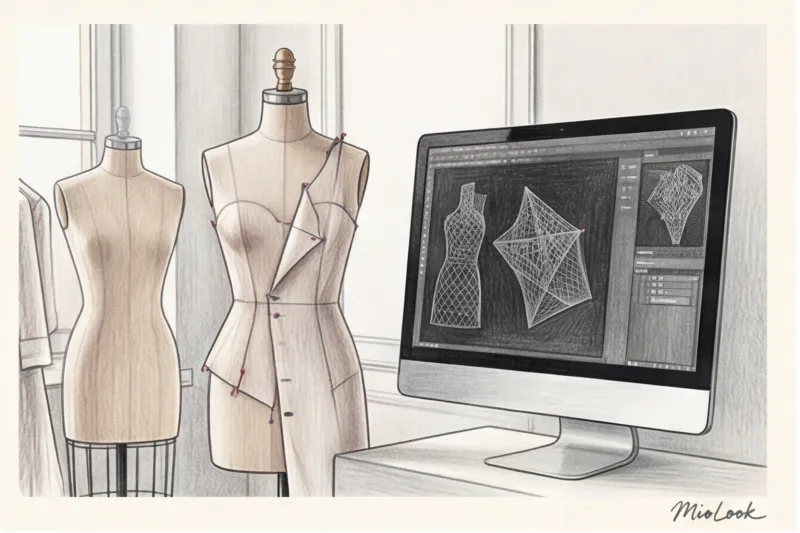
When you upload your photos to MioLook smart wardrobe The algorithm ignores flat volumes and constructs a complex system of vectors. It draws invisible axes between key structural points: the acromial processes of the shoulders, the trochanters of the femurs, the line of the knees and ankles. This allows the AI to understand how exactly mass is distributed vertically and where your actual visual center of gravity is.
"Body architecture dictates fabric architecture. If you have a sharp, defined bone structure (Yang), soft knits will look sloppy. You need fabrics that hold their shape as well as your skeleton."
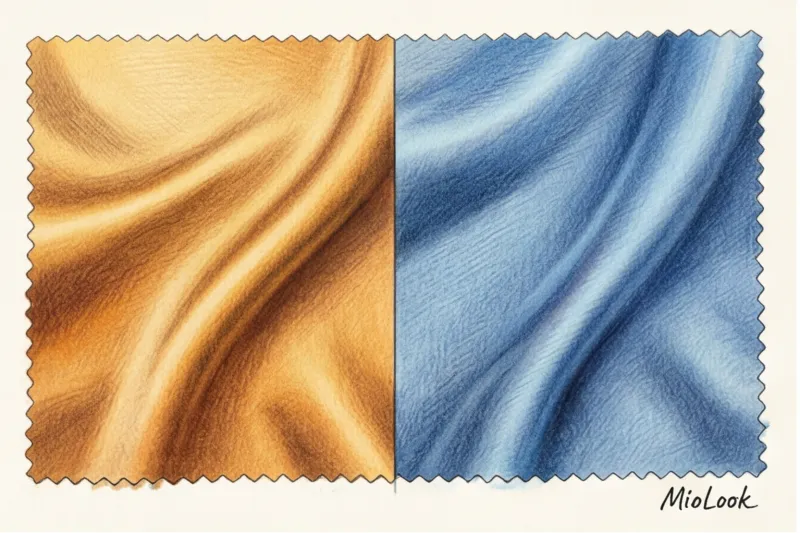
Based on these geometric points, the algorithm predicts fabric drape. For example, if the shoulder vector has a sloping, rounded slope (Yin dominant), the app will recommend flexible fabrics: heavy bias-cut silk, fine viscose, or cashmere, which will flow along the body. If the shoulder girdle has a sharp right angle, the AI will suggest rigid textures: dense gabardine, tweed, or denim, which create a clear frame.
But the most valuable thing is translating raw data into specific, millimeter-level shopping recommendations. Vector analysis allows the algorithm to calculate the optimal jacket lapel width specifically for you. If you have a broad chest and prominent facial features, the AI will recommend peak lapels of 8–10 cm. Narrow lapels of 4 cm on such a figure will appear short and visually widen the torso.
The same applies to the rise of trousers. By calculating the distance from the bottom of your bust to your hipbone, the algorithm accurately determines the ideal rise. It doesn't matter whether you buy basic jeans for €40 at a mass market or invest €350 in wool trousers from a premium brand—if the waist of the garment is off by a couple of centimeters from your natural waistline, the proportions will be off. AI eliminates this error by giving you a clear parameter: "Look for trousers with a mid-rise, with the waistband exactly 2 cm below your navel." This isn't just advice from women's magazines; it's the higher mathematics of impeccable style.
Debunking myths: common mistakes when analyzing appearance
Have you ever tried to determine your color type by painfully examining the veins on your wrist by the light of a desk lamp? If so, you've fallen victim to the most persistent glossy myth of the 1990s. When it comes to modern color theory, it's time to forget the advice from old magazines and turn to physiology.
Myth 1: The Wrist Vein Test
For years, we've been told that blue veins indicate a cool undertone, while green veins indicate a warm undertone. From a dermatological perspective, this advice is completely useless for styling. The color of your wrist veins is an optical illusion, the result of how different wavelengths of light penetrate the epidermis. Blue light dissipates quickly, while red light penetrates deeper, being absorbed by oxygenated hemoglobin. What you see depends on the thickness of your skin and the amount of subcutaneous fat, not on the underlying pigmentation of your face.
You can buy a luxurious cashmere sweater for €350, swearing by your "green" veins, but it will mercilessly highlight dark circles under your eyes. Why? Because the concentration of melanin, carotene, and capillary distribution on the face and wrist are radically different. The face requires a completely different approach to light.
Myth 2: Gold and silver test
Another classic misconception: holding gold and silver foil (or jewelry) to your face to determine your "temperature." The problem with this amateurish method is that it only works for extreme skin tones and completely ignores people with neutral undertones.
According to analysts at the Pantone Color Institute, pure, uncompromisingly warm or cool skin tones are quite rare. Most of us fall somewhere on the spectrum. For example, if you have olive skin—which physically combines cool blue pigment and warm yellow carotene—the metal test will return an error. Neither bright yellow gold nor icy silver might suit you at all. In such borderline cases, a neural network can determine your color type with mathematical perfection: the algorithm MioLook calculates precise RGB pixel proportions and HEX codes, rather than relying on crude binary "hot/cold" comparisons.
Access to MioLook for €0.99 — one-time payment
Start creating perfect images with the help of artificial intelligence
Get access — €0.99 onceMyth 3: Black makes you look slimmer and pale.
Here, the fashion industry made two fundamental mistakes by mixing optics and color. Firstly, black does absorb light, visually reducing volume, but only If it's a matte texture, like thick wool or crepe, it's best. A shiny satin black silk, on the other hand, will highlight your curves and add inches.
Secondly, the effect of black on your face depends entirely on your natural level of contrast. If you have low contrast (light eyes, light-brown hair, soft skin tone), black on your face won't just make you look aristocratically pale. It will cast harsh micro-shadows on your jawline and neck, visually deepen your nasolabial folds, and accentuate even the slightest skin imperfections. However, for high-contrast skin types, a deep, dark shade works as an ideal focal filter—it draws attention to itself and makes your skin appear clearer and more even.
My main recommendation to clients at this stage: stop trusting at-home tests with foil and veins. The physiology of pigmentation is too complex to be reduced to the rules of girls' magazines from the early 2000s.
Instructions: How to prepare for AI analysis in MioLook for 100% accuracy
There's a ruthless rule among data scientists: "Garbage In, Garbage Out." No matter how perfect the algorithm's architecture, if you upload a selfie taken in an elevator under a fluorescent light, the result will be catastrophically distorted. To accurately determine a person's color type, a neural network must be fed clean, reference data. Over the years of working side-by-side with fashion photographers on set, I've learned strict rules of portraiture that are now ideal for preparing for digital styling diagnostics.
Light is your greatest ally and your worst enemy. We need absolutely neutral, diffused daylight. The best scenario is to approach a window on a cloudy day, facing the light source at a distance of about half a meter. Direct sunlight will create harsh shadows, visually altering the facial structure, and incandescent lamps will add a non-existent warm undertone. Your checklist for the perfect diagnostic shot looks like this:
- No makeup. Even a lightweight BB cream with SPF or a translucent lip balm changes the basic saturation and temperature parameters. We wash everything off until skin is clean.
- Neutral background. Ideally, a medium-gray wall (in photography, this is called 18% gray) or a matte white sheet of cardboard. If you stand against bright wallpaper or a wooden cabinet, they will reflect a color reflection on your skin, and the algorithm interprets this yellow or green tint as part of your natural pigmentation.
- Uniform illumination. No flash and no trendy ring lights that unnaturally whiten the center of the face and create distorting glare.
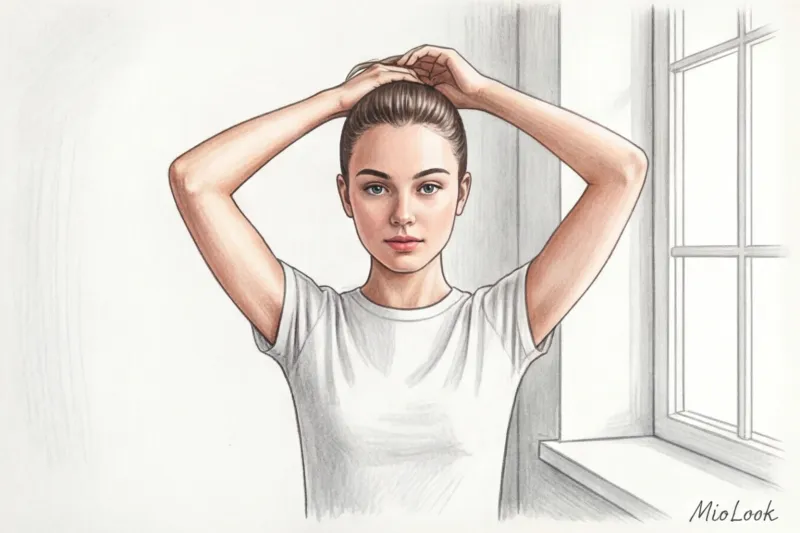
A separate and absolutely critical requirement is hair treatment. Your hair should be slicked back, fully exposing your forehead, cheekbones, and jawline, all the way to your ears. Why such strictness? It's vital to separate your natural root color from the colored lengths. Today, most women sport complex coloring techniques like balayage or contouring, which can easily cost €200-300 at a good salon. If these artificial highlights appear in the frame, artificial intelligence will take them into account when calculating your natural contrast. The result is an incorrect verdict. We're only interested in the genetic base: the shade of your eyebrows, eyelashes, irises, and those few millimeters of uncolored roots at your forehead.
Finally, optics and angle. A typical selfie taken with your arm extended automatically uses your smartphone's wide-angle lens (usually a focal length of 24–28 mm). The main problem with these lenses is barrel distortion. They visually enlarge objects in the center of the frame (like the nose) and dramatically narrow the edges (like the shoulders and cheekbones). This dramatically distorts both facial proportions and body geometry, turning you into a different person. For accurate vector analysis, have someone else take the photo or use a tripod.
The lens should be positioned exactly at chest level for a full-length figure analysis—this will eliminate the "big head" and shortened legs effect. For a portrait, hold the camera at eye level. Keep the distance at least 1.5–2 meters. If you need a closer shot, use only the camera's optical zoom (50mm equivalent), but don't get any closer. Only by adhering to this strict technical protocol will you give the algorithm a chance to see the real you. Once you have this "sterile" photo, upload it to MioLook , and you will see how accurate machine analysis can be when it is not confused by optical illusions.
From Theory to Practice: Implementing AI Results into Your Wardrobe
Over the past five years, I've conducted hundreds of wardrobe reviews, and the statistics are always the same: 80% of women experience mild shock upon receiving their new, mathematically-calibrated palette. There's an overwhelming urge to throw all the "wrong" items into black bags and toss them in the trash. Stop. The fact that you decided determine a person's color type using a neural network and got an objective result, does not mean that tomorrow you will have to spend €3,000 on a complete wardrobe renovation.
Smart style transformation isn't a revolution, but a gradual evolution. Our goal is to seamlessly integrate algorithm recommendations into your real life without straining your budget. I always suggest the "20 percent rule" to my clients: start by updating just a fifth of your capsule wardrobe, focusing on basic layers. Buy two or three tops in your key AI shades (for example, in the €50-€100 range for high-quality cotton or viscose). You'll be surprised how one well-chosen turtleneck or silk blouse can elevate an entire look, making even a questionable jacket complement your natural contrasts.
This is where my favorite comes into play face-framing rule The color algorithm primarily works with the microcontrast of your face: skin pigmentation, iris depth, and lip undertone. This means that only the 30 centimeters of fabric directly under the chin are critically important. Do you have a favorite mustard sweater, even though the AI has classified you as a cool "summer" color? Don't give it up. Simply wear an icy blue or crisp white shirt with a stiff collar underneath, which will create the right reflection on your skin. And feel free to move any favorite shades "forbidden" by the algorithm to the lower half of your silhouette: trousers, flowing skirts, shoes, and bags won't affect how others perceive your appearance.
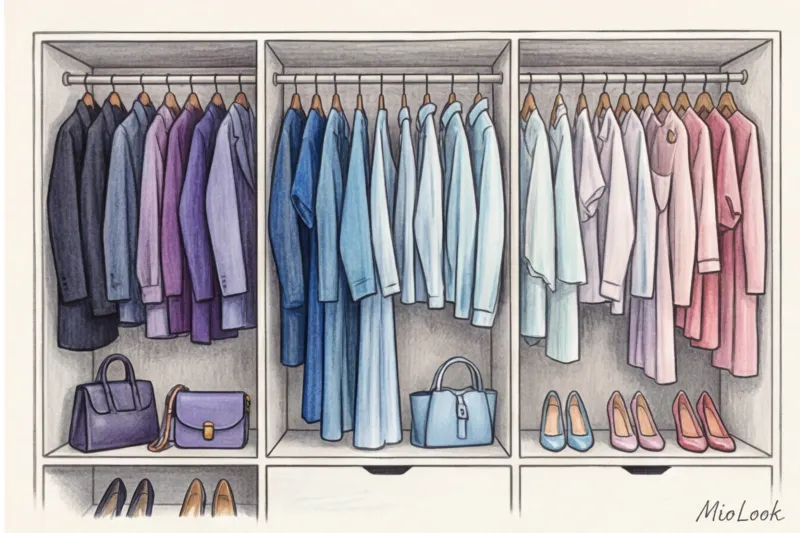
The next step is a technical audit of your current capsule using AI silhouette recommendations. Open MioLook smart wardrobe and compare your everyday items with the system's vector analysis of body proportions. Look for discrepancies at key structural points: shoulder line, waistline, and hems. For example, if the algorithm identifies you as having a sharp geometric (Yang structure) dominant, but your closet is full of rounded lapels and soft, shapeless knits, that's a signal. The item doesn't necessarily have to be thrown out, but now you know for sure that that relaxed cardigan needs to be structured with a stiff leather belt with a geometric buckle.
To make the process less chaotic, here's a step-by-step plan for the weekend that I use when styling professionally:
- Portrait Zone Calibration: Remove shades from your face that the algorithm has flagged as disharmonious. If you have an expensive €400 trench coat that's making your face look yellow, save the day with the right cashmere scarf from your new AI palette.
- Sorting by vector and texture: Sort your pieces not by season, but by fabric architecture. Put aside anything that visually disrupts your individual proportions calculated by the neural network. Often, it's not the garment itself that's the issue, but how it's draped—try this method. French tuck (partially tucked hem) if the AI recommends asymmetry to correct the hip line.
- Smart shopping list: Create a shopping list exclusively of missing links. Stop buying yet another pair of jeans. Invest in "face" layers of the right temperature and thickness, which will become the bridge between your old wardrobe and your new digital style map.
Your ideal image begins Here
Join thousands of users who look flawless every day with MioLook.
Get access — €0.99 onceFor years, fashion dictated who we should be. The industry forced us to fit into the confines of fleeting trends, buy collections after beautiful advertising campaigns, and quietly despair when the magic of Margiela or Prada suddenly vanished in the fitting room. Today, the rules of the game have changed. Artificial intelligence has finally returned the focus to the most important person in the industry—you. The mathematics of color and vector body analysis are not strict constraints, but your personal tool of liberation. Technology has lifted the burden of doubt, leaving room for pure creativity. Use this algorithmic data not to limit your choices, but to dress every day with your eyes closed, knowing with absolute certainty that every thread in your closet works flawlessly for you.
Guide Chapters
How to Determine Body Proportions: Secrets from AI and Stylists
Same height doesn't mean same proportions. Find out why a regular measuring tape can be deceiving and how modern AI technology can help you find your perfect silhouette.
How to determine a Kibbie's type from a photo using a neural network online
Stylists often make mistakes in facial typing due to subjective bias. Find out why artificial intelligence is much more accurate.
How to choose clothing colors based on your color type: app
A single mistake with a shade can cost thousands of euros. Learn how to use an AI app to create a personalized palette and a flawless, high-status wardrobe.
How to Determine Contrast Ratio in Appearance: An Accurate AI-Powered Method
Black-and-white filters on smartphones often distort the real picture. We'll explain how math and AI can accurately calculate your contrast level.
Determine your face shape from a photo: a neural network will select a haircut
The human eye is 40% off when judging proportions. Learn how AI analyzes biometrics to accurately select haircuts and makeup.
Determine your color type from a photo: a neural network is more accurate than a stylist
Professional stylists often make mistakes due to lighting and metamerism. Learn how AI algorithms accurately calculate your color type.
How to determine your body type from a photo online using AI
Measuring yourself with a tape measure in front of a mirror is so last century. Find out why neural networks analyze your proportions more accurately and how to find out your body type in just a few minutes.
How to take the right photo for a neural network | MioLook
A lighting error can completely distort your color type. Learn how to prepare for a photo shoot with an AI stylist and get the most accurate results.