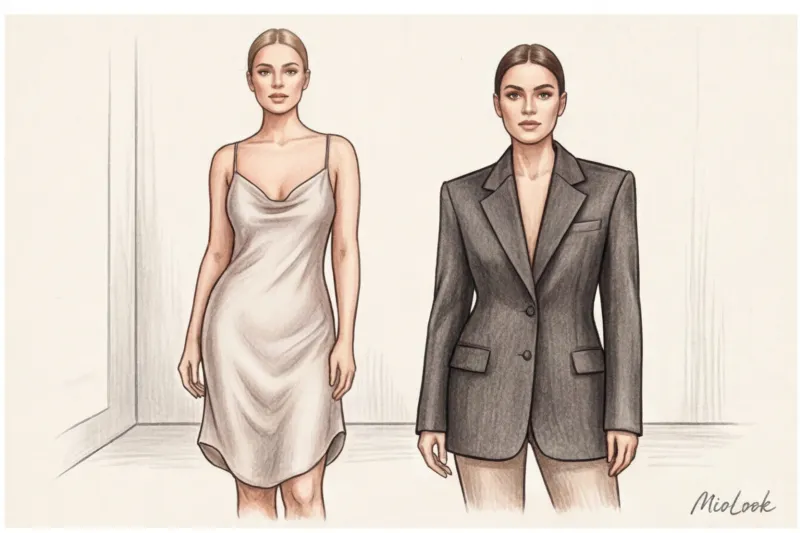
I recently conducted a professional experiment. I sent photos of the same client to three different practicing stylists, asking them to classify her. The results were astonishing: the first stylist confidently called her a Dramatic, the second saw her as a pure Natural, and the third categorically declared her a Flamboyant Natural. Three experts—three completely different diagnoses for the same bone structure.
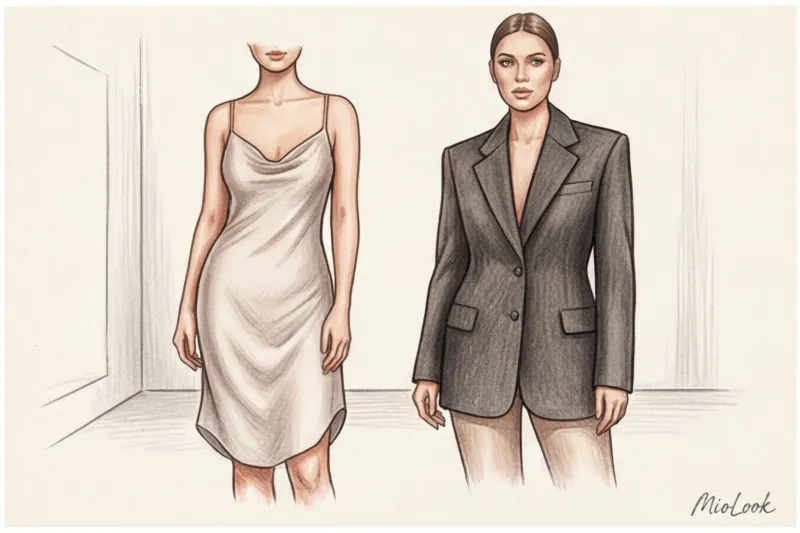
It was at this moment that I finally became convinced: the notorious stylistic "observation" and intuition are the main enemies of accurate typing. If your goal is to objectively Determine your Kibbie type from a photo online , you need a dispassionate algorithm, not an artist with their taste biases. Incidentally, artificial intelligence has already proven its superiority in working with skin tones, as discussed in detail in our article on how MioLook's neural network will be able to determine a person's color type. Now it's time to entrust the geometry of our body to mathematics.
Math Instead of Magic: Why Kibbee and Larson Are the Perfect Problem for AI
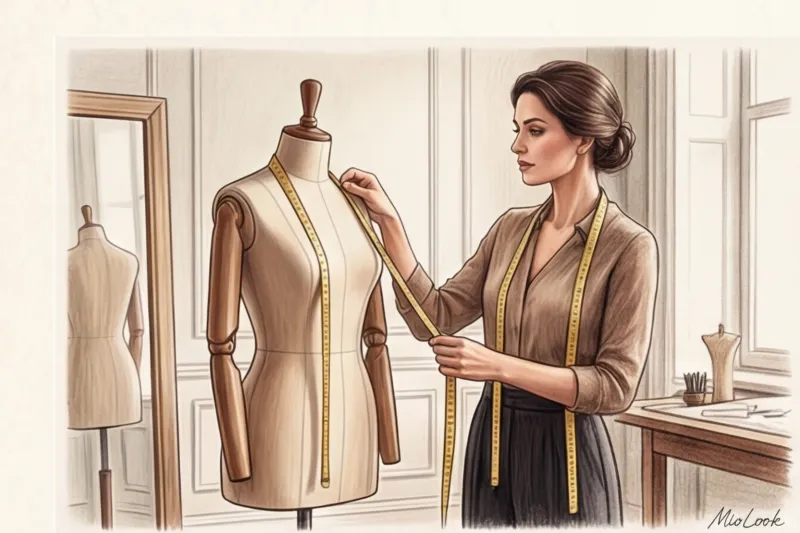
It's commonly believed that understanding your personality type requires capturing some elusive "essence" or "vibe." This is one of the most pernicious misconceptions. If we open David Kibbee's original book, "Metamorphosis" (1987), we won't find any esotericism. His theory is based on strict anthropometry—the balance of yin (softness, roundness, delicacy) and yang (angularity, width, geometry).
Why do stylists get it so often wrong? The answer lies in human psychology and the halo effect. The human eye is easily distracted by details. A stylist sees a girl with full lips, big eyes, and a sweet smile, and her brain automatically places her in the Romantic or Gamine category. Meanwhile, the objective width of her chest and broad shoulder line (pure Yang) are completely ignored.
In my column "The Death of Subjectivity," I already wrote about how the style industry is rapidly shifting from intuition to data. Computer vision doesn't admire dimples. It measures millimeters and pixels, analyzing the wireframe. This is why determining personality type is an ideal mathematical problem for a neural network.
Access to MioLook for €0.99 — one-time payment
A smart AI stylist will select the perfect look.
Get access — €0.99 onceHow neural networks work in appearance analysis
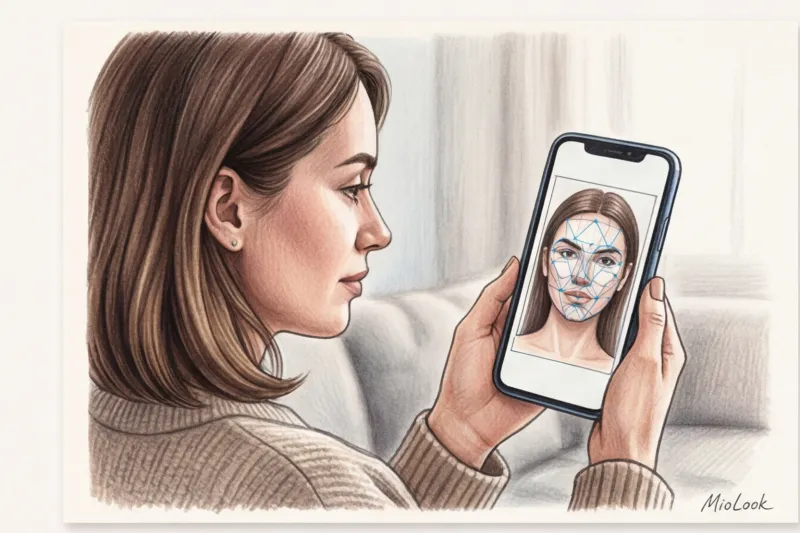
Modern AI models don't just "look" at your photo. They build a detailed skeletal model. A computer vision algorithm (landmark detection) places over 120 control points on your body and face. It calculates the precise ratio of your limb length to your torso (which is critical if you have, for example, long body and short legs ), the width of the hips relative to the shoulders and the span of the collarbones.
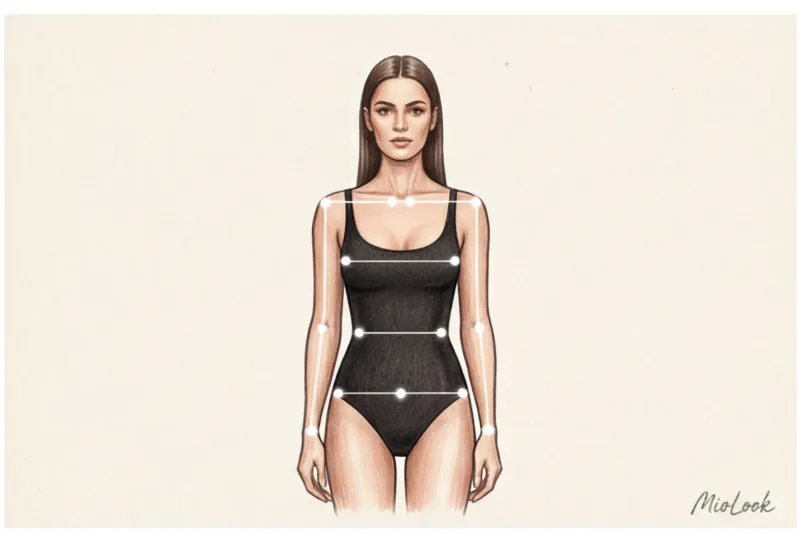
When analyzing facial features, the neural network measures jaw angles, eye set, and lip shape in strict proportions, rather than using categories like "pretty" or "stern." If the jaw angle is 110 degrees, you're Yang, and the algorithm will record this in the database. It doesn't care how feminine your smile is.
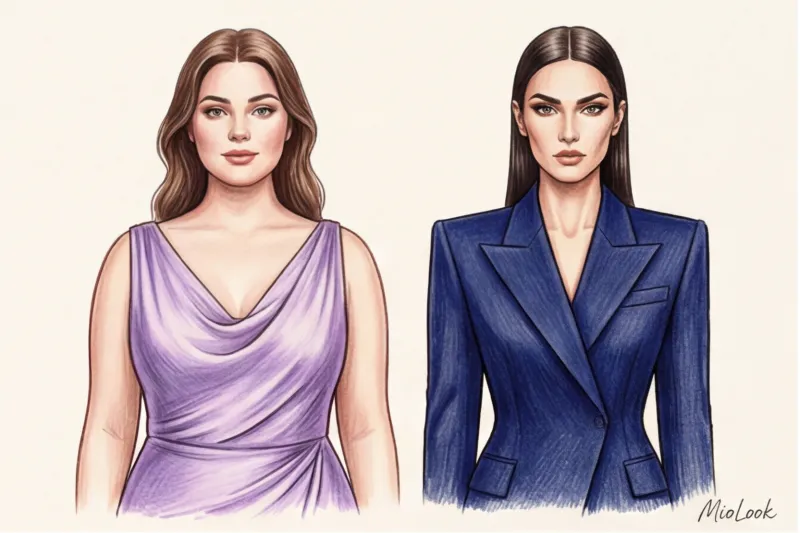
"The main advantage of AI in body typing is that the algorithm can't be fooled by excess weight. Unlike the human eye, which confuses soft tissue with Yin structure, the neural network reads the underlying bone structure."
In my practice, clients with a size L/XL are often labeled "Romantic" by human stylists simply because of their body volume. The neural network, however, unmistakably recognizes the wide, sharp bones of a Dramatic type beneath that volume.
Kibby vs. Larson: Which is Easier for Algorithms to Determine?
David Kibbee's system offers 13 pure personality types. Dwyn Larson went further, expanding the system to 20 types and introducing the concept of fractionalization. In her system, you can be 60% Dramatic and 40% Gamin.
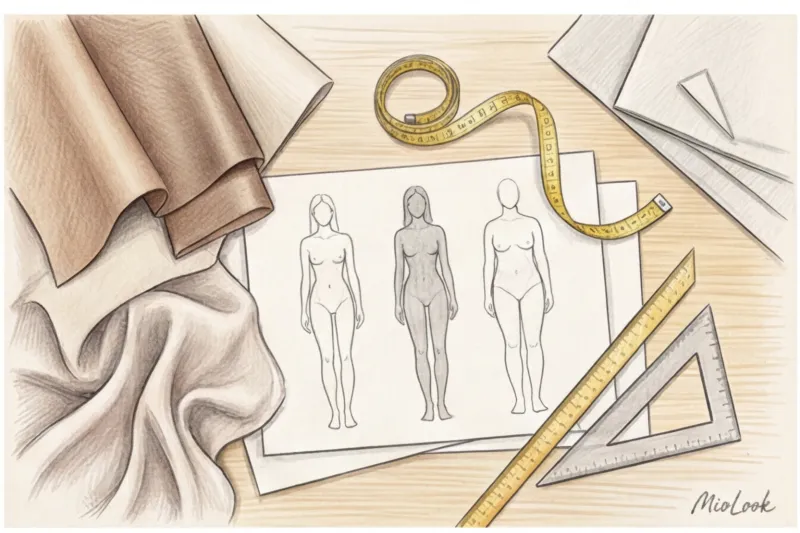
Over my 12 years as a stylist, I've constantly seen clients frustrated by trying to squeeze themselves into the rigid confines of Kibbe's 13 body types. In the mirror, they see a Romantic face and a Natural figure, and neither description fits them 100%.
For neural networks, Larson's system is a true gift. The algorithms think in probabilistic distributions. The AI doesn't force you into a single-word box. It produces a percentage distribution of facial and body dominant features, which is infinitely closer to real human anatomy than the rigid classification system of the 1980s.
Access to MioLook for €0.99 — one-time payment
Start creating perfect images with the help of artificial intelligence
Get access — €0.99 onceHow to determine your Kibbie type from a photo online: instructions for a neural network
Artificial intelligence is only as smart as the quality of the data you feed it. The main reason for incorrect results in online tests is poorly sourced photos. Feed the algorithm a selfie in a bulky hoodie, and you'll get a random string of letters, not a typed image.
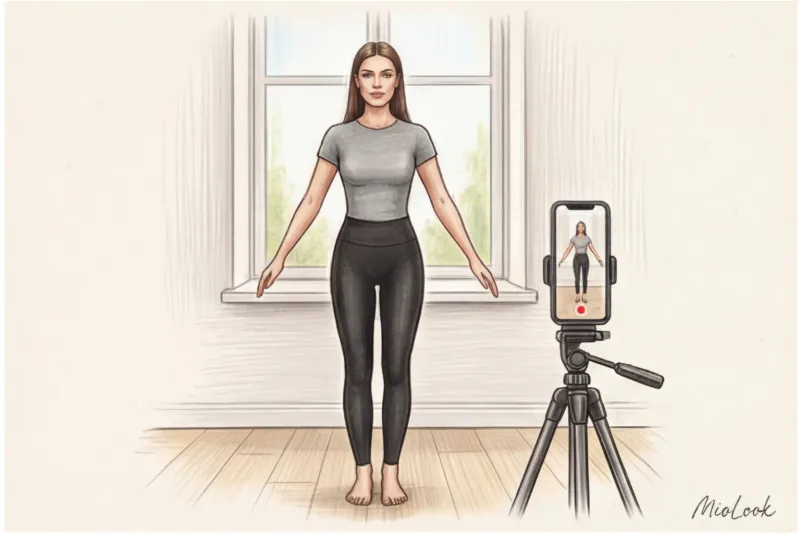
Clothing for photos should be as form-fitting as possible (leggings and a top). Avoid black on a dark background—the algorithm simply won't recognize your body contours and will "cut off" your waist. Choose contrasting, light-colored clothing without prints.
Correct light, angle and focal length
Never, under any circumstances, take a mirror selfie for typing purposes. Due to the physics of smartphone lenses, the focal length distorts body proportions by up to 20%. The bottom of the frame becomes elongated, while the top becomes narrower. This will cause the algorithm to think you have endless Dramatic legs, when in reality, you're a miniature Soft Gamin.
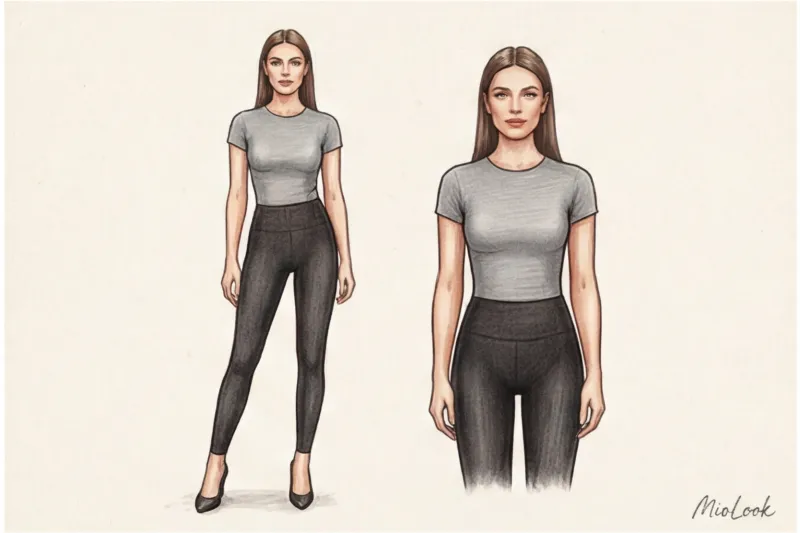
- Camera position: strictly at chest level, parallel to the floor.
- Distance: 2-3 meters away from you. Ask a friend or use a tripod.
- Lighting: even daylight from the window in front of you. Harsh shadows from the side can visually cut off volumes and distort real waist proportions.
Test Drive: Common Algorithm Errors and How to Avoid Them
Even advanced models sometimes stumble. One of the most common mistakes my clients make when testing AI apps is taking photos with their hair down. A voluminous hairstyle visually widens the shoulders and neck. The algorithm interprets this as bone width, and voila—you get a Natural look instead of a Classic look. Hair should be slicked back.
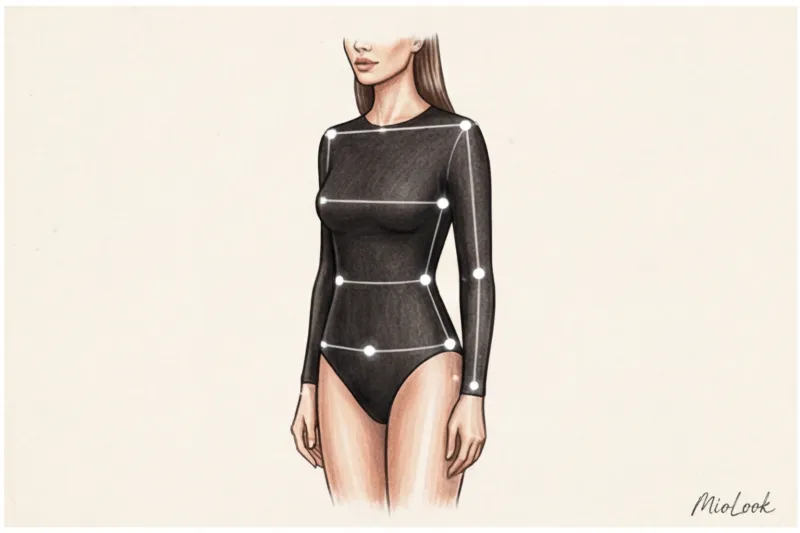
The second problem is missing limbs. In the Kibbe system, the size of the hands and feet is a key indicator of Yin or Yang. If your palms or feet aren't visible in the photo, the accuracy of the analysis drops by a third. Stand up straight, arms slightly relaxed at your sides, fingers fully visible.
What if the AI produces different results in three different photos? Take the average. Machine learning is sensitive to micro-shadows, so running three or four correct frames will yield a perfect, accurate diagnosis.
Your perfect look starts here
Join thousands of users who look flawless every day with MioLook.
Get access — €0.99 onceFrom Type to Capsule: How to Use the Results in a Smart Wardrobe
So, the AI has returned a result: you are, let's say, a Dramatic Classic. What should you do next? A body type isn't a life sentence to a single style; it's a guide to tailoring.
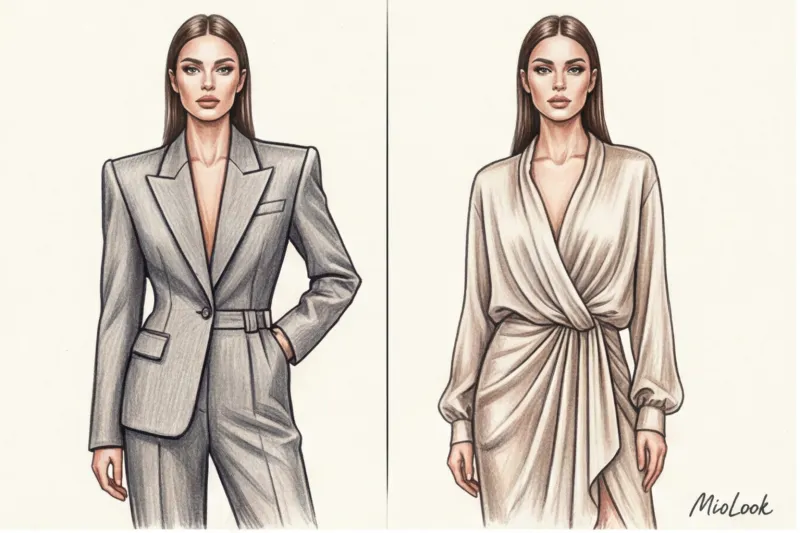
This is where the most dangerous misconception in the world of styling lies. Many believe that if you're a Romantic, you're obligated to wear ruffles and floral dresses, while a Dramatic is only allowed to wear formal men's suits. This is absurd. Your body type is dictated by the silhouette, the density of the fabric, and the scale of the details, not your aesthetic.
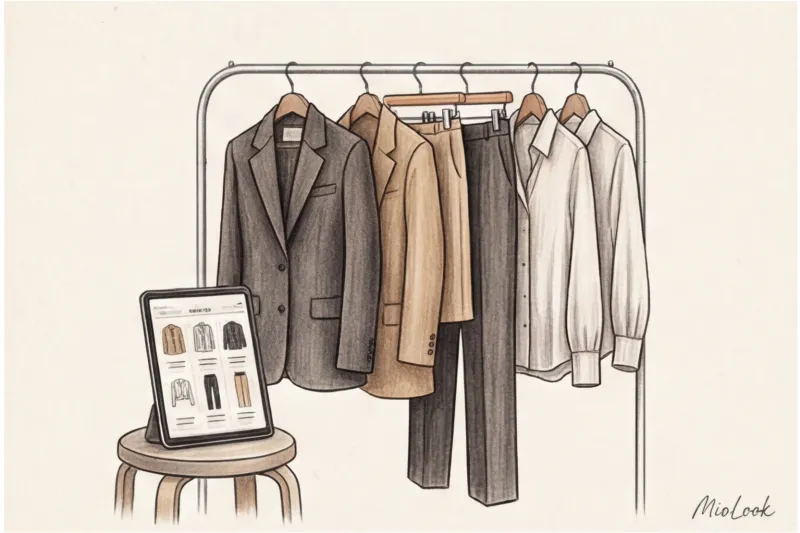
The Dramatic can easily wear relaxed casual if they choose the right materials. Instead of thin knits, which will make them look bony, choose heavy denim, structured cotton (180 g/m² or higher), or architectural wool. Conversely, the Romantic will look chic in a business suit if its lapels are rounded and the fabric is flowing (such as heavy crepe or viscose), not stiff as cardboard.
By uploading your typing results to the app MioLook , you get a smart filtering tool. You'll no longer buy a €50 jacket from a mass-market store that looks out of place on you because its square shoulders clash with your sloping Yin silhouette. You'll go to, say, COS or Massimo Dutti and buy a jacket for €120–150 that mathematically matches your shoulder line.
Summary: Should you trust your style to algorithms?
Let's be honest. Artificial intelligence is far superior to humans in measuring proportions, scanning anthropometry, and providing objective bone structure diagnostics. The computer doesn't suffer from stereotypes and doesn't try to fit you into its own tastes.
But algorithms have their own inherent limitations. A neural network knows that sharp collars and stiff fabrics suit you, but it doesn't know that you work at a kindergarten, where such a dress code is inappropriate. It doesn't take into account your personal brand, the climate of your city, or your budget.
The role of a stylist—or your own personal style—isn't going away. It's simply moving to a new level. The algorithm provides you with the perfect geometric canvas and the technical specifications. And the colors you fill it with are entirely up to you. Take the perfect photos according to the instructions above, leave the work to the neural networks, and enjoy creating within your ideal geometry.