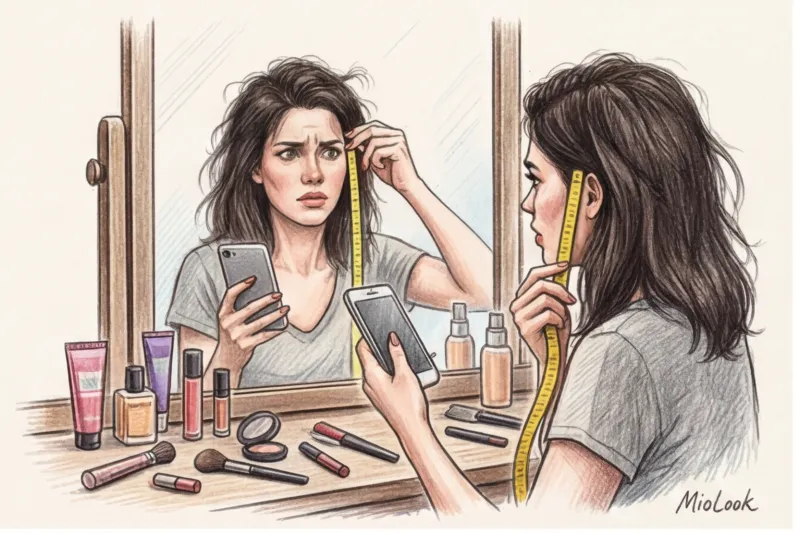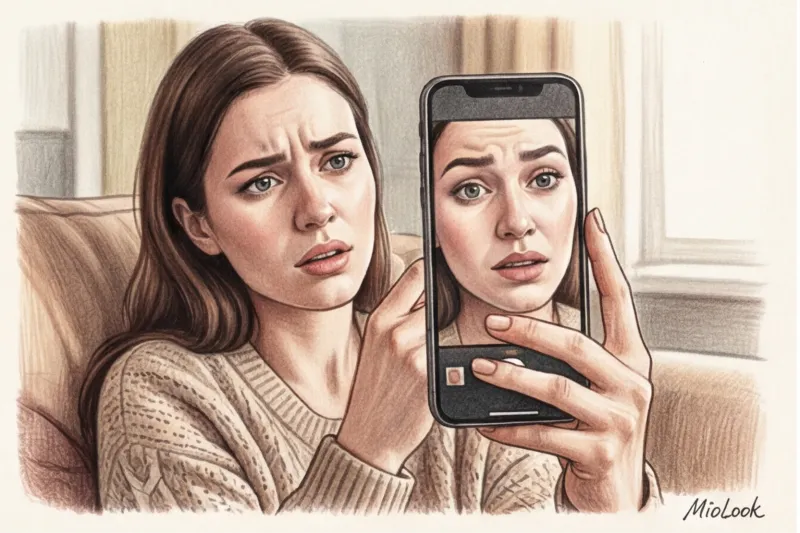
Did you know that the human eye has a 40% error rate when trying to distinguish a round face from a heart-shaped one? We look in the mirror every day, but what we see isn't geometry, but our emotions and insecurities. One person thinks her jaw is too heavy, another thinks her cheeks are too plump. And so we wear the same curtain-style hairdo for years, trying to visually get closer to the mythical "perfect oval."
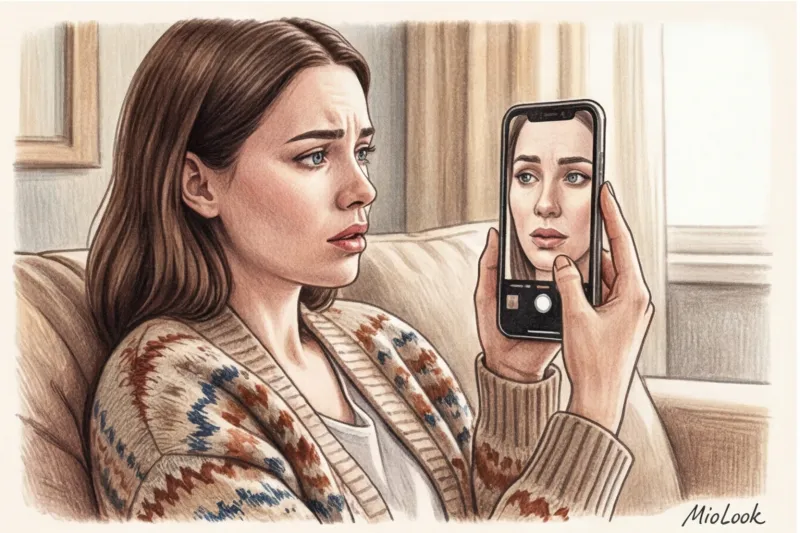
We have already discussed in more detail the comprehensive analysis of appearance in the guide on how MioLook's neural network will be able to determine a person's color type. Today we'll be looking at facial architecture. While stylists used to make us draw on the mirror with lipstick, today Use a neural network to determine face shape from a photo Maybe in a couple of seconds, based on strict biometrics. No guesswork—just pure math.
The Mirror Illusion: Why We Misdiagnose Ourselves
Our brains are designed in such a way that we're unable to perceive our own faces objectively. We focus on individual features—a wrinkle, the width of a forehead, or the shape of a nose—while completely ignoring overall proportions. Added to this are the optical distortions that deceive us every day when we look at our smartphone screens.
If you take a selfie from less than 30 centimeters away, the wide-angle lens of the front camera acts like a magnifying glass. According to the laws of optics, your nose appears 30% larger, and your jawline is mercilessly distorted. An elongated rectangle in such a photo easily turns into an oval, and an oval into a sphere.
Over 14 years as a stylist, I've learned that 8 out of 10 women misjudge their face shape. One client once came in asking for help concealing her "chubby cheeks," convinced she had a round face. When we measured her, it turned out she had a classic "heart" shape—just with softer tissue in the middle third. Because of this misjudgment, she'd been wearing a straight parting for years, which made the lower half of her face appear heavier.
The third problem is visual noise. The human eye is inevitably distracted by the volume of hair, the shadows from room lighting, and even your current makeup. Seeing the pure geometry of bone structure without special tools is virtually impossible.
Access to MioLook for €0.99 — one-time payment
A smart AI stylist will select the perfect look based on your unique proportions.
Get access — €0.99 onceHow to determine face shape from a photo: neural networks versus the naked eye
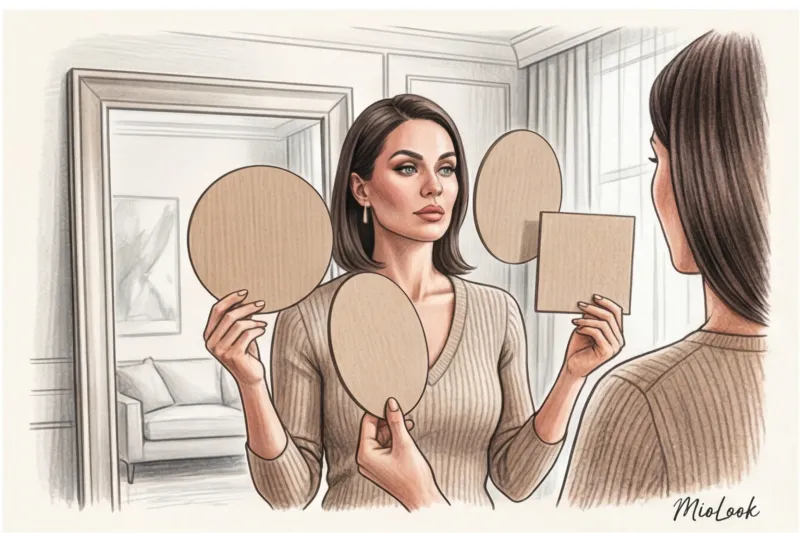
Remember the old advice from magazines in the 2000s: "stand in front of a mirror, close one eye, and outline your face with lipstick"? This method is hopelessly outdated for one simple reason: the parallax effect. A slight shift of the head by a few millimeters or a shaky hand can completely alter the drawn figure.
Computer vision algorithms work differently. When you upload a photo to MioLook Artificial intelligence first and foremost "cleans" the frame of visual noise. It ignores hairstyles, cast shadows, and blended bronzer. Mathematics is impartial: the algorithm doesn't know your insecurities; it only sees strict height-width ratios.
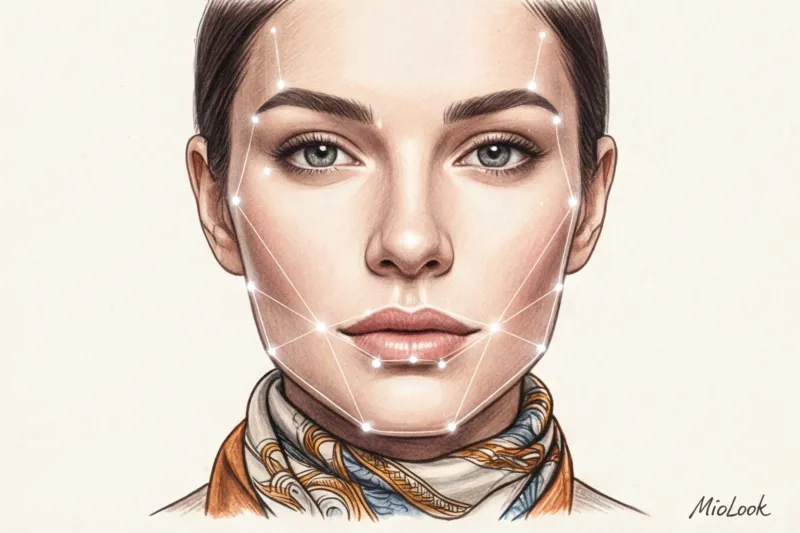
Beauty Biometrics: 68 Key Points
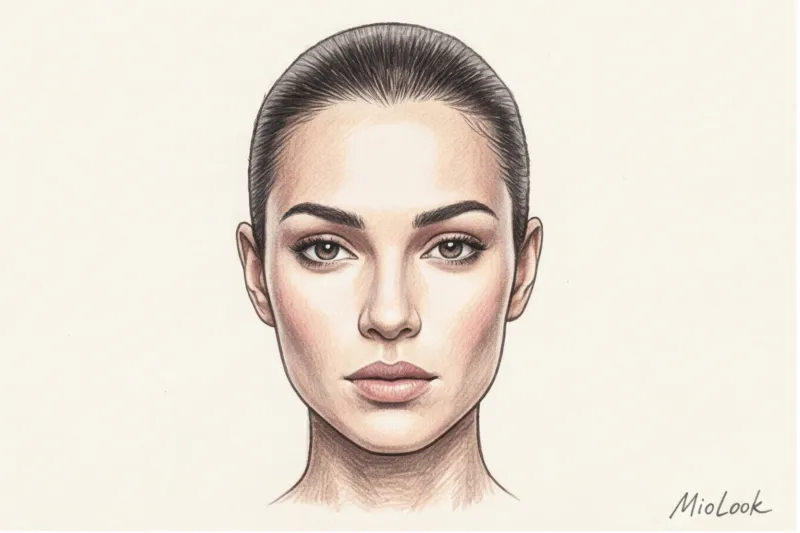
The AI stylist's work is based on Facial Landmark Detection technology. The algorithm projects an invisible grid of 68, and in some cases, 106, reference coordinates onto your photo.
How exactly does it work? The neural network measures four main axes:
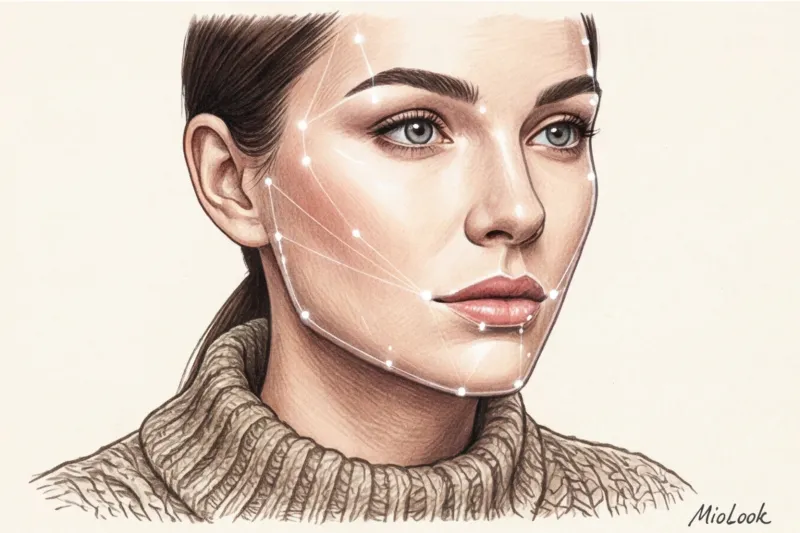
- Forehead width: the distance between the extreme points of the hairline.
- Width of cheekbones: the distance between the most protruding points under the outer corners of the eyes.
- Jaw line: angles of the lower jaw at their widest point.
- Total length of face: a strict vertical line from the hairline to the bottom of the chin.
These parameters are then compared. For example, if the cheekbone width and the face length are almost equal, and the jawline has a gentle curve, the face is a circle. If the length predominates and the jawline has sharp angles, the face is a rectangle.
Breaking Stereotypes: Why AI Isn't Looking for the "Perfect Oval"
Until the early 2010s, hairdressing schools taught the golden rule: "Any face shape should be visually corrected, bringing it closer to an oval." Stylists painstakingly trimmed bangs to conceal the high forehead of a rectangular face and curled hair to soften the angles of a square face.
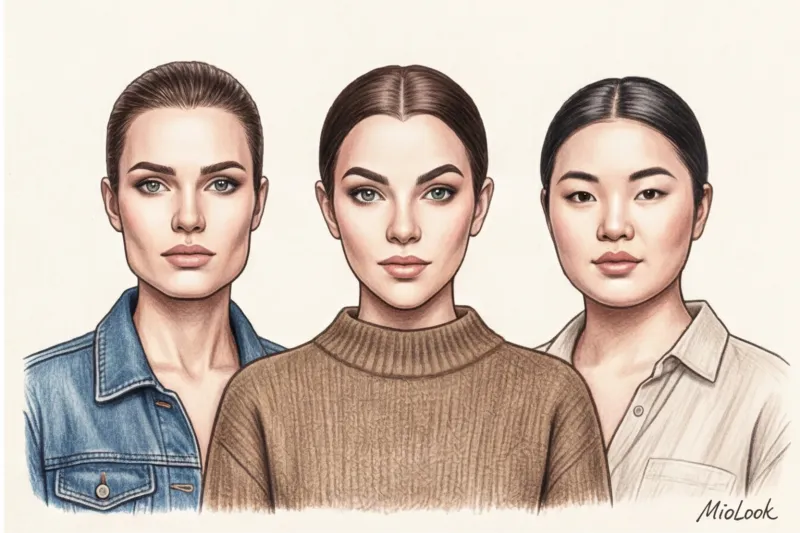
The pursuit of the "perfect oval face" is a relic of an era when beauty standards were dictated by glossy, heavily retouched magazines. As analysts at the WGSN trend bureau note in their 2024 reports, the era of standardized faces is finally over. The modern beauty industry is built on individuality.
Look at Angelina Jolie, Olivia Wilde, or Margot Robbie. Their faces are far from the classic oval; they have pronounced, wide, angular jaws. And it's this bone structure that gives them an architectural and luxurious appearance. The neural network doesn't try to disguise your unique geometry. It selects haircuts and makeup to highlight these features as your signature features, not hide them under layers of hair.
Your ideal image begins Here
Join thousands of users who look flawless every day with MioLook. Discover your face shape without any mistakes.
Get access — €0.99 onceFrom Algorithm to Scissors: How AI Chooses Haircuts
Knowing your face shape is half the battle. The other half is applying this information correctly in the hairdresser's chair. Your face shape dictates the geometry of your haircut: where volume is needed for balance, and where a crisp, clean cut is needed.
Even an experienced stylist at a salon where a haircut starts at €150 can make a mistake in the initial assessment. A thick, unruly head of hair can visually widen the face, tricking the stylist into thinking it's square, when underneath the volume lies a graceful, elongated oval.
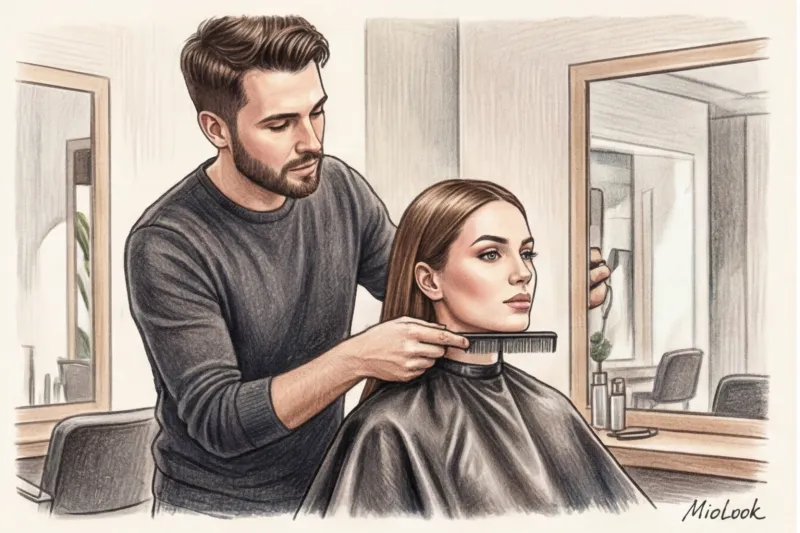
I had a client in my practice who had been hiding her jawline behind voluminous layered haircuts for 10 years, considering her face "too square and harsh." When we ran her photo through the scanner, the AI clearly identified a diamond shape. We decided on a short pixie with volume on top, fully revealing her cheekbones and chin. The result was stunning: her face looked significantly more graceful and youthful once we stopped hiding it behind these "curtains."
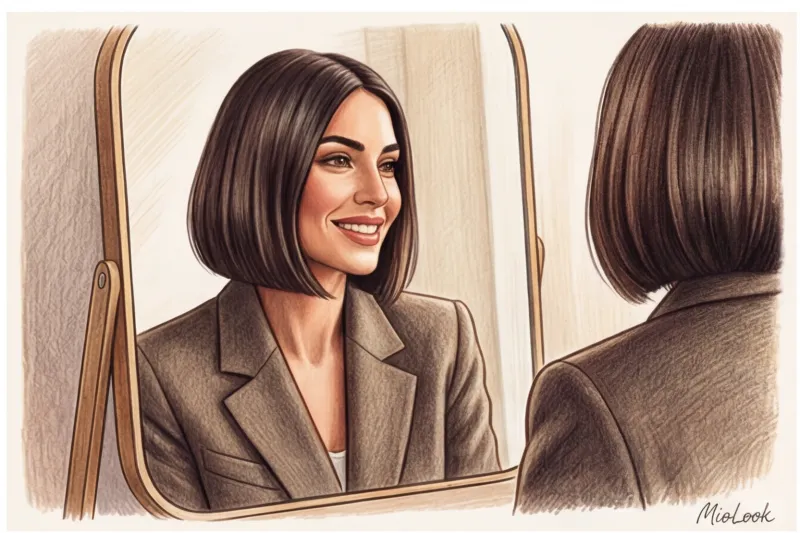
Using the algorithm's recommendations, you'll be able to speak the same language with your stylist. Instead of simply saying, "Make me look beautiful," you could say, "I have a heart-shaped face, so I need a tight bob that reaches right to my collarbones to add volume to the lower third, and longer bangs that fall away from my cheekbones."
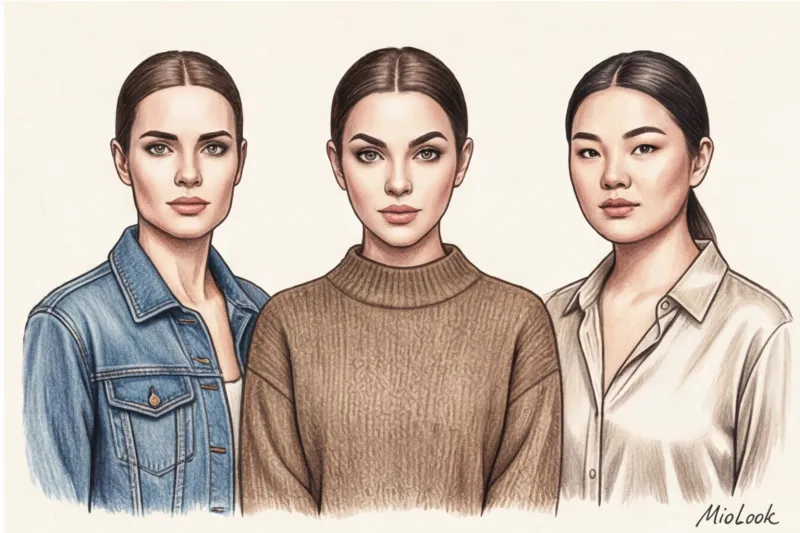
Makeup Architecture: How Smart Algorithms Set Accents
Popular TikTok contouring schemes, where beauty bloggers draw two dark lines under the cheekbones and add a light spot on the forehead, work for a maximum of 15% of women. For the rest, it's a surefire way to visually distort the facial anatomy.
Proper makeup architecture is based on precise mathematical principles. If you have a rectangular face, apply bronzer not under the cheekbone, but slightly above it, using horizontal strokes to visually "cut" the length. If your face is round, sweep blush high toward the temples using a draping technique, creating the illusion of sharp angles.
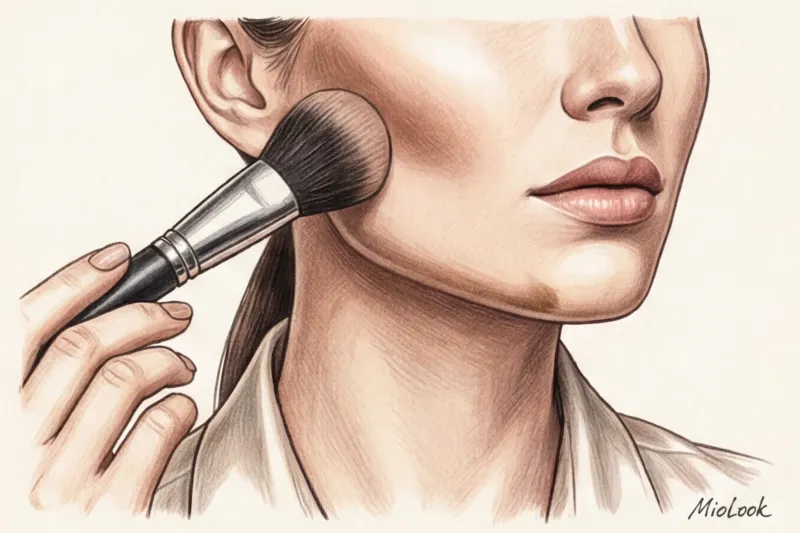
This is especially critical when creating a professional image. We wrote in detail about how makeup influences perception of status in the article Business Makeup: Rules, Instructions, and Common Mistakes Incorrectly placed accents (for example, an overly focused lower jaw on a square face) can make the facial expression appear more aggressive or tired, which is unacceptable for a business environment.
Checklist: How to take a photo for accurate analysis in MioLook
Computer vision only works flawlessly if you provide it with high-quality input data. The neural network interprets what it sees. Therefore, it's important to follow a few simple technical rules before taking a selfie for analysis.
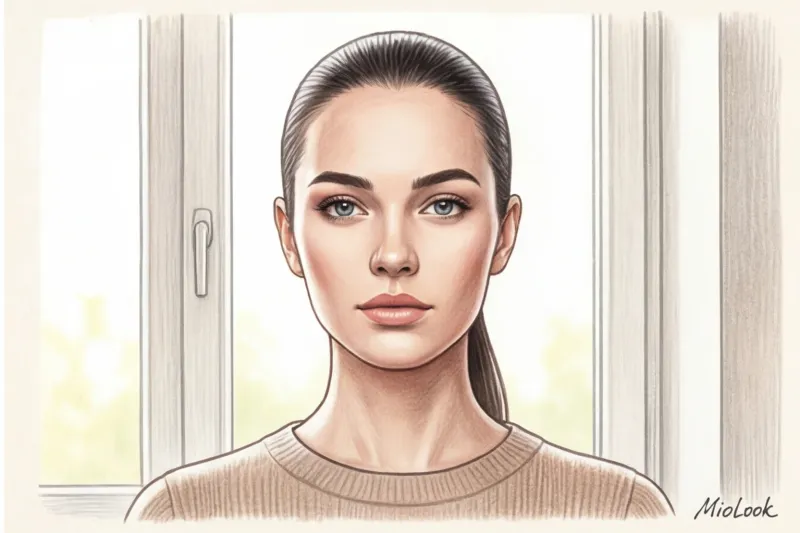
Here are three steps to the perfect photo:
- Lighting: Stand facing a window during daylight hours. The light should fall evenly across your entire face. Side lighting will create deep shadows, which the algorithm might mistake for hollow cheekbones or a narrow jaw.
- Camera position: Hold the phone strictly at eye level, at arm's length (at least 40-50 cm). Lowering the camera will make your chin appear larger; raising it will make your forehead appear disproportionately large.
- Preparation: Gather your hair into a tight, sleek ponytail. Pin your bangs with bobby pins. Your face should be completely relaxed, lips closed, and not smiling (smiling changes the volume of your cheeks and the width of your cheekbones).
When it does NOT work: It's important to understand the limitations of this technology. The analysis will be inaccurate if you have had heavy contouring that alters your actual volume, or if you have significant temporary swelling (for example, after a dentist appointment or a flight). Take the photo on a clean face on your normal day.
Ready to get started?
Try MioLook's free plan—no commitments required. Discover your face shape and get personalized recommendations.
Get access — €0.99 onceTechnology has forever changed our approach to style. We no longer have to guess, second-guess ourselves in the stylist's chair, or blindly copy trends that don't suit us. Understanding your facial biometrics is a fundamental step toward conscious style, allowing you to manage your self-image with mathematical precision.