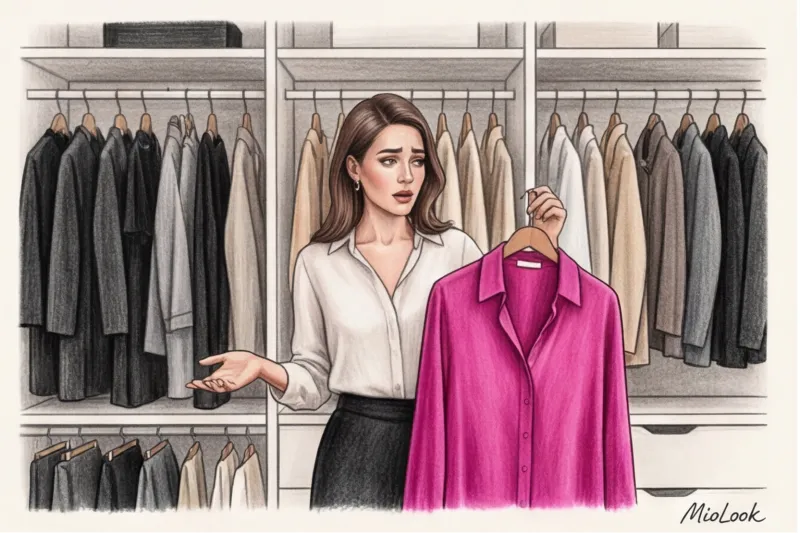
Do you know how much a wrong undertone costs? Over 12 years as a personal styling consultant, I can give you a precise figure. For one of my clients, it was €2,800—that's how much a gorgeous camel-colored Max Mara coat cost, which made her complexion look sallow. It was a perfectly cut, luxurious wool coat, but with a warm, yellowish undertone that clashed disastrously with the cool, olive undertone of her skin.

We have already discussed the physics of this phenomenon in more detail in our a complete guide to determining color type using a neural network , but today I want to talk about practicality. How to translate dry data on contrast levels into a work-appropriate, stylish, and, most importantly, wearable wardrobe.
When you decide Choose clothes colors according to your color type, app It's not just a fashionable gadget, but an impartial mathematician. It doesn't get tired, isn't swayed by discounts, and doesn't try to sell you a stale size. Let's explore how to use the AI palette at a premium styling level.
The End of Subjectivity: Why Color Mathematics Is More Reliable Than a Stylist's Eye
I remember an incident in a closed Milan boutique. My client was trying on a muted peach-colored silk blouse. In the fitting room, bathed in the warm light of halogen lamps, the shade seemed divine. But as soon as we stepped outside into the natural light (around 5500 Kelvin), the magic disappeared. The blouse turned a dirty pink, highlighting even the slightest redness on her face.
This is an optical illusion called metamerism—the property of color to change depending on the light source. The human eye is extremely vulnerable to such tricks. Moreover, according to the PANTONE Color Institute, even professional colorists experience eye fatigue after just 15 minutes of continuous work with color swatches.
Now add to this the distortions from makeup artists' ring lights, which often shift skin temperature by 2,000-3,000 Kelvin. Artificial intelligence is immune to this weakness. It analyzes the pure pixels of skin, irises, and hair roots, reading their RGB code without emotional bias. For a machine, there is no concept of "fashionable color"—only wavelength and reflectivity.
Access to MioLook for €0.99 — one-time payment
A smart AI stylist will select the perfect palette and look based on your unique parameters.
Get access — €0.99 onceHow to choose clothing colors based on your color type: an app like your pocket expert
Forget the outdated "Winter-Spring-Summer-Fall" system. In modern styling, it's as bad form as matching your bag exactly to your shoes. High-quality AI assessment is based on the principles of Albert Munsell's color system, developed in the early 20th century and now the standard for colorimetry.
Color is assessed using three strict vectors: temperature (warm/cool), saturation (pure/muted), and value (light/dark). The MioLook algorithm creates your personalized hue map based on these coordinates.
Why is this important for your wallet? Cost-per-wear statistics are ruthless. A 2023 study by WGSN found that items that perfectly match a person's natural color palette are worn 60% more often. A digital color palette on your phone is your filter against impulse purchases, saving you hundreds, sometimes thousands, of euros per year.
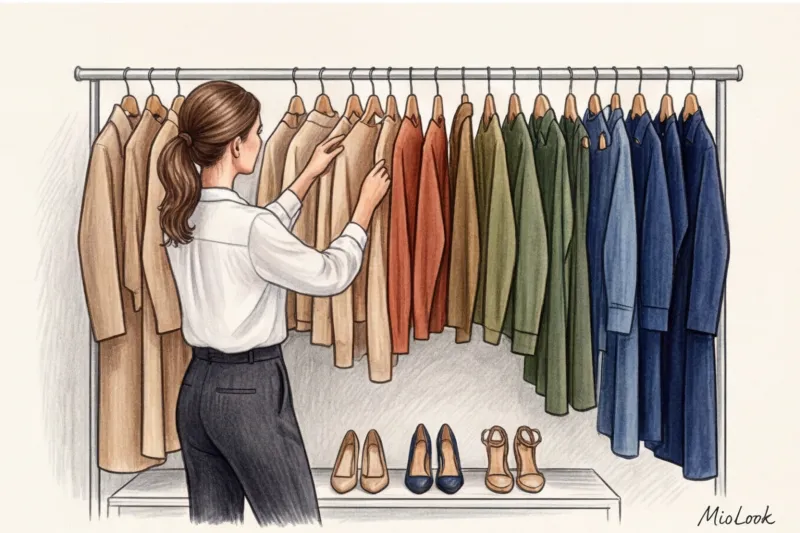
Digitization of contrast and undertone
The most important step the algorithm performs is contrast measurement. The app literally calculates the difference between the whites of your eyes, the color of your iris, your skin tone, and the shade of your hair roots.
If you have porcelain skin and black hair (high contrast), the AI will recommend clean, vibrant colors (emerald, royal blue) and geometric prints. If contrast is low (light brown hair, soft eye color), the app will base your look on complex, dusty shades (sage, dusty rose) so your clothes don't overpower your face.
The Secret to Expensive Looks: How Fabric Texture Distorts Your Palette
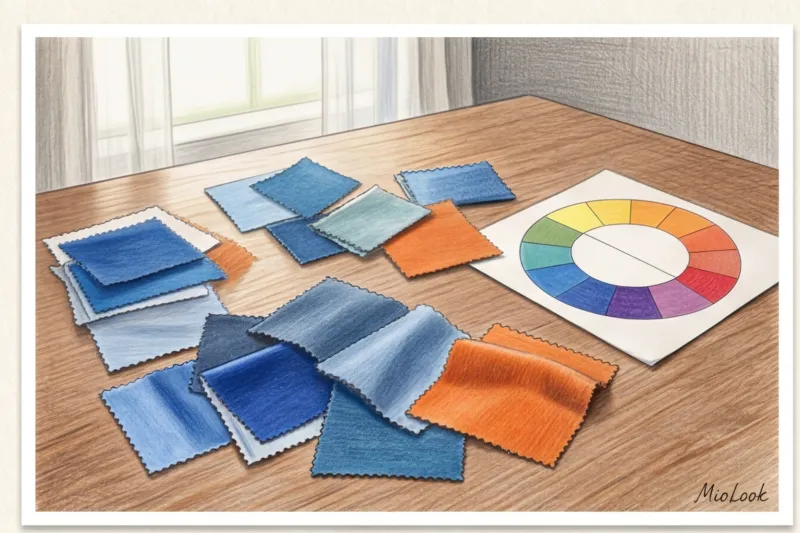
This is where true premium styling begins. One of the most common mistakes I see women make when trying to follow their palette is forgetting about texture. Texture can change the color beyond recognition.
One of my regular clients avoided black for 10 years. A stylist once told her that black "ages and kills" her. And it was true when she wore a thick, matte black wool jacket. The fabric absorbed the light, casting harsh shadows on her face.
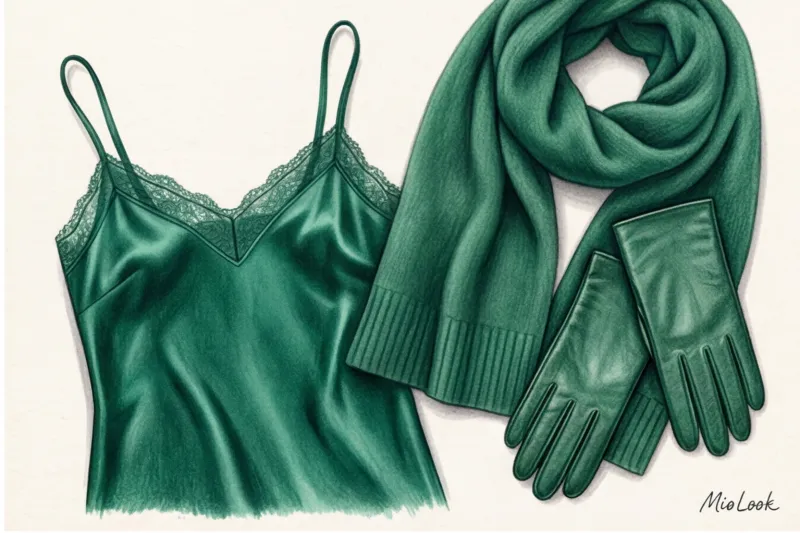
What did we do? We replaced the dense wool with translucent black silk chiffon and glossy satin. The skin showed through slightly, reducing the contrast, and the silk's subtle sheen acted as a reflector. The black remained, but its physical properties changed. This is the secret to integrating "risky" shades.
"The same shade of red on glossy silk and matte Loro Piana cashmere are two completely different colors for your appearance. Silk will reflect light onto your face, while cashmere will absorb it."
That's why investment pieces—coats (from €500), jackets, cashmere sweaters—require a perfect, uncompromising fit within your AI palette. They're matte, thick, and occupy a large area.
The 30-Centimeter Rule: How to Wear "Forbidden" Colors from Someone Else's Color Type
Let's bust the biggest myth: there are no colors you "absolutely can't" wear. You can wear any color in the visible spectrum.
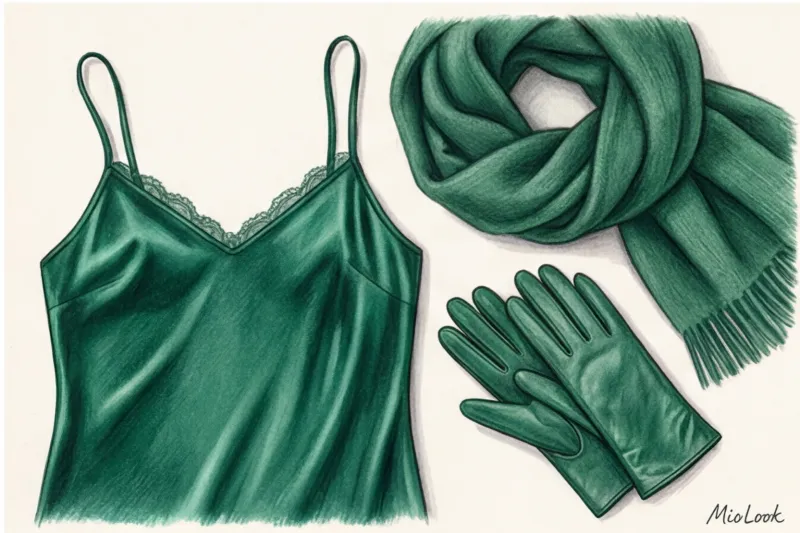
A counter-insight from my own practice: dressing head to toe strictly in your ideal palette is a recipe for a boring, flat, and sometimes outdated look. True elegance always requires a touch of casualness (the Italians call it sprezzatura) and a push beyond the norm.
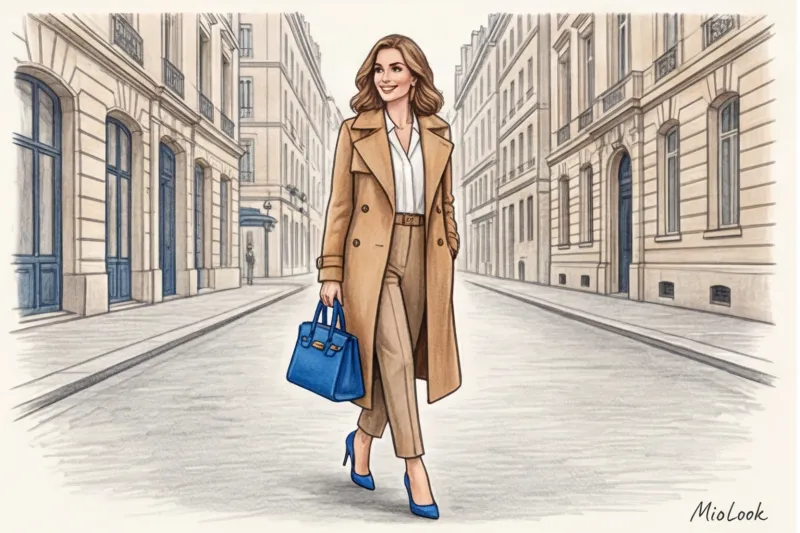
The only area where the AI palette must be strictly adhered to is the portrait area. This includes those 30 centimeters from the face: collars, scarves, earrings, and hats. Anything below the neckline (skirts, trousers, shoes) or micro-accessories (belts, bags) can be absolutely any color.
Fair Limit: This digital approach works flawlessly for daytime and office wear. However, if you're putting together an evening look by candlelight (where the lighting drops to 1500 Kelvin), even the perfect AI palette may require manual adjustments using more active evening makeup, as the low light reduces contrast.
Your perfect look starts here
Join thousands of users who look flawless every day with MioLook. Create your perfect capsule look without any mistakes.
Get access — €0.99 onceFrom Digital Palette to Capsule Collection: A Wardrobe Audit
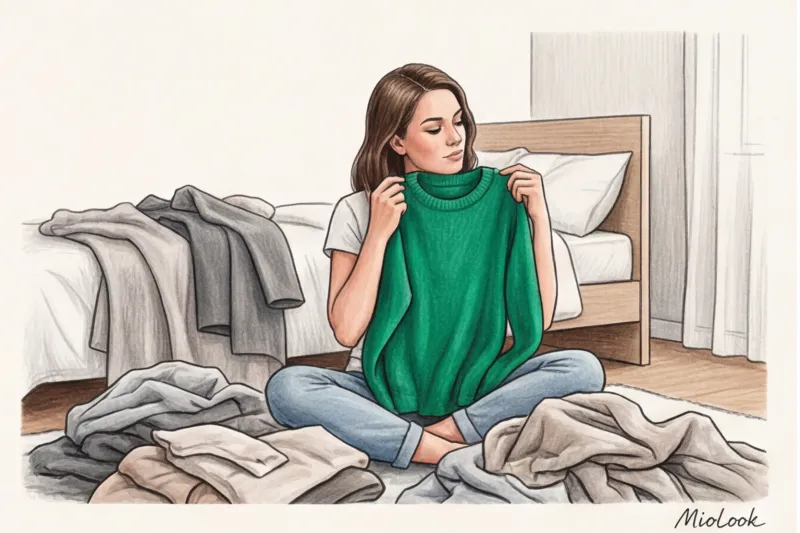
In my experience, up to 80% of items in the average wardrobe clash not because of style, but because of undertone clashes. You can't wear a sweater with a warm ochre undertone with cool steel gray pants—the look will fall apart.
How to conduct an audit using the app's results? Arm yourself with your digital palette and divide your closet into three piles:
- Perfect hit: Items in the portrait area that fully comply with the AI's temperature and contrast recommendations. This is your gold standard.
- For resale/giveaway: Items that are not your temperature, that are located near your face and that cannot be saved in layers.
- Requires color correction: My favorite category is expensive items (like a quality sweater for €300) that don't suit you in a color.
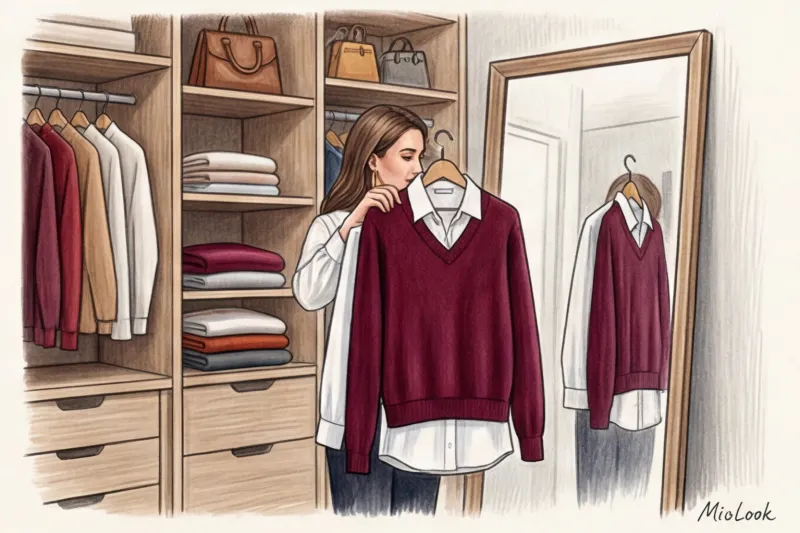
How can you save an expensive item from the third category? Use the buffer method. Wear a shirt in the right shade (for example, a crisp white) under the unsuitable pullover, letting out the collar and cuffs. This 3-centimeter barrier of the right color between your face and the sweater will completely neutralize the negative effect.
Checklist: 5 Steps to Smart Color Investing with MioLook
The premium approach is when we don't just look for "pretty" colors, but build a status-based, manageable base without visual noise.

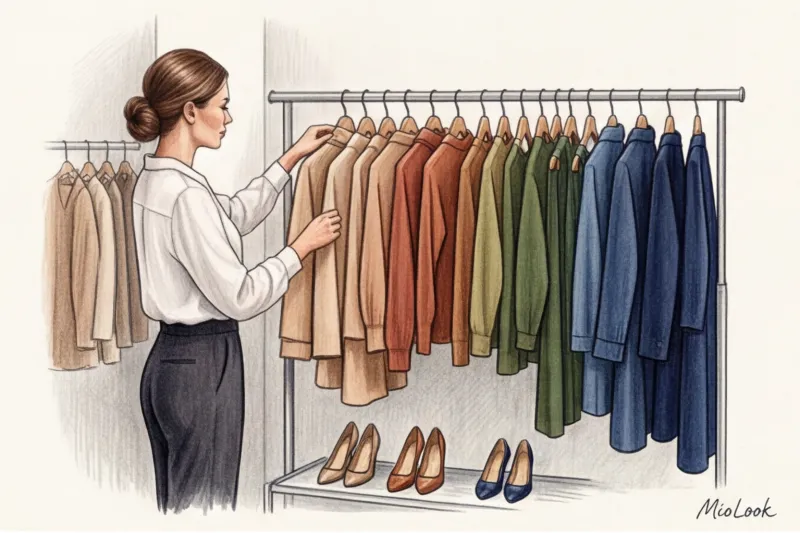
- We determine the dominant. Choose 2-3 basic neutral shades from your AI palette (e.g., graphite, camel, navy). These are the colors we buy our most expensive items in: coats (from €400), suits, and structured leather bags.
- We select accents. Choose 3-4 bright colours from the recommendations for silk scarves (50-150 €), blouses, basic T-shirts.
- We check the temperature before the checkout. Never buy anything without comparing it to an electronic palette. Metamerism in stores will deceive you, but a phone screen won't.
- We ignore sales of other people's shades. A sweater in neon lime that's 70% off isn't cheap if it's not your color palette. It's worth exactly what you paid for it because you'll only wear it once. That's a 100% loss.
- We are forming a jewelry base. The AI palette will accurately determine your temperature. Cool undertone? Invest in white gold and platinum. Warm? Yellow. Neutral? You're in luck—rose gold or mixed metals will become your signature style.
Creating a wardrobe isn't art for art's sake; it's the applied architecture of your image. Using smart algorithms removes the burden of doubt in the fitting room. You no longer wonder whether something suits you or not. You know exactly where you stand in the world of color, meaning every investment works to enhance your status and confidence.