What is creative business style and why does it sell your ideas?
Have you ever noticed how often talented designers, architects, and creative directors fail important pitches simply because their appearance doesn't match the scope of their ideas? Over 12 years as a stylist, I've seen this dozens of times. Recently, the founder of a branding agency approached me with a typical problem: at investor meetings, she was perceived as a run-of-the-mill manager, not a visionary. I peeked into her wardrobe—it was impeccable, but completely bland beige business casual. And therein lay the main mistake.
Statistics and psychology are adamant: we have exactly seven seconds to form a first impression. In those moments, her clothes conveyed "I'm a safe and predictable performer," when they should have confidently proclaimed, "I'm an innovator who can be trusted with million-dollar budgets." This is where... creative business style — your most powerful non-verbal sales tool.
At its core, creative business style is a delicate balance between corporate reliability and creative freedom. You visually communicate two things to the client simultaneously: "I'm systematic enough to meet deadlines and manage budgets" and "I'm free enough from templates to create something outstanding for you." Standard office attire doesn't cut it. A graphic designer in a standard dark blue two-piece suit from a mass-market brand is unlikely to inspire confidence as a creator of unique concepts. For experts in creative professions, basic, overly formal attire paradoxically diminishes their expertise in the eyes of the client. I discussed the mechanics of this phenomenon in more detail in an article about Expert image and wardrobe for a personal brand.
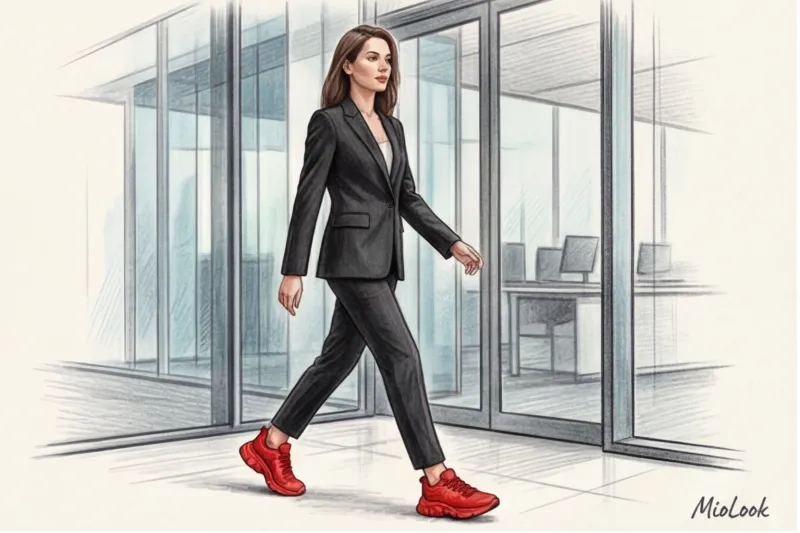
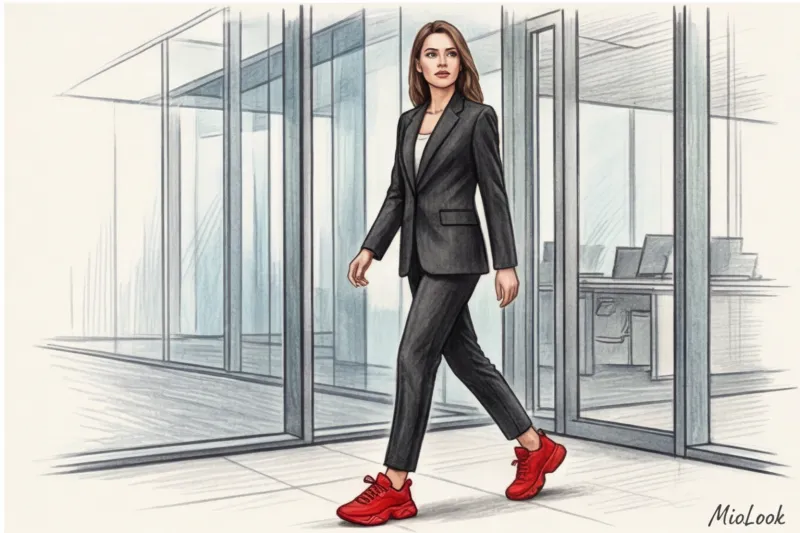
And this isn't just a stylistic theory. In 2014, researchers from Harvard Business School published a study proving the so-called "Red Sneaker Effect."
"Intentional, subtle nonconformity in a strict professional environment is subconsciously interpreted by others as a marker of incredibly high status and competence. A person who breaks the dress code with an unconventional detail is perceived as possessing sufficient authority to ignore the rules."
Anyone who wears a complex, asymmetrical jacket to a board meeting conveys absolute confidence in their professionalism.
Differences from Smart Casual and Classic Dress Code
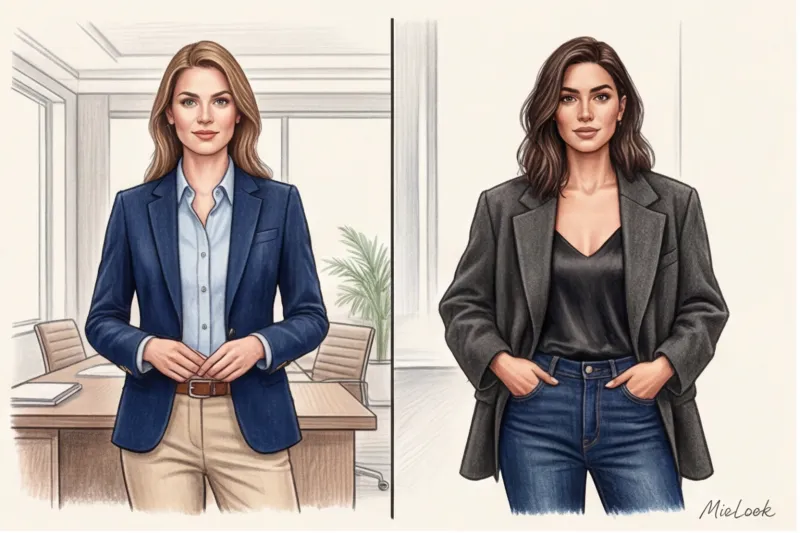
Many clients come to me convinced they're already dressing creatively, when in reality, they're stuck in the smart casual paradigm. Let's get this straight. Smart casual is about personal comfort: your favorite jeans, a cozy cashmere sweater, basic loafers. Creative business style is about making a bold statement and tightly controlling the audience's attention. Every detail here works to enhance your presentation.
To clearly illustrate the difference, I have compiled a comparison table of the two polar approaches:
| Parameter | Classic dress code | Creative business style |
|---|---|---|
| Cut and silhouette | Strict symmetry, rigid forms, fitted | Asymmetry, deconstruction, oversize, architectural lines |
| Materials | Smooth suiting wool, silk, traditional cotton | Complex textures: bouclé, raw silk, matte leather, raw edges |
| Color palette | Black, blue, gray, beige (maximum neutral) | Deep complex shades, total monochrome with one bright accent |
The transition from classic to creative is often intimidating: complex designer pieces are harder to combine. If you're just starting out find your own clothing style and are afraid of looking out of place, I highly recommend digitizing your images. In the app MioLook My clients create separate capsule wardrobes for important meetings and pitches. You simply upload items to the virtual wardrobe and tag them: this unusually cut jacket is your "art object," and these straight wool trousers are your "basics." The algorithms will suggest how to balance these elements to create a look that's authoritative and luxurious, but not at all boring.
The Creative Uniform Paradox: Why Top Experts Choose Minimalism
There's a persistent stereotype: if you work in the creative industry, your wardrobe must resemble the costume department of an experimental theater. For years, pop culture has instilled in us the notion that creative individuals must express themselves through a riot of color. Many aspiring professionals sincerely believe that without leopard print, neon accents, or extravagant hats, they won't be considered creative enough. In reality, trying to look like a "city madman" often reveals professional insecurity rather than genius.
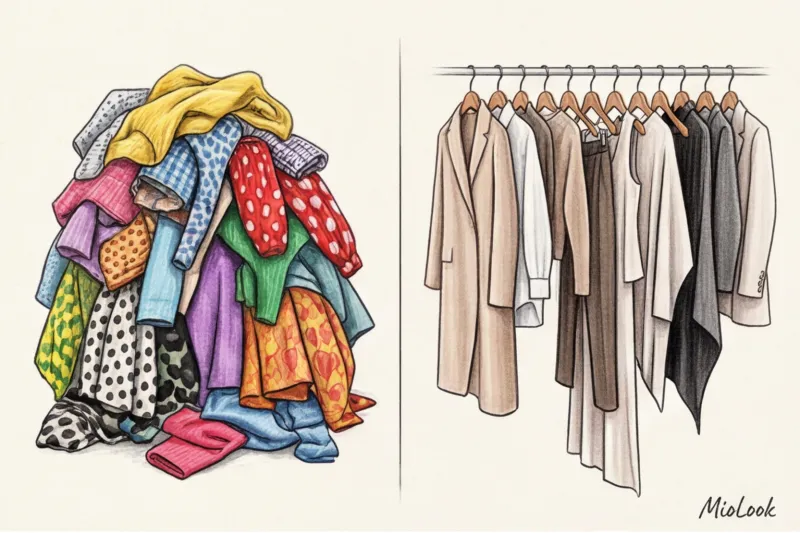
True visionaries have long since cracked this system. Have you heard of the concept of "decision fatigue"? According to research by the American Psychological Association, the human brain is capable of making a strictly limited number of high-quality decisions per day. Every morning is a drain on your cognitive budget. If you spend precious mental energy balancing fuchsia with emerald in the morning rush, you'll physiologically have less energy available for generating breakthrough ideas, managing a team, or delivering a complex pitch. That's why a calm, predictable wardrobe is vital for the creative brain.
Look at the acknowledged geniuses of the industry, the editors-in-chief of fashion magazines, and the top directors of agencies. Their choice is a modern conceptual uniform. The famous black turtlenecks of Steve Jobs or Elizabeth Holmes were just an early, slightly exaggerated iteration of this approach. Today's creative elite (think Phoebe Philo or the Olsen sisters) opt for monochrome pantsuits, deconstructed trench coats from Maison Margiela, or minimalist dresses from Jil Sander. Their main secret lies in a shift in focus: they convey creativity through complex architectural forms, asymmetry, and rich textures, rather than through garish color. Monochrome works as the perfect blank canvas for the scale of your personality.
I had a particularly revealing case in my practice. A sought-after interior designer approached me with a typical complaint: "I have nothing to wear to meetings with VIP clients, even though my closet is overflowing with designer pieces." Her wardrobe consisted of complex floral prints and statement pieces that clashed with each other. Compared to her own refined, minimalist interiors, it looked chaotic. We took a radical decision and transformed her style into an architectural minimalist one. We removed all patterns, leaving deep graphite, muted olive, and undyed wool. We replaced the colorful blouses with jackets with exaggerated shoulders made of dense fabric that hold their shape perfectly.
The results exceeded her expectations. Her morning preparation time dropped from forty minutes to seven. But most importantly, after two months, she noticed that clients were approving large estimates more quickly. Her new, visually "expensive" and structured image conveyed absolute confidence and control.
Access to MioLook for €0.99 — one-time payment
A smart AI stylist will select the perfect look.
Get access — €0.99 onceRemember this simple rule: the more complex your professional task and the larger your ideas, the cleaner and more concise your visual message should be. A well-thought-out, minimalist uniform isn't a limitation on your creative freedom, but an effective tool for managing your client's attention.
The Anchor and Canvas Formula: A Systematic Approach to Image Creation
How do you create an image that's engaging to look at but doesn't scream "I tried too hard"? The answer lies in the mathematics of visual perception. Research in design psychology shows that the human brain enjoys complexity only when it's structured. In styling, I translate this principle into a signature methodology I call the "Anchor and Canvas" formula.
Concept "Canvas" The idea is that exactly 80% of your look consists of neutral, yet structured, perfectly-fitting pieces. This isn't just the proverbial "basic white T-shirt." It's about pieces that hold their shape and set a professional tone: palazzo pants in heavy wool suiting, a tailored shirt in thick cotton without unnecessary darts, a monochrome sheath dress with a crisp shoulder line. Minimalist brands like COS, Jil Sander, and The Row have built entire empires on this. Canvas is your foundation. If it's wrinkled, made of thin, flimsy knitwear, or doesn't fit well, no amount of design trickery will save the look.
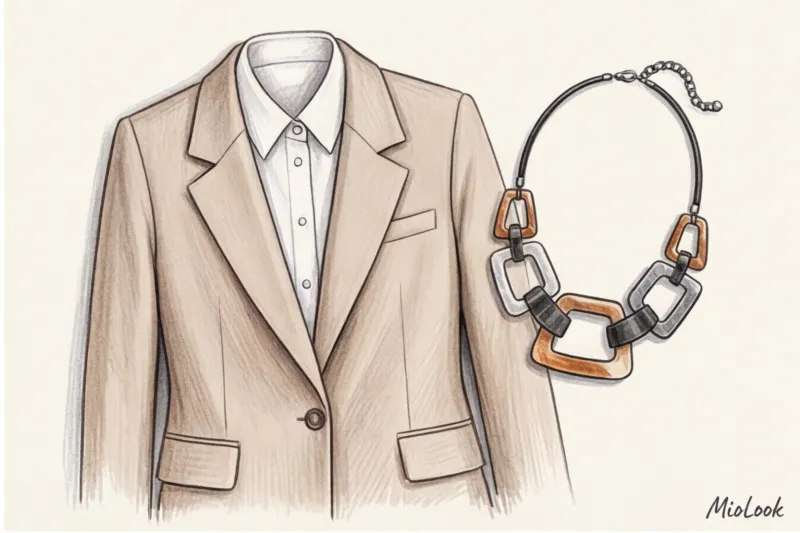
The remaining 20% of the image is your zone of absolute creative freedom, the concept Anchors This is one powerful, non-standard element (the very one statement piece ), which instantly catches the eye and compels the other person to focus on you. The anchor takes on the entire semantic load of your creativity. It silently communicates to the client or partner: "I think outside the box, but I know how to stay within the boundaries."
What can act as such a visual magnet? In my experience, the following anchor examples work best:
- Asymmetrical jacket — for example, with a single deconstructed lapel, an offset button line, or contrasting inserts (think Maison Margiela's cerebral aesthetic).
- Massive geometric brooch — made of crushed metal, raw stone, or architectural plastic. Try pinning it not on the classic lapel, but on the collar of a turtleneck or even the waistband of formal trousers.
- Shoes with architectural heels — beveled, transparent, or geometric. From the front, you look completely conservative, but as soon as you take a step, a creative detail is revealed.
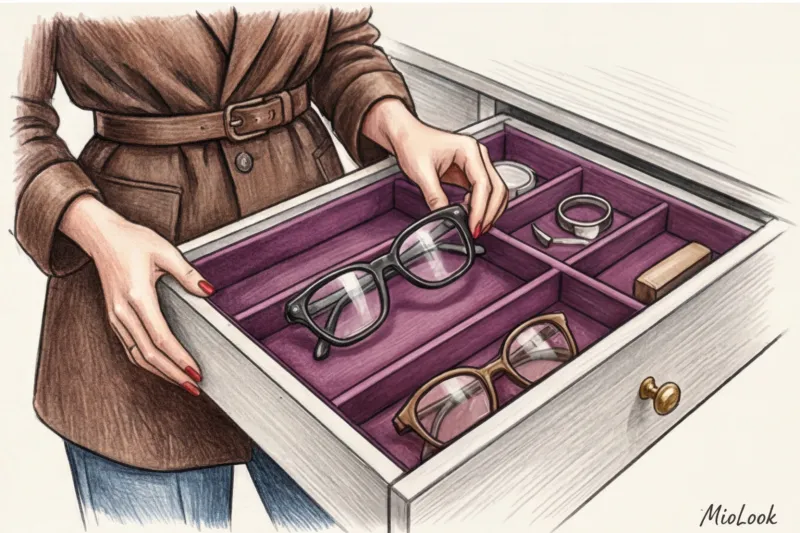
- Unusual glasses — in a massive, chopped frame (like those from Kuboraum or Thierry Lasry). For experts, this is generally the main tool for framing the face and conveying intelligence.
"The biggest mistake I see creative professionals make is trying to wear 'all the best at once.' Two anchors in one look create a visual conflict and turn the expert into the city madwoman."
A strict rule of my methodology: one look, one anchor. If you've chosen glasses with complex geometric shapes, your shoes and bag should become an invisible part of the "canvas." An asymmetrical top? That means skipping the complex print on your pants.
To ensure this systematic approach works every day without the morning panic, your wardrobe needs to be properly categorized. I recommend my clients use MioLook app You can use it to digitize your items and assign tags to them: #canvas for the structural base and #anchor For accent details. The app will help you quickly generate look formulas where exactly one accent will be paired with a perfect neutral base, saving you those precious 15 minutes before an important meeting.
Creativity Scale: How to Adapt Your Style to Business Challenges
Clothing is the interface through which we interact with the world. And, like any good interface, it should adapt to the individual user. Last year, the art director of a major fintech startup approached me. She was scheduled to present at a three-day international conference, where the audience varied dramatically: from stern investors on the first day to avant-garde web designers at the private afterparty.
We didn't pack three different suitcases. Instead, we used a scenario-based approach, dividing her capsule into three levels of creativity. This method allows us to subtly manage the experience without changing our DNA.
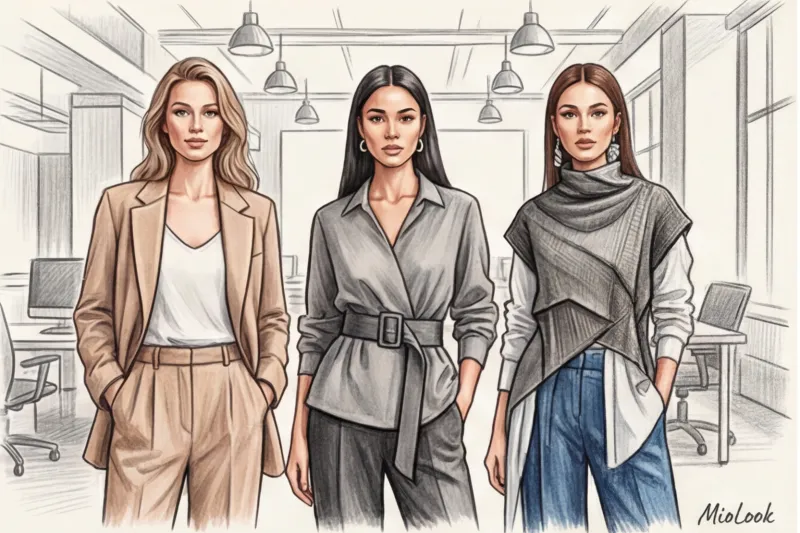
Level 1 (Trust & Safe): Meeting with a Conservative Client
Banking, law, the public sector, or your first meeting with investors. In this environment, your creativity should whisper, not shout. The main goal of your image is to convey absolute reliability and consistency. You demonstrate that you know how to play by the rules of the business world, but you do it with style.
At this level, we keep visual noise to a minimum. No deconstruction, ragged edges, or loud prints. The emphasis shifts to expensive textures and perfect cut On the first day of the conference, my client wore a deep graphite suit, but instead of a standard shirt, we opted for a top made of thick matte silk, and swapped the classic pumps for leather loafers with a stiff square toe. The silhouette echoed The Row's aesthetic: closed, minimalist, but with impeccable shoulder architecture. The result: investors saw someone they could trust with multi-million-dollar budgets, because her appearance exuded an expensive, controlled order.
Level 2 (Pitch & Inspire): Project Defense
Pivots, tenders, defending your creative concept to the board of directors. The committee can watch ten presentations a day—their vision becomes blurred. Your task is to make a lasting impression, break through fatigue, but maintain your status as an expert.
This is where it comes into play one bright "anchor" The basics remain neutral, but we add a striking element. For the second day of the performance, we kept the same graphite trousers but added an asymmetrical jacket with a complex cut and a massive crumpled metal brooch on the lapel. This single focal point keeps the audience's eyes on your face and chest while you speak. It works flawlessly: the listener's brain registers the visual anomaly, and you automatically stand out from the line of identical speakers in blue jackets.
Level 3 (Vanguard & Network): Industry Group
Industry exhibitions, biennials, conference after-parties. You're among your own kind—designers, architects, creatives. Here, conservative rules are abandoned, and the pure avant-garde takes center stage. Your appearance becomes a social marker, communicating: "I'm in context, I'm in the spirit of the times."
At the third level of the scale, maximum freedom is allowed: complex layering, playing with proportions, mixing styles. On the final day, our heroine wore wide palazzo pants and a long, deconstructed shirt over them. The same neat French tuck (where the shirt hem is slightly tucked in at the front) gives way to a deliberate, considered casualness. Ankle boots with the signature angled heel, in the spirit of Maison Margiela, completed the look. In a creative environment, such complex styling works as the perfect icebreaker—people come up to you to compliment your shoes or the cut of your jacket, and it becomes the beginning of a productive networking event.
Access to MioLook for €0.99 — one-time payment
Start creating perfect looks with the help of artificial intelligence. Tagged your items by creativity level and save time on your morning routine.
Get access — €0.99 onceFor this system to work for you every day, your wardrobe should be clearly organized according to these three scenarios. When you know exactly what level of creativity is appropriate today, you stop second-guessing your choices and focus all your energy on solving real business problems.
5 Key Elements of a Creative Business Wardrobe
If you take a standard corporate tailored suit and simply sew it out of fuchsia fabric, you won't achieve a creative business look. You'll end up with an entertainer's uniform. The true aesthetic of a creative professional isn't built on flashy colors, but on a deep understanding of form, proportion, and tactility. To assemble a wardrobe that communicates your expertise without being overly overbearing, simply focus on five basic elements.
1. Architectural cut instead of classic
The foundation of a creative wardrobe is working with form. Classic business style requires strict symmetry and a tailored fit. We borrow these principles. Japanese school of design (think of the work of Yohji Yamamoto or Rei Kawakubo): deconstruction, clever oversize and asymmetry.
Oversized here isn't simply a three-size-too-large garment. It's a sculptural exploration of the air between the body and the fabric. A jacket with dropped shoulders, trousers with asymmetrical pleats, or an unconventional shirt demonstrate your spatial thinking. By choosing an architectural cut, you demonstrate to your client your ability to push the envelope while remaining within the bounds of professionalism.
2. Complex textures instead of gloss
The cheap sheen of smooth synthetic fabrics instantly kills the status quo of an outfit. In a creative environment, tactility reigns supreme. Swap the usual smooth suit wool and satin for materials with a distinct character: bouclé, raw silk, thick linen, or matte leather.
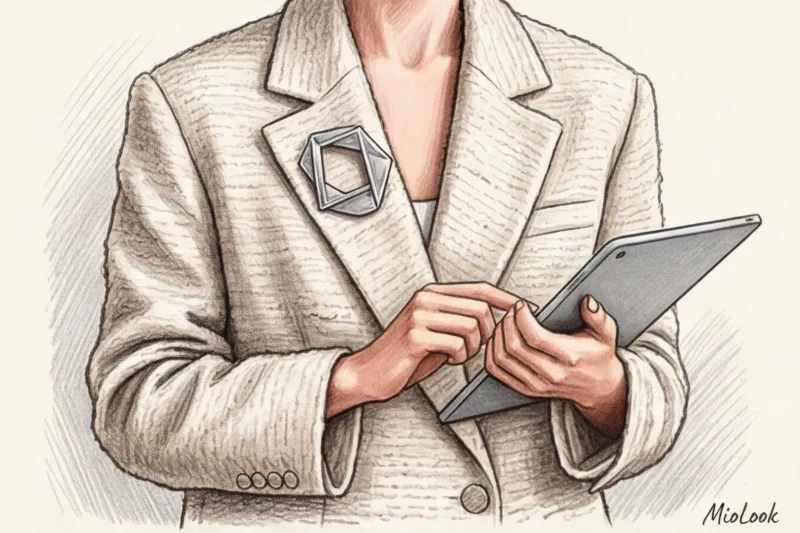
Raw silk, for example, has a characteristic roughness and fine knots. Unlike glossy silk, it doesn't look pretentious, but upon closer inspection, it betrays an expensive, sophisticated piece. According to the analytical agency WGSN (2024), the macro trend for "grounding" textures is currently dominating the premium segment, as materials with a sophisticated feel subconsciously inspire more trust in the recipient.
3. Intelligent color palette
Forget about bold, spectral colors like pure red, piercing blue, or bright yellow. They're too aggressive for business communication and draw attention away from your ideas and toward your clothing.
The creative class chooses intellectual shades These are colors with a hint of gray or brown: dusty cedar, sage, deep graphite, marengo, dark chocolate, and cobalt. This palette looks expensive, is easy to combine, and serves as the perfect backdrop for your presentations. You can also look striking in monochrome, if that monochrome is composed of three different shades of graphite.
4. Shoes as an art object
In a creative wardrobe, shoes take on the role of that "anchor" we mentioned earlier. While your outfit remains a minimalist canvas, your shoes can be a true work of art.
One of my clients, a Senior UX designer, conducted a kind of A/B testing during interviews as an experiment. She noticed that a formal pantsuit paired with ankle boots with a slanted architectural heel garnered more informal compliments from hiring managers than classic pumps. You don't have to go for the avant-garde, like Maison Margiela's Tabi boots, if that's not your thing. A square-toe, contrast stitching, or a sculpted heel are enough.
5. Glasses as the main tool for framing the face
Glasses are the only accessory that provides direct eye contact during negotiations. For a creative professional, they're not just a medical device, but a powerful tool for conveying intellect and taste.
Avoid thin, unnoticeable metal frames that lack a face. Opt for thick acetate, tortoiseshell, or complex geometric designs. A solid, well-shaped frame brings your features together, sharpens your gaze, and adds weight to your every word.
"Complex designer pieces require a perfect eye. If you wear an asymmetrical jacket with a textured skirt and arty shoes, you risk looking like a city madwoman. Balance is everything."
Mentally combining non-standard cuts can be extremely difficult. To avoid wasting morning hours trying on clothes in front of a mirror, I strongly recommend digitizing such items. MioLook I create separate tags for my database: "architecture," "texture," "art object." The app allows me to create a look formula in a couple of clicks, combining one complex item with two basic ones. This prevents overload and ensures that my appearance works for my reputation, not against it.
Digitizing Style: How to Manage a Creative Wardrobe with AI
A 2023 study of wardrobe habits conducted by the Wharton School revealed a curious paradox: the more complex the cut and texture of an item, the less often we wear it. Our brains, predisposed to optimizing energy, simply refuse to solve visual equations with three unknowns in the morning.
Complex designer pieces—asymmetrical skirts, deconstructed tops, or jackets with exaggerated shoulders—are physically difficult to mentally pair. You may remember perfectly well that you have a stunning jacket from Maison Margiela or Dries Van Noten hanging in your closet. But standing in front of your closet at 7:30 a.m., you can't immediately remember which trousers to pair with its unconventional proportions without distorting your silhouette. As a result, your hand treacherously reaches for your familiar, safe sweater. This is precisely why creative business style demands rigorous, ruthless digitalization.
When I switched to architectural minimalism myself, I quickly realized that my working memory couldn't handle the variability. I started transferring all the items of clothing to MioLook app The point isn't simply to take pretty photos of things on a white background. The real value lies in tagging and creating algorithmic formulas for images.
In the app, I rank each accent piece by its level of creativity. For example, the tag Level 2: Pitch Instantly filters all the pieces suitable for me to pitch my project to the board of directors. I also create virtual lookbooks there: I layer a complex, sculptural jacket with basic palazzo pants, add geometric shoes, and save the combination. In the morning, all I have to do is open my smartphone and choose a ready-made scheme that's guaranteed to work.
Your ideal image
it begins Here:
Join thousands of users who look flawless every day with MioLook.
Get access — €0.99 onceDigitization offers another powerful advantage for professionals: rigorous cost-per-wear data analytics. In a creative wardrobe, the right "anchors" are expensive. It's easy to feel guilty about buying a structured wool jacket from a conceptual brand for a hefty price. But let's look at the raw numbers.
A year and a half ago, I bought a complex deconstructed trench coat. Thanks to the app's automatic tracking of worn items, I have precise data: in the first eight months, I wore it 42 times. The CPW formula (cost of wear divided by number of times worn) showed that one outfit in this designer masterpiece cost me less than a cup of artisan cappuccino. And the impact this trench coat made during business negotiations recouped its cost many times over, demonstrating my unconventional thinking.
Investing in a high-quality designer jacket, an avant-garde bag, or sophisticated shoes is always financially justified. But only on one condition: if this item is integrated into your personal system of coordinates, contributes to your reputation on a weekly basis, and can be managed with a couple of clicks, rather than hanging like dead weight in the back of your closet.
Key Mistakes: How to Avoid Crossing the Line Between "Expert" and "Freak"
Remember Coco Chanel's famous quote about removing one accessory before leaving the house? In our niche, this rule should be taken to an absolute. The line between a recognized visionary and the "town madman" is incredibly thin. Over the years of styling, I've noticed a clear pattern: it's the newcomers, having gained freedom of self-expression, who most often make three fatal mistakes that completely destroy their professional status.
Mistake 1: Competing accents
Imagine this: a complex, deconstructed jacket, a bold geometric print on a blouse, and chunky shoes with tractor soles clash in a single look. A visual short-circuit occurs. The human brain can't process so many unconventional signals simultaneously.
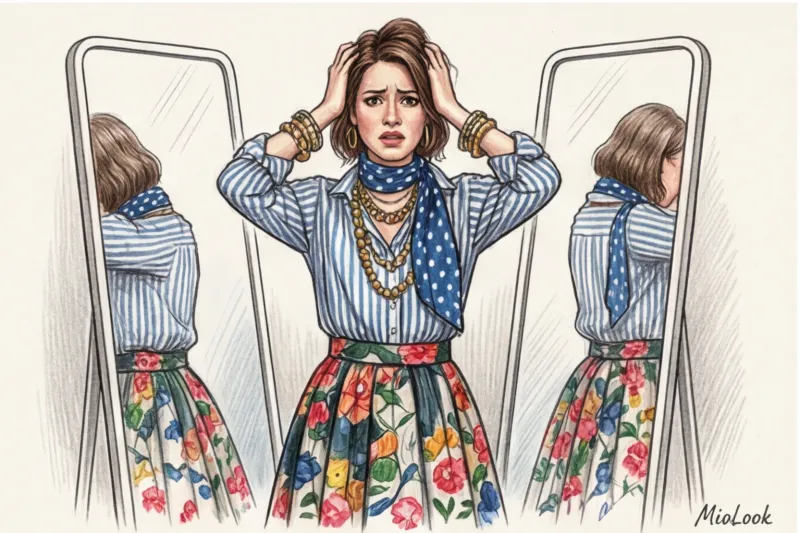
Instead of sensing your competence, your interlocutor subconsciously feels anxious from the visual noise. Creative business style It doesn't tolerate polyphony. If you've chosen ankle boots with an architectural heel in the spirit of Maison Margiela, they should stand out against a completely calm, monochrome base. The rule is simple: one look, one semantic center.
Mistake 2: Ignoring context and audience
Clothes are a communication tool, not just a therapy session for your ego. One of my clients, a brilliant art director, once showed up to a board presentation of a conservative fintech startup wearing a total look in the style of dark avant-garde Rick Owens. She didn't sell the project. Why? Because her appearance created a barrier between her and the investors.
Dressing exclusively for yourself, ignoring the context of the meeting, is a sign of unprofessionalism. Your avant-garde look should be calibrated to the client's level of receptivity.
Style should build bridges. You can remain true to your aesthetic, but you must adapt its intensity to a specific business objective. For a conservative audience, a single unusual detail, such as glasses with complex frames, is enough, rather than completely disrupting the silhouette.
Mistake 3: Cheap creativity
This is the most brutal trap of the mass market. Asymmetry, exaggerated volumes, and raw edges only look conceptual in premium designs. Trying to buy a complexly tailored jacket made of thin, squeaky polyester for $30 always ends in failure. Low-quality fabrics don't hold their shape, have a cheap sheen in the light, and instantly ruin any design idea.
My professional motto: less is more. Consider having just two conceptual jackets in your closet, made of thick suiting wool or heavy matte silk, rather than ten dubious acrylic experiments that will cheapen your look.
To avoid these pitfalls, I recommend testing looks in advance. Gather your boldest combinations and upload them to MioLook app The digital format on a smartphone screen mercilessly highlights the overload of details and dissonance of textures that the eye often "forgives" during a quick morning glance in the mirror.
Checklist: Auditing Your Creative Business Style
In cognitive psychology, there's a term called "thin-slicing"—the human brain's ability to make remarkably accurate inferences based on a fraction of a second of observation. According to a classic Princeton University study (2006), it takes us exactly one-tenth of a second to assess the status, trustworthiness, and competence of a stranger.
In a business context, this phenomenon is transformed into a tough three-second rule This is how long your image has to speak before you open your mouth and begin presenting your project. During these moments, the client perceives the meta-message. What does your appearance convey? "I'm a chaotic artist who misses deadlines" or "I'm a systematic visionary who can be trusted with a million-dollar budget"?
To ensure your "three seconds" work to increase your checks and not cause hidden doubts in investors, I strongly recommend a ruthless closet audit. Here's a step-by-step, five-point plan I use in kickoff sessions with senior creative agency executives:
- Step 1. Air audit (proportions). Put all the tightly packed things away on the far shelf. In a modern, intelligent wardrobe, there must be air between the body and the fabric. Keep only those jackets, shirts, and trousers that maintain an architectural shape and create a clear, confident silhouette.
- Step 2. Tactility (texture) test. Run your hand along your clothes rack. If 80% of your items are smooth, thin, and synthetic, your wardrobe will look flat. Add depth: create a seasonal shopping list that includes heavyweight raw denim, cold-spun wool (fresco), bouclé, and matte leather.
- Step 3. Inventory of “anchors”. Find 3-4 statement pieces in your closet. This could be a jacket with exaggerated shoulders, an asymmetrical skirt, or shoes with a sculpted heel. If you don't have any, you're stuck in boring business casual. This is your first area for targeted investment.
- Step 4. Banish cheap creativity. The most painful, but necessary step. Get rid of T-shirts with ironic slogans, flimsy, colorful knitwear, and outdated plastic jewelry. Remember: one poor-quality item can ruin the impression of an expensive designer suit.
- Step 5. Digitization and assembly. Don't try to keep complicated layering combinations in mind—it's a surefire way to morning stress and a return to your usual jeans and sweatshirt look. Take photos of the filtered items and upload them to MioLook Create at least five ready-made capsule formulas for various business tasks (from a formal pitch to informal networking). The app will help you categorize things by creativity level and track which images bring you the most confidence in meetings.
"Treat your wardrobe like an interface. Make it intuitive for your target audience, aesthetically pleasing, and functional."
In conclusion, I want to emphasize the main point: creative business style is no longer about fashion, fleeting trends, or self-expression for the sake of shock value. It is a pragmatic tool. visual communication of your professional value.
When a client hires you to develop a brand strategy, an architectural project, or a complex UX design, they're buying your taste, your unique vision, and your ability to bring structure to chaos. A well-designed wardrobe effortlessly demonstrates that you can apply these skills not only to client briefs but also to yourself. Your appearance should be the first and most compelling example in your portfolio.
Guide Chapters
Business Sneakers: How to Wear Them with a Suit
White sneakers are no longer a one-size-fits-all solution for the office. Learn how to pair sneakers with a business suit, taking proportions and trends into account.
How to Dress as a Girl in IT: From Hoodies to Smart Casual
Appearance in IT isn't just a fashion statement; it's part of a career strategy. Learn how to incorporate elements of "quiet luxury" into your wardrobe while maintaining your usual comfort.
Office-Style Jeans: How to Look Professional
Denim is no longer just for weekends. Learn how to transform jeans into a statement piece for your business wardrobe.
How to Wear an Oversized Blazer to the Office: A Style Guide
An oversized jacket is the perfect uniform for creative professionals. We'll explore how to style a voluminous cut for everyday work.
What to Wear to the Office in Summer Without a Dress Code: Style for Creatives
How should you dress in the heat if you work in a creative field but want to look professional? We'll explore common mistakes and build the perfect summer wardrobe.
Stylish office wear for women over 40: status and trends
How should you dress for the office after 40 to look like a high-status visionary, not just a run-of-the-mill performer? We explore the rules of creative business style without age stereotypes.
The Ideal PR Man's Clothing Style: Status and Comfort
Working in PR and events isn't just about glamour; it's also a rigorous test of your wardrobe's survival. We'll explore how to dress stylishly, with class, and with practicality.
Winter Office Style for Women: Layering Secrets
A chunky sweater is the worst enemy of a business wardrobe in winter. Learn how to layer to look professional and feel comfortable.
Bright Colors in Office Wear: How to Wear Them Without Going Overboard
How to add color to your business wardrobe without losing your professional status? We'll explore the rules of incorporating color and prints with a personal stylist.
The difference between smart casual and business casual for creatives
A formal suit can kill your creative idea before the presentation even begins. We'll explore how creative professionals can find a balance between professional attire and self-expression.
Office Accessories: How to Express Yourself
A perfectly crafted business attire makes you stand out from your colleagues. Learn how one striking detail can help you build a strong personal brand.
How to transform a daytime look into an evening one without unnecessary items
Forget about lugging around heavy bags of extra clothes for events. The secret to a perfect transformation lies in the clever design of your morning outfit.
Stylish Office Makeup: Forget Boring Nude
Forget the "no makeup" rule. Learn how to use color and pops of color to highlight your professionalism and creativity.
Everyday business hairstyles for the creative industry
How to find a balance between a strict dress code and creative freedom? We explore stylish and quick hairstyles for working in the creative industry.
The perfect capsule wardrobe for the office without a dress code
Having no strict dress code is a trap that can harm your career. Learn how to put together a stylish outfit for a creative office and look like an expert.
What to Wear to a Creative Agency Interview: A Guide
A formal black suit can cost you an offer at a modern company. Learn how to choose the right attire for an interview in the creative industry.