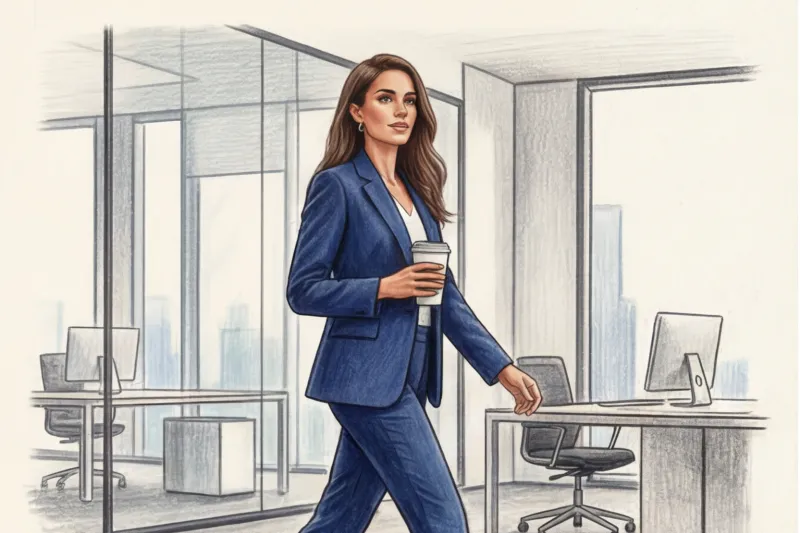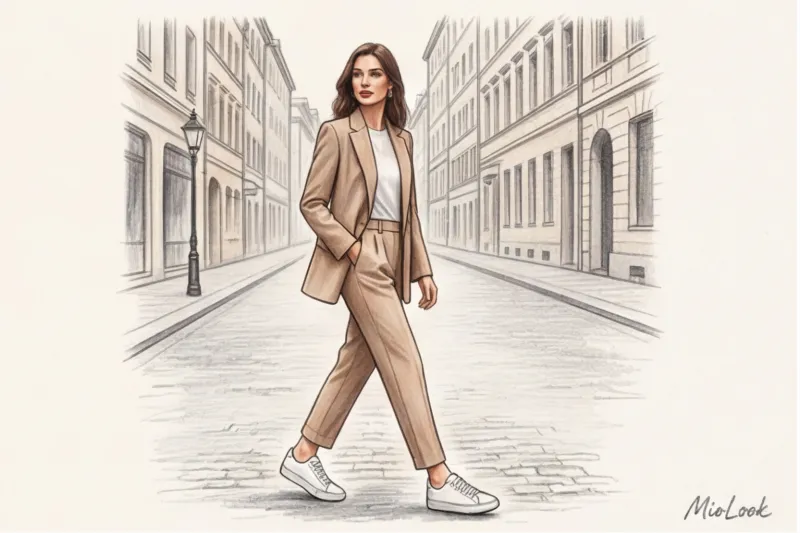
You know what style question I get asked most often during my consultations? "Emily, what white sneakers should I buy to wear with a suit?" My answer is usually discouraging: you might not need white sneakers at all. We're used to thinking that a minimalist white pair is the perfect complement to any business wardrobe. But if you pair thin, flat sneakers with the currently trendy wide-leg palazzo pants, you'll look like you're wearing orthopedic shoes to the office.
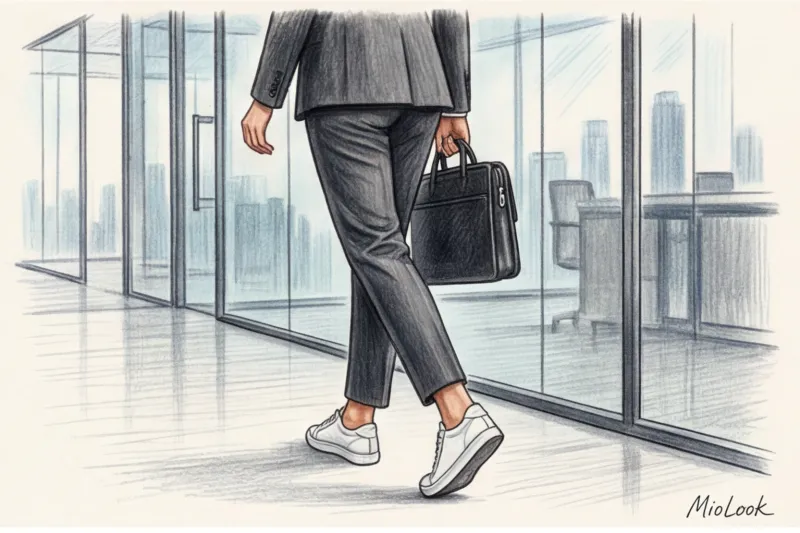
Integrating athletic shoes into a corporate wardrobe requires less taste than a basic understanding of geometry and proportion. We discussed the evolution of office dress codes in more detail in our the complete guide to creative business style , but today I want to explore the mechanics. We'll apply an engineering approach: the visual weight matrix, trouser length rules, and strategic impression management.
Anatomy of a Trend: Why Business Sneakers Have Become the New Normal
Wearing sneakers with a business suit has long ceased to be a sign of rebellion. It's a symbol of modern productivity. According to the Society for Human Resource Management (SHRM)'s 2023 report, over 70% of companies have permanently relaxed their employee attire requirements following the pandemic. But it's not just about comfort.
In 2014, researchers from Harvard Business School published a landmark paper describing "The Red Sneakers Effect." They demonstrated a paradoxical phenomenon: mild, deliberate violation of dress codes in a professional environment paradoxically increases A person's status in the eyes of their colleagues. When you wear a formal suit with well-chosen sneakers, you convey a nonverbal message: "My expertise is so high that I can afford to play by my own rules."
"The difference between casual and stylish is intent. It's one thing to give in and wear old running shoes because your feet are tired. It's quite another to consciously choose business-style sneakers as an architectural element of your look."
Access to MioLook for €0.99 — one-time payment
A smart AI stylist will select the perfect look.
Get access — €0.99 onceThe Biggest Mistake: Why Your Sneakers Look Ridiculous With a Suit
A couple of years ago, a client—a top manager at a major IT company—came to me with a question. He'd bought a gorgeous, slim-fitting Italian wool suit and decided to "modernize" it with chunky sneakers in the style of ugly shoes (hello, Balenciaga Triple S). The result? He looked like a cartoon character with giant feet. The problem was the "foreign element" effect—the shoes and the suit were in completely different weight classes.
A counterintuitive insight I've gained over the years: the success of a combination is 90% dependent not on the color of the shoes, but on their design and the correct length of your trousers.
The Rule of Visual Weight and Silhouette
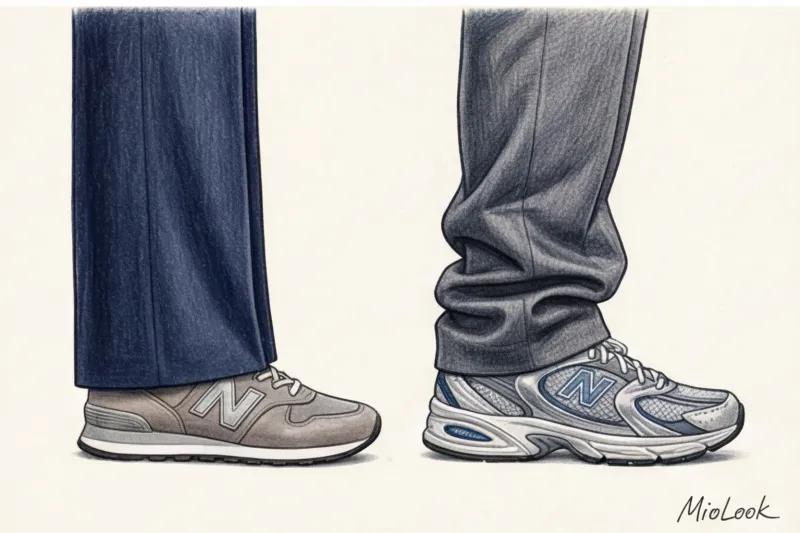
Visual weight is how much "space" a garment takes up within the overall look. For a suit and sneakers to complement each other, their visual weights should match or complement each other appropriately.
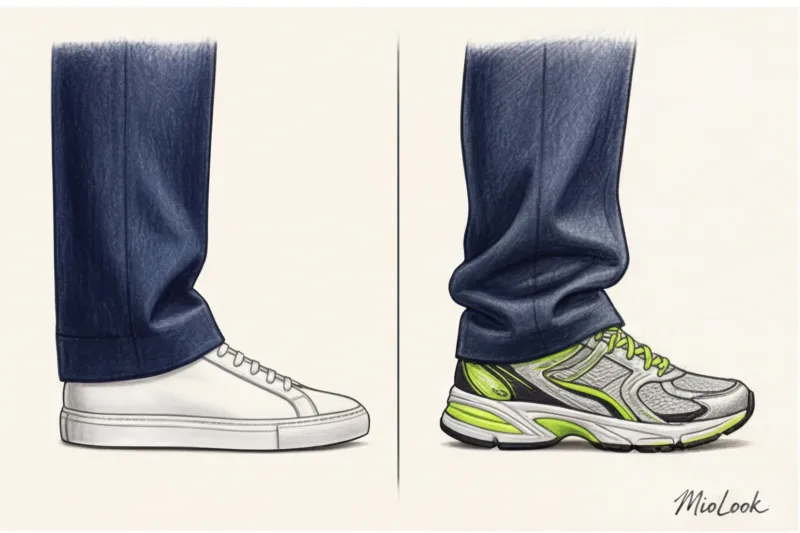
- Skinny cropped trousers + chunky sneakers = clown boots. The thin ankle emphasizes the exaggerated volume of the shoe, breaking the proportions of the body.
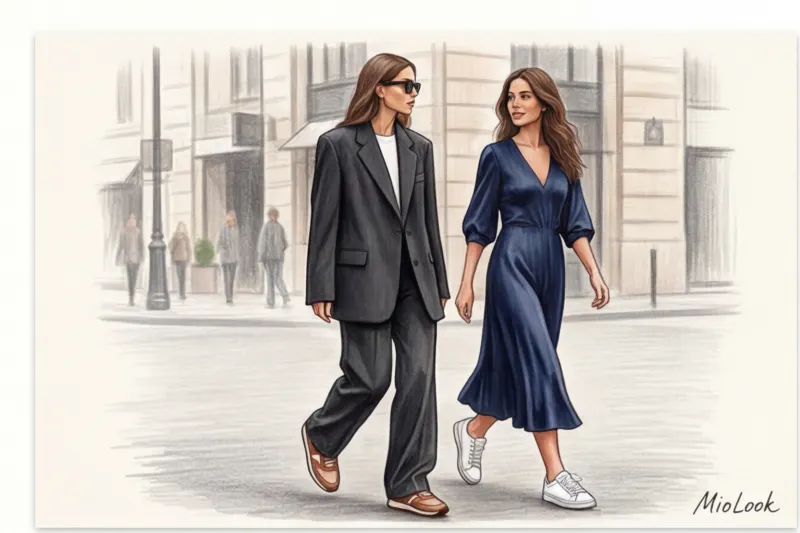
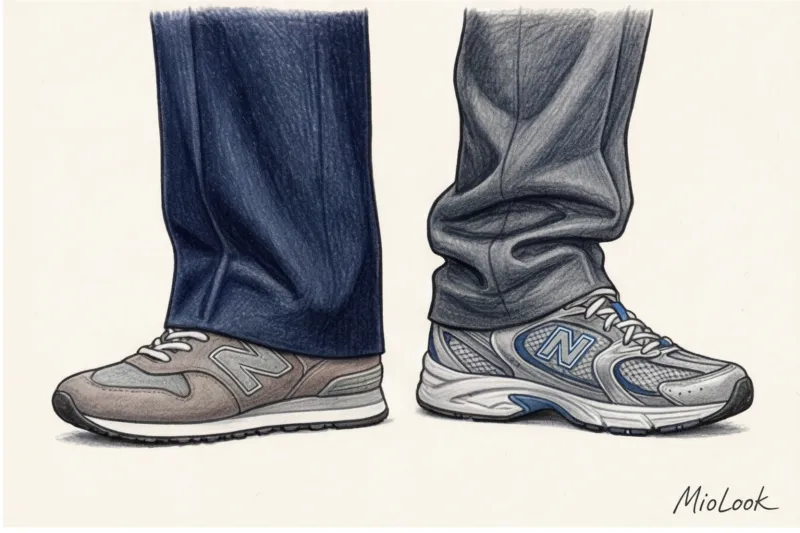
- Wide trousers (palazzo) + thin sneakers = “bare legs” effect. A wide pant leg will simply swallow up a sleek shoe. This is where the myth of white sneakers' versatility collapses. Palazzo shoes call for retro runners with a thick sole that can support the bulk of the fabric.
- Oversized jacket + chunky sole = balance. If you have a bulky top (like a structured, man-sized jacket), you'll want shoes with a statement sole to avoid looking like you're about to topple over.
Pant Break is crucial
In classic tailoring there is a term pant break — a crease in the fabric where the trouser leg meets the shoe. With sneakers, the rules change dramatically:
- No Break: The pant leg ends just above the edge of the shoe, revealing a hint of ankle or toe. This is the perfect length for tapered trousers and classic leather sneakers.
- Half Break (half break): The pant leg lightly touches the tongue of the sneaker, creating a single soft crease. This is the only surefire way to style wide-leg suit pants with retro runners.
- Full Break (full hall / "accordion"): An absolute no-no. If the fabric bunches up over your sneakers, the look instantly loses its class and looks sloppy. Get to the tailor immediately!
Access to MioLook for €0.99 — one-time payment
Start creating perfect images with the help of artificial intelligence
Get access — €0.99 once4 Ideal Sneakers for a Business Wardrobe
I personally tested 15 pairs of "office" sneakers—from budget-friendly mass-market to premium—monitoring the fatigue in my feet after a 10-hour workday filled with meetings and commuting. My findings completely aligned with orthopedic experts' recommendations: completely flat soles are harmful to the spine when worn for long periods. Here are four silhouettes that solve this problem and cover 90% of your wardrobe needs.
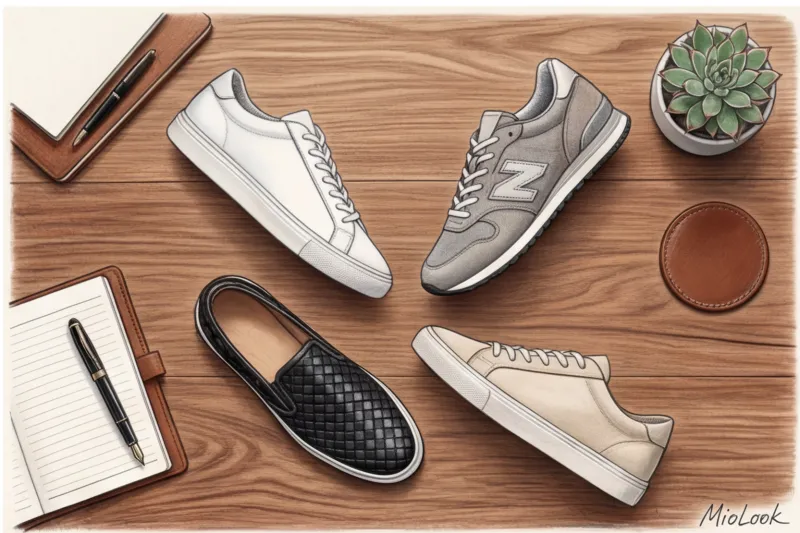
- Basic minimalist sneakers (Court shoes): Inspired by tennis classics. Smooth matte leather, completely free of logos, and a flat (but not too thin) sole. A classic Oxford shoe. Reference brands: Common Projects, Veja. Perfect for formal, structured suits.
- Retro runners: Running shoe silhouettes from the 70s and 80s. A combination of suede and thick nylon, a sophisticated yet muted palette (like taupe and beige). They have an anatomical drop of about 10-12 mm, perfect for posture. A great choice for relaxed, oversized suits.
- Premium slip-ons: Laceless models made of woven leather or thick suede with a thick rubber sole. They're a modern, more dynamic alternative to loafers. They pair perfectly with summer business attire and cotton or linen suits.
- Smart sneakers: Hybrids that borrow elements of classic shoes—for example, broguing (perforations), patina, or even leather inserts on the sole—are a godsend for those working in more conservative fields but want to add comfort.
Dress Code Matrix: Business-Style Sneakers for Different Industries
Let's be honest: what's appropriate at a creative agency could cost you a contract at an investment bank. I've developed a simple matrix to help you calibrate your choices.
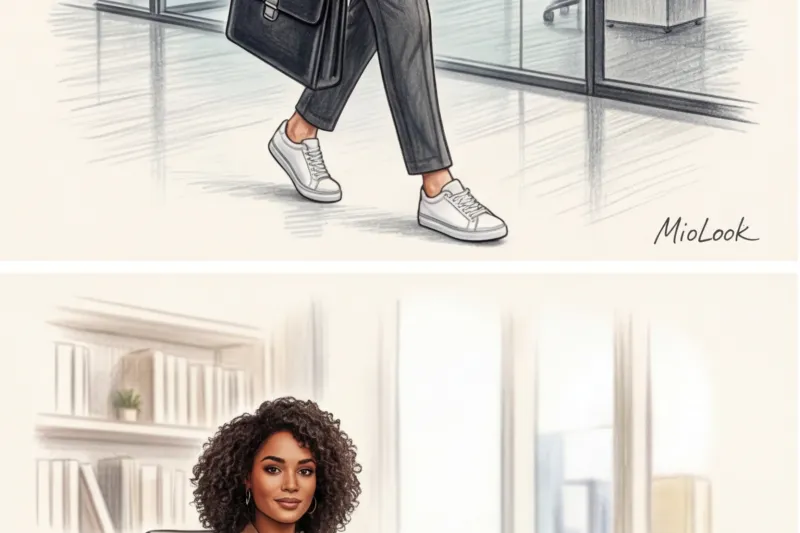
- Business Formal (Conservative): Law firms, traditional banking, and the public sector. Here, sneakers are still taboo on weekdays. The exception is Casual Friday, when formal hybrid models or minimalist leather sneakers matching the trousers are acceptable.
- Business Casual (Traditional): Corporate sector, consulting. Your choice is court shoes in basic colors. The main rule: the level of formality of your sneakers should match the accessories (for example, the smooth leather of your sneakers should complement a leather belt or a structured tote bag).
- Smart Casual (Modern): IT, media, marketing. Retro runners and subtle contrasts are acceptable. For example, a navy suit looks great with deep burgundy or emerald sneakers. This is where we start playing with textures—suede adds depth to the look.
- Creative Business (Creative Class): Architecture, design, fashion. This is where the "Red Sneakers Effect" really shines. Chunky silhouettes, color blocking, and limited edition models are all acceptable. Your shoes are a tool of nonverbal communication here, demonstrating that you've got your finger on the pulse of trends.
Your perfect look starts here
Join thousands of users who look flawless every day with MioLook.
Get access — €0.99 onceColor Palette: How to Avoid Violating Corporate Etiquette
If you want your look to look expensive (in the quiet luxury or old money aesthetic), the color of your shoes should be a strategic decision, not a coincidence.
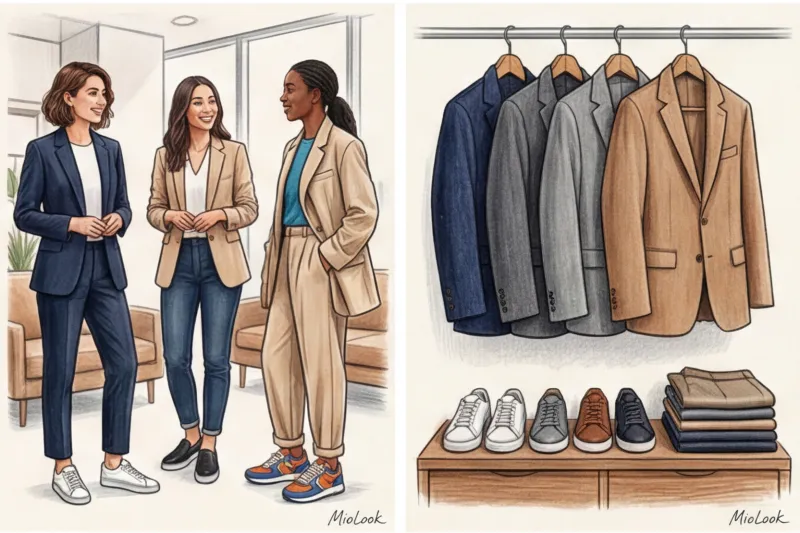
White — is a versatile canvas that freshens up any outfit, from graphite to beige. But it demands obsessive, perfect cleanliness. Pure white sneakers say, "I'm in control of my life." Dirty white sneakers scream, "I can't cope."
Monochrome (black, dark blue, graphite) — the safest choice for integrating into a formal wardrobe. If you wear dark blue suede sneakers with dark blue trousers, the shoes will visually blend into your leg. This not only reduces the informality but also dramatically elongates the silhouette.
The Three Color Rule: If you choose statement sneakers (like a retro runner combo), make sure one shade matches the color of your jacket, top, or bag. This will tie the look together.
Office taboos: Neon accents, large reflective details, overtly athletic mesh that reveals socks, and oversized logos. Save those for the gym.
Office Shoe Care: A Checklist for Status Professionals
In business attire, sneakers require even more careful maintenance than classic leather shoes. Dusty Oxfords are just that: dusty Oxfords. Dirty sneakers with a suit are disrespectful to your colleagues.
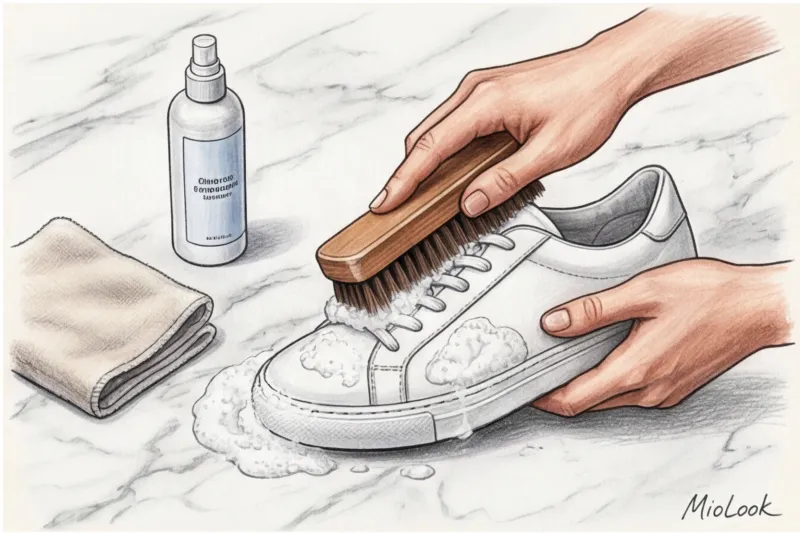
I once had a client spill coffee on her white sneakers 15 minutes before an important investor pitch. Micellar water and cotton pads bought at the nearest pharmacy saved the day. But it's best not to let things get too extreme. Here's your basic arsenal:
- Melamine sponge: White sole eraser. One swipe and the yellow residue disappears. Use only on the rubber part of the sole, as it will scratch the leather.
- Cedar tree shapers: The main secret to the longevity of leather sneakers is that they absorb moisture after a day of work and smooth out creases at the toes. Without them, smooth leather would become covered in deep wrinkles within a month.
- Water-repellent impregnation: Apply biweekly. Protects suede from chemicals and textiles from street dust.
And the bitter truth: "office" white sneakers don't last as long as dress shoes. If they're worn heavily, they need to be replaced every season. Once the leather loses its shape and becomes difficult to clean, relegate the pair to dog walking shoes.
Summary: The formula for the perfect sneaker look
Business sneakers aren't a compromise between comfort and status. They're a new, dynamic language of the professional world. Before leaving home, run a quick checklist:
- Does the silhouette of the sneakers match the width of the trousers? (Is there a "clown shoe" or "bare leg" effect?)
- Are the pants the right length? (No accordion over the sneakers).
- Are the soles and laces absolutely clean?
- Is this level of relaxation appropriate for today's meetings?
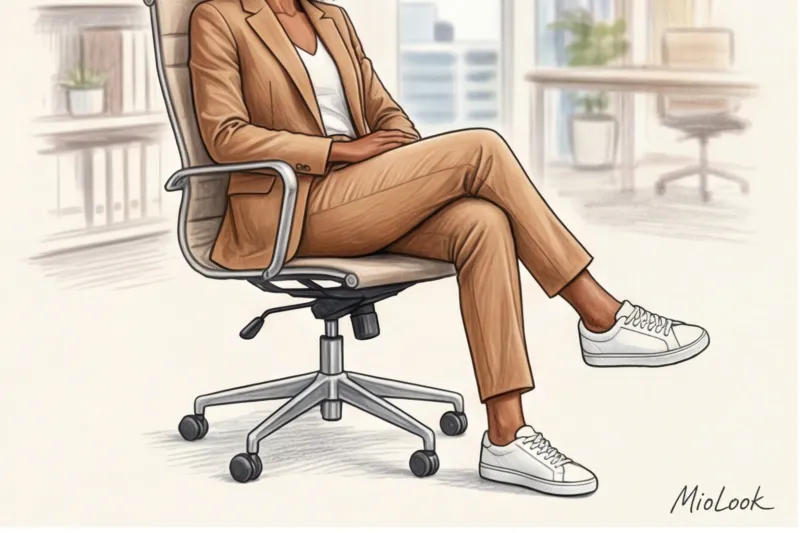
Creating a harmonious wardrobe, where every outfit pairs perfectly with the right pair of shoes, takes time and a keen eye. To save yourself from the morning "what to wear" panic, I recommend digitizing your wardrobe. Upload photos of your outfits and shoes to MioLook app A smart algorithm will analyze proportions, colors, and style, instantly providing you with ready-made combinations that work flawlessly.
Leave doubts in the past. Your expertise deserves to be conveyed with style and absolute comfort.