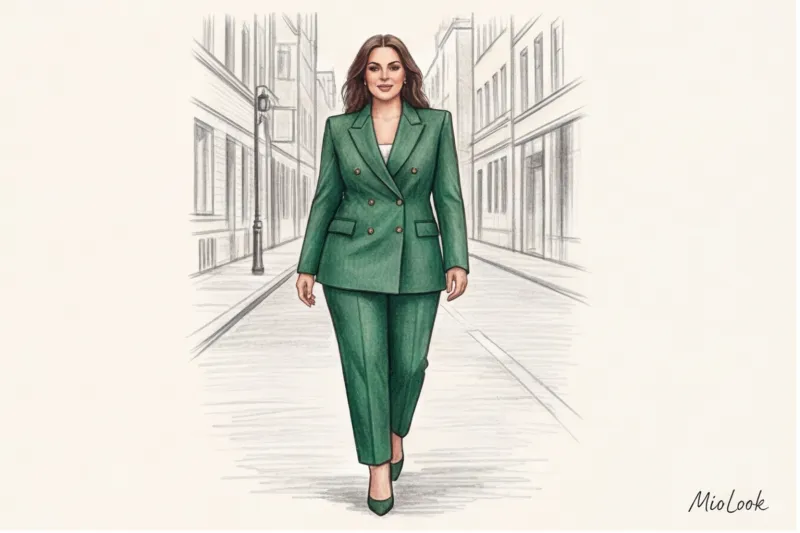
Over the 12 years I've been a personal stylist, I've performed the same ritual hundreds of times: I'd take the measuring tape a client brought to their first fitting and hide it in the back drawer. Why? Because numbers lie. When we discuss body types of plus-size women, how to dress and what to combine with what, most people make a fatal mistake: they try to disguise the body, turning it into a flat geometric figure.
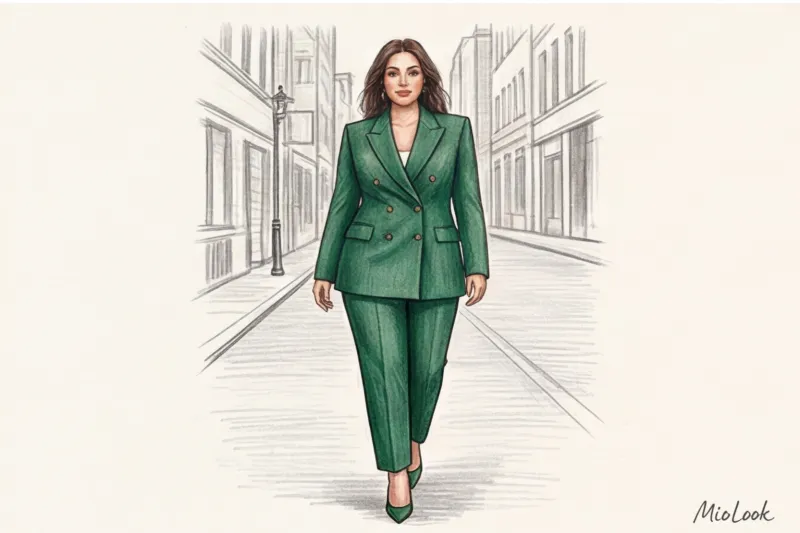
In classical theory, we're used to dividing women into "apples" and "pears." We've already discussed the absurdity and outdated nature of this approach in more detail in our A complete guide to body types: how to choose clothes and forget about "pears" Today, I offer you a completely different, architectural approach. We'll work with fabric density, cut lines, and volume distribution to highlight your natural figure, rather than hiding it in shapeless robes.
Forget about apples and pears: new geometric style
The fruit theory of body typing isn't just outdated—it's toxic. It forces women to focus on "flaws" and think exclusively in terms of concealment. Instead of asking "how to hide my hips?" modern styling asks "how to create a harmonious silhouette architecture?"
Casting directors at modern fashion weeks (as noted by an analytical report) Vogue Business (By 2024) designers have long been looking for something other than a standard, flat mannequin, but rather an interesting body architecture. Designers are working with volume as if it were a sculpture. And we should learn from this approach.
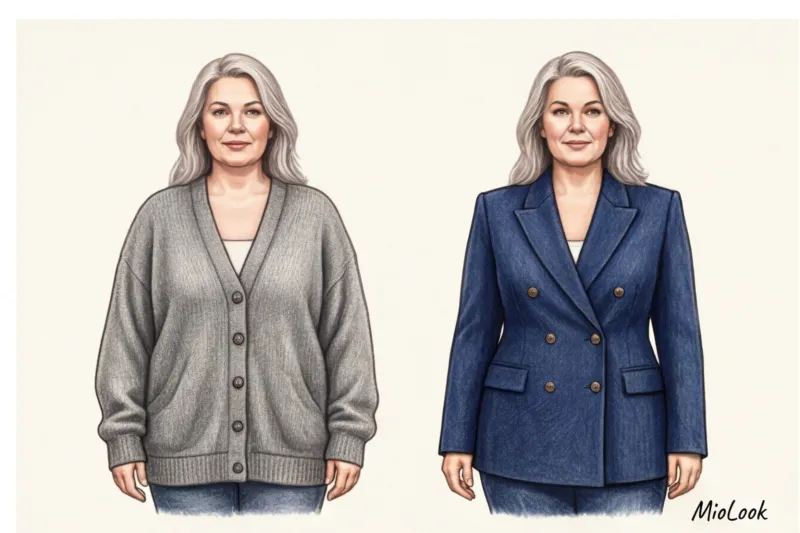
One of my clients, Anna, spent years buying A-line tunics in an attempt to hide her belly, believing she was an apple shape. As a result, she looked like a monumental column. At our very first appointment, we swapped the thin tunic for a structured jacket with a defined shoulder line from the Massimo Dutti collection. The result? She dropped two visual sizes in 15 minutes in the fitting room. We didn't change her body—we changed the geometry of her lines.
Modern classification: 4 volume distribution vectors
Let's abandon flat 2D silhouettes in favor of 3D analysis. When analyzing body types for plus-size women and how to dress stylishly, we focus on bone structure and four volume distribution vectors:
- Lower vector (dominant hips): Your main tool is balance. If volume is concentrated at the bottom, don't hide it under long, bell-shaped skirts. We add accent shoulders (shoulder pads are back in fashion) and use light shades in the portrait area.
- Upper vector (lush chest, wide back): Our goal is to create deep V-shaped verticals. An unbuttoned shirt collar, elongated jacket lapels, and long pendants.
- Central vector (volume in the abdominal area): The high waist and unbuttoned top layers work their magic here. High-waisted straight trousers and a cardigan thrown over them create two vertical lines that visually cut off the sides.
- Proportional vector (uniform volume): Your goal is to maintain natural proportions. Don't tie yourself down with a thin, contrasting belt; stick to monochrome looks.
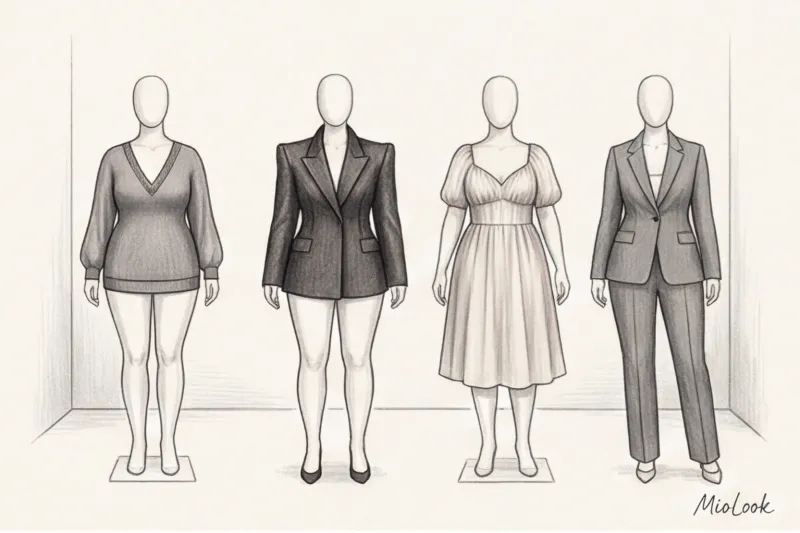
"Stylists don't look at the stomach or hips. We look for the points of support: the shoulders, collarbones, wrists, and ankles. This is the framework on which any look rests," says Isabella Garcia.
Grace Points: How to Use Your Wrists and Ankles
Have you ever noticed how the same shirt can look boring, or incredibly stylish? The secret lies in the exposed points of grace. These are the thinnest parts of our body: wrists, ankles, neck.
3/4 sleeve or correct shirt cuff (so called Italian roll (When the cuff is turned up just above the elbow and then the sleeve is rolled up) instantly lightens the silhouette. Cropped trousers that reveal a graceful ankle, paired with loafers, create a dynamic look. These micro-techniques are especially relevant if you're putting together Business casual for women: how to create a stylish look for the office.
Access to MioLook for €0.99 — one-time payment
A smart AI stylist will select the perfect look based on your individual proportions and points of support.
Get access — €0.99 onceThe Biggest Plus-Size Myth: Why Oversized Clothes Make You Look Bigger
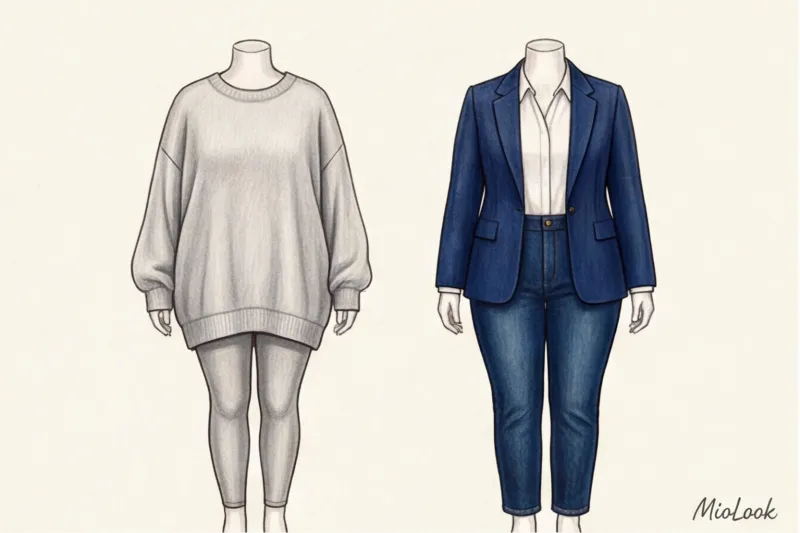
It's time to reveal the most counterintuitive fact: oversize clothing is the main enemy of the plus-size wardrobe. According to statistics from the McKinsey Global Consumer Habits Report (2023), almost 70% of curvy women buy clothes one or two sizes larger in an attempt to "hide" their curves. But the effect is completely opposite.
The mechanics are simple. By hiding in a hoodie, you visually occupy a space equal to the widest points of this shapeless sweater. The brain of the person looking at you automatically interprets this giant square as the size of your body.
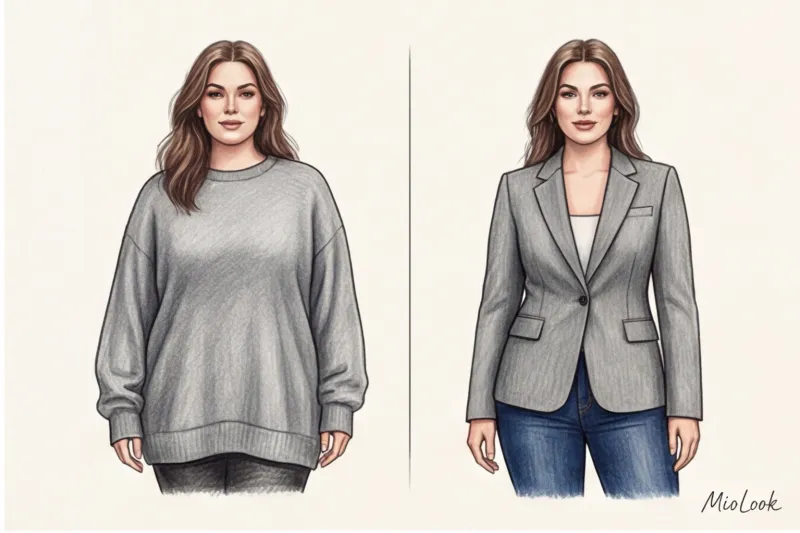
Remember the difference between a "loose fit" and a perfectly proportioned "semi-fitted silhouette." The perfect fit is when there's air between your body and the fabric, about 2-3 centimeters of leeway. The garment shouldn't dig into your skin, but it should follow the contours of your figure.
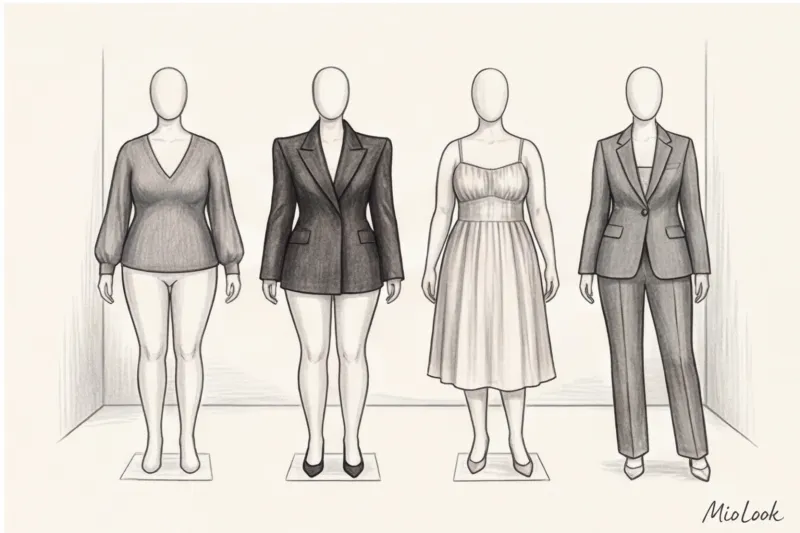
Fair Limit: This semi-fitted cut tip doesn't work if you choose thin, cheap fabrics. A semi-fitted dress made of flimsy knitwear will highlight every crease in your underwear. And here we come to the most important rule.
The Rule of Density: Fabrics that Work Like a Sculptor
Thin, flimsy knitwear is your number one enemy. It lacks structure, sags, and deforms at the elbows and knees, turning any figure into a tired comma. Remember: fabrics should work for you like a good sculptor.
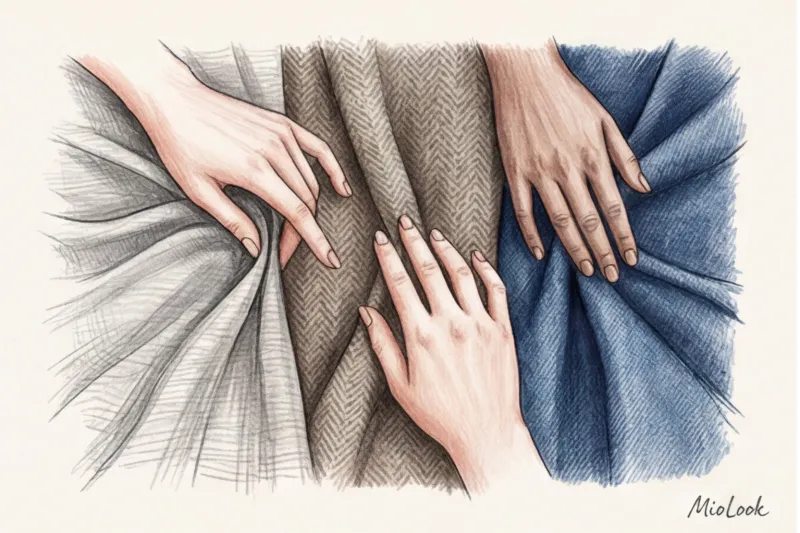
One day, at a fitting in Milan, a tailor I knew told me a brilliant phrase: "There are no bad figures, only lazy tailoring and a lack of understanding of the properties of the material." To ensure your clothes create a flattering silhouette, look for the right proportions in the composition.
- Thick cotton: Choose fabrics with a density of 180 g/m² (often found in basic COS lines or premium Uniqlo models).
- The right denim: Ideal jeans are made from denim that weighs at least 12 ounces.
- Suit wool and gabardine: They hold the crease on trousers perfectly, creating that very elongating vertical line.
- Elastane content: Read the labels! The elastane content should be no more than 2-3%. If it's 5% or more, the item will quickly lose its shape and start clinging to areas it shouldn't.
Thick fabrics are relevant not only in the cold season. If you are choosing What to wear to the office in summer without a dress code , choose thick linen with added viscose - it breathes, but keeps the shape of the jacket.
Fail-Safe Image Formulas: The Mathematics of Style for 50+
I don't believe in inspiration from glossy magazines that can't be applied to real life. I believe in clear, mathematical wardrobe formulas. Here are three tried-and-true combinations that save my clients at important events and in everyday life.
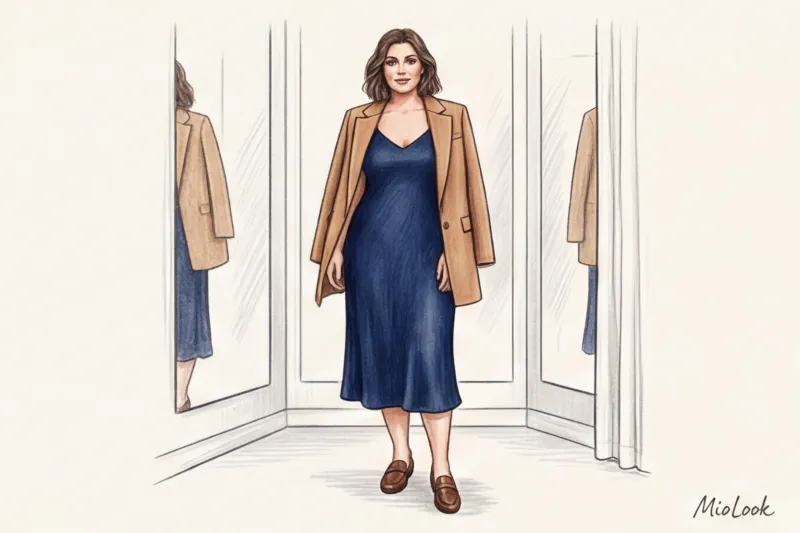
Formula 1: Straight midi dress + structured long jacket + loafers
This is instant glamour. A dress made of thick viscose or matte silk creates a single column of color. A contrasting jacket draped over it (length just below the widest part of the hips) with defined shoulder pads creates two strong vertical lines. A guaranteed elongation of the silhouette. Ideal for smart casual dress code.
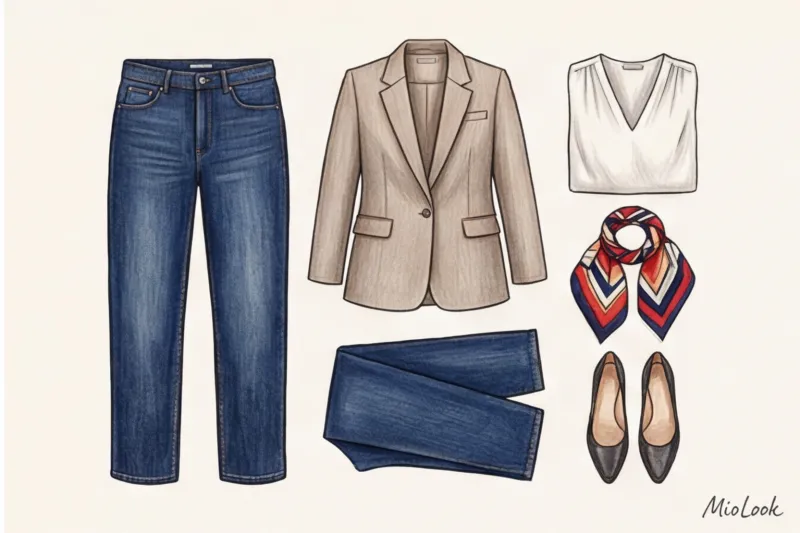
Formula 2: Full-length straight jeans + V-neck top + chunky knit cardigan (open)
The secret here is the length of the jeans—they should cover the ankle and rest slightly on the shoes, elongating the legs. The V-neckline reveals the collarbone, and the textured cardigan, left unbuttoned, adds coziness without bulk.
Formula 3: Monochrome trouser suit with a matte texture + bright shoes
When you need to look classy (for example, for an interview at an IT company for a management position), choose a two-piece suit in a deep shade (dark chocolate, inky blue). Matte fabric absorbs light, visually narrowing your silhouette, while bright pumps or loafers draw the eye downward, forcing your interviewer's gaze to skim your entire body.
Your perfect look starts here
Join thousands of users who look flawless every day with MioLook. Upload your items, and we'll curate the perfect formulas for you.
Get access — €0.99 onceColor and Print: How to Stop Hiding Behind Black
How many times have you heard that "black is slimming"? As a color expert, I can tell you that's only half-true. Black is slimming only if the fabric is thick, matte, and perfectly cut. A black dress made of thin, shiny satin will make you look twice as big, highlighting every glint of light on your curves.
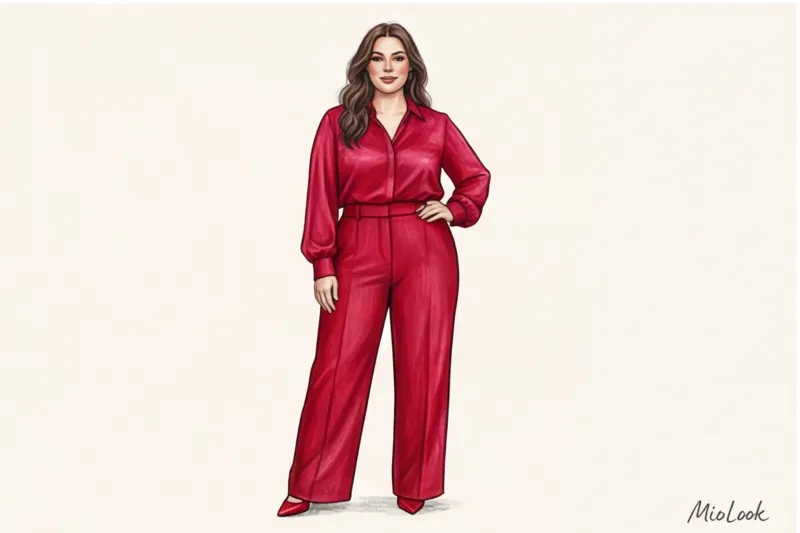
Plus-size Mediterranean women know how to live life. On the streets of Rome or Madrid, you'll rarely see a plus-size woman dressed head-to-toe in mourning black. They choose color! Deep burgundy (Marsala), emerald, sapphire, terracotta—these monochrome looks work just as well as black, but they add status and confidence.
When it comes to prints, keep proportionality in mind. A small cotton floral (millefleur) on a statuesque figure creates an imbalance, making the body appear larger in contrast to the small pattern. Choose medium or large geometric prints, wide diagonal stripes, or abstract designs that distract from the eye's focus and prevent true volume from being perceived.
Checklist: 5 First Steps to a New Wardrobe
Theory is dead without practice. If you're ready to stop hiding your figure and start dressing it, here's your routine for this weekend:
- Conduct a ruthless audit. Remove all shapeless, stretched-out knitwear and clothing that is two sizes too big from your closet. Place them in a plastic bag. If in doubt, store them on the attic for a month.
- Invest in architecture (lingerie). A great look starts with the right bra that lifts your bust to the right height, freeing up your waist, and seamless, high-waisted panties.
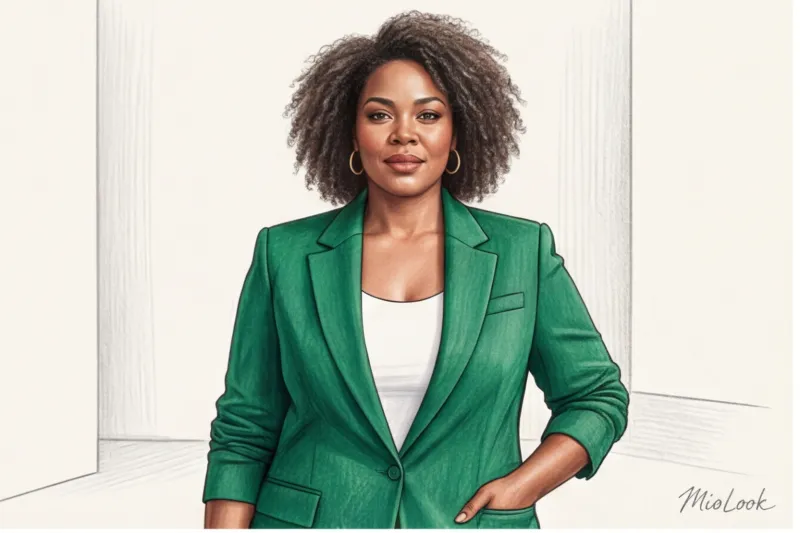
- Find your perfect jacket. Straight or slightly fitted, with a crisp shoulder line, made of high-quality wool blend, this is armor that will pull together any everyday look.
- Buy basic trousers. Ditch the skinny jeans for straight trousers or palazzo styles with a mid- to high-waist made of thick gabardine.
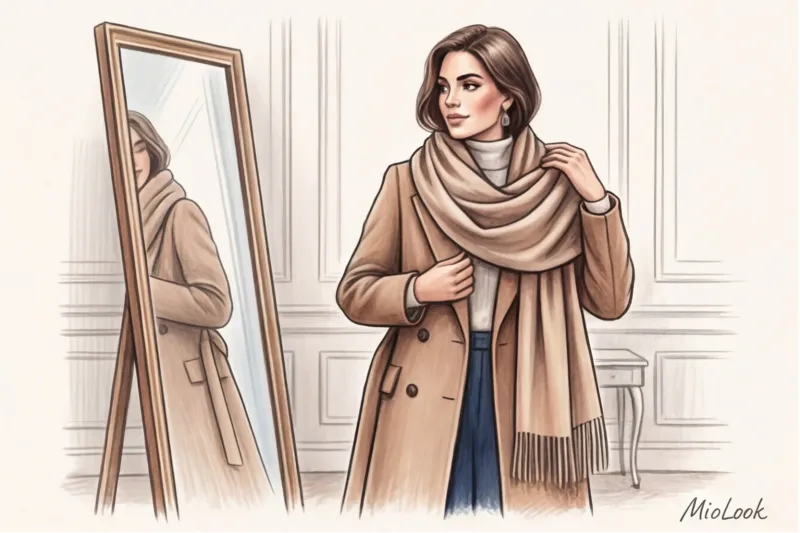
- Add emphasis to the portrait area. Use silk scarves, large earrings, and statement necklaces to draw the eye to your face.
Your body right now, at this weight and size, is a magnificent architectural project. There's no need to wait until you lose 5 or 10 kilograms to start looking fabulous. Stop buying clothes to hide. Buy them to express yourself to the world with dignity.