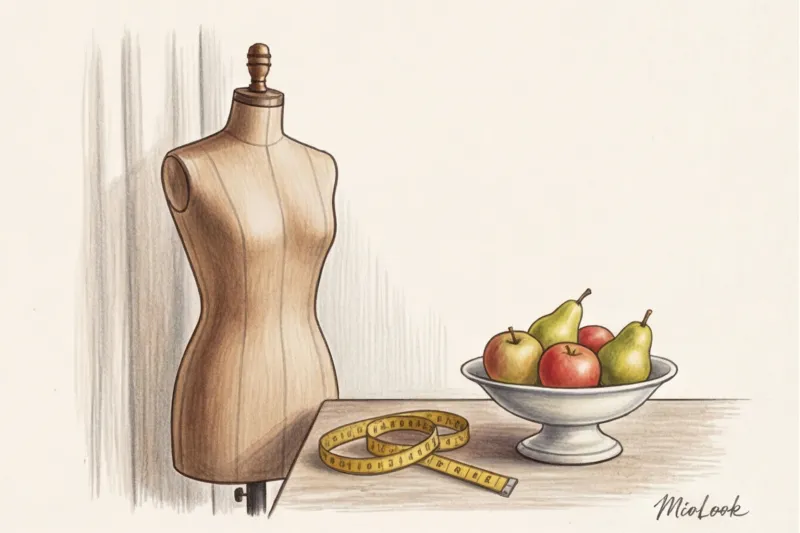
How many times have you stood in front of the mirror, wondering if you're a pear-shaped figure or perhaps an hourglass figure who's gained a little weight? Over 14 years as a personal stylist, I've erased hundreds of fruity metaphors from my mind. The truth is, the conventional "bust-waist-hips" formula is completely useless for styling if you don't know your vertical proportions.
Two women with exactly the same measurements (90-70-100) can look completely different in the same sheath dress. For one, it might fit perfectly, while for another, it might bunch up at the waist and be tight in the hips. Why? Because of the different hip heights and torso lengths. If you want to understand, How to determine your body type based on parameters , you'll have to forget about finding flaws and approach your body like an architectural project. I talked in more detail about why we're abandoning outdated labels in our a complete guide to body types.
Why the Old Approach Isn't Working: The Three-Digit Myth
The "apple" and "pears" body-typing system became obsolete back in the 2000s. Its main problem is that it ignores your bone structure, height, and posture. It focuses solely on horizontal measurements and forces women to mask what marketers have labeled "flaws."
According to the international standard for sizing typology ISO 8559 (which designers rely on when creating clothing), the human body is described by dozens of anthropometric points. No professional tailor can sew you a suit based only on your chest and hip measurements. The shift from camouflage to an architectural approach means we begin to work with the body's lines and geometry, rather than complexities.
Instead of worrying about wide hips, we calculate balance. We look at how the width of the shoulder girdle relates to the pelvis, and how the length of the legs relates to the torso. It's this knowledge that allows us to buy clothes online without trying them on and get the right size 9 times out of 10.
Access to MioLook for €0.99 — one-time payment
A smart AI stylist will select the perfect look based on your proportions.
Get access — €0.99 onceHow to determine your body type based on parameters: step-by-step instructions
Objective numbers are your best friend. A tape measure is devoid of emotion; it doesn't know if you ate too much of a croissant for breakfast or didn't sleep well. It simply records the facts. To create your personal figure passport, we need to take two types of measurements: horizontal (width) and vertical (length).
Preparation: What you'll need and how to get up properly
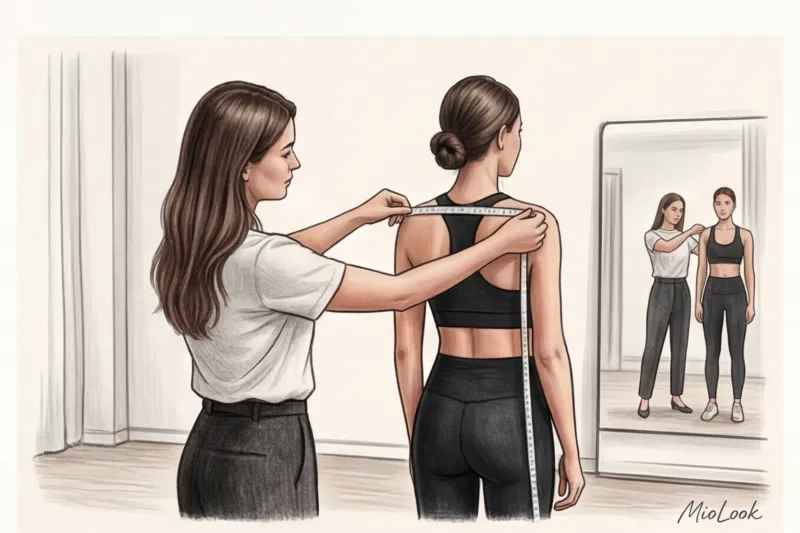
To start, wear thin, smooth underwear without push-up padding or a form-fitting knit bodysuit. Measuring your figure over jeans or a thick sweater is pointless—you'll add 2 to 5 centimeters of unnecessary weight.
- Stand up straight, but relaxed. Don't suck in your stomach to the point of cramping. Breathe naturally. If you take your measurements while inhaling deeply, the clothes you buy won't fit properly.
- Find your natural waist. Take a regular string or a thin elastic band and tie it around your stomach. Bend left and right a couple of times. The elastic will naturally slide down to the narrowest part of your torso. This is your true waist. Leave the elastic there until you've finished measuring.
Horizontal measurements: width architecture
Now take a soft measuring tape (not a tape measure from a hardware store!) and mark the base horizontal lines.
- Shoulder width. Measured from the back of one shoulder to the back of the other. This is a critical measurement if you're choosing women's business suit A jacket should always fit perfectly in the shoulders—getting it tailored there is practically impossible or unreasonably expensive.
- Chest volume. The tape runs strictly horizontally along the most prominent points of the chest and shoulder blades.
- True waist. We measure along the same elastic band that we tied earlier (usually this is the area 2-3 cm above the navel).
- Hip volume. The main rule is that the tape should run across the fullest part of your buttocks. Not where your lower back is, or where your belt sits. Include the "breeches" area if you have one.
Vertical Proportions: The Secret Everyone Forgets
Now, what distinguishes professional styling from amateur? We measure verticals. In the Italian school of bespoke tailoring, these parameters determine the placement of darts and pockets.
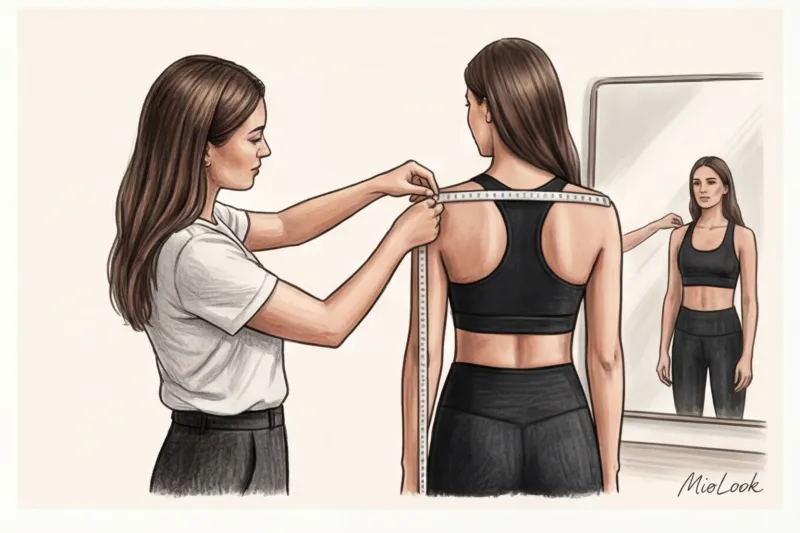
- Torso Length: the distance from the armpit to the waist line (our elastic band).
- Hip height: The distance from your waist to the widest point of your hips, which you just measured. This determines your fit type—High hip (high hip, steep curve) or Low hip (low hip, smooth transition).
- Leg length: from waist line to floor (without shoes).
This is where the golden ratio (1/3 to 2/3) comes into play. Ideal visual balance is achieved when the torso visually takes up a third of the height, and the legs two-thirds. Knowing these lengths will tell you whether to tuck your shirt into your trousers or wear it untucked.
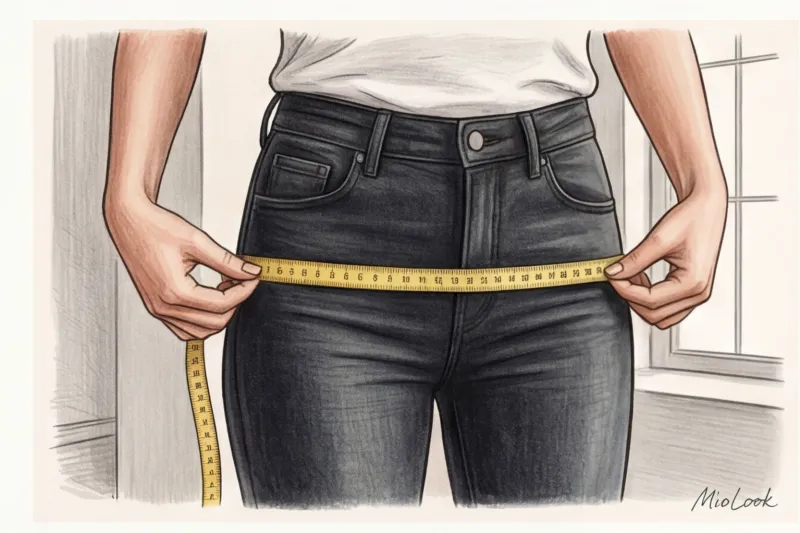
Analysis of results: reading your geometry
Have you written down the numbers? Now let's translate them into silhouettes. Instead of fruits, we'll use letter symbols that reflect the balance of widths.
Compare the width of the shoulders and the volume of the hips (in half-girth):
- A-line silhouette (lower balance): hips are more than 5% wider than shoulders (visually the bottom is heavier).
- V-silhouette (upper balance): shoulders are noticeably wider than hips.
- H-silhouette (straight): The shoulders and hips are approximately equal, the waist is weakly defined.
- X-silhouette: The shoulders and hips are balanced, the waist is clearly defined.
Now let's look at the waist. It is considered expressed , if the difference between the hip and waist measurements is more than 25 cm. If the difference is less than 20 cm, the waist nuanced And here lies the most common catch.
"I had a client named Anna in my practice. She'd always considered herself a pear-shaped woman and hid her hips because the difference between her waist and hips was a whopping 28 cm. But vertical measurements revealed she had an extremely short torso and high hips. Her waist, defined in centimeters, was simply 'lost' due to the lack of space between her ribs and pelvis. We stopped accentuating her waist with contrasting belts and switched to a mid-rise, straight-leg trousers, and her figure became visually elongated and more graceful."
Vertical measurements always adjust for horizontal ones. If you have short legs (relative to your torso), any cropped culottes will make your silhouette appear squat, even if you have a perfect X-shaped silhouette.
Your perfect look starts here
Join thousands of users who look flawless every day with MioLook. Upload your parameters and get ready-made looks.
Get access — €0.99 onceCommon mistakes when taking measurements (and why clothes don't fit well)
According to statistics, about 70% of women incorrectly measure their natural waistline when taking their own measurements. This results in dresses with a waist cut riding up or bunching up unattractively at the stomach.
Here are the main mistakes I see all the time:
- Measure your waist along the waistband of your favorite jeans. If you wear a mid-rise or low-rise, your waistline sits at your hipbones. This is not your waist! Your true waist is almost always higher.
- Ignoring the "breeches". Many people measure their hips too high, focusing only on the back of their buttocks and ignoring the wider hips at the sides. This results in a pencil skirt that ends up bursting at the seams.
- The tape is too tight. If the tape digs into your skin, creating folds of skin, you're deceiving yourself. Clothing with these dimensions will choke you. Your index finger should fit easily under the tape.
- Measurements in the wrong underwear. A sports bra flattens the breasts, while a firm push-up bra adds volume and alters the bust's height. Measure yourself in a comfortable, everyday bra.
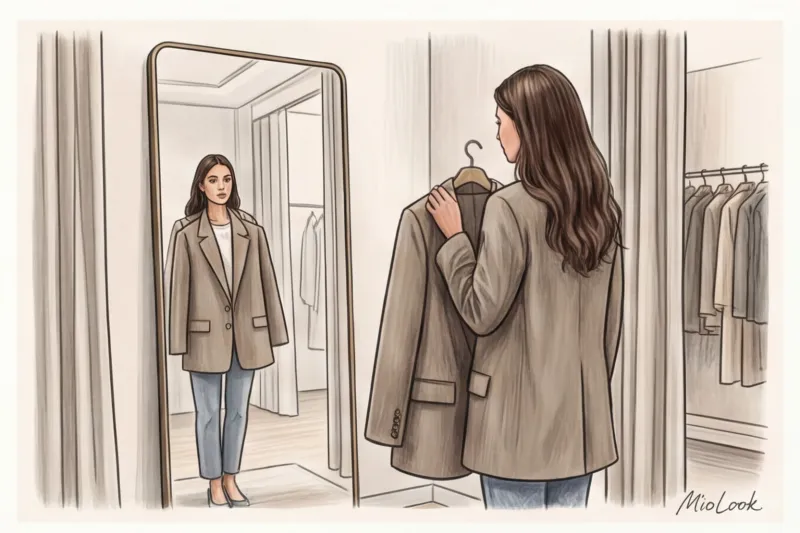
From numbers to style: how to use this data in the fitting room
Understanding your proportions saves not only money but also stress. For example, now you know that you have an A-line silhouette (hips wider than shoulders) and a nuanced waist. This means that patterns from brands like Zara (which often tailor to an H-line silhouette) may fit you differently: pants will be nice in the hips but too big in the waist.
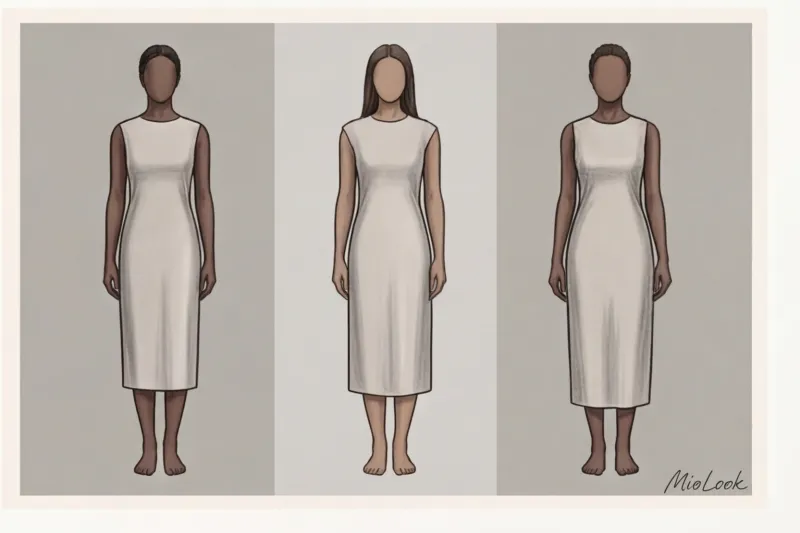
In mass-market clothing, it's perfectly normal to be a size M on top and a size L on the bottom. Don't try to squeeze yourself into one suit size. Buy the top and bottom separately—that's how you assemble a functional outfit. capsule wardrobe.
The golden rule of a stylist: Always buy a garment based on the widest part of your body and have the rest adjusted at a tailor's. If a jacket fits perfectly through the shoulders but doesn't meet at the chest (and you have a pronounced fullness), order a size up and ask the tailor to take it in at the back. It costs a little, but it will look like it was tailored.
There's a limitation here, though. I must admit, the math of measurements doesn't always work. It doesn't work. When choosing items made of stiff raw denim or 100% linen, which lack stretch and shrink after washing, the numbers are just a guide, and the final decision is made only after you've sat in the pants on a chair.
To automate this process, you can enter your parameters in MioLook app An algorithm trained on styling rules will help you visualize how specific styles will look on your body shape, suggesting harmonious combinations.
Checklist: Your Personal Figure Passport
Before your next online or offline shopping trip, create a separate note on your phone called “My Measurements.”
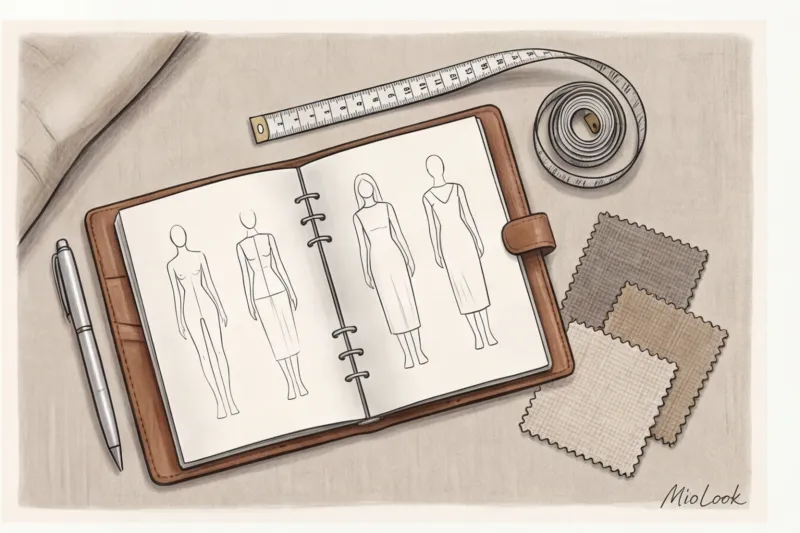
You will only need 6 current numbers:
- Shoulder width (cm)
- Chest circumference (cm)
- True waist (cm)
- Hip circumference (including breeches) (cm)
- Torso length (cm)
- Hip height (cm)
Update this information every six months or if you notice a change in weight of more than 3-4 kilograms. Height and bone structure remain constant, but measurements may fluctuate.
Stop beating yourself up for not fitting into the average brand's patterns. Patterns are created for mannequins, not for living people with unique breathing, posture, and body movements. Your goal isn't to force your body to fit clothing standards, but to use your knowledge of your proportions to tailor clothes to your body.