A week ago, a client came into my studio. For the past ten years, she'd been buying soft skinny jeans a size too small for her actual size, believing the tight elastane would visually "bulk" her hips. When I brought her a pair of stiff, 100% cotton Levi's 501 straight leg jeans in her actual size 30 into the fitting room, she initially refused to wear them. "They'll make me look boxy," she said. Five minutes later, she was looking in the mirror with tears in her eyes, because the thick denim had acted like an architectural corset, elongating her silhouette and hiding absolutely every nuance she was so self-conscious about.
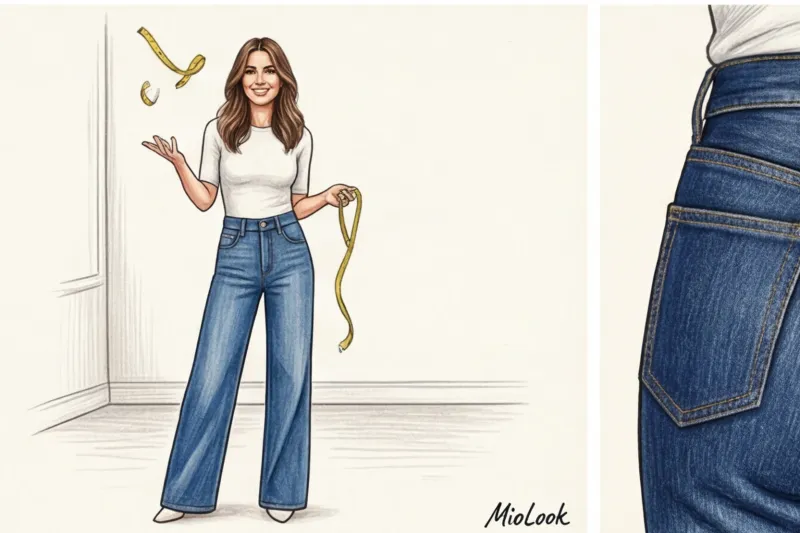
In my 12 years as a personal stylist, I've realized one thing: women hate buying denim because the industry has been feeding us broken rules for decades. We've been categorized into "apples," "pears," and "hourglasses," forcing us to mask our so-called "flaws." I discussed why we're finally abandoning this outdated fruit-based typology in our article. a complete guide to visual correction without stereotypes.
Today we are completely changing our approach. If you want to settle the issue once and for all, How to choose jeans according to your body type , you'll have to stop thinking of yourself as a fruit. Jeans aren't tights. They're a complex, architectural wardrobe element. And we'll select them like engineers—studying the frame, patterns, and fabric density.
Down with the Fruit: How to Choose Jeans for Your Body Type in the New Paradigm
When you put on jeans and they bunch up under your buttocks or dig into your stomach, it doesn't mean there's something wrong with your body. It just means the brand's fit doesn't align with your bone structure. Modern styling works with the geometry of lines: the length of the torso, the difference between the waist and hips, and the shape of the pelvis.
Instead of searching for jeans that "hide wide hips," we look for a style with the right rise and precise yoke angle. It's this technical approach that allows my clients to create high-status looks where denim feels less like country house wear and more like the foundation for elegant urban chic.
Access to MioLook for €0.99 — one-time payment
A smart AI stylist will select the perfect look based on your individual proportions and your existing wardrobe.
Get access — €0.99 onceThe Anatomy of Perfect Denim: What a Professional Stylist Looks for
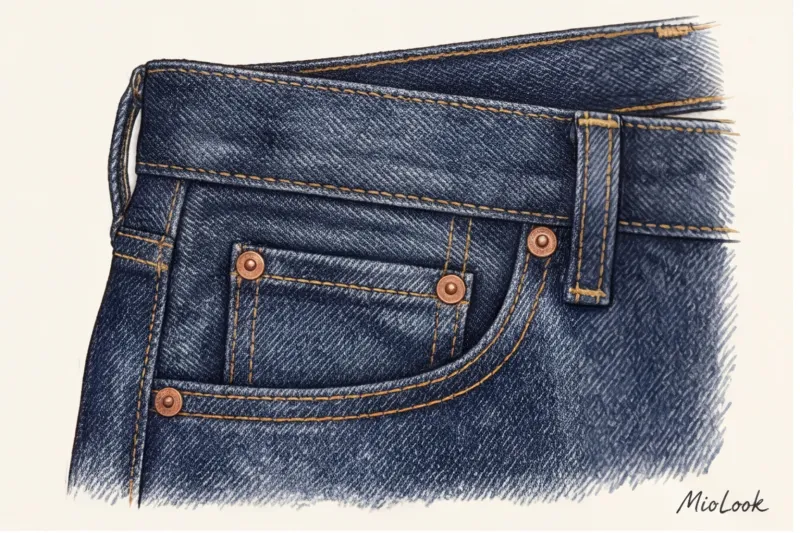
Before looking at the size tag, I always turn the jeans inside out and evaluate their construction. High-quality denim is built on strict mathematical proportions.
The key parameter is the balance between the front and rear landing ( front rise And back rise ). Standard technical measurements in the industry are as follows: a mid-rise is 9-10 inches, and a high-rise starts at 11 inches. Pattern designers at premium brands like AG Jeans or Khaite know a secret: the back rise should always be at least 2-3 inches longer than the front rise. Anything less than that, and the jeans will slide down relentlessly every time you sit down.
Pay attention to the side seams. If the seam is slightly offset forward (half a centimeter toward the center of the leg), it creates a powerful optical illusion, visually narrowing the thigh. This technique is often used in expensive straight-leg styles.
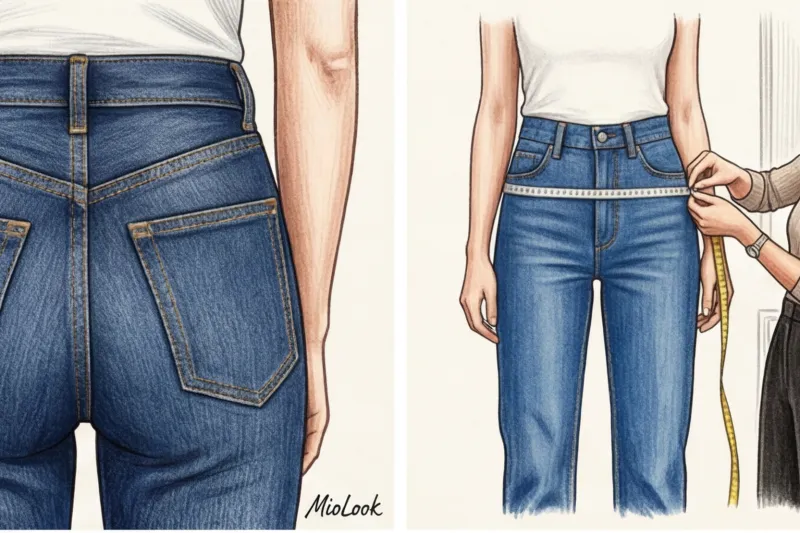
Yoke and pockets: the secret to a flawless back view
The back view isn't shaped by squats in the gym, but by two details: the yoke and the pockets. The yoke is the horizontal or V-shaped seam between the waistband and the back pockets.
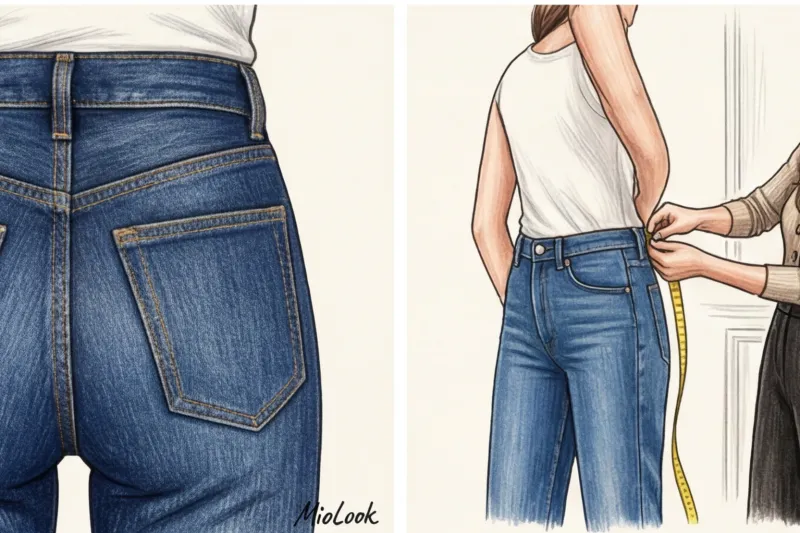
- V-shaped yoke: The further the "S-shaped" line descends, the more rounded and lifted the buttocks appear. This is the gold standard of denim.
- Straight yoke: It creates a completely flat shape and visually widens the pelvis. It only works if you're aiming for a deliberately androgynous, "boyish" silhouette.
The pocket rule states that the pocket size should be proportionate to the area of the buttocks. Tiny pockets on wide hips create a gigantic effect—they are lost against the fabric, making the hips appear larger. Pockets that are too widely spaced wide wide widen the hips, while pockets that are slightly angled inward (toward the center seam) create a lifting effect.
We select the geometry of jeans to suit your body shape.
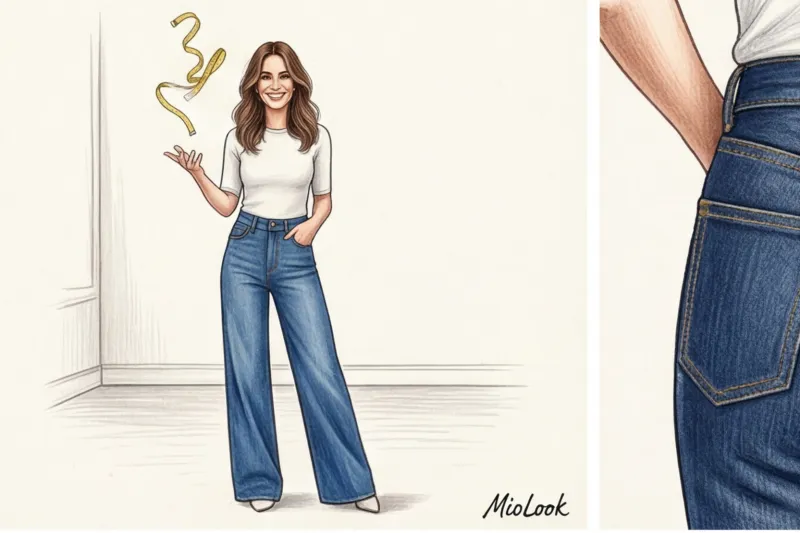
Let's leave behind the advice from magazines of the 2000s about everyone needing bootcut jeans. Today, we're focusing on modern silhouettes: Straight, Wide-leg, Barrel, and Flare. Choose them based on your body measurements.
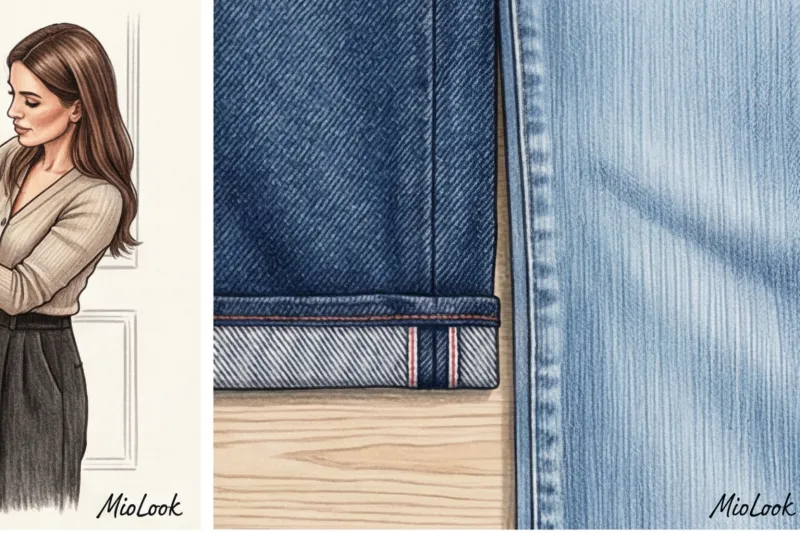
For a pronounced drop (narrow waist and rounded hips)
The main problem for women with pronounced curves is the waist gap, when jeans fit perfectly at the hips, but you can fit two fists through the waist. This happens when the manufacturer cuts the waistband along a straight line rather than a curve.
You need to look for patterns marked Curvy fit (They're designed with a wider rise) or invest in high-waisted wide-leg jeans made of thick denim. The wide-leg fit balances out your hips, while the high rise accentuates your narrowest part. But there is an important limitation here: If you have a noticeable drop in waist but a very short torso, avoid ultra-high waists (12+ inches), otherwise your chest will visually "lie" right on your waist.
For a straight silhouette (without a pronounced drop)
If your shoulders, waist, and hips are roughly aligned, our goal is to create the illusion of curves through texture. Skinny jeans are a no-no here, as they'll only emphasize your rectangular shape.
Your best friends are mom jeans with a tight fit and the ultra-fashionable barrel-leg style. They artificially add volume in the crotch area and taper toward the bottom, creating that curve that nature didn't intend. Be sure to use a contrasting belt (for example, black leather on light blue denim)—this horizontal line will visually break up the straight silhouette and accentuate the waist.
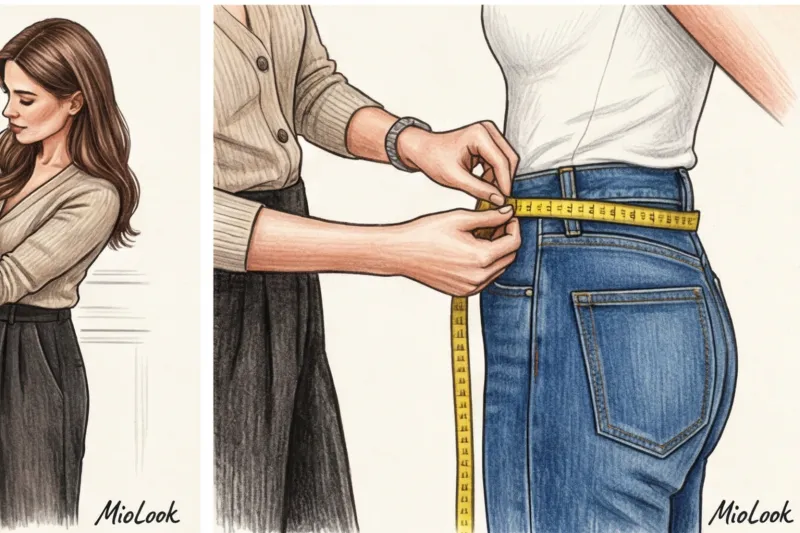
To correct proportions: length of legs and torso
The fit of your jeans can change how tall you appear to others.
- Short torso + long legs: Mid-rise (just below the belly button) is your only choice. A high rise will eat up any remaining torso.
- Long torso + short legs: A high waist (11 inches and up) is recommended. Choose full-length jeans and wear them with low heels so the hem of the jeans almost touches the ground. This will add 10 centimeters to your legs.
Your ideal image begins Here
Join thousands of users who look flawless every day with MioLook. Digitize your wardrobe in just a few clicks.
Get access — €0.99 onceThe Stretch Myth: Why 100% Cotton May Fit Better
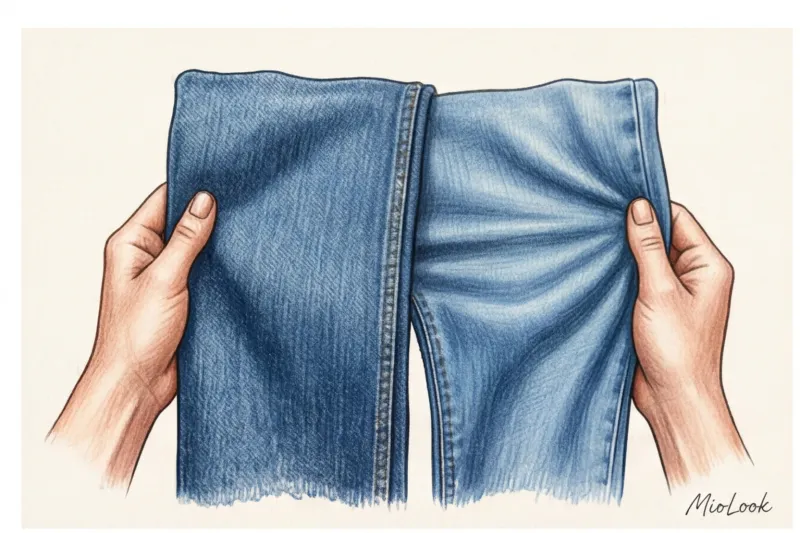
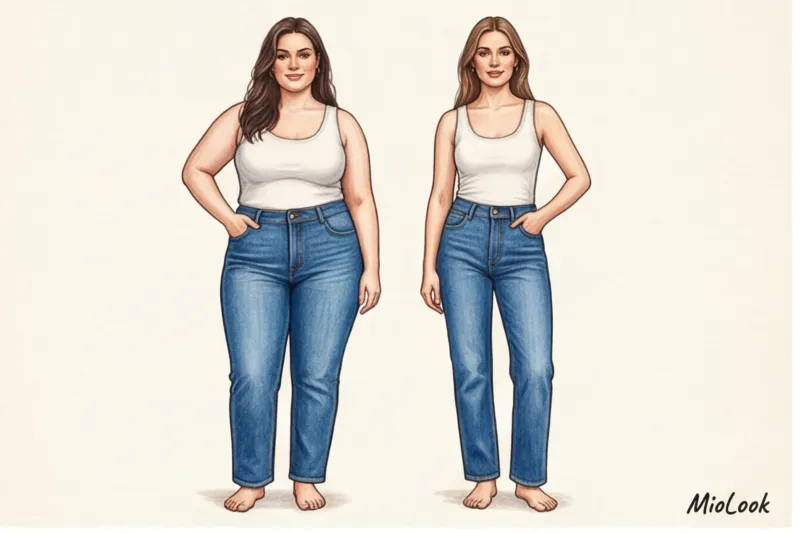
Now I'm going to say something that goes against most mass-market advice. If you're plus-size or have cellulite you want to hide, run from thin, stretchy denim.
Textile industry research, including data from the analytical agency WGSN for 2024, shows that denim with an elastane content above 3% loses its original shape after just 15-20 wears. Thin stretch fabric clings to the body like a second skin, treacherously highlighting every slightest unevenness, crease, and contour of the garment.
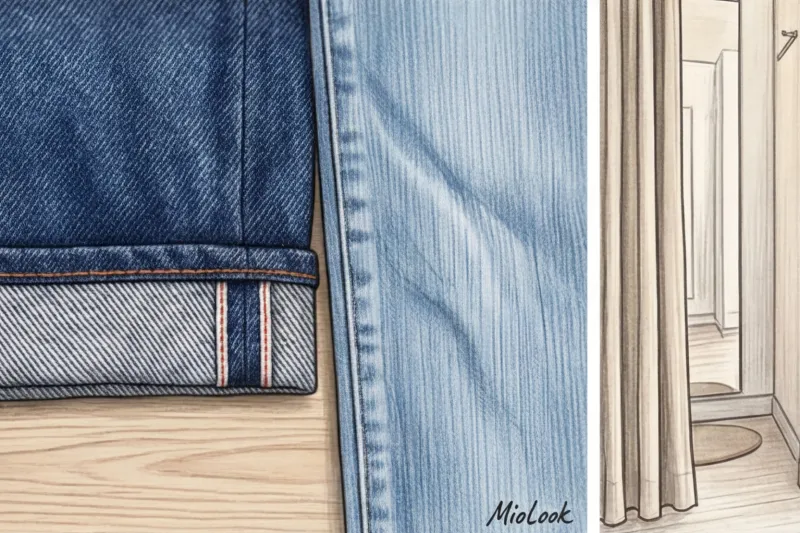
100% rigid cotton (rigid denim), on the other hand, works like a sculptor. Yes, it looks alarmingly stiff on the hanger. But with a weight of 12 to 14 ounces (oz), this fabric doesn't follow the body's imperfections—it dictates its own, perfectly straight lines. If you're not ready for rigid denim at all, use the "2% Rule": look for 98% cotton and a maximum of 2% elastane. This will provide minimal comfort when bending your knees, but will preserve the pants' architecture.
Try-On Like a Pro: Isabella Garcia's Checklist
Buying jeans is a physical job. My clients know: we always take three sizes of the same style into the fitting room: your usual size, a size up, and a size down. Different fits behave unpredictably.
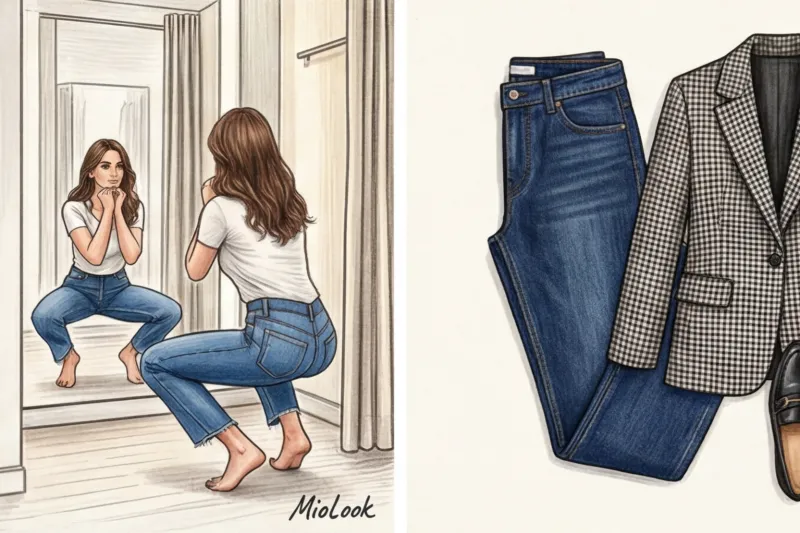
Once in the booth, complete three mandatory tests:
- Squat test. Put on your jeans and squat down (as if you were sitting on a low chair). If you notice a hard, painful fold in your groin, or if the back seam is digging into your skin, take them off. The back rise is too small.
- The two-finger rule. When buttoned, two fingers should fit snugly between the waistband and your stomach. If your entire palm fits, the jeans are too big and will stretch out and hang loosely.
- Difficulty of the first clasp. If you're buying 100% cotton, you should fasten the top button in the fitting room with a slight effort (pulling in your stomach). Real denim, due to body heat, will stretch exactly half a size in the first three days of wear. If the cotton feels loose in the store, you'll be wearing pants a size too big within a week.
Stylish denim formulas: from smart casual to evening wear
Once you've found "the right" pair of jeans, they become a powerful foundation for dozens of looks. In the app MioLook We often use basic denim as a starting point for a capsule collection. Here are three of my favorite, tried-and-true formulas, inspired by the Mediterranean aesthetic of effortless casualness.
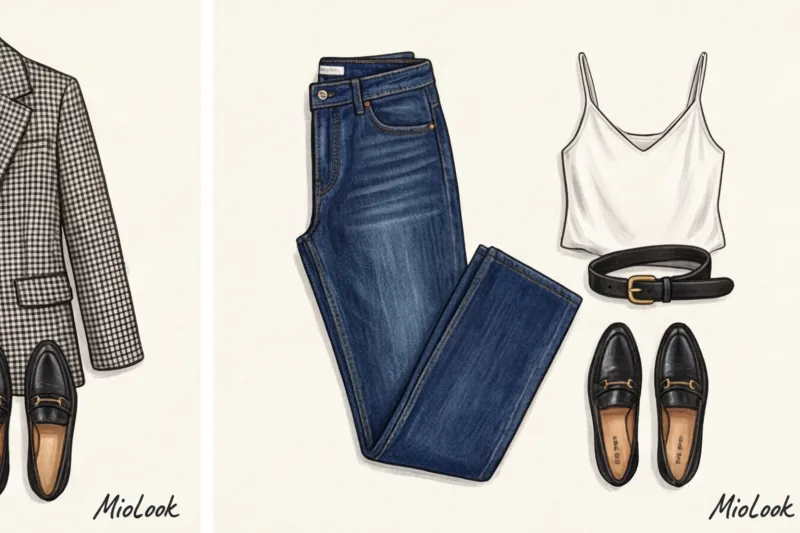
- Formula 1 (Office / Business Meeting): Straight-leg dark blue jeans (no fading) + structured houndstooth blazer + basic white T-shirt + leather loafers. Dark, solid denim reads like dress pants, but tones down the formality.
- Formula 2 (Date/Evening Out): Wide-leg palazzo jeans, a flowing silk top with thin straps, and pointed-toe ankle boots. The contrast of rough work fabric and delicate silk always looks luxurious and alluring.
- Formula 3 (Relaxed Weekend): Barrel-leg jeans + an oversized cashmere sweater in a neutral shade + retro sneakers (like suede Adidas Samba or Gazelle). A relaxed look that exudes impeccable taste.
Ready to get started?
Try the MioLook plan for free—no commitments required. Upload your jeans to your virtual wardrobe and discover dozens of new pairing ideas.
Get access — €0.99 onceChoosing jeans isn't a lottery or a reason to feel insecure. It's simply a search for the right engineering solution for your unique shape. Forgo thin stretch fabrics in favor of sculpted cotton, pay attention to the pocket geometry, and don't be afraid to try on unusual sizes. The perfect pair of jeans shouldn't change your body—they should serve as a flawless frame for it.