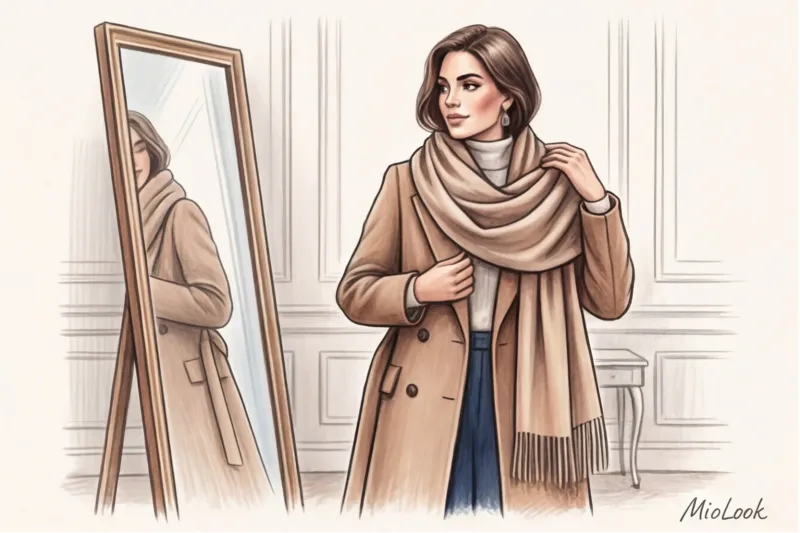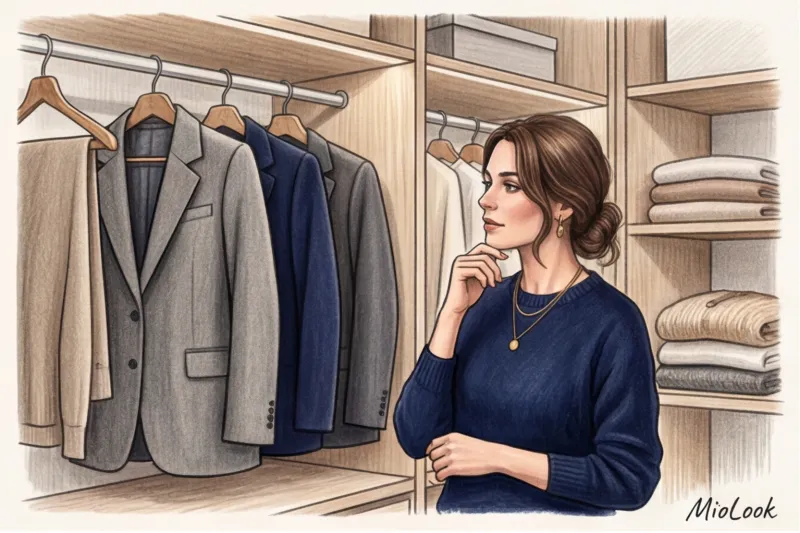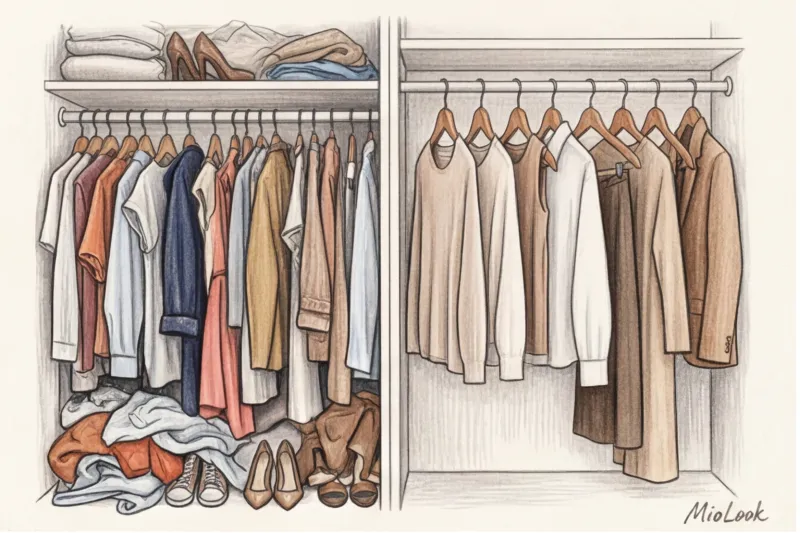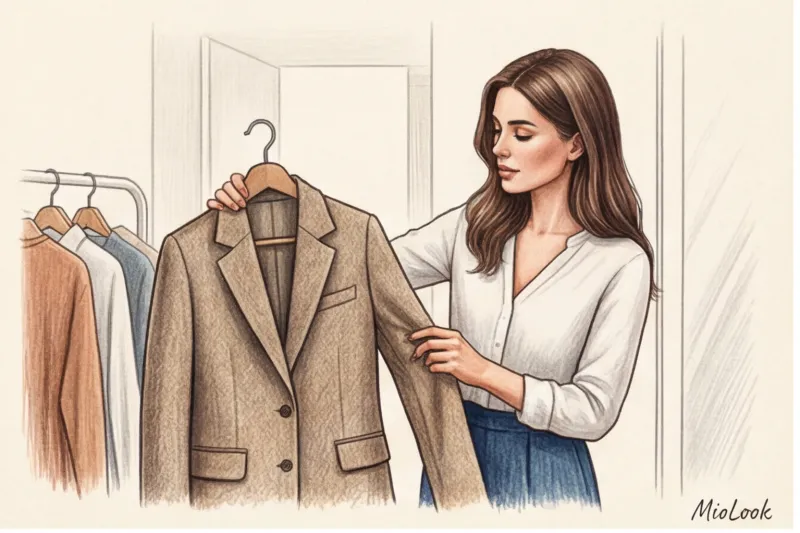
Style evolution: why a basic wardrobe in your 30s is radically different from a 20-year-old's
Remember your closet at 22? Mountains of impulse purchases at sales, ultra-fashionable tops for one season, and the constant morning despair in front of open doors. Once we cross a certain age threshold, the rules of the game change. The ideal Basic wardrobe for a 30-year-old woman — this is no longer an attempt to prove something to someone. It's a powerful tool for managing impressions and, more importantly, one's own comfort.
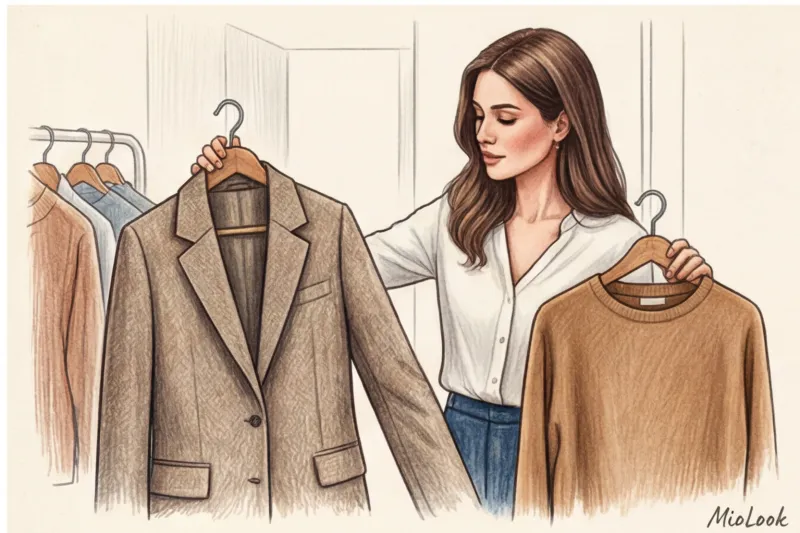
Over 12 years of working as a personal stylist, I've noticed a clear pattern: my clients' needs change dramatically as they approach their thirties. While in our twenties we're searching for ourselves by sifting through dozens of fleeting trends, by thirties a significant psychological shift occurs. Clothes begin to convey inner confidence and status. My clients no longer need to hide behind flashy designs—they need a foundation that says, "I know who I am, and I value myself."
Style in your 30s means refusing to compromise. You no longer settle for shoes you can't walk in or synthetics that don't breathe, no matter how fashionable they are.
Completely different selection criteria come to the fore. Huge brand logos give way to impeccable tailoring. We begin to physically sense that a cheap item with a loud print looks far worse than a no-name, but perfectly fitting jacket made of a dense natural fabric. Tactile comfort plays a special role. Stiff seams and itchy sweaters are mercilessly consigned to the trash, because nothing is worth discomfort throughout the day. Incidentally, it's precisely the right choice that... combination of textures in clothing - silk, thick cotton, smooth leather - becomes the main marker of an expensive, high-status image.
The shift from fast fashion to conscious consumption isn't just a matter of ecology, it's also pure mathematics. The "less, but better" concept paradoxically saves money. A seminal McKinsey report (2023) on the transformation of millennial shopping habits confirms that the 30-year-old generation has finally shifted its focus to sustainability and premium materials. Instead of buying five polyester shirts for €20, we prefer to invest in one perfect shirt made of dense cotton or Tencel for €100-150. In the long run, such an investment pays for itself many times over, as the fabric doesn't pill or lose its shape after the third wash.
But the most valuable resource a well-designed wardrobe gives us is time. At this age, life usually reaches its peak: career, family, personal projects. We simply don't have forty minutes in the morning to try on a dozen combinations and suffer from the thought, "I have nothing to wear again." A well-designed wardrobe works like a smart construction kit. It allows you to assemble a stylish and appropriate look in exactly three minutes, eyes closed. You pick up a structured jacket, straight jeans, a quality T-shirt—and you look like a team of stylists just worked on your outfit.
The biggest myth among stylists: there is no universal list of “10 basic things”
Open any glossy fashion magazine from the 2000s, and you're sure to stumble upon an article titled "10 Things Every Woman Must Have in Her Closet." This classic cliché stubbornly dictates that we buy a crisp white shirt, a black pencil skirt, a beige trench coat, and classic pumps. The problem is that this uniform template was created decades ago for the corporate world of Wall Street, not for modern women with flexible schedules and multitasking.
The stereotype that a white shirt will save any situation is perhaps the most pernicious misconception in the styling industry. Stiff cotton requires impeccable posture and daily steaming, which is completely incompatible with, for example, long drives or working with children.
A wardrobe can't be universal because there's no such thing as a universal life. Buying clothes based on someone else's list is a surefire way to end up with a closet full of expensive but useless textiles.
One of my clients, a lead developer at a large IT company, came to me in utter despair. Influenced by fashion blogs, she'd invested around €2,500 in the "perfect basic wardrobe": tailored wool jackets, silk blouses with bows, and those same skinny skirts. The result was predictable: every morning, she'd slip into her trusty jeans and a cashmere sweater. In her office, with its ottomans and informal culture, a strict dress code seemed ridiculous, and a pencil skirt simply restricted her mobility at her desk.
My client fell victim to the so-called "fantasy wardrobe." We very often buy clothes for the version of ourselves we only dream of becoming—a bohemian art-hall regular, a cool movie businesswoman, or a socialite—completely ignoring the reality of our everyday lives. It's this cognitive dissonance that creates thing with a label syndrome , when dozens of never-worn wardrobe items wait for years for a mythical “special occasion.”
To break this vicious circle, I use in practice the author's tool - Lifestyle Matrix The essence of this method is to calculate your actual (not imaginary) workload mathematically precisely. According to WGSN analytics (2023), women regularly wear only 19% of their closet contents precisely because their purchases don't align with their actual lifestyle.
Take a piece of paper and distribute your 168 hours per week as a percentage. Here's what this might look like in practice:
- Remote work and Zoom calls: 40%
- Walking the dog and household routine: 25%
- Meeting friends in informal cafes: 15%
- Sports and fitness: 15%
- Social events and theatre: 5%
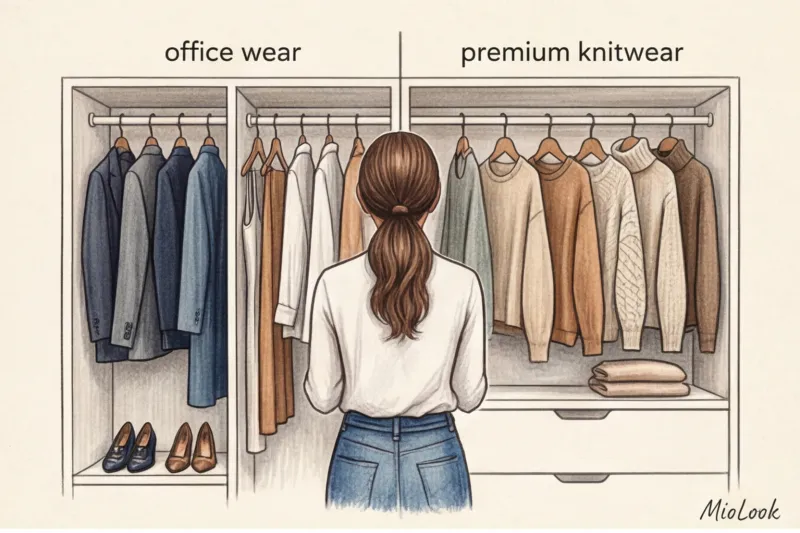
This is where the ironclad law comes into play. matching rule: a basic wardrobe for a 30-year-old woman should consist of 80% of things for your basic routine If you spend 40% of your time at home on your laptop, invest not in another three-piece suit, but in premium loungewear, well-cut joggers made of thick cotton, and comfortable long sleeves.
Access to MioLook for €0.99 — one-time payment
A smart AI stylist will select the perfect look.
Get access — €0.99 onceAn audit through the Lifestyle Matrix instantly highlights the holes: you suddenly understand why you always have "nothing to wear" to a regular Sunday brunch. The answer is simple: 70% of your shopping budget has been spent on party dresses for years, which account for a mere 5% of your real life.
Forgoing glossy clichés in favor of analyzing your own workload saves colossal resources. When you know for sure that your day consists of driving and work meetings in creative clusters, you stop looking at uncomfortable tight skirts and redirect your budget to high-quality leather loafers and structured, loose-fitting jackets. Your basics finally become a personal tool, not a museum piece.
The formula for the ideal base: status, comfort, and textile literacy
A study by Northwestern University (USA, 2012) introduced the term into psychology enclothed cognition — "embodied cognition." Scientists have proven that clothing directly alters our cognitive processes and body language. What we usually call "expensive" is actually interpreted by others not by the price tag, but by the microkinetics of our bodies. When a stiff collar chafes your neck or a synthetic blouse becomes staticky, your shoulders reflexively tense, and your movements become abrupt and fidgety. Conversely, when heavy, cool fabric flows smoothly across your skin, your stride naturally slows, your breathing deepens, and your posture straightens. This tactile comfort is the foundation of genuine, unfeigned confidence.
What really makes a garment visually "expensive"? It's a trinity: impeccable fit, precise geometric cut, and the refined texture of the fabric. Cheap material always gives away its value by the way it refracts light—it shines flat and aggressively. High-status fabric absorbs light, creating a deep, complex matte or delicate satin finish. This is why the concept of "quiet luxury" works so reliably. Brands like The Row, Loro Piana, or even premium lines like COS and Massimo Dutti avoid flashy logos. Hidden status signals work more subtly: others perceive the perfect balance of proportions and the way the fabric holds its shape in motion. The absence of a logo forces others to evaluate the garment itself and you in it, not the brand's marketing budget.
How to Read Labels: Ingredients Worth Paying For
Knowing how to read sewn-in labels is a basic skill for a conscious consumer, saving hundreds of euros a year. Today, we're not limited to choosing between coarse cotton and cheap synthetics. The textile industry has given us a new generation of natural fabrics made from regenerated cellulose. cupra, tencel (lyocell) and modal If you see these names on the label, you're looking at a great investment. Why is it better than regular viscose? Early generations of viscose often shrink and wrinkle easily. Cupra, on the other hand, is made from cotton fluff; it breathes like cotton but flows and drapes like heavy silk, creating that signature geometric fold. Tencel (made from eucalyptus) has antibacterial properties and is incredibly durable.
There's a common myth that a basic wardrobe should consist exclusively of 100% natural fabrics. In practice, the right blends perform much better. If you're buying pants for the office or for active city commuting, 100% linen or cotton can sometimes perform worse than a blend with 2-5% elastane. Pure linen will develop stiff creases after 15 minutes in a taxi, while cotton can stretch out at the knees. A small percentage of elastane is an engineering necessity, allowing the fabric to spring back to its original shape, keeping your look neat until evening.
Knitwear deserves special attention. This is a category where skimping is absolutely essential. A high-quality sweater made of smooth merino wool (usually in the €100–€150 range) will last you five years without losing its shape. Cashmere is ideal for those who value maximum lightweight comfort with high thermal insulation, and alpaca is the best choice for voluminous, textured cardigans, as it contains no lanolin and is virtually pill-free.
"The main rule of textile literacy: avoid 100% acrylic and cheap polyester in items that come into contact with the skin. Acrylic is a plastic thread that imitates wool. It will simultaneously make you sweat indoors and freeze outdoors, and after three washes, the item will be covered in an indelible layer of pilling."
Quality testing right in the fitting room: seams, fittings, density
You can identify a quality item in two minutes, without leaving the fitting room. Start by visually assessing the twist density of the thread—do the "light test." Hold a T-shirt, shirt, or fine knitwear up to a bright light source. If you can clearly see your fingers or the outline of the lamp through the fabric, the thread is loosely twisted. Such an item will quickly deform and lose color. A quality basic T-shirt should be dense, opaque, and hold its shape like a soft frame.
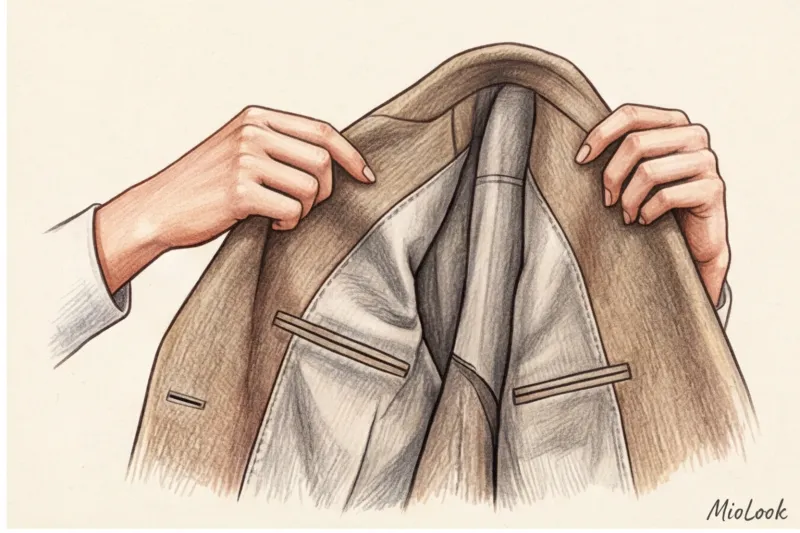
The second rule: the inside is the face of the brand. Turn your jacket or trousers inside out. High-status items have seams finished with binding (a special tape), overlock edges that don't fray, and linings made of breathable viscose or cupra, not squeaky polyester that will make you feel like you're in a greenhouse. Look for edging along the armholes and neckline—it prevents stretching in the most vulnerable areas.
The third indicator of quality is the hardware. It's the details that often reveal the true cost of a garment. Cheap, glossy plastic buttons can ruin even a well-cut garment. Look for buttons made of natural horn, mother-of-pearl, wood, or high-quality metal. By the way, a little life hack: if you find a perfectly fitting blazer at a mass market (say, for €60), take it to a tailor and have the plastic buttons replaced with horn ones for €15. The visual value of the item will increase dramatically. Zippers should move completely smoothly—quality brands use proven hardware like YKK or Riri.
Finally, how can you check an item for pilling before bringing it home? Take a small patch of fabric from the back (closest to the seam) and rub it vigorously but gently against itself for 10-15 seconds. If fuzz or micro-pilling immediately begins to form on the surface, don't hesitate to leave the item in the store. It will lose its marketable appearance after just one day of use.
Digitize your best finds
When you start investing in high-quality fabrics and precise cuts, it's important to monitor how these pieces work in your wardrobe. Upload your essentials to your smart wardrobe to create dozens of new looks with a single click.
Get started with MioLookInvestments vs. Consumables: Cost Per Wear (CPW) Concept
Have you ever considered that cheap items drain your budget much faster than expensive ones? The economics of a smart wardrobe are governed by strict financial rules, and the most important of them is metrics. CPW (Cost Per Wear) According to the Business of Fashion (2023) analytical report, women tend to psychologically overestimate the cost of basic items and completely underestimate the real cost of impulse purchases from mass-market stores.
Let's get down to some concrete numbers. Imagine buying a high-quality, basic wool coat for €500. At first glance, it sounds like a significant expense. But you'll wear it almost every day for at least two seasons—that's about 100 outings per year. So, your coat's CPW is only €5. Now, let's take a trendy acrylic sweater with intricate embellishments for €50. You'll wear it to two meetings, after which it'll pill or you'll simply get tired of it. Its real cost to you is €25 per outing. The math is inexorable: this "cheap" sweater cost you five times as much as the "expensive" coat.
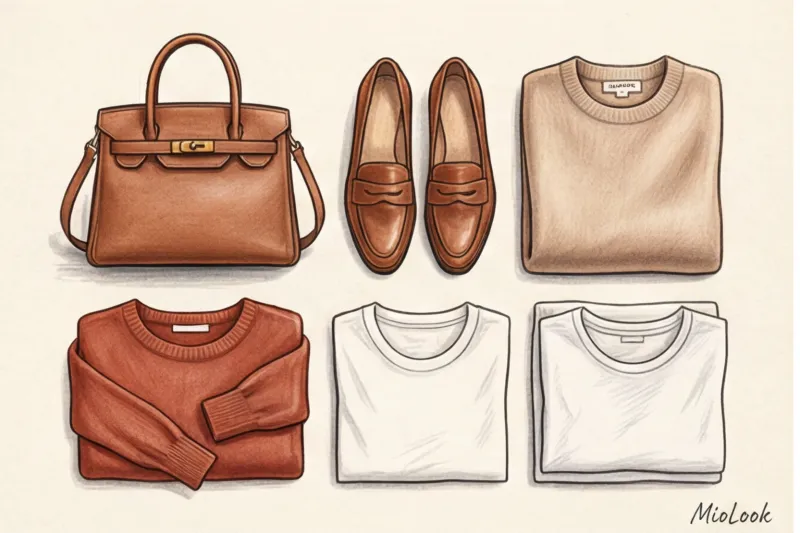
To make your wardrobe work for you, I recommend spending about 70% of your shopping budget on wardrobe investments These are the items that form the framework of an outfit and bear the brunt of its visual impact: outerwear, well-tailored jackets, quality shoes, and structured bags. They are the ones that establish status. Even if you're wearing the simplest jeans, a luxurious straight-cut coat and a crisp leather bag will instantly elevate the entire ensemble. Shoes and bags are separate markers of quality. Cheap shoes can ruin a person's gait and rob them of confidence, while a geometrically well-shaped bag communicates poise.
On the other hand, there are consumables — a category where you can and should save money. This includes basic cotton T-shirts, socks, tights, and thin underwear (turtlenecks, tank tops). Why? These are the first layer of clothing. They come into direct contact with the body, are exposed to deodorants, and require constant washing. A €15 T-shirt and an €80 T-shirt will wear out in roughly the same amount of time due to physical wear and tear of the fabric. Therefore, it's not worth investing in something that, for obvious reasons, won't last more than one or two active seasons.
But even when buying an inexpensive base, it's important to maintain a strategic approach. This is where my golden rule comes into play. the rule of "three images" Before you go to the checkout with any new item, do a mental test: can you create three complete outfits with it right now, using everything else in your closet? If the answer is "no," and you need to buy new pants and a cardigan to go with that turtleneck, it's not a basic item, but a potential "hanging garment" with a tag, just taking up shelf space.
To make this task easier and stop buying individual items, I strongly recommend digitizing your closet. When you can visually see your entire arsenal on your smartphone screen, you don't have to imagine in the fitting room. You just open smart wardrobe feature in MioLook and in two clicks you can check what your potential purchase will go with, creating ready-made outfits on the go.
Access to MioLook for €0.99 — one-time payment
Start creating perfect images with the help of artificial intelligence
Get access — €0.99 onceAn eco-friendly approach: how to care for your base so it lasts for years
According to the British organization WRAP (Waste and Resources Action Programme), extending the active life of an item by just nine months reduces its carbon, water, and waste footprint by 20–30%. Sustainability isn't just about buying sweaters made from recycled plastic; it's also about preserving what's already in your closet. By purchasing premium essentials, you're taking responsibility for their longevity.
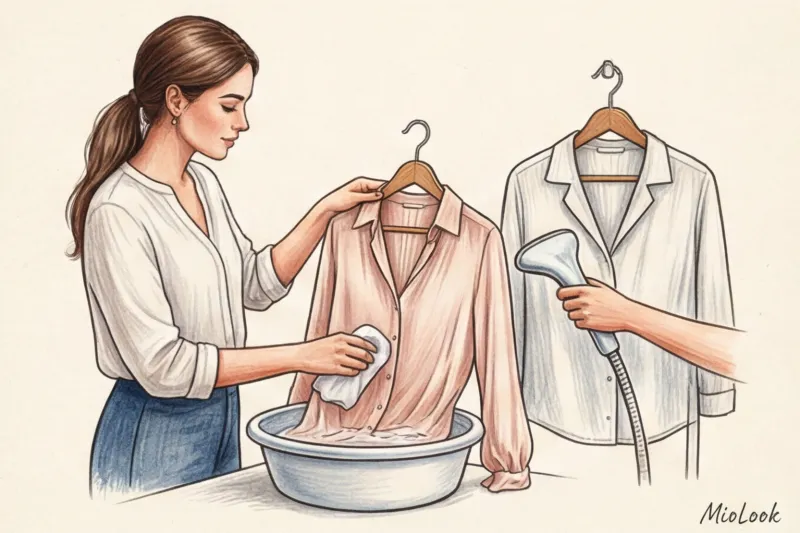
We're obsessed with washing. Machine washing with harsh chemicals wears out fabric faster than daily wear. When I review new clients' wardrobes, I regularly see expensive denim that's been "killed" within a couple of months, or basic tops that have lost their shape. My first piece of advice is always categorical: ditch store-bought fabric softeners forever. They coat the fibers with a thick silicone film that robs the fabric of breathability and literally breaks down the elastic fibers. Switch to liquid eco-gels or biodegradable powders—this action alone will extend the life of your elastane-containing items several times over.
How can you reduce the number of washes? Invest in a good handheld steamer (reliable models can be found for €60–€120). Hot steam kills 99% of odor-causing bacteria and straightens fibers without mechanical friction. Heavy denim or coarse wool items often benefit from simply airing them out. Freezing works great for killing bacteria on jeans: place them in a cotton bag in the freezer for 24 hours. Low temperatures refresh the fabric while preserving the fiber structure.
Another subtle quality threat is regular dry cleaning. Professional solvents (such as perchloroethylene) leach lanolin—a natural animal fat—from natural fibers. As a result, the threads dry out, become brittle, and lose their luster. Alternative home care is much safer: hand wash silk and cashmere in cool water with a specialized eco-friendly shampoo or a regular, mild, sulfate-free baby wash.
Proper storage is the final step in textile care. Forget about thin metal hangers from the dry cleaner: they will permanently distort the shoulder line. Jackets and coats require wide wooden hangers, while silk blouses require soft velvet or satin. Heavy knitwear should never be hung: a cashmere sweater will stretch under its own weight in a couple of weeks. Store such items on shelves, always placing sachets of natural cedar or lavender between them to protect against moths. For seasonal storage, use only breathable cotton bags, not vacuum-sealed plastic bags, which can suffocate natural fabrics and cause them to turn yellow.
To avoid washing clothes "just in case" at the end of the season, start tracking how often you actually use them. By digitizing your closet MioLook , you'll be able to see the statistics for each item. If the app shows that you only wore a cashmere cardigan twice this winter, and even then over a thick T-shirt, there's no need to wash it—just refresh it with steam before storing it for the summer.
A Wardrobe Framework for Your Lifestyle: 3 Ready-Made Scenarios
According to a global report by the analytical agency WGSN (2023), the traditional concept of dress code has completely fragmented. Today, a wardrobe base is a purely flexible system. What is a foundation for a banking analyst will be dead weight in the closet of a graphic designer or a mother on maternity leave. How can basic principles be adapted to different career and life paths without losing status and comfort?
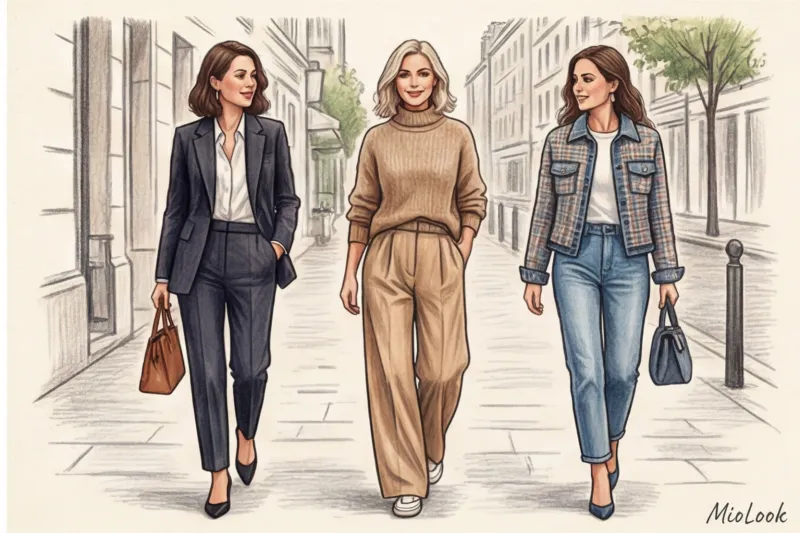
Having analyzed over 200 of my clients' wardrobes over the past year, I've discovered a clear pattern: a successful capsule collection is always built around the dominant pattern of your routine. If you try to assemble a "universal" set from glossy magazine lists, you'll inevitably end up with too many items and nothing to wear. Let's examine the three most common patterns and flesh them out with specific textures.
Scenario 1: Corporate Career and Business Meetings
For women whose week consists of meetings, presentations, and office work, clothing should convey composure and authority. However, at 30, we're no longer willing to sacrifice comfort for rigid formality.
The basis of such a wardrobe becomes a three-piece suit with a perfect fit Why a three-piece suit? A vest gives you an extra layer and makes you look classy, even if you take off your jacket in a stuffy office. Look for wool blends (for example, 70% fine wool, 28% viscose, and 2% elastane)—this blend is virtually wrinkle-free by the end of the workday. The budget for a quality three-piece suit typically starts at €250–€350 for a mid-up suit.
Instead of stiff cotton shirts that restrict movement and require perfect ironing, I always recommend investing in silk blouses Dense natural silk (look for a density of 19 to 22 momme) drapes beautifully, allows the skin to breathe, and softens the overly masculine feel of suiting fabric.
Silk has unique thermoregulating properties: it's cool under the air conditioner and cool outside. It's an investment in your physical comfort during tense negotiations.
When it comes to accessories, it's all about status geometry of bags Soft hobo bags or shapeless backpacks ruin the business silhouette. You need a rigid bag (a tote or structured satchel) that can hold a laptop and A4 documents without collapsing. Shoes should provide comfort for 10 hours. Forget 10-centimeter stilettos: the correct heel height for a business outfit today is 4-6 cm (a stable block heel or a sleek kitten heel). If you want to download your business looks to your phone and plan your outfits for the week ahead, use the "smart wardrobe" feature in MioLook - this eliminates the morning panic before going out.
Scenario 2: Freelancing, Remote Work, and Creative Professions
The absence of a strict boss isn't a reason to switch to stretched-out T-shirts. A creative professional's foundation is built on a balance of relaxedness and aesthetics. Your main ally here is premium knitwear.
Cashmere suits (loose drawstring trousers and a jumper) and chunky knit cardigans create a cozy feel, yet still look expensive if you choose the right shade: taupe, dark chocolate, or deep gray melange. If 100% cashmere (usually starting at €300) isn't yet in your budget, look for merino wool with a touch of silk—it will achieve a similar effect at around €120–150.
The bottom of the base in this scenario rests on structured denim of the correct density To achieve a sophisticated look, jeans should be made from a heavyweight fabric (12–14 ounces) without excessive distressing, rhinestones, or unnecessary embellishments. Straight or slightly wide-leg jeans made from 100% cotton create a clean silhouette that offsets the softness of a knit top.
A freelancer's shoe capsule excludes classic pumps. Replace them with:
- Loafers made of smooth matte leather on a thick, but not hypertrophied sole.
- Minimalist sneakers without logos (in the style of the basic Common Projects models).
- Cossacks for emphasis — they perfectly take the edge off basic jeans and oversized blazers.
The secret of this scenario is layering as a substitute for strict tailoring Instead of wearing one elaborate top, try a basic white tee, layer a thin button-down cardigan over it, and drape a contrasting sweater over your shoulders. This technique creates that sophisticated, casual look prized in the creative world.
Scenario 3: Active motherhood and a dynamic schedule
I had a telling case: I completely overhauled a client's wardrobe with a mother of two toddlers after she confessed that her silk skirts and palazzo pants were hanging in her closet for months simply because she couldn't bend over to her child in the sandbox. For a mother, a basic wardrobe isn't a rejection of style, it's a technological upgrade.
The key factor here is wrinkle- and stain-resistant fabrics Consider high-tech blended materials. Modern nylon, Tencel, and fabrics with lightweight water-repellent finishes allow you to wipe away coffee or baby food stains with a damp cloth, eliminating the need to throw the garment in the washing machine after your first walk.
The aesthetics of this vector is based on sporty chic Thickly woven joggers (not to be confused with those thin sweatpants that stretch out at the knees after an hour) paired with a hoodie in a monochrome, expensive shade are the perfect uniform. The secret lies in the color: a tracksuit in ecru, dark emerald, or camel looks like a deliberate fashion decision, not like gym attire.
A bag in a dynamic schedule must be hands-free. Choose roomy crossbody on a wide strap (a strap 4-5 cm wide does not cut into the shoulder) or simple city backpacks. Shoes require anatomically correct flat sole Ditch the completely flat ballet flats in favor of sneakers with orthopedic insoles or leather Chelsea boots with good cushioning.
Your ideal image begins Here
Join thousands of users who look flawless every day with MioLook. Digitize your closet and find the perfect combinations for any occasion.
Get access — €0.99 onceColor Integration: A Basic Wardrobe Isn't Just Beige and Black
Have you ever noticed how the word "capsule" automatically conjures up images of a dreary row of gray-and-black hangers? The stereotype that basics must be dull and colorless is hopelessly outdated. According to the Pantone Color Institute's 2024 report, premium clothing sales are seeing a steady 15% decline in pure black clothing in favor of deep, complex shades. And there's a physiological explanation for this. After age 30, a harsh, jet-black complexion often highlights signs of fatigue and expression lines, acting as a merciless contrast filter.
How can you determine your personal base colors so that a well-designed basic wardrobe for a 30-year-old woman doesn't look mournful? The secret lies in replacing stark black with refined, rich alternatives: deep wine (Marsala), rich emerald, inky indigo, or warm dark chocolate. My favorite styling trick during fittings is to hold a dark chocolate-colored cashmere jumper up to a client's face instead of the usual black. The effect is always striking: skin tone is visually evened out, and the look instantly gains a polished finish.
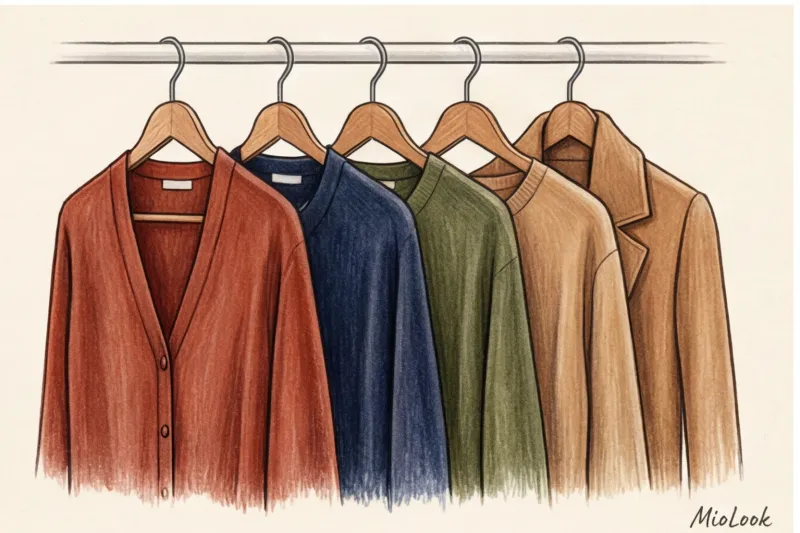
The correct use of these shades is best realized through the rule of monochrome. Assembling an outfit in a single color is a powerful tool that visually elongates the silhouette through a continuous vertical line and adds a touch of class. An important nuance: to prevent a monochrome look from appearing flat, be sure to mix textures. A smooth satin skirt paired with a voluminous wool sweater in a single emerald shade (where the total cost of a basic outfit can start from €150–250) will look incredibly elegant. If you're having trouble imagining how these colors will coexist in your closet, try using the "smart wardrobe" feature in MioLook — the app will help you digitize your items and clearly show how harmoniously the wine shade matches your existing base.
Prints in a basic wardrobe deserve special attention. Classic geometric patterns work flawlessly: pinstripe and micro-houndstooth patterns act as a neutral backdrop, easily pairing with solid-color pieces. However, one thing you should absolutely avoid is overly floral prints. Large roses or abstract buds on a blouse are not only difficult to coordinate with other elements of the outfit, but they also greatly simplify the look. Furthermore, bright flowers are too striking an accent. Wearing such a piece twice in a week will inevitably create the feeling of wearing the same thing, undermining the very idea of a versatile wardrobe.
Checklist: Where to start a wardrobe audit and how to maximize its effectiveness
Have you ever found yourself wanting to throw out your entire closet and start over? It's a common urge when we realize our style no longer aligns with our inner self. However, the most destructive illusion many influencers promote is the promise of assembling a basic wardrobe for a 30-year-old woman in a single weekend. As a practicing expert, I am categorically against such forced marches. True transformation begins not at the mall, but with a ruthless yet thoughtful audit of what you already own.
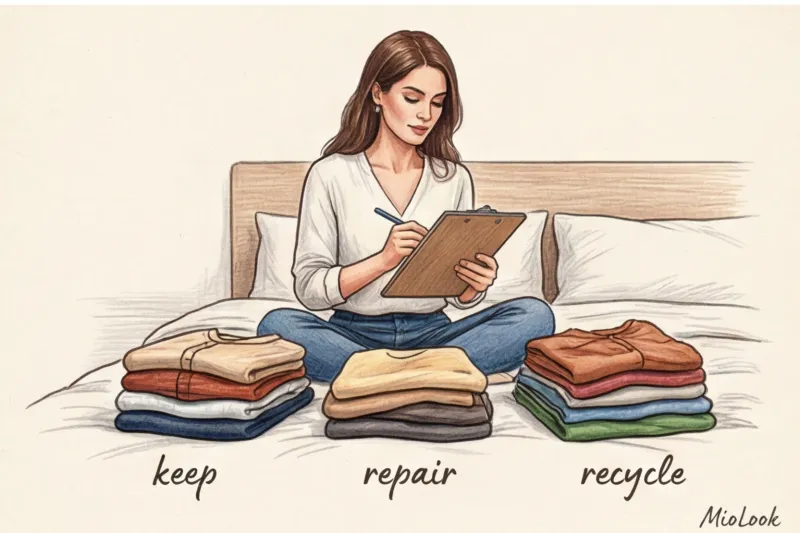
Step one: the 12-month rule. Let's agree: we no longer keep clothes "for the summer house," "in case I lose weight," or "because I feel bad about wasting €150." If an item hasn't been worn for a year and isn't seasonal outerwear or formal evening wear, it's time to go. But getting rid of dead weight needs to be done sustainably. According to the Global Fashion Agenda, over 70% of discarded clothing ends up in landfills each year, even though most fabrics are recyclable. Separate discarded items into three categories:
- Resale: Send designer items in good condition to platforms like Vestiaire Collective. It's a great way to eco-friendly clean up your space and reclaim some of your budget for new, more prestigious investments.
- Upcycling and repair: A beloved but outdated jacket can be taken to a tailor for alteration or replacement of plastic fittings with metal ones.
- Processing: Anything that cannot be restored is sent to specialized textile bins, where it can be turned into furniture upholstery or building materials.
Step two: gap analysis. Once the closet is "cleaned out," we don't rush out to buy another white T-shirt. Now comes the stage of identifying blind spots. My personal audit method: hang the key bottoms (trousers, skirts, quality denim) you wear most often on a railing and try to create at least three outfits for each, covering different situations. Where the system fails, a "gap" appears. A smart shopping list shouldn't consist of something abstract like "buy a blazer," but rather a very specific query: "structured straight-cut jacket, dark chocolate color, merino wool blend, budget under €250."
Step three: digitization. To visualize this process and avoid having to keep formulas in your head, I urge you to implement technology. Spend two hours on the weekend taking photos of your remaining database. After uploading these photos to MioLook , you'll get a smart virtual assistant. The app not only helps you digitize your closet but also algorithmically finds new combinations from old items you simply didn't notice. What's more, you can test potential purchases: upload a screenshot of an item from an online store and see how it fits into your current wardrobe before you commit.
Step four: gradual replacement. Why can't you assemble a quality wardrobe essential in a weekend? It can take weeks to find the perfect pair of wool trousers or that perfect cashmere sweater with the perfect V-neck. Gradual replacement is the key principle of conscious style. Set a comfortable budget for the season and change your wardrobe in iterations. Start with two key investment pieces (for example, a good trench coat or statement shoes), and then refine the look with tailored accessories.
A perfectly curated basic wardrobe for a 30-year-old woman is a living, flexible organism. It matures with you, adapts to career changes, and protects your personal boundaries. By stopping buying random trendy items and starting to invest in textile comfort, you're buying the most valuable thing—time. Time no longer wasted panicking in front of the mirror in the morning, and confidence that's instantly recognizable to others. Set aside a couple of hours this weekend for the first stage of your wardrobe audit—your closet should start working for you.
Guide Chapters
Evening wardrobe for a 30-year-old woman: style and comfort
Tired of uncomfortable one-night-stand dresses? Learn how to put together a stylish evening capsule that works for you, not just sits in your closet collecting dust.
Colors in clothing for women over 30: a status wardrobe
Cheap, flashy shades lose out to deep, basic colors. Learn how to manage your impression and emphasize your status with your wardrobe palette.
The Perfect Summer Wardrobe for a 30-Year-Old Woman
Summer is merciless when it comes to poor cuts and cheap fabrics. Learn how to put together stylish and comfortable basics for the city and vacation at 30.
Winter Basic Wardrobe for 30-Year-Olds: Style and Warmth Without Sacrificing
At 30, you no longer have to choose between beauty and warmth. We explore how smart fabrics and the right cut can help you create an elegant winter wardrobe.
How to Build a Basic Wardrobe on a Budget: Stylist Secrets
Looking expensive doesn't mean spending millions on designer brands. We reveal the professional secrets for creating a prestigious wardrobe on a budget.
The Perfect Basic Wardrobe for Plus Size Women in Their 30s
Forget shapeless robes and the "hide it all" rule. Learn how to create a stylish foundation for a gorgeous figure in your 30s that will highlight your status.
Basic Shoes for Women in Their 30s: Investment Guidelines
Forget the clichéd advice from the 2000s. Learn how to invest in essential shoes and bags to look expensive and feel comfortable.
How not to dress at 30: what clothes to throw away
Forget the outdated rules from the glossy magazines. We'll figure out which items are truly worth giving up after 30 for the sake of comfort and personal style.
Basic wardrobe for a 30-year-old mother on maternity leave: tips
Maternity leave isn't an excuse to wear whatever you "don't mind." Find out how beautiful clothes can change your mood and why high-quality items are more practical than mass-market items.
Everyday wardrobe for a 30-year-old woman: no unnecessary things
Tired of having a full closet and nothing to wear? Let's learn how to create a functional capsule wardrobe without impulse purchases or random trends.
How to Find Your Style in Your 30s: A Step-by-Step Guide
Tired of clothes that are more appropriate for a college student? Learn how to overcome the 30-something style crisis and build a wardrobe that reflects your status.
The Ideal Business Wardrobe for a 30-Year-Old Woman
Forget boring gray suits. Learn how to create a stylish and comfortable office look that highlights your professionalism and femininity.