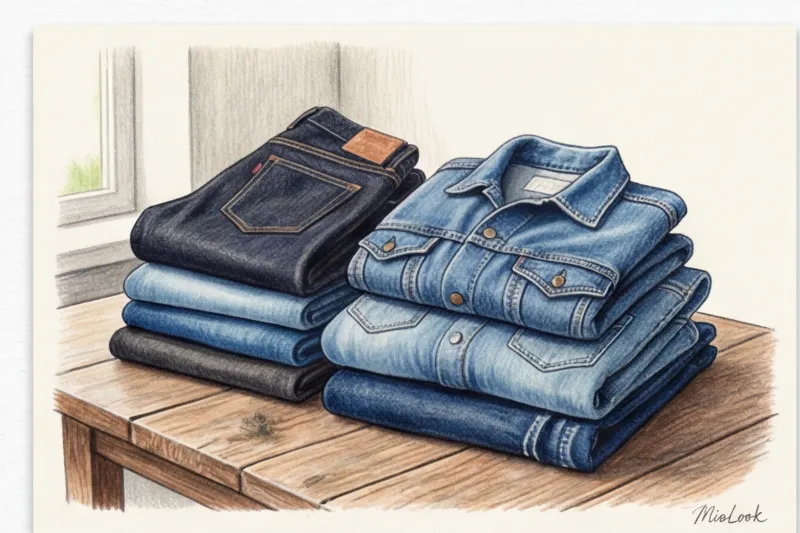
Why a Denim Basic Wardrobe Is More Than Just Jeans
"I have sixteen pairs of jeans, but I have absolutely nothing to wear"—that's the phrase I hear from almost every other client when I start sorting through their wardrobe. And every time, the picture is the same: rows of identical skinny or straight-leg pants, differing only in the shade of blue and the degree of wear, crowd the hangers. The main paradox I constantly encounter in my styling practice is that a well-composed wardrobe basic denim wardrobe — this is not an endless collection of identical trousers.
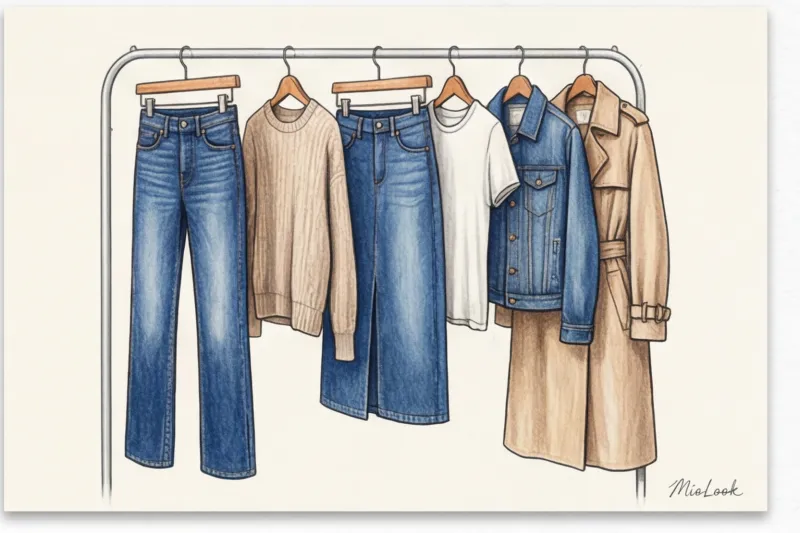
Let's dispel this myth once and for all: a true denim capsule doesn't mean buying five pairs of jeans of the same style. Instead, it's a complex, self-contained ecosystem of tops and bottoms, where each piece fulfills a specific stylistic need and interacts with the rest.
As a fashion journalist, I love tracking the evolution of trends across the decades. Consider this historical reference: in 1873, when Levi Strauss patented trousers with copper rivets, denim was a purely utilitarian work uniform for Californian miners. The fabric was prized solely for its durability. But after a century of development, this rough twill conquered the runways of Dior and Chanel, forever earning the status of a "new classic." These designers proved that workwear can be elegant.
The main secret of denim's appeal, which I always explain in my masterclasses, is the architectural role of dense cotton. Unlike fine knits, which cling treacherously to the body and accentuate absolutely every nuance of the figure, true, rigid denim works like a carefully tailored, sculptural framework. It shapes the silhouette, establishes clear geometric lines, and visually elongates proportions. The dense fabric literally "gathers" the figure, creating the perfect contour where needed.
Another unique quality I greatly appreciate about this material is its absolute transseasonality. This is crucial in a modern wardrobe: the same item can seamlessly transition from a summer staple to a winter one. My favorite example is a thick denim midi skirt with a slit. In July, you wear it with a weightless silk slip top and sandals, and in January, it looks stunning paired with a voluminous premium cashmere sweater and thigh-high leather tube boots. You invest once (a quality denim piece typically ranges from €120–€250), and wear it year-round.
The formula for the perfect denim capsule from a stylist
Over the years of working at European fashion weeks and analyzing private clients' wardrobes, I've developed a strict yet highly variable formula. I call it the "3-2-1 Rule." This simple math will save you from impulse purchases and ensure that items work synergistically rather than hanging around like dead weight.
Here's what this system looks like in practice:
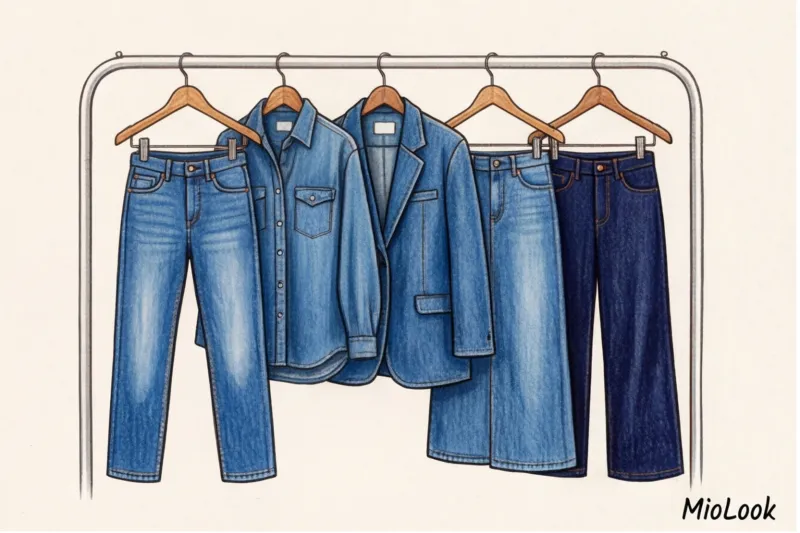
- 3 pairs of jeans: One absolute classic (for example, straight deep indigo colors), one trendy model (wide baggy or palazzo for relaxed looks) and one pair for maximum comfort (slightly loose slouchy).
- 2 "tops": a structured denim jacket (regular or oversized) and a soft chambray shirt.
- 1 alternative "bottom": a midi/maxi denim skirt or Bermuda shorts of the right length.
This compact selection of six pieces forms the perfect base. In professional settings, we often refer to denim as a neutral canvas for more complex, statement pieces. A complex tweed jacket can look too pretentious with classic trousers (we discussed this balance in more detail in the article about Office Siren capsule ), but paired with straight jeans it instantly becomes relevant and fresh.
To avoid getting confused with new combinations, I recommend my clients digitize this basic six. After uploading their items to the app MioLook , you can visually see how your new denim jacket pairs with your existing dresses or blouses. This is a fantastic tool that helps you see your wardrobe as a whole and create outfits in a couple of clicks, saving you time in the morning.
The Anatomy of Quality Denim: What to Look for When Buying
While researching a report on sustainable production in 2018, I spent a week visiting old textile mills in Okayama, a Japanese prefecture rightfully called the world capital of premium denim. It was there, standing amid the deafening roar of vintage 1920s shuttle looms, that you began to understand why the right pair of jeans objectively can't cost €30. And why a €200 pair isn't overpaying for a brand name, but a mathematically sound investment.
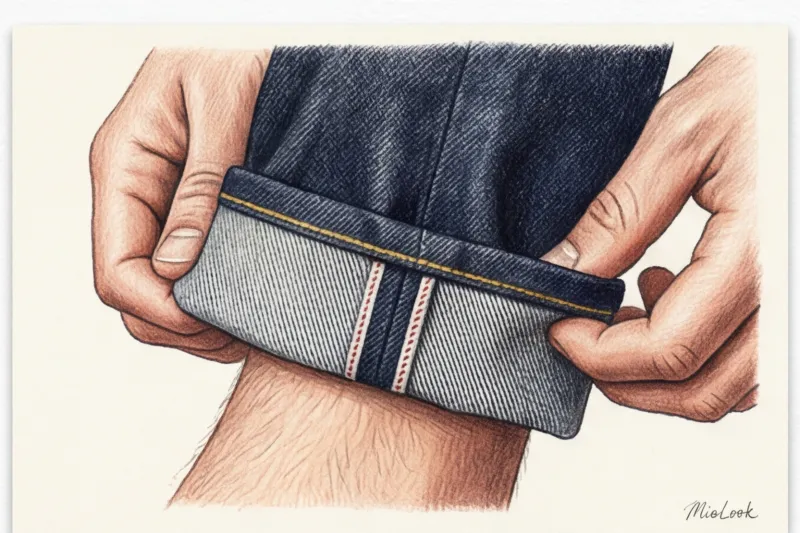
These slow looms weave a narrow cloth, the edges of which are tightly interwoven with a single thread, forming the very same edge selvedge Unlike modern wide machines that simply trim the fabric edge, selvedge does not unravel, maintains its seam geometry for decades, and is the primary indicator that you are sewing a top-quality item.
Visual markers: 30-second fitting room test
You don't need to be a technologist to distinguish a quality item from a disposable knockoff. When you enter a store, always check three elements:
- Fittings: Real rivets on the pockets should be copper, not a cheap alloy that will darken after the first wash. Look for an engraving on the fly. YKK on the zipper pull or heavy, all-metal bolts.
- Chain stitch: Turn the bottom edge of the pant leg inside out. If the hem is stitched with a stitch resembling a braided or chain stitch, you're looking at a high-quality gathered garment. This stitch is more elastic than a regular stitch and, after washing, creates a beautiful raised pattern along the edge (a roping effect).
- Weaving direction (Twill): Look closely at the diagonal ribs on the fabric. Right-hand weave ( Right-hand twill ) is a strict standard that provides classic rigidity. Left-hand ( Left-hand twill ) makes the fabric noticeably softer and fluffier. And if you see a zigzag pattern, that's broken twill (broken twill). This ingenious development prevents the age-old problem of denim, where the side seam of the pant leg twists forward over time.
Have you ever wondered why some mass-market jeans make your butt look flat, regardless of your actual figure? It's not you, it's the ruthless frugality that's at fault.
The difference between mass-market and premium clothing lies in the patterns. Mass-market clothing strives to fit as many details as possible onto a single bolt of fabric. To achieve this, the back seam and yoke are cut almost in a straight line. This saves up to 15% of material, but completely destroys the anatomical fit—a straight cut makes the buttocks appear flat and wide. Premium brands cut the yoke in a deep "V" and make the back seam curved. This architectural geometry lifts and rounds the silhouette.
The second cost-saving measure is washing. To achieve a distressed effect, mass-market jeans use harsh chemical acids (which is why cheap jeans often smell of sulfur), which destroy the fibers even before you buy them. Expensive brands use complex, multi-step enzyme or pumice treatments, preserving the strength of the cotton.
Density (Oz) and Composition: The Elastane Myth
The main marketing ploy of the last twenty years has been to convince women that jeans should feel like athletic leggings. The ubiquitous addition of stretch has killed the very essence of denim as a shapewear material.
Remember the rule: 1-2% elastane is the absolute maximum , only suitable for skinny or slim silhouettes. For straight and wide styles, look for the tag. 100% cotton (rigid) Yes, these jeans may feel stiff the first day. But after a couple of weeks of wear, pure cotton warms up, softens, and permanently molds to your body's contours. Stretch fabric simply stretches, rewarding you with stretched knees and a sagging backseam after just three months.
Denim weight is measured in ounces per square yard (oz). Knowing how to read this specification will help you avoid seasonal errors:
- 10–11 oz: A lightweight summer option. Ideal for palazzos and shirts, but doesn't hold up well at the waist.
- 12–14 oz: The gold standard for your denim wardrobe essentials. This weight is comfortable year-round, perfectly conceals figure flaws, and creates a defined hip line.
- 15+ oz: A selection of true denimheads. This material (often raw, unwashed denim) literally sits on the shelves in stores. Breaking them in is a form of fashionable asceticism in its own right, but the results are worth it: they last for decades, developing a unique creasing pattern.
Many clients doubt whether it's worth paying €150–€250 for a pair of skinny jeans instead of the usual €40 for a pair with elastane. In such cases, I suggest simple math: add both items together. MioLook smart wardrobe And track the cost-per-wear metric. You'll wear a stiff, 100% cotton garment at least 300 times over the next five years, while a cheap stretch one will end up in the trash after 30 wears, having lost its shape. Investing in the right density always pays off.
Access to MioLook for €0.99 — one-time payment
A smart AI stylist will select the perfect look.
Get access — €0.99 onceJeans: The Foundation of Your Capsule
A well-designed denim wardrobe is always based on precise geometry. When we walk into the fitting room with a dozen pairs of denim, the moment of truth begins: the cut architecture determines whether a piece will become your "uniform" or end up at the bottom of your closet. I always insist that a modern wardrobe isn't built around one perfect pair—you need three diverse silhouettes to cover the full range of stylistic needs.
But before we dive into styles, I'll share a professional secret. During fittings before lookbook shoots, we always check the fit of hems using two methods. Remember them and use them with every purchase:
- Squat test: After putting on your jeans, sit on a chair or squat deeply. The backseam shouldn't cut into your body, and the waistband shouldn't stick out more than two fingers' width. If there's a large gap, it means the manufacturer skimped on darts and cut the waistband in a straight line, ignoring the anatomy of the pelvis.
- Pinch test on thighs: Stand up straight and try to pinch the fabric at the widest part of your thigh. The ideal measurement for basic jeans is when you pinch exactly 1–2 centimeters of loose fabric. If you can't pinch it, the jeans will become misshapen as you walk; if there's too much fabric, the jeans will visually add size.
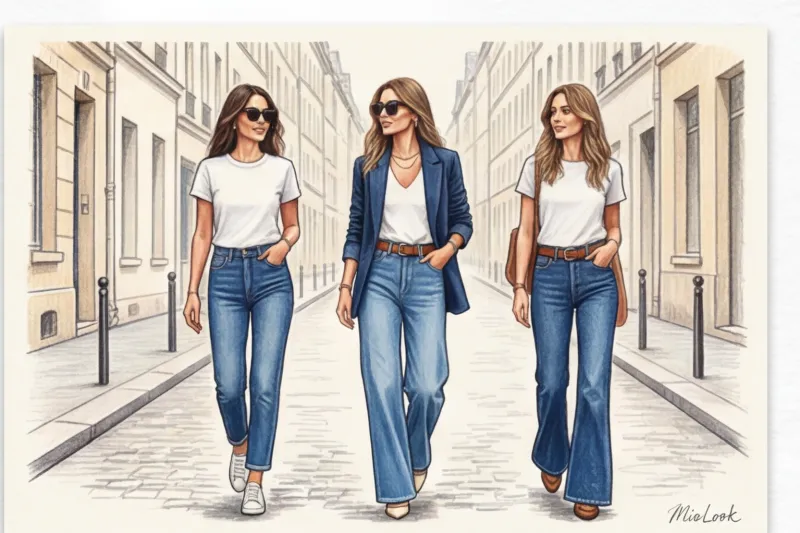
Now that we've cleared the technical inspection, let's take a look at three essential silhouettes that will form the core of your denim capsule wardrobe. High-quality examples of each category in the mid-up segment (like COS, Arket, or Massimo Dutti) will cost you between €80 and €130, making them a worthwhile investment.
Straight-leg: an absolute classic
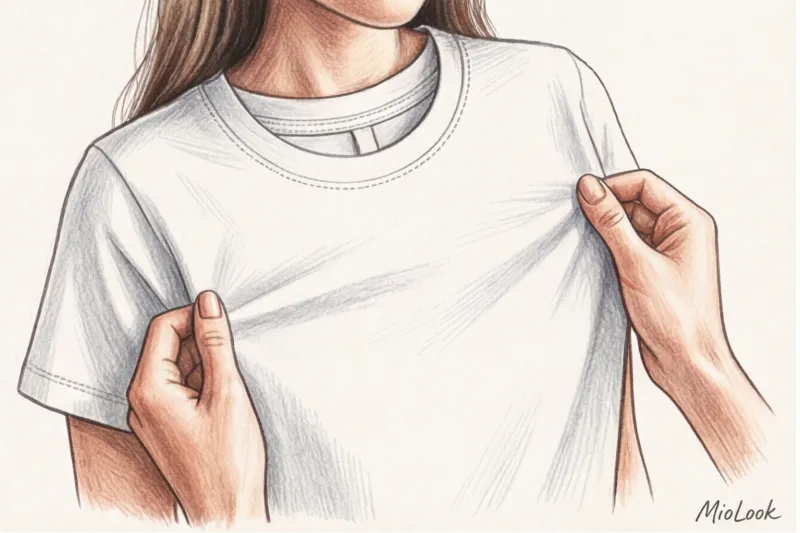
This is your style's zero kilometer, a cut that transcends time and trends. The straight cut, not hugging the calf, creates a flawless vertical line. Recall the iconic aesthetic à la Jane Birkin: straight jeans, a simple white T-shirt, and a touch of casualness. This silhouette makes it easy to recreate the iconic Parisian chic.
The key to straight-leg jeans is their hem. The perfect length is crucial. I recommend two options: either ankle-grazing, which gracefully reveals the narrowest part of the ankle (perfect for loafers and ballet flats), or a confident, floor-length cut that gently folds over the shoe. Anything in between, ending mid-heel, visually cuts off the leg and looks sloppy.
Wide-leg and Baggy: The Architecture of Comfort
The global shift in fashion toward comfort has made wide-leg styles the primary answer to the demand for comfort. However, they are one of the most insidious silhouettes. Many women are wary of wide-leg styles, fearing they will look bulky. The secret lies in the principle of volume balance.
How to wear voluminous bottoms without looking bulky? Whether you choose overly wide jeans or relaxed baggy jeans, the top should pull the look together. Use compact knitwear, a bodysuit, or a "French tuck" (a shirt partially tucked in at the front) to define your waist. A structured jacket with defined shoulders is a great option. If you pair baggy baggy jeans with a shapeless hoodie, your silhouette will inevitably become boxy.
Lengthening silhouettes: Bootcut and Flare
The third essential element is your personal visual correction tool. Bootcut styles (slightly flared from the knee down, originally designed to be worn over cowboy boots) and more dramatic flares (a pronounced flare) work real magic on proportions.
Strict geometry is at work here: the flare from the knee mirrors the wide hips. If you have a figure with a defined bottom, this style will create the illusion of a perfect hourglass figure, while tapered styles would create a triangle-like silhouette. To maximize this effect, wear the Flare with a floor-length silhouette (just 1 cm off the ground) paired with heels or pointed-toe ankle boots – your legs will appear endless.
Balancing these three different styles with your collection of sweaters, shirts, and jackets can be challenging. To avoid wasting precious morning time trying on clothes, I recommend digitizing your basic silhouettes. After uploading your items to MioLook smart wardrobe , you can visually create outfits right on your smartphone. The app will help you visually evaluate how a straight hem, wide-leg, or flare style pairs with different top styles, maintaining the perfect balance of proportions.
Tops and Dresses: Expanding Your Basic Denim Wardrobe
In 2019, before an important interview with the creative director of a Parisian fashion house, I stood in front of the mirror wearing an impeccable yet painfully predictable wool pantsuit. One spontaneous decision changed everything: I ditched the crisp white shirt and replaced it with a slightly distressed denim shirt. This move worked like magic—it instantly toned down the formality, transforming the strict office sheath into the image of a confident woman who doesn't try too hard to conform to others' expectations. It's these subtle elements that prove a complete denim wardrobe essential isn't just about pants.
Shirt: Chambray vs. Light Denim
Many people confuse denim and chambray, although structurally they are completely different fabrics and behave differently when styled. Denim is a twill weave with a characteristic diagonal rib, while chambray is created with a plain weave (where a colored warp thread and a white weft thread cross). This makes the material significantly lighter and more flowing. If you're looking for a piece for complex layering, choose chambray with a weight of 5-7 oz.
Why not thin denim? Try wearing a classic denim shirt under a heavy wool jacket or cashmere sweater—you'll feel like a clumsy knight in armor, the fabric bunching up in rough folds. Chambray, on the other hand, lays softly. I love wearing it three ways: unbuttoned over a basic white T-shirt (hello, '90s minimalism), tucked under a structured blazer for relaxed business casual, or as a basic base layer under a voluminous jumper, with just the collar and cuffs showing for a dramatic effect.
Trucker Jacket: Shoulder Architecture
The iconic trucker jacket is a true architectural framework for everyday looks. The Levi's Type III silhouette, introduced in 1967, serves as its historical benchmark: those recognizable V-shaped seams from the chest pockets to the waistband visually elongate the torso, sculpting the figure.
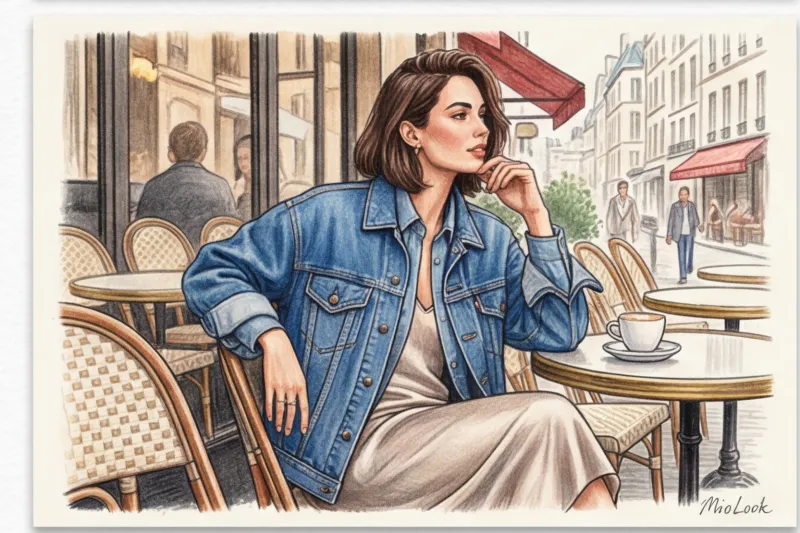
Today, when shopping, we're faced with a choice between vintage oversized jackets and cropped styles. If your style leans toward masculinity, look for men's vintage: these jackets act as a protective cocoon and look phenomenal when contrasted with flowing silk slip dresses. Cropped styles (cut just to the waist) enhance the proportions of petite women when paired with wide-leg, high-waisted trousers.
What should you absolutely not wear with a trucker jacket? Over the years, I've developed a strict rule: avoid pairing a heavy denim jacket with thin, form-fitting knit dresses made of cheap viscose. In this case, the difference in texture doesn't create a beautiful contrast, but rather highlights the slightest nuances of your figure and cheapens the entire outfit. Also, avoid wearing cropped trucker jackets over long, shapeless tunics—this will visually cut your torso into unflattering horizontal blocks.
The Long Denim Skirt: From Microtrend to Concrete Base
Just a couple of seasons ago, a denim maxi skirt with a deep front slit seemed like a fleeting nostalgia for the Y2K aesthetic. However, according to analytics platform Lyst, searches for this item not only skyrocketed by 140% last year but also firmly plateaued. Today, this skirt has become an essential staple.
A straight or A-line midi or maxi skirt serves the same utilitarian purpose as jeans, but looks much more elegant. A deep slit in the front or back isn't so much a nod to sexuality as a purely functional element, allowing for comfortable striding in rigid denim. Excellent styles in basic shades are now easy to find in the €80–€150 price range. Pair them with high, smooth, tube-style boots that tuck into the hem in the fall, and with minimalist leather mules in the warmer months.
To figure out which tops or skirts will complement your current capsule wardrobe, you don't have to buy everything. You can digitize your items by uploading them to MioLook , and test new combinations using smart algorithms. This will save you from impulse purchases and give you a fresh perspective on the items you already have in your closet.
Access to MioLook for €0.99 — one-time payment
Start creating perfect images with the help of artificial intelligence
Get access — €0.99 onceColor and Cooking: Assembling a Palette Without Mistakes
The true magic of denim lies in its chemistry. When I spoke with the technologists at the iconic Italian mill Candiani (one of the world's leading producers of premium denim), they explained the key principle: classic indigo never completely dyes the cotton thread. The pigment settles only on the surface of the yarn—this is called ring dyeing. This is why your basic denim wardrobe lives and changes with you: as you rub, the top layer of dye wears off, revealing the white core of the thread. And yes, for this same reason, real jeans always fade within the first few weeks of wear—this is a sign of the authenticity of the process, not a manufacturing defect.
This technological nuance brings us to the top of the denim hierarchy - raw denim (raw denim) A deep, unwashed indigo. Buying a pair of these (usually priced between €150 and €350) is the ultimate in class and elegance. The stiff fabric is initially stiff and requires some breaking in, but after a few months, it literally molds to your body. Characteristic "whiskers" appear along the thighs and so-called "honeycombs" appear behind the knees—a unique pattern of wear that is uniquely tailored to your body shape and impossible to replicate artificially.
For everyday routine, the unconditional basis remains mid-blue (medium blue shade) This is the most versatile color for casual looks, but it's here that the line between "expensive" and "cheap" becomes critically thin. Cheap mass-market washes are identified by sharp, symmetrical light spots on the thighs, as if stenciled with harsh acid. Expensive washes are achieved through extensive enzyme treatment (natural enzymes) or washing with real pumice stones. The result is a soft, seamless gradient that visually slims the leg without creating a harsh highlight.
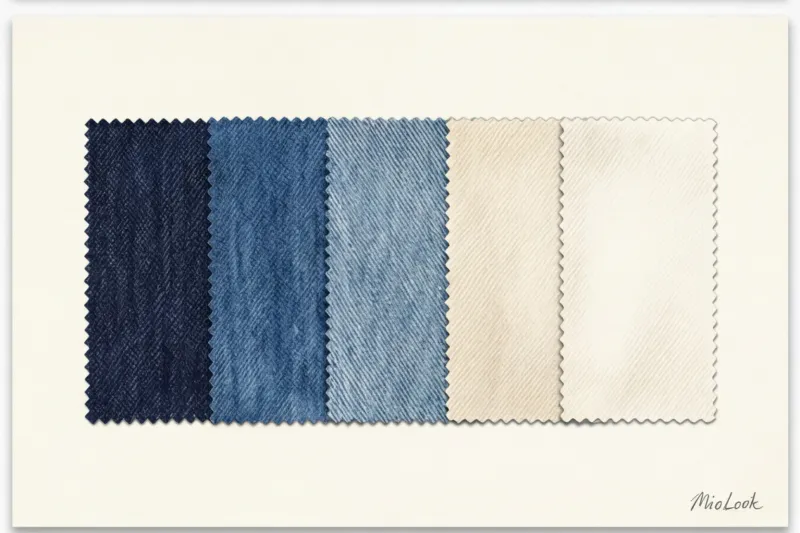
When creating a capsule, many people mistakenly rely on pure white for the warm season. My professional advice: replace it with ecru (milky or off-white) Pure white denim often looks flat, unattractively highlights pocket linings, and downright cheapens the look. Ecru, on the other hand, is the natural color of undyed cotton. If you look closely at this fabric, you'll notice tiny dark flecks—the remains of the cotton bolls. This shade has a sophisticated feel and transitions incredibly easily from summer to fall. Simply pair these jeans with an oversized camel cashmere sweater and suede loafers.
The finishing touch to a well-designed palette is washed black or graphite. Unlike a dull black, which quickly develops whitish streaks along the seams and looks washed out on thick cotton, washed black has a complex, vintage texture from the start. I love using it to create multidimensional looks:
"The secret to the perfect all-black look lies in the clash of textures. Pair rough graphite denim with a smooth silk top and patent leather shoes—it's this play on the contrasts of light absorption and reflection that creates that perfect Parisian casualness."
To ensure your palette works together, I recommend doing a digital inventory. Upload your current jeans and jackets to MioLook smart wardrobe and look at the resulting color chart. In my practice, 8 out of 10 clients are surprised to discover that they've been unknowingly buying the same shade of mid-blue for years, completely ignoring the potential of raw denim or elegant ecru. Visualization helps break this pattern and make future purchases more strategic.
The Canadian Tuxedo: The Art of Wearing Denim with Denim
Observing the street style at the Palais Tokyo during Paris Fashion Week, I often see the same stylistic mistake. Influencers try to replicate the double denim trend, but end up looking like they're wearing a heavy lumberjack uniform. An all-denim look is a merciless litmus test of taste. It can look like a couture masterpiece, or it can look downright cheap, especially when showgoers choose equally thick, stiff pieces for both tops and bottoms, buttoning them up tight.
Before we deduce the formula for the perfect pairing, let's recall the origins of this bold approach. In 1951, legendary American singer Bing Crosby was denied entry to a fashionable Vancouver hotel because he was dressed entirely in denim. Levi's designers responded to the incident brilliantly: they specially tailored a formal denim tuxedo for the singer, complete with a mocking interior patch: "Notice to all hotel owners: Denim is acceptable." Thus, the ironic term "Canadian tuxedo" became a permanent fixture in fashion vocabulary.
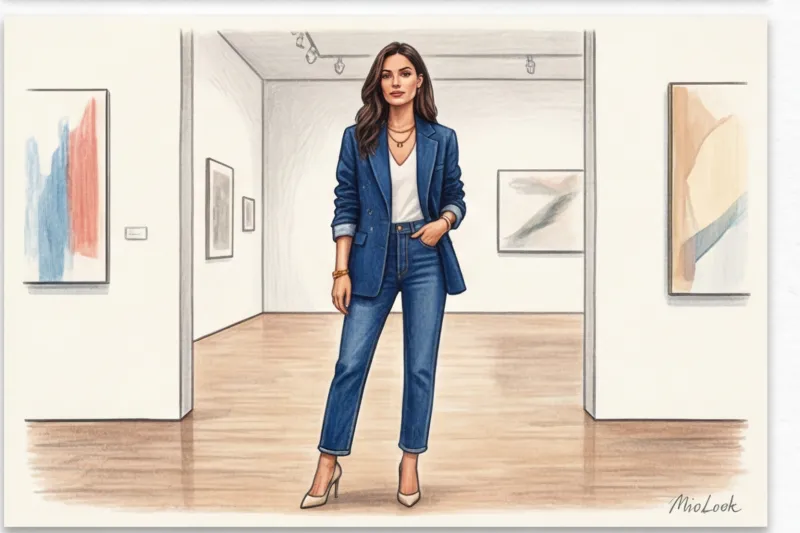
Today, this technique is an indicator that your denim basic wardrobe is working at an advanced level. If you're just starting to experiment, use rule of contrast This is the safest territory for beginners. Combine contrasting shades: for example, a weightless light blue shirt and dark blue, almost black jeans. The difference in color saturation acts as a visual equalizer—it clearly separates the body's proportions and prevents the figure from becoming a solid rectangular blob. Pay attention to detail: if your dark jeans have contrasting tan stitching, complement it with a warm caramel-colored belt.
The pinnacle of stylization is monochrome rule The goal is to find a perfect tone-on-tone match. When the top and bottom merge into a single color vertical, it creates the effect of a luxurious jumpsuit that dramatically elongates the figure. To ensure you're choosing the right shade when buying items from different brands, I recommend uploading photos of them to MioLook smart wardrobe — the algorithm will help you visually assess whether the temperature undertones of blue are in conflict.
But the real secret of a luxurious Canadian tuxedo lies in the clever use of texture. Pairing a jacket and jeans of the same weight (for example, 14 oz) creates a wooden silhouette and deprives it of movement. Remember the golden rule: a thick, architectural bottom (12-14 oz), which reliably gathers the shape of the hips, should be paired with a thin, flexible top (around 6-8 oz). The shirt should flow and easily be tucked in casually, asymmetrically, at the front (the aforementioned French tuck). This contrast in fabric weight is what removes the workwear-like appearance of double denim, lending the look a relaxed elegance.
Your ideal image
it begins Here
Join thousands of users who look flawless every day with MioLook.
Get access — €0.99 onceIntegration: How to Incorporate a Denim Basic Wardrobe into a Business Style
Last fall, Anna, a team lead at a large IT company, approached me. Her request was stark: "I manage a team of thirty male developers and need authority, but in a classic three-piece suit, I look like an alien among hoodies and sneakers." We started building her workspace not with pleated trousers, but with the right denim. And it worked flawlessly—we found the perfect balance between professionalism and modern comfort.
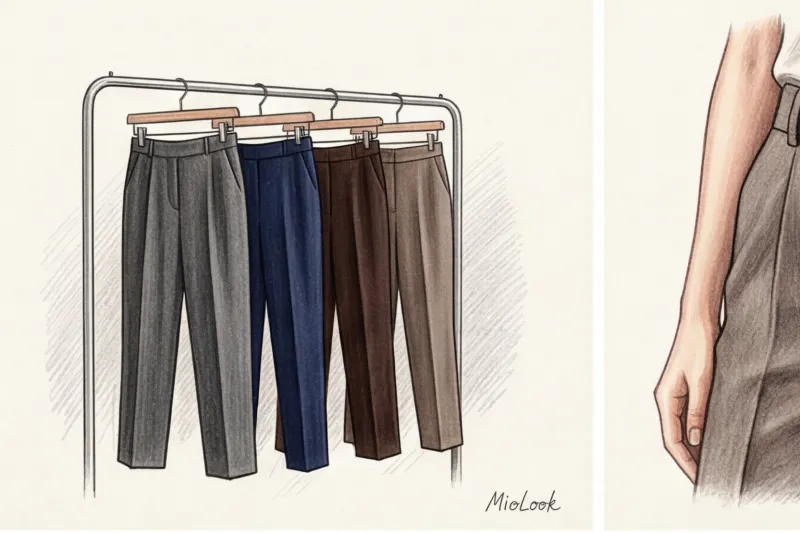
The smart casual dress code is tricky because the line between "relaxed elegance" and "Friday casual" is incredibly thin. If you want to integrate a denim basic into your everyday work life, remember the golden rule: the fabric should visually imitate pants. Only deep dark wash (dark indigo without a hint of gradient) or matte charcoal black are acceptable. No ripped knees, raw edges, creases, or contrasting yellow stitching. The silhouette is strictly classic, straight or slightly tapered, without being excessively tight. We've already discussed the acceptable boundaries and nuances in our articles. "Can I wear jeans to the office?" And Smart Casual for Women.
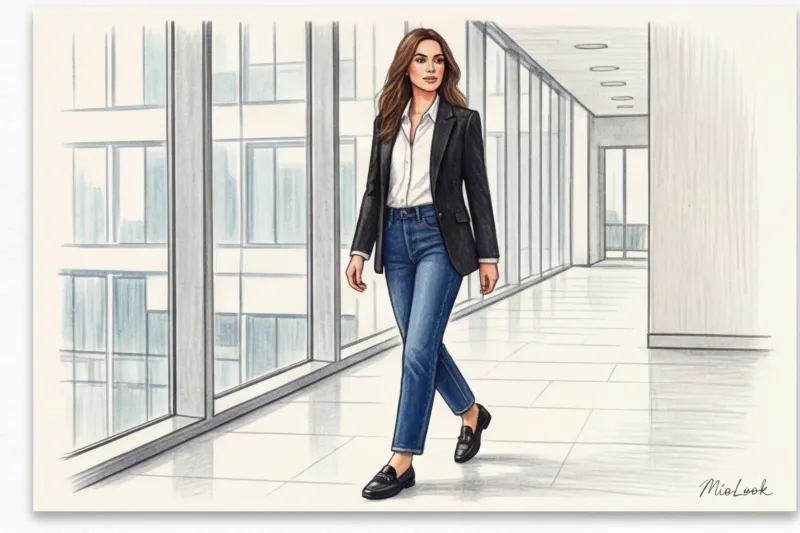
The secret to a flawless business look with denim lies in the stylistic "Sandwich Principle." Think of the jeans as a filling that should be tightly sandwiched between two strict, formal elements. The top layer is an architectural jacket with a sharp shoulder line (for example, made of thick wool or textured tweed), and the bottom layer is a pair of classy shoes. This contrast instantly elevates the seriousness of the entire outfit, transforming a casual piece into a business uniform. Add a silk blouse or cashmere turtleneck, and you've achieved the perfect balance: formal enough for a boardroom meeting, yet dynamic enough for an evening networking event.
Shoes act as the final switch, switching from "weekend" to "investor meeting" mode. Leather loafers with a stiff sole, classic oxfords, or structured ankle boots with a square or pointed toe literally pull the look together. The rigid shape and smooth texture of these shoes discipline the relaxed weave of the cotton. Conversely, pair the same dark jeans with soft textile ballet flats, and the corporate glamour disappears without a trace. A pair of the right leather loafers will cost you between €150 and €250, but it's an investment that will make even mass-market denim look expensive.
Denim in the office doesn't tolerate fuss. Save experiments with asymmetry and oversize for the weekend. Work denim is a canvas where the cut of your jacket and the quality of your shoes play a key role.
To ensure you're confident every morning that your look is business-appropriate, I strongly recommend gathering tried-and-true formulas in advance. Digitize your jackets, formal shoes, and office jeans by uploading them to MioLook Save your best Sandwich Principle combinations in your outfit section—this way, you'll create your own personal digital cheat sheet for those mornings when you only have three minutes to make a decision.
A Manifesto for Durability: How to Wash and Store Denim
In 2014, at the Fortune Brainstorm Green conference, Levi's CEO Charles Berg made a statement that shocked half the audience: he admitted that the jeans he was wearing on stage hadn't seen a washing machine in over a year. As a journalist accustomed to fact-checking, I initially treated this with a grain of salt. But after speaking with factory technologists and avid vintage collectors, I completely changed my mind. Spoiler: Berg was absolutely right.
Your basic denim wardrobe is an investment. Water, the harsh mechanical abrasion of the drum, and chemicals are its main enemies. Washing after every wear catastrophically quickly leaches the indigo pigment, distorts the factory patterns, and weakens the fabric. In my experience, switching to a mindful care approach, which I describe below, prolongs the life of denim three times longer. Instead of mindlessly throwing it in the washing machine, we switch to targeted preventative maintenance.
Alternatives to Laundry: Myths and Effective Methods
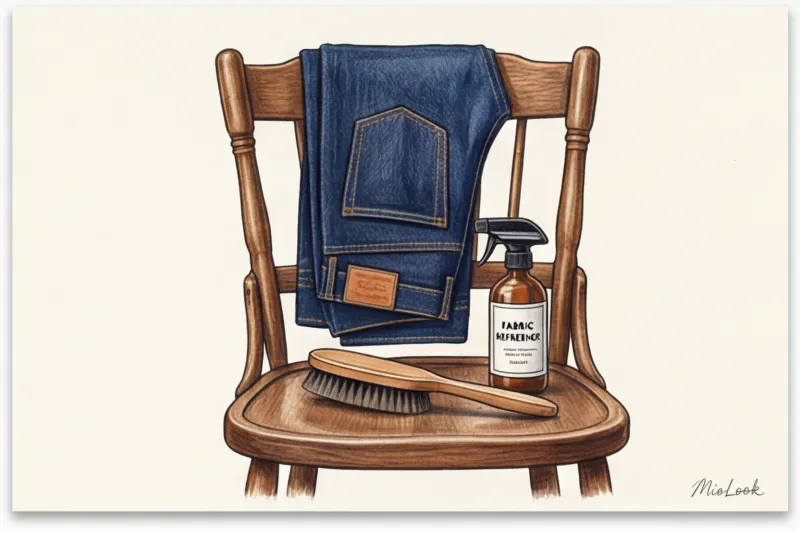
Before throwing your jeans in the laundry basket, try one of these methods. You'll be surprised how rarely jeans actually need water.
- Freezing (the main myth): For a long time, fashion forums have recommended putting jeans in the freezer to "kill bacteria and odor." Let's be honest—it's a beautiful myth. Researchers from the University of Alberta have proven that household freezers only temporarily "sleep" bacteria without eliminating them. As soon as you put the jeans back on and they warm up from your body, the microorganisms reactivate.
- Steaming (working tool): This is what really works. A good handheld steamer eliminates odors with hot steam (around 100°C) and restores fabrics to their original shape, slightly shrinking stretched fibers on knees or thighs.
- Local cleaning: A coffee stain or a splash of spring mud isn't a reason to wash the entire item. Use a damp cloth and a drop of mild soap to gently spot-clean the stain.
- Ventilation: Hang your jeans on the balcony on a cool evening. Fresh air is an excellent natural deodorizer for heavy cotton.
Machine washing rules: if you can't do without water
Sooner or later, denim will need to be washed. I recommend doing this no more than once every couple of months if worn regularly. And the rules are crystal clear:
Always turn your jeans inside out inside out Before loading into the drum, this protects the front side from abrasion of the pigment against the metal walls. Use only the delicate cycle and cold water (strictly 30 degrees Celsius). Hot water not only causes severe shrinkage but also literally "cooks" the fibers, making them brittle.
A critically important nuance: Absolutely forget about fabric softener. It's a total denim killer. The chemical composition of fabric softeners coats the cotton fibers with a greasy film, impairing their breathability. And if your jeans contain even 1-2% elastane, fabric softener will destroy these elastic fibers within a couple of washes, turning the resilient fabric into a shapeless rag.
Drying and smart storage
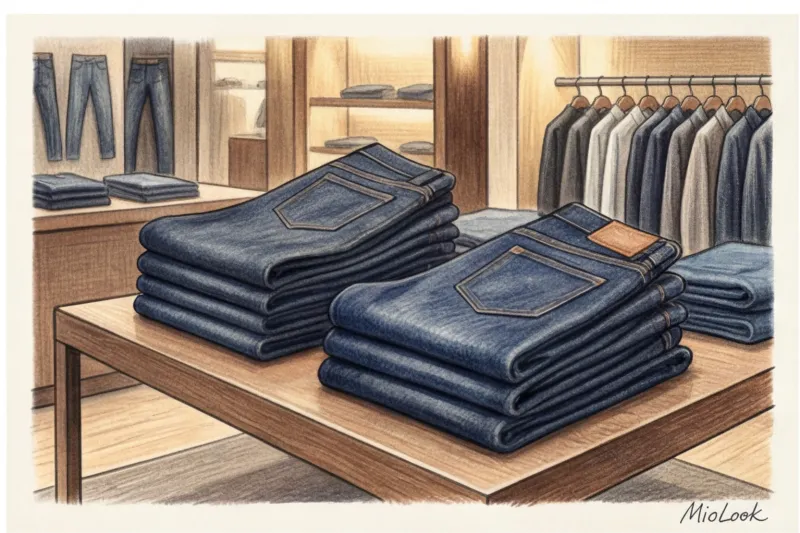
Tumble drying is a no-no. The high temperatures of tumble drying burn the life out of cotton fibers and are guaranteed to ruin the fit (especially on vintage pieces, which can cost anywhere from €150 to €300 and up). Denim should be dried naturally: ideally, laid flat, away from radiators and direct sunlight. It's best to store jeans folded on a shelf—this prevents them from stretching under their own weight, as can happen when using hangers with clips.
To avoid confusion about which pairs need a steam refresh and which need a rare wash, I strongly recommend digitizing your items. By adding your basic denim wardrobe to MioLook , you can visually monitor how often you wear each item and create fresh looks without wearing your favorite pair to the point of holes.
Checklist: Building Your Own Denim Wardrobe from Scratch
According to a large-scale study by the Ellen MacArthur Foundation (2023), the average woman wears a purchased item only 7-10 times before discarding it. In the denim category, this statistic is even more dismal due to the "impulse sale" effect. For your denim basics wardrobe to become a seamless ecosystem, not just a pile of blue cotton on a shelf, you need to completely shift your consumption paradigm. I've put together a step-by-step plan to help you build the perfect capsule wardrobe without breaking the bank.
Step 1: Audit and ruthless cleaning
Any functional capsule wardrobe starts with empty space. Take out absolutely every piece of denim you own. Now we turn off sentimentality and turn on rationality.
Immediately throw away (or better yet, recycle) jeans with stretched knees. Deformed knees are an irreversible sign of deteriorated elastane, and no amount of hot washing will restore them to their original shape. Also thrown away are styles with an abundance of rhinestones, pronounced rips, and contrasting abrasions that visually distort the proportions of the legs. Keep only those pieces that maintain the silhouette's structure.
Digitize surviving basic elements: upload their photos to MioLook This simple step will forever free you from buying jeans that are almost indistinguishable from the ones already hanging in your closet.
Step 2: The Foundation. Investing in the Foundation
Only after stripping down do we move on to the basics. Your goal is to buy the perfect straight-leg jeans, which will become a blank canvas for any style. Look for a 12-13 oz weight—that's the sweet spot that already offers figure-flattering benefits, but isn't too rigid and requires months of break-in.
Choose a deep indigo (raw) or a uniform mid-blue. No gradients or highlights on the hips. A quality pair with a proper chain stitch and brass hardware will cost between €130 and €250, but this is the only item in your wardrobe whose cost per wear will eventually approach zero.
Step 3: Tops. Adding Volume and Texture
A proper denim basic wardrobe is never limited to just bottoms. In step three, we add more layering. Your goal is to add an oversized trucker jacket or a chunky denim shirt.
A loose-fitting top is crucial: it allows you to layer oversized cashmere sweaters in winter and layer it over thin silk slips in cool summer. If your basic jeans are dark, a top a couple of shades lighter is a good choice—this will create the classic Canadian tuxedo look with the contrasting textures we discussed earlier.
Step 4: Expand. Accent Silhouettes and Colors
Only when you've got the perfect base and versatile top pieces covered can you move on to trends. At this stage, we buy a trendy piece that will refresh the capsule wardrobe. Today, it's wide-leg jeans or a maxi skirt in thick denim with a front slit.
To prevent a piece from looking like a passing fad, take it into an alternative palette. I recommend going with washed black, which will add a grungy, casual feel, or a refined milky color (ecru). Ecru works phenomenally in fall/winter looks, creating a striking effect. "quiet luxury" paired with caramel knitwear and suede shoes.
By putting this four-step matrix together, you'll have more than just a set of items, but a mathematically calibrated design. Your wardrobe will begin to work for you, saving you time every morning and giving you the confidence that only impeccably fitted denim can give.
Guide Chapters
Stylish jeans for women over 40: how to choose
For years, mass-market fashion has been telling people that after 40, they should wear stretchy jeans. We explain why this is a mistake and how to find your perfect status jeans.
What colors go with blue jeans: stylist tips
Blue denim isn't a neutral color, but a complex material. Let's explore the color palette to find out which shades will create the perfect look.
How to properly wash jeans in a washing machine: care secrets
Regular washing can ruin expensive denim in just a few washes. Learn the professional approach to caring for your jeans to preserve their color and shape for years to come.
What to wear with a long denim skirt: top 10 looks
A long denim skirt is a versatile staple that can replace dozens of pairs of trousers. We're breaking down the top 10 modern looks, from relaxed to formal.
Denim trends: what women's jeans are in fashion in 2024
The fashion industry is tired of shapeless oversized fits and thin stretch fabrics. We explore the current denim trends for 2024 and learn how to choose the perfect pair of jeans.
Women's office jeans: how to wear them without breaking the dress code
80% of companies allow denim, but most employees don't know how to style it. Learn how to choose the perfect jeans for work and look professional.
How to Wear a Women's Denim Jacket: A Style Guide
Slim-fit denim jackets are a thing of the past. We'll tell you how to choose the right basic jacket and what to pair it with for a modern look.
How to wear a women's denim shirt: layered looks
Forget boring combinations and thin denim. Discover stylist secrets for creating sophisticated and stylish layered looks with a shirt.
How to Choose Jeans for Your Body Type: A Complete Guide
Traditional advice about "apples" and "pears" no longer applies. Discover the engineered approach to denim and find your perfect pair of jeans.
Everyday Denim Capsule: 5 Denim Pieces
How to stop buying identical jeans and build a smart wardrobe? Discover 5 denim pieces that will solve the "nothing to wear" problem forever.
What Shoes to Wear with Jeans: A Stylist's Cheat Sheet
How can the wrong shoes visually shorten your legs and ruin expensive denim? We break down the math behind ideal proportions from a professional stylist.
Total denim women's look: how to look expensive and stylish
The all-denim look has long ceased to be a work uniform and has become a symbol of intelligent fashion. We'll tell you how to pair denim for a classy look.