Visual body shaping: from outdated rules to modern optics
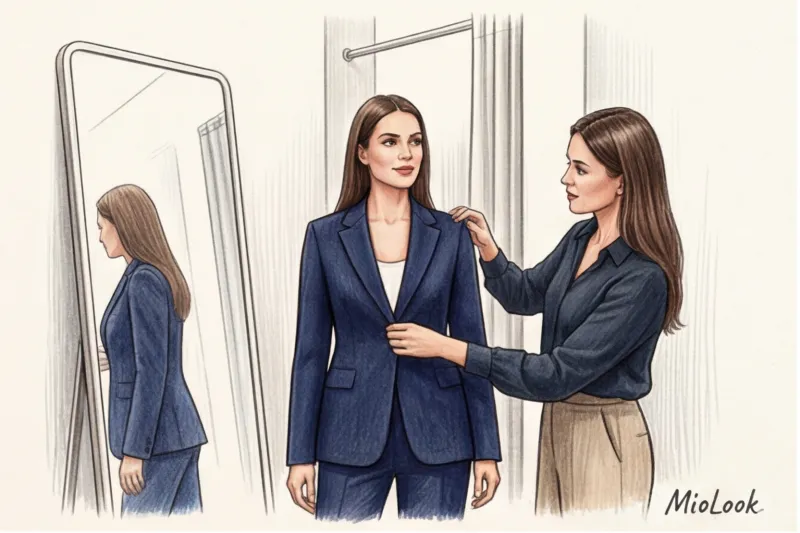
"I'm too wide in the hips, I need something to hide it"—that's the phrase that begins about half of my first consultations. Last week, a client named Anna came to see me. For years, she'd been swaddling herself in shapeless, cocoon-like cardigans (not cheap, by the way, made of premium cashmere, ranging from €250-€300), in a sincere attempt to disguise her lower body. As a result, her shoulders appeared sloping, her height had visibly decreased, and she looked tired.
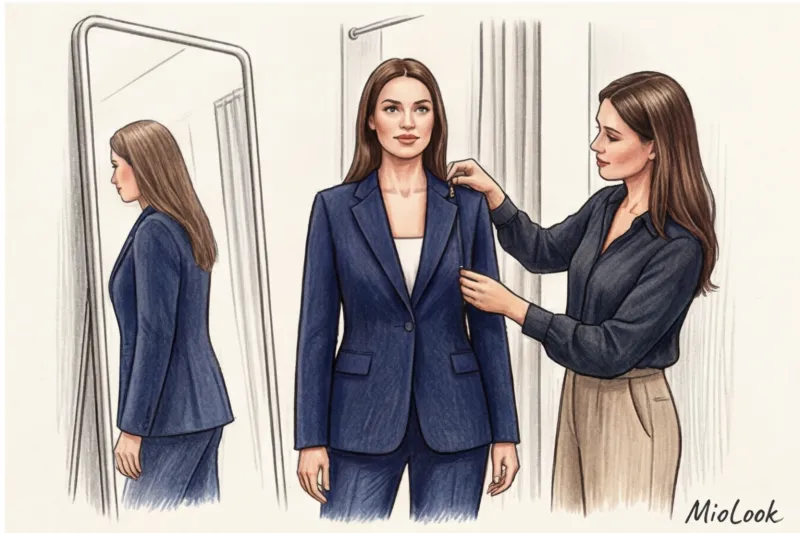
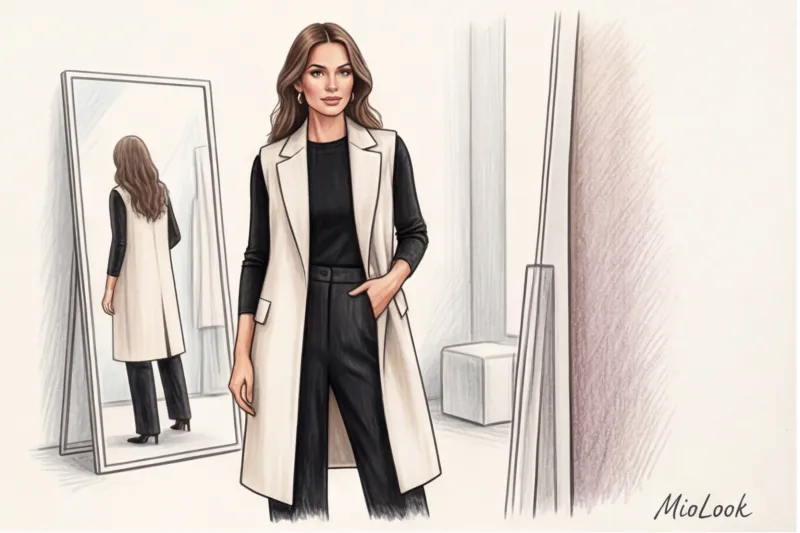
I suggested a simple experiment in front of a large mirror in the studio. We removed the knit "cover" and put on a structured jacket with a defined shoulder line, ending just below the waist, complemented by straight-leg trousers with a crease. No painful weight-lifting, diets, or magic. But in literally 15 minutes, Anna's back straightened, her gaze changed, and for the first time she looked at her reflection with genuine admiration. Smart visual body shaping — it's not about tightening up until you lose your pulse, but about how we build the guiding lines of the silhouette.
The "hide your flaws" approach is hopelessly outdated. Psychologically, it's extremely destructive: it forces women to constantly focus on their flaws, conveying this body insecurity to others. And from a stylistic standpoint, trying to hide a large body part under meters of excess fabric always backfires. You're not disguising the volume, you're making it shapeless, making the overall figure appear a couple of sizes larger.
The modern paradigm of style is based on a completely different principle: managing focus of attention We work like theater directors, illuminating the desired part of the stage with a spotlight. We decide where the audience will look. In this context, clothing is a powerful tool for body architecture, not just a piece of fabric to conceal it. We use dense textures to maintain shape where the body doesn't, and flowing fabrics where we need to add movement.
If we want to draw the eye away from the midriff, we don't wrap it in a dark robe. Instead, we create a strong accent in the portrait area with color or draw attention to graceful ankles with the right length of pants. Accessories here act as visual magnets (I highly recommend exploring How to choose a belt according to your body type or choose the right print size , so that these accents play into your hands).
Over 14 years of practice, I have developed a fundamental rule: we cannot change the physical dimensions of the body with fabric, but we have absolute power over how the brains of others read our proportions.
Fabric doesn't have a fat-burning effect and can't physically lengthen leg bones. However, the human eye is lazy. It follows the trajectories and boundaries we present to it, and the brain instantly draws conclusions based on this visual data. If the hem of your skirt ends in a horizontal line at the widest part of your calf, the brain automatically assumes your entire leg is just as thick. If we create a continuous vertical line of color, the brain perceives the silhouette as slender and elongated. This is pure optics, based on the laws of visual perception, and it is these laws that give us freedom in our clothing choices.
The main secret of stylists: the rule of the golden ratio and proportions
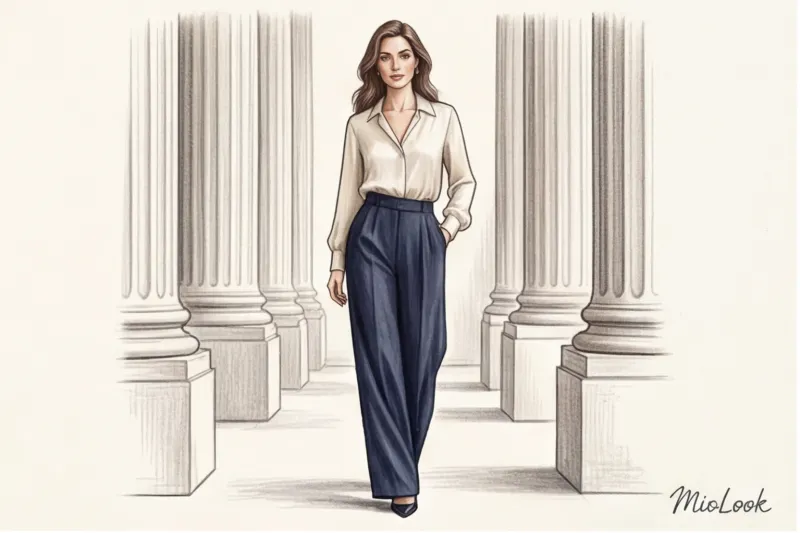
Did you know that the laws of visual harmony are absolutely identical whether you're designing the façade of the Parthenon or putting together an everyday outfit for the office? The architects of Ancient Greece and the great artists of the Renaissance relied on the principle of the golden ratio. The human brain is biologically programmed to perceive as "beautiful" and "correct" what follows a certain mathematical rhythm. In the context of personal style, we don't use complex fractions, but translate the classic formula (1:1.618) into the most powerful tool in fashion design— rule of thirds.
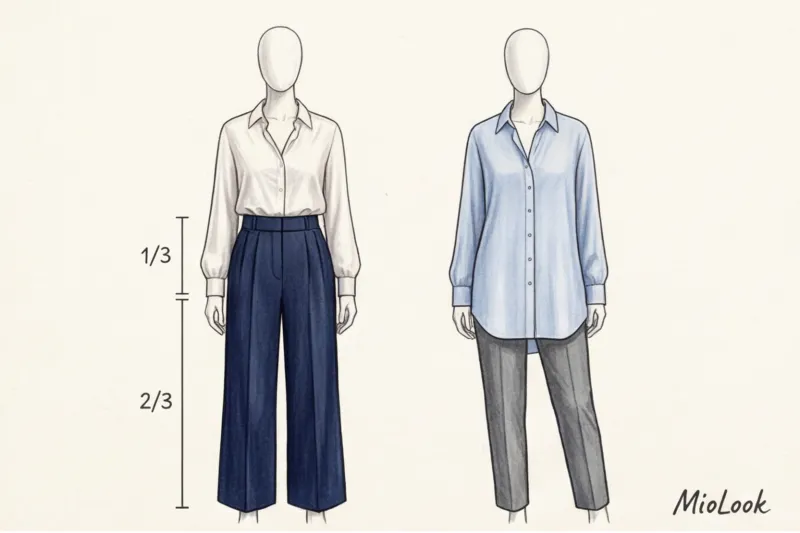
The essence of this stylistic concept is extremely practical: to make the figure appear light, stately, and proportional, the silhouette should be divided not in half, but into three equal parts. The ideal visual basis for the vast majority of female figures is proportion. 1/3 on the top (top, blouse, sweater) and 2/3 on the bottom (trousers, skirt, visually elongated legs).
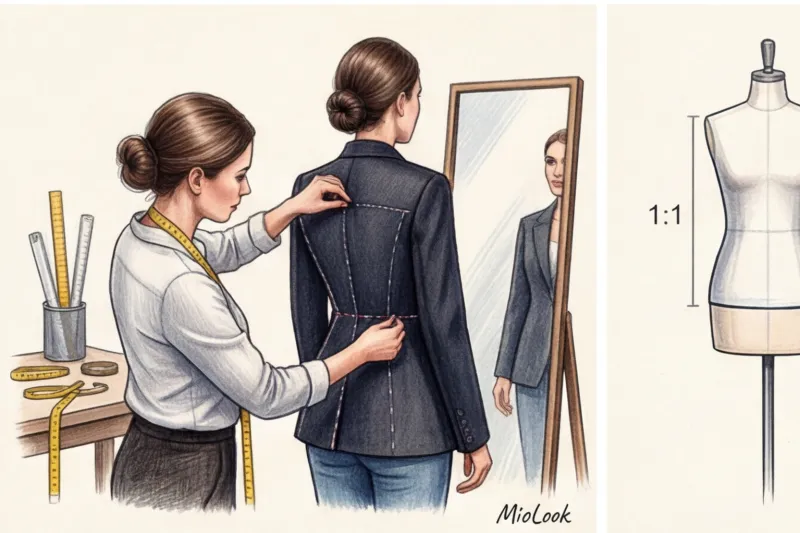
The most common mistake I correct almost every other wardrobe review is the 1:1 ratio. Imagine a classic, very real-life scenario: basic jeans and a cozy sweater worn untucked, ending right at mid-thigh. What's happening, optically? You're literally cutting your body in half.
In a 50/50 ratio (where the top is equal in length to the bottom), the legs appear disproportionately short, and the torso takes on the shape of a massive, heavy square. The viewer's gaze is unable to identify the dominant feature, and the silhouette becomes squat. Just define the waist by shortening the top, and the figure instantly elongates.
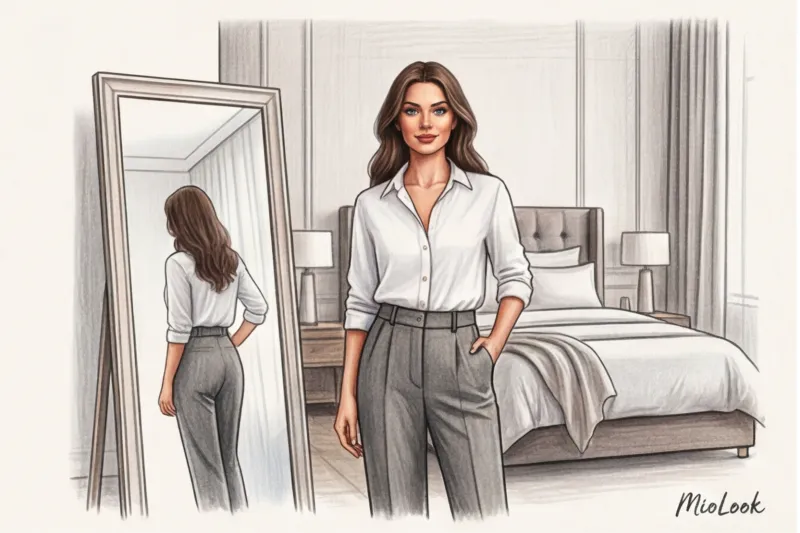
Sometimes it's difficult for us to objectively assess our own proportions in the mirror due to distorted perspective. I always recommend photographing your outfits. By uploading two options—a jumper worn loose and the same one casually tucked into the waistband— MioLook , you can visually compare them in the image gallery. The app's interface allows you to see yourself from the side, and you'll immediately notice how moving your waistline up just 10-15 centimeters magically "grows" your legs.
Where the length of the product should end: the rule of horizontals
While proportions (thirds) define the overall architecture of our look, the edges of clothing act as guiding markers for others' gazes. This is where the most important and indisputable rule of styling comes into play: Any horizontal cut of clothing automatically attracts attention and visually expands the part of the body on which it ends.
This applies to the hem of a skirt, the hem of a jacket, the sleeve length, the cuffs of trousers, and even the top edge of ankle boots. To ensure a graceful and delicate silhouette, all horizontal lines should run exclusively along your anatomical "narrowest" areas. For most women, these are:
- Wrists;
- Waist (or a point just above it, under the lower ribs);
- The area just below the knee;
- Ankles.
Let's look at a practical example. If the sleeve of a basic T-shirt ends at the fullest part of the forearm, the arm will appear fuller. But if you roll the sleeve diagonally a couple of centimeters or choose a long sleeve with a 3/4-length sleeve that hits at a thin wrist, the entire figure will appear lighter.
The same goes for the midi length, which is surrounded by many myths. It's widely believed that it's height-cutting and only suits tall women. In fact, according to the PANTONE Color Institute and WGSN research reports, midi remains the most versatile length in the world. The secret is that it suits absolutely everyone. if you find the right point.
Your ideal midi skirt or dress should end precisely at the narrowest point—below your calf, but above your ankle bone. If the skirt's hem hits the widest part of your calf, your legs will look like they're stacked. That's why I always recommend having the length adjusted at a tailor's. A basic skirt made of thick cotton or wool from COS or Zara, priced between €60 and €90, will look like a luxury bespoke piece if the tailor trims the length by an extra 3-4 centimeters to tailor it to your personal anatomy.
This rule also applies to footwear. Contrasting ankle boots whose tops dig into the wide part of your calf will cut off your leg and add a few visual pounds. Choose shoes that hug the narrowest part of your ankle or, conversely, have the shaft tucked under the hem of your skirt, without creating unnecessary horizontal lines.
Access to MioLook for €0.99 — one-time payment
A smart AI stylist will analyze your clothes, help you achieve the right proportions, and select the perfect look for every day.
Get access — €0.99 onceHow to visually elongate your height and appear slimmer: building a vertical line
In 1889, German psychiatrist Franz Müller-Lyer published an optical illusion that remains a staple in any stylist's arsenal. Its essence is incredibly simple: two segments of exactly the same length appear different to us if we draw inward-pointing arrows at the ends of one (>—< ), а на концах другого — наружу ( <—> ). The human brain automatically perceives a segment with “outward arrows” as longer.
How does this relate to our everyday wardrobe? Directly. By choosing clothes, we create these same creases on ourselves every day. A deep V-neck sweater, a peaked jacket with elongated lapels, creases in trousers, or the loose, unbuttoned tails of a trench coat—these are the very same "outward creases" that force the other person's gaze up and down, artificially elongating our height.
The Continuous Line Illusion: How Monochrome Images Work
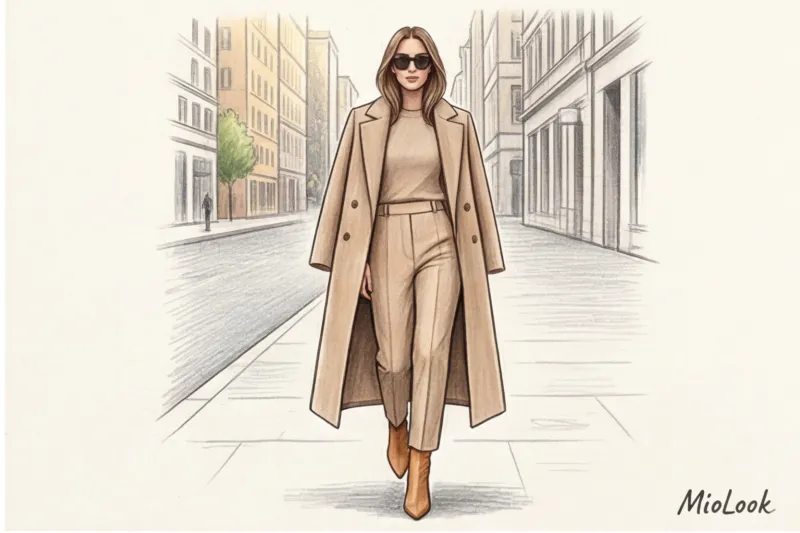
The most powerful tool for creating a stretching illusion is a monochromatic look, or total look. When we wear a top, pants, and shoes in the same shade, we eliminate horizontal obstacles for the eye. The gaze perceives the figure not as a collection of disparate blocks (torso, pelvis, legs), but as a single, continuous column of color.
An important point: a monochrome look doesn't mean you have to wear identical fabrics from head to toe. On the contrary, to prevent your figure from looking like a flat blob of color, you need to exploit texture differences. Combine materials that reflect light differently. For example, a beige cashmere sweater (a matte texture that absorbs volume), cream silk or satin trousers (a subtle highlight), and suede pumps. This play of textures within a single color looks expensive and works flawlessly to elongate the silhouette.
Color vertical: inside or outside
You can construct an extruding line in two ways: by creating an internal or external color vertical.
- Internal vertical: You wear a base layer in a single color (for example, a graphite top and graphite palazzo pants) and layer a contrasting camel-colored jacket over it, leaving it unbuttoned. The two vertical flaps of the light-colored jacket visually "cut off" your sides, leaving only a narrow dark stripe visible inside. You instantly appear a couple of sizes slimmer.
- External vertical: It works on the principle of a contrasting frame. You choose a light top and wear a dark three-piece suit over it. The dark clothing creates a sharp outer edge to the silhouette, pulling it together.
Correct fit and focus on the waist
For the color vertical to be fully effective, we need to position the waistline correctly. According to researchers from the University of Liverpool (2020), who studied the attractiveness of proportions, the human eye instinctively judges leg length from the visual point where the waistband of a garment begins, rather than from the anatomical hip joint.
That's why a high-rise waist is your best friend for visually lengthening your legs. The return of the Y2K style with its extremely low waists has played a cruel joke on many: a low waist elongates the torso but mercilessly "steals" inches from the legs. By raising the waistline of your trousers to the narrowest point under your ribs, you artificially add 3-5 centimeters to your legs.
But what if you don't like tucking in your shirts or sweaters completely for fear of emphasizing your belly? This is where the famous French tuck (French tucked hem). Take the hem of the jumper exactly in the center (about the width of the belt buckle) and casually tuck it into the waistband, leaving the sides and back exposed. This technique kills two birds with one stone: it defines the high waist while maintaining proportions, and creates diagonal folds that softly drape the hip area.
If you use a belt, pay attention to its width. A wide, contrasting belt (more than 4 cm) will create a rigid horizontal line and "cut" you in half, negating any vertical line you've created. To subtly define your waist without constricting it, choose thin belts (1.5–2 cm) that match your trousers. Excellent basic options in smooth leather can be found at most premium and mid-range brands in the 40–70 € range. To understand exactly where your ideal waistline is, I recommend photographing your outfits in front of a mirror. You can upload your outfits to the "smart wardrobe" feature in MioLook , to clearly compare how shifting the waist by just a couple of centimeters changes the perception of the figure.
Shoes that make your legs look longer
The bottom of our visual vertical is shoes. And it's here that most fatal mistakes are made, capable of ruining even the most carefully thought-out look.
The golden rule for slender legs: Shoes should match the color of whatever they're in contact with. If you're not wearing tights or a skirt with a thin, nude nylon, choose nude pumps whose undertone blends as closely as possible with your skin tone. If you're wearing black, opaque tights, your shoes should be matte black (suede works better than patent leather, as it doesn't create a glare that disrupts the silhouette). By wearing trendy white chunky sneakers with black tights, you create a sharp contrast at the ankle that cuts down on height.
Ankle straps deserve special mention. No matter how elegant the shoe, a contrasting horizontal strap acts like a visual scissors. It cuts the foot at its thinnest point, shortening the calf and making it appear thicker. If you're not ready to give up Mary Janes, find a compromise: choose shoes with a T-strap (which creates an extra vertical line along the instep) or a V-shaped vamp.
The shape of the toe plays an equally important role. Square toes, popular in recent seasons' collections, or a completely round toe create an obtuse angle at the end of your color column, abruptly stopping the eye from drifting. An elongated toe—a classic pointed or a soft almond—on the other hand, adds a few extra centimeters to your legs, as the eye continues to follow an invisible line beyond the tip of the shoe.
Volume Correction: Working with Color, Print, and Texture
How many times have you heard the categorical mantra "black is slimming"? It's perhaps the most persistent and, at the same time, the most insidious myth in the industry. Let's debunk it right now. At a lookbook shoot in 2021, a client with a luxurious hourglass figure (size 50) brought a suitcase full of black viscose turtlenecks and thin cardigans. "They elongate the silhouette!" she confidently declared. We put on one of these tops, and the thin black knit instantly acted like a topographical map, mercilessly highlighting every crease in her underwear and the slightest unevenness of her body.
We then swapped out the "slimming" top for a structured dress in thick beige cotton (a basic, well-cut model, costing around €150). And a miracle happened: the figure sculpted, the silhouette became more defined. Why? Because the density and structure of the fabric are always primary. Black on a flimsy texture only exacerbates the situation, creating unnecessary shadows. A dense, light-colored material, on the other hand, holds its shape and defines the body's architecture, ignoring its physical softness.
If we want to use shades wisely for visual correction of the figure , you need to rely on the basic laws of color. Light and warm colors (peach, milky, warm beige, coral) always appear forward, creating an optical illusion of proximity. Our eyes perceive them as larger objects. Dark and cool shades (deep emerald, sapphire, graphite, dark chocolate) recede into the background, visually receding and compressing the space.
It is on this law of physics that technology is built. color blocking Color blocking is a powerful tool for creating the desired silhouette. Remember Stella McCartney's iconic "Octavia" dress, which once made a splash on the red carpet. The designer placed wide dark panels on the sides of the dress and a shaped light block in the center. Our brains are lazy: it only reads the light central part, while the dark sides literally "fall" into the darkness, dissolving into the background. You can replicate this trick yourself: wear a dress in a light, warm shade and layer a long, cool, dark jacket over it, leaving it unbuttoned. You'll cut off any excess volume on the sides with your own hands.
Access to MioLook for €0.99 — one-time payment
Start creating your perfect looks with AI. Upload your items and plan your color-blocking capsules right on your smartphone!
Get access — €0.99 onceMatte vs. Shiny Fabrics: Managing Texture
When we talk about textures, we return again to physics, namely, the reflection of light. Imagine the principles of contouring in makeup: to highlight cheekbones, we apply a shimmery highlighter, and to narrow the nose or forehead, we apply a matte contouring powder. In clothing, everything works absolutely identically.
Shiny textures—satin, sequins, natural and imitation silk, smooth leather, patent leather, lurex—work like a giant highlighter for your body. They actively reflect light in all directions and visually add volume to the area they're placed on. If you have even the slightest bump, a bias-cut satin skirt will highlight it, making you look like you're five months pregnant.
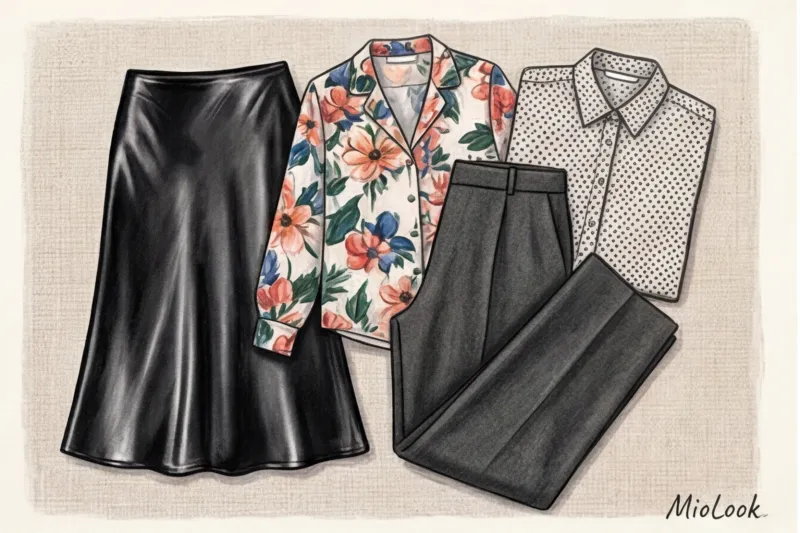
Matte fabrics—heavy cotton, suiting wool, tweed, suede, and high-quality, sheen-free viscose—absorb light. They act like a sculptor, drawing volumes into shadow and creating clear silhouette boundaries. Velvet and corduroy, by the way, are at risk: their pile partially absorbs light, but at the curves (where the pile refracts), it produces a bright highlight, insidiously emphasizing the texture.
"To balance out figure imbalances, combine textures. If you have narrow shoulders and a small bust but full hips (a classic pear shape), wear a pearl satin blouse over a pair of matte, heavy suit pants. You'll add air and volume where it's lacking and tone it down where it's too much."
Print Scale: Why Size Matters
Another important aspect of volume correction is working with the fabric pattern. This is where the principle of proportionality comes into play. The size of the print should be in harmony with the scale of your figure and facial features.
When a plus-size woman (size 50 and up) wears a dress with tiny flowers (called "millefleur"), an optical dissonance arises. Against a backdrop of tiny buds, a larger figure appears even more massive, due to the law of contrast. Conversely, if a petite woman of 155 cm (5'5") chooses a blouse with giant tropical leaves (each 20 cm wide), the print simply "devours" her. The person disappears, leaving only a walking pattern.
But the main danger lies in strict geometry and the notorious polka dot. Any regular, symmetrical pattern looks ideal only on a flat surface. As soon as a check, horizontal stripe, or polka dot touches the curves of the body—a full bust, rounded hips, or a protruding belly—the pattern inevitably distorts and stretches.
Our brains are programmed to instantly spot anomalies. A distorted polka dot pattern works like a magnifying glass, literally screaming, "Look here, there's extra volume that's distorted the fabric!" If your goal is to conceal the nuances of texture, abandon strict geometry in favor of abstraction. Watercolor splashes, animal prints (leopard, zebra), chaotic brushstrokes, or asymmetrical floral patterns lack strict axes. When stretched along the curves of the body, they don't deform visually, reliably disguising the actual volumes beneath.
How to Correct Your Figure with Tailoring: Practical Scenarios
For a long time, glossy magazines taught us to think in terms of a fruit basket: "apple," "pear," "banana." This system of body typologies was popularized back in the late 1990s, and, unfortunately, it still breeds insecurities in fitting rooms. Today, in professional circles, this approach is considered hopelessly outdated. We no longer try to squeeze a living woman into a rigid "type." The modern style paradigm has shifted to targeted solutions for specific problems.
Your body isn't a collection of problem areas to be feverishly concealed. It's an architectural foundation on which we, like sculptors, create focal points using cut lines and material density. Let's explore the most common requests from my practice and translate them into the language of design solutions.
One of the most common tasks is How to delicately hide a tummy And here I'll share an insider secret that will change everything. Start not by buying shapewear or oversized dresses, but by visiting a professional bra fitter.
According to statistics confirmed by lingerie styling experts, 80% of problems with a protruding tummy can be solved solely by choosing the right bra size. Sagging breasts visually "eat up" the waist, turning the torso into a monolithic rectangle. As soon as we select a cup that lifts the breasts to the correct height, space is created between them and the tummy. You literally "appear" a waist where there wasn't one just moments ago.
When it comes to choosing your clothes, forget about thin, tight knitwear that will treacherously highlight every fold. Your formula for success is built on three pillars:
- Semi-fitted cut and dense fabrics: The fabric shouldn't be tight across your stomach like a drum. Choose items that hold their shape (structured cotton, thick viscose, suiting wool). They create their own framework around your body.
- Peplum and A-line dresses: The architectural peplum (in the spirit of modern collections from COS or Khaite) is a brilliant invention. It sits snugly at the narrowest point under the bust and flares out over the tummy, creating the illusion of a perfect hourglass figure. A-line dresses work on the same principle.
- The magic of the wrap cut: Famous wrap dresses (like Diane von Furstenberg's) create a diagonal line that visually "cuts" the volumes and draws attention away from the central part of the figure.
A particular pain point for many women with a belly is choosing pants. They instinctively gravitate toward flat-front or low-waisted styles, struggling to button them. under belly. This is a fatal mistake. Your best ally is high-waisted trousers with pleats At the waist. Why does this work? The pleats create the necessary extra volume from the fabric. The stomach fits comfortably into this space, the pants fit beautifully without straining in the crotch, and the creases in the legs remain perfectly straight. High-quality pants of this cut from essential European brands will cost you between €100 and €150, making them the most profitable investment in your wardrobe.
Balancing broad shoulders or hips
When working with pronounced asymmetry between the top and bottom, our main goal is to balance the visual mass. And for different body features, the algorithms will be mirrored.
If you have broad shoulders (formerly the "inverted triangle"), our goal is to soften the top line and draw the viewer's gaze downward. Eliminate boat necklines, shoulder pads, and puffy sleeves. A deep V-neck is your best friend. It creates a powerful vertical line, elongating the neck and breaking up the chest width. The second trick is raglan sleeves. Since raglan sleeves don't have a defined shoulder seam, they physically fail to emphasize the width of the shoulders, making the line soft and sloping.
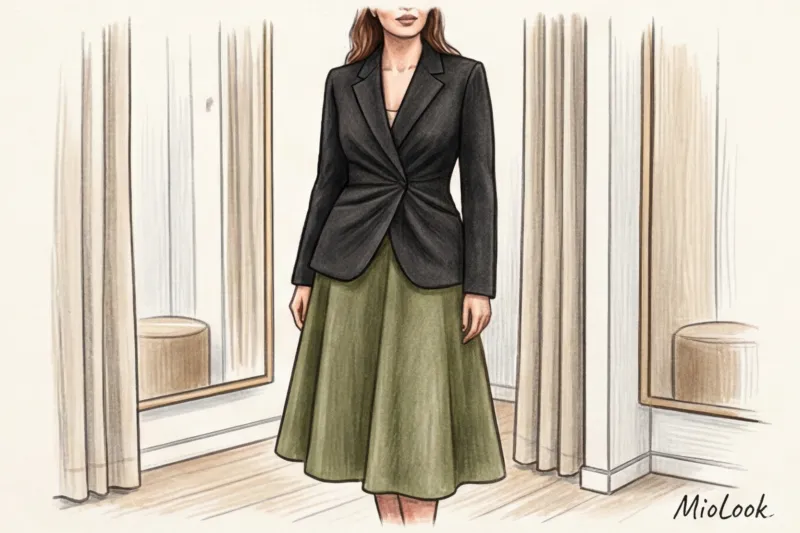
To completely distract from the bulky top, we shift the focus to the bottom: put on a simple dark jumper and add bright trousers (for example, a rich burgundy shade) or a pleated skirt. The dynamic folds of the pleated skirt automatically draw the eye to the legs. You can create several of these combinations and save them in your profile on MioLook — the app will help you visually assess how harmoniously the color spots are distributed in the image.
A completely different algorithm for working with voluminous hips (formerly "pear"). Here, we work in reverse: we draw the focus upward, creating a focal point for the portrait. Any details that draw attention to your face and shoulders are used: prominent brooches on the lapel, silk square scarves, statement earrings, light-colored tops with complex collars or accent buttons.
We keep the bottom as neutral as possible: it should be a smooth, dark bottom without any fraying, patch pockets, or embellishments. The fabric should be flowing but heavy, allowing it to fall under its own weight without clinging to every curve of the hip.
And the most important rule that is violated everywhere is jackets of the right length A study on proportion perception conducted by the Institute of Color and Style (2022) confirms a physiological fact: the horizontal hemline of a garment acts like a neon indicator. If your jacket, sweater, or cardigan ends exactly at the widest part of your hip, you're drawing a horizontal line there with your own hands, adding a couple of sizes. The jacket should be either short (ending at the hipbone) or long (completely covering the buttocks, extending into the narrower part of the leg, where the hip begins to taper).
Attention Management: Accessories as Visual Magnets
Have you ever noticed how our gaze automatically gravitates to the most striking or unusual detail in someone else's outfit? Neuroscientists call this salience—the property of an object to stand out from the rest. In the context of styling, we use this principle constantly. Accessories aren't just finishing touches or pretty additions. In fact, accessories are "buttons" that control the gaze of your conversation partner. Where you place them, that's where the world will look. And if our goal is to effectively visually correct our figure, we must use these magnets with complete conscious thought.
Let's say you're bothered by the volume in your lower body and want to shift the focus away from your hips. The worst thing you can do in this situation is wear a contrasting belt with a chunky buckle or bracelets that, when you hang your arms, sit right at the level of the problem area. The best solution is to draw the focus upward, to your midsection. Large, sculptural earrings (like trendy metal drop earrings or geometric rings from brands like COS or Jil Sander), a textured necklace, or a bright silk scarf will draw attention solely to your face. This works flawlessly: as long as your midsection is framed by expressive details, any nuances below the waist remain in an optical "blind spot."
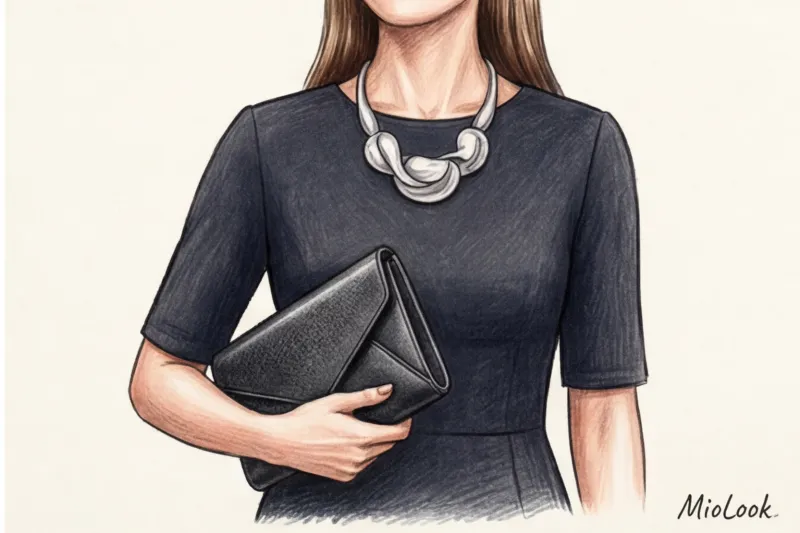
Now let's talk about bags. Many women wear their favorite practical crossbody bag for years, unaware that it's insidiously distorting their proportions. If the long strap is adjusted so that the bag hangs exactly at the widest part of the hips, it physically adds volume by adding a layer of material and drawing the eye. Remember the rule of horizontals? Here it works in 3D. Instead, try swapping your usual crossbody bag for an underarm bag—a so-called "baguette" (in the spirit of the legendary Prada Cleo). It not only removes excess volume from the hip line but also beautifully elongates the figure, creating a new, higher focal point.
And here I want to share a crucial professional life hack, rarely discussed outside of fashion academies. The scale of your accessories should strictly correspond to the scale of your facial features and bone structure. If you have a large frame, are tall, and have distinctive facial features, a tiny, thin chain with a tiny pendant will visually make you look larger—it will simply get lost against your background, highlighting the contrast. Meanwhile, chunky cuffs or statement rings (excellent basic options are now easily found in the €50–€150 price range) will create a harmonious balance.
To hone your skill of working with focal points, I always recommend analyzing your looks from a distance. By uploading photos of your everyday outfits to MioLook , you can put together a visual gallery and quickly understand where exactly the eye falls in the first second - and, if necessary, shift the focus with the right accessory.
Your ideal image begins Here
Join thousands of users who look flawless every day with MioLook.
Get access — €0.99 onceChecklist: 5 mistakes in visual body shaping that backfire
Spend a couple of hours sipping coffee on a bench at any major shopping mall and you'll accumulate a veritable encyclopedia of style faux pas. Before turning to me, the vast majority of women were unconsciously sabotaging their looks with the same techniques. They genuinely thought they were camouflaging problem areas, when in fact, they were only highlighting them. Even the most carefully considered figure-shaping scheme will fail if it's based on these five common misconceptions.
- The illusion of shrinking: buying clothes one size smaller.
Women tend to believe the magic of numbers on the tag. It seems that if you squeeze into a size S instead of your confident M, the tight fabric will act like a bandage and "pull" your silhouette together. In practice, physics can't be fooled: overstretched material creates horizontal creases, buttons on the chest come apart, and seams dig treacherously into the skin. The viewer's brain interprets this signal unambiguously: the garment is too small, meaning the person wearing it is larger than the garment itself. Air between the body and the fabric (at least a couple of centimeters) is the key to a slim figure.
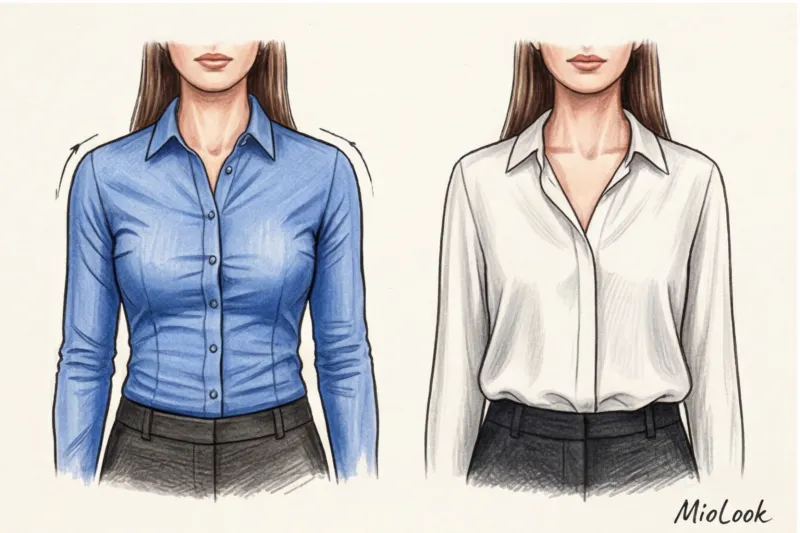
A mistake many people make is that tight clothing doesn't make you look slimmer, it just highlights the tightness of the fabric. - Tent effect: total oversize.
The second extreme is trying to hide every millimeter of the body under shapeless robes. Wanting to disguise a protruding belly or full hips, many wrap themselves in oversized sweatshirts and enormous, wide-legged pants. The problem is that total oversize clothing conceals not only flaws but also all the assets, turning a complex, beautiful female figure into a monolithic square. For a voluminous garment to work, it needs a point of support: exposed, slender wrists, ankles, or a defined waist.
- The caterpillar effect: poorly chosen underwear.
No blouse, even the most luxurious, will fit well on an improperly designed base. A bra band that's too tight creates prominent rolls on the back, even on the most slender women. And panties with stiff elastic bands that cut the buttocks in half create unnecessary folds that show through thin trousers. Smooth, properly fitted, seamless underwear is an invisible, yet absolutely essential, foundation for any look.
- Dangerous intersections: horizontal lines in wide areas.
We previously discussed the horizontal rule, but it's precisely this violation that most often disrupts proportions in practice. A classic example: boots that end exactly at mid-calf (at the widest part of the shin) visually make the leg look like a massive column. A jacket with a hem that cuts the silhouette exactly at the widest point of the hips has a similar effect. Always ensure that the hem of any garment falls only along the narrowest parts of the body.
- Posture killer: ignoring posture.
It's not exactly about cut or fabric, but it's a fundamental aspect of aesthetics. A hunched back automatically rolls the shoulders forward, lowers the bustline, and pushes out the stomach, visually adding non-existent volume. On a rounded back, even an impeccably tailored €500 wool jacket will puff up the shoulder blades and bulge unattractively in the front. Straightened shoulders instantly remove a few visual pounds without dieting or complex optical illusions.
To break these habits, stop relying entirely on your usual mirror at home—it often flatters or distorts proportions due to a specific angle and lighting. Start taking full-length photos of your outfits. Upload these photos to MioLook , you'll be able to put together a visual digital lookbook and impartially evaluate the silhouette from the outside: is the top too tight? Are the shoes cutting in the wrong place? A phone camera is always more honest, and it will reveal those nuances we often miss in the rush before going out.
Conclusion: visual correction is freedom, not boundaries
For decades, the fashion industry has cultivated an unspoken but highly toxic stereotype: if a garment fits poorly, there's something wrong with your figure. I want to put this issue to rest once and for all and shift the focus. The fundamental truth I teach all my clients is this: clothes should serve you, not you, who should try to fit them. The great Cristóbal Balenciaga, the unrivaled architect of the female silhouette, said, "A woman doesn't need to be perfect to wear my dresses. The dress will do it itself." If premium wool trousers costing €150 or even €300 gather in unsightly folds at the crotch, that's a problem solely with the brand's cut, not your body.
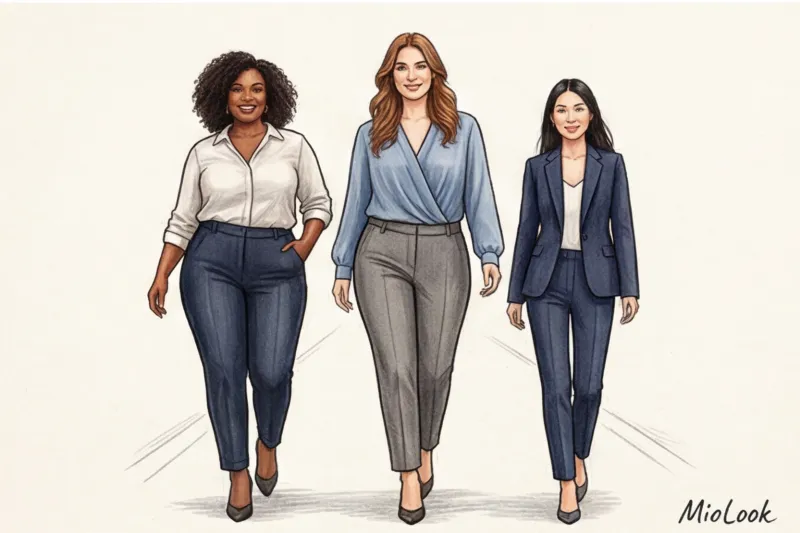
Often, the very concept of "correction" is perceived as an attempt to deceive others, to disguise one's true self, or to hide behind meters of fabric. But reality works differently. Using illusions is a tool for boosting self-confidence. It's not a disguise, but a clever visual PR of your appearance. When you know for sure that a V-neck reveals the graceful line of your collarbone, and a monochrome diagonal color scheme elongates your height, you stop nervously tugging at the hem of your sweater or slouching. You walk into a room and project absolute calm, because you have complete control over how you are perceived.
According to research in fashion psychology (specifically, Professor Karen Pine's 2014 book "Mind What You Wear"), what we wear directly impacts our cognitive abilities and social courage. When a garment cuts off our figure horizontally in the wrong place, our brain expends a colossal amount of energy on background anxiety. A well-designed silhouette frees up this energy for life, work, and social interaction.
"Clothes are just fabric until you breathe life into them. But the cut can determine whether you breathe deeply or hide in the shadows."
To make sure all the theory we've learned doesn't just remain text, I have a practical exercise for you. Set aside an hour this weekend—that's my top recommendation: experiment with the rule of thirds and verticals in front of a mirror. Pull out your favorite basics from your closet and create three test outfits. First, intentionally disrupt the proportions: wear a long, contrasting sweater untucked with jeans, creating a 50/50 ratio. You'll see how your legs appear a few centimeters shorter. Then, simply tuck in the hem of the same sweater (using the French tuck technique), creating a perfect 1/3 to 2/3 ratio. Notice how the dynamic of your silhouette instantly changes.
Be sure to take full-length photos of every step you take. The human eye often gets blurry in a mirror, focusing on imperfections, while a smartphone camera lens captures the true geometry of forms. By uploading these experimental shots to MioLook app , you can put together a visual digital lookbook and assess yourself impartially, like a true stylist. A digital wardrobe allows you to practice your eye every day, creating the perfect outfits right on your phone screen.
Your personal style is your own personal space of freedom. The laws of color, knowledge of textures, print scale, and cut geometry aren't rigid rules you have to force yourself to adhere to. They're your brushes and paints. Choose the tools that resonate with you, break the rules when you feel like it, but do so mindfully. You're already beautiful. And a well-chosen wardrobe will only help you convey that beauty to the world without further ado.
Guide Chapters
Style Secrets: What Shoes to Wear with Full Calves
How can the right pair of shoes visually reduce your calves by two sizes? We explore the secrets of an architectural approach to style.
How to visually lengthen your neck: necklines and accessories
"Computer posture" can take away neck length, but the right clothing can restore ideal proportions. We explore the architecture of cuts and the influence of accessories.
How to visually enlarge your breasts with clothing
Forget uncomfortable push-up bras and stiff foam. We explore tailoring tricks and the principles of optics that create the illusion of volume with the right clothing.
Figure-shaping prints: how to wear geometric prints
Vertical stripes aren't always slimming. We explore how geometric patterns work on fabric and learn how to manipulate your silhouette with prints.
How to visually reduce breast size: choosing the right top
Forget shapeless, oversized pieces. We'll explore real styling techniques and cutting architecture that will help you gracefully adjust your volume.
How to visually narrow your waist: clothing illusions
Forget uncomfortable corsets and tight belts. We reveal stylist secrets that will help you create the perfect silhouette using simple optical illusions.
Clothes for short girls: how to visually add height
Why don't standard brand patterns fit heights under 160 cm? Learn how to visually elongate your silhouette using simple optical illusions.
How to visually reduce shoulders: choosing the right top
We'll explore common clothing mistakes for the Inverted Triangle body type. Learn how to use lines and tailoring to turn broad shoulders into your silhouette's most striking feature.
Color blocking in plus-size clothing: body shaping
Forget black robes! Discover how color architecture can visually redefine your silhouette and accentuate your proportions.
How to Hide Full Arms: The Right Sleeves and Tops
Hiding bulky shoulders under dark cardigans is a common mistake in summer. We'll show you how to use the right cut to look graceful and effortless.
How to Hide Wide Hips: Clothes for a Pear-Shaped Body
We'll explore common mistakes women with pear-shaped figures make. Learn how to stop hiding behind shapeless clothes and achieve a harmonious silhouette.
How to choose clothes according to your figure: a neural network stylist
Say goodbye to unsuccessful online orders. Learn how AI algorithms help you find the perfect style for your body type without time-consuming fittings.
How to visually lengthen your legs: stylist secrets
Forget about uncomfortable stilettos! Learn how to use geometry and proper clothing proportions to make your legs appear infinitely longer.
How to Hide Your Belly with Clothing: Stylist Tips and Tricks
Forget shapeless robes! Discover stylist secrets for choosing styles and fabrics that will visually shape your figure and conceal your belly.
Slimming Clothes: 10 Rules for Visually Losing Weight
Forget shapeless black robes. Discover 10 optical illusions in styling that will help you visually drop a few sizes.