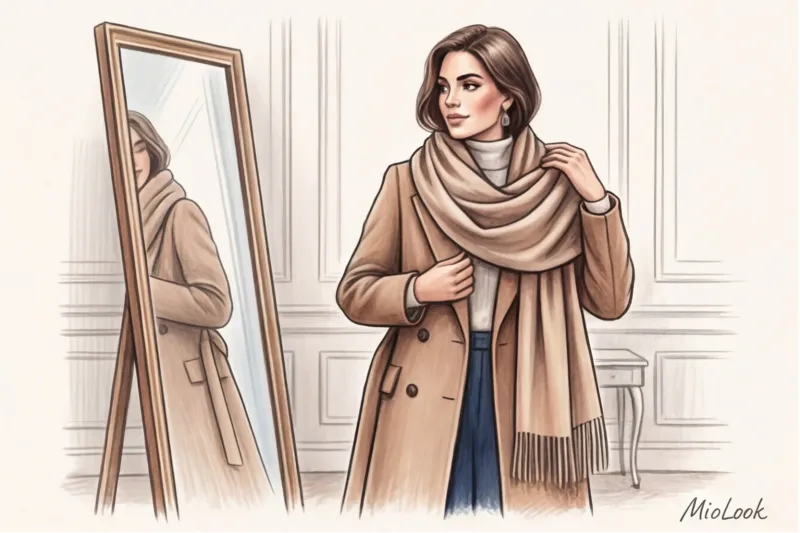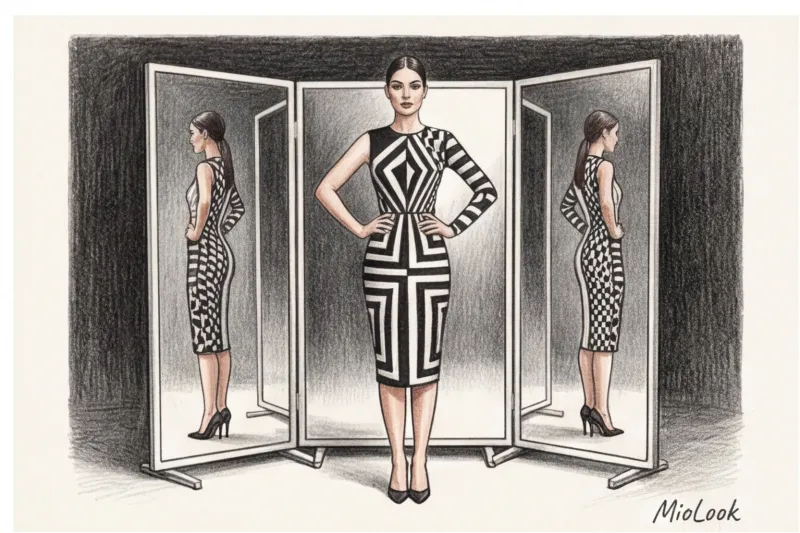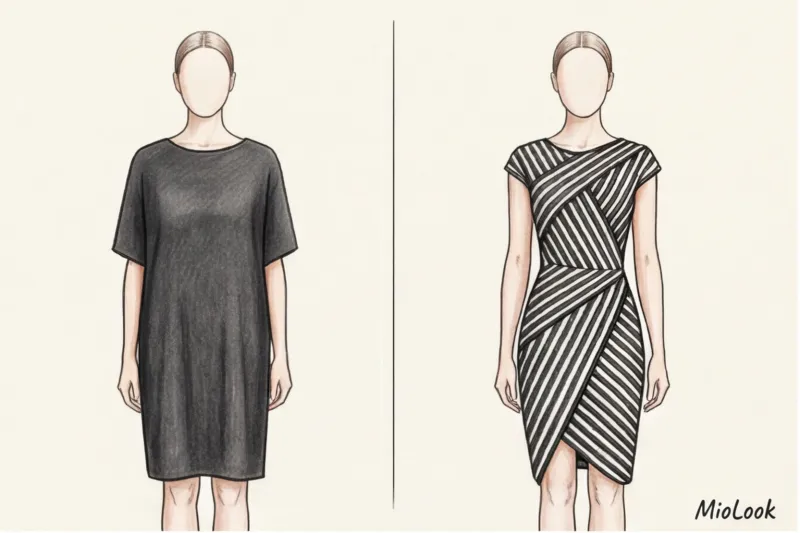
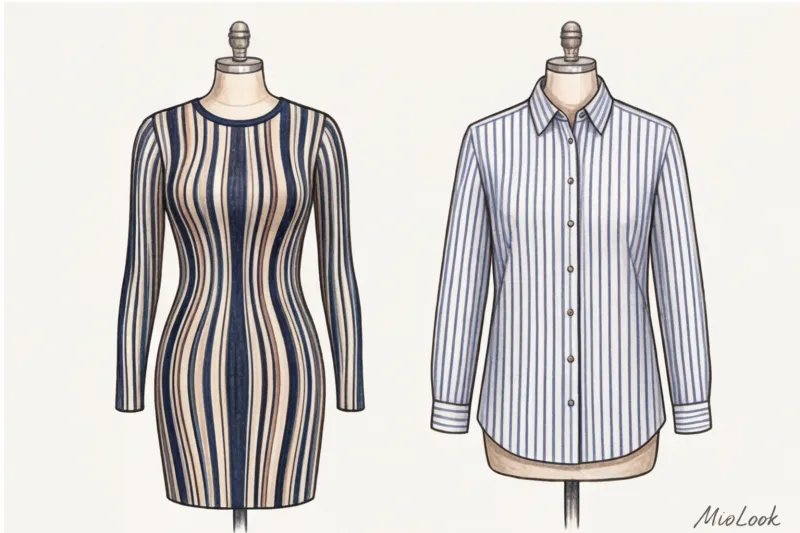
Three years ago, a client, a top manager at an IT company, came to me for a consultation with the following question: "Julia, I bought an expensive vertical striped dress to look slimmer, but it makes me look two sizes too big." We opened the cover, and I saw a luxurious yet form-fitting knit dress from a well-known brand. The problem wasn't my client's figure or even the width of the stripes. The problem was the laws of physics.
Flowing around the body's natural curves—the chest, stomach, and hips—straight lines on the soft fabric inevitably curve. They begin to act like a 3D topographic map of the relief, treacherously emphasizing and visually enlarging every millimeter of volume. Instead of elongating the silhouette, the effect is like a magnifying glass.
We discussed the basic architecture of the silhouette in more detail in our A complete guide to visual body shaping: concealing flaws But today I want to explore the most complex and interesting topic: figure-shaping prints. We'll look at geometry not through the prism of outdated glossy magazine advice, but through the eyes of premium tailors and the laws of optical illusion.
Optical illusions and body-shaping prints: how they actually work
Clothes are the architecture of your body, and prints are the guiding vectors along which the other person's gaze glides. The main mistake I see in 90% of cases when sorting through wardrobes is that women choose a pattern, completely ignoring the texture and density of the fabric.
Any geometric pattern requires a rigid frame. If you use cotton with a weight of less than 180 g/m² or thin viscose, the pattern will "flow." For figure-shaping prints to truly elongate and sculpt your silhouette, the fabric must hold its shape regardless of your movements.
The Helmholtz Effect and Debunking the Vertical Stripe Myth
Did you know that the rule "vertical lines make you look slimmer, horizontal lines make you look fatter" was scientifically disproved back in the 19th century? In 1867, German physicist Hermann von Helmholtz proved that a square filled with horizontal lines appears narrower and taller to the human eye than a square with vertical lines.
How to apply this in your wardrobe? A classic Breton striped shirt with an unbuttoned structured jacket Creates the perfect illusion of slimness. The horizontal lines create a rhythm, and the straight edges of the jacket cut off excess at the sides.
Access to MioLook for €0.99 — one-time payment
A smart AI stylist will select the perfect look based on your proportions.
Get access — €0.99 once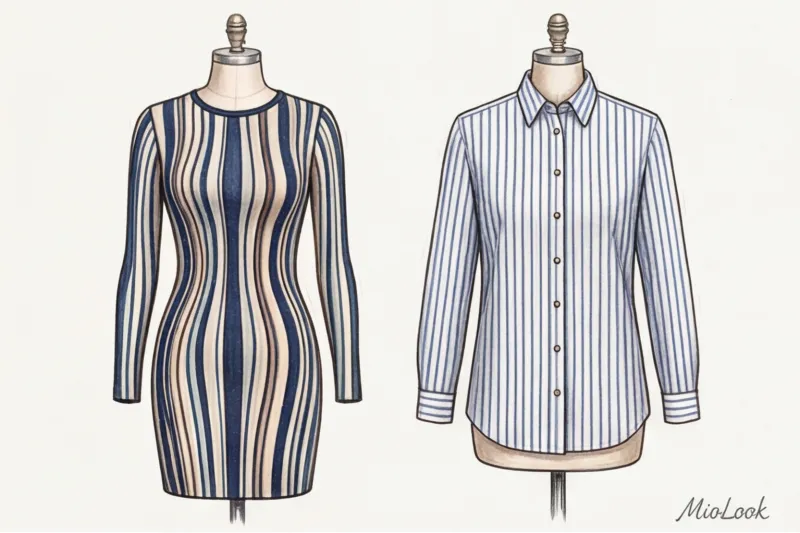
Line architecture: how figure-shaping prints create premium stretch
Over 12 years of working with Italian artisans, I've learned one ironclad rule: a garment's status is determined not by its logo, but by the technology used to create the design. There's a huge difference between a cheap print simply slapped on top of a smooth fabric and a pattern where colored threads are woven into the very structure of the material.
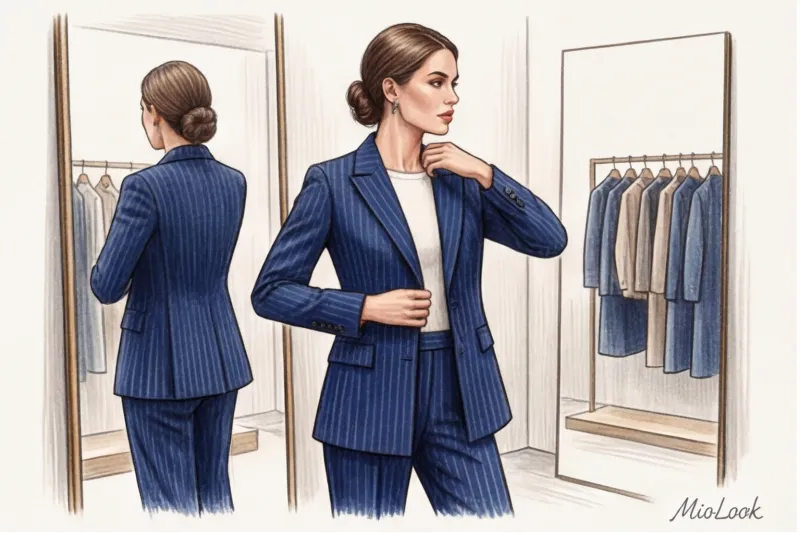
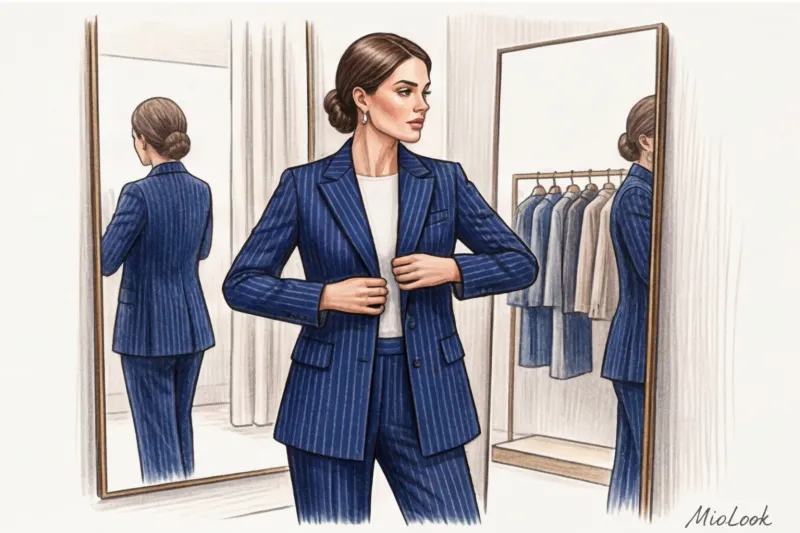
A fine pinstripe on dense suiting wool (from 280 g/m²) is the gold standard of tailoring. These threads create a delicate, continuous vertical line that resists deformation. In a high-quality suit, which can cost between €500 and €1,500, these lines create a rigid frame. They gather the figure, making the posture appear more upright.
Diagonals and Chevrons: The Secret Weapon of Visual Correction
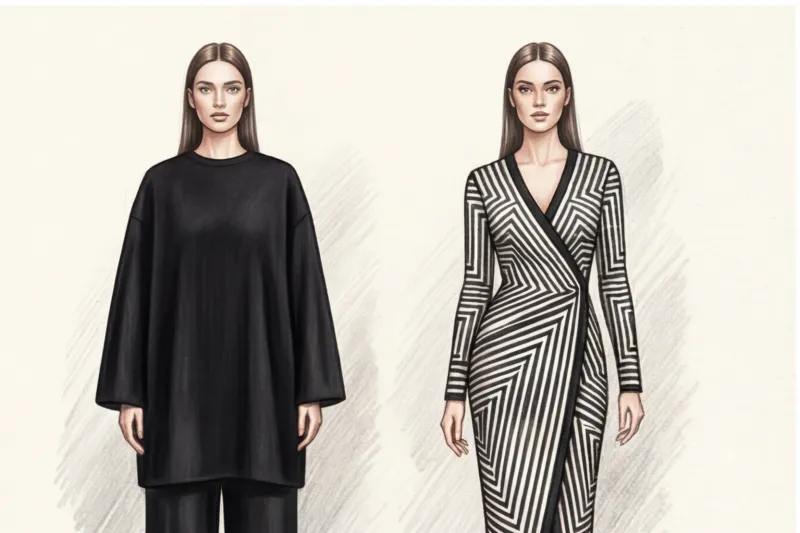
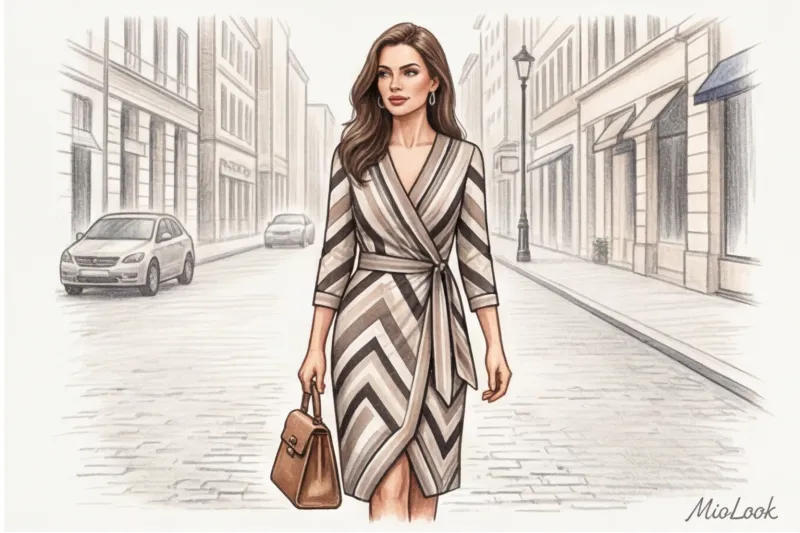
Straight lines are predictable. But if you want true magic, choose diagonals. The V-shaped lines and zigzags that have become the hallmark of the iconic house of Missoni are the most powerful tools in a stylist's arsenal.
Why does this work? Visual perception studies show that the human eye lingers 40% longer on the intersections of diagonal lines than on straight lines. Chevrons detract from the actual boundaries of your body. The viewer simply can't discern where exactly your hip ends or your waist begins—they see only the dynamic up-and-down movement of the lines.
"Diagonal cuts and slanted lines always create a slimming effect because they allow the eye to wander endlessly, without being caught by the horizontal boundaries of the silhouette."
Scale Matters: How to Choose the Right Print Size for Your Body Type
Petite women, 158 cm tall, often fall in love with a giant architectural check on a coat, while those with a curvy size 50 try to "hide" behind a tiny chintz flower. Both are fatal flaws in proportion.
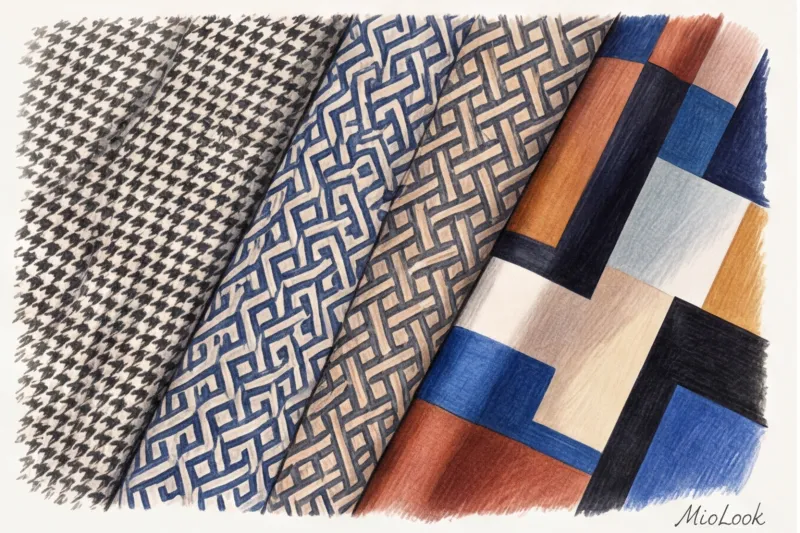
The rule of proportionality states that figure-shaping prints should make up no more than 1/3 of the total area of the visual volume of the item.
- For miniatures (up to 160 cm): Choose small and medium-sized geometric patterns. Large blocks of color will simply crush you, visually making you appear shorter.
- For plus-size figures: A small print (2mm polka dots or tiny checks) on a three-dimensional figure creates an "infinite field" effect. The eye can't grasp the details, and the dimensions seem immense. Medium and large scales are your options.
Stylists have an old but effective trick: the ideal size of a pattern's rapport (the repeating element of a pattern) is roughly equal to the size of your clenched fist. If you're unsure about your choice, upload a selfie from the fitting room to MioLook — algorithms will tell you whether the scale of the geometry conflicts with your natural characteristics.
But here I must make a fair digression: this is a rule doesn't work If you have very contrasting, large facial features, even if you're petite, you can pull off a bold, dramatic geometric shape.
Your perfect look starts here
Join thousands of users who look flawless every day with an AI stylist.
Get access — €0.99 onceColor and Contrast: When Geometry Becomes Dangerous
Not all geometry is safe. According to the Pantone Color Institute (2025), 60% of the perception of form depends on the contrast of shades, not just the lines themselves.
A black and white optical illusion attracts maximum attention. If you have wide hips that you want to minimize, wearing a contrasting black and white zebra-print skirt is the worst idea. You'll literally be shining a spotlight on that area.
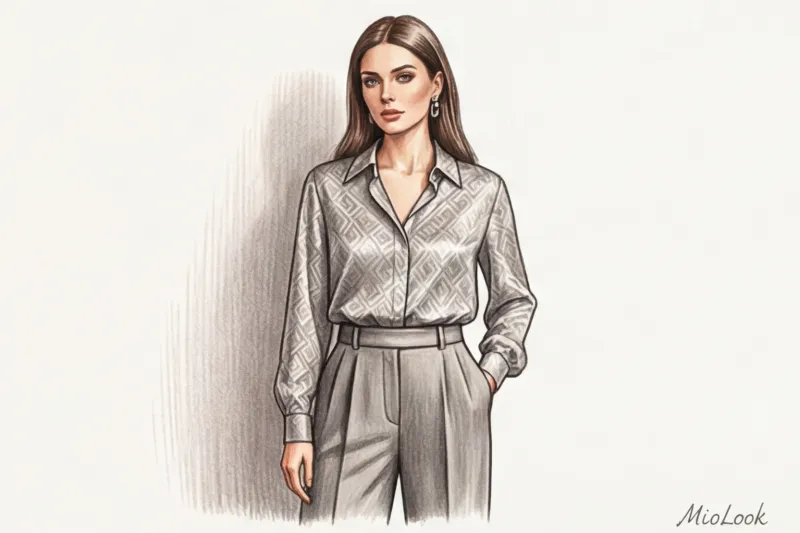
Secret a status wardrobe in the Old Money aesthetic — This is low-contrast geometry. Note the tone-on-tone patterns: beige checkered on a sand background, matte jacquard on shiny ecru silk. These figure-shaping prints work with extreme subtlety. They create a vertical line through the play of light and shadow on the texture, rather than through garish color.
A stylist's checklist: how to choose figure-flattering prints without making mistakes
When my clients go shopping on their own, I give them a strict checklist. Geometry doesn't forgive shoddy tailoring. Here's what to check in the fitting room:
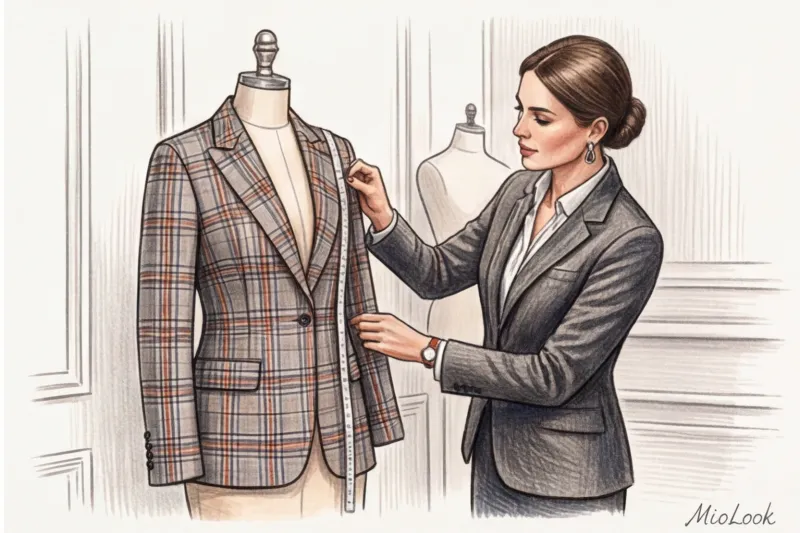
- Distortion test. Put the item on. Now sit on the ottoman, bend over to pick up your bag, and cross your arms. Are the lines slanted and looking like distorted mirrors? Leave the item in the store. The fabric isn't thick enough for your figure.
- The Match Test. This is the main indicator of how much an item costs. Look at the side seam of a jacket or trousers. Mass-market brands priced at €40–€60 have checkered lines that are chaotic—the manufacturer was saving fabric. In premium tailoring, the tailor spends 30% more material to ensure the horizontal lines of the pattern flow perfectly from the front to the back. This misalignment ruins the silhouette.
- The rule of a single vertical. The safest way to wear geometric patterns is to create a monochrome frame around them. For example, a blouse with a bold print + solid-color trousers in a matching color scheme + an open, long vest.
Investing in Geometry: 4 Patterns That Always Work
If you're looking to invest in pieces that will last 5-10 years without going out of style and will flatter your figure, check out this list. According to Lyst's 2024 report, these classic patterns remain among the top 10 most sought-after prints year after year.
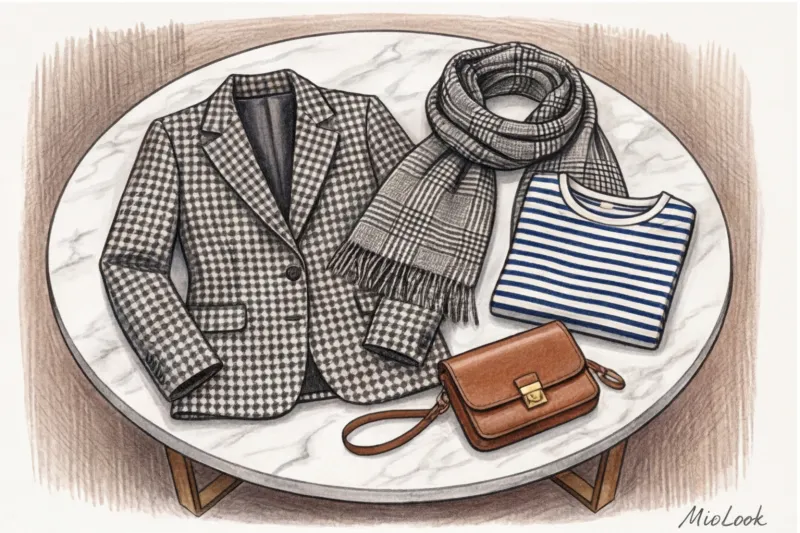
- Classic Houndstooth. Opt for a mid-tone combination of beige and chocolate (instead of stark black and white). It works great on heavy tweed jackets.
- Prince of Wales cage (Glen plaid). An ideal choice for a business suit, the fine interwoven thread creates a complex yet subdued pattern that visually flatters the figure and looks exceptionally expensive.
- Chevron on thick knitwear. A lifesaver for your fall/winter wardrobe. Unlike straight stripes, diagonal zigzags on chunky knit sweaters don't add bulk to your waist.
- Chalk stripe (Pinstripe). Invest in palazzo pants or a men's-style jacket made from quality wool with a subtle, subtle stripe.
In conclusion, I'd like to share the most important advice I repeat to every client. When choosing figure-shaping prints, consider the texture of the fabric first, and only then the design itself. Even the most brilliant geometric design printed on flimsy material will ruin your overall design. Invest in density, pay attention to scale, and let the lines work for you, not against you.