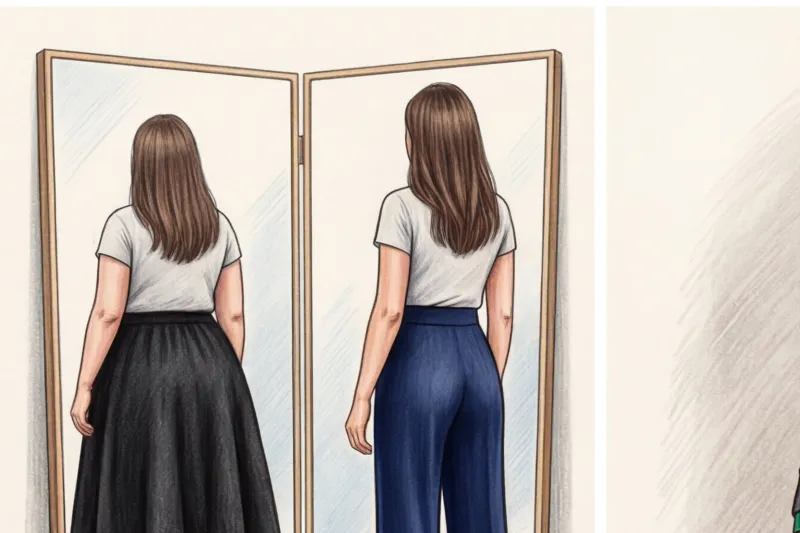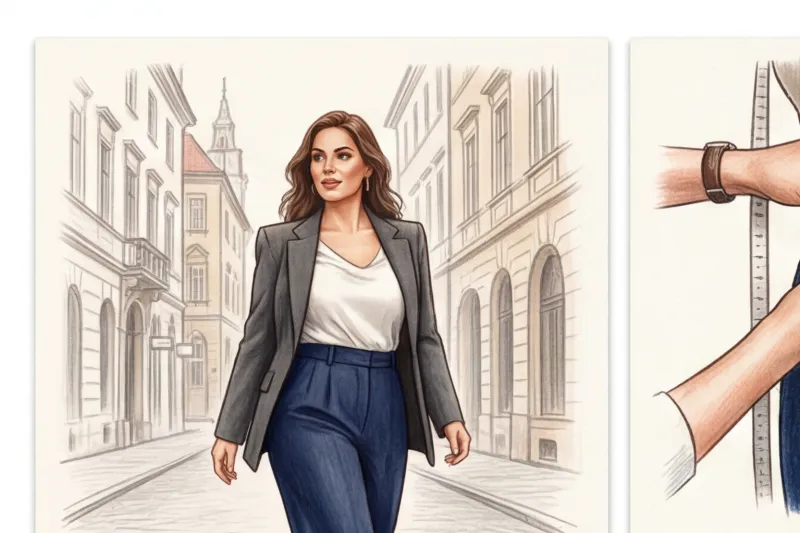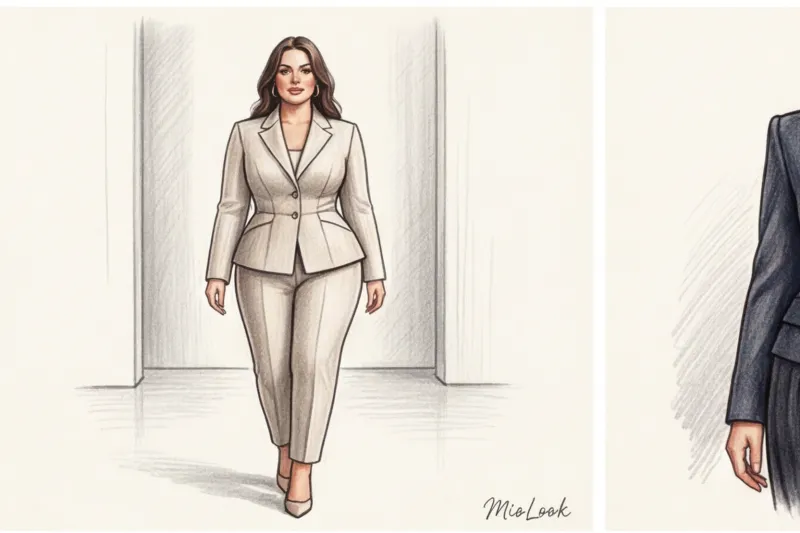
When I downloaded statistics from 500 of our users' digital wardrobes in the MioLook app, the numbers confirmed my long-held suspicion. Women trying to figure out how to hide wide hips buy black pants a size too big in 80% of cases, completely ignoring the waist. As a result, rather than disguising their hips, they voluntarily go up a few sizes.
We have already discussed the basic principles of working with proportions in more detail in our A complete guide to visual body shaping: concealing flaws But today I want to talk about the pear-shaped figure from a completely different perspective. We'll stop hiding and start building a well-designed silhouette.
How to Hide Wide Hips: Why Old Tips No Longer Work
The destructive psychology of "camouflage" is the main enemy of modern style. The desire to conceal the lower body forces women to choose clothing that physically takes up more space.
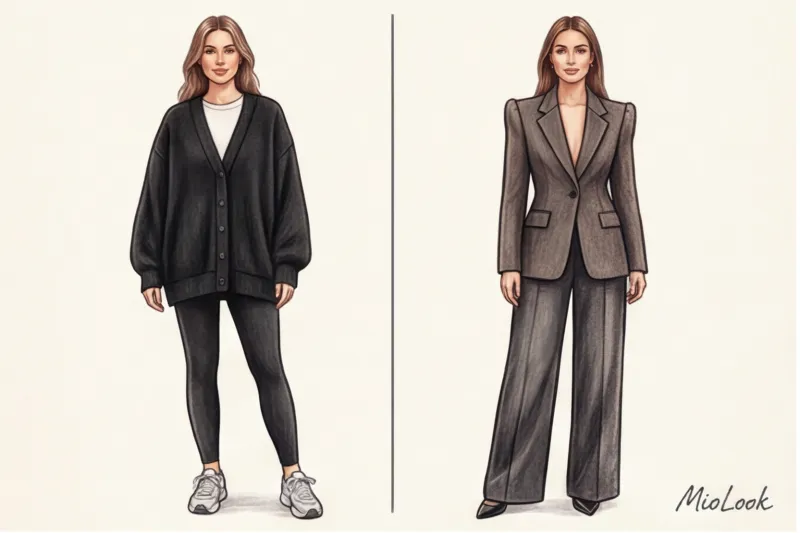
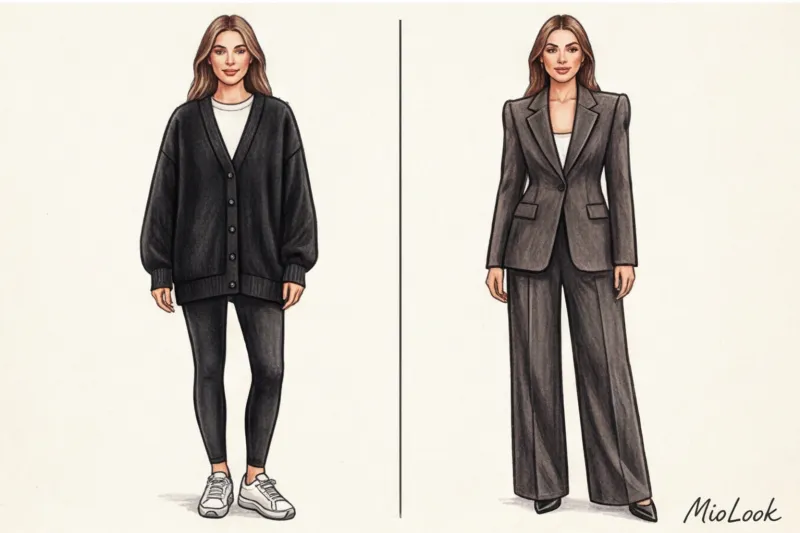
One of my clients, Anna, spent years swaddling in expensive cashmere cocoon cardigans (in the €200-€300 price range), sincerely believing they concealed her size 14 hips and 11-12 waist. In reality, these shapeless cardigans obliterated her graceful waist, transforming her figure into a heavy monolith. Once we swapped the soft knit for a structured jacket with defined shoulders, Anna visually lost 15 pounds in a single minute.
Let's honestly debunk the main myth: "Black bottoms always make you look slimmer" This is the most dangerous misconception for a pear-shaped figure.
"According to research by the Pantone Color Institute (2023), matte dark shades absorb light the most. If you wear black skinny jeans or leggings, they don't reduce volume but create a sharp, high-contrast outline of your figure against the surrounding environment."
Black skinny pants accentuate every curve and emphasize the difference between wide hips and narrow ankles. A modern approach requires focusing attention: instead of trying to squeeze ourselves into a dark sling, we choose the right fabric texture that holds its shape.
Pear-Shaped Body Anatomy: Your Strengths
Your body type isn't a diagnosis or a list of limitations. It's simply the starting point for your personal architectural design. Those with a lower body type have some amazing advantages:
- Graceful collarbones and fragile shoulders;
- A thin waist that rarely becomes slender even when gaining weight;
- Feminine curve of the hip.
Our goal isn't to eliminate this curve, but to "highlight" the top so that the look looks harmonious. When building a wardrobe in the app, I always recommend that clients shift focal points upward.
Digitize your wardrobe
Upload your items to MioLook and let the smart algorithm create the perfect proportions for your figure.
Get access — €0.99 onceSilhouette Architecture: Key Rules for Visual Correction
Over 12 years of working as a stylist, I've learned that fashion is subjective, but geometry is not. To balance wide hips, we need to apply a few ironclad rules of optical illusion.
The rule of balance. We physically broaden the shoulder girdle. The return of shoulder pads is the best gift for the pear-shaped figure. Use boat necklines, puff sleeves, and structured jacket shoulders. This creates an inverted triangle in the upper body, visually balancing the lower body.
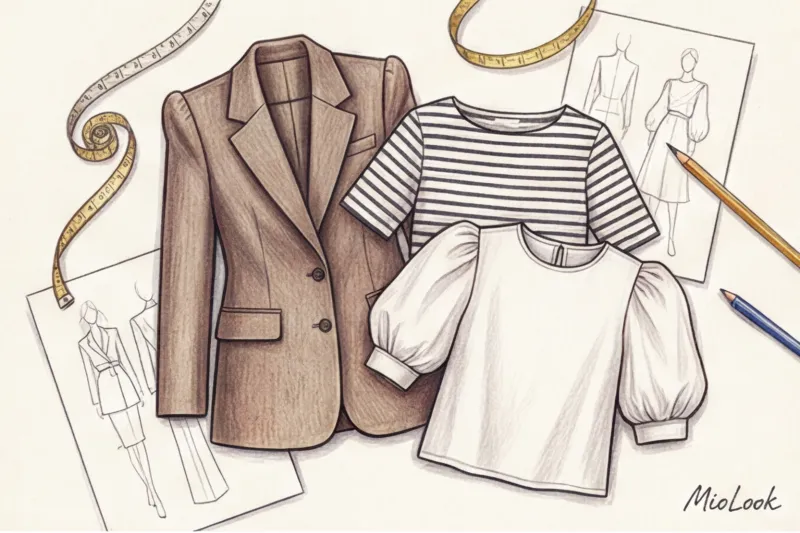
The Golden Ratio rule in clothing. The length of the top is everything. Research by the British Institute of Design (2022) confirms that a horizontal line across the widest part of the body visually increases it by 15-20%. Your top, sweater, or jacket should end either higher the widest part of the hips (at the waist or just below), or significantly lower (a long blazer that covers the groin area).
Multi-layered and vertical. An unbuttoned jacket, cardigan, or heavy shirt worn over a basic top creates two sharp vertical lines. They literally "cut off" the side volume, forcing the eye to read only the narrow inner stripe.
The Perfect Trousers and Jeans: From Skinny to the Perfect Palazzo
The biggest mistake I see on the streets every day is thin knitwear and denim with too much elastane (more than 3-5%). These fabrics cling treacherously to the hips, bunching up into folds.
You need sculpting fabrics: dense 100% cotton or suiting fabric with a weight of at least 300 g/m². Yes, these trousers (usually in the €80 to €150 range) may feel stiff when first tried on, but they physically "sculpt" the figure, reducing volume by up to one and a half sizes.
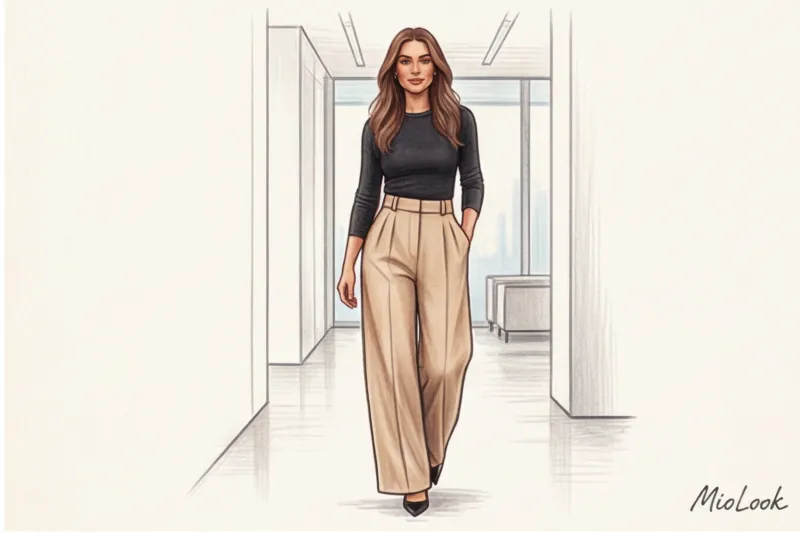
Jeans for a pear-shaped body require special care. The popular mom jeans style often lets you down: tapered at the ankle, they make your legs look like radishes, accentuating the width of your pelvis. Your best bet is a straight-leg or wide-leg style. They create a straight line from the hip's fullest point to the floor.
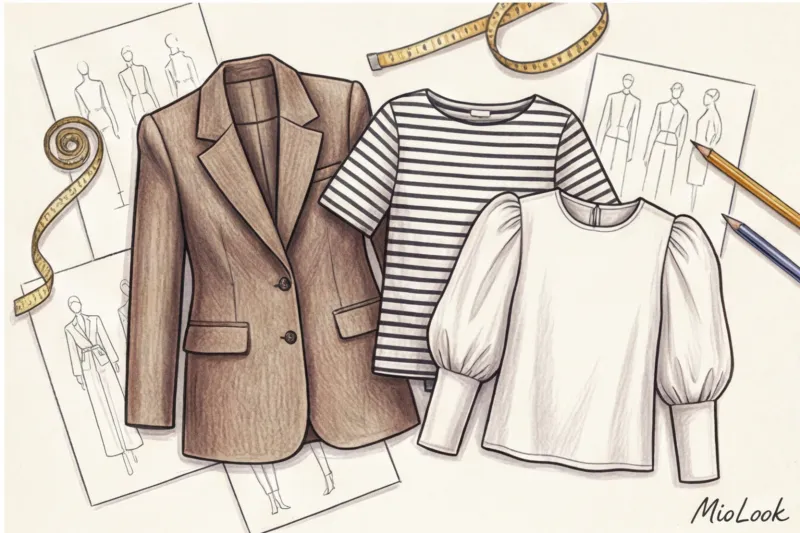
A disclaimer from practice: The high-rise rule, which I always recommend for emphasizing a narrow waist, does NOT work if you have a very short torso (the distance from your lowest rib to your hipbone is minimal). In this rare case, a high waist will "eat" your bust—choose a mid-rise rise.
Skirts and dresses that balance proportions
Skirts can become your favorite wardrobe item if you understand the technical nuances of cutting that are often overlooked by the mass market.
The ideal option is an A-line silhouette and a midi-length circle skirt. But fabric is key! Thin cupro or lightweight chintz will fluff up and make you look bulkier. Look for heavy, flowing materials: dense viscose, heavy silk, or suiting wool.
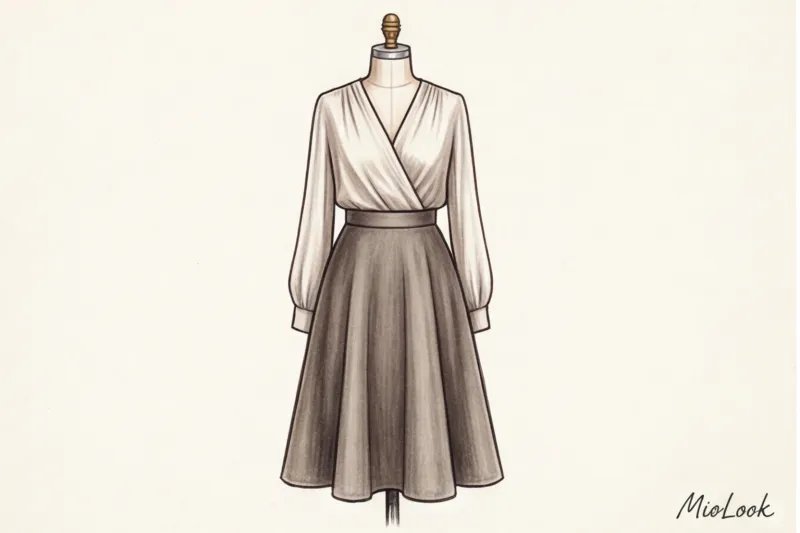
Can you wear a pencil skirt? Absolutely. But forget about thin knits. It should be an architectural piece made of thick cotton or leather, and cut just below the knee. Ending at the narrowest part of the leg (below the knee or at the ankle), such a skirt emphasizes a slim figure.
What to avoid: pleated skirts with small pleats starting right at the waist. These pleats will stretch out at the hips, creating an accordion-like shape, adding 5-7 centimeters to your appearance. If you really want pleats, look for styles with with folds stitched at the top (when the skirt is smooth up to the hip line, and the pleating starts below).
Not sure if this style is right for you?
Take a photo of the item in the fitting room, add it to MioLook and see how it matches with your base.
Try AI StylistOuterwear: Dangerous Lengths and Life-Saving Styles
In fall and winter, all your work on proportions can be ruined by one wrong jacket. Remember the rule of horizontal lines: any horizontal line draws attention to the area it intersects.
A critical mistake is jackets, bombers, and down jackets with elastic waistbands that end right at the hip line. The elastic constricts the hem of the jacket, creating a "bubble" effect right above your fullest part.
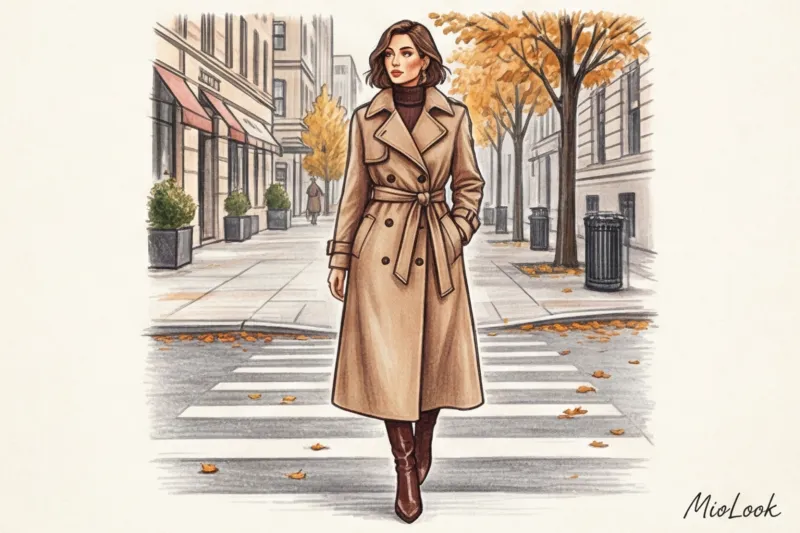
Your ideal choice:
- Classic double-breasted trench coats with a belt (emphasis on the waist + broadening of the shoulders due to lapels and epaulettes).
- Midi length robe coats (to mid-calf).
- Cropped aviator jackets that end strictly at the waist, leaving the hips free.
Knee-length coats are outdated and cut off the leg in the wrong place. Midi lengths elongate the height and create a more statuesque and slender silhouette.
Ready-made formulas for everyday looks for wide hips
Theory is great, but let's move on to practice. Here are three ready-made recipes that users often save in the MioLook app:
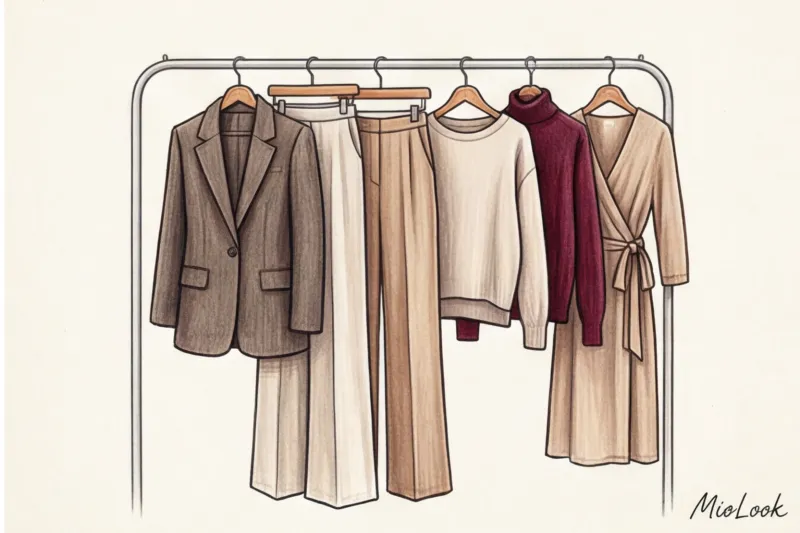
- Office with a relaxed dress code: A structured menswear-inspired blazer with shoulder pads + a basic white T-shirt (tucked in) + straight-leg, full-length trousers with a crease in a thick fabric + chunky-soled loafers. The crease on the trousers acts as an additional vertical line.
- Comfortable Casual: A chunky, textured knit sweater with a V-neck (exposing the collarbone) + wide-leg, stiff denim jeans + pointed-toe ankle boots that match the jeans. The boots match the bottoms, adding a few centimeters of leg length.
- Evening outing: A top with an asymmetrical one-shoulder neckline (draws attention away from the bottom and draws it to the face and shoulders) + an A-line midi skirt made of thick satin + large statement earrings.
Checklist: A Wardrobe Revision for a Pear-Shaped Body
It's time to take an honest inventory of your shelves. Feel free to recycle or donate items that are working against you:
- Thin ribbed leggings (they are made for sports, not for stylish urban looks);
- Knitted "waterfall" cardigans without buttons;
- Tulip skirts (the worst style for wide hips);
- Jeans with active abrasions (light spots) specifically in the hip area - this technique artificially creates 3D volume.
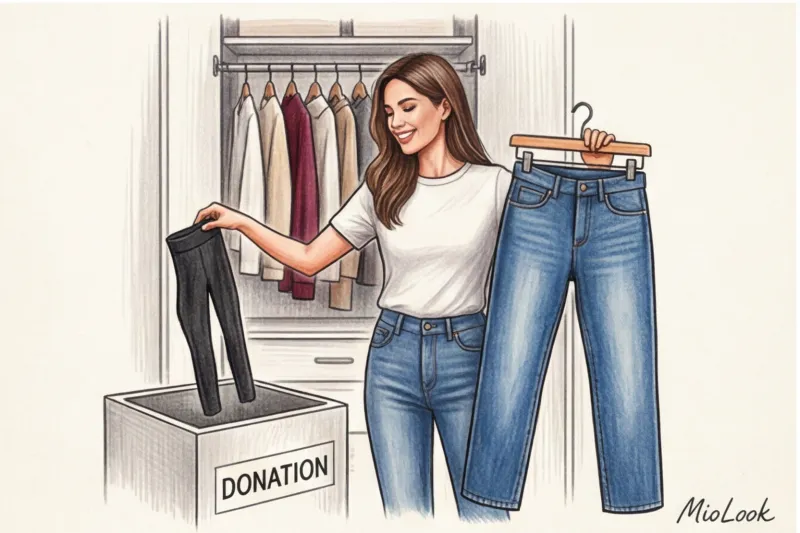
Instead, invest in the right basics: one perfect structured jacket (from €100) will do you more good than five shapeless tops.
To digitize this process, get into the habit of calculating the ratio of your clothes. A pear-shaped figure should have one "bottom" (pants/skirt) to 3-4 accent "tops" (tops, blouses, jackets). This distribution ensures that every day you focus on your best features—your face, your delicate shoulders, and your slender waist. Stop hiding in black and start managing your proportions like a true architect.