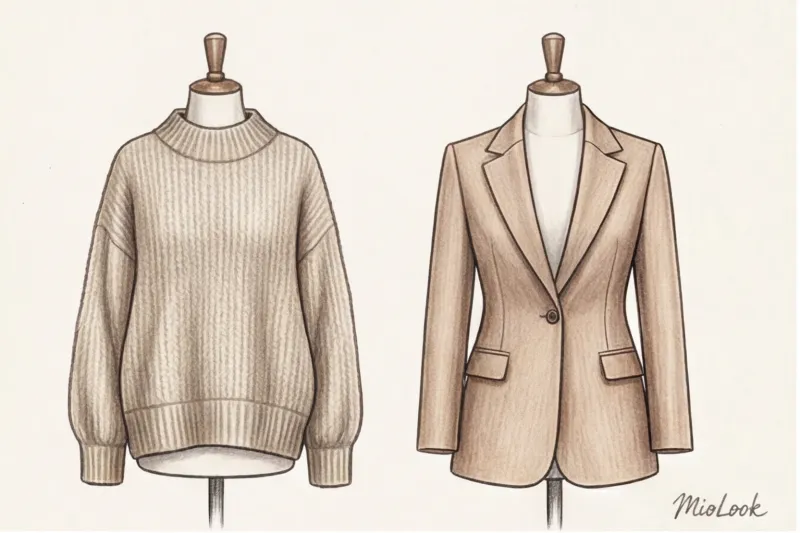
"Sofia, I just want to hide. Let's buy me a hoodie two sizes bigger." That was the phrase I used to begin my wardrobe review with a client, a luxurious size 75F. For years, she'd been buying thick knitwear and men's sweatshirts, hoping to become less noticeable. Instead, she'd been turning her figure into a solid rectangular monolith, visually adding at least two sizes. It's a classic trap: trying to hide our curves, we often choose items that dramatically increase them.
The question is, How to visually reduce breast size , every second client with a size D and above asks me. We discussed the basic principles of working with proportions in more detail in our a complete guide to visually correcting your figure and concealing imperfections Today, however, I want to dig deeper. Forget the clichéd advice from the 2000s like "just wear black." We'll be talking about the architecture of cuts, textile physics, and optical illusions that truly change the perception of a silhouette.
Architecture instead of camouflage: the main mistake of a large bust
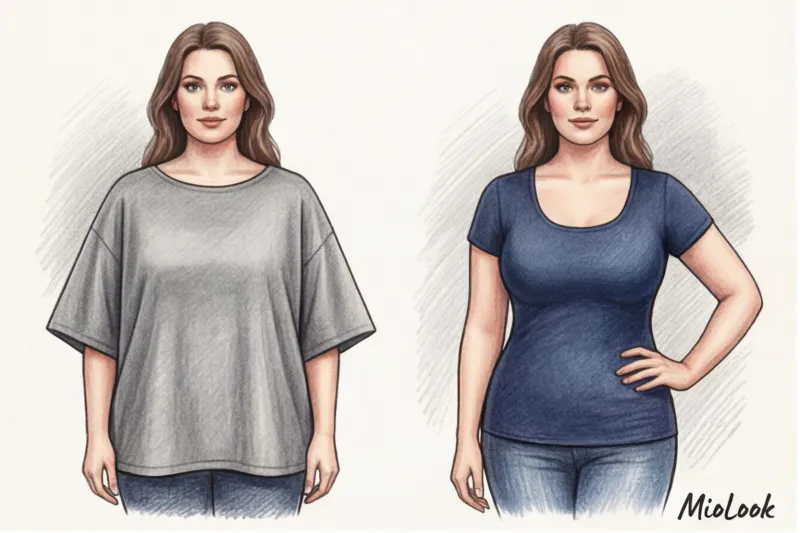
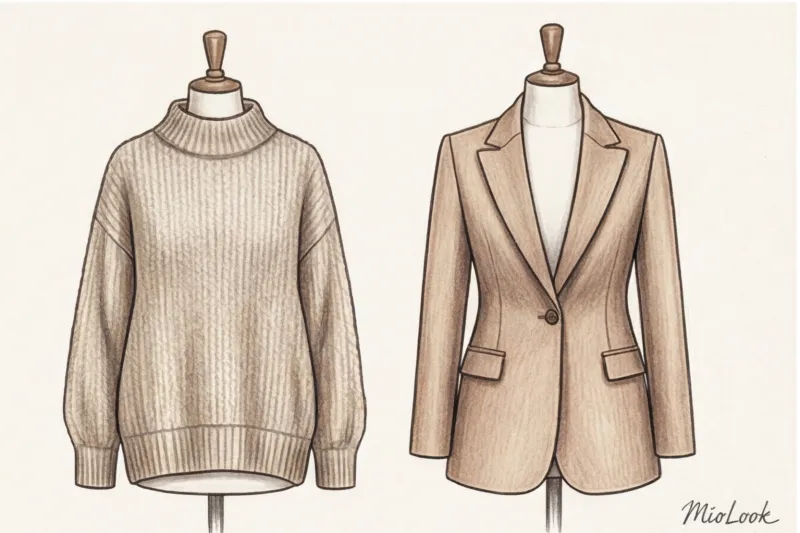
There's a ruthless law in styling that I call the "plumb line effect." If you put on a bulky, chunky-knit sweater or a trendy cocoon cardigan (even if it's luxurious cashmere for €200), the fabric falls straight down from the fullest point of your chest. What happens? All the empty space below your bust, all the way down to your stomach, is filled with fabric. Your torso becomes equal to the width of your chest. You lose your waist, your posture, and your sense of lightness.
That's why oversized clothing is your worst enemy if your goal is to visually reduce your bust. Clothing design operates on the principle of the Müller-Lyer optical illusion: lines bounded by diverging angles appear longer and wider. Shapeless clothing creates precisely this out-of-focus effect.
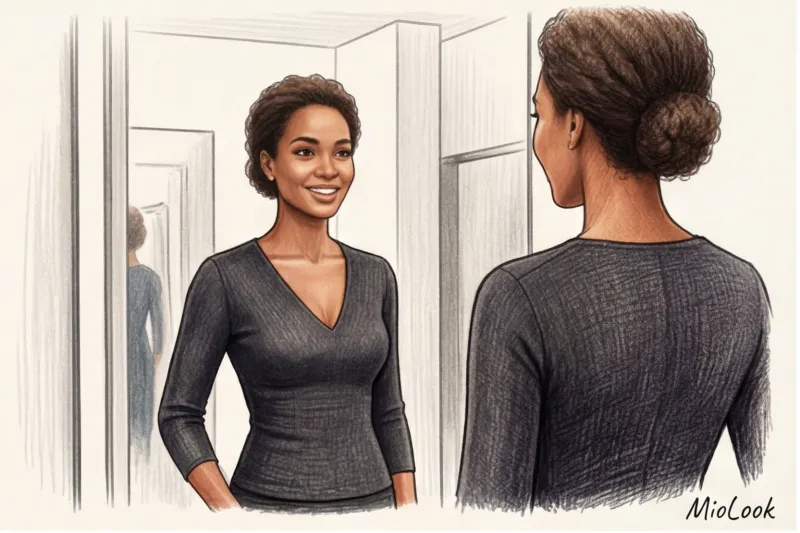
Your best friend is a silhouette with a semi-fitted silhouette. Clothing should contour to the body, leaving just enough air between the fabric and the skin (about 1.5–2 cm of ease) to maintain movement without losing shape. With that same client, we swapped the hoodie for a flowing viscose blouse and a structured jacket from COS. The difference in the mirror brought tears to her eyes—she saw her waist for the first time in ten years.
Access to MioLook for €0.99 — one-time payment
A smart AI stylist will select the perfect look based on your proportions and body structure.
Get access — €0.99 onceHow to visually reduce breast size: the role of fabric texture and density
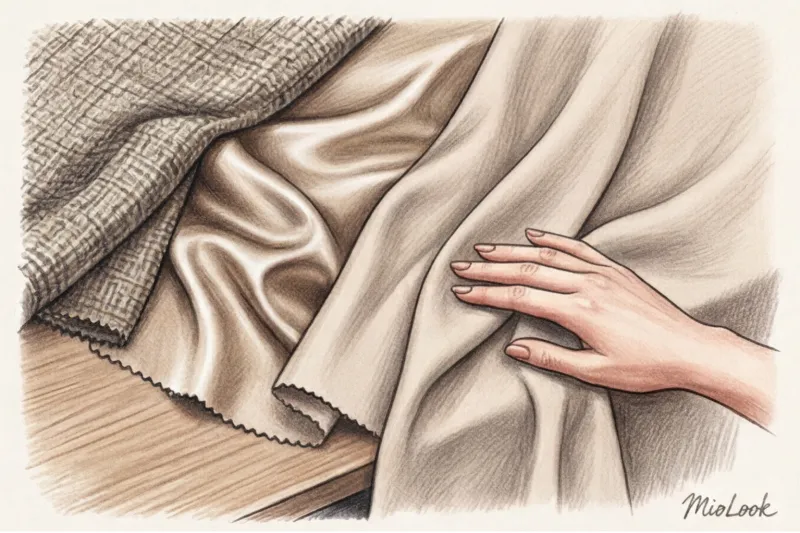
Textile science is no less important than patterns. If you choose the perfect style but the wrong fabric, the magic won't work. Why do thin, flimsy knits or cheap synthetics (often found in the under-€30 segment) cling treacherously to every fold? They lack the weight and thread count to support their own structure.
On the other hand, overly stiff fabrics—starched cotton, taffeta, or heavy organza—create an "armored" effect. They bulge at the protruding points and are reluctant to fall, creating a tent-like effect.
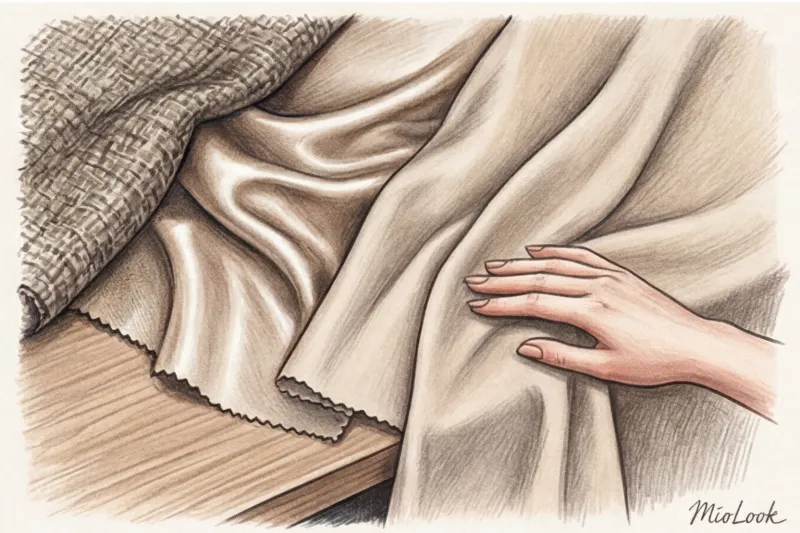
The ideal balance for a full bust is a dense yet fluid texture. Look for fabrics that are heavy enough to form even vertical folds under gravity. These include crepe viscose, heavy matte silk, Tencel, or suiting wool with a weight of at least 220 g/m².
Another critical factor is matte versus shiny finish. According to a 2024 study by WGSN on texture perception, shiny surfaces (satin, polyester silk, sequins) reflect up to 70% of incident light. This creates an optical illusion: glare visually increases the volume of the bust by 10-15%. Matte fabrics, on the other hand, absorb light, making the contours more defined and compact.
Anatomy of cut: which top styles work for you
The shoulder line plays a crucial role in the perception of torso volume. In my experience, 8 out of 10 plus-size women mistakenly choose clothes with dropped shoulder seams or dolman sleeves. This is a fatal mistake. A dropped seam visually widens the horizontal line of the chest, while a dolman sleeve blurs the line between the arm and the torso, turning the upper body into a square.
You need a clearly set-in sleeve. The seam should run exactly along the anatomical junction of the shoulder and arm. This creates a clear vertical frame that organizes and disciplines the silhouette.
V-neck and wrap: why it's a classic
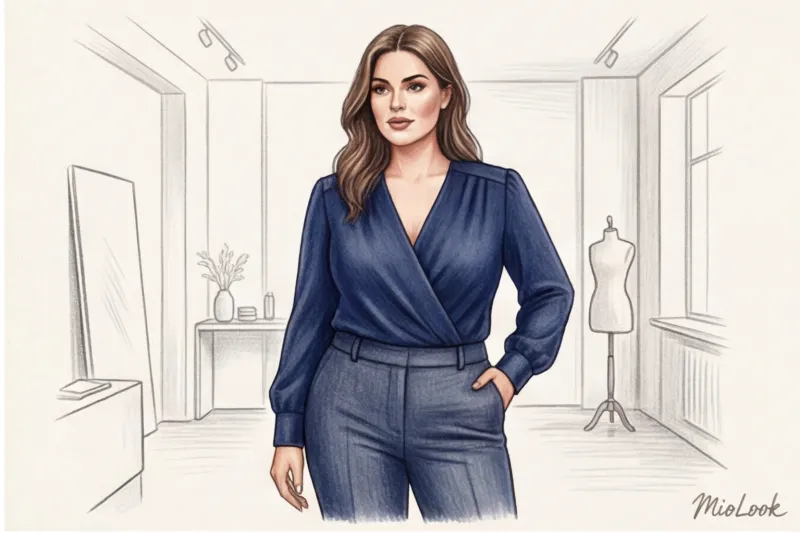
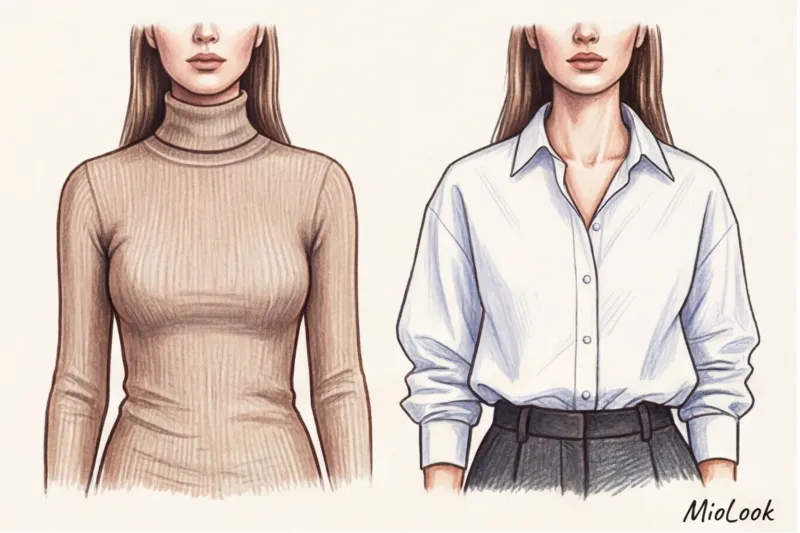
A turtleneck or crew neck transforms a large bust into a single, indivisible mass (a horizontal monolith). A V-neck acts as a saving vertical axis, dividing this area in half, visually lengthening the neck and elongating the silhouette.
Wrap-tops utilize diagonal lines, which have the strongest optical effect of narrowing objects. If you work in an office and are concerned about the depth of your neckline, the rule is simple: for a business dress code, the bottom of the "V" should not fall below the imaginary armpit line. If you want to wear a blouse with a deeper neckline, layer it—wear a thin silk or viscose camisole underneath. It looks elegant and appropriate.
Darts and seams: the invisible framework for a perfect fit
Never buy straight-cut shirts (such as the popular oversized basics from Zara or Massimo Dutti) if the difference between your chest and waist measurements is more than 15 cm. Such a shirt will stretch across your chest and balloon out at the back.
Your savior is darts (bust and waist) or relief seams (also known as princess seams, running from the armhole or shoulder down). They allow the fabric to contour to the complex three-dimensional shape of the bust without strain or unnecessary folds. Yes, finding such a shirt in the mass market is harder, but it's better to invest €80-120 in one perfectly tailored semi-fitted model than to own five cheap shirts that will ruin your figure.
Collars and Lapels: Scale Matters
The rule of proportion applies here. A tiny Peter Pan collar or narrow, pointed lapels against a full bust will create a comical contrast. They will make the bust appear even larger.
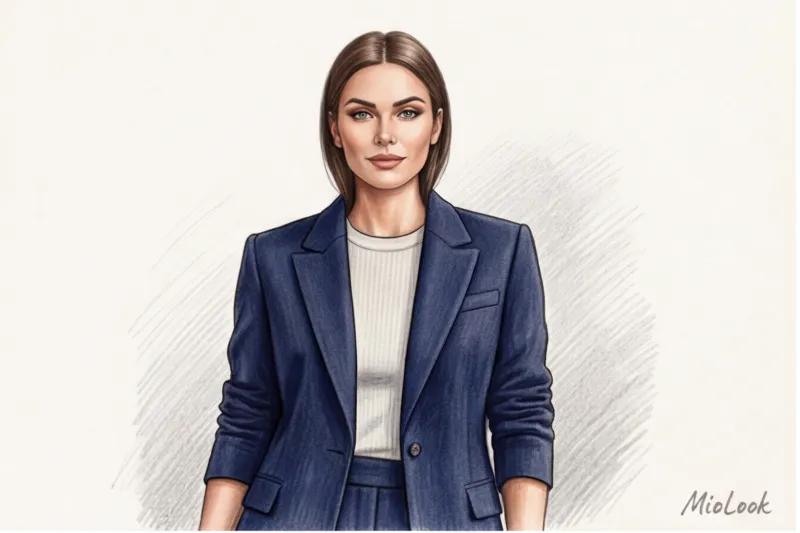
Choose collars and lapels that are medium or large (jacket lapels should be around 8–10 cm wide). They will balance the scale and harmonize the overall proportions of the upper body.
Your perfect look starts here
Join thousands of users who look flawless every day. Try choosing the perfect wardrobe with the help of artificial intelligence.
Get access — €0.99 onceColor Illusions: How Prints and Shades Change Proportions
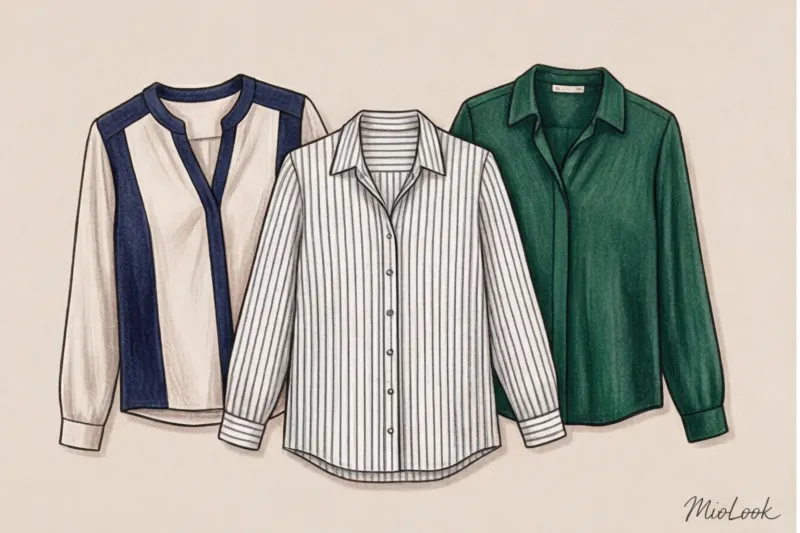
Black is indeed slimming, but wearing it head to toe is boring and outdated. A completely black top can look heavy. Replace it with deep, elegant shades: emerald, sapphire, dark chocolate, wine, or graphite.
Color blocking is a powerful visual narrowing tool. A blouse or jumper with a lighter center and darker side panels creates a "column" effect. The human eye is lazy: it only notices the light center, ignoring the darker edges. The torso instantly appears several centimeters narrower.
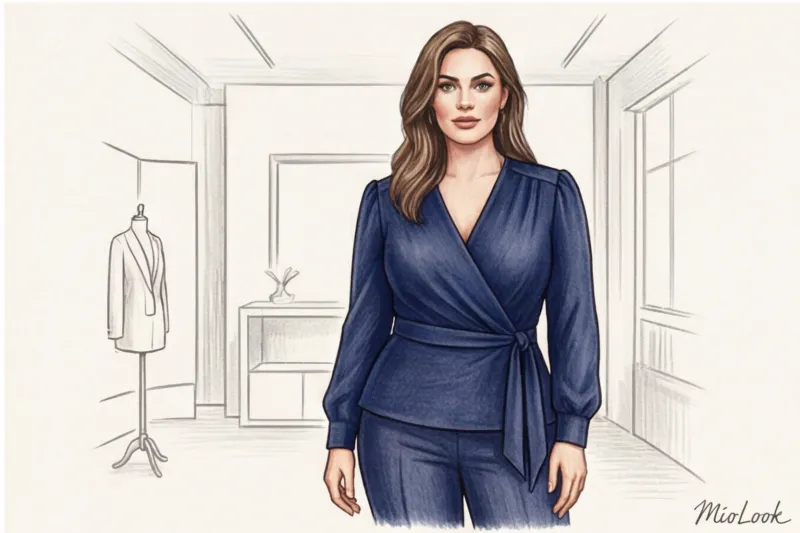
As for prints, avoid large circular patterns. Large flowers or large polka dots stretch across the bust, creating a 3D lens effect. Options that work best for you include medium or small geometric prints, abstract fluid patterns (without sharp circles), and, of course, subtle vertical stripes.
Lingerie Foundation: Why Styling Won't Work Without the Right Bra
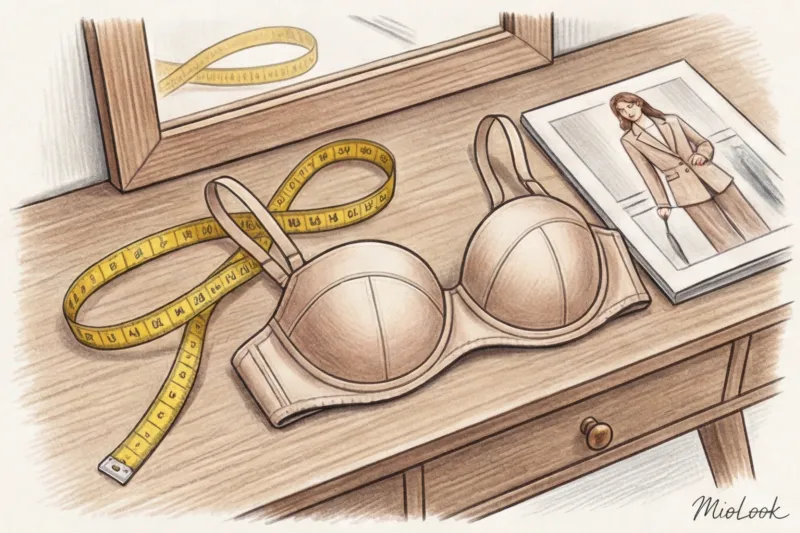
I'm here to bust one of the industry's most pernicious myths: minimizer bras are the bane of a curvy silhouette. Many women think minimizers solve the problem because they physically flatten their breasts. But physics doesn't fool you: the volume doesn't disappear, it's simply "smeared" across the chest. As a result, you may appear slightly smaller in profile, but from the front, your torso becomes wide and massive, and your arms begin to rub against your sides.
As renowned British bra-fitting expert Sarah Tremellen notes, the right bust height can visually "shed" 3-5 kg without any dieting. The key to a proper bra is "lift"—a high-quality lift.
When the breasts are lifted and positioned in their anatomical position (midway between the shoulder and elbow), the waist area beneath them is freed up. The waist is lengthened, and proportions are restored. Look for bras with a structured cup design made of 3-4 pieces. Seamless, stretchy styles will never support a heavy bust.
Checklist: Creating a Harmonious Look for Large Breasts
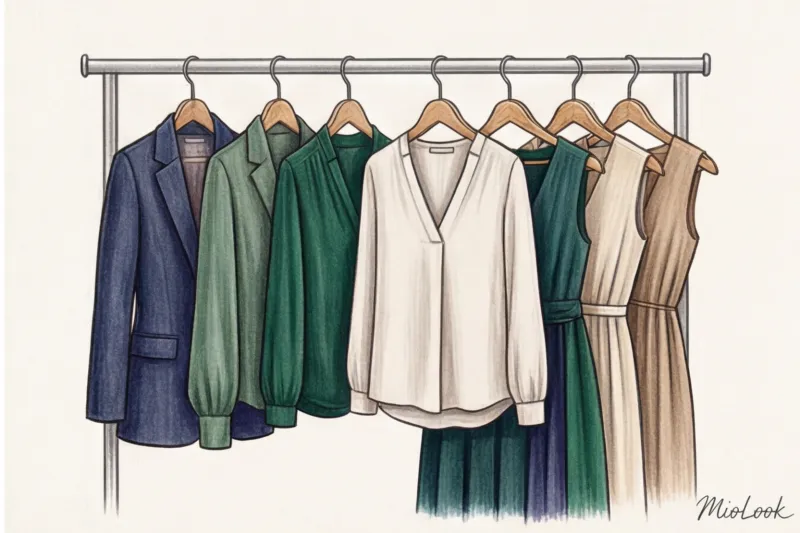
When you go shopping or collect a capsule in the app MioLook , run each item through this algorithm. Take a screenshot to check it in the fitting room:
- Rule 1: Check the base. Before trying on clothes, make sure you're wearing a structured bra that lifts your breasts rather than flattens them.
- Rule 2: Fabric Evaluation. Crumple the fabric in your hand. Does it flow and have weight (crepe, tencel)? Take it. Does it shine, crisp, or stiff? Return it to the hanger.
- Rule 3: Find the darts. Is your shirt completely flat on a hanger? It won't fit. Look for bust darts or raised seams.
- Rule 4: Check the shoulder and neckline. The seam should lie exactly on the shoulder bone, and the neckline (ideally V-shaped) should reveal the collarbone.
It's important to clarify: when do these rules NOT apply? If we're talking about formal eveningwear, where tight historical corsets or dresses with built-in whalebone bustiers are acceptable, other body-sculpting principles come into play. But for everyday, business, or casual wear, this checklist is your bible.
A full bust isn't a flaw to be hidden under shapeless sheaths. It's a strength, a luxurious asset that simply requires a more thoughtful, architectural frame. Invest in the right cut, and you'll be surprised how effortless and graceful your silhouette can be.
Ready to get started?
Upload your items to the MioLook smart wardrobe, and algorithms will suggest which combinations will elongate your silhouette and highlight your best features.
Get access — €0.99 once