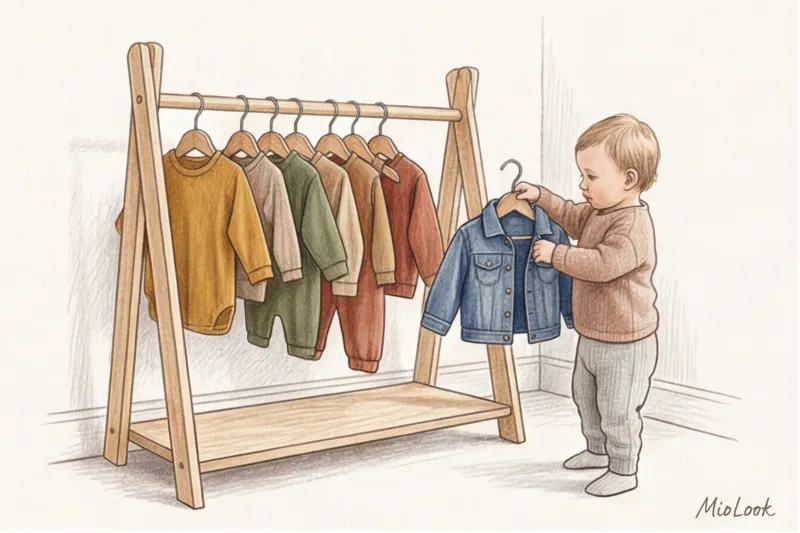
What is a capsule wardrobe for a child and why is it a lifesaver for a mother?
"Mom, I can't wear these pants, they're not dinosaur friendly!" Sound familiar? It's morning, you're already running late, your coffee has long since gone cold, and a real fashion drama is unfolding in the middle of the nursery. In 12 years of working as a personal stylist, I've seen hundreds of luxurious women's wardrobes, but when it comes to children's closets, even the most organized mothers often find themselves scratching their heads. There's a ton of clothes, but nothing to wear before kindergarten. That's why capsule wardrobe for a child It's not just a cool social media trend. It's your primary tool for surviving and defusing morning nerves.
Let me tell you a story from my practice. About a year ago, a client named Elena came to me. Every morning with her four-year-old son, Mark, was a battlefield. Mark categorically refused to get dressed, screaming and throwing things. When we started sorting through his closet, I noticed a pattern: he kept trying to wear his favorite acid-yellow Batman T-shirt with green tartan pants. He intuitively sensed a powerful visual discord, it irritated him, but he could only express his feelings through a tantrum along the lines of "I don't want to wear this." As soon as we put together a well-designed capsule for him, his morning tears disappeared as if by magic. Why? Because it's impossible to make a mistake in a capsule.
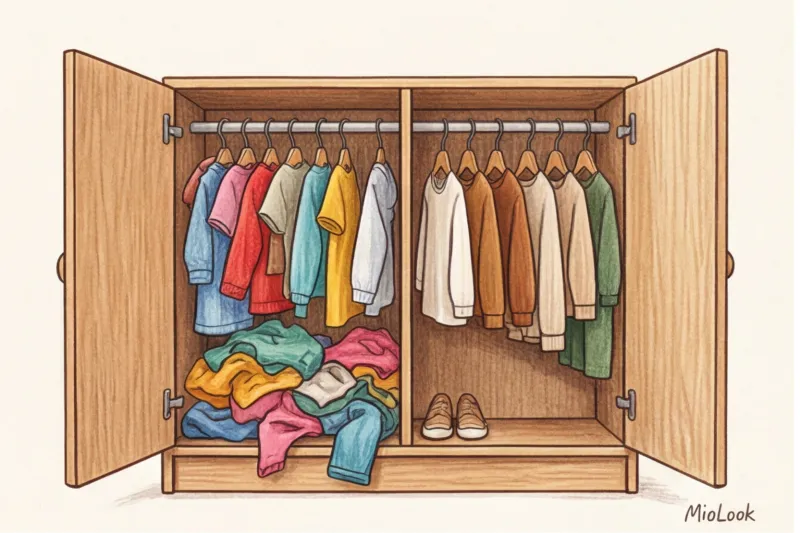
Let's clarify the most important rule right away: creating a children's capsule wardrobe doesn't mean depriving a child of color or forcing them into aesthetically pleasing, yet dull, beige minimalism. It's a clever design. It can include both vibrant colors and beloved cartoon prints. The secret lies in the mathematical calculation: each bright piece is balanced by a calm base. If the bottom is active, the top is neutral, and vice versa.
Besides saving you stress, the capsule is also a great lesson in financial literacy for the whole family. Why are 15 quality items objectively more profitable than 30 impulse purchases from the mass market? It all comes down to the indicator. cost per wear (price per wear). A basic, thick hoodie made of high-quality fleece for €45 will survive 50 washes, falls on the pavement, and berry stains. Three thin synthetic sweatshirts for €15 will pill and lose their shape after a month of active wear. Spending the same €45, you'll face the eternal problem of "I'm embarrassed to wear this to a party." A high-quality capsule collection works for you every day. And if after your inventory, you find mountains of unworn items, I recommend checking out our A guide to where to donate old clothes.
Cultivating taste and independence from the cradle
Clothing is much more than just protection from the cold. For a growing person, it's a crucial tool for establishing personal boundaries and independence. Choosing what to wear today is one of the first legitimate ways to declare to the world, "I exist, and I make my own decisions."
Montessori education is based on the principle of "Help me do it myself." By giving children a range of clothing choices, we foster confidence. But giving them absolute freedom in a chaotic closet is dooming them to frustration.
Good aesthetic taste isn't an innate gift. It's a matter of observation. By offering your child a capsule where colors and textures are already "played together," you're subtly, day after day, training their eye. Over time, they'll begin to understand that corduroy looks great with smooth cotton, and that a bright print requires a calm background.
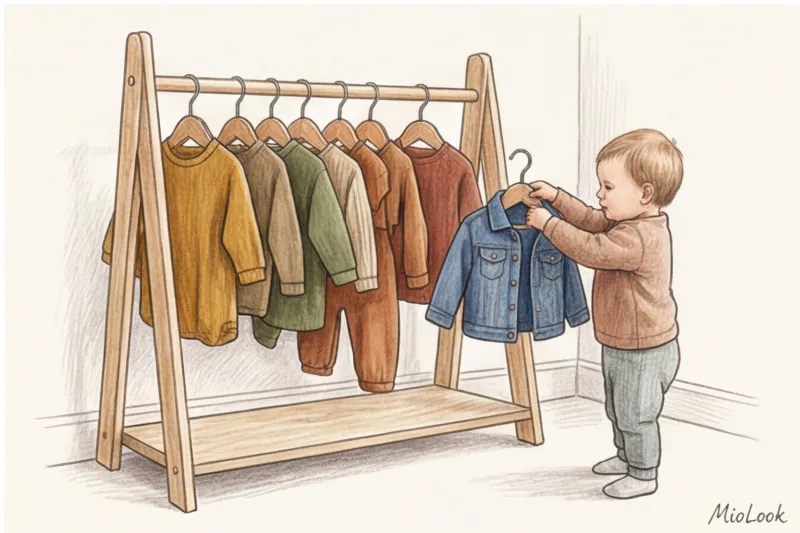
For this system to work, it's necessary to implement the "accessible closet" rule. How can you organize storage so your child can create stylish outfits on their own?
- Move the bar to eye level: A child shouldn't have to tiptoe to reach for things. The ideal height for a preschooler is about 90–100 cm from the floor.
- Use open baskets: Instead of heavy drawers, use fabric or wicker baskets. Add stickers with pictures to them (socks go here, shorts go there).
- Group ready-made kits: Just like we put together the perfect capsule collection of home clothes For yourself, hang children's clothes in sets: jeans on one hanger together with a matching long sleeve T-shirt.
There's another modern life hack my clients love: Digitize your baby's capsule with an app. MioLook In the evening, while sitting on the couch, you can open the smart wardrobe on your tablet and encourage your child to swipe and choose their look for tomorrow from the combinations the app (and you) have already approved. This turns a routine into an engaging game and gives your child a complete sense of control over their life.
The Anatomy of the Perfect Baby Capsule: Formulas from a Stylist
According to a recent study by research agency Mintel (2023), the average parent regularly uses only about 40% of their child's closet. The remaining 60% is made up of those same impulse buys: stiff jeans that are uncomfortable to sit in on the floor, itchy sweaters, and T-shirts that simply don't have the right shorts. To break this cycle of morning tantrums and endless laundry, we'll turn to strict yet incredibly effective fashion math.
My main professional secret when working with children's wardrobes is The golden rule of "3 tops for 1 bottom" Why this particular ratio? It's all about gravity and children's biomechanics. Cherry juice, chocolate ice cream, gouache, and street dirt inevitably land on the chest and stomach. The upper body bears the brunt of 80% of all household disasters, while pants usually end up with a dusty knee cap that can be easily brushed off with a damp cloth. Having three T-shirts for every pair of jeans ensures your child will always look neat, and you won't have to run the washing machine for one dirty item.
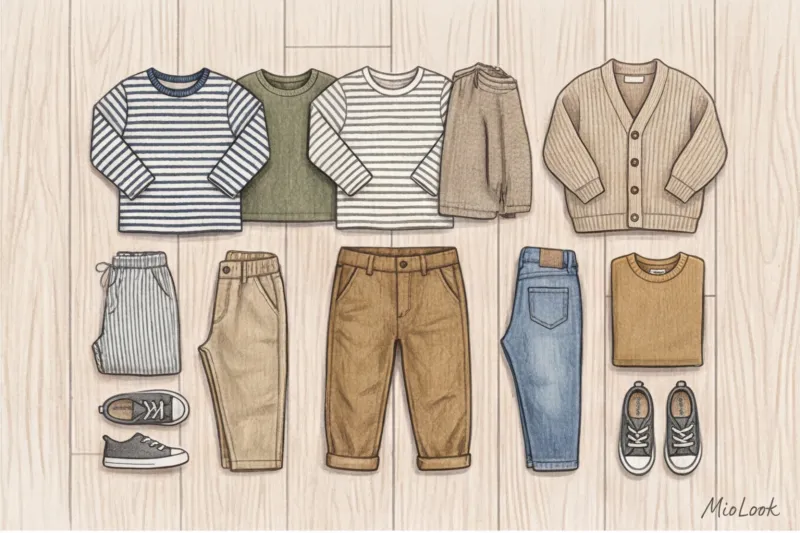
Let's get down to specifics. How many items does it really take to cover an active child's needs for the season? Here's my tried-and-true basic formula that works without fail:
- 5 tops: 3 plain basic T-shirts, 1 thick long sleeve shirt and 1 accent item (flannel shirt or blouse with a collar).
- 3 bottoms: 1 pair of classic blue jeans, straight or loose fit, 1 pair of comfortable joggers (without a strong print), and 1 pair of shorts (or a thick corduroy skirt).
- 2 top layers: 1 oversized zip-up hoodie and 1 structured denim cardigan or jacket.
- 2 pairs of shoes: Basic light-colored sneakers and technical running shoes.
"The math behind the capsule is mind-blowing: 5 tops multiplied by 3 bottoms gives us 15 basic combinations. Add two different top layers, and you've got 30 unique looks. Changing your shoes doubles the result to 60 options! A high-quality 12-piece base will cost around €150-€250, but it will free you from the "nothing to wear" problem for six months."
This is the most common question I get from my clients: "Isabella, what about my daughter's favorite color, acid pink? What about the Spider-Man T-shirts?"
It's a mistake to think that a child's capsule wardrobe is all about dull beige and minimalism. I'm categorically against depriving children of color and self-expression. The secret lies in adapting the 60-30-10 design rule. Keep 60% of the wardrobe (those basic bottoms and top layers) neutral: graphite, deep blue, camel, or soft khaki. Dedicate 30% to elegant complementary shades, like terracotta or mustard. And the remaining 10% is the legitimate territory of children's imaginations, including that very same acid pink.
Access to MioLook for €0.99 — one-time payment
A smart AI stylist will select the perfect look from your existing items and suggest what's missing from your capsule wardrobe.
Get access — €0.99 onceTo harmoniously integrate a print with a favorite character into a stylish base, I always use the "visual sandwich" principle. If your child insists on a loud Spider-Man t-shirt, tone it down with a pair of crisp, heavy jeans (bottom) and layer an unbuttoned, solid-color shirt or cardigan (top). The bright piece will be framed by calm, structured textures. This way, your child gets their favorite character on their chest, and you get an aesthetically pleasing, put-together look without visual noise. And to avoid getting confused when combining complex prints with a base, it's very convenient to upload photos of the items to MioLook — the app will automatically show you which combinations work best, allowing you to plan looks in just a couple of clicks.
How to put together a capsule wardrobe for a child based on their age
One of the most common mistakes I regularly discuss in my personal consultations is parents' attempt to apply a single stylistic template to children of different ages. You find a successful brand of basic clothing and, out of inertia, scale its formats to suit a three-year-old and a first-grader. But what was adorable and worked flawlessly in preschool becomes a functional disaster at school.
According to a large-scale study European Society of Paediatric Ergonomics (2022), an improperly chosen cut and fabric texture can reduce a child's natural physical activity by 20%. Developmental physiology dictates strict rules: growth patterns, body proportions, and activity patterns change dramatically. A toddler's center of gravity is shifted, they have a characteristic protruding tummy, and their legs are shorter relative to their torso. They require a higher elastic waistband and extra room for diapers. A younger schoolchild's limbs are elongated, their waist is developing, and clothing must ensure a proper fit during prolonged sitting at a desk without compressing the pelvic organs.
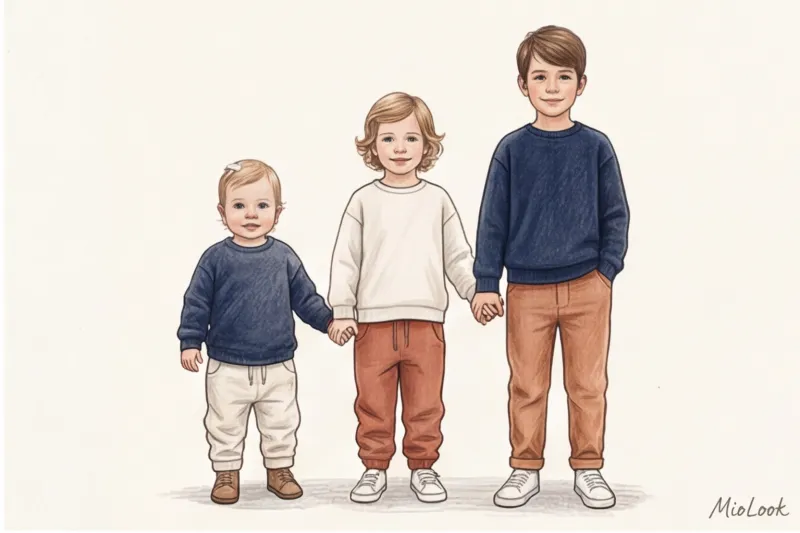
That's why the "buy the same jeans for both sons" approach doesn't work. A capsule approach requires flexibility and an understanding of the biomechanics of each age. Let's explore how to adapt fashion formulas to the real needs of a growing adult.
Toddlers (1-3 years): Ergonomics, spots, and freedom of movement
Between one and three years of age, children explore the world empirically: with knees, elbows, and the inevitable testing of puddle depth. At this stage, we prioritize absolute freedom of movement and ease of care.
The first rule of a stylish toddler capsule is a complete rejection of hard denim and dense, non-stretchy fabrics. Classic jeans (especially those made from 100% cotton without elastane) prevent proper hip abduction. They're simply uncomfortable for a baby to squat, crawl, or climb in. Replace them with joggers made from soft three-thread fleece, micro-corduroy pants, or stretch denim (jeggings). Good basic pants made from the right knitwear will cost you between €15 and €25 in a mass-market store, and this investment will pay off with hundreds of comfortable walks.
Another common mommy pain point is endless stains from berries, grass, and paint. Perfectly clean pastel long sleeves are a stylish utopia for photoshoots. In real life, opt for "smart prints" that hide minor stains. Prints don't have to be colorful cartoons. Melange textures, muted tie-dye, dense floral patterns (millefleur), or chaotic geometric designs look luxurious.
"A toddler capsule should be bulletproof. Reinforced knees aren't a marketing ploy, they're a necessity. Choose pants with factory patches or contrasting Cordura inserts on the knees; this will triple the lifespan of the garment."
And finally, forget about complicated fastenings. No back buttons or tight zippers—only elastic waistbands, wide necklines, and snaps on the shoulder seams. Clothes shouldn't make you tear when you put them on.
Preschoolers (4-6 years): Time to Show Character
By age four, children are actively socializing, and kindergarten begins, at which point an unspoken but strict dress code comes into effect: comfortable enough to change independently. Teachers won't tie shoelaces for thirty children. Your capsule should consist of transformable items that your child can handle on their own in a few minutes before and after nap time.
But the main stylistic battle of this age is integration of "wants" Right now, ultimatums are popping up: "I'll only go to kindergarten in a Spider-Man T-shirt!" Many mothers with good taste are desperately trying to ban superhero or princess merch. As a stylist, I recommend a different approach: harmoniously incorporating a flashy item into a stylish look.
The formula is simple: if we choose a statement, sophisticated top (that bright T-shirt), everything else should be as refined and basic as possible. Put on the T-shirt with the hero, add simple graphite joggers or beige cargo pants, and casually throw on an unbuttoned olive corduroy shirt over the top. You get a relaxed, layered street style where the print acts not as a childish absurdity, but as an ironic accent.
By the way, to avoid morning arguments, I recommend digitizing your closet. In the appendix MioLook My clients create a separate "Kindergarten" section where we upload their favorite character t-shirts and create ready-made outfits in advance. The child scrolls through the screen and chooses their outfit for the day—this gives them the illusion of complete control and saves your nerves.
For active outdoor play, build your capsule like an "onion"—layers that are easy to remove. A cotton t-shirt + a zip-up fleece track jacket + a lightweight windbreaker. If your child gets sweaty, remove one layer without ruining the overall look.
Younger students (7-10 years): Between school uniform and personal style
At seven, a child's wardrobe undergoes a tectonic shift. School uniforms are introduced, and the school capsule set becomes a separate, rather expensive module (a high-quality basic set costs between €100 and €250). The problem is, these items often hang around like dead weight from Friday evening until Monday morning.
My professional advice: master the mix of school and everyday pieces. The boundaries between formal and casual styles have long been blurred. How to wear a smart white shirt on the weekend? Wear it untucked, layer a voluminous, solid-color hoodie over it, allowing the stiff collar and cuffs to peek out, then add wide-leg jeans and chunky sneakers. The result is an ultra-fashionable preppy aesthetic that will make your child feel incredibly confident at the movies or at a cafe.
At this age, social media has a huge influence on taste. Responding to TikTok and YouTube trends within reason is your responsibility if you don't want your child to feel insecure. Baggy silhouettes, Y2K aesthetics, and cargo bags with multiple pockets are their language of self-expression.
Don't try to dress a ten-year-old in classic skinny jeans if the whole class wears oversized ones. Set aside a budget for two or three trendy items (for example, parachute jeans or a zip-up hoodie with a distinctive print, priced between €30-€50 per item) and integrate them into your quality base. You'll give your child the desired status among their peers while maintaining the overall harmony of the capsule and avoiding tackiness.
Fabrics and Textures: Hidden Traps of the Children's Mass Market
Have you ever noticed how stunningly beautiful a linen suit looks on a mannequin in a shop window? Now imagine a child wearing it, having just slid down a plastic slide and climbed a rope web. I often see mothers, striving for absolute naturalness, buying 100% linen. In practice, this is a pure stylistic utopia. Linen has no stretch at all and restricts wide movements, and children, as we know, don't walk in a straight line. Moreover, it wrinkles so much that after just 15 minutes of active play, a child looks untidy, and the dense natural fibers absorb street dust and berry juice.
The secret to truly comfortable clothing lies in the right blends. Several years ago, while styling a campaign for a European brand, I carefully studied their children's denim production technology. It turned out that 100% dense cotton bottoms guaranteed the garment would settle to the bottom of the closet. The stiff fabric puts painful pressure on the stomach when squatting. It's critical that children's jeans or trousers contain 2-3% elastane. This tiny addition makes the fabric flexible, allowing the knees to bend freely, and the garments themselves to return to their original shape after washing.
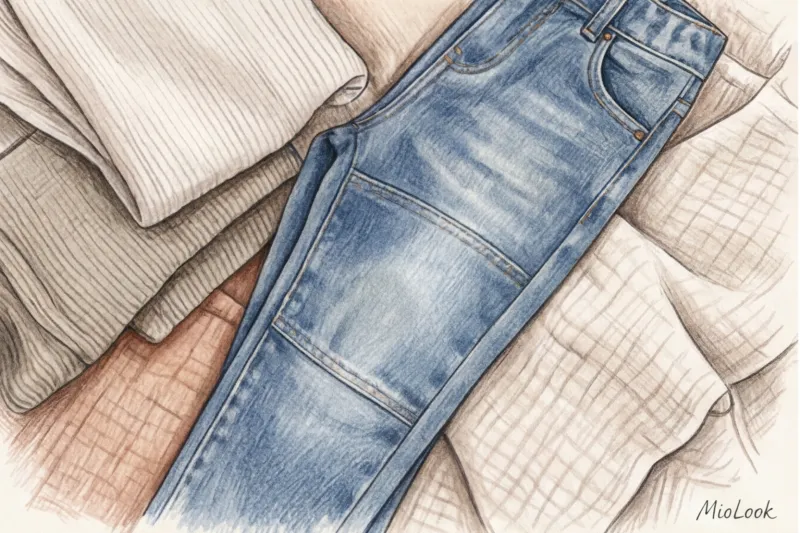
This brings us to the main myth: "Synthetics are always evil." Let's learn to read labels like a pro. There's a huge gap between cheap "glass" polyester (in which a child instantly sweats and then freezes in the wind) and the latest generation of synthetics. Modern high-tech polyamide, lyocell (Tensel), or the addition of 15-20% high-quality recycled polyester to a cotton sweatshirt aren't just a cost-cutting measure by the manufacturer, but an engineering calculation. It's this percentage that prevents the garment from shrinking after the twentieth wash and prevents pilling. Look for certification on the labels. OEKO-TEX Standard 100 - it guarantees the safety of dyes and fibers even for the most sensitive children's skin.
To ensure a child's capsule wardrobe truly works year-round, I've compiled my personal top textures. Here are my absolute favorites that can withstand any playground test:
- Muslin: A brilliant invention for the warm season. It breathes better than regular jersey, dries instantly, and—which will save you hours—it absolutely requires no ironing.
- Corduroy (microcorduroy): My favorite alternative to stiff denim for fall. Corduroy shirts and pants look sophisticated, keep you warm, and their ribbed texture does a phenomenal job of hiding minor stains.
- Three-thread fleece (loop or fleece): If you're buying basic hoodies or joggers, look for three-thread fabric. Unlike thin two-thread fleece, which stretches out at the knees within the first day, a dense three-thread fabric maintains its shape for years. A high-quality suit made from this material will cost between €40 and €60, but it will easily outlive three children.
- Boiled cotton: This fabric has been enzyme-washed at the factory. It's incredibly soft to the touch, no longer shrinks at home, and has a light, stylish, casual texture.
Try MioLook
for free
Start creating perfect images with the help of artificial intelligence
Get access — €0.99 onceSmart Investing: How to Buy for Growth and Look Stylish
In 2023, a European study of the children's clothing market published sobering statistics: during a growth spurt, a child wears an item of clothing for an average of only 3.5 months. It's no wonder that many parents try to buy extra clothes. But you know what kind of stylistic nightmare I most often see at playgrounds? Clothes bought three sizes too big, in which the child literally drowns. Sweaters that slip off the shoulders and jeans that bunch up at the knees—this isn't a rational approach, but rather visual chaos.
Let's debunk the biggest myth: clothes "for growth" absolutely don't have to look baggy or sloppy. By putting together a capsule wardrobe for your child, you can invest in pieces that will last two or three seasons while remaining within the current aesthetic. The secret lies in the right proportions, clever cutting, and clever styling.
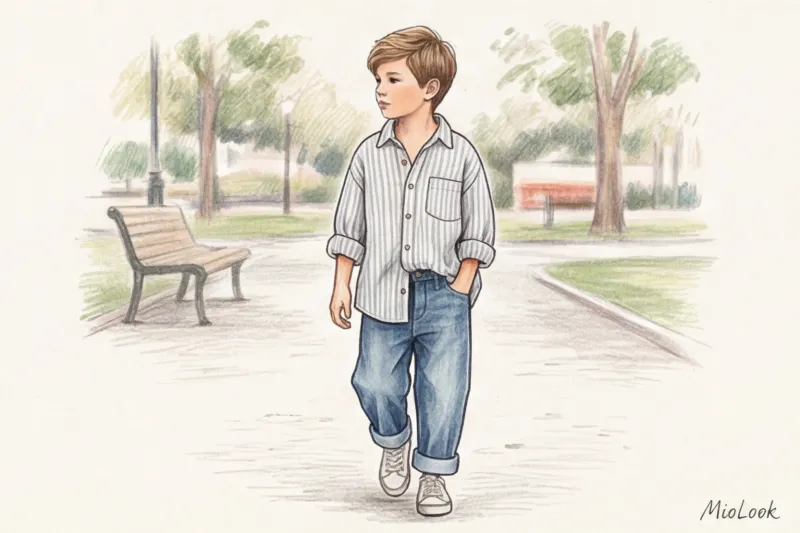
As a stylist, I'm always on the lookout for transformable pieces. There are specific styles that will grow organically with your child. First and foremost, these are joggers with tight cuffs Thanks to the wide elastic at the bottom, they'll never drag on the ground, even if the legs are 5-7 centimeters longer than needed—the excess fabric simply drapes beautifully and naturally. For girls, they'll be a brilliant investment. A-line dresses (A-line). The first season, it's a classic midi dress, the next year, a flirty mini, and the season after that, it turns into a great tunic, which we style with thick leggings. And, of course, oversized shirts If you're buying a high-quality cotton model (for example, a thick oxford in the €30-€45 range), feel free to go up a size or two: at first, it works as a relaxed top layer over a T-shirt, but as you grow, it fits snugly across your shoulders.
Premium manufacturers have long understood parents' pain and integrated hidden adjustments into their products. My absolute must-have for a children's base is trousers with elasticated waistband (with a buttoned drawstring) at the waist. You buy a size larger, secure the waist to your child's current measurements, and adjust the length by tucking it in correctly.
And here we come to the main styling trick. To make a larger item look thoughtfully oversized, use the technique rolled cuffs (rolled sleeves). If you are buying a denim jacket or jacket with extra fabric, look for styles that have roll-up sleeves with contrast lining Or an interesting print on the inside. A neatly rolled sleeve, revealing a brightly colored back, looks like a bold statement, not a cost-cutting move. On the streets of Milan or Madrid, you'll constantly see children in oversized garments with rolled-up sleeves—that's the very definition of Mediterranean casualness.
The main rule of image architecture: if we use a voluminous top with some room, the bottom should be gathered and fitting. Balance of volumes is everything. By the way, in the appendix MioLook Many of my clients specifically tag these transformable items with a separate "grow-in" tag so they can clearly track which styles actually earn back every euro invested in them over the course of several years.
Dressy Myths: Why You Should Ditch the "One-Time Dresses"
Now let's talk about the biggest parenting nightmare, disguised as a holiday. You buy a luxurious, fluffy tulle dress or a stiff three-piece suit for €100-150. On the hanger, it looks like an aesthetic dream. In reality, we experience sensory overload: the stiff seams chafe delicate skin, the child scratches and cries, sweats in the synthetic satin, and begs to be changed exactly fifteen minutes after the party starts. Sound familiar?
According to statistics from the largest European retail platforms for 2023, children's special-occasion outfits account for 70% of items resold brand new, with tags, or worn only once. To avoid this trap, I always implement the concept of "modular elegance" The essence of this stylistic approach is simple: we create a festive look from high-quality basics, complicating them with interesting combinations of textures and accent details.
Let me challenge conventional wisdom. As a stylist, I guarantee you: a simple caramel corduroy A-line skirt paired with a basic long-sleeved heavy cotton top and a statement collar will look far more expensive, aristocratic, and stylish than any sparkly "princess dress." The former creates a refined aesthetic. old money and absolute freedom of movement for the girl. The second is a plastic sheen and a waste of money, as wearing this dress a second time to the playground or kindergarten is simply impossible.
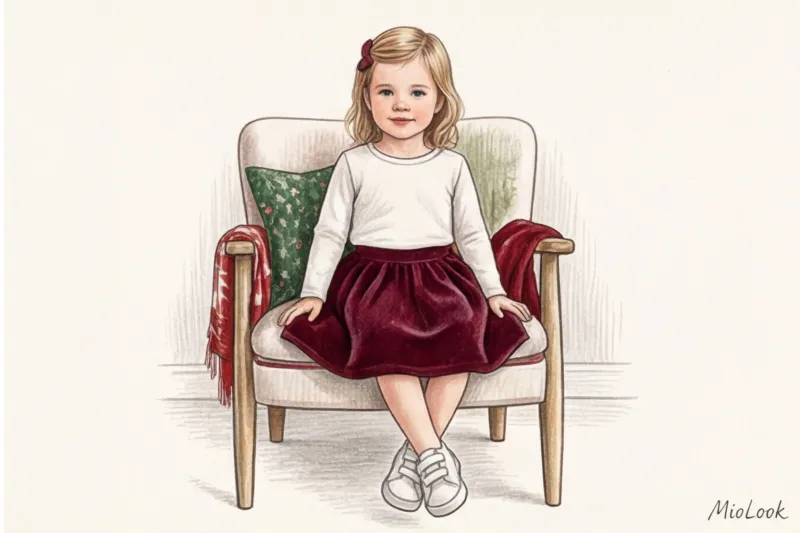
In this smart system Accessories decide everything They are the magical triggers that instantly transform a look from casual to formal. What do I recommend always keeping in your arsenal? False lace collars (they instantly elevate any simple jumper), textured velvet or linen bow ties for boys, and elegant tights with delicate lurex or intricate lace weave. And, of course, shoes: classic patent leather shoes or even contrasting light-colored sneakers, which tone down any unnecessary pretentiousness and add a relaxed European confidence to the look.
The best thing about this approach is its incredible variability. By loading the basics into MioLook , you can easily visualize how many formal combinations you can create with everyday cardigans, solid-color trousers, and a few statement pieces. This not only saves you money (you'll agree, buying a stylish collar for €15 is much more enjoyable than a cake-like dress for one evening), but also instills in your child an understanding of good taste, appropriateness, and comfort from an early age.
Your ideal image begins Here
Join thousands of users who look flawless every day with MioLook. Create stylish capsule wardrobes from what's already in your closet!
Get access — €0.99 onceChanging Seasons: Adapting Your Baby Capsule to the Weather
April and October are the two months of the year when most parents panic, pulling out huge vacuum-sealed bags of "out-of-season" clothes from their closets. I suggest you put this exhausting ritual behind you once and for all. A well-designed capsule wardrobe for a child functions as a single, seamless mechanism, where at least 40% of the items flow seamlessly from one season to the next.
The main rule of a smart wardrobe: don't buy everything from scratch. Those loose-fitting cotton long sleeves and basic T-shirts you've been buying for cool summer evenings (usually priced between €15-€25 apiece from quality, minimalist brands) should never be consigned to the back of the closet this winter. In cold weather, they become the perfect base layer for oversized cardigans and sweaters. For example, a summer sundress made of heavy denim looks incredibly stylish with a ribbed turtleneck and thick tights in the fall, and a lightweight denim jacket makes a great midlayer under a loose wool coat.
When it comes to truly cold weather, demi-season layering—that same Scandinavian dressing philosophy—comes into play. My personal guide to properly layering "cabbage" for long winter walks is based on three strict rules:
- Base layer (moisture wicking): Thermal underwear made of merino wool or high-quality, high-tech synthetics. Forget about pure cotton for active play in the cold—it will instantly absorb sweat, cool down, and your child will freeze.
- Middle layer (thermal insulation): A fleece jacket or lightweight down vest. Fleece acts as a warm air trap. An important nuance from practice: At temperatures down to -5°C, thermal underwear and a membrane are sufficient for an active child, and we only add fleece when the thermometer drops below -10°C.
- Top layer (protection): A membrane jacket or overalls. The membrane itself doesn't provide warmth; its purpose is to provide an impenetrable shield against wind and wet snow, while allowing excess moisture to evaporate from the body.
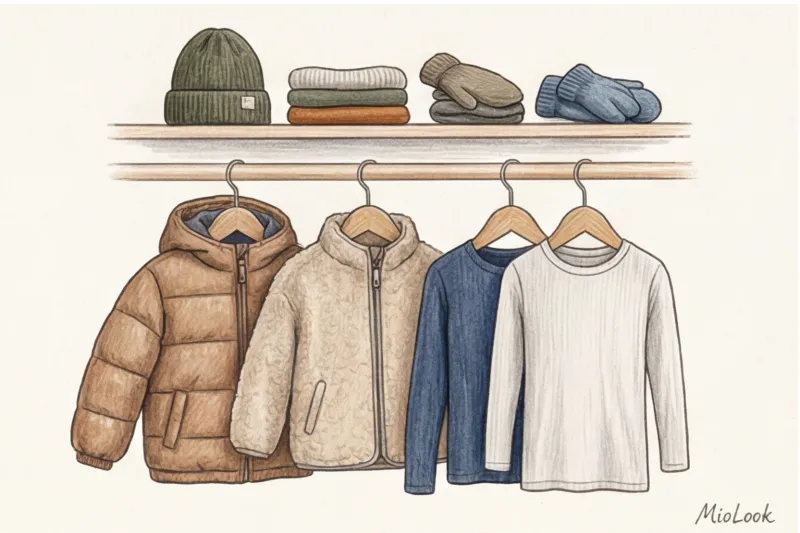
To avoid the hassle of deciding which T-shirts to keep for the winter and which to put away, many of my clients use the cabinet digitization function in MioLook We simply tag basic items as "all-season," and the app automatically suggests stylish layering formulas based on the current weather outside.
A child's summer capsule wardrobe requires a separate, yet equally thoughtful approach. Sun and heat protection without sacrificing style hinges on avoiding revealing tops in favor of appropriate, covered styles. Dermatologists worldwide tirelessly reiterate that clothing with a UPF factor, or simply thick but breathable linen and muslin, protects delicate baby skin more reliably than any cream. My favorite summer formula for hot climates: a loose, long-sleeved crinkle-cotton shirt, roomy Bermuda shorts, and closed-toe sandals. This look keeps your child cool thanks to the air layer, provides reliable UV protection, and looks like a tiny, yet elegant, resident of the Amalfi Coast.
Checklist: Where to start sorting out your child's closet today
A 2021 study by the Princeton University Neuroscience Institute on visual noise demonstrated that physical clutter within our line of sight directly overloads our cognitive system. When you open the door early in the morning and a clutter of faded long-sleeved shirts and lonely socks spills out onto your desk, your cortisol levels soar even before breakfast. A well-designed capsule wardrobe for your child isn't just a nod to minimalist fashion; it's your own personal stress reliever.
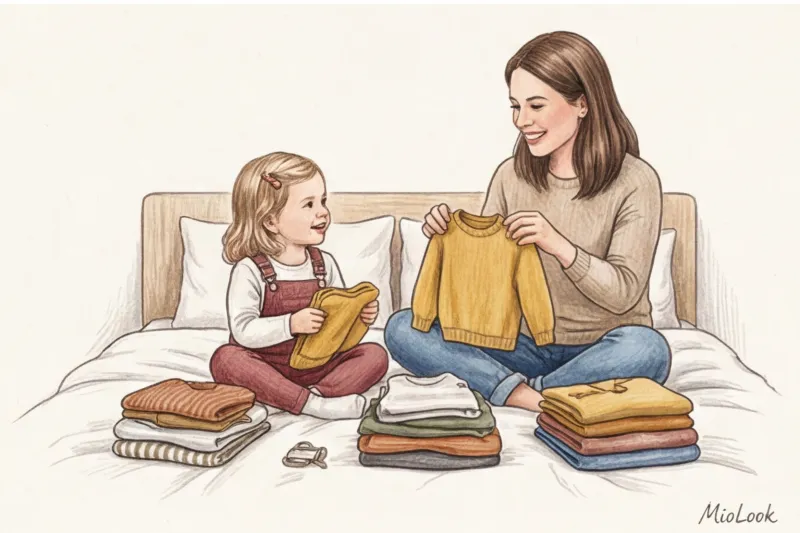
But theory is dead without practice. If right now the nursery's dresser won't close due to an overabundance of clothes, and there's once again "nothing" to wear to the playground, we need an action plan. Here's my step-by-step system, which I use in every session with my clients.
Step 1: Complete audit and rigorous sorting
Take out absolutely everything. Yes, even from that far-off drawer where you hide your "summer cottage stuff." We divide clothes strictly into three categories: first – they're too small or downright uncomfortable; second – those with stubborn stains, stretched collars, or pilling; third – in perfect condition.
My honest advice as a stylist: if a cheap mass-market item has lost its shape after the fifth wash, don't keep it for home use. Throw it away or recycle it. It's better to keep a quality hoodie from Arket or Zara Kids for home wear, even if it just has a tiny gouache stain, than to tolerate a misshapen synthetic. An important limitation from personal experience: Don't do this audit in front of a 3-5 year old child, otherwise you risk an hour-long tantrum over an old, washed-out T-shirt that you suddenly "feel so sorry" about.
Step 2: Identifying wardrobe gaps
This is where the real analysis begins. I often see the same stylistic trap in closets: an overabundance of tops with bold prints and a catastrophic lack of basic bottoms. If you have 10 dinosaur tees but only one decent pair of straight-leg jeans, that's a clear "hole."
To visualize this imbalance and not keep everything in my head, I ask clients to take photos of the items that have passed the selection. After uploading them to inventory function in the MioLook app , you'll immediately see honest inventory statistics. The app will clearly highlight that, in addition to your five bright sweatshirts, you're desperately short of a pair of neutral corduroy pants.
Step 3: Create a capsule shopping list
Only after identifying a shortage do we open our online shopping cart. The shopping list should be ruthlessly pragmatic, based on the "3 tops for 1 bottom" formula. If we see a shortage of a base layer, we budget specifically for it.
For example, a high-quality set of three solid-color long-sleeved T-shirts made of thick cotton will cost around €30–€45, while a pair of well-cut basic jeans will cost around €25–€40. Don't buy a fifth dressy skirt for €60 if your child doesn't already have comfortable leggings for active play. Investing in a capsule set of 15 quality items (on average, this will cost between €200–€280 per season) will pay for itself many times over, as these clothes will withstand daily washing cycles.
Step 4: Organize into ready-made kits
The clothes are sorted, the missing pieces are bought. Now we're changing the very logic of storage. Ditch the classic "all shirts together, all pants separately" piles—these are the ones that cause morning chaos.
"The secret to a stress-free dressing routine lies in vertical storage and ready-made formulas. When a sweatshirt, a matching T-shirt, and matching joggers are already hanging on one hanger, even a five-year-old can dress themselves without disturbing the color balance," notes child ergonomics expert Sarah Wells (2022).
Gather 5-6 finished bows in advance on hangers. Fold the rest vertically, using the KonMari method, into drawers so your child can see every item. Do this sorting tonight, spending exactly 40 minutes. Removing visual clutter will give you an incredible sense of relief, and your child will have the freedom to choose within the aesthetic boundaries you've set. Good taste truly begins with order.
Guide Chapters
Family look for mom and baby: stylish and suitable for every day
Creating a cohesive couples look isn't just about buying matching sweatshirts. Learn how to stylishly and comfortably combine your wardrobe with a baby capsule.
Color Combinations in Children's Clothing: Putting Together a Capsule Collection
Tired of morning tantrums over mismatched clothes? Learn how to create the perfect color palette for your child's wardrobe.
Basic Shoes for Children: How Many Pairs Do You Need Per Season?
How many pairs of shoes does a child really need for one season? A stylist shares the golden "3+1" formula for creating a smart shoe capsule wardrobe without breaking the bank.
The Perfect Spring Kids Wardrobe: A Stress-Free Capsule
Tired of morning tantrums and temperature fluctuations? Learn how to properly pack a mid-season capsule for your child to ensure comfortable and stylish clothes.
Capsule wardrobe for boys: stylish looks
Forget morning arguments over clothes! Learn how to put together a comfortable and stylish wardrobe for your son.
Winter capsule for children: warm, comfortable and stylish
Tired of long mornings getting ready and tantrums over an uncomfortable jacket? We'll tell you how to put together the perfect winter wardrobe to keep your child warm.
Summer capsule for a child: a wardrobe for the sea and the city
Packing your child for vacation? We'll show you how to create a functional summer wardrobe that fits in one bag and will save you a lot of stress.
A capsule wardrobe for a girl: putting it together without tears
Getting ready for kindergarten in the morning will no longer be a hassle. We'll show you how to create a smart wardrobe organizer that both mom and daughter will love.
Basic wardrobe for a newborn: a capsule wardrobe without the extras
Learn how to create the perfect capsule for your baby, avoiding impulse purchases of uncomfortable items. Practical tips for choosing first clothes.
How to save money on children's clothing without sacrificing quality
Is your closet overflowing and your child has nothing to wear? We'll tell you about smart shopping and capsule shopping rules that will save your budget from unnecessary spending.
The Perfect Back-to-School Capsule: How to Build a Year's Content
Forget about uncomfortable white shirts and formal suits. We'll explore smart shopping algorithms and learn how to put together a school wardrobe your child will love wearing.
Kindergarten Capsule: List of Items and Rules
How to save your child from morning tantrums over clothes? We're putting together a practical wardrobe for kindergarten without unnecessary expenses and uncomfortable knitwear.