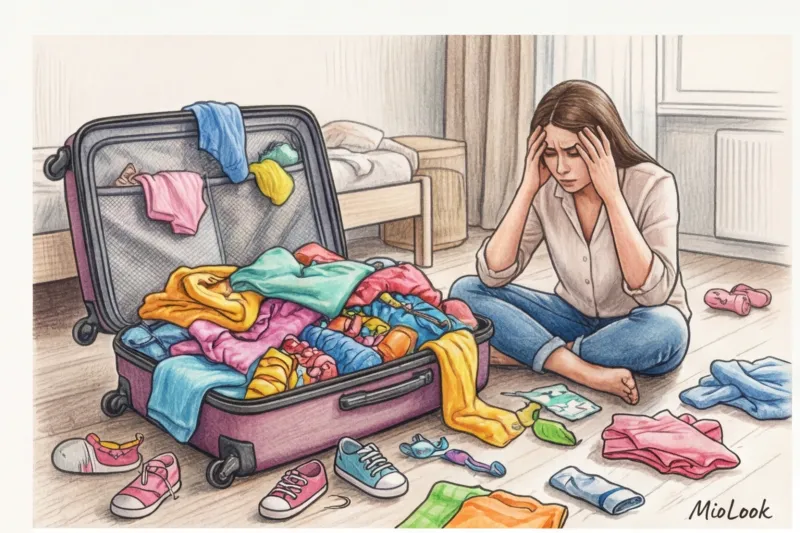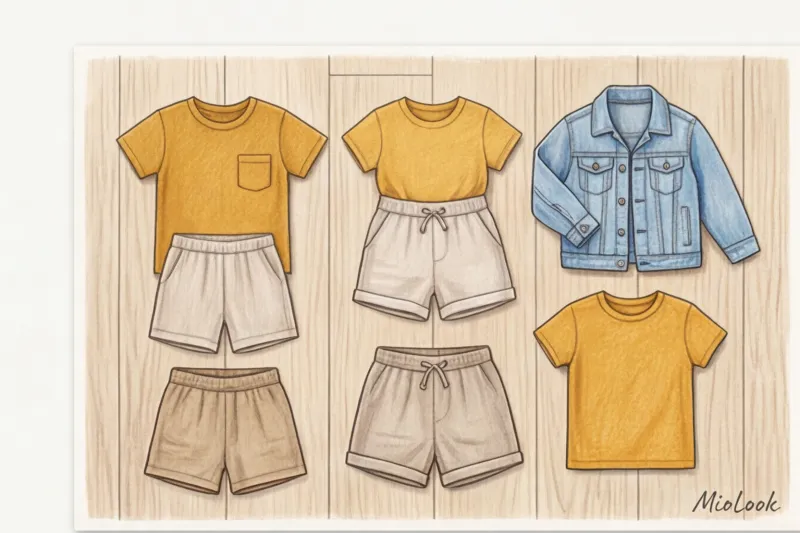
Three huge suitcases for a ten-day vacation. Sound familiar? My client Anna took her five-year-old son on a beach vacation with exactly this amount of luggage. The irony was that upon returning home, we discovered that 60% of the items had never been removed from the suitcase, and the child had spent the entire vacation in three favorite T-shirts and only shorts. This story from my styling practice perfectly illustrates the main problem with parental shopping: we buy emotions, not functionality.
We have discussed the basic principles in more detail in our The complete guide to a child's capsule wardrobe Today, we'll talk about the practical application of these rules. A summer capsule for a child isn't just a shopping list. It's a mathematically proven system that saves you money, stress, and luggage space. If done correctly, two weeks' worth of clothing will fit into a small bag weighing 1.5–2 kg, and your morning routine will be reduced from 20 minutes to 3.
Summer capsule for a child: the formula for the perfect vacation and city life
The difference between a chaotic collection of items and a smart capsule is interchangeability. In a capsule, there are no random purchases like "these shorts are cute, I'll figure out what to wear them with later." Every item contributes to the overall result.
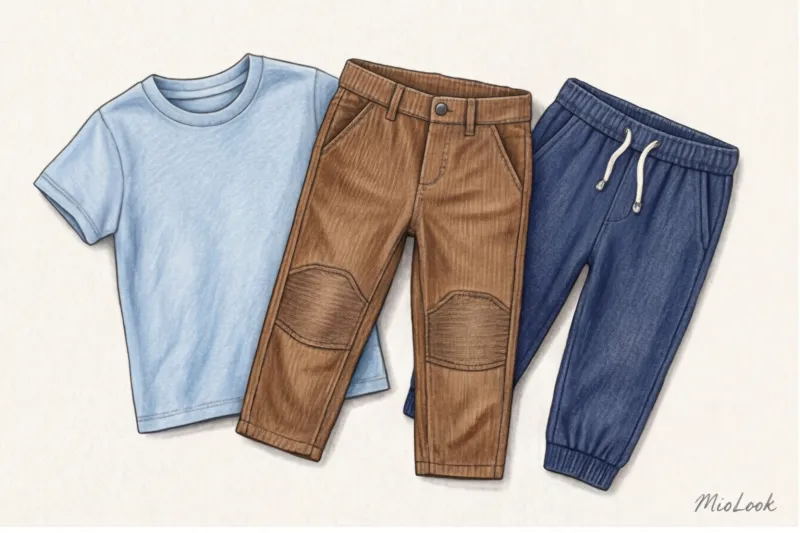
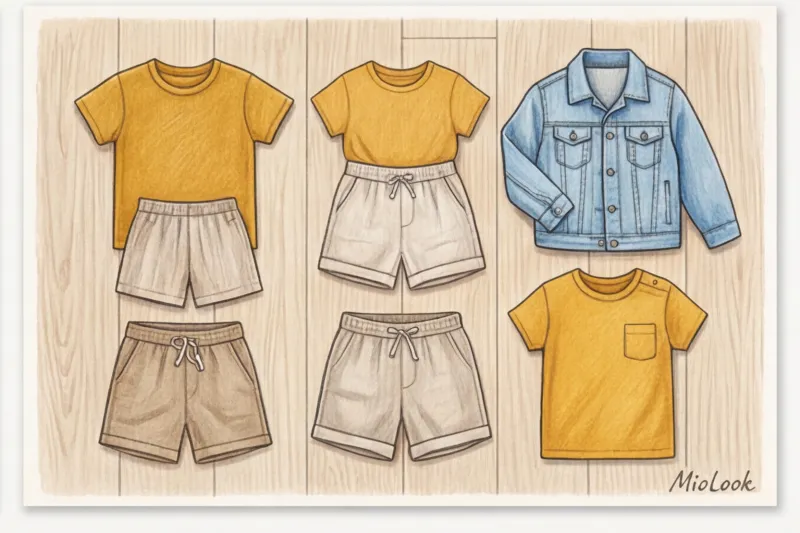
The golden rule of a stylist when creating a children's summer capsule is 3 tops for 1 bottom Why is this so? Children stain T-shirts and shirts three times more often than shorts or pants. Furthermore, the portrait area always attracts more attention—by changing just the top, you visually create a completely new look.
The math behind a wardrobe is astounding: just 12 well-chosen pieces (for example, 3 bottoms and 9 tops that match) give you up to 48 different combinations. That's enough for not only a two-week beach vacation but also a month of active city living.
Why 12-14 items will replace an entire suitcase
The optimal size for a child's travel capsule is 12-14 items of clothing (not including underwear and accessories). A 2023 study by the American Psychological Association (APA) confirms an interesting fact: too many choices leads to frustration and morning tantrums in children aged 3-5.
A limited but well-thought-out capsule gives your child the illusion of control. When the closet only contains coordinating items, you can confidently say, "Choose what you'll wear." And they won't choose a classic shirt with sweatpants because they simply aren't in the capsule. This is safe for a mother's sense of style and beneficial for developing independence.
Access to MioLook for €0.99 — one-time payment
Start creating perfect images for yourself and your children using artificial intelligence.
Get access — €0.99 onceThe biggest mom myth: why 100% linen and dark, "non-marking" colors are a bad idea
In my 14 years as a stylist, I've regularly encountered the same misconception: "You need to buy your child dark clothes so stains won't show." This is the biggest mistake in summer wardrobes.
White is the most practical color for a child's summer wardrobe. Sound counterintuitive? Let me explain. A light-colored cotton T-shirt stained with chocolate ice cream or berry juice can be soaked in oxygen bleach and washed at 90 degrees Celsius. It will return to its pristine white color. However, if you do this to a brown or dark blue item, the stain will be gone along with the pigment, leaving the item irreparably ruined by a whitish streak. White fabrics also reflect sunlight, protecting your child from overheating.
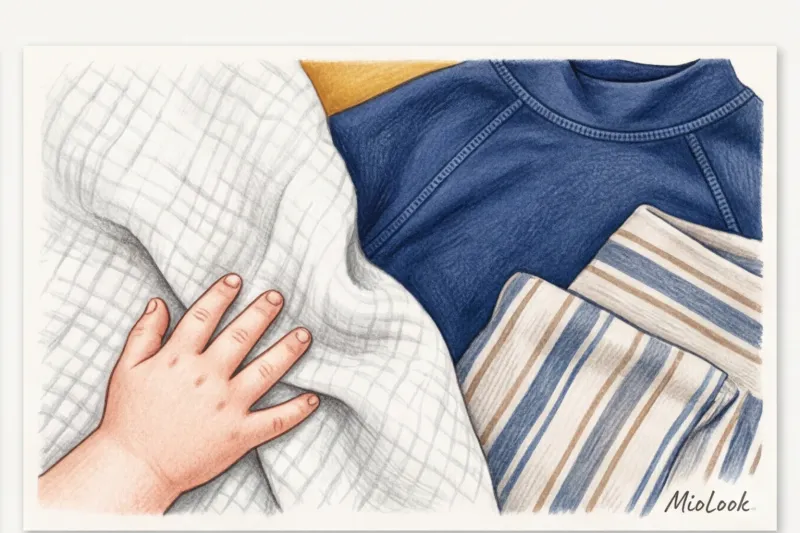
The second myth concerns linen. "Linen is the perfect summer fabric," marketers say. But in my experience, pure, dense linen often causes children to cry. It's stiff, lacks stretch, and after contact with seawater and sand, it begins to mercilessly chafe delicate skin.
What to choose instead of pure linen:
- Muslin: Two- or three-layer cotton. It breathes, dries instantly, and, most importantly, gets softer after each wash.
- Seersucker (reaper): fabric with a natural crash effect.
- Blended flax: Look for 50-70% linen and 30-50% cotton or viscose.
"The main rule of a vacation wardrobe: if an item needs ironing, leave it at home. Choose fabrics with a natural wrinkling, such as muslin and seersucker. Even budget brands, ranging from €15 to €30, offer excellent options."
Basic structure of a summer capsule: a checklist of items
Here's a step-by-step plan I've tested on dozens of my clients that covers 100% of an active child's needs in the summer:
- Basic T-shirts (3 pcs.): plain, cotton density from 160 g/m² (thin ones will quickly lose their shape).
- Accent T-shirts/polos (2 pcs.): with a print or interesting texture.
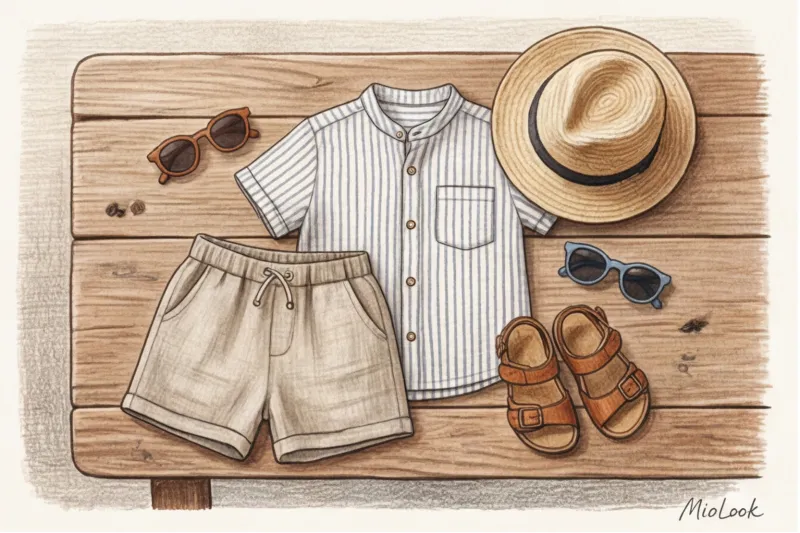
- Everyday shorts (2 pcs.): Some are knitted for active games, some are cotton/chinos for the city.
- Lightweight trousers (1 pc.): muslin or thin cotton (protection from mosquitoes in the evening).
- Long sleeve shirt (1 pc.): for sun protection and creating stylish layered looks.
- Second layer (1 pc.): cotton cardigan, light hoodie or denim jacket.
- Swimwear (2 pcs.): While one pair of swimming trunks is drying, the child puts on the second.
The second layer rule is crucial. In the city, you'll face icy air conditioners in shopping malls, and at the seaside, cool evening breezes. A lightweight denim jacket or a thick, oversized cotton shirt will save the day.
UPF-rated clothing: a must-have for the sea
Did you know that a regular cotton T-shirt offers almost no sun protection? According to the European Society of Paediatric Dermatology, a dry white cotton T-shirt has a sun protection factor of approximately UPF 5-7. But when a child swims and the fabric gets wet, this value drops to a critical UPF 3.
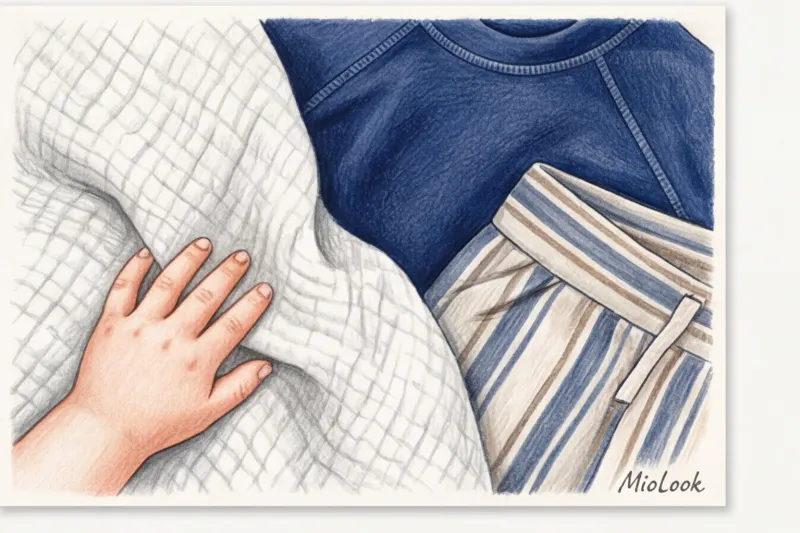
That's why a rashguard (swimming shirt) with a UPF 50+ rating isn't a fad, but a medical necessity. To avoid looking like a surfer's uniform outside the beach, choose basic shades (terracotta, olive, dusty blue) without oversized logos. Then you can easily wear it with regular shorts on your way to the beach.
Color Palette: How to Incorporate Your Favorite Dinosaur into Your Stylish Wardrobe
Creating a capsule collection begins with choosing a palette. Choose two base neutral colors (e.g., off-white and beige) and two or three accent colors (e.g., mustard, terracotta, and khaki). All clothing should fit within this scheme.
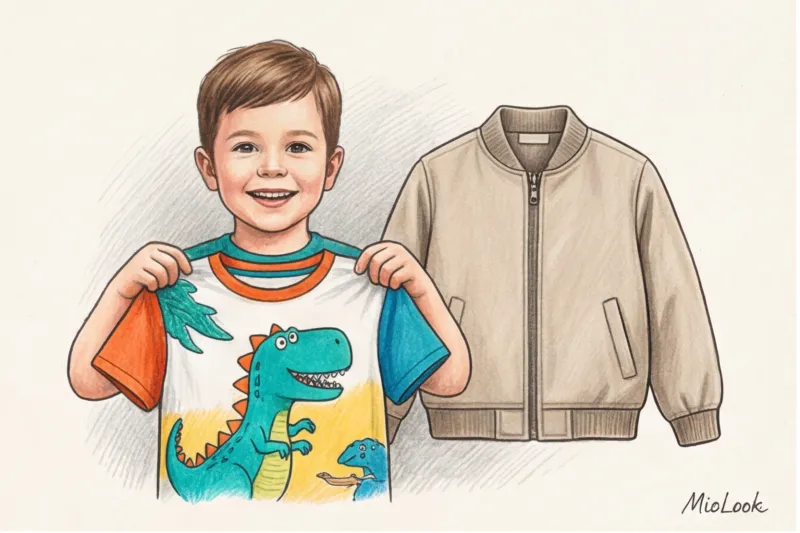
But what about children's desires? Once, a client and I were putting together a wardrobe for her son, Mark, who flatly refused to wear "boring" solid-color clothes. All he wanted was a neon Batman print covering his entire chest.
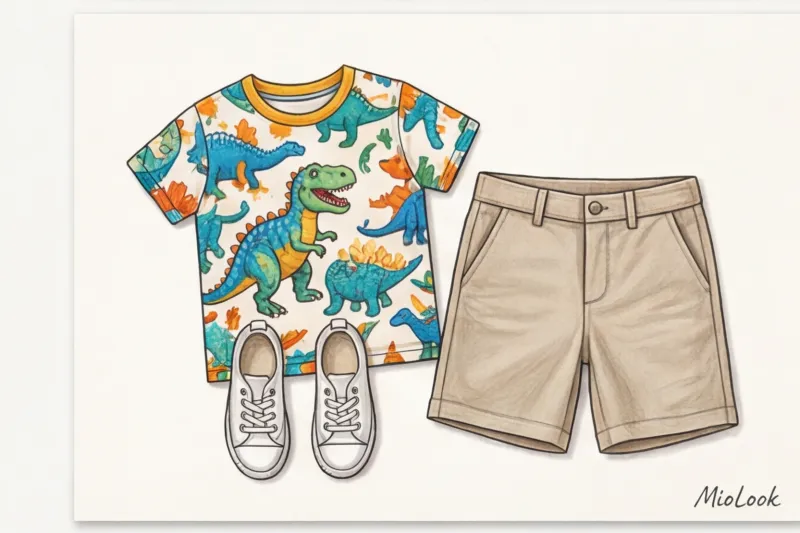
We didn't break the child, but used the rule "1 accent print for 3 basic items" We came to an agreement with Mark: he could choose any two T-shirts featuring his favorite characters, but he would wear them exclusively with basic, solid-color beige chinos. The acid-colored print instantly "calmed down" against the elegant beige cotton. The child was happy, and his mother no longer flinched at the sight of his outfit.
Your perfect look starts here
Upload items into the app and let the algorithms create stylish capsules for the whole family.
Get access — €0.99 onceHow to Adapt a Capsule: From Beach Mode to City Mode
The secret to a smart summer capsule is changing the context through details. You don't need separate outfits for the restaurant, the sandbox, and the beach.
I'll show you using the example of a regular oversized muslin shirt:
- Scenario "The Beach": A shirt thrown over swimming trunks, unbuttoned, sleeves rolled up casually, rubber sandals on her feet. A relaxed, lazy look.
- Scenario "Dinner on the Embankment": The same shirt is buttoned all the way up (except the top one), tucked into cotton chinos with a belt, and white sneakers. A whole new level of formality!
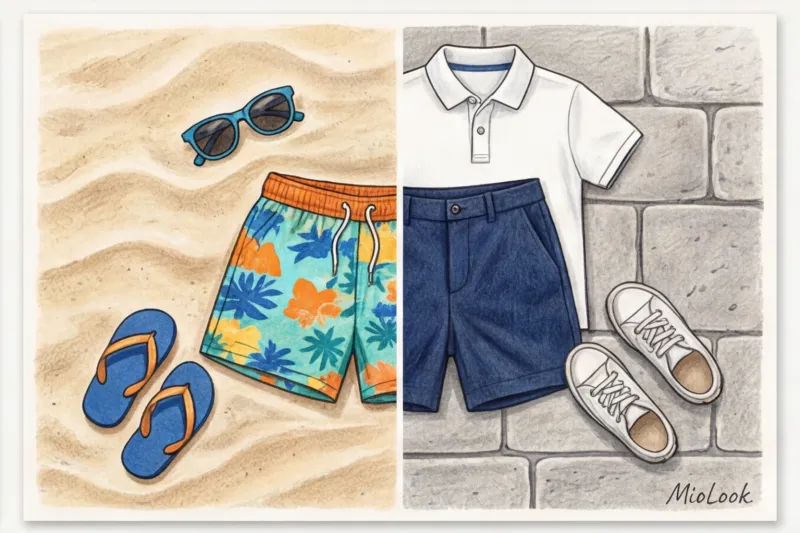
The same goes for layering. On a hot city afternoon, a child might wear a basic T-shirt and shorts. As soon as you enter a museum with powerful air conditioning, an unbuttoned long-sleeved shirt is thrown on over the T-shirt. It looks stylish and protects against the temperature change.
Shoes and accessories: what you absolutely mustn't skimp on
While you can save money on T-shirts and shorts by buying mass-market items for €10–€15, shoes and accessories require an investment. For a full summer, a child only needs three pairs of shoes:
- Lightweight closed-toe sneakers or trainers: for flights, long excursions and cool days.
- Leather sandals with heel lock: for everyday city walks.
- Rubber shoes (Crocs or Aquashoes): for beach and pool only.
It's important to make a serious disclaimer here, especially when comfort comes at a cost. Orthopedists are adamant: Crocs and rubber clogs are footwear exclusively for water. Wearing them in the city for more than an hour is detrimental to the development of a child's foot, as they don't provide the necessary support and cushioning.
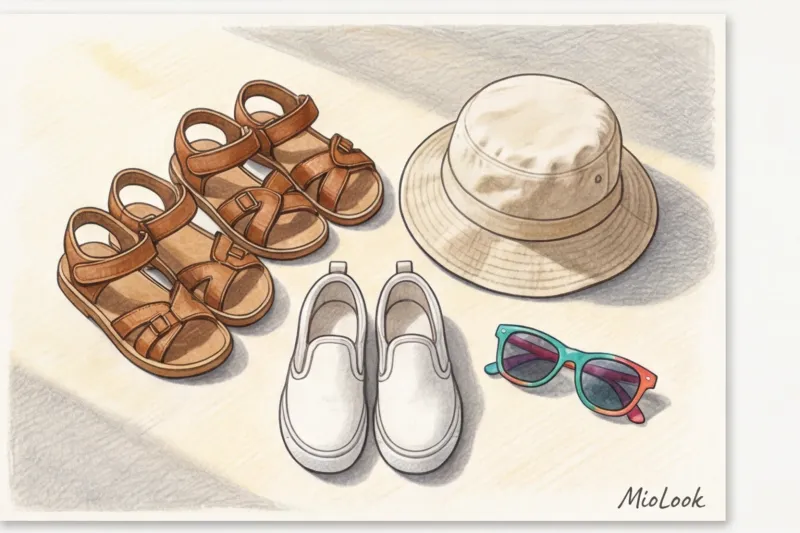
Headwear: Forget tight baseball caps. They only cover the face, leaving the ears and neck (the most common sunburn areas for children) exposed. A wide-brimmed Panama hat with a tie under the chin is the ideal choice.
Sunglasses: This isn't a fashion accessory or a toy. A child's lens transmits more UV light than an adult's. Look for lenses labeled UV400 or 100% UV Protection, typically priced between €30 and €50. Cheap plastic glasses from the market without protection will cause more harm: under a dark lens, the pupil dilates and receives a severe dose of UV light.
Suitcase Packing Guide: Your Summer Action Plan
To avoid running around the shops the day before your flight, use this algorithm. I make all my clients go through these three steps:
- Strict audit. Get out all your summer clothes from last year. Try them on. Ruthlessly discard anything that's become too small, has lost its shape, or has stubborn stains.
- Shopping list. Look at the remaining list and write down exactly what's missing. For example: "I need 1 white t-shirt, 1 pair of khaki shorts, and new sandals." To visualize the list, it's helpful to use MioLook app — upload your existing items there, and the algorithm will automatically suggest gaps in your wardrobe.
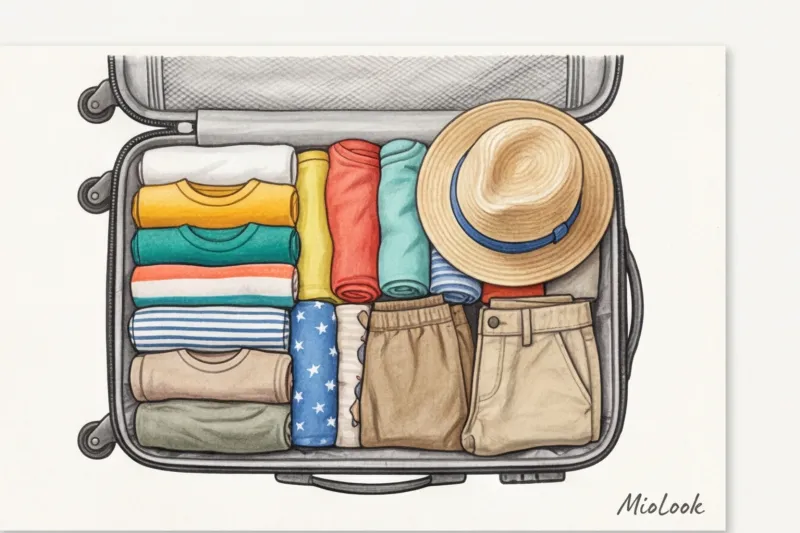
- Packing a suitcase. Use the KonMari method—roll your clothes into tight rolls. Firstly, this saves up to 30% of suitcase space. Secondly, it reduces wrinkles in clothes (especially muslin and cotton).
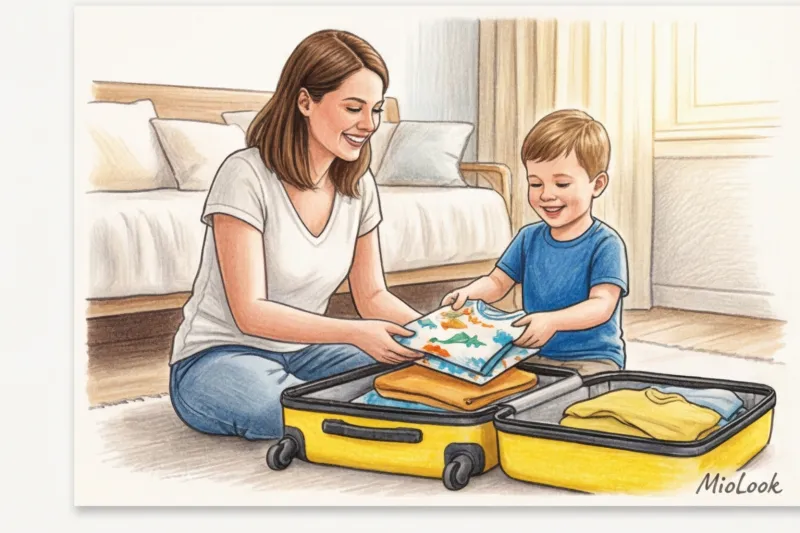
The secret to a stylish child on vacation isn't a ton of rhinestone-studded items or intricate prints. It's a well-thought-out wardrobe, the right breathable fabrics, and shoes you can run five kilometers in without wearing out your feet. Invest the time to create a plan of 12 perfect items once, and you'll never have to pay for excess baggage or coax your child into wearing "that pretty, but itchy shirt" again.