Why the classic approach to maternity clothing no longer works
When I first found myself backstage at Paris Fashion Week over a decade ago, I learned the industry's cardinal rule: your style is your visual voice. But have you ever noticed a strange transformation? As soon as a woman sees two lines on her pregnancy test, it's as if the mass market decides she's lost her sense of style along with her waist. In my career as a stylist, I regularly witness this drama: brilliant professionals accustomed to the impeccable architectural tailoring of Celine or The Row suddenly find themselves in a specialized maternity section, where they're persistently offered... ruffles, rhinestones, and childish polka dot prints. That's why a well-composed capsule wardrobe for pregnant women — it’s not just a set of one-size-fits-all items; it’s your main tool for maintaining your personal identity during the most radical changes in your body.
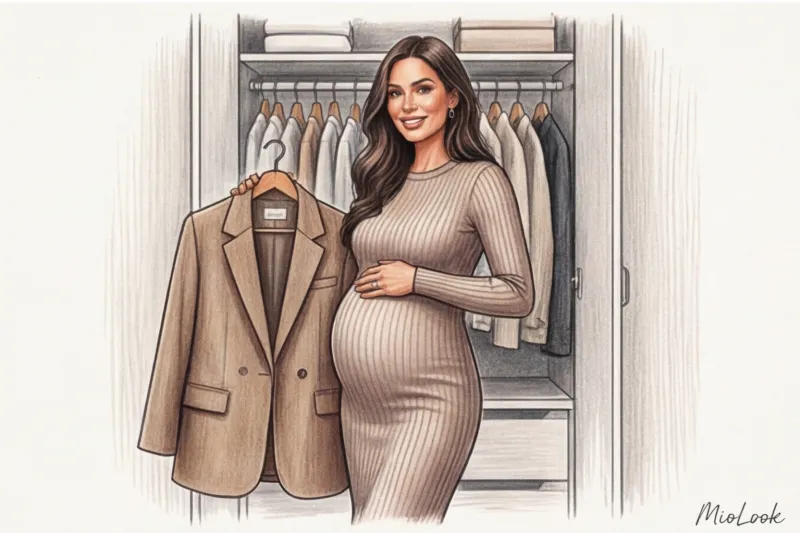
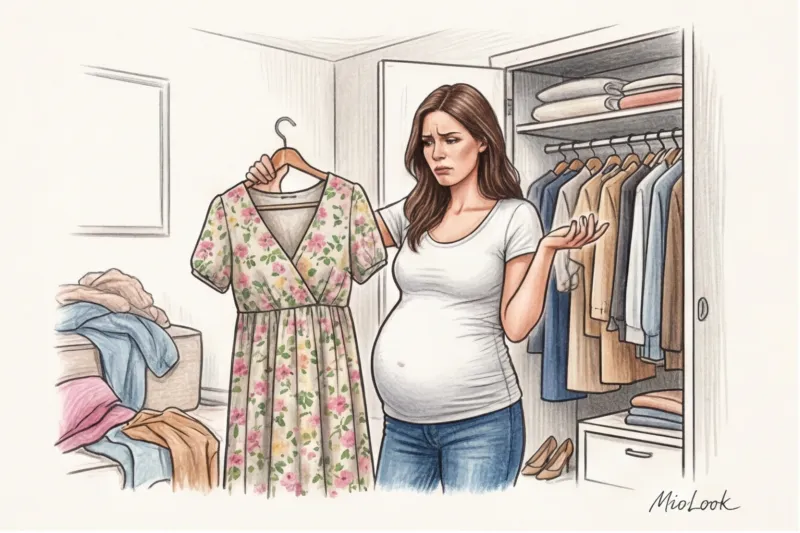
Let's face it: the traditional maternity wear industry is obsolete. For decades, marketers have been pushing clothes that physically distort the silhouette. The most glaring example is the notorious gathers and drawstrings right under the bust. This adapted empire silhouette, in its worst, mass-market execution, mercilessly distorts proportions. By stretching the fabric from the fullest point of the bust downwards, such designs visually transform the figure into a monolithic tent, depriving it of any dynamic movement. One of my clients, an architect at a major firm, once exclaimed in exasperation, "In these specialized dresses, I feel less like a project manager and more like a giant cupcake."
The stereotype that pregnancy obliges a woman to completely change her aesthetic to something "soft and homey" is a marketing ploy that costs women hundreds of euros and a huge loss of self-confidence. Buying an entire wardrobe labeled "maternity" is a waste of money and a direct threat to your personal style.
The fashion industry has already found a way out. Today, the concept of "Non-Maternity Maternity Wardrobe" — a maternity wardrobe without maternity items. This approach, actively promoted by influencers like Pernille Teisbaek and Rosie Huntington-Whiteley, eschews specialized brands in favor of masterfully styled everyday items. According to the WGSN global trend study (2023), over 65% of women no longer want to invest in clothes "for a few months," preferring pieces that will last them after giving birth.
Understand, The difference between a capsule wardrobe and a basic wardrobe During this period, it's critically important that the capsule be built on the strict interchangeability of a minimal number of items. And to ensure this system works, I recommend my clients use a clear mathematical formula.
The 70/30 Rule: How to Save Money and Maintain Your Style
The essence of my favorite 70/30 rule is extremely pragmatic: in the ideal capsule bag for an expectant mother, 70% of the items should be from regular collections (or even from your partner’s closet), and only 30% from specialized lines. That is, How to build a capsule wardrobe: step-by-step instructions Often described for standard figures, here it requires a small adjustment for elasticity.
These 70% — your stylistic foundation and long-term investment. This includes:
- Oversized and masculine cut: Voluminous jackets and men's shirts create complimentary vertical lines and conceal early pregnancy changes.
- Textured knitwear: Ribbed knit dresses and tops that stretch horizontally but retain their density and shape thanks to 3-5% elastane.
- Wrap dresses: Diane von Furstenberg's brilliant invention from the 1970s. Few people know this, but during pregnancy, not only the waist but also the chest expands (by an average of 5-10 cm). The wrap-around design perfectly accommodates these physiological changes.
The remaining 30% This is an area where technological innovation is essential. No matter how much you love your vintage Levi's 501s, by the sixth month they'll start to constrict blood flow. This 30% includes specialized jeans with a support band (under-bump or over-bump—fitting under or over the stomach), the right seamless underwear that doesn't irritate the breasts, and thick leggings with a special insert.
Let's look at the numbers: a complete seasonal wardrobe refresh in the maternity section will cost between €400 and €800 on average. And these items will be vacuum-sealed just three months after giving birth. By following the 70/30 rule, you'll not only maintain your usual chic style but also continue to wear most of your items during your recovery period.
To avoid impulse purchases, I strongly recommend starting with an audit. Upload your current oversized sweaters, elasticated knit skirts, and loose shirts to the app. MioLook Artificial intelligence will help you take a new look at what you have already exists , creating dozens of looks from your 70%. Only then will you understand which specific items from the 30% you really need to buy.
The Anatomy of a Perfect Capsule: Styles and Fabrics That Grow with You
The secret to successful maternity style lies not in the labels of specialized brands, but in the simple physics of materials. Last year, while working on a wardrobe for the creative director of a London PR agency, we encountered a typical problem: a strict dress code and a growing belly seemed incompatible. The solution was a complete overhaul of compositions and constructions. We rebuilt her capsule wardrobe based solely on the properties of fabrics.
The first and most important step is rejection of rigid structures in favor of architectural softness Classic tailoring (darts, rigid taped seams, a snug waist) is based on maintaining a defined shape. Pregnancy, however, requires a dynamic approach. Natural linen, heavy poplin, or non-stretchy denim begin to work against you as early as the fourth month, creating unnecessary tension and discomfort.
They should be replaced by materials with natural fluidity: viscose, modal, and especially tencel (lyocell). Tencel not only drapes beautifully, conforming to the body's new curves, but also absorbs moisture 50% more effectively than cotton. Considering that expectant mothers have a higher basal body temperature, this breathable quality becomes critically important.
A maternity capsule wardrobe shouldn't consist of shapeless robes. Architectural softness means that the garment maintains its shape due to the density of the weave, but also adapts to your body shape.
However, softness alone isn't enough—the fabric must be able to return to its original state (recovery rate). This is where the key rule for buying knitwear lies: look for 3-5% elastane in the composition (Spandex or Lycra). A 100% cotton jersey dress will stretch out across your stomach and by evening will ripple unattractively, losing its original silhouette forever. Adding just 4% elastane acts like a spring—the fabric stretches with you during the day and shrinks back after washing. A high-quality basic turtleneck made of a modal blend will cost around €45–60, but it will last you for nine months without becoming a stretched-out sack.
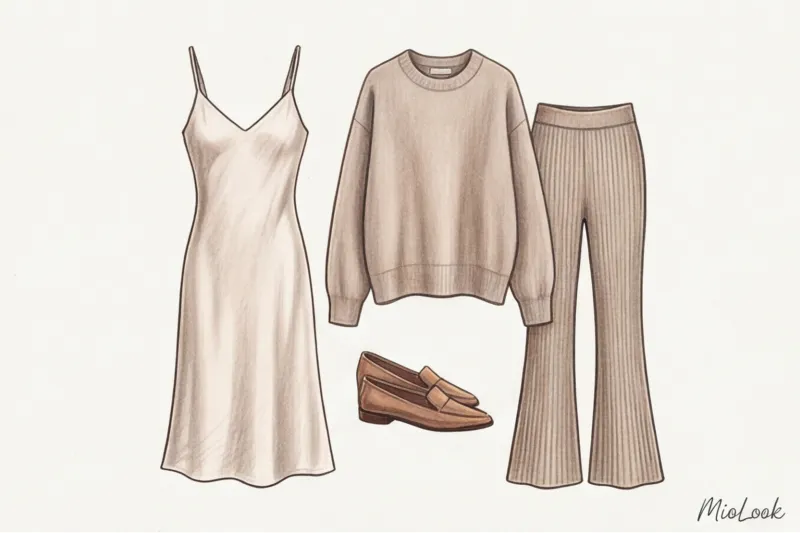
But what to do with non-stretchy, fine fabrics like silk? The fashion world found the answer to this question exactly one hundred years ago. Bias cut , brilliantly introduced into circulation by couturier Madeleine Vionnet in the 1920s, has become a real salvation for pregnant women today.
The essence of the Vionnet technique is cutting the fabric at a 45-degree angle to the warp and weft threads. This mathematical marvel of construction imbues the completely inelastic, smooth silk with the properties of knitwear. The fabric acquires the ability to stretch horizontally (accommodating a growing belly) and simultaneously drape beautifully vertically, creating a graceful, elongated silhouette instead of excess bulk.
Transforming silhouettes for any stage
Understanding the physics of fabrics allows us to select three flawless silhouettes that will seamlessly fit into your wardrobe and stay there after your baby is born.
- Slip dresses made of thick silk or cupro. Thanks to the bias cut we mentioned above, this dress fits perfectly at any stage of pregnancy. I recommend choosing thick cupro (a vegan silk substitute)—it has a velvety texture, resists static, and is easy to machine wash. A basic midi slip dress in the €120–€180 range will be the foundation for dozens of looks.
- Wrap dresses and tops (a-la Diane von Furstenberg). The iconic silhouette, created by Diane von Furstenberg in 1974, features a unique design. Long ties allow you to adjust the fit millimeter by millimeter. As your belly grows, the wrap line naturally shifts higher, creating an elegant empire waist.
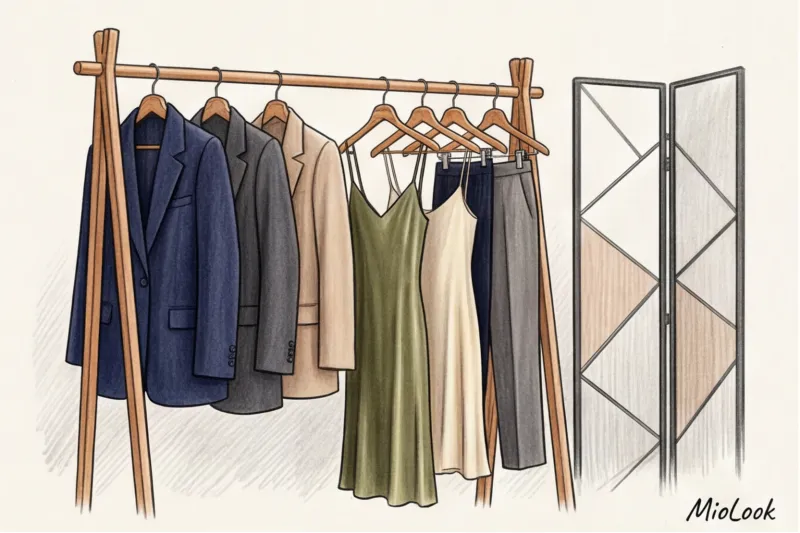
- Men's shirts and oversized jackets as a top layer. To be fair, bodycon dresses and bias-cut silk can be psychologically unsettling if you're not used to flattering your figure. This is where the principle of verticals comes in handy. By wearing an unbuttoned men's shirt made of thick cotton or a structured, tailored jacket over a slip, you create two distinct vertical lines. They visually elongate your height, tie your look together, and subtly conceal any extra bulk at the sides.
Access to MioLook for €0.99 — one-time payment
A smart AI stylist will select the perfect look from your items and suggest how to integrate new purchases.
Get access — €0.99 onceMaternity Capsule Wardrobe by Trimester: Style Evolution
Your body's evolution during this period isn't linear—it's a series of sharp changes that require immediate stylistic adjustments. Every three months, you have to reacquaint yourself with your silhouette, and not only physical but also psychological comfort comes to the fore. In the first few weeks, we crave maximum privacy, but as we approach the midpoint, the desire to beautifully highlight our new status emerges.
Do you know what the most common "life hack" I encounter during my first consultations with expectant mothers is? A regular hair tie, stretched between the button and buttonhole of a pair of pre-pregnancy jeans. Just last month, while sorting through her wardrobe with the marketing director of a Berlin IT company, I pulled three such pairs out of her closet. It's a desperate attempt to cling to old clothes that only causes physical pain and ruins the silhouette.
Trust me: the moment you start using a hair tie or a safety pin, it's a clear sign. Your old wardrobe has stopped working, and you need a full-fledged maternity capsule wardrobe, not the illusion of "just another week." A properly designed capsule wardrobe will evolve with you, adapting to your changing sizes without the need for monthly shopping.
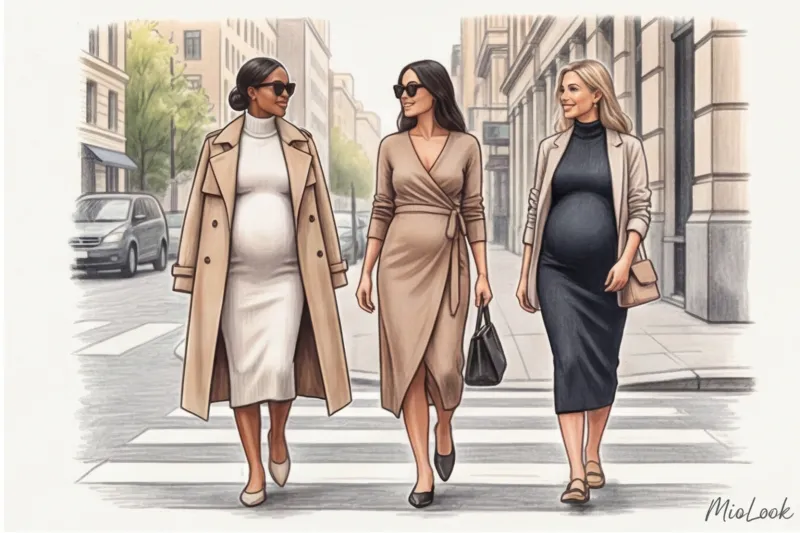
First trimester: secrecy and adaptation
The first three months are a time of stylistic paradoxes. You haven't yet developed a real belly, but progesterone levels cause severe bloating, making your usual clothes feel mercilessly tight. Psychologically, this is the most difficult stage: you don't feel pregnant, but simply "gained weight," and most women prefer to hide their condition from colleagues and management.
The solution lies in clever concealment and avoiding rigid waistbands. Drawstring trousers and skirts with elastic waistbands are your best friends. Pay attention to this detail: if the waistband of a skirt or trousers remains flat and structured in the front (like in classic suits) and the elastic is hidden only in the back, you maintain a perfectly tailored look while gaining the necessary 4-6 centimeters of freedom. Brands like COS or Arket often offer such styles in their regular lines, and they're a brilliant investment of around €80-120 that will last you for years to come.
To hide changes in my figure from my most attentive colleagues, I always use architectural multi-layeredness The trick is to create an optical illusion using vertical lines. An unbuttoned, long, straight-cut jacket worn over a slightly loose silk top visually "cuts" your silhouette into three narrow vertical stripes. The viewer's gaze glides down the jacket's lapels, completely ignoring what's happening at the waist.
Second and third trimesters: Focus on the belly and maximize comfort
Around 16–20 weeks, hiding the changes becomes pointless, and a crucial psychological shift occurs: we move from concealment to aestheticization. At this stage, basic items from your regular wardrobe (the same 70% rule we discussed) begin to be combined with specialized pieces.
The most crucial step is switching to the right specialized "bottoms." The industry offers two landing options: under-bump (under the belly) and over-bump (on the stomach, with a high knitted panel). In my practice, I recommend models under-bump should be preferred only in the second trimester, especially if it falls during the hot summer, when the extra layer of fabric on the stomach causes discomfort. However, for the third trimester, over-bump absolutely irreplaceable. A high-quality elastic panel (look for at least 15% spandex) works like a lightweight bandage, providing mechanical support for your growing belly and taking some of the strain off your lower back.
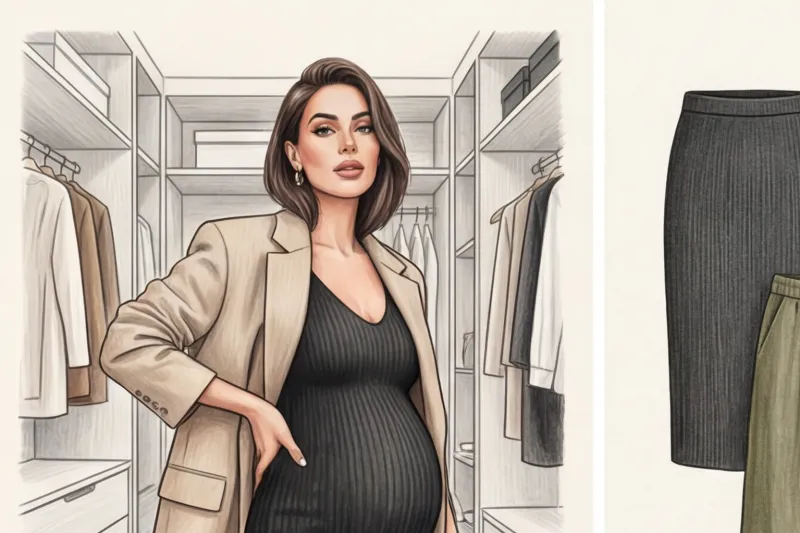
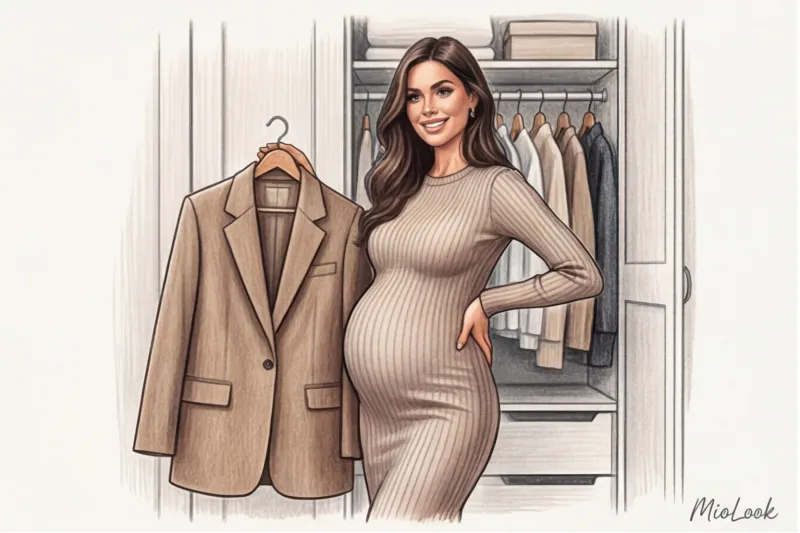
When it comes to dresses, forget about shapeless slouchy dresses. The ideal choice for the second and third trimesters is a form-fitting ribbed knit dress. Thanks to its texture, the ribbed knit stretches horizontally just right without distorting the vertical rhythm of the fabric. This dress creates a stunningly beautiful, chiseled silhouette, highlighting the midriff as the main focus of the look. Pair it with an oversized men's shirt or a tailored blazer, and you'll have a look straight out of a Vogue cover.
And here lies the main mistake that 90% of women make: they forget about fourth trimester — the postpartum period. Your body doesn't return to its original shape overnight. After giving birth, your belly will look roughly the same as it did in the fifth month of pregnancy, and this is completely normal. That's why nursing and recovery clothes should be planned mid-pregnancy.
When choosing items for your capsule now, test them for functionality right away: do dresses have a deep V-neck or a wrap-around design for easy access when feeding? Do shirts unbutton with one hand? To avoid confusion about what's right for you now and what needs to wait, I strongly recommend digitizing your items. Upload your database to MioLook — The smart wardrobe feature helps you filter clothes that are relevant for your current trimester in just a few clicks. This eliminates morning stress and trying on clothes that physically don't fit you right now, saving you time and stress.
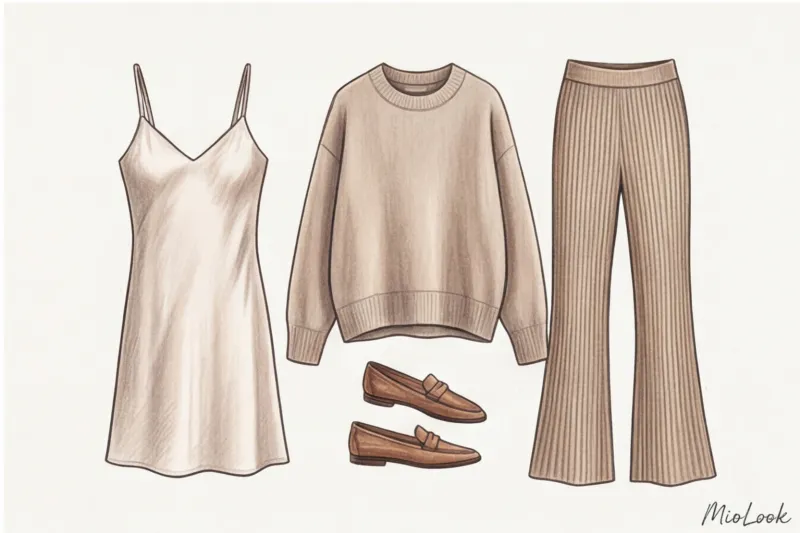
Basic Formula for a 15-Item Capsule (Checklist)
According to a 2023 McKinsey research report, the average woman regularly wears only 20% of her everyday wardrobe. During pregnancy, this figure often drops to a disastrous 10%, leaving the expectant mother surrounded by clothes that don't fit her. Over the years as a fashion journalist and stylist, I've developed a strict rule: capsule wardrobe for pregnant women does not tolerate impulse purchases and requires a dry, mathematical approach.
Below is the very same insider, precise list I compile for my private clients. It ruthlessly excludes "disposable" items of questionable cut (forget T-shirts with childish slogans). This is a ready-made scheme of interchangeable items for creating 30+ everyday looks. The average budget for such a high-quality base from brands like COS, Arket, or Massimo Dutti is €500 to €800, but the cost-per-wear (cost per outfit) will be minimal—most items will last for years.
Tops: Playing with proportions and layering
We're completely abandoning tight, thin tops in favor of pieces that create clean, architectural lines. Your absolute essentials for the coming months:
- 2 oversized shirts (Pure white with thin blue stripes, made of heavy cotton). They work flawlessly as a stand-alone piece or as a lightweight jacket worn open over a dress.
- 2 basic t-shirts (One size larger than your usual). My personal advice: go straight to the men's department and look for heavy cotton at least 180 g/m². It's not see-through, holds its shape, and doesn't clutter your underwear.
- 1 long cardigan An indispensable tool for creating two open vertical lines that visually elongate the silhouette and eliminate excess volume.
- 1 structured jacket While your body inevitably takes on new, softer contours, the jacket's wide, crisp shoulder line brings a sense of collectedness and dynamism back into the look.
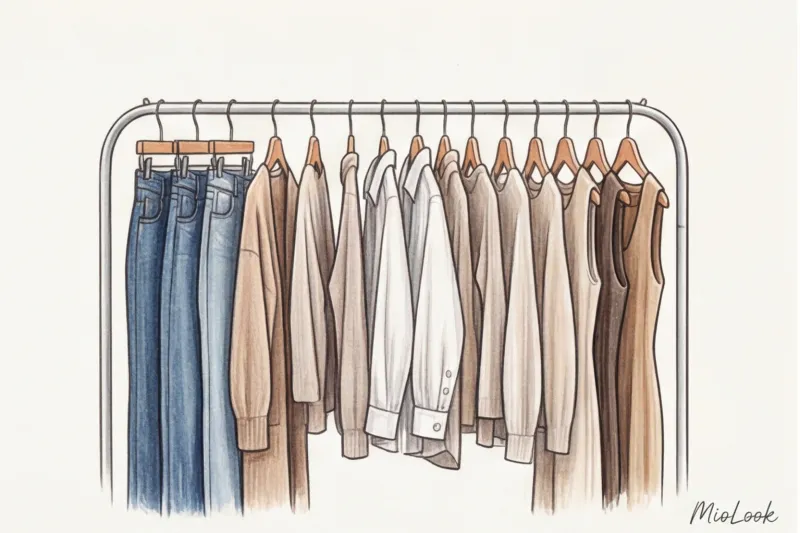
Bottoms: Uncompromising comfort
It is in this category that we specifically integrate specialized clothing to minimize any pressure on internal organs.
- 1 pair of specialized jeans Choose straight or wide-leg, full-length styles with an elastic band. This is your ultimate utility investment.
- 1 pair of knitted trousers Cashmere, thick merino wool, or a cotton blend with 3–5% elastane added is ideal to prevent the knees from bulging.
- 1 pair of maternity leggings A luxurious staple to pair with oversized men's shirts and a structured jacket (a reimagined '90s Princess Diana aesthetic).
- 1 silk midi skirt with elastic Wear it under your belly. The silky, flowing texture will add the necessary polish and visual lightness to your everyday look.
Dresses and outerwear: adaptability of cut
Dresses are the most functional elements of a capsule wardrobe, if you choose the right style in advance, without restricting movement:
- 1 knitted midi (Heavily ribbed fabric). Instead of shyly hiding your new figure in loose-fitting layers, this dress elegantly hugs your curves, creating a confident and very modern silhouette.
- 1 slip dress Wear it over a basic tee for daytime or add chunky jewelry for an evening out.
- 1 shirt dress This ingenious invention adapts as your belly grows (just unbutton a couple of the bottom buttons) and will be your absolute salvation during subsequent breastfeeding.
"The secret to a smart wardrobe is avoiding accessories that dictate a rigid fit. We choose smart pieces that adapt to your size, not the other way around."
The capsule is completed with outerwear. You need a classic trench coat or robe coat (models that require no fastening whatsoever). You simply tie a soft belt just above your natural waistline, just above your belly. No strained buttons or loose zippers.
To avoid having to think about all these fashion combinations, I recommend my clients digitize their purchases right away. Upload photos of these 15 items to the "smart wardrobe" feature in MioLook Artificial intelligence will automatically generate dozens of ready-made combinations for you depending on the weather outside, forever eliminating morning stress and thoughts like "I have nothing to wear again."
Access to MioLook for €0.99 — one-time payment
Start creating perfect images with the help of artificial intelligence
Get access — €0.99 onceWork and Business: How to Adapt Your Business Wardrobe During Pregnancy
In 2022, the CEO of a major fintech startup approached me. The situation was classic, but no less stressful: she was facing a crucial round of investor negotiations, and her pregnancy was inexorably approaching eight months. "Camilla, I can't pitch in a flyaway dress; I need to maintain my credibility, but my usual Tom Ford cut won't fasten anymore," she confessed during her first fitting. This brings us to the main challenge of corporate style during this period: how to maintain status and so-called executive presence (professional presence) when your body changes every week.
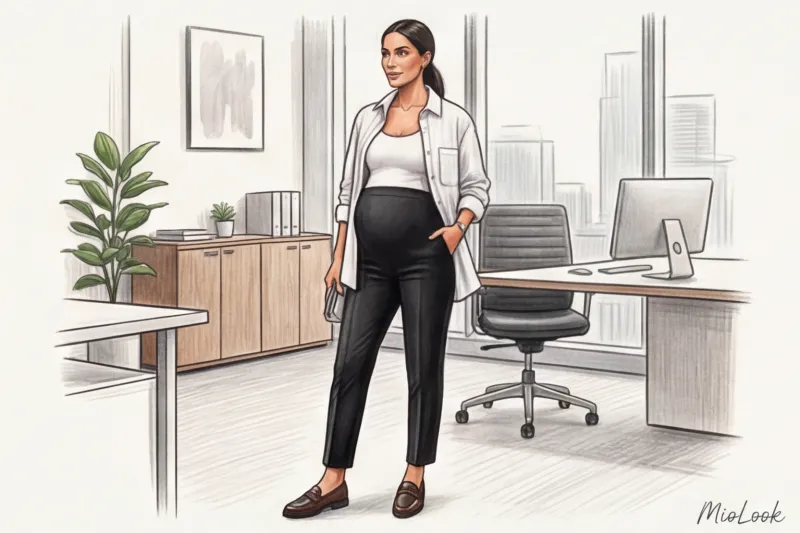
The secret lies in visual psychology. In the business world, authority is conveyed through clear, geometric lines. When a silhouette inevitably rounds out at the waist and hips, we need to offset this softness elsewhere. In the case of my CEO client, we opted for structured shoulders. We took a voluminous, thick, cold-spun wool blazer (from the men's line, as it traditionally has a more defined shoulder area) and used it as a rigid frame. Broad, graphic shoulders instantly balance out a prominent belly, restoring a businesslike composure to the look.
Alternatives to the Formal Suit: Monochrome and Architecture
The classic two-piece trouser suit in a dry, non-stretchy fabric will have to be put aside for now. The most elegant and practical alternative, which I incorporate into 90% of my "maternity" capsule collections, is a monochrome knitted suit paired with a tailored jacket.
Imagine a smooth, finely ribbed knit midi dress or a longline top and skirt set in deep graphite, chocolate, or cobalt. On its own, such knitwear might look too casual for a boardroom. But when you layer a structured, oversized jacket over it, optical magic happens. The inner monochrome column elongates your height and provides absolute comfort for your growing belly, while the outer, rigid layer ensures strict business attire.
To avoid wasting precious morning time choosing the right shade of jacket to go with your knitwear base, I recommend digitizing these outfits in advance. After uploading the basic items to the "smart wardrobe" feature in MioLook , you can create dozens of variations of business looks in a relaxed environment and simply open the app before leaving the house.
Trousers with creases: how to avoid the "sweatpants" effect
If you prefer trousers to the office, be careful. The main pitfall of maternity stores is the use of thin, loose knits, which make business trousers look uncannily like pajamas or sweatpants.
How to choose the right pants for the office? Look at the fabric composition. ponte di Roma (a dense double knit that holds its shape perfectly) or a tightly woven viscose blend with 3-5% elastane. True business trousers in a maternity capsule wardrobe should have a stitched crease—not just an ironed one. This ensures that the central vertical crease, which elongates the legs, won't disappear after the first wash or long hours at the desk. Investing in a quality pair will cost between €80 and €120, but it will pay for itself many times over with a flawless fit. And remember the golden rule: the elastic bandage insert should be made of a dense matte fabric that matches the trousers themselves, not cheap shiny mesh, which often shows through light-colored blouses.
The Magic of Accessories: Managing Attention in the Portrait Zone
Finally, we come to the most subtle styling tool—directing the gaze of your interlocutor. In later stages, when your belly becomes the obvious dominant feature of your silhouette, we need to shift the focus of your business partners' attention to the so-called portrait zone (face, neck, collarbone).
- Sculptural earrings: Replace your usual discreet studs with large earrings in a tumbled metal (gold or silver). They add sparkle to your face and draw the eye.
- Silk scarves: Tie a classic bob (90x90 cm) around your neck, letting the ends fall asymmetrically down along the lapels of your jacket – this will create an additional, slimming vertical line.
- Brooches: A large vintage brooch on the lapel of a formal jacket works like an optical magnet.
These details in the portrait area aren't just decorative; they strategically distract attention from the changes in her figure. Returning to the story with my client: during those crucial negotiations, she wore a massive matte metal flower brooch on the lapel of her black blazer. According to her, the investors looked her exclusively in the eyes. The deal, incidentally, was successfully closed.
Shoes and accessories: relief from swelling and a shift in the center of gravity
According to clinical recommendations from orthopedic doctors, during pregnancy, the body's center of gravity inevitably shifts forward. This biomechanical restructuring greatly increases the load on the lumbar spine. Add to this the active production of the hormone relaxin, which softens ligaments, making joints more vulnerable and unstable. Therefore, avoiding high heels is not just a matter of convenience, but a strict medical necessity. Orthopedists warn that wearing heels during this period provokes hyperlordosis (excessive arching of the lower back), which directly leads to chronic pain. From a stylistic standpoint, trying to maintain balance in 10-centimeter heels with a visible belly disrupts the natural proportions of the figure and conveys tension, whereas modern, sophisticated fashion demands a light, confident casualness.
What stylish alternatives will save the day? My absolute favorites for pregnancy capsules are shoes that can be put on hands-free (bending over to pick up laces in the third trimester is quite an ordeal). Opt for flat suede mules, ultra-soft leather loafers (especially those with flexible soles) sacchetto ) and retro-style sneakers. Sports models like the New Balance 530 or classic Adidas Gazelle offer excellent cushioning and are currently at the peak of popularity. The visual bulk of retro sneakers perfectly balances out a voluminous outer layer, whether an oversized trench coat or a loose men's jacket. A quality pair of basic leather loafers or the right sneakers typically costs between €100 and €250, making them a wise investment in your well-being.
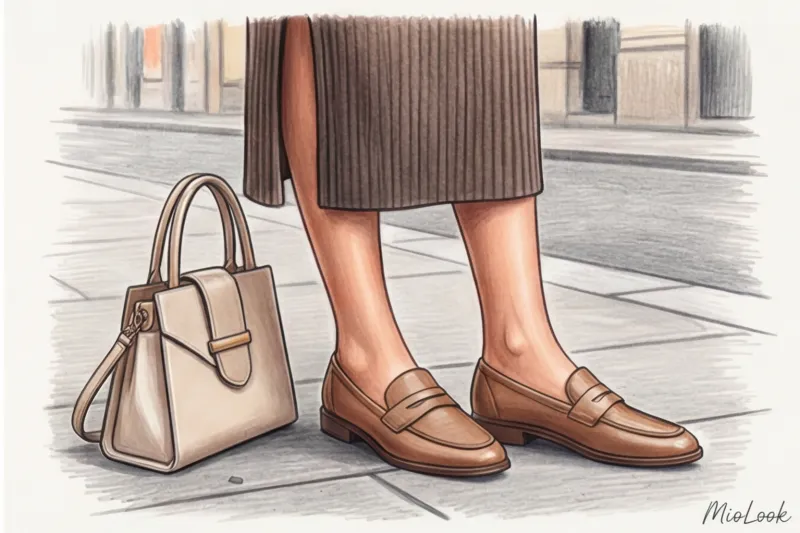
Here lies a crucial insider nuance that many women forget: How exactly to buy shoes During pregnancy. During the second and especially the third trimesters, foot volume inevitably changes due to fluid retention, and the arch often flattens under the weight of your feet. A stylist's golden rule: always try on new shoes only in the afternoon and buy pairs at least half a size larger than your usual size. Shoes that seemed perfect at 10am can become torture devices by 5pm due to natural evening swelling.
Accessories also require a thorough overhaul. The usual bulky tote bags and heavy shoppers, which we're accustomed to wearing on one shoulder or in the crook of our elbows, create an asymmetrical load on the back. The body instinctively slants, trying to support this weight. The only smart solution is to temporarily switch to structured, medium-sized crossbody bags with a wide fabric or leather strap. They completely free up your hands, distribute the weight evenly across the back, and create a visually stunning vertical line that elongates the silhouette. Look for bags made of lightweight materials—an empty accessory shouldn't weigh more than 400 grams.
To see how new flats and cross-body bags will pair with your usual dresses or formal office jackets without losing their elegance, I recommend uploading photos of the items to MioLook Virtual styling tools will help you calibrate proportions on your smartphone screen and ensure your look is harmonious and classy, even without heels.
Your ideal image
it begins Here
Join thousands of users who look flawless every day with MioLook.
Get access — €0.99 onceChecklist: 5 Steps to Creating Your Perfect Capsule
I often see women make the same strategic mistake: upon seeing those coveted two lines on the pregnancy test, they immediately rush off to buy the specialized selection in the maternity section. Stop. A functional maternity capsule wardrobe is built entirely differently—it's a thoughtful process of adaptation, not impulsive consumption.
"Your closet should be a mirror of your current life, not a repository of past habits or future expectations." This principle from renowned New York stylist Allison Bornstein perfectly describes her style philosophy during pregnancy.
Let's translate all the theory we've covered earlier into a concrete, step-by-step action plan.
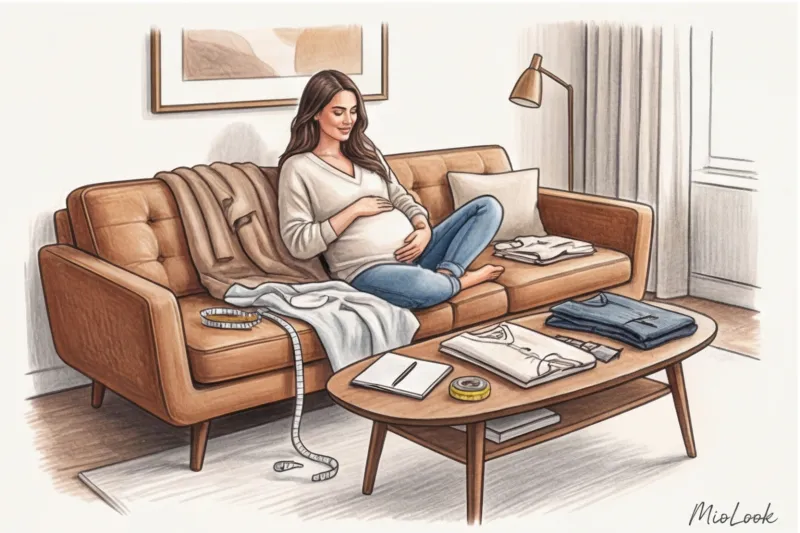
- Step 1: Inventory (put aside what is weighing you down). Clear out some space. Your first task is to ruthlessly put away any items with a stiff waistband or a tight fit around the stomach and chest on the top shelves or vacuum-seal them. If the zipper is difficult to close, it doesn't belong there. The psychology of styling is unforgiving: seeing your favorite silk skirts every morning that temporarily don't fit triggers morning micro-stress and a surge of cortisol. Keep only what fits perfectly and feels comfortable right now.
- Step 2: Buy the right underwear (seamless tops, bandages). Before investing in dresses, get the right foundation. Physiology dictates its own rules: the bust and stomach are the first and most dramatic changes in size. You'll need high-quality microfiber tops (they stretch two to three sizes without losing their elasticity) and supportive bandages. A good support belt (in the €40-€80 range) not only relieves the lower back but also acts as lightweight shapewear—it smooths the silhouette under fine knitwear, allowing the fabric to flow rather than bunch up in unsightly folds.
- Step 3: Select specialized bottoms (jeans/trousers). This is the very narrow category where buying items "marked maternity" really makes sense. You don't need five pairs—one perfect pair of jeans and basic suit pants with an elastic insert is enough. In winter, I recommend a fit over-bump (a wide belt is pulled over the stomach for warmth), in the summer - under-bump (under-the-belly fit). Pay attention to the denim's composition: look for at least 3-5% elastane. Brands like COS or specialized mass-market lines offer excellent minimalist options for €50-€120 that will withstand daily wear and washing.
- Step 4: Integrate oversized pieces from your (or your men's) wardrobe. Now bring back your favorite oversized jackets, wrap dresses, and chunky knit cardigans. And for the perfect straight-cut shirts, I always send my clients to my partner's closet or straight to the men's department. A classic men's shirt made of heavy cotton (look for a weight of at least 180 g/m² on the tag), worn open over a fitted slip dress, creates that perfect vertical line that visually elongates the silhouette and adds a sense of collectedness.
- Step 5: Using the MioLook app to build images virtually. The hardest part is making these disparate elements work together when your resources are limited and your body is constantly changing. Over the years of styling practice, I've learned that if an outfit isn't planned in advance, when you're tired, you'll habitually throw on leggings and a stretched-out hoodie. To avoid unnecessary purchases "out of desperation," digitize your remaining base and new purchases. Upload them to MioLook , you'll get a smart assistant. The virtual assembly feature lets you create and save dozens of combinations while you're literally lying on the couch. The system will automatically suggest fresh combinations from your existing items, proving you don't need a mountain of new clothes.
Building your wardrobe for this period isn't a story of restrictions and self-denial. It's your personal masterclass in mindful consumption and masterful proportions. You're investing not just in fabric for nine months, but in your own peace of mind, professional confidence, and physical comfort every day.
Start with the first step this evening. Simply open your closet and put away those pants that have become a bit too tight. I promise, you'll immediately feel an incredible sense of lightness—both on your closet shelves and in your mind.
Guide Chapters
Maternity Photo Shoot Looks: Stylish Ideas
No pink tulle or flower crowns. We'll explore how to take a high-fashion approach to your maternity photo shoot while maintaining your unique style.
Maternity Outerwear: How to Choose Wisely
Why shouldn't you shop at specialized maternity departments? Learn how to invest in the right silhouettes that will last for years.
Basic Maternity Dresses: 5 Stylish Styles
Forget shapeless robes! A stylist shares a selection of 5 perfect basic dresses that will flatter you during and after pregnancy.
Homewear for pregnant women: style and comfort
Pregnancy isn't a reason to sacrifice your style for shapeless shirts. We'll tell you how to choose stylish clothes for home and the maternity hospital.
What to Wear in the Third Trimester: Style Without Losing Confidence
The final months of pregnancy aren't a reason to put your style on hold. We'll show you how to maintain elegance and class with an architectural approach to your wardrobe.
Office Wear for Pregnant Women: A Stylish Dress Code
Professionalism doesn't disappear when you get pregnant. Learn how to create a comfortable and classy business wardrobe for expectant mothers without boring robes.
Style: How to Hide Your Belly in Early Pregnancy
In the first trimester, bulk is caused by hormones and swelling, not by the baby's growth. Learn how to effectively conceal these changes in your figure using your regular wardrobe.
A minimal list of things for pregnant women without unnecessary expenses
Why spend hundreds of euros on clothes you'll only wear for a couple of months? We'll tell you how to create the perfect maternity capsule without breaking the bank.
A Stylist's Guide: How to Choose Maternity Jeans
Pregnancy isn't a reason to give up on your personal style. Learn how to find the perfect structured denim jeans with the right fit.
Demi-season wardrobe for pregnant women: stylish essentials
Forget shapeless clothes and childish prints. We'll show you how to put together a stylish and comfortable maternity essential for spring and fall.
How to Wear Regular Clothes During Pregnancy: Tips
Pregnancy isn't a reason to give up your favorite wardrobe. Discover fashion insiders' secrets on how to style your favorite pieces throughout the nine months.
Maternity clothes that can be worn after giving birth
A smart wardrobe for expectant mothers without unnecessary expenses and shapeless dresses. A personal stylist's advice on choosing items that will last long after the baby is born.
Summer wardrobe for pregnant women: a capsule for the heat
Tired of uncomfortable maternity clothes? Learn how to put together a comfortable summer capsule collection using stylish and breathable pieces from everyday brands.
Stylish Winter Wardrobe for Pregnant Women: Capsule Collection
Learn how to put together a stylish winter maternity capsule wardrobe without buying specialized items. Smart layering secrets for expectant mothers.