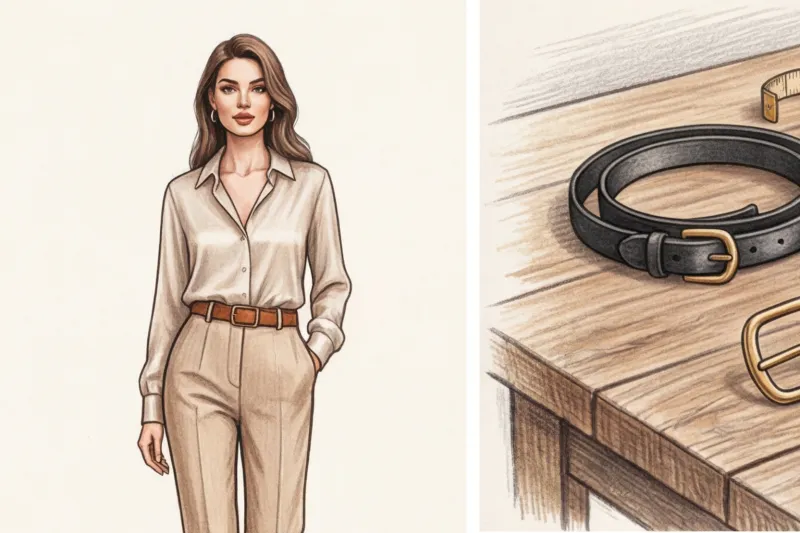
Why do you need a belt: more than just support for your trousers?
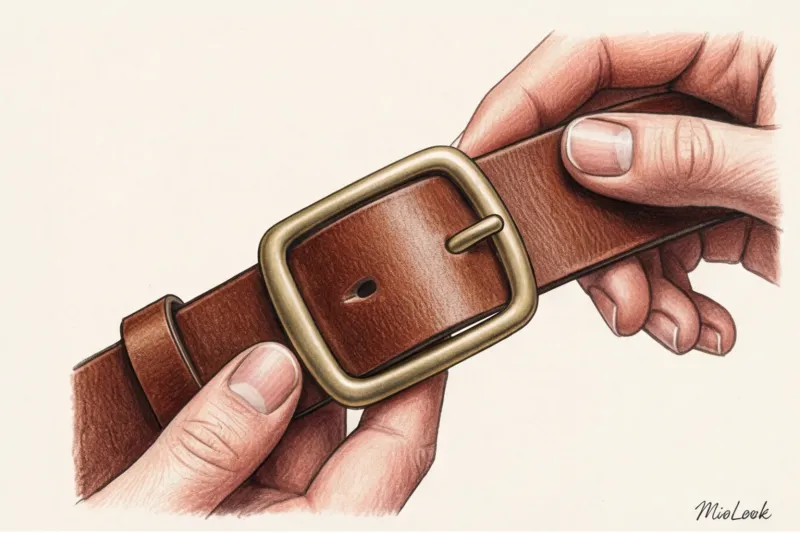
You know what item most often gathers dust on the back shelf of a closet with its tag still attached? A thin, unimpressive belt that "came with" a pair of trousers or a dress. Most women, out of habit, perceive this accessory as purely utilitarian: to make jeans fit tighter and prevent them from slipping down. But as an image consultant, I can confidently say: this is a colossal mistake. If you understand, How to choose the right women's belt , you get into your hands the most powerful tool for managing your focus.
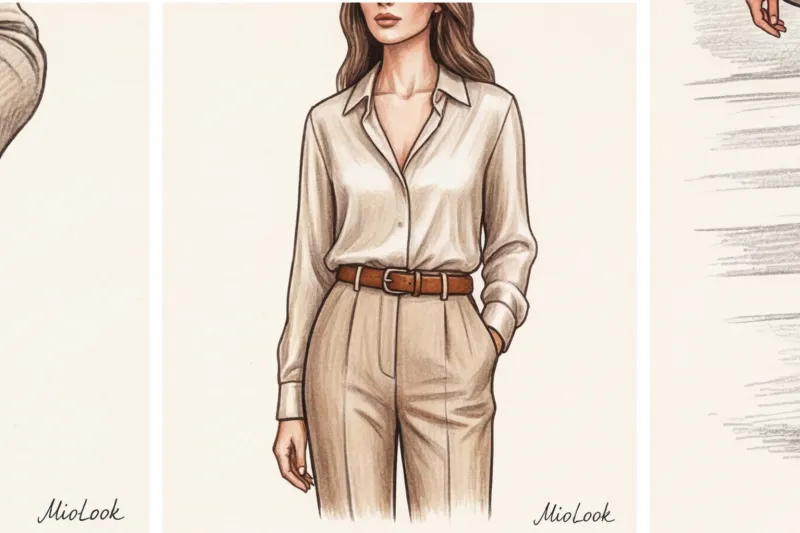
In my wardrobe analysis practice, there's one constant trick. The first thing I do when a client puts on her usual oversized jacket or straight dress is adjust the position of her belt. I literally move it a couple of centimeters higher or lower, adjust the tension, and 9 out of 10 times, we achieve an instant optical effect of "minus 5 kilograms." A belt isn't just a strip of leather. It's an architectural element that instantly reconfigures the geometry of your body. And believe me, a smart investment in a quality belt (even a basic €40-€80 one) can update your wardrobe more effectively than buying a dozen new dresses.
Let's turn to the laws of composition. Any belt inevitably creates a distinct horizontal line on your body. And the human eye is designed to read the length of your legs precisely from the point where this horizontal line runs. If you wear a belt at a low waist (hello, 2000s trends!), you artificially elongate your torso and mercilessly shorten your legs. Move this line to your natural waist or a centimeter higher, and you'll visually elongate your silhouette, adding those coveted 10-15 centimeters to your legs without any hint of heels.
A good fit also works masterfully to shift the visual center of gravity. If you have large hips (for example, you gather The perfect basic wardrobe for an hourglass figure A belt cinched tightly across the hips (like a pear-shaped figure) will create a monumental bottom, literally pinning the figure to the ground. But shift the emphasis to the narrowest point under the ribs, and a heavy figure instantly becomes light and graceful. The center of gravity shifts upward, and the massive lower half fades elegantly into the shadows.
And finally, color is the foundation of silhouette color correction. As a certified colorist, I constantly remind everyone: a belt acts as an equalizer of proportions. A contrasting black belt on a light-colored dress will cut your figure in half, visually reducing your height. However, a monochrome approach—when the belt's shade matches the color of the garment but has a different texture (for example, the matte wool of a dress and the glossy leather of a belt)—preserves the vertical line of your height, delicately sculpting your curves. If you're unsure whether a particular combination will work on your figure, try the look on in front of a mirror, take a photo, and upload it to MioLook: this way you can objectively assess from the outside where exactly the horizontal line places emphasis and whether it breaks your natural proportions.
How to choose the right women's belt: basic stylist rules
Let's move from emotions to the strict mathematics of style. Thinking about that, How to choose the right women's belt Most women make the same mistake: buying an accessory purely impulsively, because they "liked the shape of the buckle" or "it was on sale." However, in professional styling, choosing a belt is based on a clear selection matrix. This is the intersection of your physiology (height, bone structure, torso length) and aesthetics (natural coloring and style vector).
The foundation of this matrix is rule of proportionality This is a basic design law that states that the size of an accessory should be directly proportional to the scale of your figure. This is why petite women with thin wrists absolutely cannot wear chunky belts with oversized logos, a la the 2000s. A large buckle against a petite frame creates an optical dissonance—it visually "presses" the figure down, making the woman appear even shorter, and makes her look like she's wearing her older brother's leftovers. Conversely, on a statuesque woman with a larger frame, a delicate, thin belt will simply disappear, highlighting her volume by contrast.
Belt width and figure scale
To avoid making mistakes in stores, European image institutes have developed a clear classification of belt widths based on height. These figures are not fictitious, but rather the result of working with the golden ratio.
- For height up to 160 cm (petite): The optimal width is between 1.5 and 3 cm. If you wear a belt wider than 3 cm, it will literally "eat" the space between your chest and hips, depriving you of a waist and making your torso look square.
- For average and tall height (165 cm and above): The gold standard is considered to be a width of 3 to 5 cm. This size harmoniously breaks up the long vertical line of the body and looks as proportionate as possible.
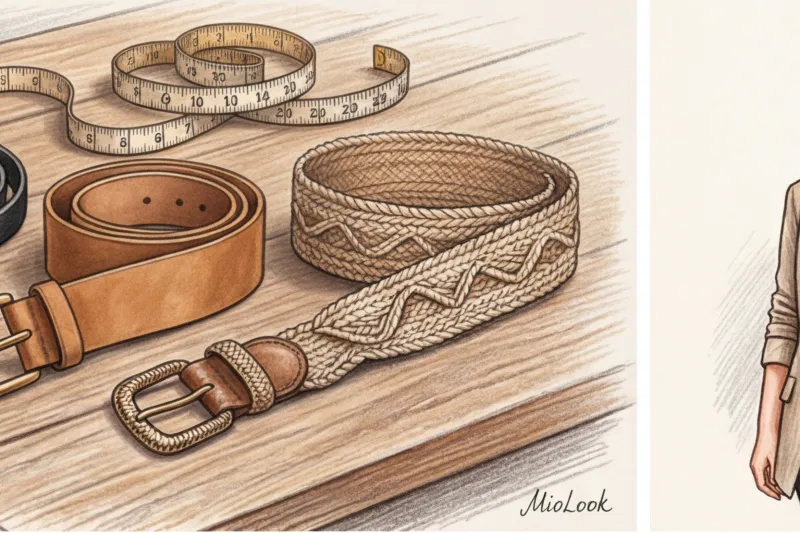
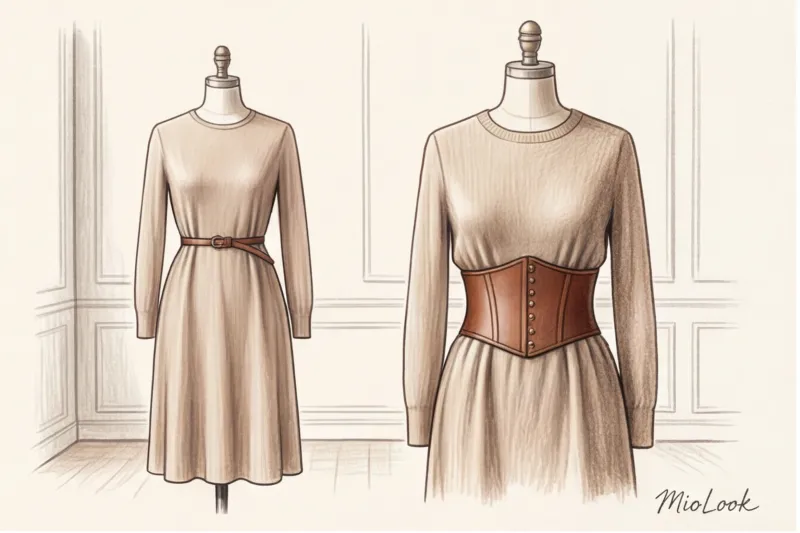
Deserving special attention wide corset belts (6 cm and wider) This is a powerful accent tool, but it's incredibly tricky. Who do they suit? Women with a long torso. In this case, a corset helps balance proportions by slightly shortening the upper body and visually lengthening the legs. Who should they not be worn by? Women with a short torso. The distance from the lowest rib to the pelvic bone is crucial here. If this distance is too small, a wide corset belt simply won't fit anatomically: it will dig into the ribs when sitting, causing physical discomfort and visually making the upper body look bulky.
Contrast: The Key Rule of Color Correction
As a colorist, I often see how the wrong belt shade can ruin an entire silhouette. Contrast is your primary tool for color correction. When you wear a contrasting belt (for example, a dark chocolate belt over a white dress), you create a harsh horizontal line that uncompromisingly "cuts" the figure in half.
When is this a good idea? If you're taller than 175-180 cm and want to ground your silhouette slightly, balancing out your endlessly long legs. A strong horizontal line will stop the eye from wandering and add solidity to your figure.
When is this bad? If you're trying to look taller and slimmer. In that case, your best friend is... monochrome reception Choose a belt that matches your outfit (pants, skirt, or dress). This will eliminate the horizontal line and elongate the vertical line, while maintaining the waist's structure thanks to the belt's slight volume. An alternative way to create a unified vertical line is to match your belt exactly to your shoes (not your bag, but your shoes!), which will visually connect the center of your figure with its base.
Not sure what color belt will suit your look?
Upload photos of your items to the MioLook smart wardrobe. Artificial intelligence will analyze your data and suggest ideal color combinations based on the laws of color theory.
Assemble an image in MioLookHere we come to the main misconception that I have been struggling with for years: the myth of the black belt's versatility In the fashion industry, it's commonly believed that a sleek black belt is a must-have. This isn't true. According to color type theory, pure black offers the highest level of contrast. If you have a soft complexion (muted summer, soft autumn—light brown hair, low-contrast eyes, fair skin), a black belt on light-colored clothing will look like a foreign object, like rough duct tape constricting your waist. For these types, shades of dark chocolate, taupe, graphite gray, or deep caramel are a true "base." They create the desired edge, but do so subtly, without stealing the show.
Texture and fittings: the devil is in the details
Even if you've chosen the perfect width and color, the wrong texture can ruin the whole effect. The laws of optics work flawlessly in fashion: anything shiny visually increases volume, while anything matte absorbs light and reduces volume.
Let's compare matte and glossy textures A patent leather (glossy) belt reflects light, creating bright highlights. If you have even a small amount of belly fat you'd like to conceal, a patent leather belt is the worst choice. The highlights will act as a spotlight, directly targeting the problem area. Matte leather or thick suede, on the other hand, will softly contour your silhouette without adding extra inches.
No less important selection of buckle metal This isn't just a piece of hardware; it's a full-fledged adornment that sits at the very center of your figure. The basic rule is: the metal's undertone should complement your skin tone and the hardware of your other accessories. If you have a cool, rosy undertone and wear white gold or silver, choose belts with steel, nickel, or silver buckles. For warm skin with a peachy undertone and those who love yellow gold, brass, bronze, and gold-toned alloys are ideal. Of course, modern fashion allows for a deliberate mix of metals, but to achieve this, the belt buckle should have a slightly aged, vintage texture rather than a bright, shiny finish.
"A complex texture is the easiest way to make an outfit look more expensive without increasing the purchase price. Smooth leather is seamless, while embossing conveys a certain status," note analysts at the WGSN Institute.
Exactly texture (Velvety suede, intricate weaves, crocodile or snakeskin embossing) allow you to create a luxurious look without flashy logos and contrasting colors. For example, a crocodile-embossed belt in a sophisticated shade of burgundy or taupe, even if purchased at a mass-market store for €30-€45, will look as if you paid at least €150 for it. The texture creates a play of shadows, adds complexity to a monochrome outfit, and demonstrates your advanced styling skills.
Body Shaping: How to Use a Belt for Different Body Types
Forget the 90-60-90 measurements. According to the WGSN Global Anthropometric Study (2023), less than 8% of modern women have a classic hourglass figure. So why are we still trying to style different body types according to the same outdated template? The goal of smart styling isn't to squeeze yourself into a corset until you faint, but to use the belt as an optical illusion, adapting it to your unique geometry.
The first step to understanding how to choose the right women's belt is to understand your own anatomy. Most mistakes arise from confusion between the natural, high, and low waistline. natural waist — this is the narrowest part of your torso. Finding it is easy: lean to the side, and where the crease forms is your natural horizontal line. High waist (under the bust) visually lengthens the legs infinitely, but eats up the length of the torso, which is critical for girls with voluminous breasts. Low waistline (on the pelvic bones), on the contrary, stretches the body, but can catastrophically shorten the legs.
This is where the golden rule of architecture and style comes into play—the 1/3 to 2/3 ratio. The human eye perceives a silhouette as harmonious when the top of the garment takes up one-third and the bottom two-thirds. The belt is the physical marker that draws this line. If you wear jeans at the hips and insert a contrasting belt, you're mercilessly chopping your figure in half (the 1/2 to 1/2 ratio). The result? You appear shorter and your hips wider. By manipulating the height of your belt, you literally rewrite your proportions.
Rectangle and Apple: Creating a Waist Where There Is None
The most common phrase I hear from clients with a straight body type or a pronounced tummy: "I don't have a waist, so I don't wear belts at all." This is a fundamental misconception. If nature hasn't given you a distinct curve, we'll create one ourselves. Counterintuitive advice: you absolutely NEED a belt, but you need to wear it in a specific way.
Get to know the technology "unbuttoned jacket" — a favorite technique among industry insiders. The mechanics are as follows: you put on a base layer (like a top and pants), cinch your waist with a belt, and then throw on a thick, structured, straight-cut jacket over it, leaving it unbuttoned.
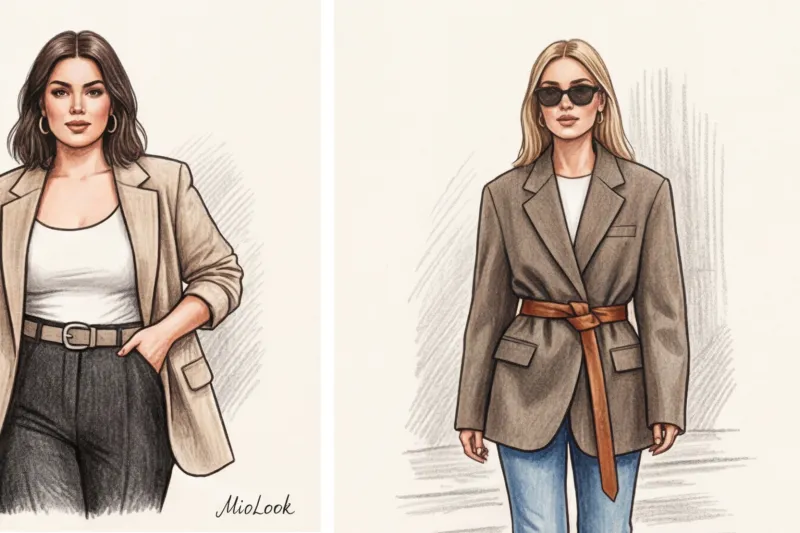
What's happening visually? The straight, stiff waistband of a jacket (thick wool models from brands like COS or Arket work great) cuts off your actual waist. People see only a narrow strip of base layer in the center, crossed by a belt. The viewer's brain completes the picture, assuming your waist is equal to the width of this visible gap. This is an instant "down two sizes" effect.
What's absolutely not allowed? Avoid thin, contrasting belts that are 1–2 cm wide. A bright, narrow belt on a large waist looks like the equator on a globe, only emphasizing the waistline. Opt for wider styles (4–6 cm). strictly in tone with your top A black long-sleeved T-shirt, a black matte belt, and an unbuttoned jacket will create the perfect vertical line. A quality basic belt for this look will cost around €60–€120, but it will flatter your figure better than expensive procedures.
To avoid buying unnecessary items and to test how your current jackets and tops perform in layering, I recommend digitizing them. After uploading your items to MioLook , you can use the smart wardrobe feature to create this corrective look on the screen and understand exactly what width and texture of belt you need to buy.
Pear and Inverted Triangle: Balance of Volumes
For these two body types, the belt acts as a balance beam. The main goal is to draw attention away from the heaviest part of the body and shift the focus to the most beneficial areas.
For girls with a figure "Pear" (voluminous hips, fragile top) It's often advised to hide the breeches under loose-fitting clothes. In practice, a statement belt placed at the narrowest point of the torso—usually just below the ribs—works perfectly. By wearing an A-line dress and belting it at the high waist, you draw the viewer's gaze upward, to your face and graceful shoulders, completely ignoring the fullness of your hips.
However, there's a serious danger here: avoid belts with excessive embellishment. Chunky, shiny buckles, a scattering of rhinestones, or giant metal logos (remember the flashy logo buckle trend of a few years ago) placed close to the hip line will act like a magnifying glass. They'll visually add extra weight to your hips and overload your silhouette.
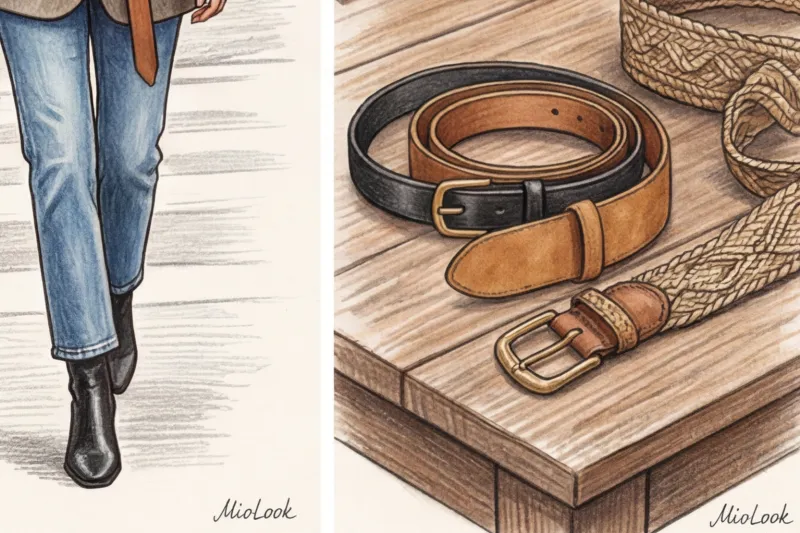
U Inverted Triangle (Broad shoulders, athletic back, narrow hips) The strategy is the exact opposite. We need to artificially add weight and texture to the lower body. This is where you can and should break the classic rules by wearing belts at the hips. Asymmetrical belts, styles with long fringe, or architectural leather peplums will be your best allies.
A recent experiment with street style looks, featured in Vogue (2024), clearly demonstrated that a soft suede belt, casually knotted at the hip over a long shirt, balances broad shoulders more effectively than any full skirt. It breaks up the monolithic horizontal line and adds movement to the lower third of the silhouette, creating a more proportional figure.
Mistakes that make your legs look fuller and shorter
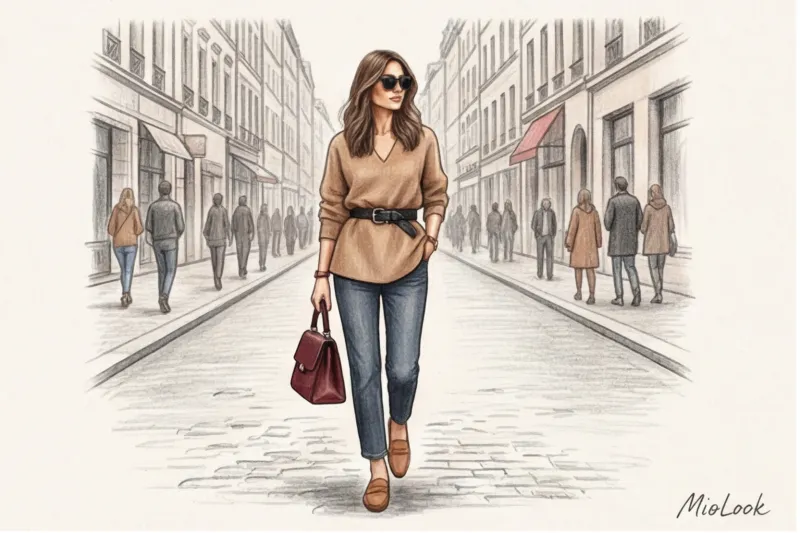
Analyzing street style chronicles and the images of girls on the streets every day, I notice the same optical catastrophe. Many guides on how to How to choose the right women's belt , they miss a crucial step: the mechanics of wearing it. You can buy a luxurious accessory for €200, but ruin all its advantages with one wrong move. Let's look at the main mistakes that ruin proportions.
Mistake 1: A contrasting belt on a low waist
Remember the basic golden ratio in styling. A harmonious silhouette is built on a proportion of 1/3 (torso) to 2/3 (legs). When you wear a contrasting dark belt with light-colored trousers or jeans with a mid- or low-rise, you mercilessly chop your figure in half. This harsh horizontal line (the 1/2 to 1/2 ratio) instantly "eats" the length of your legs and visually grounds your figure, making it appear square.
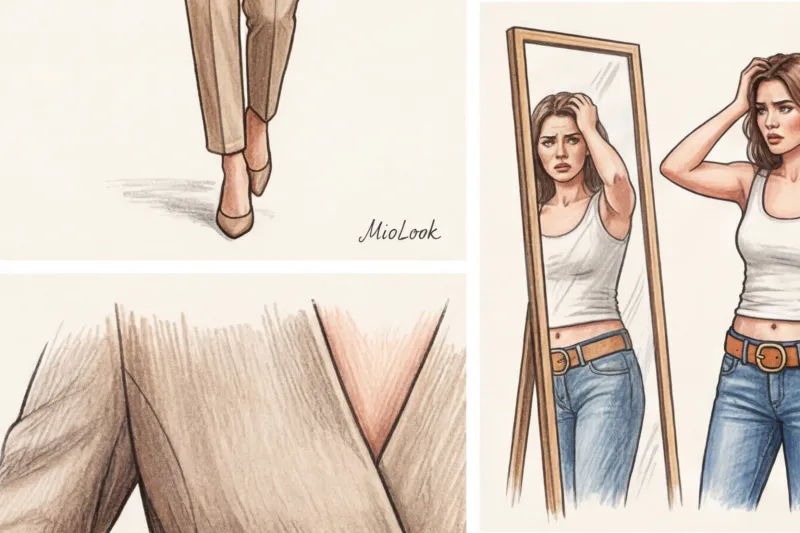
Error 2. An unattended belt "tail"
A long belt tail dangling forlornly down the hip isn't Parisian casualness, but rather banal sloppiness. From a geometric standpoint, the dangling tail creates a random diagonal vector that disrupts the carefully crafted central vertical. Look at the Bottega Veneta or The Row lookbooks: there are no randomly protruding elements.
- Solution: Always tuck excess belt length into belt loops or use hidden loops. If it's too long, take it to a tailor—shortening a belt costs next to nothing, but it can dramatically change the look.
Error 3. Dissonance of textures
Using a soft fabric drawstring belt over a heavy wool coat or bulky down jacket is a direct violation of the law of strength of materials. Flimsy silk or cotton fabric is physically unable to hold the rigid shape of heavy winter clothing. The result is chaotic creases, and the belt itself looks like it was accidentally taken from a summer cardigan.
"The thickness of an accessory should always match or exceed the thickness of the base layer. A winter coat requires a stiff, structured leather belt at least 4 cm wide, capable of defining the silhouette."
Mistake 4. The "shot glass" silhouette
This is my favorite topic to discuss in my body optics lectures. Women often think, "The tighter I tie my belt, the thinner my waist will appear." In practice, the physics of the process work against you. When you mercilessly tighten the center, the dense fabric of a sweater or dress (and sometimes the softer tissues of the body) doesn't disappear—the volume is pushed up and down.
Unnatural rolls and folds form above and below the belt. This volume makes your hips and ribcage appear exponentially wider in contrast. Instead of a graceful hourglass figure, you get an over-stretched shot glass silhouette. Remember the golden rule of fit: you should always be able to fit two fingers between your body and the fastened belt.
Try MioLook
for free: Start creating perfect images with the help of artificial intelligence
Get access — €0.99 onceTrends vs. Essentials: Which Belts Should Be in Every Woman's Wardrobe?
According to fashion platform Lyst's 2023 analytical report, accessories, and women's belts in particular, consistently rank among the top 5 most frequently purchased impulse items. In pursuit of the latest trends, we readily shell out money for a bright plastic belt with rhinestones that we'll wear just once to a party, but put off purchasing a quality basic piece for years. This is the fundamental difference between a momentary trend and a smart style investment.
A true wardrobe investment is measured by the Cost Per Wear formula. A basic belt made of thick, smooth leather with high-quality brass hardware for €150, worn every other day for three years, will cost you literally pennies per wear. Meanwhile, a trendy €25 accessory from a mass-market store forgotten in the closet after a single photo shoot is a complete waste of money.
The concept of a belted capsule wardrobe is based on strict functionalism. By loading items into MioLook And when analyzing combinations, my clients are often surprised to discover the mathematics of style in action: just 3 correct basic belts can easily replace 10 random belts, covering up to 90% of the tasks when creating looks for any season.
Basic Belt Wardrobe (Minimum)
When figuring out how to choose the right women's belt for your wardrobe, I always recommend starting with the "rule of three." This is the optimal approach that will help you avoid wasting your mornings on lengthy fittings.
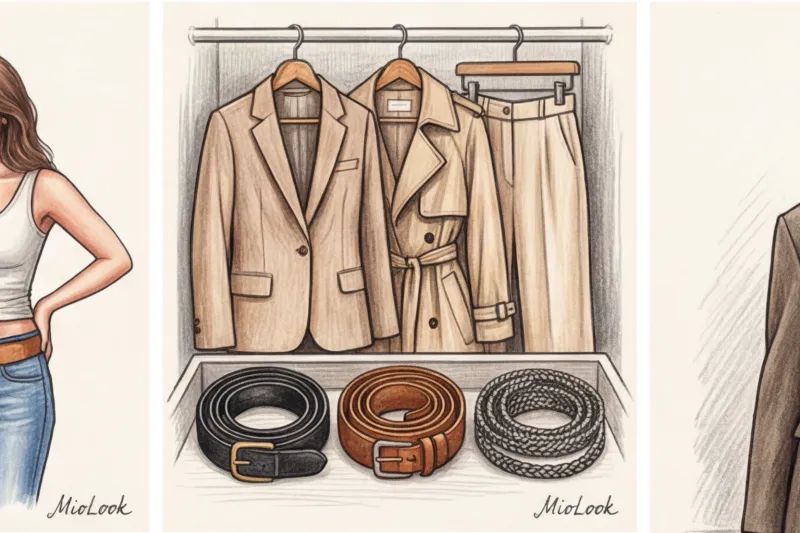
First of all, you need structured leather belt of medium width (approximately 3-4 cm). Abandon the preconceived notion that it must be black. For women with a soft Slavic complexion, shades of dark chocolate, deep burgundy, or rich graphite are much more versatile. They perfectly complement the color of basic shoes and bags without creating overly harsh, figure-defying contrasts. The optimal price range for such a piece, which must retain its shape for years, is from €60 to €120 (excellent bovine leather options are regularly found at Massimo Dutti, COS, and local leather brands).
Secondly, the capsule must contain light belt For summer and pastel looks. I regularly see on the street how a lightweight, cream-colored linen dress is literally "killed" by a heavy black belt. Your savior is a belt in beige, taupe, or soft caramel. A flawless combination for the warm season: white palazzo pants, a sand-colored linen top, and a camel-colored belt. This instantly elevates the style, creating that very aesthetic of "quiet luxury."
Thirdly, thin, elegant strap (1.5–2 cm wide). This is a fine tool for delicate fabrics—silk slip dresses, chiffon skirts, and flowing blouses. A heavy buckle on such looks would look out of place and physically pull the thin fabric down, disrupting the fit, while the neat, minimalist hardware of a thin belt will only add a graceful finishing touch to the silhouette.
Accent belts: corsets, basques, chains
Once the basics are assembled and working for you, you can move on to stylistic experiments. Accent belts are no longer about simply holding up sagging trousers, but about creating an architectural look. They are what add visual complexity to an outfit.
My absolute favorite for working with proportions is basque belts This is a brilliant way to add geometric detail to the most basic outfit. Imagine: a classic oversized white shirt, straight jeans, and a wide leather peplum belt over the shirt. The silhouette instantly gathers, creating a defined waist and a subtle nod to the dramatic aesthetic of Alexander McQueen. Since this is a statement piece, you don't necessarily need to spend a premium budget; quite decent, shapely models in thick faux leather can be found in the €30-€50 range.
They work no less interestingly chain belts This elegant take on the Y2K runway revival is a welcome change of pace. However, wearing them bare-waisted with low-rise jeans would look dated today. A trendy take on the style is a tiered metal chain casually draped over a voluminous men's jacket or a minimalist knit maxi dress. Khaite often uses this technique: the cool, heavy metal contrasts luxuriously with the soft texture of cashmere or wool.
Indispensable for the summer season fabric belts in macrame or boho style Thick cotton weaves, wooden buckles, and suede fringe all work perfectly with relaxed linen suits and Ibiza-inspired dresses. These belts don't require a rigid fit; they're often simply tied in a loose knot. One important caveat I always warn my clients about: any statement belt (be it a shiny chain or a wide peplum) is contraindicated if your goal is to draw attention away from the midriff. In this case, complex embellishments will act like neon signs, and it's best to return to a simpler base.
How to Wear Belts in a New Way: Fashion Insider Tips
Once you've mastered the basics, it's time to move on to the next level. At the Bottega Veneta and Loewe shows, stylists have long ignored the classic, utilitarian purpose of belt loops, turning the belt into an independent styling tool. When my clients ask how to choose the right women's belt for a unique look, I always advise looking in the men's department or deliberately choosing styles two or three sizes larger than usual.
Let's start with integrating the accessory into outerwear. A belt worn over a voluminous mandarin jacket, a loose trench coat, or a coat is the perfect way to tame the trendy oversize look while maintaining structure. The key to securing a belt in these situations is to avoid overtightening the fabric. Heavy wool or thick gabardine should maintain a subtle, architectural volume above the belt. Choose thick, shape-retaining belts at least 4 cm wide, otherwise the bulky outerwear fabric will visually "eat up" the thin strip of leather, throwing off the proportions.
My personal styling trick, which always gets me compliments at events, is tying my belt in a knot instead of using a buckle. I take a soft, non-stiff leather belt (excellent options can be found in the €40-€80 range) that's intentionally longer and tie it in an "Italian knot." It's incredibly simple: thread the end through the buckle, then pass it under the main ring of the belt from the bottom up, and down through the resulting loop. The result is an elegant, hidden fastening with no visible details. This technique looks deliberately casual and instantly takes the formality out of an overly formal office suit.
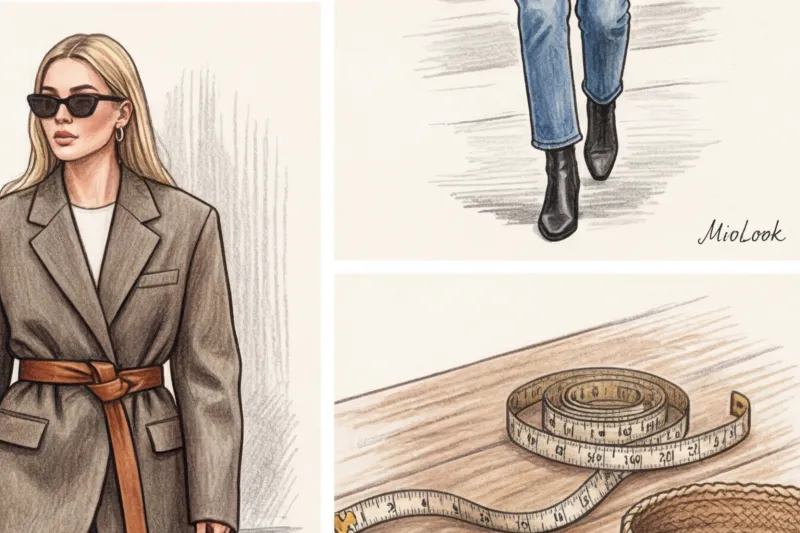
Another trick we spotted on the runways (thanks to Miuccia Prada) and happily adopted into real life is layering. Instead of one wide corset belt, wear two thin belts (1.5–2 cm wide) together. They can be identical or in contrasting colors (for example, dark and bitter chocolate). Thread them through the same belt loops of your jeans or wear them slightly overlapping over a flowing dress. And if you choose belts with different hardware, you'll brilliantly embrace the trend for a deliberate mix of gold and silver metals. The look immediately acquires a complex texture that begs to be explored.
Your ideal image begins Here
Join thousands of users who look flawless every day with MioLook.
Get access — €0.99 onceFinally, let's talk about the cold season. A winter wardrobe is often guilty of turning the figure into a shapeless square. To restore a feminine hourglass silhouette, wear a belt over a chunky knit sweater. The secret to a perfect fit is technique: after fastening the belt at the waist, be sure to pull the knit fabric up, creating a soft slump. The belt should just be subtly visible under the folds of the knit, defining the narrowest part of the torso, rather than constricting you in half. For this technique, I highly recommend suede textures—unlike smooth leather, velvety suede doesn't slide over fluffy wool or cashmere and reliably maintains the desired proportions all day long.
Checklist: Perfect Belt Fit Before Leaving the House
A few minutes before leaving the house, we often take a quick look at ourselves, fix our hair, and run errands. During commercial lookbook shoots, stylists have a "last 30 seconds" rule—this is the time for a rigorous technical analysis of the silhouette. Even if you've spent hours learning how to choose the right women's belt for your measurements, a sloppy fit will ruin the entire geometric design. Even a premium €400 accessory from Khaite or Bottega Veneta will look awkward if you ignore the laws of physics and styling.
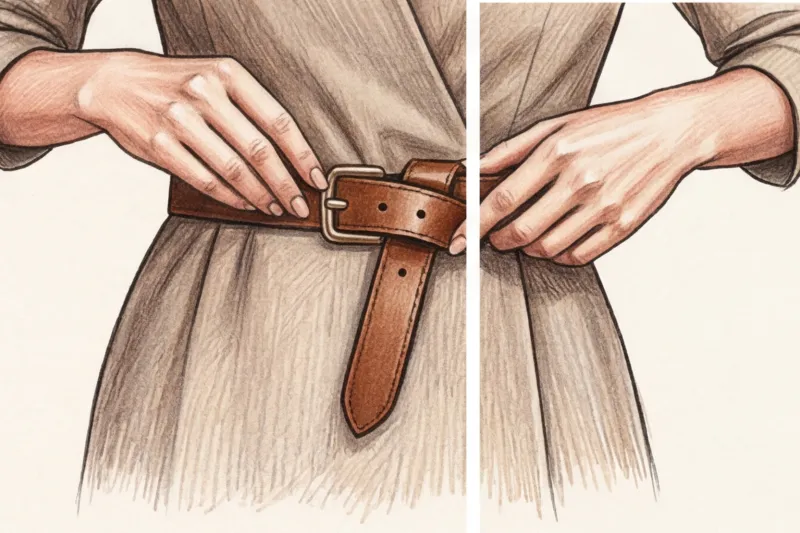
To avoid ruining your carefully curated outfit, check four checkpoints before going to the mirror.
The Two-Finger Rule: Testing Tension and Breathing
First and foremost, there should be room for two fingers to fit between the waistband and your body (or base layer). This isn't just a matter of comfort after a heavy meal. If you tie leather or heavy fabric too tightly, unsightly folds of fabric will form above the top and bottom edges. Take a deep breath. If you immediately want to undo the buckle, you've tightened it too much. The British Institute of Colour and Style (2024) emphasizes in its report on the physiology of clothing perception: a slight loose fit around the waist paradoxically makes it appear narrower than an aggressive cinching system.
Proportion Audit: The Golden Ratio in a Mirror
Move two meters away from the mirror. Your legs should appear longer than your torso—this is an evolutionarily ingrained standard of harmony, which our eyes perceive in milliseconds. If your waistline divides your figure exactly in half (a 1:1 ratio), immediately move it a couple of centimeters higher, closer to your natural waist, or throw an unbuttoned jacket over it to create a vertical line. I always recommend taking quick selfies at chest level and analyzing them in an app. MioLook In the photo from the side, the distortion of proportions is immediately noticeable, allowing for quick adjustment of the seat height.
Jewelry Balance: Matching Metals
A buckle is as much of a statement piece as statement earrings or a watch. The basic rule is: the metal on your waist shouldn't clash with the main accents in your portrait or the hardware on your bag. If you have a bag with a heavy gold chain and brass buttons on your trench coat, a cold steel buckle will create visual noise. The only exception is a deliberate mix of metals (bimetallic styling). If you intentionally wear white and yellow gold jewelry together (for example, rings in the style of the iconic Trinity design), then steel hardware paired with warm earrings will be seen as a deliberate choice rather than a stylistic error.
Taming the "tail": fixing the free edge
There's nothing more unsightly than a long belt with its tail hanging loose. When buying a quality basic belt, such as a smooth leather belt in the €50-€80 range, think about how you'll wear the excess length. If it only reaches the first belt loop on your trousers, tuck the end neatly into it. If you're wearing a longer belt without belt loops over a dress, secure the loose end with a stylish knot (a hidden loop or French knot will do). My personal photoshoot lifehack: if a stiff leather edge stubbornly sticks out, use clear double-sided adhesive tape for the body and clothing. It won't ruin the garment but will create a flawless silhouette.
The finishing touch to your style
Managing proportions is a skill that can be easily developed through observation. Think of a belt not as a utilitarian fastener holding up pants, but as a clever optical instrument that focuses attention on your best features. Take a quick inventory today: take out all your belts, get rid of any that are frayed or out of shape, and keep a few basic options that work perfectly. And remember: a flawless look is one in which you not only look relevant but also feel 100% confident.
Guide Chapters
What to wear with a women's chain belt: stylist tips
Metal belts are back in fashion with a new twist. Learn how to incorporate a chain belt into modern looks and enhance your figure's proportions.
Belt Width for Short Women: Style Secrets
A belt isn't just an accessory, it's a powerful tool for body structure. Learn how to use the right belt to visually add length to your legs or balance out a tall frame.
How to Wear a Corset Belt: Stylish Looks
A corset belt isn't just an evening accessory, it's a powerful tool for manipulating proportions. Learn how to stylishly incorporate it into your everyday wardrobe.
How to Tie a Long Belt Fashionably: 7 Stylish Ways
We'll explore 7 safe and stylish ways to tie a long leather belt. Learn how to create a beautiful knot without creases or cracks in the material.
Basic women's belts that should be in your wardrobe
A cheap belt can ruin even the most expensive look. Find out which essential belts are a must-have in your wardrobe.
What should a women's belt be paired with in 2024?
Perfectly matching the color of a belt, bag, and shoes is considered bad form these days. Learn the secrets of color and trendy combinations from a stylist.
How to Wear a Belt with a Women's Jacket: Stylist Tips
Transform a shapeless silhouette into a style icon. Learn the architectural approach to pairing a belt and jacket for a flawless waist.
How to tie a belt on a coat: stylish patterns
Forget boring bows that ruin your silhouette! We'll show you how to stylishly tie a belt on a coat or trench coat for a luxurious and elegant look.
How to Wear a Belt with a Dress: Styling Tips
A belt is more than just a utilitarian detail; it's a powerful architectural tool. Let's explore how to choose the perfect accessory for any dress.
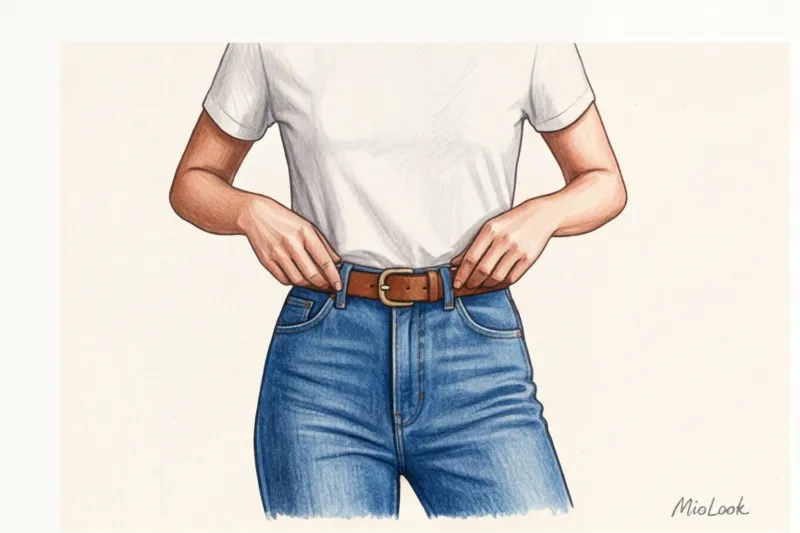
Which Belt to Choose for Women's Jeans: A Stylist's Guide
Perfect jeans can easily be ruined by the wrong accessory. Read on to learn how to choose a basic belt that will add a stylish and luxurious touch.
How to choose a women's belt size: avoiding mistakes
Buying a belt based on your bare waist is a common mistake that can cost you money. Learn how to choose the right belt length based on your clothing layers.
How to Wear a Belt to Hide Your Belly: Stylist Tips
Forget uncomfortable corsets and waist trainers! Discover secret styling tricks that will help you visually shape your figure with the right belt.