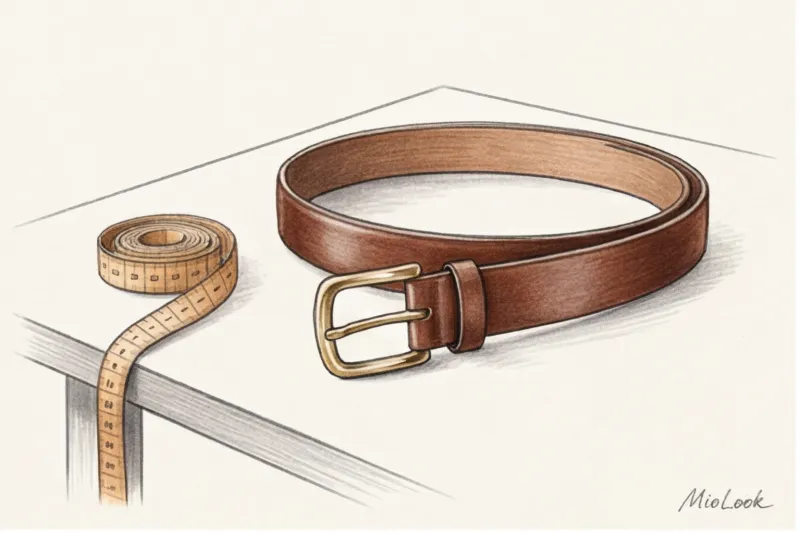
One of my clients, let's call her Anna, spent three months hunting for the iconic Gucci Marmont belt. She ordered it online for €450, proudly choosing a size 70—the exact measurement of her waist on bare skin. The accessory fit perfectly over a thin silk dress. But then October arrived. Anna tried wearing the same belt over a heavy wool Massimo Dutti jacket, and the pin wouldn't even reach the first hole. The result: tears, disappointment, and an expensive belt sitting in a box for six months.
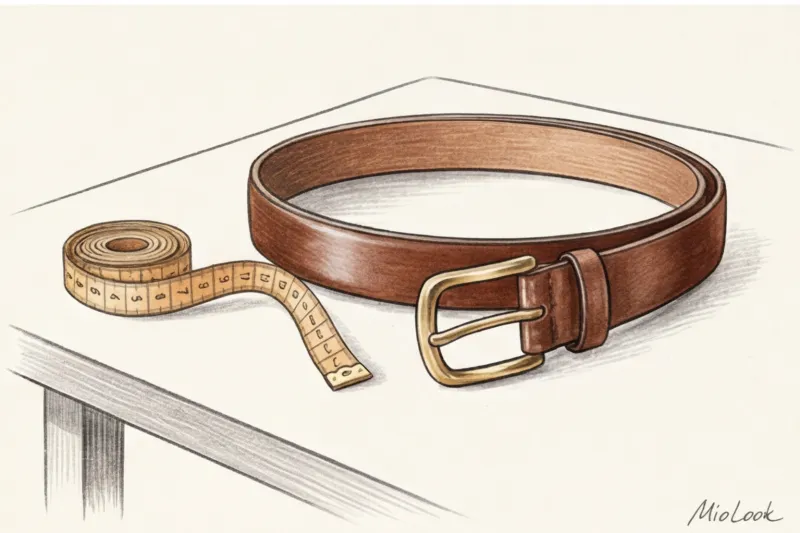
Why did this happen? Because buying a belt exactly to your bare waist size is a serious mistake that will cost you money and frustration. If you want to understand once and for all, How to choose the size of a women's belt , you will have to stop thinking like a tailor measuring a body and start thinking like an architect.
The size of an accessory doesn't depend on how many centimeters you measure in the morning on an empty stomach, but on the thickness of the fabrics in your outfit and the rise of the garment. We discussed in more detail how the width and color of an accessory influence the visual correction of your silhouette in our complete guide: How to choose the right women's belt for your figure Today we'll focus exclusively on the mathematics and geometry of ideal length.
The Anatomy of a Perfect Fit: What Does Belt Size Really Mean?
After 12 years of working as a stylist at fashion weeks, I've realized one thing: 80% of women don't know how belts are measured. Just because the number "80" is stamped on the inside of the belt doesn't mean the total length is 80 centimeters.
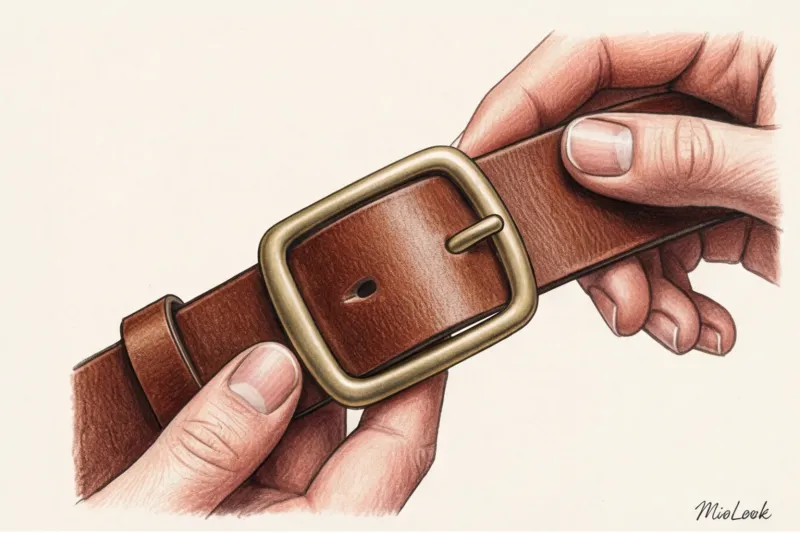
According to the standards of European leather manufacturers, a classic women's belt has exactly 5 holes (in the luxury segment, the distance between them is exactly 2.5 cm or 1 inch). The correct size is the distance from the inner edge of the buckle (where the pin is attached) to the third, central hole.
The ideal fit for a classic belt is when it's fastened exactly at the center hole. This leaves you with two holes to spare if you gain weight or wear a thick sweater, and two holes to spare if you lose weight or wear a thin silk garment.
This is where the architectural approach comes into play. The thickness and density of the leather itself critically influences the girth. A wide, 4-centimeter belt made of stiff saddle leather will "eat up" about 1.5-2 cm of volume simply due to its thickness when bent. Meanwhile, a soft, 2-centimeter suede belt of the same length will fit snugly. This is why your waist is never the same as your belt size.
Your perfect look starts here
Join thousands of users who look flawless every day with MioLook. A smart AI stylist will analyze your wardrobe and suggest the best combinations.
Get access — €0.99 onceHow to choose the right size women's belt: a step-by-step guide from a stylist
Before you visit a store's website or a boutique, remember the most important rule: always measure over the clothing you plan to wear the accessory with. We only measure naked body when purchasing underwear.
Method 1: Measuring using an old belt (maximum accuracy)
This is the most reliable method if you're buying an item online and want to avoid returns. Find a belt from your closet that fits you best with the jeans or trousers you're looking for a new one for.
- Place it on a flat surface (table or floor).
- Take a tailor's tape measure or measuring tape.
- Measure the distance from where the metal pin touches the buckle to the hole that looks the most worn in—the one you fasten the buckle on most often.
The resulting figure (for example, 83 cm) is your ideal size. Feel free to round it up to the nearest standard value (in this case, 85).
Method 2: Body and clothing measurements (taking into account layers)
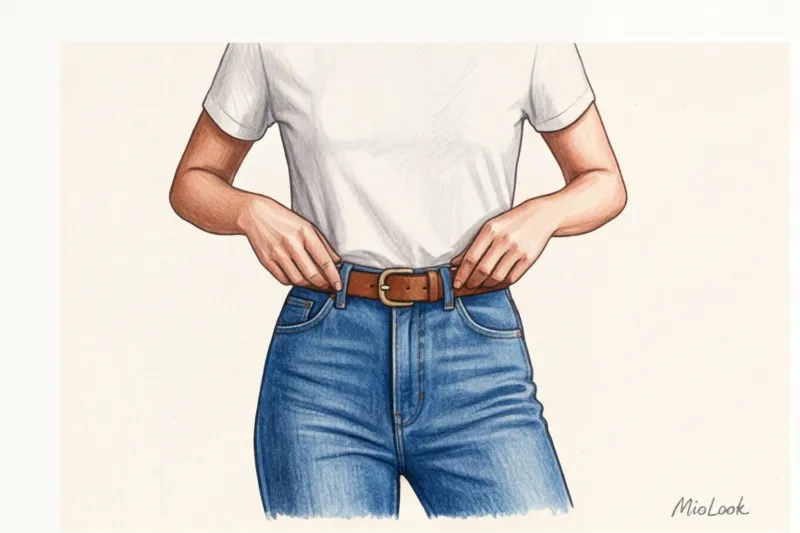
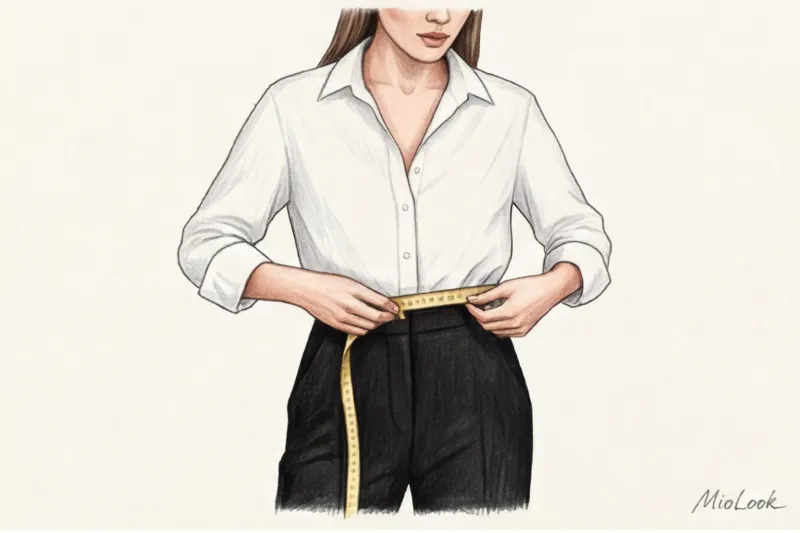
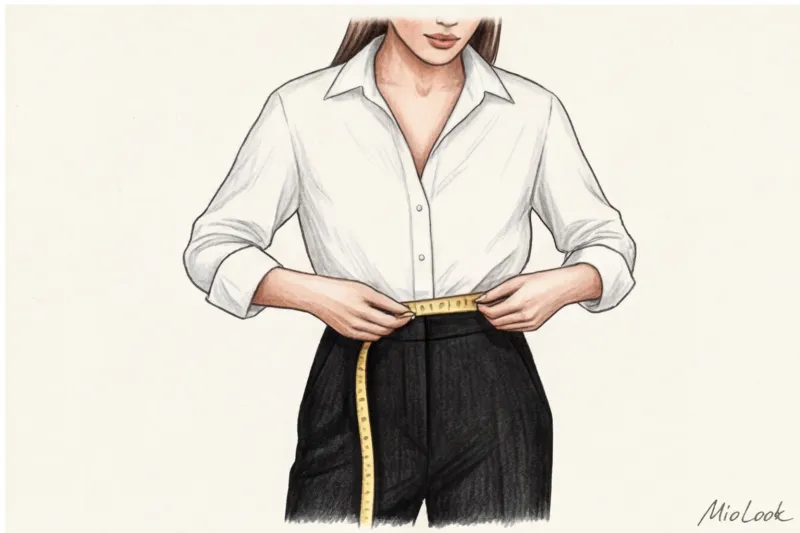
If you don't have an old, comfortable belt handy, use a soft tape measure. Put on your jeans, thread the tape measure through the belt loops, and adjust it to the desired fit—not too tight, but still allowing for easy breathing.
Next, we turn on the layer math. I've developed the following seam allowance formula for my clients:
- For thin summer trousers with a mid-rise: + 1-2 cm to the measurement.
- For heavy denim (especially if you're tucking a cotton shirt inside): + 2-3 cm.
- For wearing over suit wool (jackets): + 4-5 cm.
Important limitation: This advice does NOT work for elastic waistbands or braided belts without fixed holes (stretch belts). For these, you should go one size up or even slightly smaller, as they will inevitably stretch within the first month of wear.
Length formula: what to do with the free edge?
One of the most common questions I get in my consultations is how long should a belt tail be? This is where fashion diverges from traditional etiquette.
According to a strict business dress code, the edge of the belt should pass through the first belt loop of the trousers and extend no more than 2-3 centimeters beyond it. The total length of the free edge from the buckle is usually 10-15 cm. If it doesn't reach the belt loop, the belt is too small. If it hangs down to the second belt loop, it's too big.
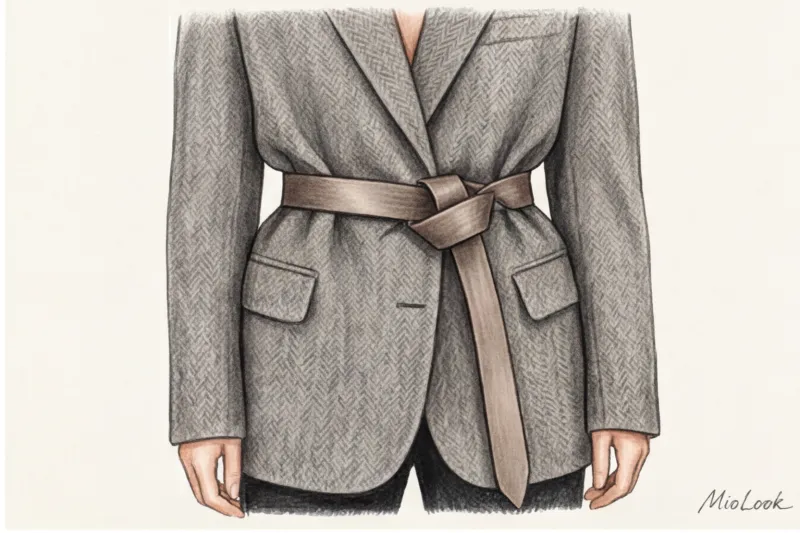
But modern trends dictate their own rules. Take a look at the Bottega Veneta or Loewe shows: there, the loose end of a long, soft belt is elegantly tied in a complex knot, draping downward. If you want to replicate this style, you'll need a belt 15-20 cm longer than your standard length. The key is to use very soft leather, not too stiffly bonded, otherwise the knot will fray.
My personal "three-finger" rule: If you're unsure about the length of a classic belt in the fitting room, fasten it through the center hole and thread the end through the first belt loop. Place your palm on the exposed end. The ideal length of the free edge should be exactly the width of your three fingers.
By the way, if you often experiment with complex styling and forget which jackets look better with a long belt and which with a short one, I recommend uploading your images to the "smart wardrobe" feature in MioLook The app will help you save your successful formulas for the future.
The Fit Matrix: How to Adapt Your Size to Different Wardrobe Items
When reviewing clients' closets, I often see the same picture: a single favorite black belt, trying to fit both low-rise jeans and a fitted dress. It's physically impossible. An ideal capsule wardrobe should have at least three different belt sizes.
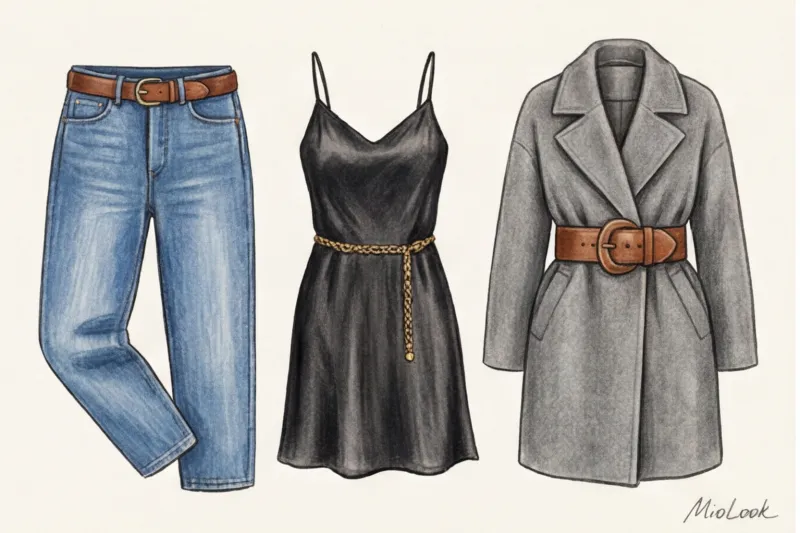
Belts for jeans and trousers
Rise is everything here. Your waist (the narrowest part) is the starting point. If you wear high-rise jeans, your belt size will be close to your waist measurement with minimal allowance. But if you're wearing trendy boyfriend jeans or cargo pants with a low-rise rise (on the hips), the difference from your waist measurement can be as much as 10-15 centimeters. For such items, you should always go 1-2 sizes larger than your base belt size.
Belts for dresses and voluminous jackets
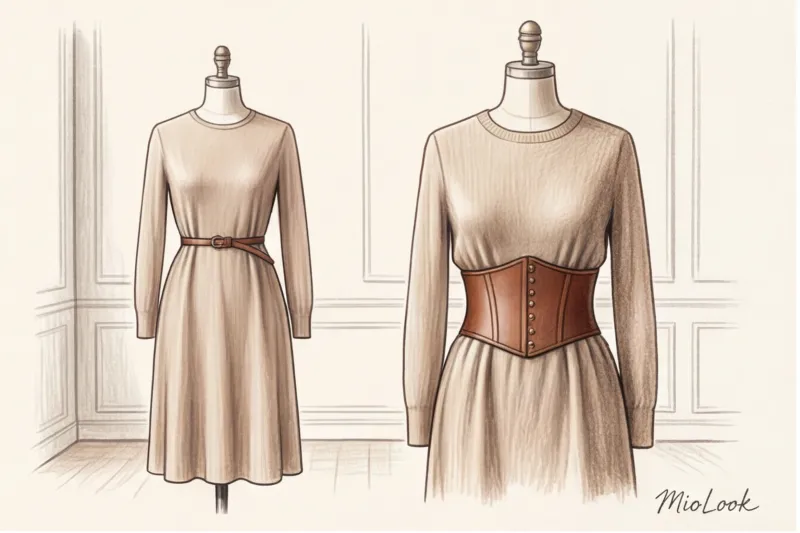
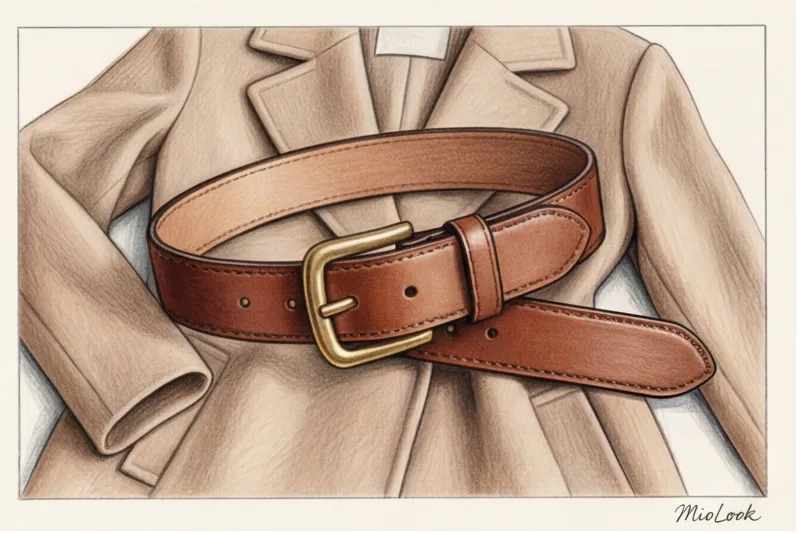
When belting a voluminous jacket or dress, we recreate the iconic silhouette of Christian Dior's New Look (1947). The belt acts like a corset, creating a rigid structure. For shirt dresses, your standard size will do. However, if you plan to wear a belt over a heavy fall trench coat or winter robe, be sure to add 5-7 cm to your waist measurement.
Access to MioLook for €0.99 — one-time payment
Start creating perfect looks with the help of artificial intelligence. Forget about the "nothing to wear" problem and choose accessories flawlessly.
Get access — €0.99 onceDecoding markings: international and European standards
Shopping in foreign online stores always carries the risk of getting confused by the numbers. Let's break down the main labeling systems to ensure you don't waste your money.
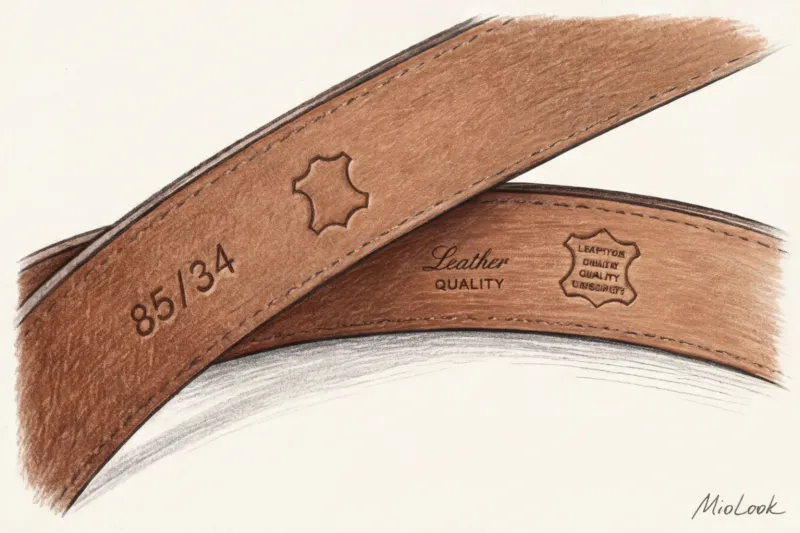
European system (centimeters):
They're usually labeled in 5 cm increments: 70, 75, 80, 85, 90, and so on. As we've already established, this is the length from the buckle to the center hole. If you see letter sizes (Zara, H&M), then XS typically corresponds to 70-75 cm, S to 80 cm, M to 85-90 cm, and L to 95-100 cm.
American system (inches):
In the US, pants and belt sizes are measured in inches: 28, 30, 32, 34. To convert these to a more understandable size, simply multiply the value by 2.54. A US size 32 is approximately 81 centimeters (our European size is 80).
Features of luxury (Hermes, Gucci, YSL):
Buying an expensive belt (in the €300–€800 range) requires special care. The French house of Hermès has a catch: their leather (for example, the popular grained Togo or Epsom) is very dense. Due to the thickness of the material, a size 80 at Hermès will fit a body circumference of 77–78 cm (30–31 in) when wearing clothes. If your measurement is exactly 80 cm (31 in), a luxurious belt with an "H" is best purchased in a size 85.
Buying Mistakes: Why Even an Expensive Belt Can Ruin Your Proportions
Even a perfectly tailored accessory will become an enemy of your figure if the rules of proportions are violated.
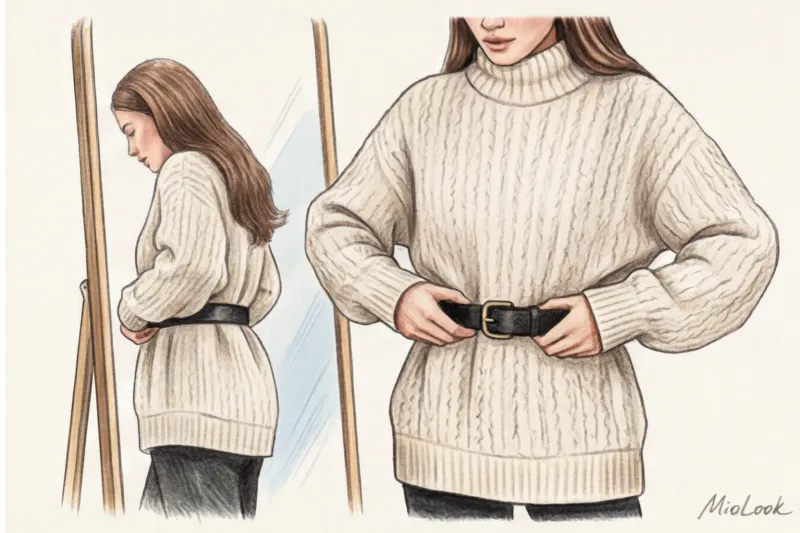
The first and most damaging mistake is buying a belt that's too tight. When the leather is stretched too tight, it literally digs into the fabric of your clothing, creating bulges at the top and bottom. Paradoxically, a belt that's a size too small will visually widen your waist and add unnecessary pounds. You should always be able to fit your index finger between the belt and your clothing.
A stylist's second pet peeve is the artisanal punching of holes. Let's return to Anna's story with her Gucci belt. When she realized it didn't fit on her jacket, she went to the nearest repair shop, where they punched an extra hole with an awl. What happened? The strict symmetry of the factory-made 2.5 cm between the holes was disrupted. The belt's edge became disproportionately short (just 4 cm from the buckle). Visually, this cheapened the €500-plus item to mass-market levels. If you've gained or lost a significant amount of weight, it's better to resell a luxury belt than to ruin it.
The third mistake concerns fashionable wide corset belts (6 cm or more wide). If you buy one that's the wrong size and it sits above your natural waistline, it visually shortens your torso. For petite women, this can shave up to 5 centimeters off your height.
Checklist before the checkout: 4 questions from a stylist
Before you hit the "Pay" button or hand over your belt to the cashier at the store, ask yourself these four questions. They'll save you from making an impulsive and unnecessary purchase.
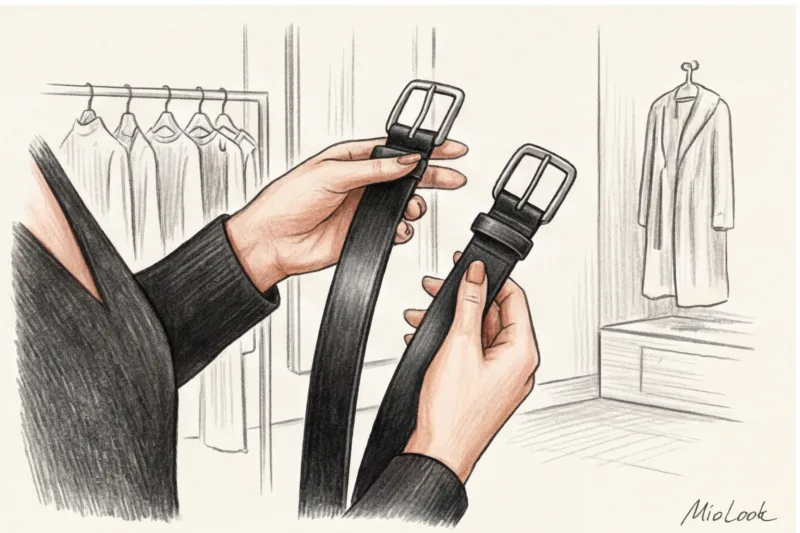
- What clothes will I wear this with 80% of the time? (If the answer is "with summer dresses," go with the correct size. If "with a coat," feel free to add 5 cm.)
- Does it converge on the center hole? (Check if you still have some room to breathe comfortably in both directions after a heavy dinner.)
- Is the free edge long enough? (It shouldn't stick out 3 centimeters, but it shouldn't wrap around your waist twice either, unless that's the design.)
- Does the weight of the fittings match the fabric? (This is a common hidden problem: a heavy cast buckle on a thin strap will simply pull the delicate silk of the dress down, disrupting the size geometry).
A belt is more than just a functional way to tighten loose jeans. In the right hands, it's a powerful architectural tool that ties together an outfit, establishes proportions, and conveys status. The right size makes this accessory unnoticeable in terms of physical comfort, yet absolutely essential for style. Choose the right length as carefully as you choose your shoe size, and your outfits will always look impeccably put together.