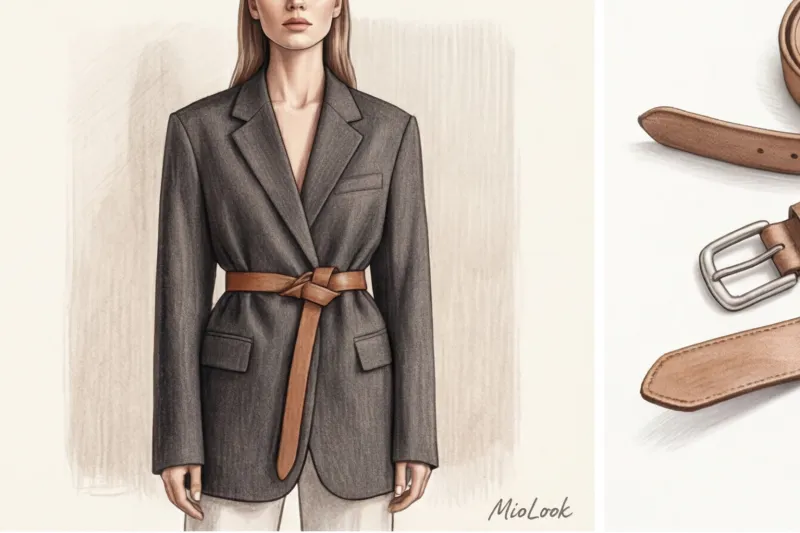
Have you ever noticed how often style tricks from social media end in disappointment in real life? You buy a beautiful accessory, get inspired by a picture, try to replicate a striking knot, and a couple of weeks later, unsightly creases and cracks appear on your skin. Spoiler: it's not in your hands. In 12 years of working as a stylist and textile specialist, I've learned one thing: how to tie a long belt fashionably depends first and foremost on the strength of materials, and only then on your imagination.
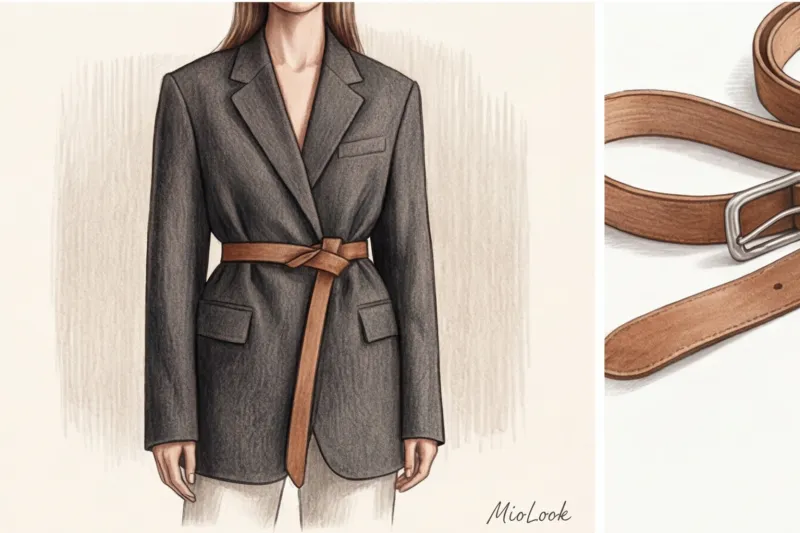
Before we get into the mechanics of creating beautiful knots, it's important to lay the foundation: understand your body's geometry. We covered this in more detail in our A complete guide to choosing the right women's belt for your figure In this article, we'll examine styling through the lens of materials science. We'll discover why stiff belts break when knotted, how leather texture interacts with the fabric of your clothing, and, most importantly, how to adjust proportions using simple weaves.
Silhouette Architecture: Why You Should Ditch the Boring Buckle
The modern belt's role has long been more than simply holding trousers at the waist. It's a powerful tool for directing attention. A classic metal buckle often cuts the figure in half, creating a sharp horizontal line. An asymmetrical knot, however, breaks this monolithic line, drawing the eye diagonally.
I had a revealing case study. One of our clients, a top manager at an IT company, brought in an expensive but outdated straight-leg jacket for a wardrobe review. Unbuttoned, it made her look boxy, and trying to fasten it with a classic, stiff belt made her look like a "schoolteacher from the 2000s." We simply replaced the belt with a long, soft, buckleless belt and tied it in an asymmetrical half-bow. The effect? Visually, she lost about 5 kilograms, and her look instantly became modern.
The secret lies in the golden ratio (1:1.618), which is widely used in costume design. If you shift the focal point of your knot just 2-3 cm above your natural waist, you'll visually lengthen your legs by 10-15 cm. And you don't even need heels to achieve this.
Materials Science: How to Choose a Leather Belt for Knots (without Breaking It)
A popular myth is that "any long belt can be tied stylishly." This is a dangerous misconception. Trying to tie a classic, rigidly bonded belt will not only ruin your silhouette with a protruding stud, but will also permanently damage the accessory within 2-3 uses.
Why does this happen? About 80% of mass-market belts (in the €20-€40 price range) are multi-layered: a thin layer of full-grain leather, an inner cardboard or synthetic reinforcement (flesh), and a backing layer. When twisted into a knot, the inner hard layer breaks. Tying a belt made of hard chrome-tanned leather reduces its lifespan by 60% due to micro-tears in the full-grain layer.
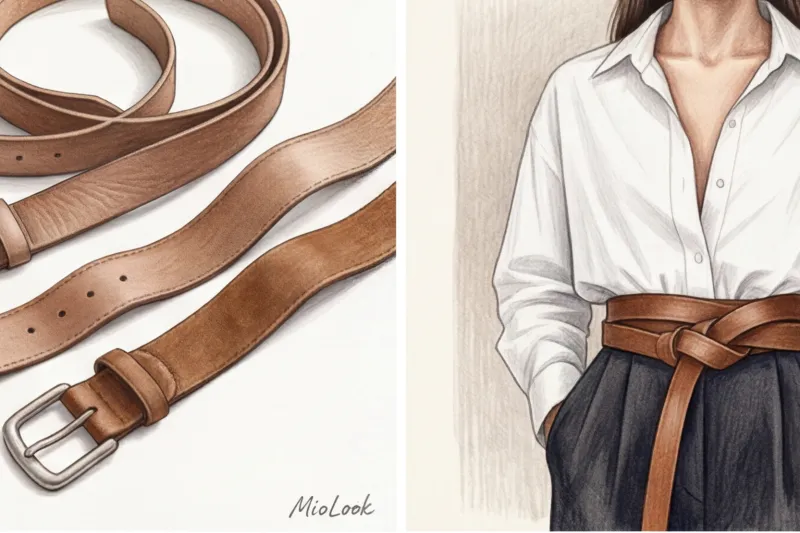
"For complex knots, look for belts marked 'unlined.' The ideal texture is soft nappa leather or high-quality suede. They drape almost like heavy fabric and don't resist being pulled."
- Ecology and tanning: Opt for vegetable-tanned leather. According to Leather Working Group (LWG) standards, vegetable-tanned leather retains the elasticity of the fibers better and develops a beautiful patina over time at the folds, rather than cracking like cheap chrome. A high-quality vegetable-tanned belt will cost between €60 and €150 on average.
- Width matters: For classic knots, a width of 2-3 cm is optimal. Belts wider than 3.5 cm require fundamentally different techniques (for example, a loose throw), otherwise the knot will be the size of a fist and add unnecessary bulk to the belly.
Your perfect look starts here
Not sure which belt will go with your new jacket? Upload your items to the smart wardrobe and let artificial intelligence create flawless combinations.
Get access — €0.99 once7 Ways to Tie a Long Belt: From Minimalism to Avant-garde
The main rule before starting: always maintain a "soft tension." The knot should be formed by the structure of the skin itself, not by pulling it tightly across your stomach. An overtightened belt not only ruins the accessory but also creates unsightly folds in clothing, highlighting even the slightest imperfections.
Method 1. "Classic loop" (Ideal for oversized jackets)
The most basic and popular method. You thread the belt through the buckle, then pass the long, loose end under the belt (from bottom to top) and down into the resulting loop.
This knot creates a strong vertical line that elongates the silhouette. It works brilliantly with heavy wool jackets worn with men's clothing. If you need to tame the excess volume of an oversized garment while maintaining a relaxed look, this is the choice for you.
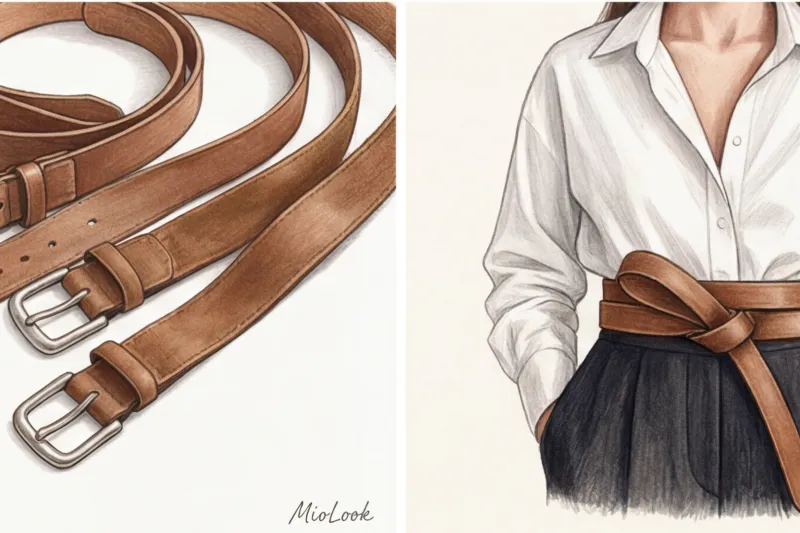
Method 2. "Double Knot" (For thin straps and flowing dresses)
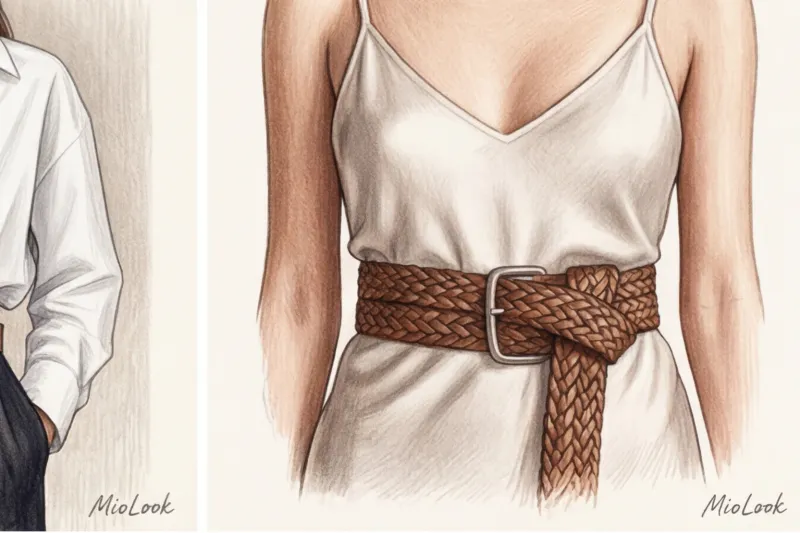
If you have a very long and thin (up to 1.5 cm) cord belt, a simple loop will look too short. Wrap the belt around your waist twice and tie the ends with a regular double knot, leaving them hanging freely. This technique creates a voluminous accent that acts as a waist embellishment. It looks especially striking on silk or viscose dresses, as the thin leather doesn't weigh down the delicate fabric.
Method 3. "Hidden Tail" (For minimalists and business photo sessions)
My favorite trick for styling clients for business photo shoots is to use a "hidden ponytail" when a chunky metal buckle glares in the frame or distracts from the subject's face.
You fasten the belt, then pull the long, loose edge back and tuck it under the belt itself. The result is an endless, smooth line with no visible end. Perfect for formal dress codes and pleated trousers.
Method 4. "Asymmetrical half-bow" (Romance without childishness)
To add a dynamic touch to your look, tie the belt like shoelaces, but pull out only one loop, leaving the other end straight. Slide the half-bow slightly to the side, closer to the hip. This is a real lifesaver for A-line dresses, trench coats, and thick shirtdresses. The asymmetry adds a more mature and sophisticated touch, removing any associations with childish dresses.
Method 5. "Spiral" (Emphasis on the waist)
A great life hack for shortening a belt that's too long (110cm+) if you don't want to take it to the tailor. Thread the belt through the buckle, then simply wrap the loose end around the belt itself (like a spiral) until you're left with a short tail of 3-5cm. This creates a tight, textured waistline that looks great over sleek, basic turtlenecks.
Method 6. "Cascading" (Street style trend)
According to analytics platform Lyst (2024), interest in relaxed, deliberately casual accessories has grown by 42%. The "cascading cascade" is a reflection of this trend. You fasten the belt (or make one gentle twist) and let the long end hang loosely along the hip, sometimes even below the knee.
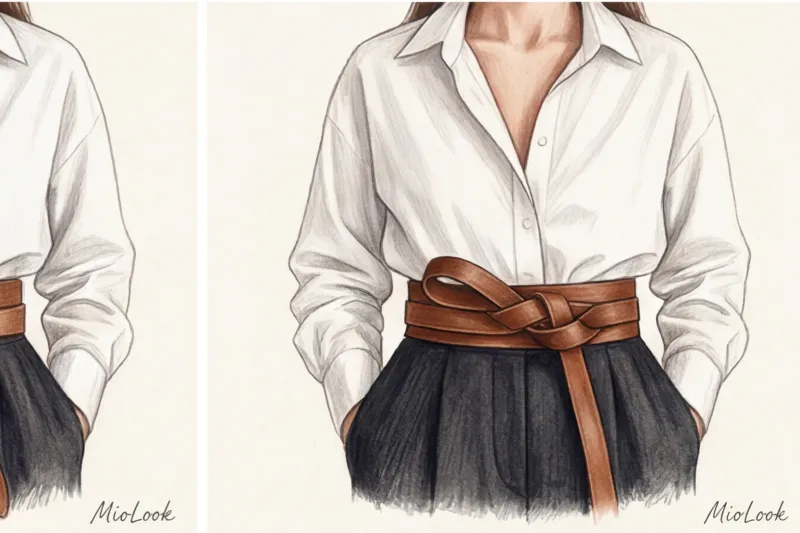
When it does NOT work: With office pencil skirts. This daring look calls for relaxed, wide-leg palazzo pants or baggy jeans.
Method 7. "Tie knot" (For thick coats and cardigans)
This technique is borrowed from men's wardrobe (the very same "four-in-hand" knot for ties). It requires a wide (3-4 cm), yet incredibly soft belt with no buckle at all. It's tied just like a classic tie. Thanks to the tightness of the knot, it holds heavy fabrics perfectly: autumn robe coats or thick, chunky cardigans.
The Rule of Contrast: How to Match Knots with Clothing Texture
Creating a harmonious look isn't just about the knot's shape, but also about the conflict (or synergy) of textures. Heavy, roughly tanned leather on a delicate silk slip dress looks incredibly stylish due to the contrast. However, there's a hidden danger: the stiff leather can cause snags when rubbed against delicate fabrics.
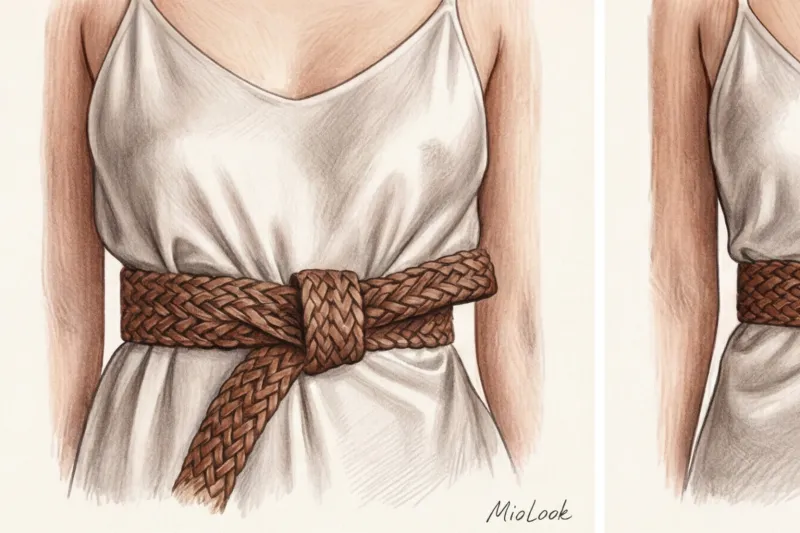
Another common problem my clients face is pilling in expensive knitwear. Constant friction between a leather knot and a cashmere sweater can destroy the delicate fluff around the waist in just a couple of days. To avoid this, choose smooth belts with a polished backing and tie them so the knot stays static and doesn't move when you walk (for example, the "Spiral" method). Learn more about... What fabric doesn't pill and how to extend the life of knitwear , read our special article.
- Thin straps on thick wool: Never try to tie a coat with a 1 cm wide belt. It will simply "sink" into the nap, fail to maintain volume, and will visually distort your proportions. For outerwear, belts at least 3.5 cm wide are recommended.
- Knots and prints: Complex weaves (double knots, half bows) are a statement piece in themselves. Tying them over a vibrant floral print or complex geometric design creates visual chaos. Complex knots call for a monochrome look.
The Biggest Mistake: How Knots Destroy Belts (and How to Avoid It)
Do you know what's the biggest killer of leather goods? No, it's not moisture. It's constant tension without rest. The biggest mistake I see all the time is trying to tighten a knot too tightly to ensure it won't come undone.
Firstly, a tight knot doesn't hold better than a soft one—it simply deforms the outer layer faster. Secondly, from a sustainability perspective, the lifespan of your accessories directly depends on the care protocols you follow.
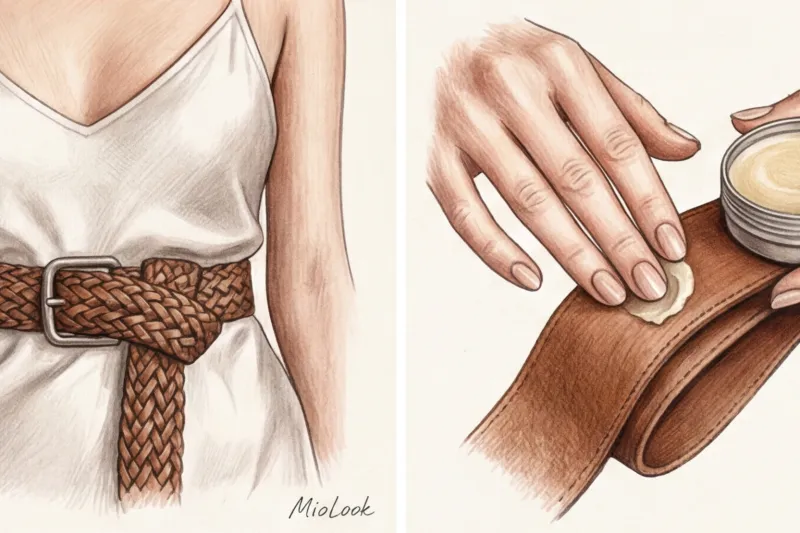
"Implement the 24-hour rule: if you wore a belt tied tightly today, be sure to untie it in the evening, straighten it, and hang it by the buckle. Leather needs 24 hours to restore its internal structure and return to its original shape."
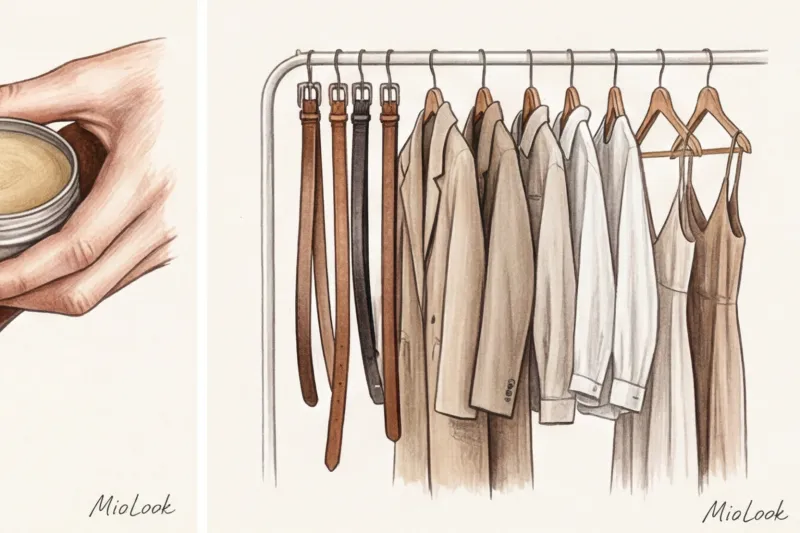
Furthermore, belts that are constantly twisted dry out faster than bags or shoes. Apply a high-quality leather conditioner (with beeswax or lanolin) to the creased areas every 2-3 months. This will extend the life of your favorite accessory from 1-2 seasons to 10 years.
Ready to start experimenting?
Try the MioLook free plan to organize your accessories and get daily styling tips with no commitment.
Get access — €0.99 onceChecklist: Integrating a Knotted Belt into Your Basic Wardrobe
You don't need dozens of belts to create a versatile look. A functional capsule wardrobe requires just three smart belts that can be tied in different ways:
- Soft black belt (nappa, width 2.5-3 cm) — a versatile soldier for a classic loop over jackets and trench coats.
- A thin leather cord in a chocolate or caramel shade (width up to 1.5 cm) — for creating double knots on summer dresses, viscose skirts and light cardigans.
- Wide belt without buckle (suede) — for tie knots on thick knitwear and autumn coats.
What garments do knots work best with? Clear favorites include shirtdresses (they remove excessive formality), masculine-style jackets (they restore feminine proportions), and basic chunky knit cardigans (they sculpt shapeless knits into a clean silhouette).
A belt knot is your personal signature. It's a signal to others: "I didn't just wear things I bought at the store; I tailored them to suit myself." Remember the key: choose soft, unpadded leather, don't overtighten belt loops, and give accessories a chance to rest. Invest in the quality of the materials, not the number of buckles, and then even the simplest outfit with a white shirt will look expensive and sophisticated.