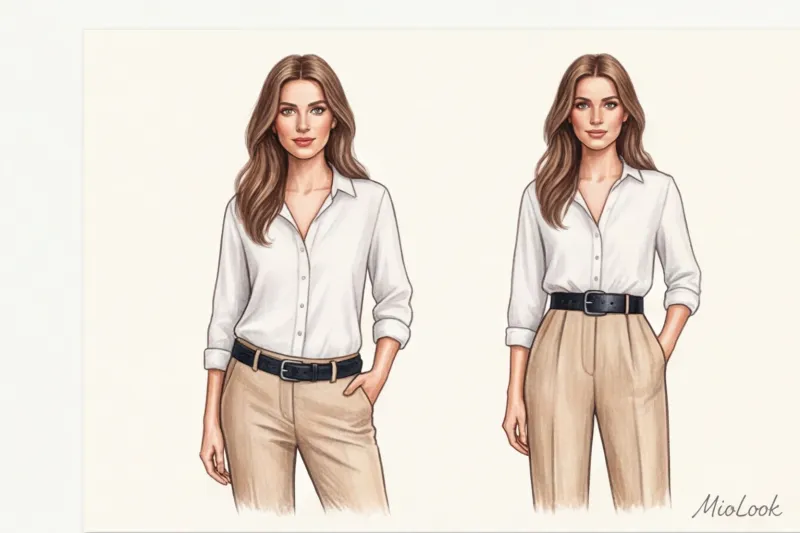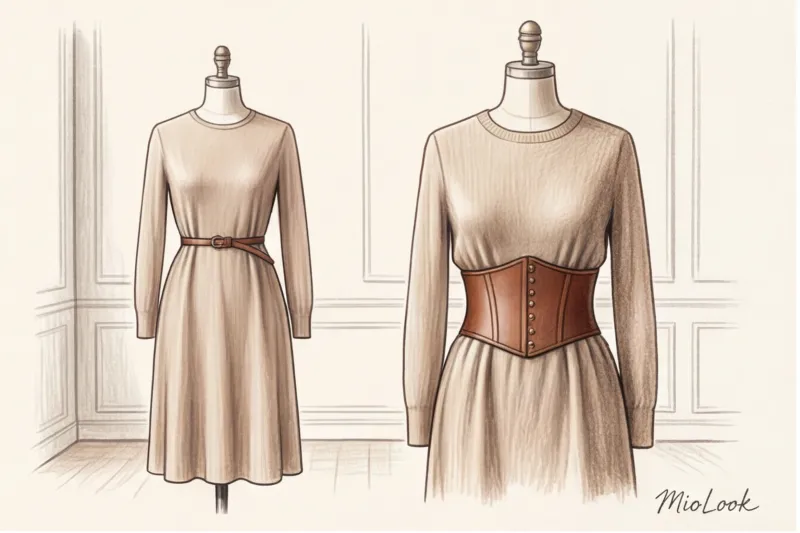
Just last week, a client named Anna came to me for a wardrobe review. She has a classic apple-shaped figure with beautiful, slender legs and a fuller midsection. In an attempt to create a waist, she wore a stiff, 10-centimeter-wide black corset belt over a loose white shirt. The result was the exact opposite: the contrasting, wide band ate up her height, emphasized her lack of curves, and visually turned her torso into a square.
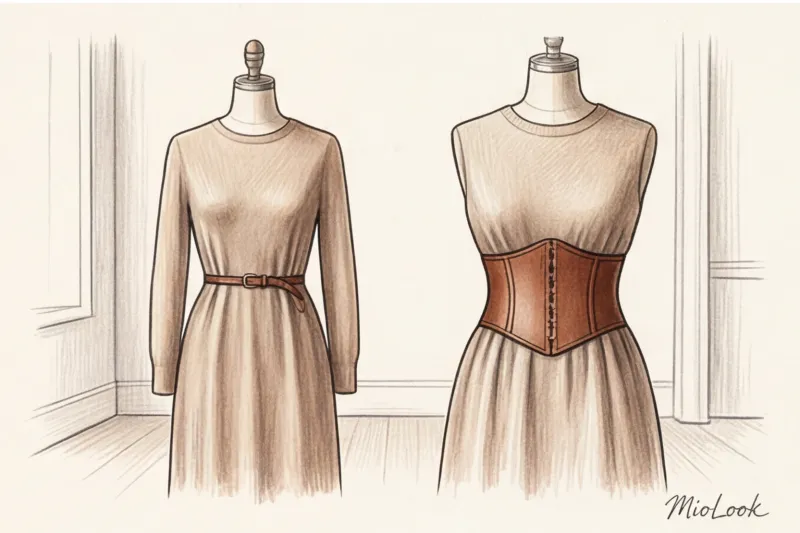
We often make this mistake: we try to use accessories like shapewear or a corset. But a belt isn't a vice. It's an architectural tool. How to choose a belt according to your body type , depends not on a desire to appear thinner, but on your bone structure, body size, and the laws of optics. We've already discussed the basic rules of proportionality in more detail in our the complete guide to perfect accessories , and today we'll look at the specific mathematics of lines, millimeters, and width.
The Ebbinghaus Illusion in Wardrobe: Why Belt Width Changes Your Body Shape
At the end of the 19th century, German psychologist Hermann Ebbinghaus discovered an optical illusion: a circle appears larger or smaller depending on the size of the objects surrounding it. In styling, this rule works reliably: the scale of a detail is always assessed relative to the background (your body).
Imagine a size 50 woman choosing a delicate, thin, 1.5 cm wide belt, hoping it will add a touch of lightness to her look. In reality, what happens is an optical collapse. Against the backdrop of her larger figure, the thin belt looks like a taut thread, ready to snap. The brain interprets this contrast unambiguously: "Since the belt is so tiny, the figure beneath it must be enormous." Conversely, an overly thick belt on a petite woman visually pins her to the ground.
"Things should work for you, not you for them. The right accessory doesn't conflict with your nature; it scales with it."
Your perfect look starts here
Join thousands of users who look flawless every day with MioLook.
Get access — €0.99 onceAnatomy of scale: how to choose a belt based on your body type and bone structure
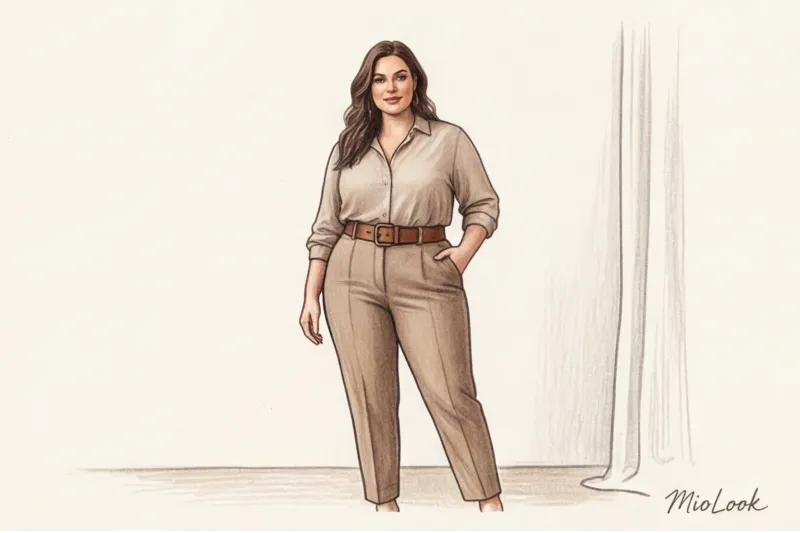
Before heading to the store, take two simple measurements in front of a mirror. No complicated formulas—just your hands and a measuring tape.
- Bone structure test: Measure your wrist circumference. If it's less than 14.5 cm, you're asthenic (small scale). Between 14.5 and 16.5 cm, you're normosthenic (medium scale). More than 16.5 cm, you're hypersthenic (large scale). This is your starting point for choosing any fittings.
- Torso Length Test: Place your palms horizontally under your chest, one above the other. If you can fit more than two palms to your waistline (the narrowest part), you have a long torso. If you can fit less than two palms, you have a short torso.
Wide belts (from 6 cm): who suits them and where they pose a danger
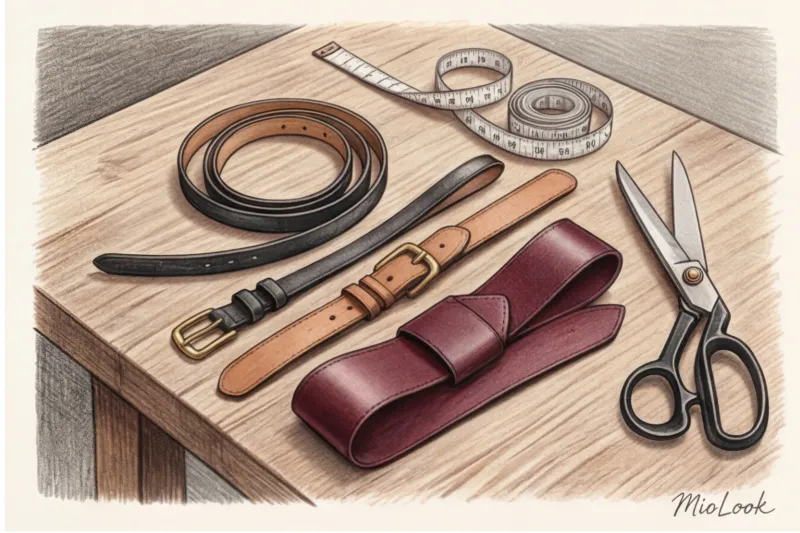
Wide, architectural belts are a powerful style tool. They're ideal for tall women and those with an hourglass figure with a pronounced waist-to-hip difference. They're also a boon for women with long torsos: a wide belt takes away some of the length from the torso, visually lengthening the legs.
But there lies a counterintuitive paradox here. There's a myth that a wide belt makes your waist appear smaller. The truth is, if you have a short torso or a rectangle body shape, a wide, contrasting belt will completely "eat" your waist. It will stretch from your ribs to your hipbones, turning you into a monolithic block. If you still want to embrace this trend, choose a belt that matches your dress or jacket.
Narrow straps (1-2.5 cm): elegance or optical trap?
Narrow belts are designed for petite women (up to 160 cm tall) and those with asthenic figures. They delicately accentuate the waist on flowing silk dresses without overloading the silhouette.
If you're larger than a size 46 and really want to wear a thin belt, try a modern styling trick: wear two identical thin belts at the same time (one slightly higher, one slightly lower, or cross them). This way, you'll maintain the graceful lines but add just the right amount of volume to maintain the Ebbinghaus illusion. Unsure about the combination? Load your items in MioLook — a smart AI stylist will show you how it will look on your figure.
The golden mean (3-5 cm): a universal base
If I were asked to keep only one belt in my wardrobe, it would be a smooth leather model 3.5 - 4 cm wide. Why this particular size?
- It fits perfectly with the standard belt loops of 90% of classic trousers and jeans.
- It follows the "golden ratio" rule in relation to the proportions of the female body of average height (165-170 cm).
- It shapes the waist without squeezing the ribs.
By the way, if you collect Basic wardrobe for a rectangle body shape , it is a 4 cm wide belt, worn just below the natural waistline (on the hips) with palazzo pants, that will help create the illusion of curves.
Access to MioLook for €0.99 — one-time payment
A smart AI stylist will choose the perfect look for you.
Get access — €0.99 onceColor and Contrast: How a Belt Cuts a Silhouette (and How to Avoid It)
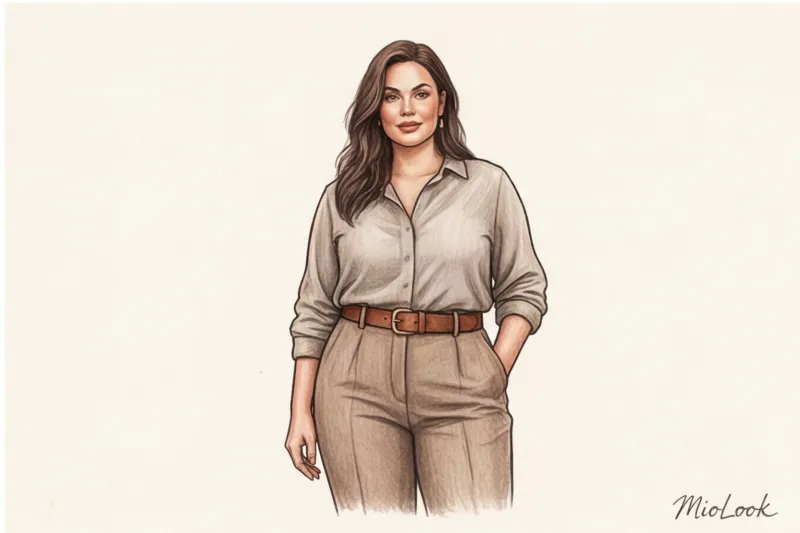
One day, my client Svetlana (162 cm, size 48) and I were experimenting. She wore a light linen midi dress and cinched it with a black belt. Her silhouette instantly "cut" in half, visually reducing her height by five centimeters. We simply replaced the black belt with a caramel color that matched the dress. The effect was stunning: Svetlana looked like she'd lost 5 kilos.
A contrasting belt always creates a horizontal accent. It draws attention to the area it's placed on. If you have a tummy you want to hide, a contrasting belt at the waist will act as a neon "Look Here" sign.
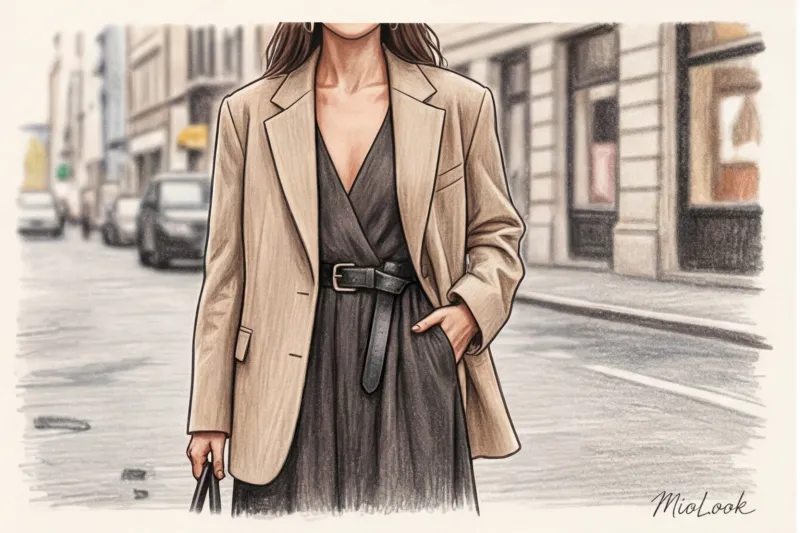
My favorite technique is "vertical": Wear a dress or top with trousers, add a belt (even a contrasting one), and layer a long blazer or cardigan over it, leaving it unbuttoned. The belt will define your waist, and the jacket's hem will cut off the sides, creating two elongating vertical lines.
Fair Limit: This trick won't work if you have a very full bust, sloping shoulders, and narrow hips. In this case, an unbuttoned, straight-cut jacket will fall down from your chest, creating a tent-like effect, and the belt underneath won't be visible.
Debunking the myths: the main mistakes when choosing a belt
In 12 years of working as a stylist, I've heard dozens of ridiculous rules that are time to forget.
Myth 1: “If you don’t have a waist, you need to tighten your belt too much.”
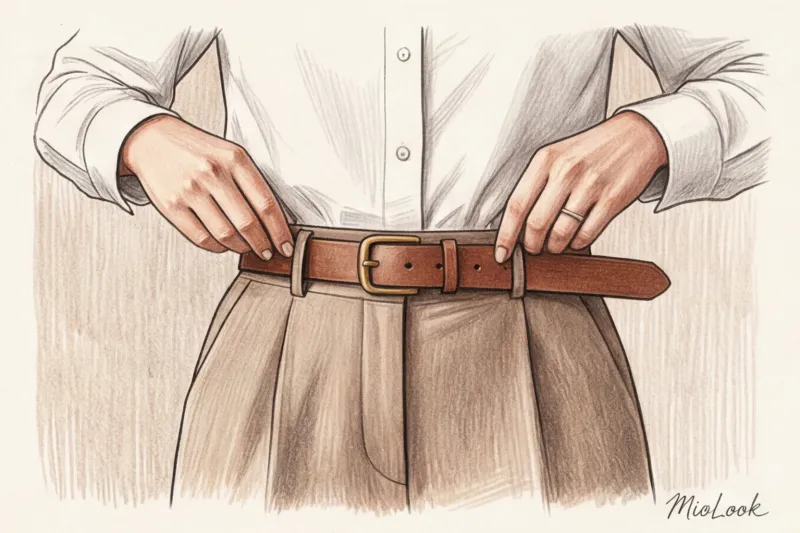
Reality: If you tighten your belt too tightly, you'll create folds of fabric (and leather) above and below it, making your waist appear even wider. The ideal fit is a semi-tight belt. You should be able to fit a finger comfortably between the belt and your body.
Myth 2: “The belt and shoes should be the same color.”
Reality: According to a WGSN analyst report (2024), strict "matching" of accessories is long outdated and makes a look too contrived and ageist. Today, a belt matches the hardware of a bag, the color of the buttons on a jacket, or stands alone in a monochrome look.
Myth 3: “An elastic belt makes you look slimmer.”
Reality: Elastic (especially with a chunky buckle) significantly cheapens a look. It pulls the fabric unevenly, distorting the proportions. Always choose a dense, shape-holding fabric.
Investing Smart: A Guide to Mass-Market Brands
Let's count the money. The cost-per-wear (CPW) metric is incredibly revealing when it comes to belts.
If you buy a trendy pressed leather (polyurethane) belt from H&M or Zara for €15, with daily wear it will crack, crease, and start peeling within two months (about 60 wears). Your CPW will be €0.25.
My personal favorite for finding basic accessories is Massimo Dutti. Yes, a basic 100% full-grain cowhide belt will set you back €50-60. But I've been wearing my black Massimo Dutti belt for four years now. It's just acquired a nice patina. At 400 times its CPW is around €0.12. That's twice the price of a cheaper alternative.
For interesting architecture and complex, minimalist shapes, I recommend checking out COS (price range: €45–€70). Zara, however, is only worth visiting for ultra-fashionable, one-season accents: chain belts, rhinestone-embellished pieces, or intricately textured pieces you'll wear five times a year.
Stylist's Checklist: How to Check a Belt Before Buying
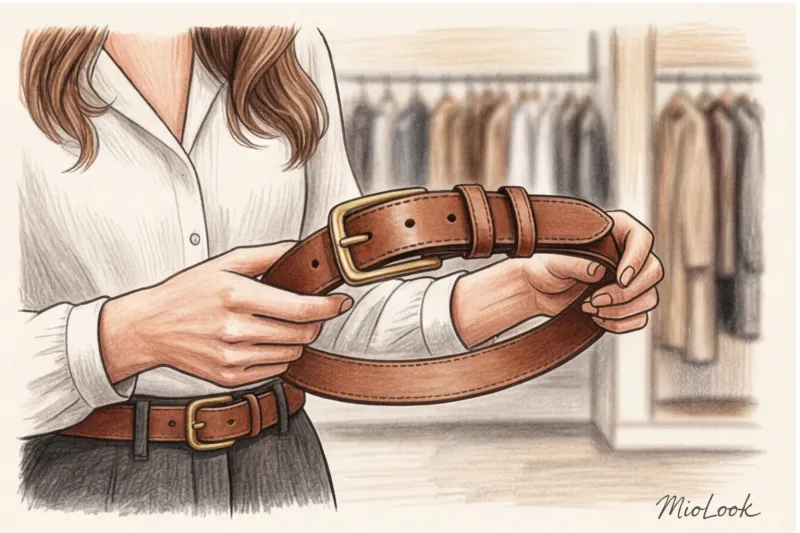
Never buy a belt just for its pretty buckle. Run a quick check in the fitting room using my checklist:
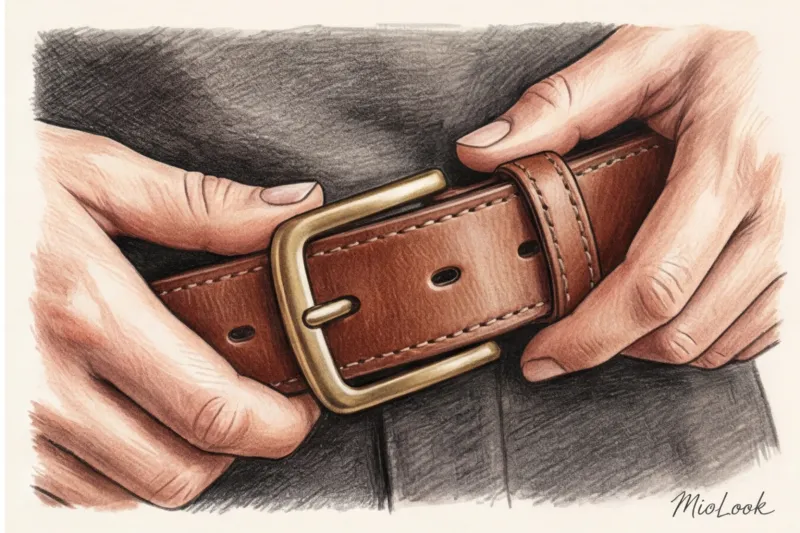
- Fold test: Fold the belt in half where there are no holes. If small cracks or white creases appear on the front side, it's cheap pressed leather. Put it back.
- Checking the edge: Look at the side edges of the belt. A quality belt will have them sealed with special paint or neatly stitched. If you see just a cut edge of material that's already fraying, the belt will quickly lose its appearance.
- Fittings: Matte metal (antique gold, blackened nickel) ages more slowly and looks more expensive than a shiny, glossy finish. Scratches from keys and bags are less noticeable on a matte surface.
- Hole Rule: The ideal fit is when the belt fastens exactly at the middle hole (usually the third of five). This leaves a neat tail that doesn't stick out, but doesn't look too stubby either.
By learning these simple rules, you'll no longer buy accessories intuitively. And to make the most of your new purchases, add your perfect belt to your virtual wardrobe. MioLook , so that the application itself integrates it into dozens of fresh images.
Remember the most important thing: a belt is the frame for your image. It shouldn't be too bulky, lest it overshadow the canvas, nor should it be flimsy, lest it get lost. Choose a proportionate belt, invest in quality, and your silhouette will always be flawless.