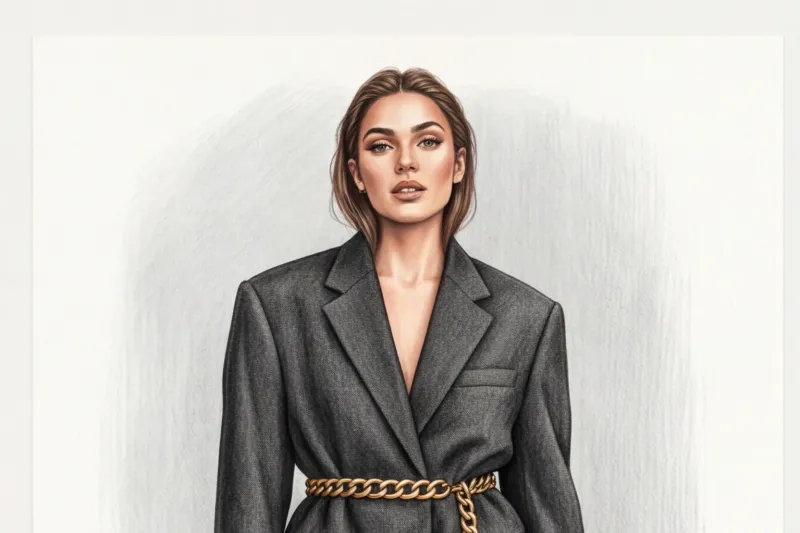
Remember 2003? Low-rise jeans, crop tops, and a thin, jingling chain across a bare midriff. For a long time, this accessory was associated exclusively with the aesthetics of the early 2000s. But if you look at the latest collections from Bottega Veneta or Saint Laurent, you'll notice a radical shift. Metal no longer reveals the body—it structures the garment. If you're wondering, What to wear with a women's chain belt Today, forget everything that the mass market dictated to you in the last decade.
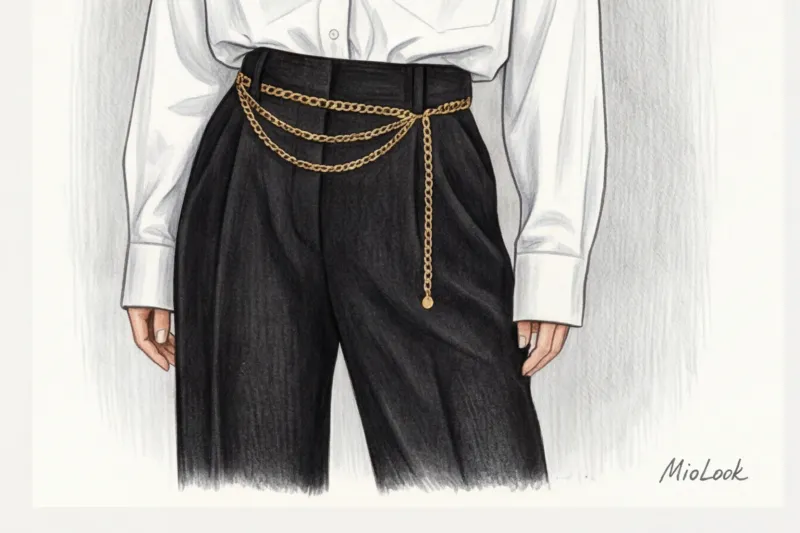
As a stylist and textile researcher, I suggest viewing metal belts not as frivolous decoration, but as a functional architectural tool. We've already discussed the architecture of silhouette and the basic principles of correcting proportions in our A complete guide to choosing women's belts according to your figure Unlike thick leather, which often cuts the figure in half, chain links work with optical illusions softly and unnoticeably.
Women's chain belt: what to wear it with and how it changes the shape of your figure
The return of metal belts represents a shift from garish Y2K style to status-conscious minimalism. According to a 2024 report by the analytical agency WGSN, demand for "fashion jewelry" has grown by 42%, displacing classic wide belts with chunky buckles from wardrobe staples. And there's a compelling anatomical reason for this.
A wide leather belt creates a solid block of color at the waist. If you don't have a defined waist-to-hip transition, such an accessory can visually square your torso. A metal chain works differently—it relies on the interplay of light and shadow. The reflective links draw attention, and the spaces between them allow the background fabric to show through without creating a harsh horizontal line. If you're interested in visual correction, I recommend checking out this article about optical illusions in clothing.
"A waist chain isn't a barrier, but a dotted line. It defines proportions without constricting the figure, keeping the look airy."
I had a particularly revealing case in my practice. A client with a classic rectangle body type came to me. She complained that oversized jackets made her look bulky, and trying to cinch them with a leather belt visually added volume to her stomach. We replaced the leather with a heavy, medium-gauge brass chain. The metal lay over the fabric, sagging slightly in the front. This diagonal sag trick visually "shed" 5 kilograms and created a waist where none physically existed.
The "Floating Line" Effect: Why Metal Sometimes Works Better Than Leather
The secret lies in the weight distribution. A leather belt is firmly fixed horizontally. A metal chain always has a slight play. Obeying gravity, it forms a soft arc (V-shape or U-shape) from the front or side. These diagonal vectors draw the eye down and toward the center, artificially narrowing the waist. To evaluate how this technique will work on your figure in advance, you can load up your clothes and try on similar combinations using virtual styling feature in the MioLook app.
Texture Analysis: Which Fabrics Make Metal Belts Look Expensive?
Here we come to the most counterintuitive styling rule. Mass-market marketing persistently convinces us that chains are made for light summer dresses and flowing fabrics. This is a mistake that cheapens the look. Metal acquires its most expensive and prestigious appearance when it's subject to a strong textural conflict.
Remember the laws of composition: smooth and shiny things seem more expressive against matte and loose backgrounds. Metallic links are lost against thin chiffon, but literally "burn" against dense, rugged materials. This is why elements of such contrast are often found in French style for autumn , where Parisian women masterfully mix roughness and elegance.
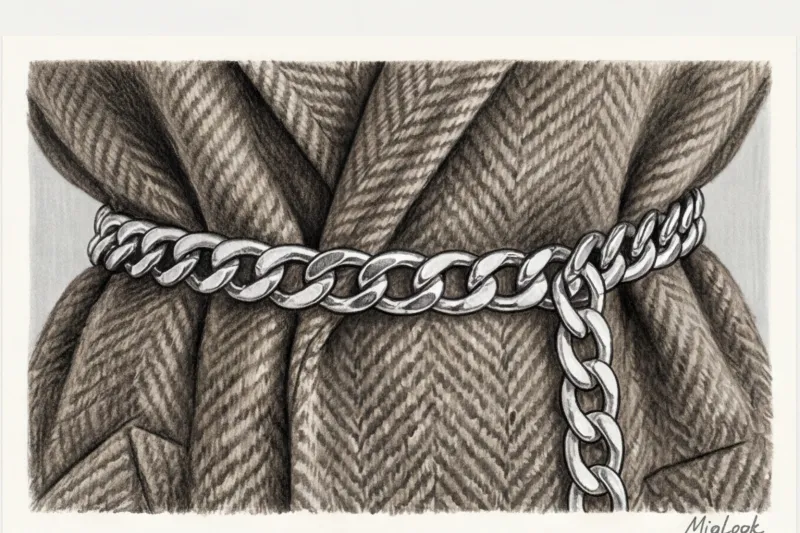
Contrast Rule: Wool, Heavy Denim, and Suiting Fabrics
Best canvases for chain belts:
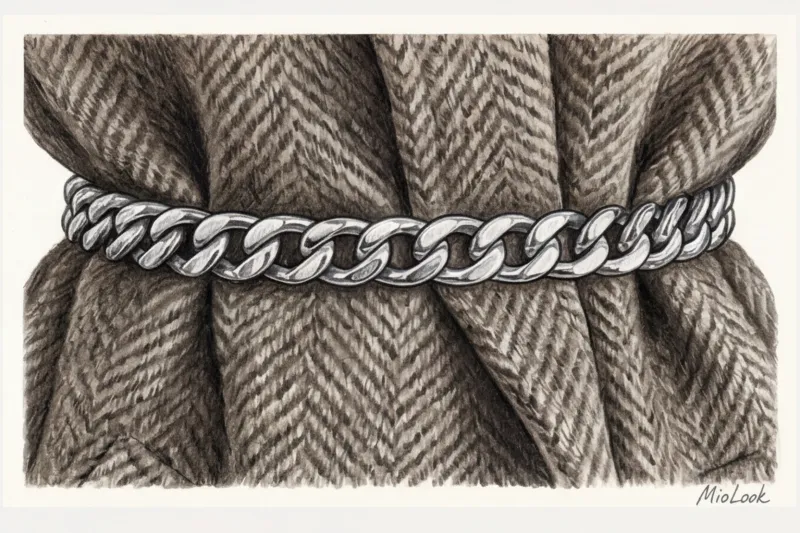
- Tweed and boucle: Threads of varying thickness create the perfect matte background for polished metal.
- Heavy cashmere and merino wool: The cold shine of the chain breaks the monolith of the warm, fluffy knitwear.
- Raw denim: Rigid cotton and metal are a classic combination that evokes the aesthetics of expensive uniforms.
As a textile expert, I must issue a warning. There is a situation where a chain belt absolutely DOES NOT work. Never wear faceted chains or belts with charm pendants over fine silk, satin, or loose acrylic knits. Micro-snags on the links will inevitably damage the delicate threads. Only one type of weave is safe for silk slip dresses: a smooth, rounded "snake chain" weave with no protruding connecting elements.
Your perfect look starts here
Join thousands of users who look flawless every day by managing their wardrobe with AI.
Get access — €0.99 onceInvesting in Quality: How to Choose a Chain Belt That Won't Tarnish
Buying a metal belt requires a technical approach. If you buy a cheap alloy for €15, it will oxidize within a month, turning your white shirt gray and becoming stained. High-quality hardware that will last for decades typically ranges from €60 to €250.
What should you pay attention to when choosing?
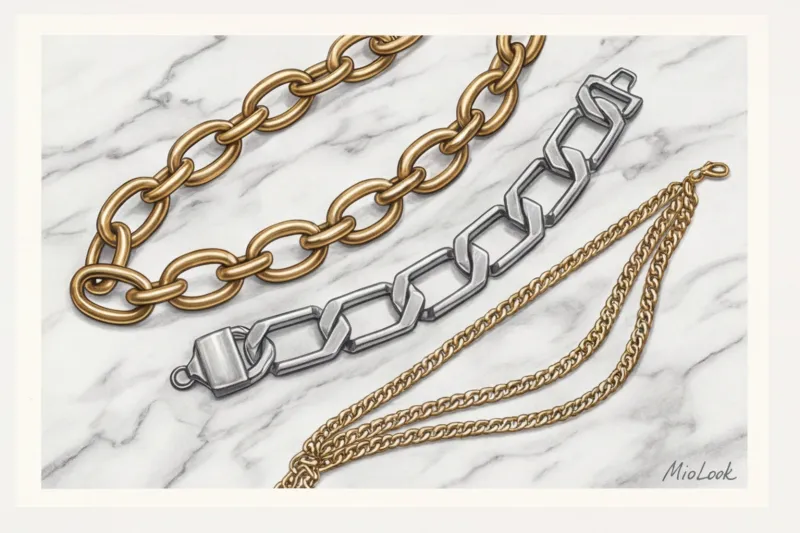
1. Base alloy. Cheap belts are cast from zamak (an alloy of zinc, aluminum, magnesium, and copper). It's lightweight, fragile, and porous. Expensive belts are made from jewelry-grade brass. Brass is malleable, holds its shape well, and has a pleasant heft. The optimal weight of a high-quality women's brass belt is 150 to 300 grams.
2. Galvanic coating. What you see on the outside is a very thin layer of precious metal (gold or rhodium). According to quality jewelry standards, the coating thickness should be between 1 and 3 microns. Any thinner, and the metal will wear away on the coat's fabric within one season.
3. Safety standards. Be sure to look for the "Nickel-free" label. According to the European REACH standard (specifically, Directive EN 1811), the use of nickel is strictly regulated because it causes contact dermatitis and leaves dark marks on clothing.
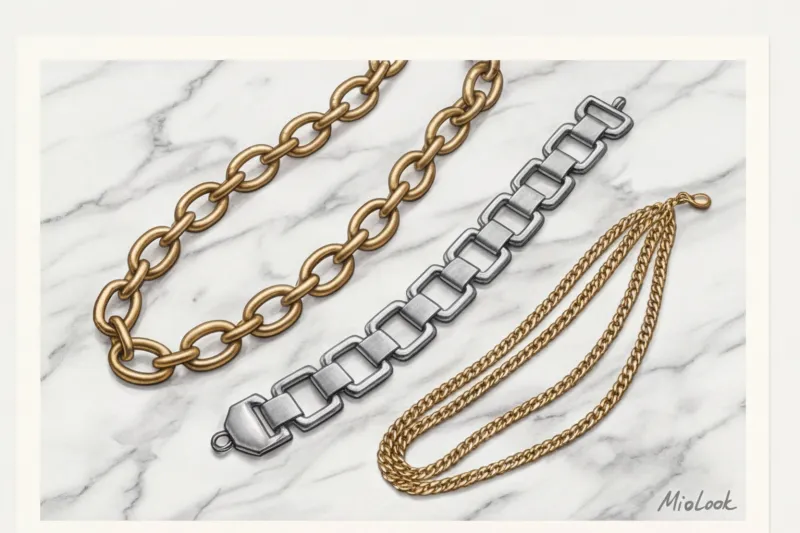
I always teach my clients the "tactile test" in the store: take a belt and run it through your tightly clenched fingers. You shouldn't feel a single roughness at the joints. If the chain bites, it will ruin your clothes.
Trendy Styles: 4 Ways to Wear a Metal Belt to the Office and Outings
Let's talk practicality. How can you integrate this accessory into a "grown-up" wardrobe without looking overdone? Here are four tried-and-true scenarios that fit even a smart-casual dress code.
Over a voluminous blazer. This is my favorite trick. Choose a men's-style blazer (with wide shoulders) made of heavy wool suiting. Button it up and place the chain at the waist. This creates an hourglass silhouette, but the loose fit of the jacket keeps you from looking too constrained.
In the belt loops of classic palazzo trousers. Swap your basic leather belt for a thin, delicate chain. This looks especially striking if your trousers are black or camel. It's a subtle hint of aesthetics. old mani style , where details decide everything.
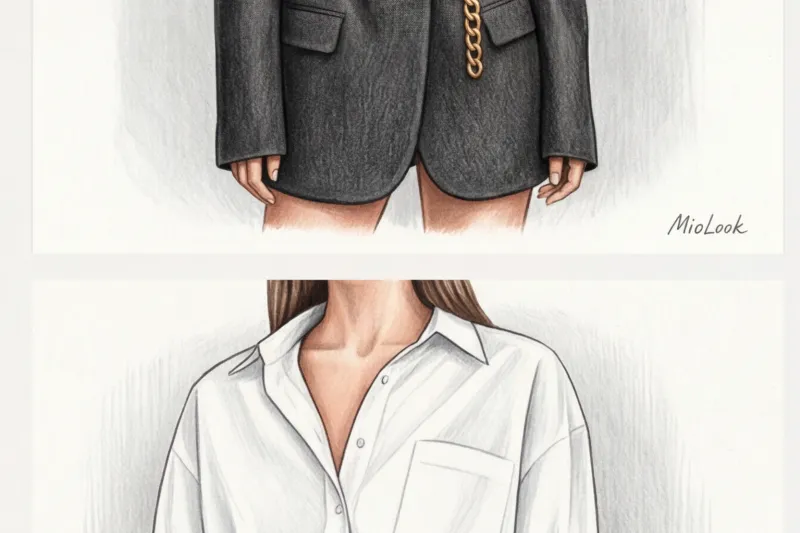
Over a long white shirt. Take a crisp poplin shirt (120 g/m² cotton). Wear it untucked with straight-leg jeans and add a chunky metal chain at the waist. The metal will absorb excess fabric volume and transform a boring basic into a sophisticated outfit.
On a slip dress. As I mentioned, extreme caution is required here. Use only completely smooth chain cords. Don't wear them too tightly at the waist, but rather slightly loose at the hips (a la 1920s style) so that the metal doesn't distort the delicate silk as you walk.
Ready to get started?
Try the MioLook plan for free—no commitments required. Create your virtual capsule now.
Get access — €0.99 onceMyths and Mistakes: Why Your Chain Belt Look Might Look Outdated
Even the most expensive accessory will lose its luster if you make basic styling mistakes. Let's explore the main anti-trends.
Mistake 1: Wearing low-waisted with a crop top. If your goal is status and not a Britney Spears-themed party, avoid direct metal contact with exposed abdominal skin. A chain belt is an adornment for clothing, not for the body.
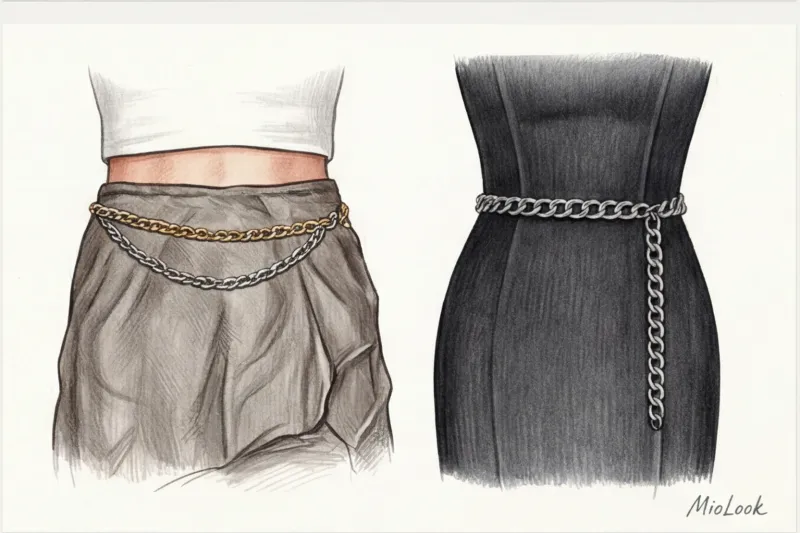
Error 2: Metal conflict and overload. A chain belt is a very bold, statement piece. If you're wearing one, avoid large necklaces, multiple bracelets, and shiny buttons. The rule of thumb is one large accent plus one micro-accent (for example, a chain around the waist and studs).
Mistake 3: Cheap yellow gloss. The color of the metal reveals its value in a split second. High-quality gold plating has a noble, slightly cool or subtly warm undertone. In Pantone terms, these are shades close to 14-1036 TCX (Gold Earth). Avoid acid-yellow, orange, or "samovar" gold—it instantly makes a look provincial.
Checklist: Perfect Fit and Care for Metal Accessories
The overall look depends not only on the garment you choose but also on its fit. The main problem with chain belts is their length. A perfectly fitted belt should fasten so that the free end (tail) hangs down 10-15 centimeters. If the tail is shorter than 5 cm, the belt will appear too small. If it hangs down to the knee, it looks sloppy and interferes with walking.
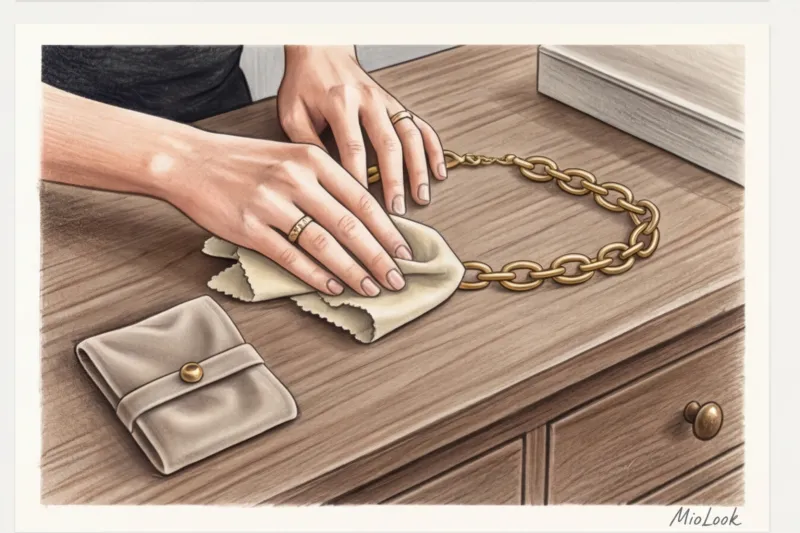
Finally, a few words about care (sustainable fashion begins with careful handling of things):
- After each removal, wipe the links with a soft microfiber cloth. Sebum, perfume, and makeup particles are the main enemies of electroplating.
- Store metal belts in individual bags (dust bags) made of suede or thick cotton. If you toss a chain in a drawer with other jewelry, it will become covered in micro-scratches, and the metal will lose its reflective properties.
- Do not twist the rigid links into a tight ball - they may become deformed at the soldered joints.
A metal belt isn't just a way to keep trousers in place (it's frankly worse at that than leather). It's a powerful styling tool that transforms a basic cut into a sophisticated design statement. Opt for heavy alloys, mix them with dense matte wool, and you'll see how this small accessory elevates your wardrobe to a whole new level of aesthetics.