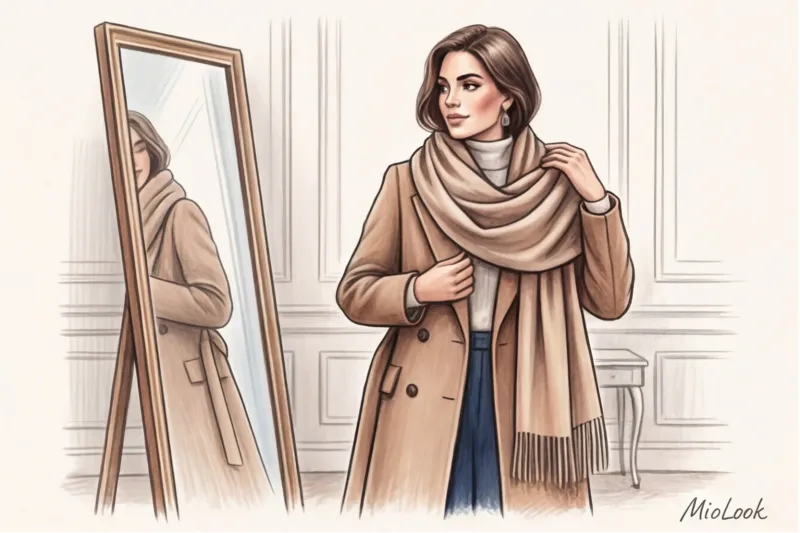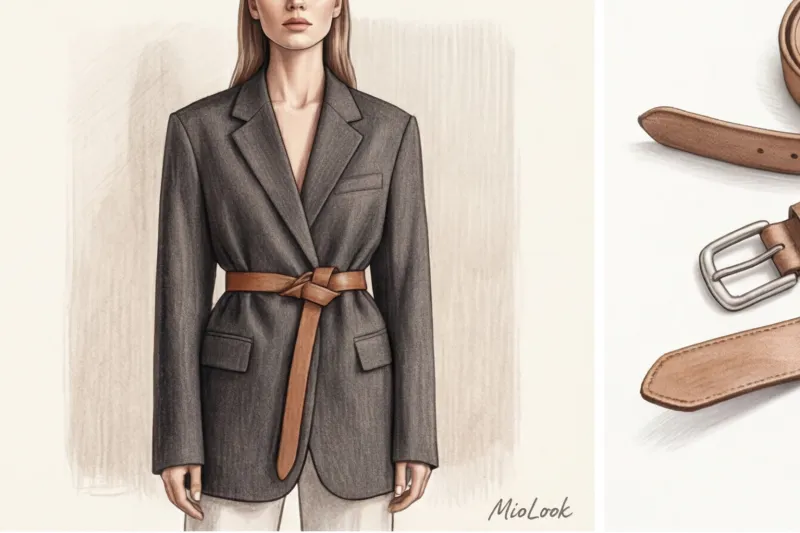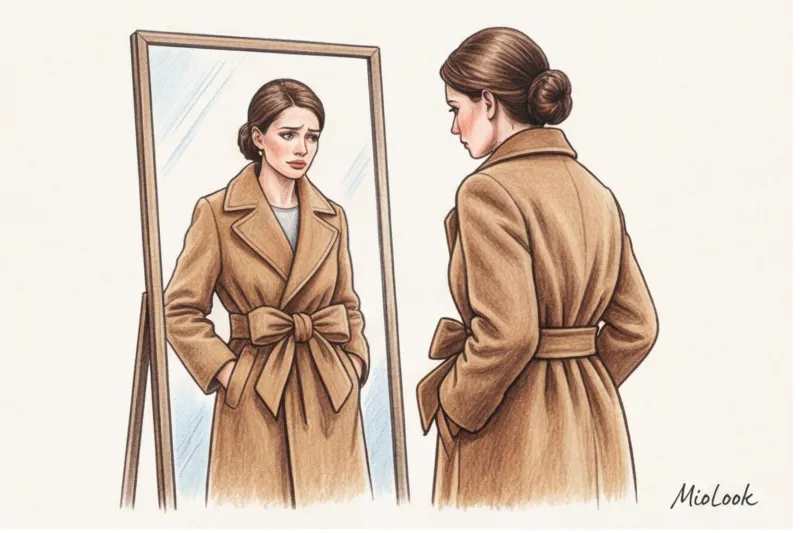
Do you know what betrays a lack of style faster than an outdated bag? The way a woman ties the belt on an expensive coat. Every morning in the fall and spring, I see the same scene on the streets of European capitals: stunning wool, excellent tailoring, and... an awkward, tightly tucked, symmetrical bow right in the center of the stomach, turning an elegant woman into a first-grader's gift.
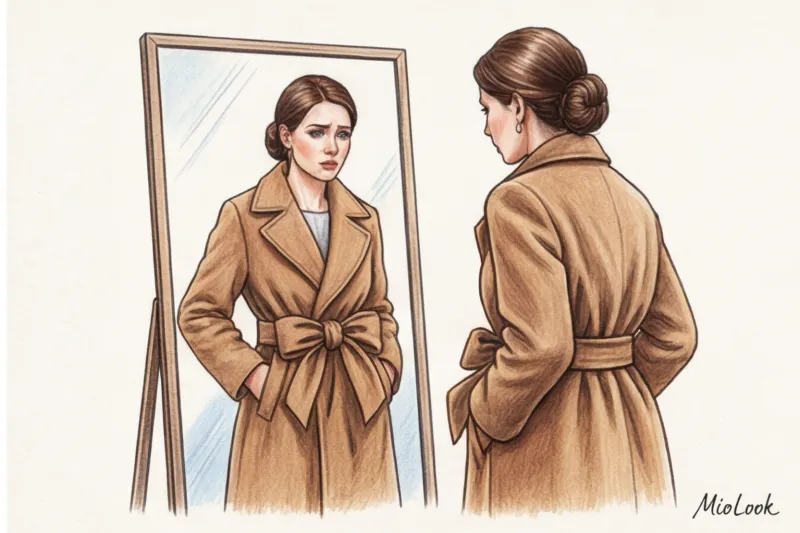
We have already discussed the basic laws of working with proportions in more detail in our A complete guide to choosing a women's belt to suit your figure , but outerwear requires a completely different approach. Here we work with dense, architectural materials. If you want to understand, How to tie a belt on a coat beautifully Forget complicated macrame patterns from the internet. We'll learn how to manage volumes.
Why a "baby bow" ruins an expensive coat: the architecture of the silhouette
Over 12 years as a personal stylist, I've spent hundreds of hours in fitting rooms. A typical situation: a client puts on a luxurious double-breasted coat from Massimo Dutti or COS made of a thick wool blend (in the €200-€350 price range). She habitually ties the belt into a bow, looks in the mirror, and says with disappointment, "It makes me look fat."
The problem isn't with the patterns. It's with the "candy wrapper" effect. Thick coat wool weighing over 600 g/m² isn't physically designed for fine gathers. When you form a classic double-loop bow, you're layering the fabric 4-5 times over an area of 10 square centimeters.
"A symmetrical bow on a thick fabric automatically adds 4 centimeters to your waist and creates a visual roll on your stomach. A mature, classy wardrobe calls for subtle asymmetry and flat lines."
My main rule for silhouette architecture: a belt isn't a rope for hay bale tying. It's a tool for attention management. Unlike lightweight cotton or gabardine, heavy cashmere or wool require flat single knots that don't disrupt the vertical line of your body.
Your perfect look starts here
Join thousands of users who look flawless every day with MioLook. A smart AI stylist will help you create a capsule wardrobe for any season.
Get access — €0.99 onceHow to Tie a Coat Belt: 3 Flat Knots for Heavy Wool
The basic rule for working with wool garments is to minimize the layers of fabric in the knot. The loose edges should fall strictly vertically, creating two parallel lines that visually elongate and slim the figure.
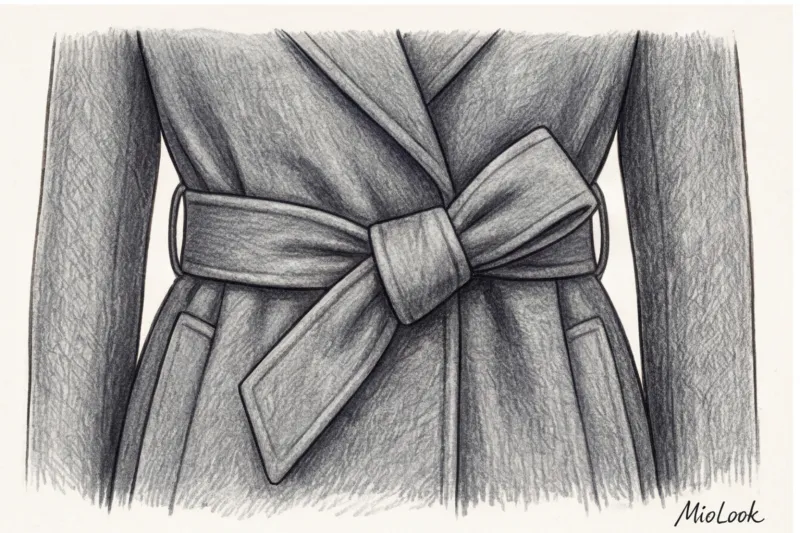
My personal life hack: the "15 centimeter" rule. Whatever knot you choose, the loose end should be no shorter than 15 centimeters. Any shorter, and the knot will stick out like a stub. If the belt is too short, it's better to wear the coat open or tie it at the back.
Pattern 1: Elegant Half-Bow (Asymmetry that makes you look slimmer)
This is an absolute favorite of Italian fashion editors and my personal number one choice for robe coats from the Zara and &Other Stories collections. Why the half-bow? The asymmetry draws the eye diagonally, distracting attention from any possible waist imperfections.
- Cross the ends of the belt, leaving one end (let's call it A) longer than the other (B) by about 10 cm.
- Pass the long edge A under the short edge B from bottom to top (like the first step of lacing a shoe).
- Fold edge A into one flat loop (eye).
- Wrap the edge of B around this loop and thread it through the resulting hole, but don't pull it out all the way.
- Pull it tightly. You should have one neat loop and two vertically hanging ends.
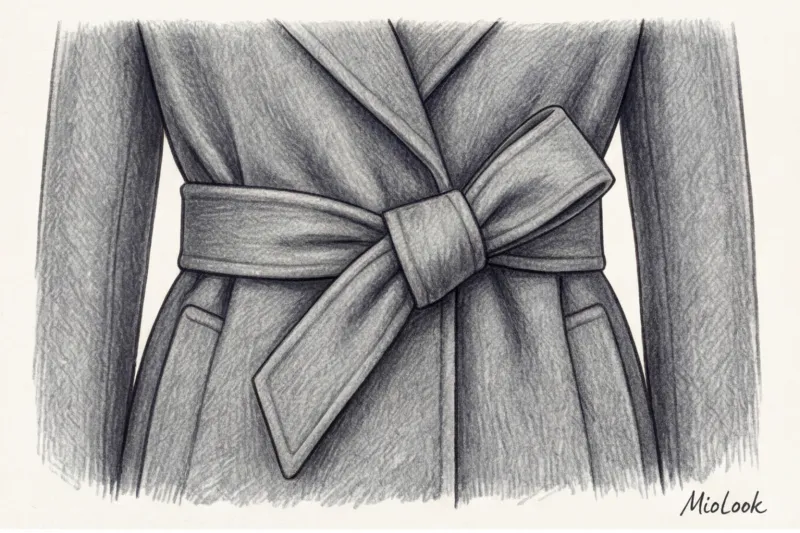
Pattern 2: Simple Flat Knot (Old Money Aesthetic)
For formal, straight-cut business coats, a half-bow can seem too relaxed. Here, the single-plane crossover technique comes to the rescue. This knot mimics a men's tie style and sits perfectly on even the stiffest fabric.
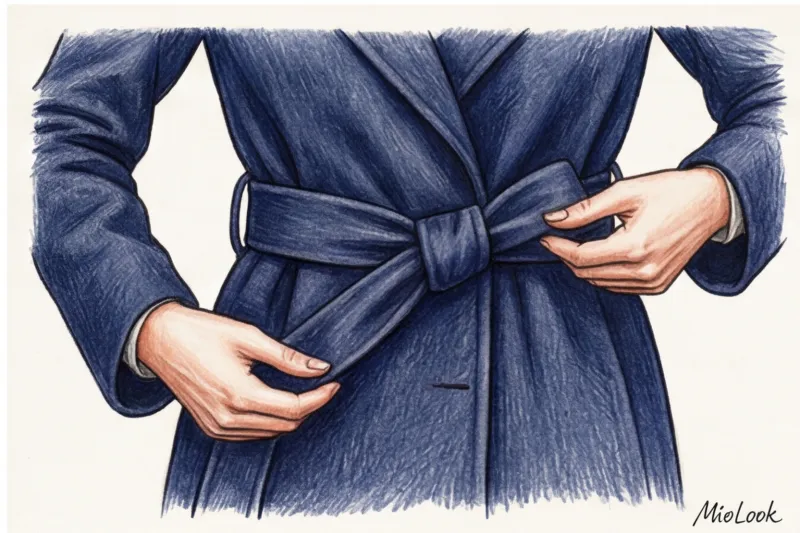
The secret is not to pull the ends in different directions (horizontally), but to pull them strictly up and down vertically.
- Place the right end over the left.
- Pass the right one from the bottom up through the resulting loop on the stomach.
- Now pass the end that is on top over the bottom one and through the resulting eyelet.
- Pull the bottom end straight down and gently straighten the top end so that it covers the knot from above.
Pattern 3: Milanese Loop (For very long belts)
Manufacturers (especially mass-market brands) often include unnaturally long belts on coats. If a regular knot leaves the ends hanging below the knees, the silhouette looks untidy. The Milanese loop solves this problem by shortening the free edge by half.
Before tying, fold one end of the belt in half (creating a long loop). Use this doubled portion as if it were a single end, wrapping the other end around it. This will tighten the structure and remove excess length without the need for scissors.
Access to MioLook for €0.99 — one-time payment
A smart AI stylist will find the perfect look. Digitize your wardrobe in minutes and stop wondering what to wear with your favorite coat.
Get access — €0.99 onceTrench Coat and Raincoat Patterns: Working with Lightweight Fabric and a Buckle
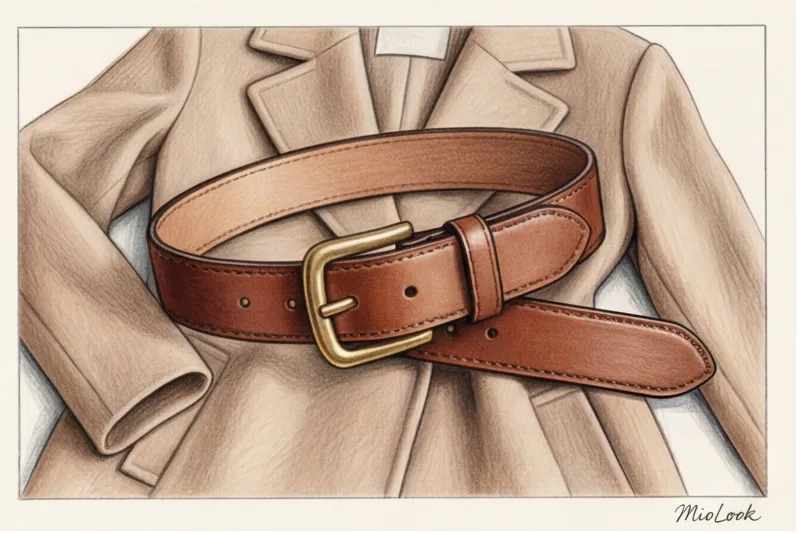
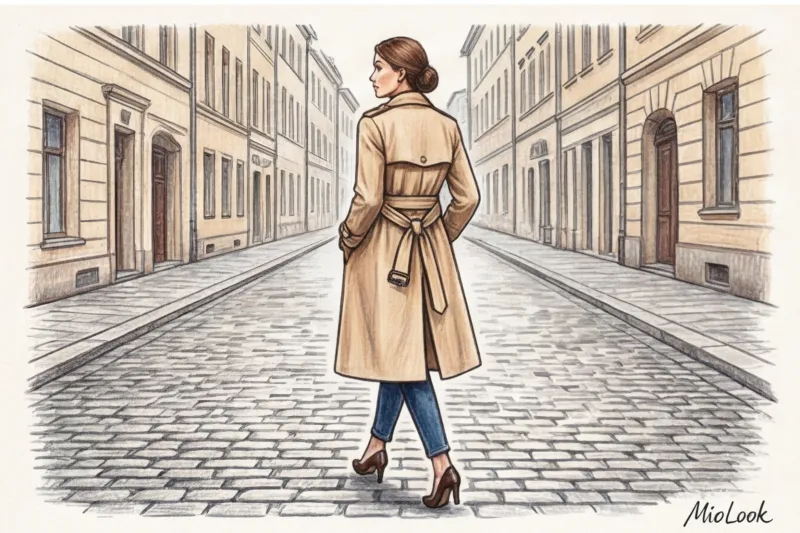
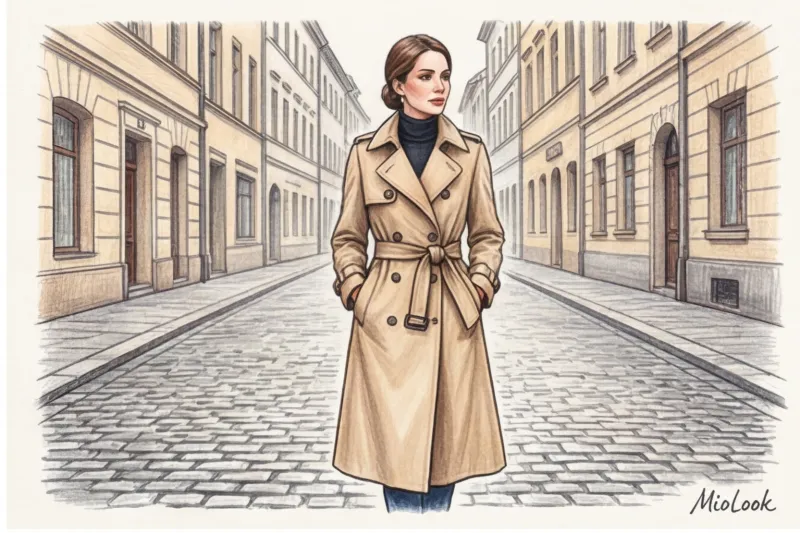
Gabardine and heavy cotton (usually weighing around 250–300 g/m²) behave differently than wool. They wrinkle easily, but they hold the shape of a complex knot perfectly. If you look at street style photos from fashion weeks, you'll notice one detail: no one fastens a classic Burberry trench coat (or its budget equivalents) with a buckle "properly."
According to the analytical agency WGSN (2024), the trend for sprezzatura—the Italian concept of deliberate casualness—has become a basic styling rule. A perfectly buckled belt today looks too boring, like you're getting ready for a school assembly.
Back knot: create a fitted silhouette without tying the coat in front
This technique allows you to wear the coat open while still maintaining a flattering silhouette. The fabric is pulled tight at the back, creating a naturally fitted silhouette.
- Classic tie knot: Thread the end without the buckle through the buckle itself, but do not fasten it with the tongue. Wrap it around the belt and pull the end down through the resulting loop. The knot will be flat and secure.
- Volumetric bow: A bow on the back of a gabardine dress is appropriate! Since there's no natural volume on the back (like on the stomach), a neatly tied, symmetrical bow will create a beautiful drape and won't add extra pounds to the front.
Sloppy street styler knot (Without using a buckle)
If you want to tie your coat in front, ignore the buckle. Bring the ends together (the buckle should just hang from one of them) and tie a basic single knot, as if it were a regular, soft belt without hardware. The secret to this style's classiness lies in smoothing out the fabric of the knot itself—it shouldn't look like a tight, wrinkled ball of cotton.
Belt-tying mistakes that visually add 5 kilograms
Sometimes all it takes is two seconds in the fitting room to adjust the fit of a garment. Have you ever noticed how some women's coats fit like a glove, while others' tend to bunch up in untidy folds? Here are the three main mistakes I correct for my clients every day:
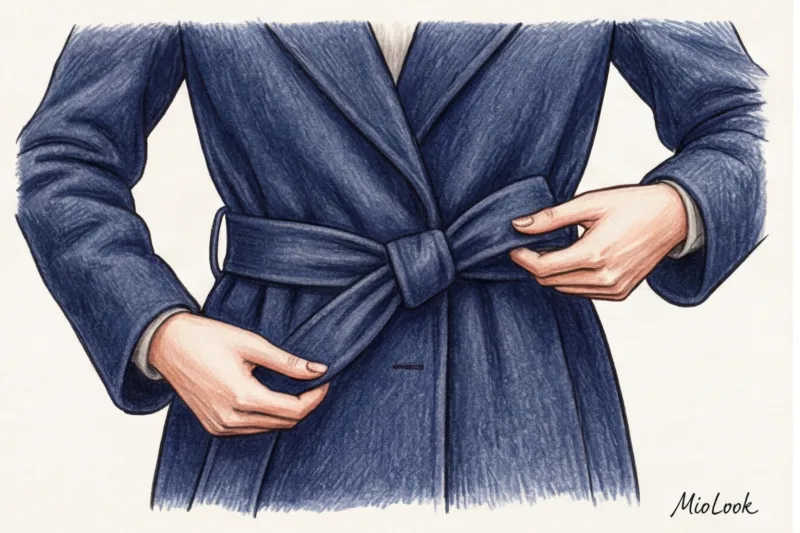
1. The knot is exactly in the center of the abdomen.
This geometric focus is on your widest point at the front. By shifting the knot just 5-7 centimeters to the side (toward your hipbone), your silhouette instantly becomes longer. The vertical line shifts, creating the illusion of a narrower waist.
2. Caterpillar effect on the back.
When you tighten the belt too tightly (especially on thin down jackets or soft coats), deep horizontal folds form on the back. The fabric should drape freely. The belt is needed to designate waist, not to squeeze you into a corset.
3. Twisted belt.
Before tying the knot, run your hands along the belt from your back to your stomach. If the belt is twisted at the back, it will break the line of your back and create a bulge that will be visible even through thick fabric.
Fair stylist limitation: My belt-tying tips don't work for all body types. If you have a pronounced apple shape (with most of your weight concentrated around your midsection), a bulky knot made from the coat itself will only make things worse. In this case, it's best to remove the belt altogether, maintaining a straight silhouette, or replace it with a stiff, medium-width leather belt fastened in the classic style.
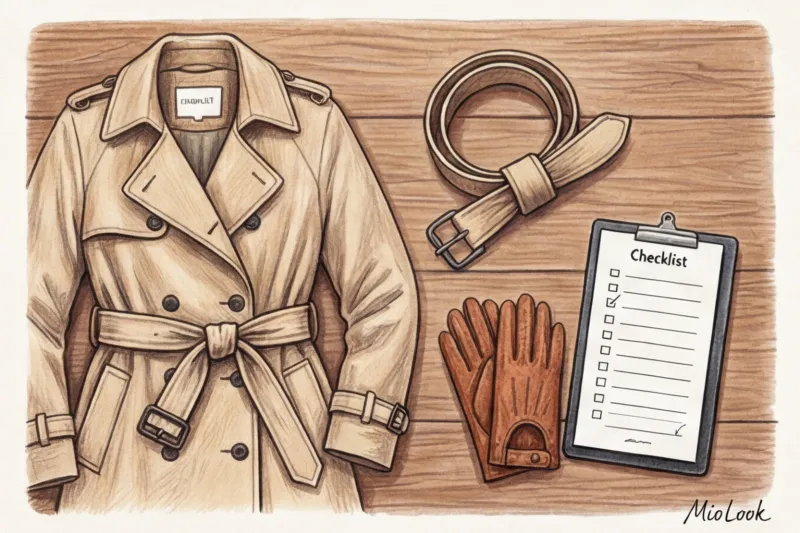
Katarzyna's Checklist: How to Choose the Perfect Knot in 10 Seconds
To avoid standing in front of the mirror in confusion, I've prepared a simple algorithm. Save it or take a screenshot before leaving the house:
- Assess the density of the fabric. Wool over 600 g/m²? Only flat knots (single or half bow). Thin cotton/gabardine? Loop knots and complex draping are acceptable.
- Look at the length of the belt. Is the loose hem shorter than 15 cm? Tie a knot at the back and wear it open. Is it hanging below the knees? Use a Milanese stitch (folding it in half).
- Consider the availability of fittings. Do you have a heavy buckle? Never tie it in the center of a complex knot—leave it hanging freely at the straight end.
- Determine the dress code. Office/formal suit? Straight tie knot. Casual? Asymmetrical off-center half-bow.
The secret to a luxurious look isn't the brand name on the tag, but how the garment interacts with your body. The perfect knot should look like you tied it casually in a few seconds while running out for your morning coffee, yet it should hold your silhouette together flawlessly all day long.