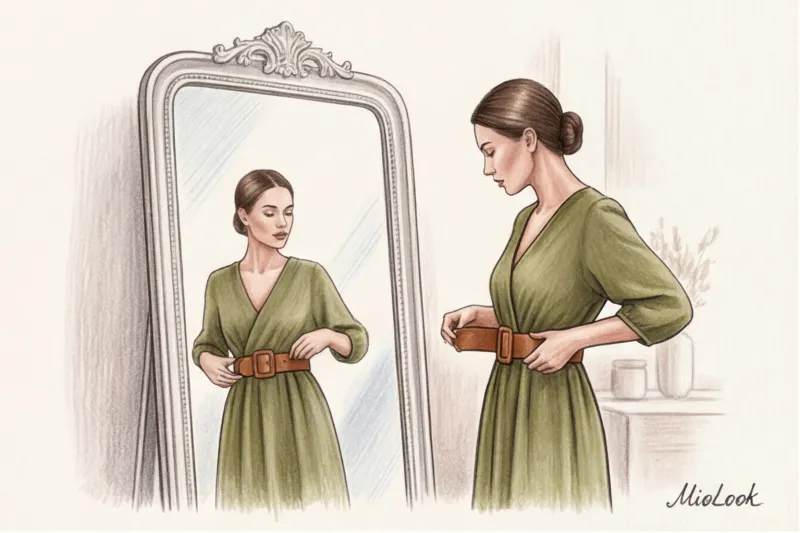
Do you know what item most often ends up in the trash during my first wardrobe reviews with new clients? It's a thin, flimsy strip of faux leather that mass-market manufacturers proudly call "a belt that goes with a dress." Over 12 years as a personal stylist, I've learned an ironclad rule: a belt isn't just a utilitarian item that keeps clothes from slipping. It's a powerful architectural tool. And if you want to figure it out once and for all, How to wear a belt with a dress , we will have to forget about banal color selection and talk about geometry.
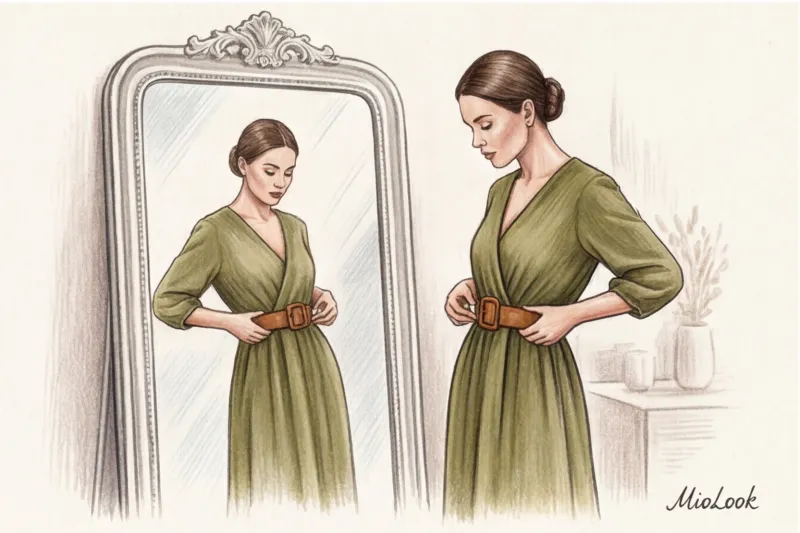
We have already discussed in more detail the basic principles of choosing this accessory in our A complete guide to choosing the right women's belt for your figure Today we'll move on to advanced styling: I'll show you how moving your belt just two centimeters can visually remove 5 kilograms and change your body proportions.
Silhouette Geometry: How to Wear a Belt with a Dress Without Ruining Your Figure
When Christian Dior introduced his iconic silhouette to the world in 1947 New Look He essentially reinvented the golden ratio for fashion. In modern style, this proportion is 1/3 to 2/3. A perfectly balanced feminine silhouette means your torso visually takes up one-third of your height, and your legs two-thirds. And the belt is the very marker that draws this line.
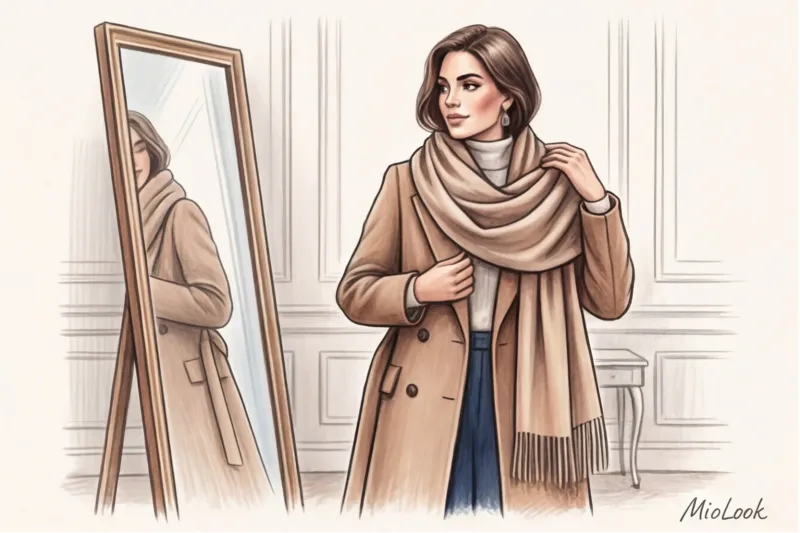
One of my clients, with a pronounced apple-shaped figure, had avoided any waist accents for years. She was convinced that belts were contraindicated for her, as they only emphasized her belly. We did a simple test drive in front of the mirror. First, we put on a classic straight-cut shirt dress. Then we tied a basic leather belt at the level where the factory belt loops were sewn (at the natural waistline)—it felt a bit heavy. But once we tried it, it felt right. micro-placement strategy And by moving the belt just 3 centimeters higher, right under the bust, the proportions instantly clicked into place. The legs visually lengthened by a good 15 centimeters, and the emphasis shifted to the narrowest part of the torso, completely eliminating the bulk in the abdominal area.
Styling Formulas: Choosing the Right Belt Width to Match Your Dress Style
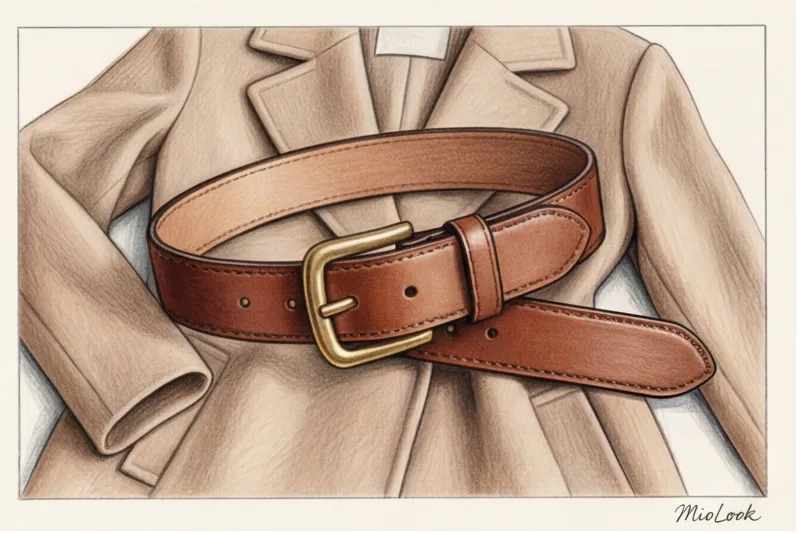
As I already said, the factory strap from the kit almost always gives away signs of cheap clothing A good belt is a long-term investment in your wardrobe. And when choosing one, my favorite stylistic formula works: Dress volume + belt density = perfect balance The denser the fabric of your dress, the stiffer the belt frame should be.
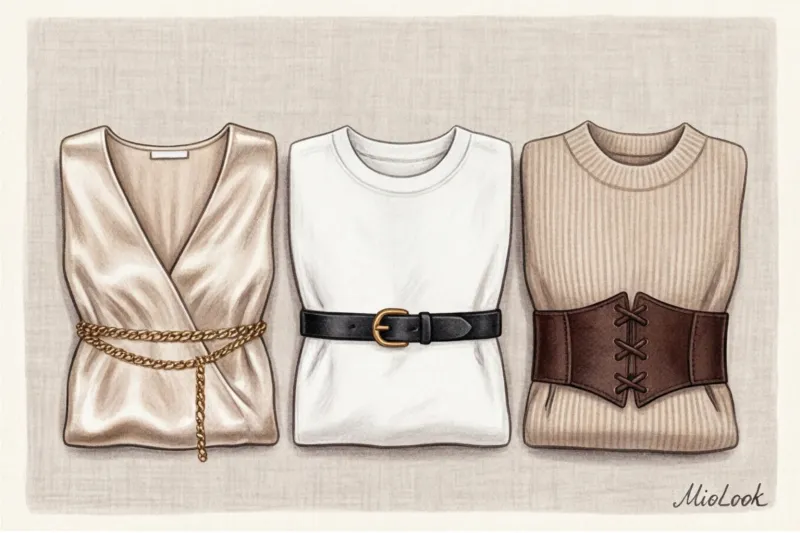
Thin straps (up to 2 cm): for flowing fabrics
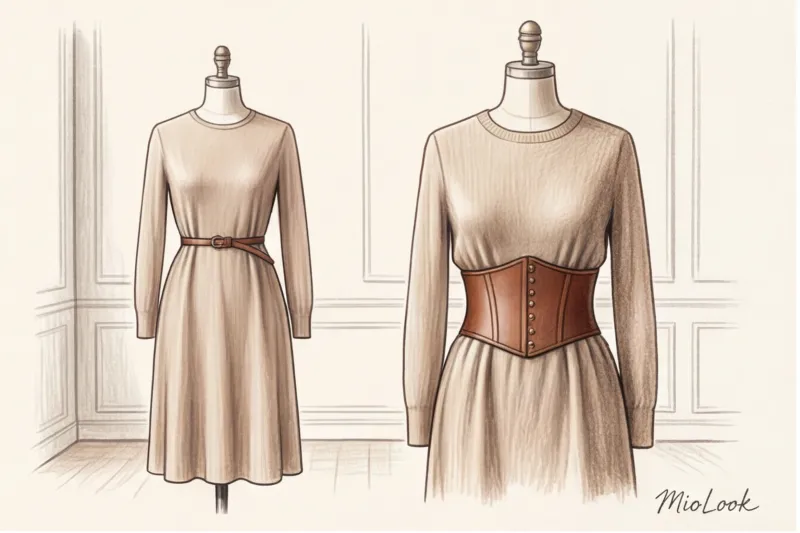
A width of up to 2 cm is the realm of delicacy and elegance. These belts work perfectly with silk slips, flowing chiffon, lingerie-style dresses, and fine linen. They subtly define the waist without overpowering a delicate look.
But there's a serious danger here. Never wear a thin belt over a thick, textured knit or an oversized sweater. The thin strip of leather will simply "drown" in the bulk of the yarn. Instead of a gathered silhouette, you'll end up with a "stretched sausage" effect, where the thick fabric hangs unattractively over the belt.
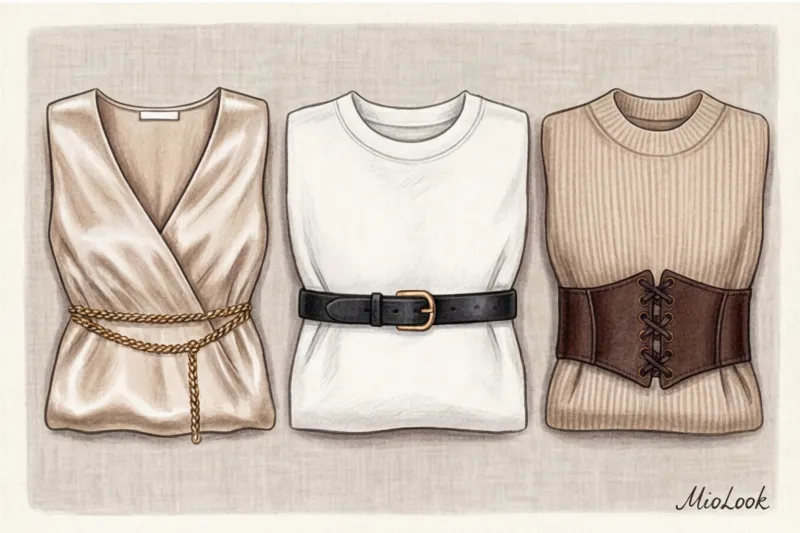
Basic straps (3-4 cm): universal soldiers
A width of 3-4 cm is the safest and smartest purchase. High-quality, medium-stiff leather in the entry-level segment (from brands like COS, Massimo Dutti, or local brands) will cost you around €50-€90 but will last for decades. This width is perfect for shirt dresses, formal office sheaths, and A-line silhouettes. It creates a clean, confident line and fits perfectly with wardrobe of a stylish woman over 40 , giving the image status.
Wide belts and corsets (from 5 cm): an architectural accent
Anything wider than 5 cm is no longer just an accessory, but the star of the look. Wide belts are great for taming voluminous boho dresses and adding structure to maxi dresses made of thick denim or cotton.
Important limitation: This advice doesn't work for everyone. If you have a short torso (a short physical distance from your lowest rib to your pelvic bone), a wide corset belt will completely "swallow" your waist. Visually, your figure will become square. In this case, always return to the universal 3 cm base.
Access to MioLook for €0.99 — one-time payment
A smart AI stylist will select the perfect look for you, taking into account your figure proportions and texture compatibility.
Get access — €0.99 onceThe main myth: should you match your belt to your shoes?
If you're still meticulously matching your bag, shoes, and belt to each other, please stop. This 2000s rule is hopelessly outdated and now works against you, instantly adding a decade to your look. According to a 2024 analytics report from Lyst, shoppers' searches for "perfectly matching accessory sets" have plummeted by 40%. Fashion has become more complex and interesting.
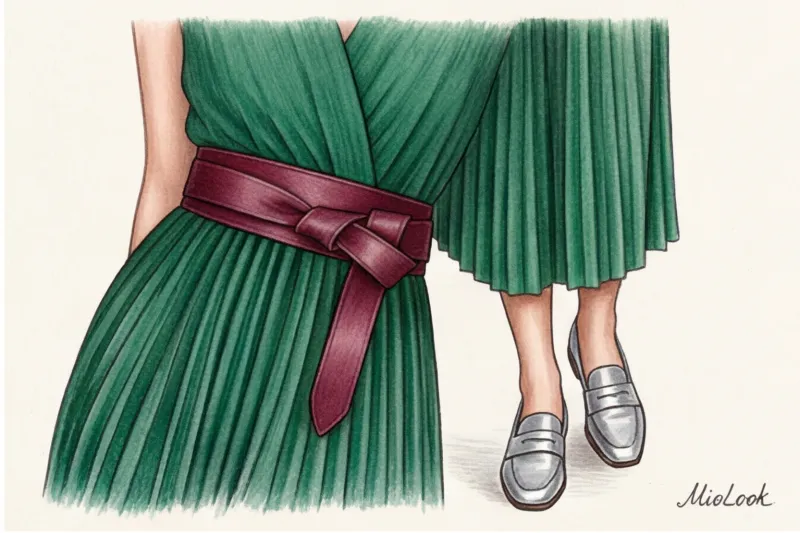
The modern approach is based on play of textures , rather than monochrome. If you're wearing a sleek satin dress and patent leather shoes, add a rugged, shaggy suede belt. If your dress is matte cotton, try a braided leather belt with brass hardware.
A belt can be a standalone, vibrant splash of color (for example, a rich burgundy on an emerald background) or complement the color of the dress (a caramel belt on a beige dress), creating the effect of an expensive gradient.
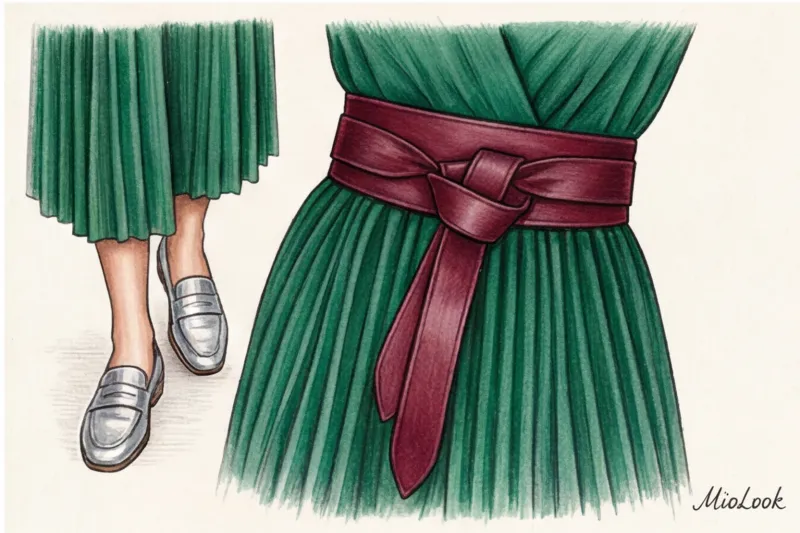
Secret Tricks: How to Stylishly Tie a Belt on a Dress
Simply fastening the buckle on the center eyelet is too formal. The most prestigious and "expensive" looks are achieved when your accessory looks like you tied it on the fly, without even looking in the mirror. This deliberate casualness (what the Italians call sprezzatura ) reveals a woman with an innate sense of taste.
"A knot instead of the usual metal clasp instantly takes the formality down a notch. A formal shirtdress transforms from office attire to relaxed brunch attire, simply because you tied the belt differently."
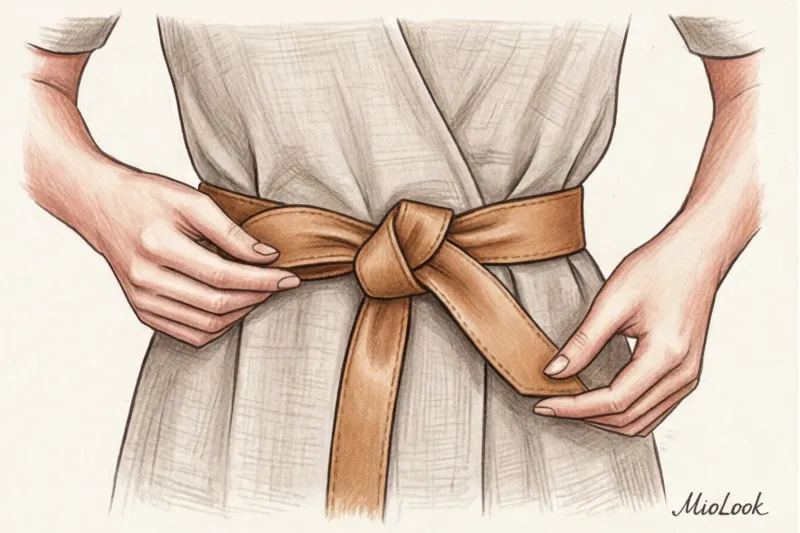
This is my favorite technique. stylist's loop for soft leather belts of medium width:
- Thread the long end of the belt through the buckle, but do not fasten the tongue into the hole.
- Pass the loose tail under the belt at the waist from bottom to top.
- Thread it through the loop formed at the top and carefully pull it down.
The remaining long tail should hang asymmetrically along the skirt. This vertical line will work to your advantage, visually elongating your silhouette and adding dynamism.
Your perfect look starts here
Join thousands of users who look flawless every day with MioLook. Digitize your wardrobe and receive ready-made formulas every day!
Get access — €0.99 onceMistakes That Add Bulge: How NOT to Wear Belts
Even a luxurious dress made of high-quality silk can be ruined by one wrong detail. Let's look at three critical styling mistakes I regularly see on the streets.
Mistake 1: The elastic belt from the 2010s. Elastic belts with chunky metal snap buckles are a no-no. The elastic mercilessly pulls fabric tight, creating unsightly bubbles around the waist and digging into the sides. Last week, during a wardrobe detox, my client and I swapped out one of these for a stiff, cognac-colored belt over her basic dress. The look instantly went from "provincial" to "old money."
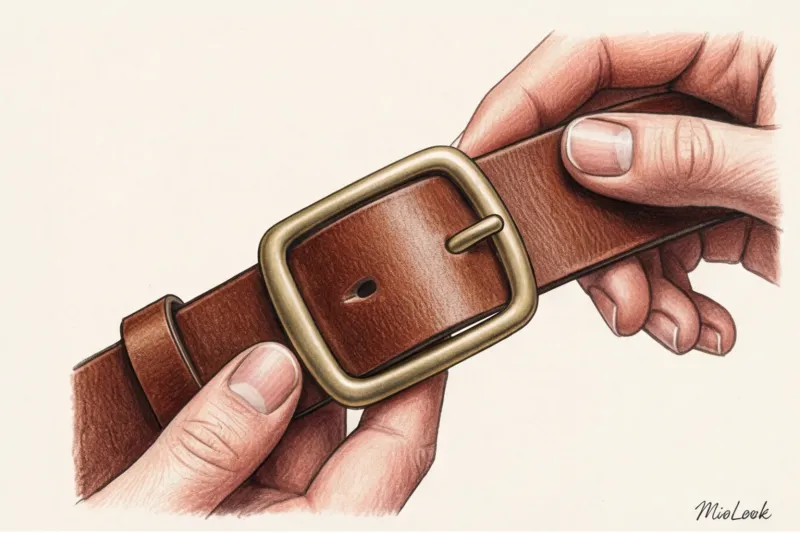
Error 2: Too much tension. Remember: a belt should only structure the fabric of your dress, not choke you. Ideal tension is easy to check: two fingers should fit comfortably between the belt and your body. If the fabric above the belt forms deep, heavy folds and bulges, you've tightened it too much.
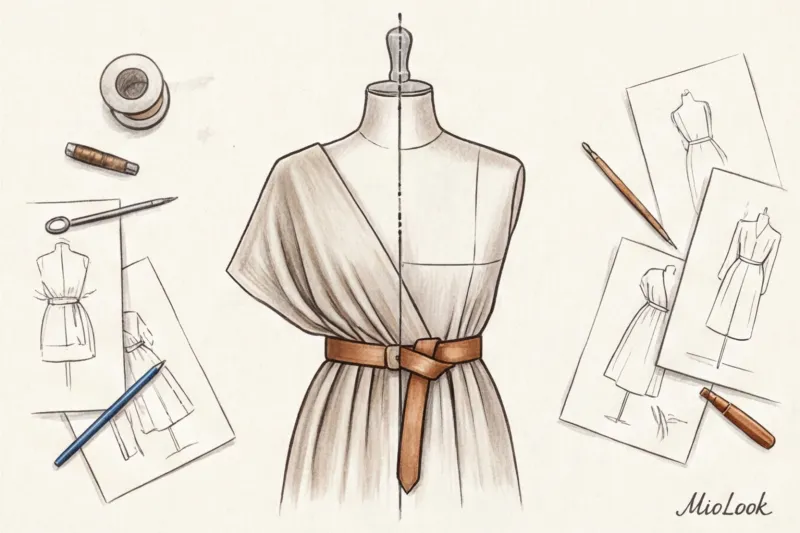
Mistake 3: Contrasting belt at the widest part of the hips. If you have a feminine pear-shaped figure (voluminous bottom) and you wear a contrasting belt at a low waist, you're visually widening the waist by half. Your gaze should always be drawn to the narrowest point of your torso for emphasis.
Checklist: 5 Steps to the Perfect Dress and Belt Pairing
Fashion isn't a set of strict laws, but rather a construction kit. But to make this construction kit easy to assemble, save my step-by-step checklist. Use it every morning:
- Assess the density of the fabric. For flowing chiffon, choose a width of 1.5–2 cm. For thick cotton (from 180 g/m²), suit wool, or denim, choose a strict 3–4 cm.
- Find your spot. Stand directly in front of a mirror and find the narrowest part of your torso. Your belt should sit there, not where the manufacturer sewed the belt loops. (By the way, you can always carefully trim the belt loops with nail scissors.)
- Keep to scale. If you are under 160 cm tall, avoid belts wider than 4 cm, otherwise they will cut your figure in half.
- Decide on the contrast. Want to look slimmer and taller? Choose a belt that matches your dress. Want a bold statement? Play with contrasting colors and textures.
- Check the fabric tension. Can you fit two fingers under the buckle? Then you're ready to go.
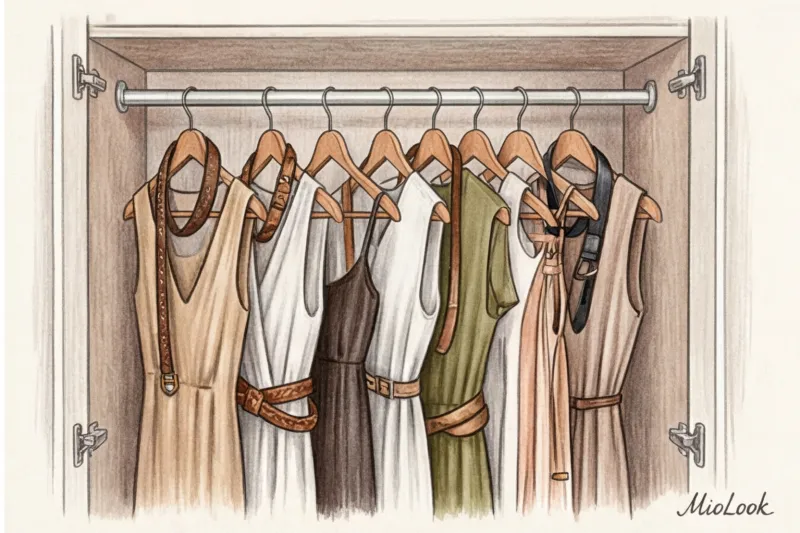
Try this experiment today: take out your most familiar, slightly boring straight dress. Take a good leather men's belt (yes, borrow one from your husband or boyfriend!), position it just above your natural waist, and tie it in a casual stylist's knot. You'll be amazed at how your body structure will be transformed by shifting the accent just a few centimeters.