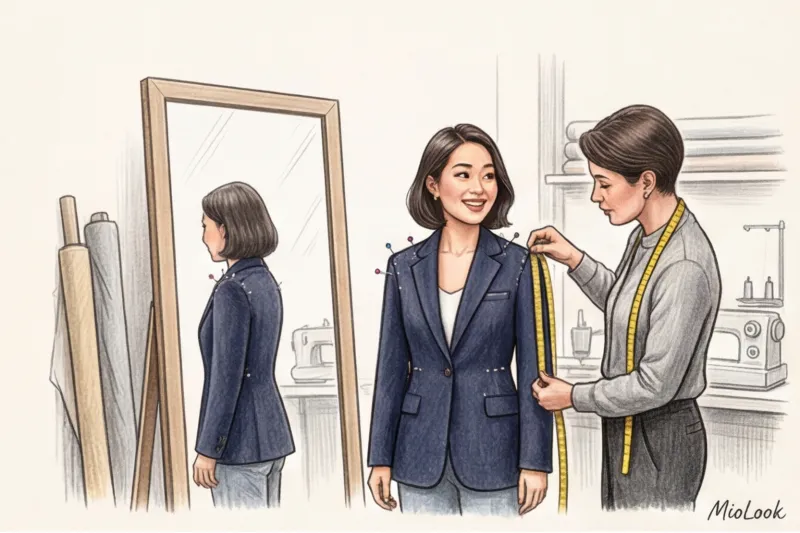
The Anatomy of a Perfect Fit: Why It's Not Just About Length
Have you ever noticed how a stunning dress on a mannequin in the fitting room suddenly transforms you into "the girl who wore her mother's clothes"? You stand in front of the mirror, roll up the hem 15 centimeters, and sigh, thinking that it's your unconventional figure that's to blame. In fact, there's nothing wrong with you. The problem lies in the dry mathematics of pattern making. Over 12 years of working as a personal stylist, I've learned one ironclad rule: when putting together a basic wardrobe for petite women, we should strive not for shortening the length, but for the correct structure of the garment.
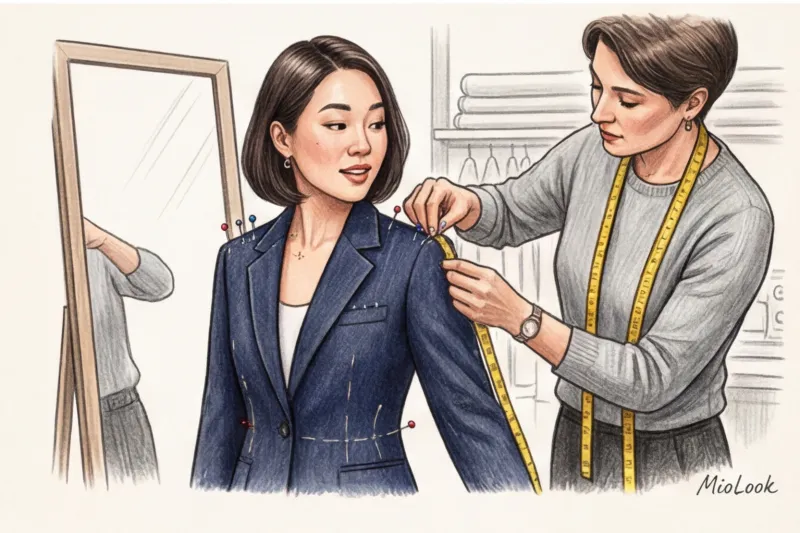
By the standards of the vast majority of European mass-market brands, clothes are cut for an average height of 168–170 cm. If you're, say, 155 cm tall, the 13–15 cm difference isn't concentrated solely in the legs—it's distributed throughout the body. As a designer, I always explain to my clients what happens when a petite woman wears a garment from the Standard line. In such a garment, the bust height (darts) will be 3–4 cm lower than the anatomical length, the back to the waist will be 4–5 cm longer than the anatomical length, and the armhole depth will be lower. The end result is a dress whose waist has treacherously slipped down onto your hips, throwing off all proportions.
A particular pain is the low armholes in shoulder garments. When the armholes are cut too low (for a taller height), you physically can't move freely. As soon as you raise your arms to fix your hair, the entire jacket or blouse rises up with you, exposing your lower back. This is a sure sign that the pattern is ill-fitting.
This leads to the most common and costly mistake petite women make: the belief that any garment can be "simply taken to a tailor and trimmed." In my experience, eight out of ten such attempts have resulted in ruined garments. Why? Because by cutting off the hem, you destroy the balance of details intended by the designer.
Imagine classic straight-leg trousers or trendy bootcut jeans. They have a predetermined taper or flare point (usually right around the knee). If you trim 10-12 cm from the bottom, you cut off the shape itself. The trousers become absurdly wide at the bottom, and the flare begins almost at the ankle. The same thing happens with outerwear: you shorten the hem of a coat, but the patch pockets remain hanging somewhere around the knee. And if you shorten a midi skirt with a slit, the luxurious deep neckline turns into a scanty, indistinct slit. The balance is irrevocably disrupted.
How can you visually elongate your silhouette if tailoring isn't working and wearing stilettos every day is torture? The secret lies in the "golden ratio" in style, or the 1/3 to 2/3 ratio. Our eye perceives leg length not from the crotch, but from the visual waistline to the floor. If you divide your figure in half (creating a 1/1 ratio, for example, by wearing a long sweater untucked with jeans), you literally "cut" your height and make your torso appear disproportionately long.
But shift the focus—wear high-waisted trousers and tuck your top completely into them—and you create perfect harmony. The top takes up exactly 1/3 of the silhouette, and the bottom 2/3. This optical trick elongates the legs much more effectively than heels. Testing out such combinations and tracking successful proportions can be difficult, so I often recommend using Smart wardrobe in the MioLook app You can upload photos of your items, create outfits on the screen, and visually check whether the 1/3 rule applies to a particular outfit before you wear it.
By the way, if you realize your closet is overflowing with out-of-proportion items, don't rush to the store. First, check out our guide. Wardrobe clearing before shopping: how to save money — there I give a step-by-step filtration system that will help you get rid of what spoils your figure without regret.
Fatal Mistake: Shopping in the Children's Department
When considering the challenges of finding the right size, we inevitably come to the main temptation. The Zara Kids or H&M Kids departments are like a magnet for petite girls. And it's easy to understand: why buy basic jeans in the adult section for €50 when the children's section has the exact same pair for €25? Why not buy a jacket for €30 instead of €80 if the sleeve length fits perfectly in a 13-14 year old size (164 cm)? It sounds like a brilliant budget-saving life hack. But, alas, it's a fatal mistake for your personal style.
Children's patterns are radically different from women's. They are designed for the undeveloped teenage figure, which is anatomically a perfect rectangle. Children's clothing completely lacks bust darts (even minimal ones). They have a completely different, significantly narrower hip width, flatter buttocks, and a different shoulder girdle angle.
One of my clients once showed up for a shopping spree wearing what she considered the "perfect" tweed jacket from the Massimo Dutti children's department. Yes, the back and sleeves were perfectly tailored. But when buttoned, the fabric was treacherously tight across the chest, bunched up in stiff folds under the arms, and flattened the silhouette, robbing it of femininity and status. The garment looked exactly as it should have—like a child's jacket on a grown woman.
Does this mean the children's section is off-limits forever? Absolutely not. You CAN, and even should, buy loose, unstructured pieces there. If you need basic plain cotton t-shirts, oversized sweatshirts, oversized hoodies, or knit joggers for casual wear, head to the teenage boys' section. They have excellent, heavyweight knitwear at a great price.
But it's absolutely forbidden to buy any structured clothing from the children's department. Jackets, classic pleated trousers, pencil skirts, fitted shirts, fitted dresses, and tailored coats are strictly prohibited. Leave the children's jackets for schoolchildren—your wardrobe deserves full-fledged feminine pieces that will accentuate your beauty, not hide it with a lack of volume.
The Top Petite Style Myths It's Time to Forget
"You absolutely can't wear baggy clothes," "don't go out without heels," "forget about floor-length dresses"—if you're shorter than 160 cm, I bet you've heard these "commandments" dozens of times. Glossy magazines of the 2000s did a great job of instilling insecurities in petite women, imposing rigid boundaries on them. But modern fashion works with proportions, not prohibitions. The secret to a stylish wardrobe isn't avoiding certain styles, but understanding the geometry of cuts.
"Street style icons like Zoe Kravitz (5'5") or the Olsen sisters (around 5'5") have been breaking outdated rules for years, swaddling in maxis and exaggerated volumes. They prove that scale and the right styling make all the difference," notes British Vogue editor Sarah Harris in her essay on new proportions (2021).
Let's explore three major misconceptions that are preventing you from creating a truly stylish and comfortable capsule wardrobe.
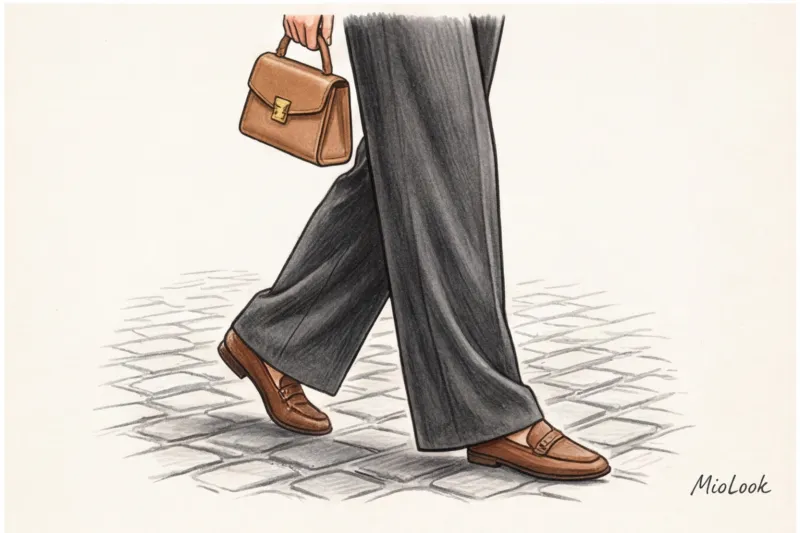
Myth 1: You should always wear heels.
Reality: Chunky stilettos (especially when paired with a hidden platform) often have the opposite effect—they emphasize a short stature, creating a visual imbalance. Heavy shoes literally drag the silhouette down. Flats that match the bottom or your skin tone are much more effective. One of my clients constantly complained about her tired legs after spending hundreds of euros on uncomfortable pumps. We completely eliminated them from our wardrobe, replacing them with pointed-toe ballet flats and simple loafers (excellent basic styles can be found at &OtherStories for €80-€120). By matching your shoes to your trousers, you create a continuous vertical line of color. The eye moves from top to bottom without obstruction, and your legs appear longer without any heels.
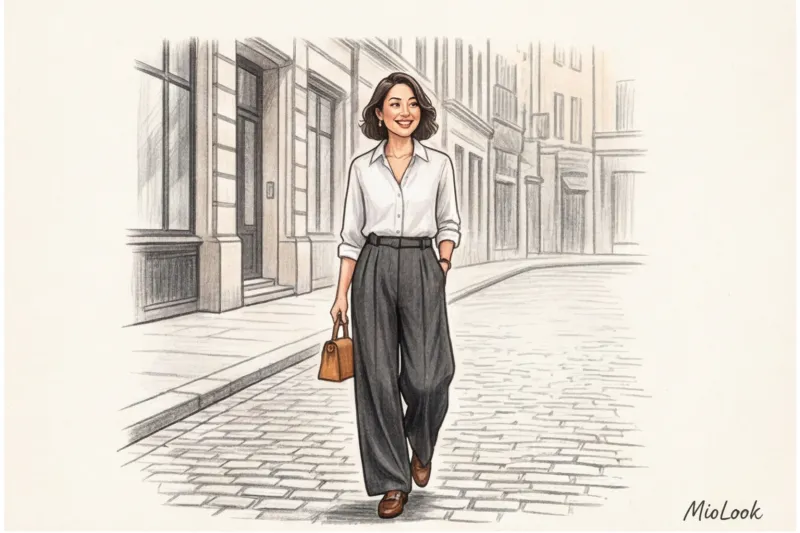
Myth 2: Wide trousers make you look boxy.
Reality: Palazzo pants are the best thing that ever happened to a petite wardrobe staple, if you style them correctly. The trick is all about contrasting volumes. Wide, flowing, high-waisted palazzo pants paired with a fitted crop top create the illusion of endless legs. The high waist artificially elevates the waistline, while the floor-length legs elongate the lower body. The key rule: the fabric should be flexible (heavyweight viscose, fine suiting wool) so it flows gracefully as you walk, rather than looking stiff.
Myth 3: Oversized and maxi lengths are prohibited.
Reality: It's believed that oversized garments will "swallow" a petite figure. This is only true if you buy a standard XL in the hopes of a trendy silhouette. A smart approach is "petite oversized." In such garments, the shoulder line is intentionally dropped, as intended by the designer, but the sleeve length reaches precisely to the wristbone, rather than dangling to the fingertips. The same applies to maxi lengths. A monochrome floor-length dress, contrary to popular belief, doesn't "pin" you down. On the contrary, a single splash of color elongates you, acting like an architectural column.
To seamlessly implement these new proportions, it's important to see the big picture. When putting together a capsule wardrobe, I often suggest clients try on unfamiliar silhouettes virtually first. You can use smart wardrobe feature in MioLook — this helps you visually check that a long dress or wide palazzos work for your proportions before you go shopping.
Access to MioLook for €0.99 — one-time payment
A smart AI stylist will select the perfect look.
Get access — €0.99 onceBasic Wardrobe for Petites: A Capsule for Everyday Life
Analyzing the wardrobes of hundreds of women across Europe, I uncovered a disheartening statistic: the average woman regularly wears only 20% of her closet's contents. But for petite women (under 160 cm), that figure often drops to 12%. Why is this? Because buying an abstract "basic white shirt" from glossy magazines without considering proportions results in the garment hanging like dead weight. It's too long, the collar is too chunky, and the shoulder seam has slipped. As a result, you end up wearing your trusty jeans and hoodie again.
That's why the concept of a capsule for short people sounds like this: fewer things, more correct proportions I always take a rigorous mathematical approach to shopping—I use the CPW (Cost Per Wear) index. If you buy a basic cashmere sweater at COS for €120 and wear it 60 times over two seasons, its real cost to you is €2 per wear. If you buy a trendy but figure-distorting, oversized jacket at a mass-market store for €70 and wear it twice, each wear has cost you €35. Every item in a miniature capsule collection must provide 100% return on investment.
The key principle for creating a basic outfit for a height of up to 160 cm is monochrome blocks and color flow from top to bottom. This doesn't mean you have to wear only black or beige. It's about matching the depth of tone. For example, a dark burgundy top tucked into dark chocolate-colored pants will create a single, vertical line of color that draws the eye. However, a sharp contrast (a white shirt untucked and black pants) will mercilessly cut your figure in half, visually shaving off 5-7 centimeters of height.
How many things do you really need for a functional base? Forget about lists of 50 items. My tried-and-true formula of 12 ideal elements Includes: 3 perfect bottoms, 4 tops of varying weights, 2 layers (a jacket and a cardigan), 2 outerwear options, and 1 perfect dress. These 12 items, if tailored to the Petite's anatomy, will give you over 40 combinations that will always make you look taller and slimmer. To avoid confusion and track your cost per piece (CPW), I recommend my clients immediately digitize these 12 items using smart wardrobe feature in MioLook - this saves a huge amount of morning time.
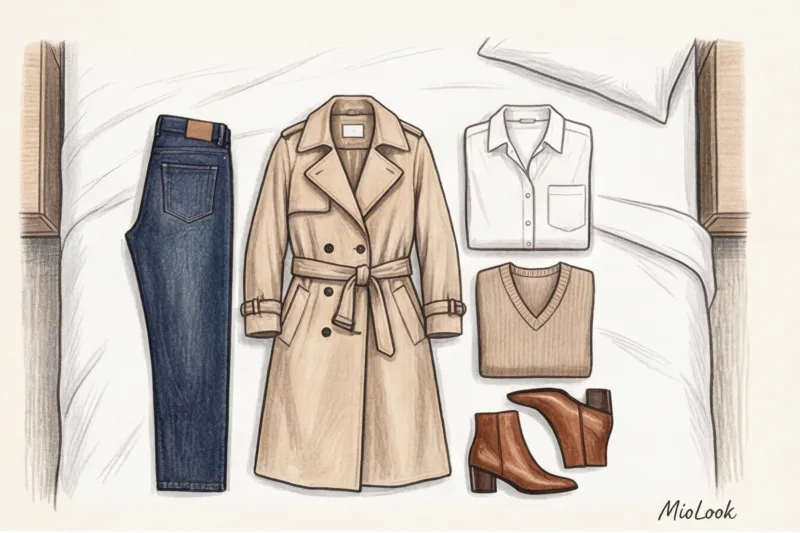
Perfect bottoms (trousers, jeans, skirts)
Let's start with the basics—what shapes the length of your legs. Jeans for petite women are uncompromising. The best silhouettes to incorporate into your wardrobe are: Straight, Bootcut (slightly flared from the knee), and proper Mom jeans. Let me clarify about the latter: proper Mom jeans aren't the huge balloons of 2018, but rather slightly tapered styles made of thick denim that don't sag in the butt. Length plays a critical role here: it should either be ankle-length (revealing the thinnest part of the leg) or full—floor-length, covering two-thirds of the shoe. Anything in between, "just above the ankle," will make you look like an overgrown teenager.
When choosing classic trousers, the strict rule of a smooth front applies. Look for high-waisted styles with a completely smooth front and a complete absence of pleats at the waist (darts). Darts are the enemy of petite women. As soon as you sit down or put your hands in your pockets, these pleats open up, adding unnecessary horizontal bulk to the stomach and hips. Ideal basic trousers are palazzo trousers of a moderate width with a crease or straight-leg styles. The crease acts as an architectural axis, elongating the silhouette. Good options with the right fit regularly appear in the &Other Stories lines in the €80–€110 range.
When it comes to skirts, we're playing with radical lengths. Your base is either a mini (the ideal length is exactly a hand's breadth above the knee, no lower!) or a confident midi/maxi with a slit. Why a slit? A solid ankle-length piece of fabric transforms a petite woman into a monolithic column. A deep side or front slit shows off the leg dynamically, lightening the design. The same principle applies to an asymmetrical hem.
Tops (Tops, shirts, knitwear)
The top of the capsule is responsible for the portrait zone and the visual elongation of the neck. This is where the geometry of necklines comes into play. V-necks and U-necks are your best allies, while turtlenecks are best avoided in a basic wardrobe. A turtleneck visually separates the head from the torso, shortening the neck and making the chest appear larger. A V-neck, on the other hand, draws the eye downward, creating a slender central axis.
The length of tops, t-shirts, and shirts is where 90% of mistakes are made. In the ideal capsule wardrobe, tops fall into two categories: cropped (ending at the waist) or hip-length. How to find your hip bone? Feel the protruding bones of your hips in the front—your top shouldn't fall below this line. Anything below that is ruthlessly tucked in. Wearing a mid-thigh-length shirt untucked artificially lowers your waist, making your legs appear 15 centimeters shorter.
When choosing sweaters and cardigans, the weight of the yarn plays a crucial role. Fine and medium-weight knits (merino blends, cashmere, and heavy viscose) drape easily and tuck into pants without creating a puffy midsection. However, textured chunky knits, cables, and voluminous "bumps"—the kind that look so beautiful on Scandinavian bloggers who are 175 cm tall—add unnecessary bulk to a petite figure. A chunky, oversized knit sweater risks looking boxy rather than stylishly French. Opt for a smooth texture or a light ribbed pattern—vertical ribbing adds a slimming effect.
Outerwear and jackets
Outerwear shapes your silhouette on the street, and proportions are especially striking here. When it comes to short silhouettes, cropped jackets (spensers) and voluminous, yet short bombers are the best friends of petites. Historical background: the spencer silhouette was invented in the late 18th century specifically to accentuate the high waistline of empire-style dresses. Today, this cut works just as flawlessly. A jacket that ends at the narrowest part of your waist, paired with high-waisted trousers, creates the effect of endless legs.
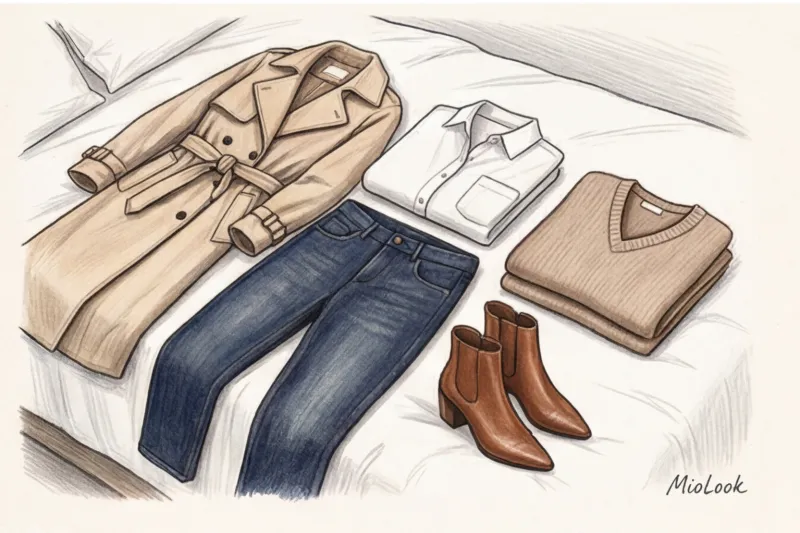
But what if you prefer a classic look? If you prefer a long jacket, choose a straight cut that covers your buttocks (before the rise of your hips at the back) with narrow lapels. Avoid fitted jackets like 0-neck and double-breasted jackets with oversized shoulders and wide lapels. A wide lapel draws the eye horizontally, broadening the chest. A straight, single-breasted jacket worn unbuttoned creates two vertical lines within the figure, effectively elongating the height.
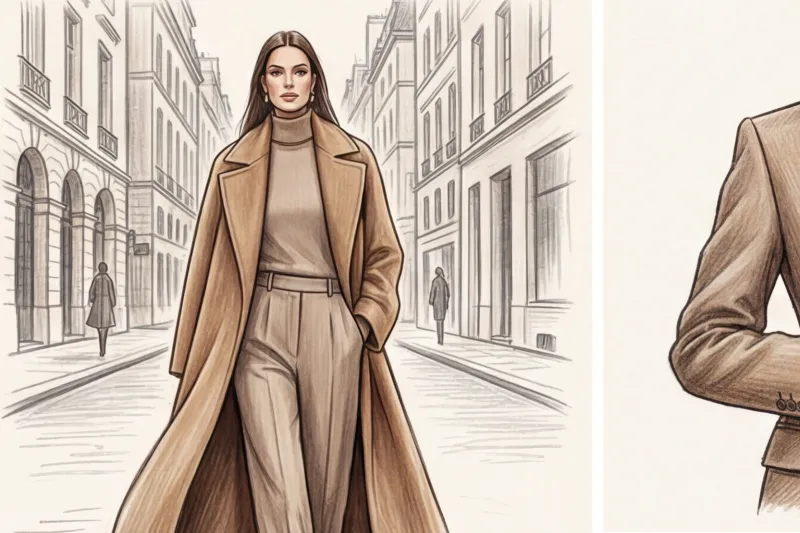
With coats, the stakes are even higher. The optimal basic investment is a midi-length coat (to mid-calf). Don't be afraid of the midi length; it works perfectly if two technical requirements are met. First, the belt fits exactly at your natural waist. Most brands have belt loops sewn in for a height of 168–170 cm. If you simply tie the belt where the manufacturer intended, it will end up on your hips. Be sure to have the belt loops altered at a tailor (usually no more than €15–20) to ensure the belt fits your natural waist. Second, narrow sleeves. Wide armholes and voluminous raglan sleeves create a "snowman" effect on a petite figure. A simple set-in sleeve that fits your arm makes even an inexpensive coat look like a premium piece.
Where to Find Clothes: A Mass-Market Guide for Women Under 5'4"
Return statistics in major European e-commerce are relentless: according to industry-specific retail reports (2023), almost 40% of trousers and structured dresses are returned to the warehouse solely because they don't fit. When putting together a basic wardrobe for petite women, we often find that standard mass-market shopping turns into an hours-long quest with no results. The problem isn't your body type, but the average industry standards. Over the years, I've developed a clear brand map for my clients—which brands are worth going to for specific items, and which ones will only frustrate us.
Salvation in the Petite lines: ASOS, Mango, Next
Let's clarify the terminology: the specialized Petite line isn't just a 10-centimeter shorter leg. It's a completely redesigned garment. Online giant ASOS (especially their own ASOS Design label), as well as Mango and Next, have amazing collections for petites. They feature higher armholes, perfectly positioned bust darts, and a waistline that doesn't slide down onto the hips.
I always look for the perfect suit trousers and structured jackets at Mango Petite (great basics are €50-€90). Next is the absolute champion of everyday denim for petites (around €40-€50). Their jeans fit perfectly, without those telltale creases and "bubble" under the knees that instantly give away a garment as a mis-sold item.
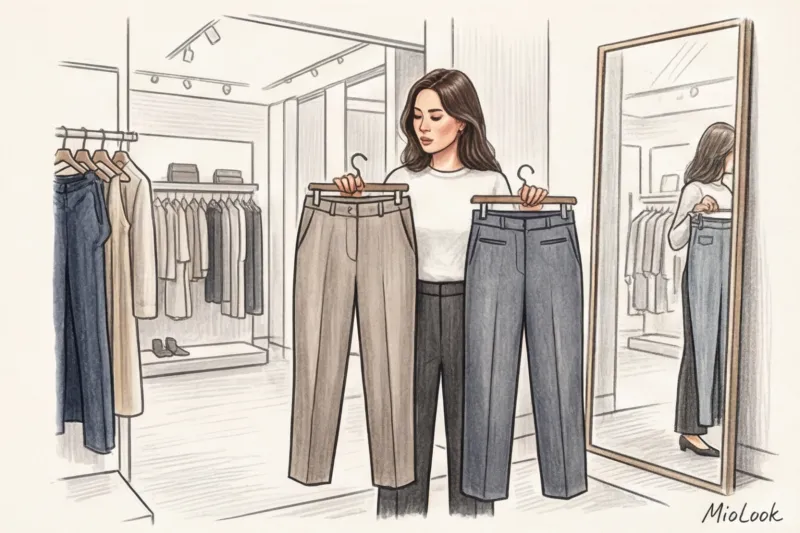
Massimo Dutti: Risk Zone and Hidden Gems
Many petite women avoid Massimo Dutti, and technically they're right. This brand's trousers, midi skirts, and classic double-breasted coats are historically tailored for a figure-hugging height of 175 cm (5'8"). If you're 158 cm (5'8") tall and wear their popular wide-leg pleated trousers, all proportions will be thrown off: the anatomical knee will end up at your shin, the pockets will be pushed down, and the inseam will sag unattractively.
But completely eliminating the brand from your shopping itinerary is a strategic mistake. What do we confidently buy at the standard Massimo Dutti? Basic knitwear and tops. Their cashmere sweaters, silk lingerie-style tank tops, and thin turtlenecks (in the €40–€120 range) fit petite women simply luxuriously. The slightly longer sleeves on the jumpers easily roll up or elegantly gather at the forearm, adding texture to the look.
Zara Secrets: How to Crack the Size Chart
With Zara, it's a completely different story—it's always a lottery, but we can learn to manage it. The main life hack that saves my clients both time and money at the tailoring shop: purposefully look for cropped styles. Trousers and jeans marked Culottes , Cropped or Ankle length On a woman 155–160 cm tall, they fit like perfect full-length trousers, just barely covering her shoes. No extra hemming costs!
Another insider tip for online shopping: always check the "Material and Care" section or the style description in the Zara app to check the model's measurements. If the model is 178 cm tall and the skirt barely covers her knee, you'll be wearing a trendy, silhouette-flattering, elegant midi. Also, pay attention to the Z1975 denim line—its fit is naturally slightly more compact than that of the premium Zara Woman line.
To avoid having to think about all these fit nuances, I urge you to digitize your wardrobe experience. When you find a brand and style that fits perfectly without alterations, add it to your wardrobe. MioLook smart wardrobe By analyzing your virtual capsule, you'll quickly understand which brands are worth returning to, avoiding impulse purchases.
Access to MioLook for €0.99 — one-time payment
Start creating perfect looks with the help of artificial intelligence and assemble your flawless capsule wardrobe without breaking the bank.
Get access — €0.99 onceShoes and Accessories: Scale Matters
In the psychology of perception, there's a classic Ebbinghaus illusion: the same circle appears tiny when surrounded by large figures and enormous when surrounded by small ones. It works exactly the same in styling. You can perfectly proportion your clothes and assemble a flawless basic wardrobe for petites, but one poorly chosen accessory will instantly distort your scale, making you appear shorter and wider.
Let's start with the biggest proportion killer: oversized bags. I regularly see stylish, petite women hiding behind giant, soft tote bags, transforming into a charming yet still overbearing figure. A strict rule of proportionality is that a bag shouldn't exceed the width of your chest. Your ideal basics are mid-size crossbody bags, structured mini totes, and baguette bags. Excellent, well-proportioned models made of high-quality leather (usually in the reasonable €80-€150 range) can be found in the basic lines of COS or &Other Stories. If your work requires you to carry a laptop, choose rigid, vertical tote bags that hold their shape and elongate your silhouette, rather than spreading out.
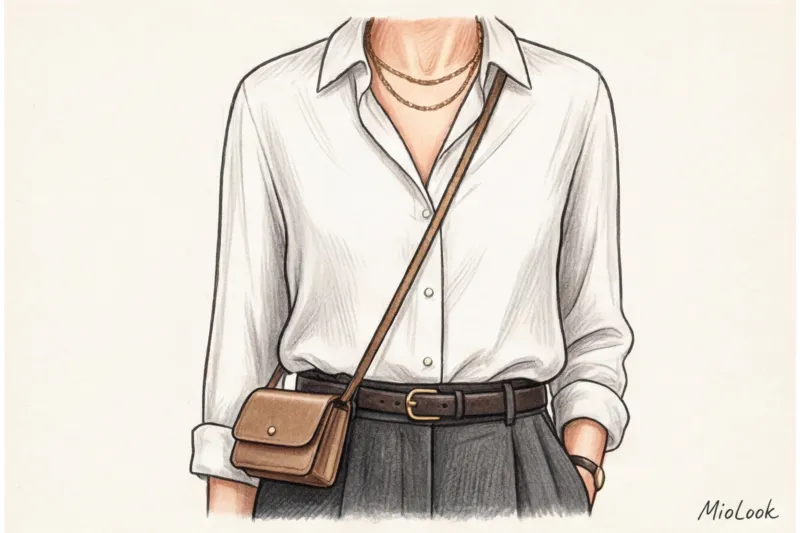
Shoes are your most powerful tool for creating the illusion of endless legs, and here the shape of the toe is everything. A pointed or elegant almond-shaped toe visually continues the line of the leg, while a trendy square toe (especially with a massive welt) abruptly cuts it off. But the main secret of stylists lies in the anatomy of the shoe itself—specifically, the cutout (the so-called vamp ). The deeper the cut of the shoe, exposing the instep, the longer your legs appear. Compare pumps or ballet flats with a deep V-neck and closed ankle boots: the former will add at least 5 centimeters to your height, even when completely flat.
The third critical element is belts. Recently, during a wardrobe review, a client who is 156 cm tall showed me her collection of wide, 10-centimeter corset belts, genuinely confused as to why they made her look boxy. The answer lies in simple anatomy: in short women, the distance from their lowest rib to their pelvic bone is physically shorter. A wide belt simply "eats up" this entire gap, depriving you of a waist. We choose narrow belts, 2-3 cm wide. They delicately define the narrowest point of the figure without cutting the torso in half.
To avoid buying unnecessary items and always see how the details work for your proportions, I recommend digitizing them. Add your bags, shoes, and belts to MioLook — When you're putting together images on screen, you'll notice much more quickly if a bulky bag starts to visually weigh down your silhouette.
Practical advice: Go through your accessories today. For everyday essentials, limit yourself to belts no wider than two fingers. You'll be surprised how much easier it is to put together outfits without any scale-distorting items on hand.
Checklist: Checking the item in the fitting room
So, here you are in the fitting room. The neon light is relentless, you're holding a stack of hangers, and two hours of fruitless searching are behind you. It's at this moment that fatigue makes us make the most costly style mistakes—buying things that are "good enough." You look in the mirror: the color seems refreshing, the texture is dense (for example, high-quality cotton or high-quality viscose for €60), but the reflection still seems disharmonious.
Save this list on your phone before your next shopping trip. It's my personal technical filter, which I use as a stylist during every fitting. A smart basic wardrobe for petite women is built on millimeters. If a garment we like fails at least one of these four points, my clients and I leave it at the store without regret. Hoping that the atelier will make it right is misleading: complex alterations will cost you between €40 and €90, which often exceeds the cost of the garment itself.
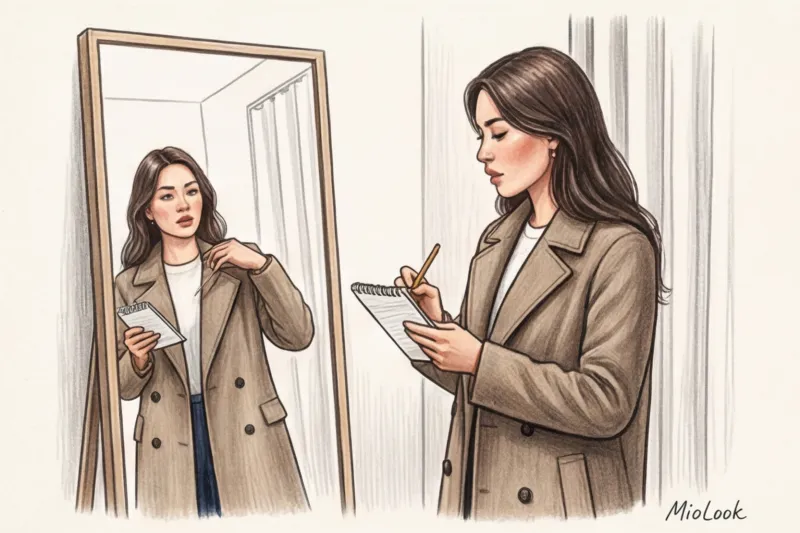
So, we put the item on, fasten all the buttons, stand up straight and check:
- The shoulder seam is straight (unless it is a dropped shoulder by design). The set-in sleeve of a jacket, trench coat, or basic shirt should fall exactly where your collarbone ends and your shoulder begins. If the seam slips even 1.5–2 centimeters, you'll instantly create a "misplaced" effect. This doesn't look like the trendy oversized fit, it looks like the item is too big, visually weighing down your upper body and making your back slouch.
- The darts on the chest do not go down. This is the most insidious aspect of standard patterns, often overlooked when buying. Women taller than 170 cm (5'7") have a physiologically lower bust than petite women. If you're wearing a structured top or dress, and the apex of the dart points somewhere near your lower ribs, the fabric will inevitably bubble unattractively under the arms and constrict your bust. Repositioning the dart on a finished garment is virtually impossible—you'll have to remake the entire front.
- The armhole does not “hang” too low (otherwise, when you raise your arms, the entire product will rise). Try my favorite "top shelf test." Put on a blouse or jacket and raise your arms up, pretending to reach for a book on a shelf. Most mass-market clothes have armholes cut too low for petite women. As a result, the excess fabric under your arms causes the entire garment to follow your arms, exposing your midriff and ruining the fit. The ideal armhole should be high and delicate enough.
- The waist of the dress coincides with your anatomical waist, and does not slip down onto your hips. The key rule of geometry for heights up to 160 cm: the cut line, waist seam, or elastic band must be positioned at the narrowest point of your torso. If this design element falls even three centimeters lower, it drastically distorts your proportions, "eating up" the length of your legs and making your torso appear unnaturally elongated.
To make the selection process easier, I always strongly recommend recording your fittings on camera. Your eyesight in the mirror gets blurry, and a smartphone lens can honestly show distorted proportions. Take full-length selfies and upload them immediately. MioLook Directly from the showroom. The app's tools allow you to compare the fit of different silhouettes side by side on a single screen. This way, you can clearly see which cut really suits your height.
Your perfect look starts here
Join thousands of users who look flawless every day with MioLook.
Get access — €0.99 onceCreating the perfect wardrobe isn't an endless search for compromises or a strict diet of forbidden styles. It's the skill of mastering your own geometry. By stopping settling for pieces that "seem to shrink if you pin them here" and starting strictly filtering fits based on these four key points, you'll change your approach to shopping forever. Sure, your closet may only have a couple dozen items left, but each one will force you to stand up straighter. You'll begin projecting confidence, and your height will become just a number on your passport, giving way to impeccable proportions.
Guide Chapters
Monochrome Look for Short People: How to Visually Appear Taller
Forget boring matte black. Learn how to use lenses and textures to visually add 5-7 centimeters to your height without heels.
Ideal Bags for Petite Women: Style Secrets
The right accessory can visually elongate your silhouette better than any heels. Let's explore how to choose the perfect bag based on your body shape.
Business Style for Petites: The Perfect Office Wardrobe
Building an office wardrobe for someone up to 160 cm tall? Forget optical illusions – we'll break down the math behind the right patterns for the perfect fit.
Winter Wardrobe for Petites: A Stylish Capsule
Learn how to put together a stylish winter capsule wardrobe for women up to 160 cm tall. Stylists' tips for choosing warm pieces that won't ruin your figure's proportions.
The Perfect Basic Wardrobe for Petite Women Over 40
Find out why simple clothing adjustments don't work for women under 160 cm. We reveal the secrets of pattern design and stylish clothing for petite women.
Fashion for plus-size and petite women: elongating the silhouette
Forget the silly rule of "wearing dark and loose." Embrace an architectural approach to style that will visually elongate your silhouette and accentuate your curves.
Oversized for Petites: How to Wear It Without Looking Shorter
True oversized fit for petites isn't just about going three sizes too big. We'll explore the rules of proportion and cut to help you fit in your clothes.
The Perfect Jeans for Short Women: How to Make Your Legs Look Longer
Tired of standard pants that feel baggy? Our stylist's advice will help you find the perfect denim that will correct your proportions and elongate your legs.