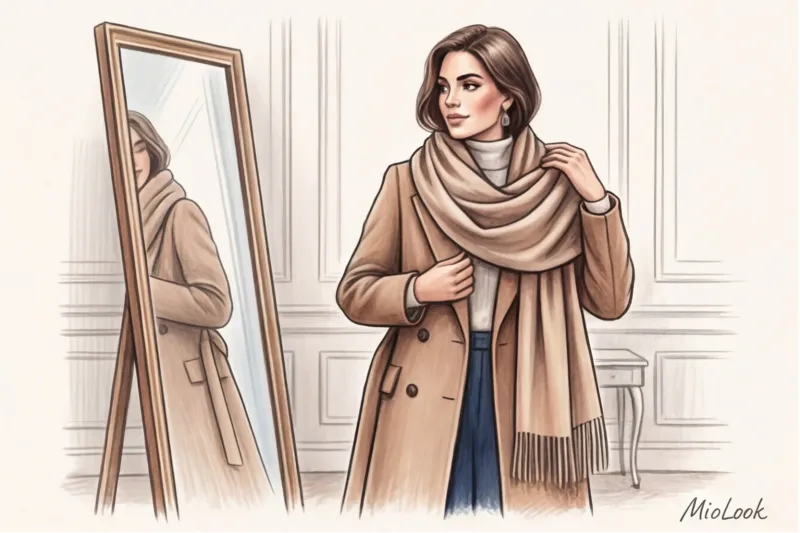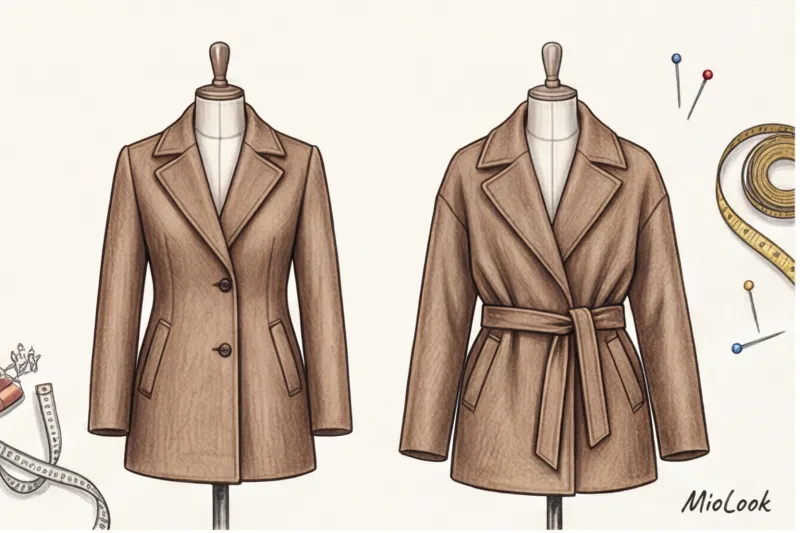
Does this situation sound familiar? November arrives, you pull out your warm winter coat, put it on, and... suddenly you feel like a child who secretly tried on his mother's clothes. Your figure disappears, your height visually shrinks another five centimeters, and your silhouette transforms into a cozy, yet completely shapeless ball.
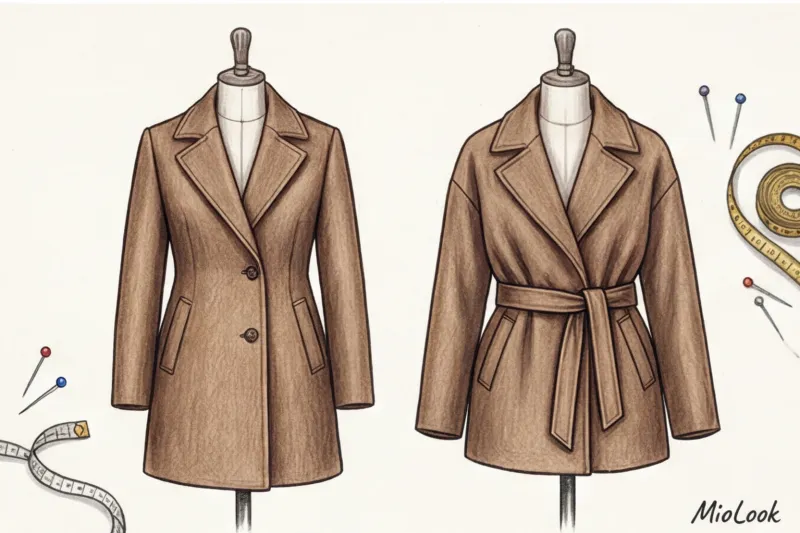
As a stylist who works with women of all sizes, I constantly hear the same question: how to create winter wardrobe for petite people Looking for something truly warm, yet elegant? Forget the clichéd advice from the glossy magazines of the 2000s like "just wear heels in winter" or "wear only black." Stilettos are dangerous on ice in winter, and all-black looks flat without a play of textures.
In fact, the secret lies not in the color or the heel height, but in the architectural approach to layers and patterns. We've already covered the basic architecture in more detail in our guide about Basic wardrobe for petite women: capsule wardrobe for those up to 160 cm , and today I'll show you how to apply these principles to the harsh realities of winter.
Winter Wardrobe for Petites: Why Standard Advice Doesn't Work
The worst advice I've ever heard was, "Just buy a regular coat and have the hem shortened at a tailor." It doesn't work, and here's why.
Clothing is constructed according to strict mathematical laws. According to clothing design standards (such as the Müller system or GOST standards), patterns for the Standard line are calculated for a height of 168–170 cm. If you're 155 cm tall, the problem isn't just that the hem touches the ground. The problem is that the whole architecture of the thing is sliding down.
The difference in waist height between a standard pattern and a Petite pattern is on average 4-5 cm. In a lightweight summer dress, this can be concealed with a belt. But in a heavy winter coat made of drape weighing three pounds, a waist that's 5 cm lower visually steals 10 cm from your legs! Furthermore, the armhole (sleeve opening) ends up somewhere near the ribs, and the darts at the chest slide down, creating unnecessary volume.
In heavy winter fabrics, this geometric error is critical. That's why searching for outerwear in Petite lines (or from brands with tailored sizes) isn't a whim, but a strict necessity.
Your perfect look starts here
Join thousands of users who look flawless every day with MioLook. The smart algorithm takes your height and proportions into account.
Get access — €0.99 onceWarmth Without Volume: Smart Layers Strategy
How do Italian women manage to look elegant even in Milan's piercing winter? They understand the fundamental principle of thermoregulation: it's not the thickness of the fabric that keeps you warm, but its composition and the air layer inside it.
According to a study on the thermal conductivity of textiles (Textile Research Journal, 2023), 100% cashmere retains heat 40% more effectively than dense acrylic, while being three times thinner. A single, oversized, chunky knit sweater from a mass-market store for €30 will make you look boxy but won't protect you from the wind. Instead, use my favorite Mediterranean layering formula.
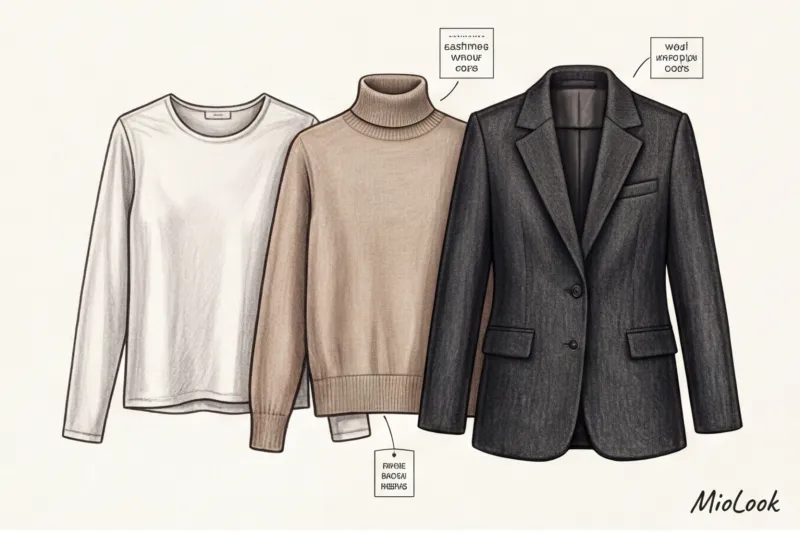
"The ideal winter layering for someone up to 160 cm is thermal underwear with a silk blend, a smooth merino turtleneck, and a thick-knit jacket or cardigan. Three thin layers are always warmer and more elegant than one thick one."
Air gap law: Never buy winter basics that are too tight. If the turtleneck is pulled tight against your body, there's no room for air to circulate, and you'll get cold faster. Leave at least 1-2 centimeters of space between your body and the fabric.
Outerwear: down jackets and coats that don't turn you into a bun
I had a telling case in my practice. A client (152 cm tall) came to me complaining that she couldn't even raise her arm on public transportation in the winter. We reviewed her wardrobe and discovered the cause: a mass-market, straight-cut down jacket had such a low armhole that the slightest movement pulled the entire jacket up. Furthermore, the large horizontal stitching ("puffy" stripes 15 cm each) visually cut her height into ten wide blocks.
We replaced this down jacket with a model featuring diamond-pattern micro-quilting and a regular armhole. The result? A visual weight loss of 5 kg and completely free movement.
What to choose for height up to 160 cm:
- Silhouette: Avoid the cocoon silhouette (O-line). It widens the midsection. Choose straight coats (H-line) or robe coats (X-line) with a belt that sits firmly at your natural waist.
- Sleeve: A set-in sleeve always, 100% of the time, beats a dropped shoulder. A defined shoulder line is the framework that holds your entire look together.
Counterintuitive approach: oversized that can be
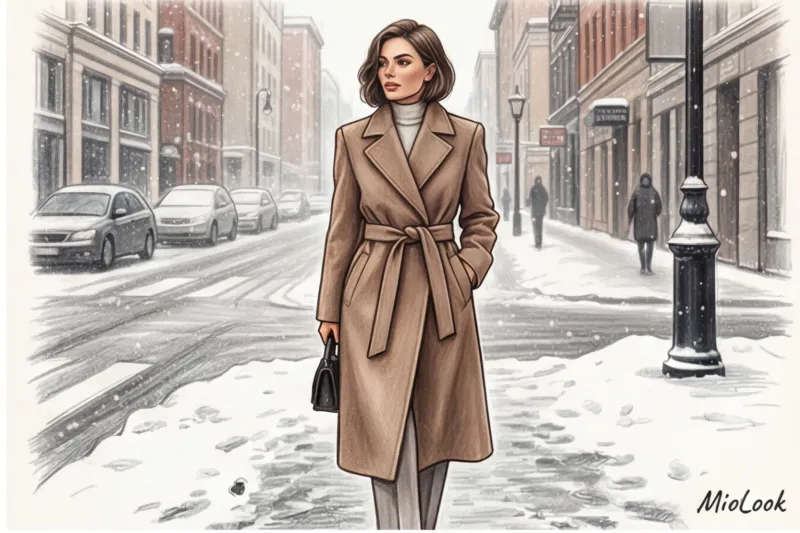
Many stylists categorically state: "Short women shouldn't wear oversized clothes." I completely disagree. For petite girls Can wear voluminous things, but this volume must be correct.
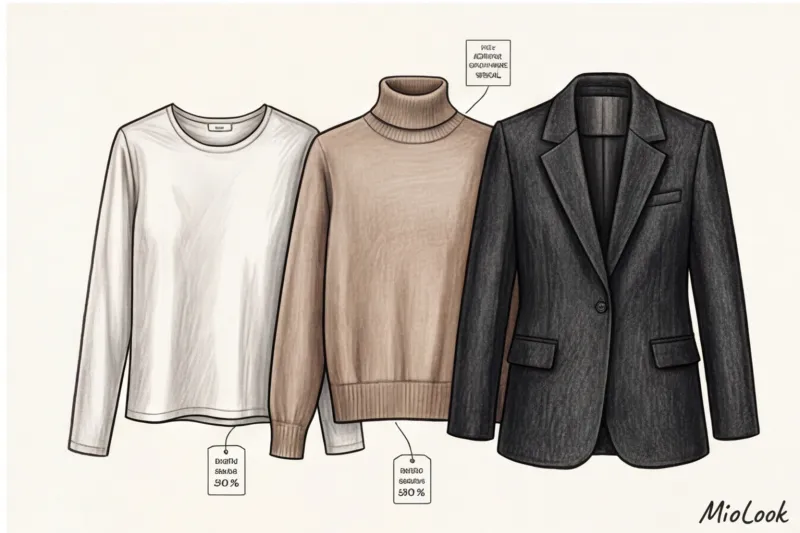
Oversize is safe if it is limited solely to the width of the garment itself (the "body" of a coat or sweater). But at the same time the shoulder seam should remain in its anatomical place The armholes should be high, and the sleeves should end exactly at the wristbone. If the sleeve covers half the palm, you'll look like a child in someone else's clothes again.
Access to MioLook for €0.99 — one-time payment
Start creating perfect layered looks with the help of artificial intelligence. Upload your items, and we'll assemble them into a capsule collection.
Get access — €0.99 onceTrousers, skirts, and knitwear: the foundation of a winter capsule
Winter clothing often breaks the ideal "golden ratio" (1/3 top, 2/3 bottom), turning the figure into a 1/1 square. To avoid this, we need to work with textures.
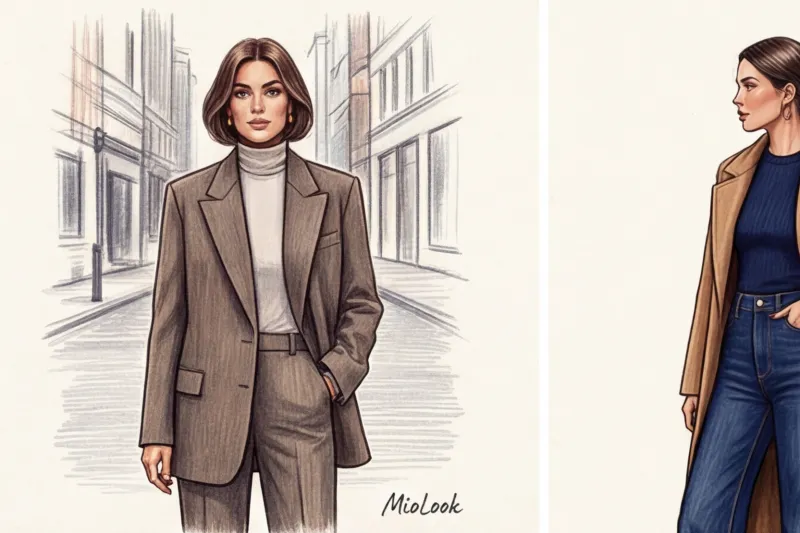
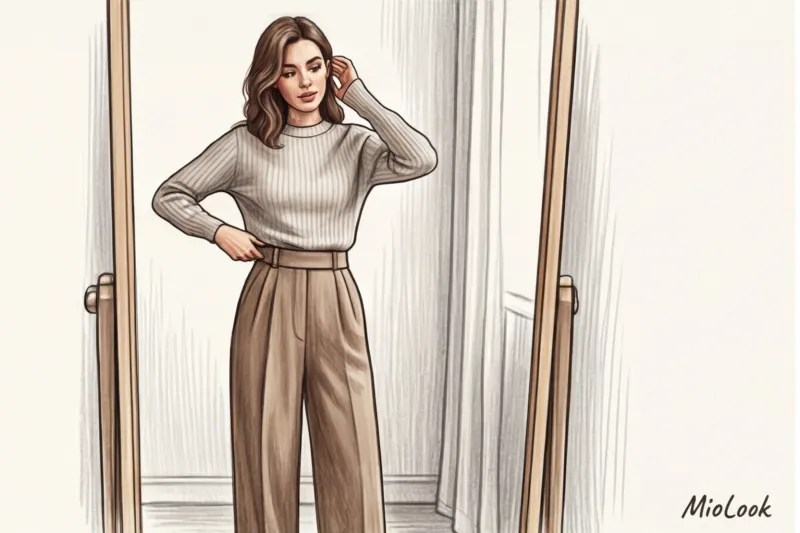
Trousers: Choose high-waisted wool styles (quality wool typically ranges from €80–€120). But be careful with texture! This is the often-overlooked limitation: thick tweed or voluminous bouclé look fantastic on the hanger, but on a petite woman's hips, they instantly add 5 cm (2 inches) of volume on each side. The ideal choice is a thick wool crepe or smooth suiting wool.
Skirts: Your ideal winter length is midi. Not knee-length (which cuts your leg in half), but a hand's breadth below the knee, revealing the narrowest part of your calf under the hem.
Sweaters: If you're wearing a thick knit, try a French tuck. Tuck in just a small portion of the sweater at the front to define the waistline, allowing the rest of the fabric to fall freely. A V-neckline will further elongate your neck.
Winter Shoes and Tights: Creating Endless Legs
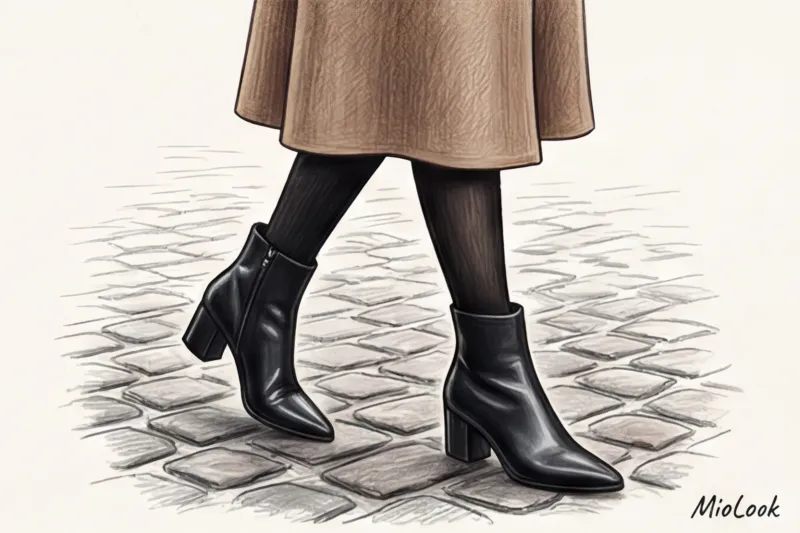
Do you know the cheapest and most effective way to visually lengthen your legs? It's a monochrome vertical. Tights that match your shoes work their magic.
According to business and urban etiquette, winter tights should be between 60 and 100 denier. Choose matte textures with 3D microfiber or cashmere. Shiny lycra tights in winter cheapen the look and make your calves look fuller.
And now about what is categorically doesn't work Popular "moon boots," dutik boots, and wide-shafted ugg boots are not recommended for those under 160 cm (5'6") tall. They create a "Mickey Mouse" effect—oversized feet against a compact frame. Instead, choose elegant boots with a stable 4-5 cm (1.5-2") block heel or ankle boots with a chunky yet neat sole.
The golden rule of a stylist: The boot shaft should be concealed under a midi skirt or fit snugly around the ankle, hidden under cropped trousers. There should be no strip of bare skin (or contrasting tights) between the boot and the hem!
Accessories: How a scarf and hat can eat up your height
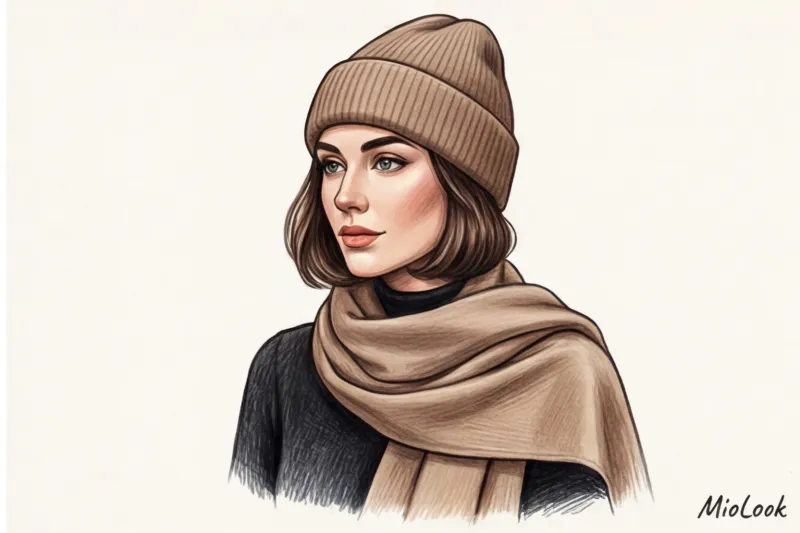
Scale is everything in a petite woman's wardrobe. I often see beautiful, short girls on the street wrapping themselves in gigantic snoods or blanket scarves. The end result is a huge woolen cloud with tiny feet sticking out. Their heads become disproportionately large relative to their bodies.
Choose beanies in a medium-weight knit. The slight volume at the crown (when the hat sits slightly on top, rather than clinging to your head like a swim cap) acts as a hidden heel, adding a couple of centimeters of height.
The same goes for bags. A huge, soft tote bag against a voluminous winter down jacket visually grounds the figure. Use the rule of contrasting textures: For a soft and voluminous down jacket, take a medium-sized, structured bag with a rigid shape. (For example, a smooth leather crossbody bag.) This will instantly pull the look together.
Ready to get started?
Try the MioLook free plan—no commitments required. Digitize your wardrobe and get ready-made outfits for every day.
Get access — €0.99 onceChecklist: 7 Perfect Items for a Winter Capsule
To make shopping easier, I've compiled a list of seven items that are perfectly combined and help maintain proportions for those up to 160 cm tall. Take a screenshot before your next shopping trip:
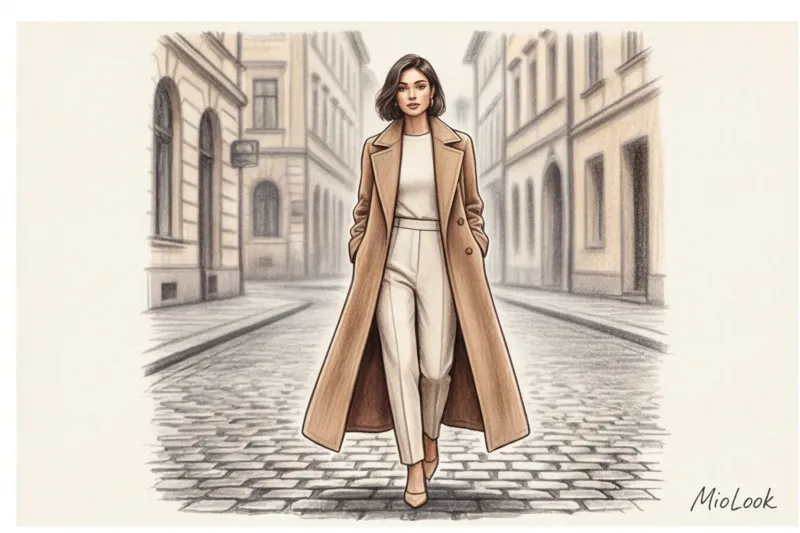
- Midaxi length wool robe coat. A must: high belt loops and clearly set-in sleeves (an investment in good wool will cost €150–€300).
- Ultra-thin down liner. Wear under a coat for an extra layer. Choose a matte one without a stand-up collar.
- Cashmere or merino turtleneck. Basic shade (camel, deep blue, chocolate). The smooth texture won't add volume.
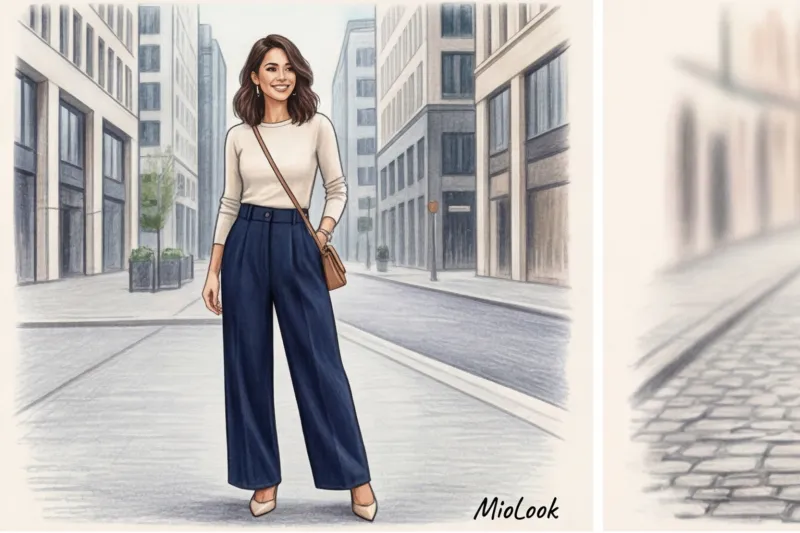
- Wool palazzo pants. Strictly high-waisted, made of flowing but dense suiting fabric.
- Straight skirt made of thick wool. Midi length, preferably with a slit in the front or side - the vertical line of skin in motion perfectly elongates the silhouette.
- Leather ankle boots with block heels. The toe should be slightly pointed (almond-shaped) - round or square blunt toes "chopped" the length of the foot.
- High-tech thermal long sleeve. Silk with added viscose or the finest wool. Your invisible shield from the cold.
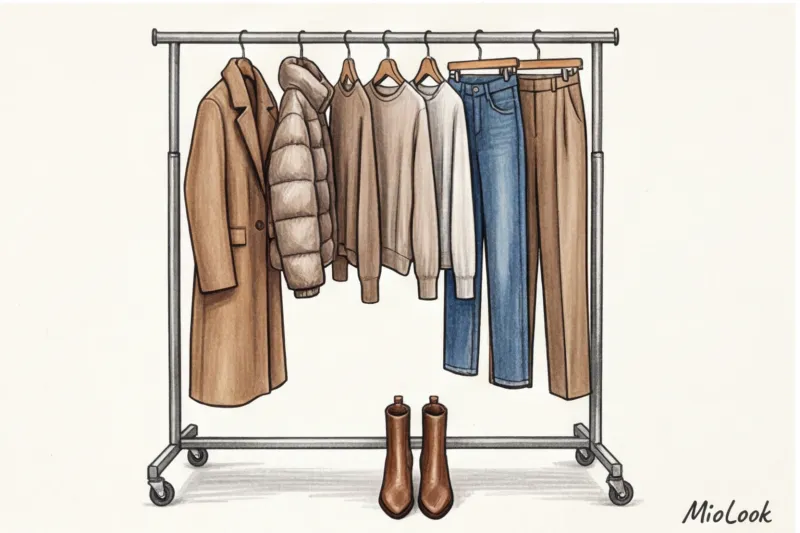
A winter wardrobe for petites isn't a compromise between cold and beauty. It's simply clever engineering. When you start paying attention to armhole height, yarn thickness, and the scale of accessories, winter dressing will no longer be a chore. Stop hiding behind shapeless cocoons: choose a coat with the right shoulder, wear thin, warm merino wool, and let this winter be your most stylish season yet.