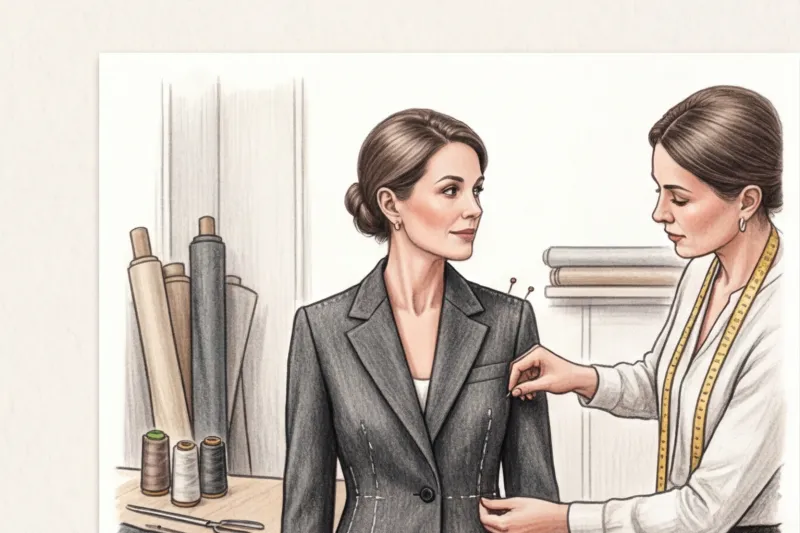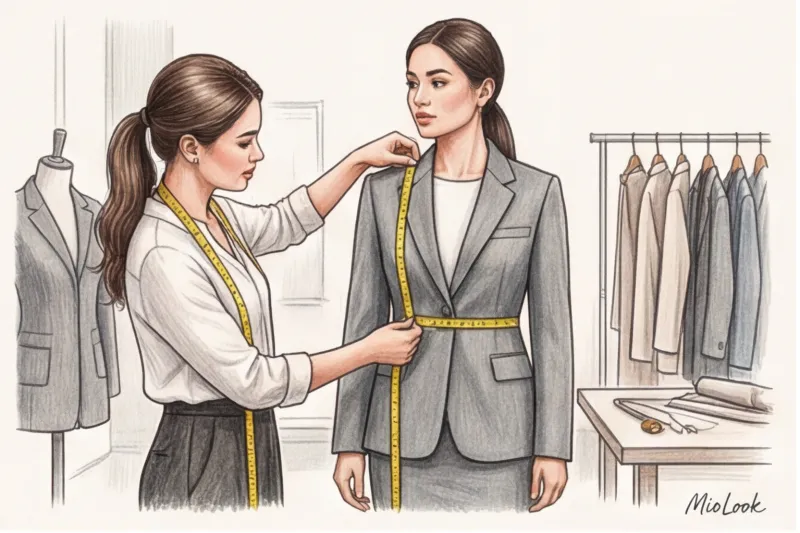
One day, a client named Anna (she's 156 cm tall) came to see me with a Massimo Dutti jacket she'd bought for €150. She'd already spent about €120 at the tailor to have it shortened and tailored, but it still fit, to put it mildly, oddly. The reason was obvious at first glance: the tailor had simply cut off the hem and taken in the sides. The enormous armhole remained, but the bust darts had treacherously slipped almost to the waist. The garment was hopelessly ruined.
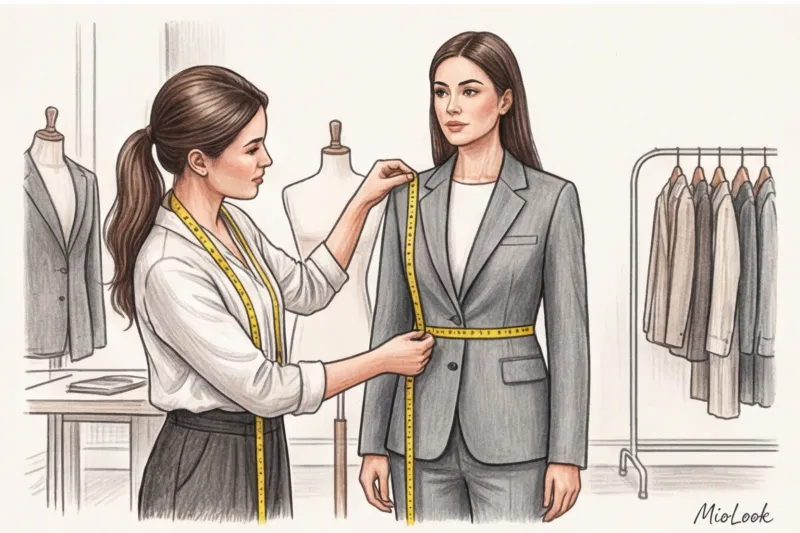
This is the most common mistake I've seen in my 12 years as a personal stylist. For some reason, business style for short women is often reduced to a series of optical illusions: "wear heels," "choose vertical stripes," "avoid contrasts." But the truth is, no stripe will save a jacket tailored for a woman who's 170 cm tall.
I have already talked in more detail about the principles of forming a compact base in our The complete guide to a basic wardrobe for petite figures In this article, we'll leave illusions aside and delve into the dry mathematics of pattern making: we'll examine armhole depth, dart height, and knee height. You'll understand why some mass-market items don't fit you properly, and how to stop wasting money on pointless alterations at the tailor's.
The Anatomy of a Fit: Why Business Style for Short People Is Architecture, Not Illusions
Let's face it. Most European mass-market brands (Zara, H&M, Mango) base their basic sizes on a height of 168–172 cm. If you're 155 cm tall, the difference is a significant 13–17 cm. And these centimeters aren't concentrated solely in leg length.
According to classical clothing design standards (for example, the authoritative Winifred Aldrich cutting system), as one decreases in height, body proportions change dramatically. The difference in bust height (the exact point where the dart should point) between a standard and petite pattern is 3-4 cm. The waistline shifts by 4-5 cm. The hipline shifts by 5-6 cm.
What happens when a woman who's 158 cm tall wears a standard jacket? The bust dart ends up under her bust, creating a hollow space. The jacket's waist drops to hipbone level, widening the silhouette in the worst possible place. And the back length distorts the proportions, making the legs appear shorter than the torso.
"Trying to fit a standard item onto a petite figure simply by cutting off the length is like trying to turn an SUV into a sports car by simply cutting off the roof. The balance of the design would be irrevocably lost."
That's why, when putting together business attire for petite women, we look not for "short" pieces, but for pieces with a well-designed silhouette, cut using the Petite pattern. According to a 2023 McKinsey report on e-commerce returns, almost 70% of mass-market clothing rejections are due to incorrect pattern proportions, not to the actual size (girth).
The Ideal Jacket for Women Up to 160cm: The Oversized Myth and the Armhole Rule
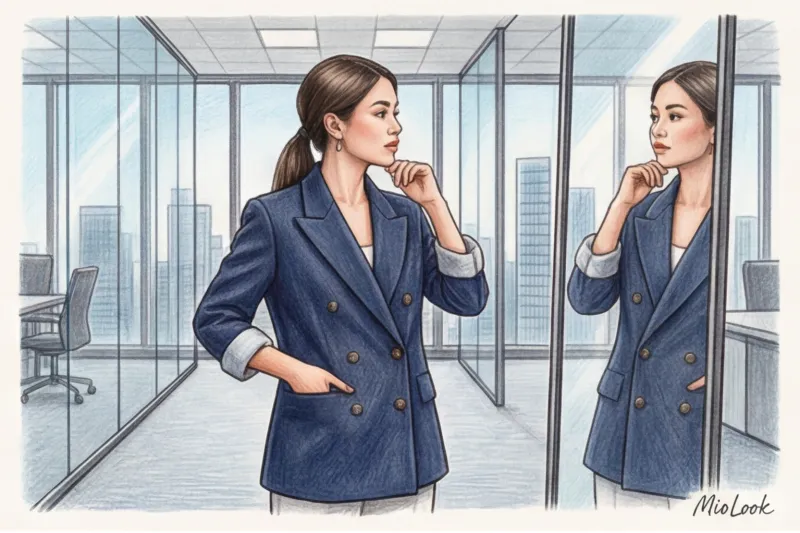
A petite woman's biggest enemy in the business attire department is the low armholes of a standard jacket. To check a jacket in the fitting room, try this simple test: put it on, button it, and raise your arms to chest level. If the jacket rides up, pulling your entire shoulder girdle with it and exposing your midriff, the armholes aren't cut for you.
A proper jacket should have a high, neat armhole, allowing the arm to move independently of the jacket's body. This is especially critical in an office setting, where you're constantly reaching for documents, working on a computer, or gesturing during presentations.
What about the relaxed silhouette trend? There's a myth that short people absolutely can't wear oversized clothing. This is a misconception. You can wear oversized clothing, but it should be in width, not length. The ideal formula for heights up to 160 cm (5'4") is: a shoulder seam in its natural place (slight expansion with stiff shoulder pads is acceptable), high armholes, shortened sleeve length (leaving a thin wrist exposed), and a garment that hits exactly mid-thigh, or a cropped cut.
Access to MioLook for €0.99 — one-time payment
A smart AI stylist will select the perfect look based on your proportions and height.
Get access — €0.99 onceBrands and Lines: Where to Find "Your" Jacket
If you're tired of endless searching, start specifically checking the Petite sections. In Europe, ASOS Design, Marks & Spencer, and Next offer excellent lines for petites. You can find the perfect wool jacket there, in the €60–€120 range, that will fit like a glove.
But I have another trick that works with standard collections (for example, at COS or & Other Stories). Look for cropped blazers in their selection. What looks like an extra-mini, waist-length jacket on a 175 cm tall model often looks like a perfect, classic-length jacket on a 155 cm tall woman, right down to the iliac bone.
Fair limitation: This trick won't work if you have a long torso and short legs (a common body type). In this case, a cropped jacket from a standard line could highlight the disproportion.
Office Blouses and Shirts: How to Avoid the "Mom Clothes" Effect
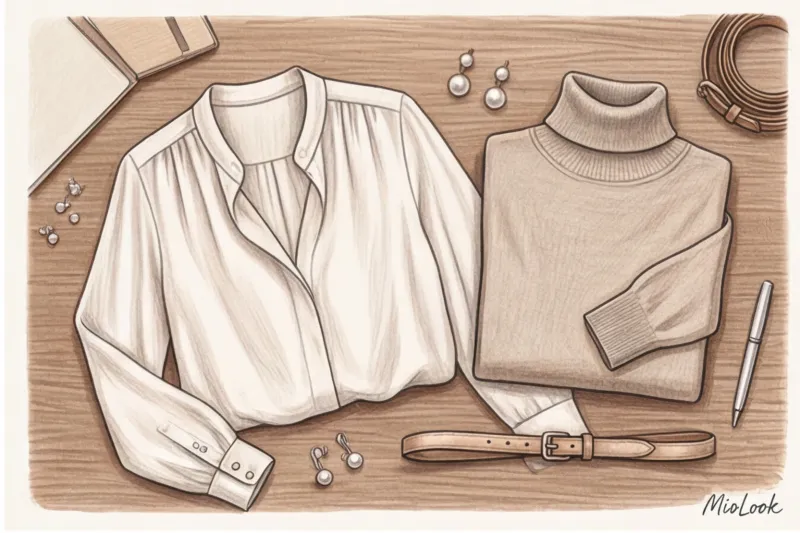
A classic white shirt made of crisp, crisp cotton is a staple of business attire. But on petite women, it often works against them. Why? Because of the stiff stand-up collar, which visually "eats up" the short neck, and the wide cuffs. When the sleeves are too long, and the cuff covers half the wrist, the result is that "baby in mommy's clothes" effect.
In my practice, I advise clients to replace stiff shirts with blouses made of flowing fabrics: thick silk, high-quality viscose (with a density of 180 g/m² or more), or bias-weave cupro.
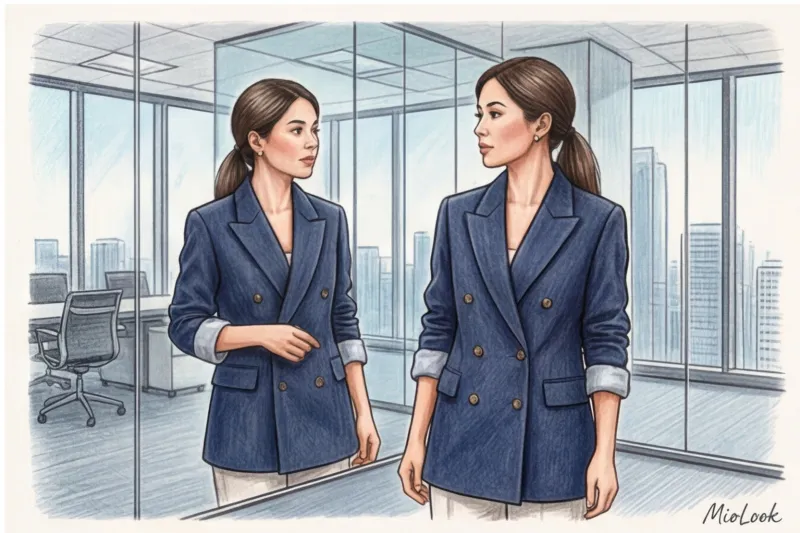
The advantage of flexible fabrics is that they don't require rigid bust darts. The fabric drapes softly over the figure, eliminating any imperfections in torso length. If your dress code allows, choose styles with a V-neck or an ascot collar (a bow tie), which can be left untied for added verticality.
Pantsuits and skirts: how to maintain proportions on your legs
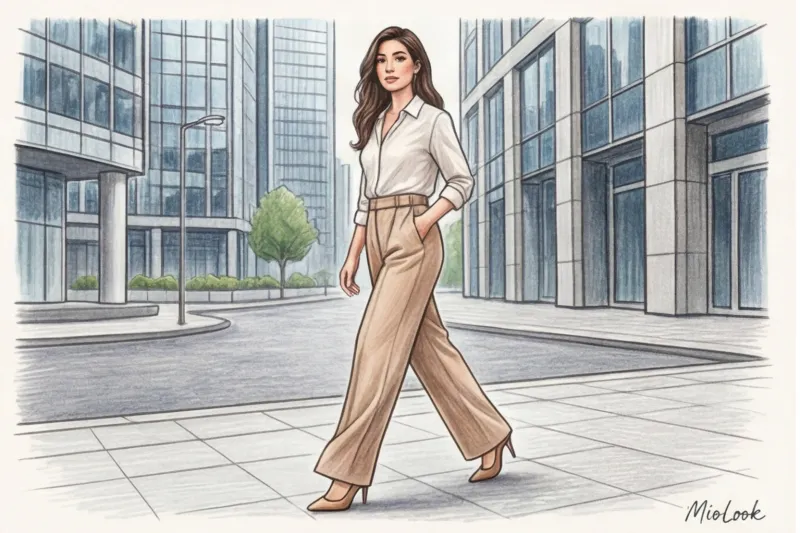
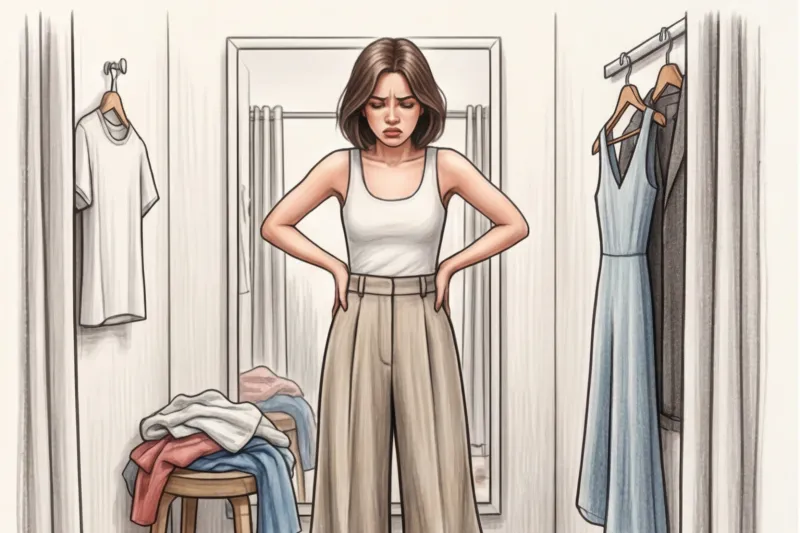
Buying pants for a petite woman is always a challenge. And again, the problem isn't just that the legs need to be shortened. The main problem lies at the knee.
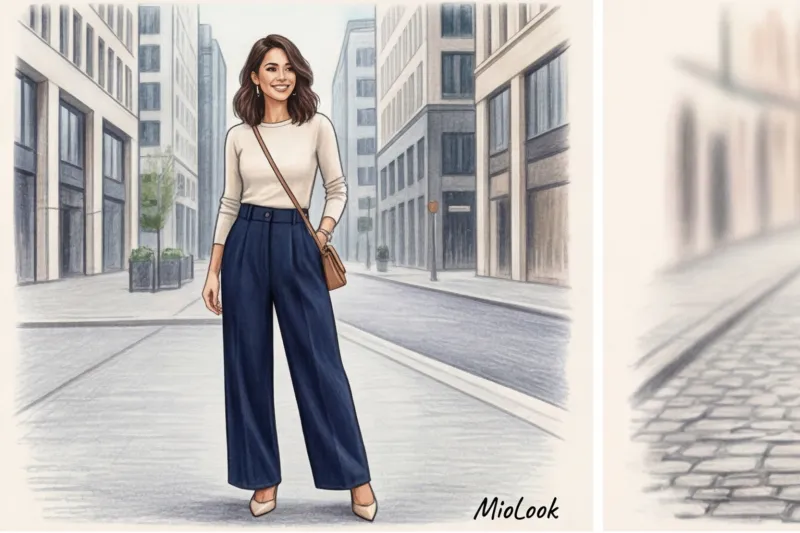
Imagine the trendy wide-leg or flare pants. In the pattern for a height of 170 cm, the taper (the knee area) is at a certain height. If you're 156 cm tall, this taper will be mid-calf. As a result, the pants lose their shape, and your legs appear shorter and wider.
My rules for the perfect pants for petite people:
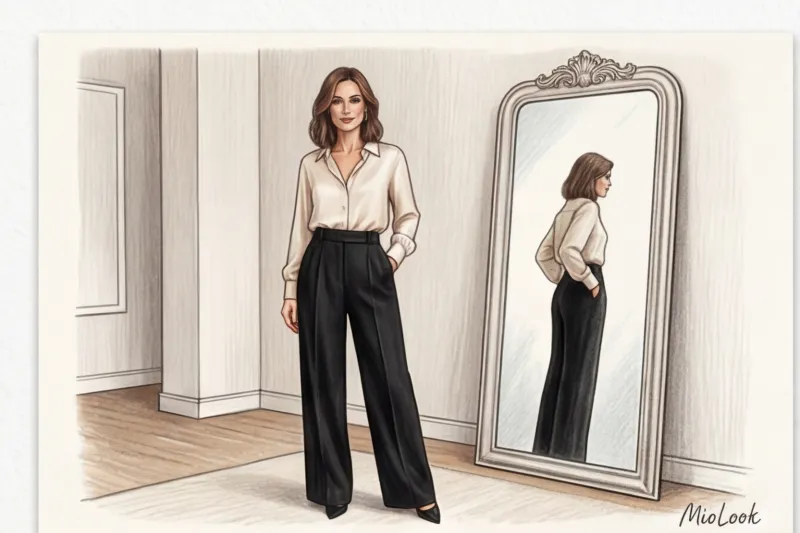
- High waist without pleats. Large pleats at the waist (darts) add volume to the midsection. This volume can look bulky on a petite figure. Opt for a flat front.
- Straight cut from the hip. Palazzo trousers and straight leg pants are the safest to have shortened at the tailor's because they don't have a noticeable taper at the knee.
- Length of pencil skirt. Strict business etiquette dictates a knee-length skirt. For petite women, the ideal length is just below the kneecap or a hand's breadth above the knee (if corporate culture permits). A mid-calf (or midi) skirt requires a perfect waist fit and matching shoes or tights.
Your perfect look starts here
Join thousands of users who look flawless every day by managing their wardrobe with MioLook.
Get access — €0.99 onceThe most expensive mistake: what the studio will fix and what it will hopelessly ruin
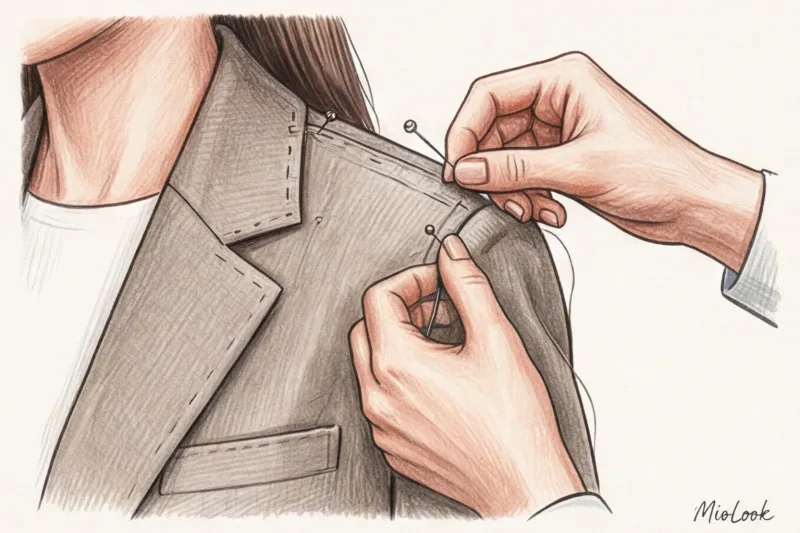
Let's return to my client Anna and her jacket. Many sincerely believe that a good seamstress can save any garment. This is a dangerous and very expensive misconception. A business suit is a rigid structure with adhesive materials inside (interlining, interfacing).
Let's calculate the cost-effectiveness. Let's say you bought a jacket at Zara for €70. If it's too big in the shoulders, the tailor will have to rip out the sleeves, reshape the cap, raise the armhole, and reseat the sleeve. This type of work in a European tailor costs between €80 and €150. The end result is a mass-market polyester jacket at the price of a premium item, with no guarantee of a perfect finish.
What you can safely bring to the studio:
- Shortening straight trousers (10–15 €).
- Shortening the sleeve of a jacket if it does not have a complex vent with unbuttoned buttons (15–20 €).
- Taking in the waist of a pencil skirt or simple trousers along the middle seam (20–30 €).
What you should absolutely not buy in the hopes of "sewing up":
- Jackets that are big in the shoulders (the seam hangs down).
- Jackets with patch pockets or flap pockets are recommended if the garment needs to be significantly shortened at the bottom. The pockets will end up at the very edge of the hem, throwing off the proportions.
- Sheath dresses have a bust dart that sits below your bust. Raising it without completely reshaping the bodice is impossible.
Checklist: Putting together a capsule collection of business attire for petites
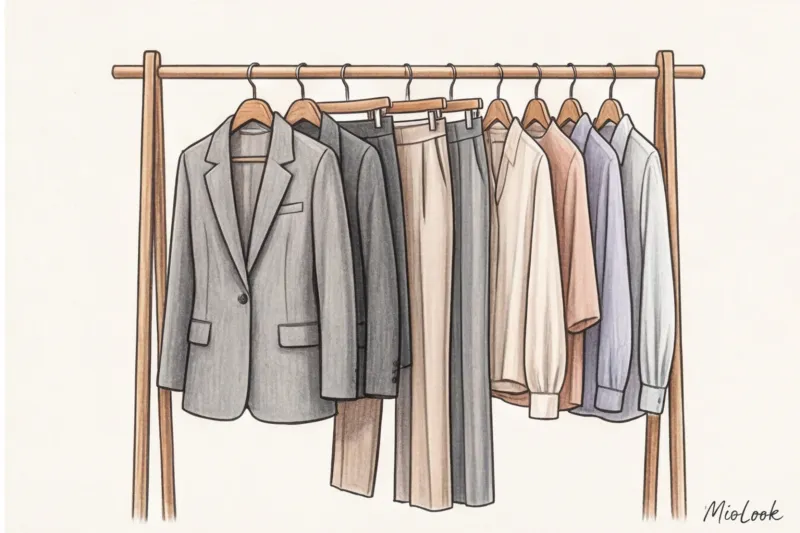
If I were building a basic business wardrobe from scratch for a client up to 160 cm tall, my shopping checklist would look like this: No abstractions, only functional pieces.
- The perfect two-piece suit from the Petite line. Look for a suit made of fine wool (Super 100s or 120s) with 2-3% elastane. Avoid stiff, stand-up neoprene or cheap, thick polyester, as these make a petite figure look boxy.
- Two flowing blouses. One is a basic light shade (pearl, ecru), the other is a deep dark (navy blue, emerald). Both are without stiff collars.
- Fine knitwear. Turtlenecks made of merino wool or silk-cotton blends are form-fitting, tucked into trousers without adding bulk at the waist, and fit perfectly under a jacket.
- Shoes with a deep cut (vamp). Classic pumps or loafers with a pointed (not blunt, round!) toe. The more exposed the instep, the longer the leg appears when paired with 7/8 trousers or a skirt.
To gather these things into a single system, I recommend digitizing your purchases. MioLook app You can take a photo of each item, remove the background, and create ready-made capsule collections right on your phone screen. This is especially convenient for petite women: you can immediately see how the proportions work together (for example, the length of a jacket relative to trousers) even before you get dressed in the morning.
Summary: Your professionalism doesn't depend on centimeters
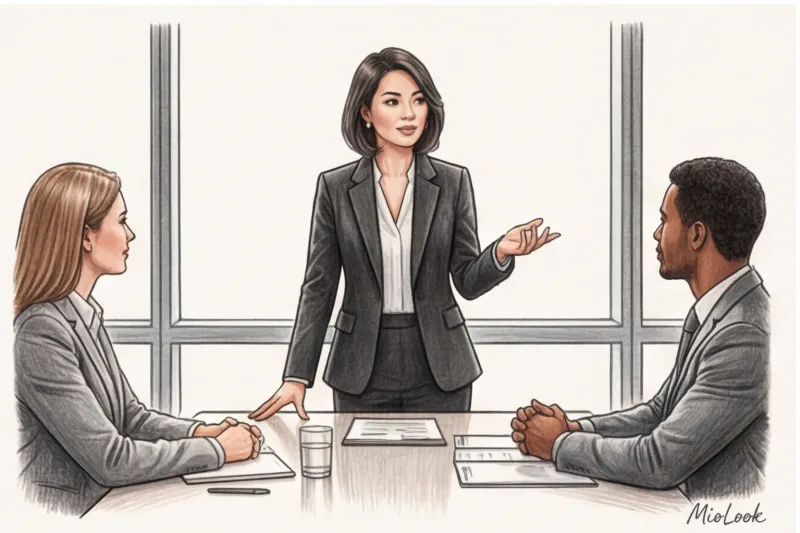
A work wardrobe for those under 160 cm isn't a punishment or a reason to feel insecure. It's simply a different frame of reference. Once you stop trying to squeeze yourself into shapes designed for tall women and start looking for brands that respect your proportions, shopping will become less stressful.
The main insight I want you to take away from this article is this: invest your time in finding the right brands with petite lines or ideal cropped styles in standard sizes, rather than wasting your money on endless and often pointless alterations at the atelier. A perfectly tailored suit communicates your status and competence far more powerfully than any brand logo.