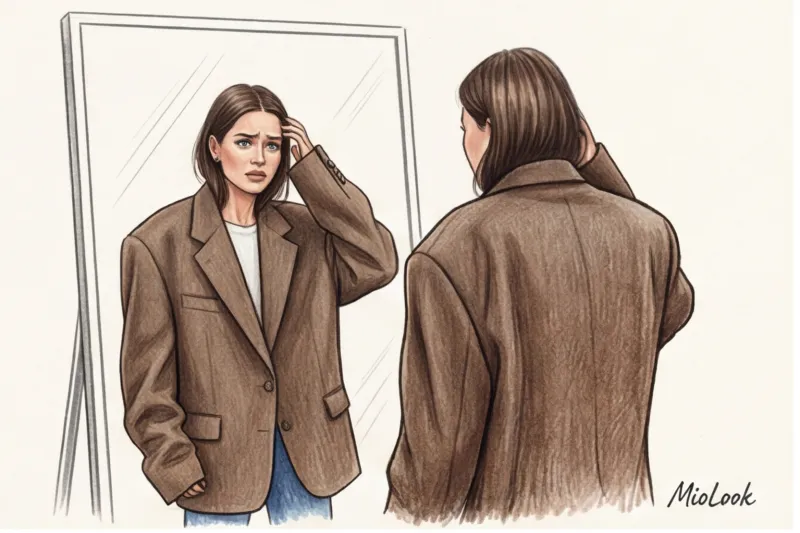
In 2019, during Paris Fashion Week, I had to create a street style look for a client who was exactly 156 cm tall. The task was complicated by the fact that the PR agencies sent samples exclusively in the exaggerated L-XL sizes, as per the runway trend. Do you know what happened when she wore an enormous Balenciaga men's trench coat? She literally drowned in it. The fabric swallowed her neck, the shoulder seams slid toward her elbows, and her silhouette became a shapeless rectangle.
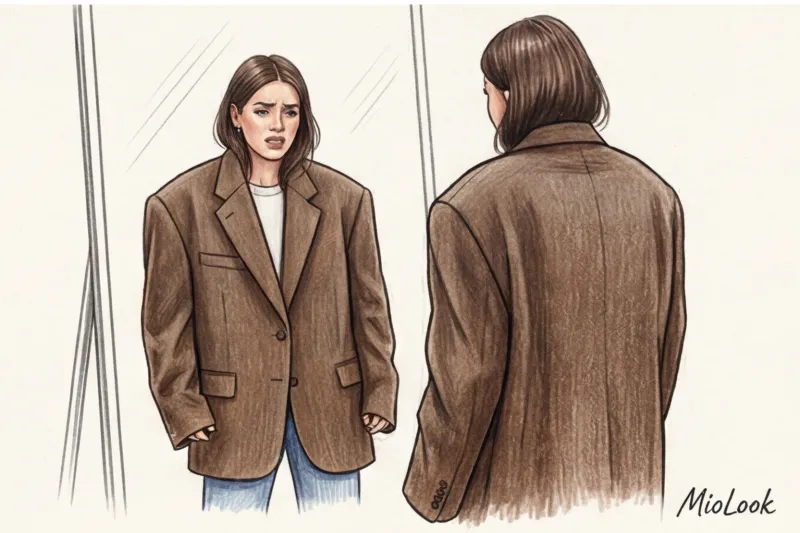
It was then, standing in the fitting room with a handful of safety pins in my teeth, that I realized the main mistake that petite girls make. Real oversized for short people It's not about blindly wrapping yourself in meters of fabric or buying something three sizes too big. It's a complex game of cutting architecture, proportional mathematics, and anchor points.
We have already discussed in more detail the basic principles of working with a wardrobe for petite women in our The Complete Guide to a Basic Wardrobe for Petites: Capsule Wardrobe for Up to 160cm Today, we'll explore the ultimate rules for working with volume, which will once and for all rid you of the fear of looking like "a teenager in his dad's jacket."
The Illusion of Volume: Why the "Buy Two Sizes Bigger" Rule Ruins Proportions
The most harmful style advice still floating around the internet is: "If you want oversized, just buy something from the men's department or two sizes up." For women taller than 170 cm, this sometimes works. For those under 160 cm, it's a death sentence.
It's all about the dry mathematics of patterns. The difference between deliberate oversize The difference between a standard size L and a standard size XS garment (for example, an oversize XS) is colossal. Construction statistics show that a standard step between sizes not only adds up to 10–12 cm to the waist and chest measurements, but also lowers the bust darts by 4–5 cm. The armholes also tend to move toward the waist.
What happens visually? The figure's center of gravity shifts downward. Dropped armholes deprive you of your waist, and a too-high neckline in a size that's too big "eats" your neck. Japanese designer Yohji Yamamoto, a master of deconstruction, once said that proper clothing should leave space for air to circulate between the body and the fabric. But this "air" should be programmed specifically for your height.
Your perfect look starts here
Join thousands of users who look flawless every day with MioLook. The smart algorithm takes your height and proportions into account.
Get access — €0.99 onceFixation points: the main secret of a stylist on how to wear oversized clothes for petite women
How does the human brain interpret someone's figure? It looks for clues. If you're wearing an oversized sweater, your interlocutor's brain doesn't see your body and assumes you take up the entire volume of the sweater. To break this illusion and reveal the fragile woman lurking within, we need fixation points.
These are the most delicate areas of the body that must be opened:
- Wrists
- Ankles
- Neck and collarbones
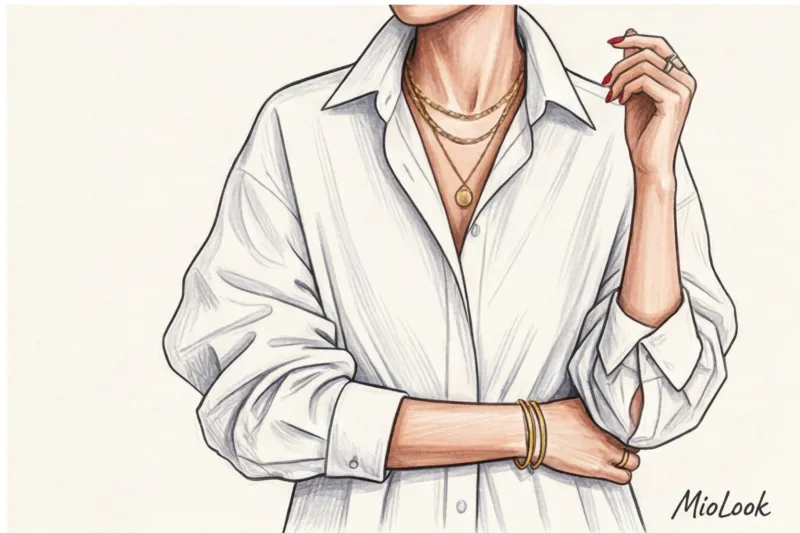
At every other photo shoot, I use the same tried-and-true trick: I roll up the sleeve of a voluminous shirt or jacket literally 2-3 centimeters above the protruding wrist bone. The difference is astounding! The silhouette instantly elongates.
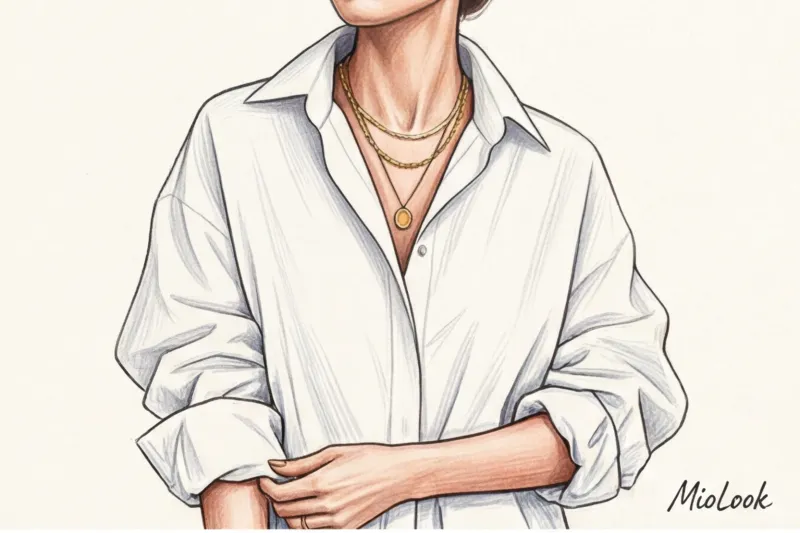
"When you wear a bulky turtleneck and long, wide-leg trousers, you become a monolith. A V-neck or casually unbuttoned top three buttons of a shirt aren't just a detail; they're oxygen for your silhouette." from personal styling practice.
Silhouette Mathematics: How to Distribute Volumes for Those Up to 160cm
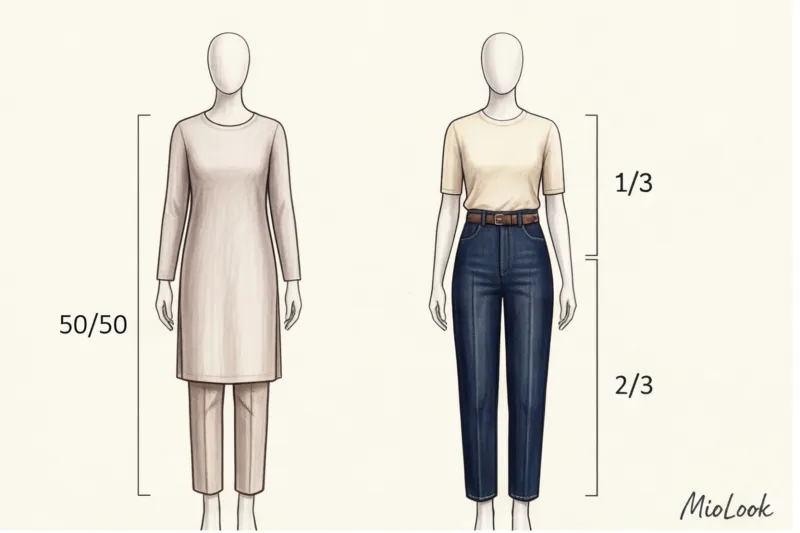
Another pitfall is the 50/50 ratio. If you wear a boxy, oversized sweater that ends at the hips and matching wide-leg pants, you'll visually cut your body in half. For petite women, this means losing at least 5 centimeters of height.
This is where the golden ratio in styling comes into play: the ratio of volumes is 1/3 to 2/3. This principle worked flawlessly back in 1947, when Christian Dior introduced his famous New Look silhouette, and it still saves modern casual looks.
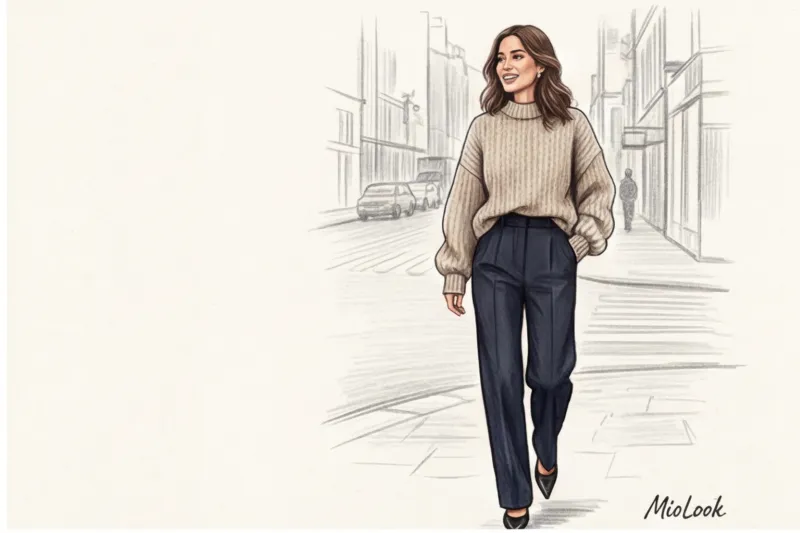
How to put this into practice? Define your waistline even in the most relaxed outfits. Use the technique French tuck (French tucked hem) - tuck just the front of an oversized sweater or t-shirt into high-waisted jeans. This will keep the oversized look relaxed in the back but show off the true length of your legs in the front.
The one bulky item rule
If you're just starting to experiment with volume, use the safest rule: one oversized piece per entire outfit. Pair a thick, oversized jacket with smooth, flowing base layers (like a silk top and straight-leg jeans). The contrasting textures enhance the fragility effect.
By the way, to avoid spending hours in front of the mirror trying to find this balance, I always advise my clients to take photos of successful combinations. You can create your virtual capsule collection in MioLook , where an AI stylist will help you visualize how a particular oversized sweater will pair with your basics.
Oversized outerwear: choose coats and trench coats to avoid looking shorter
A 2024 study by global platform Lyst found that searches for "oversized maxi coats" increased by 45%. But many petite women are wary of long, voluminous coats, opting for cropped styles that fall just above the knee. And they're making a huge mistake.
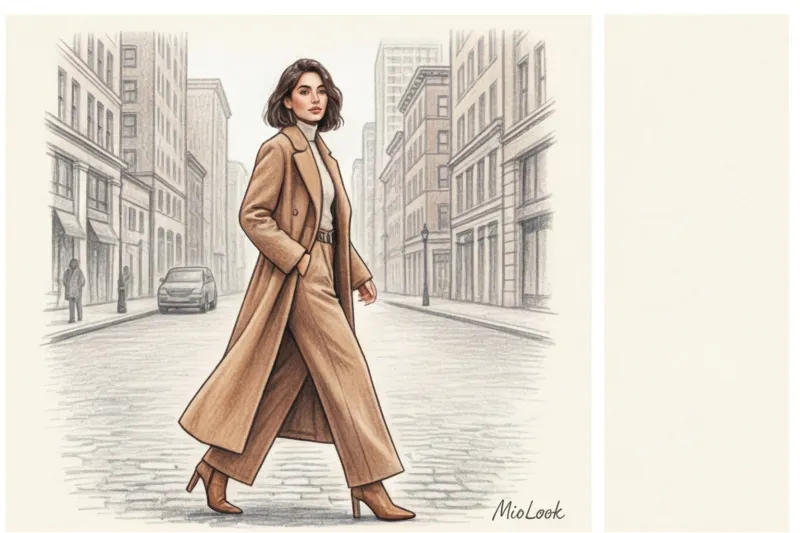
The knee-length, combined with a wide cut, makes you look like a square. Choose from a midi-length (mid-calf, about 115–120 cm at the back) or even a full maxi. The long fabric creates a continuous vertical line, elongating your height.
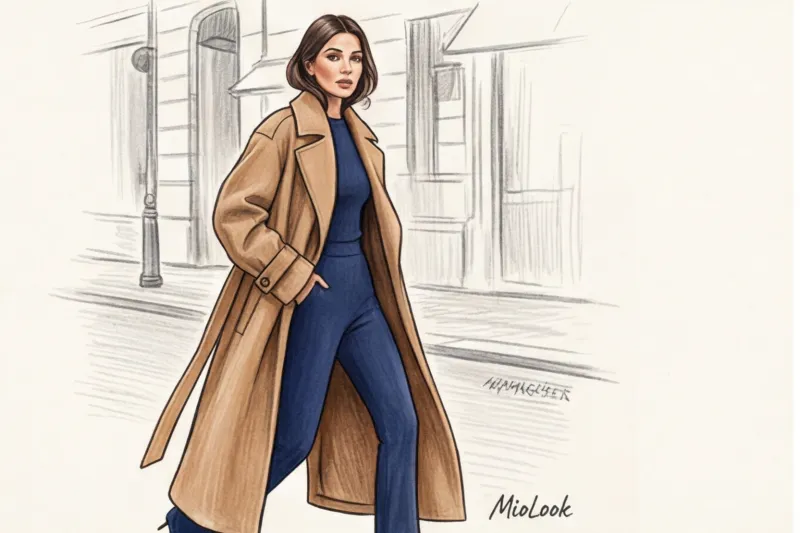
The main secret of the cut: Look for a raglan sleeve. The set-in sleeve on an oversized coat creates a sharp "angle," which, if you're short, makes your shoulders look disproportionately large. A raglan (the seam running from the neck to the armpit) gently curves down the shoulder, creating a sloping, feminine line. Look at Zoë Kravitz's street style (she's 157 cm tall) – she brilliantly wears oversized coats, always leaving them open to create two long vertical lines.
Ready to get started?
Try the free plan—no commitments required. Upload your items and get ready-made outfit ideas for every day.
Get access — €0.99 onceWide-leg trousers and oversized jeans: dangers and solutions
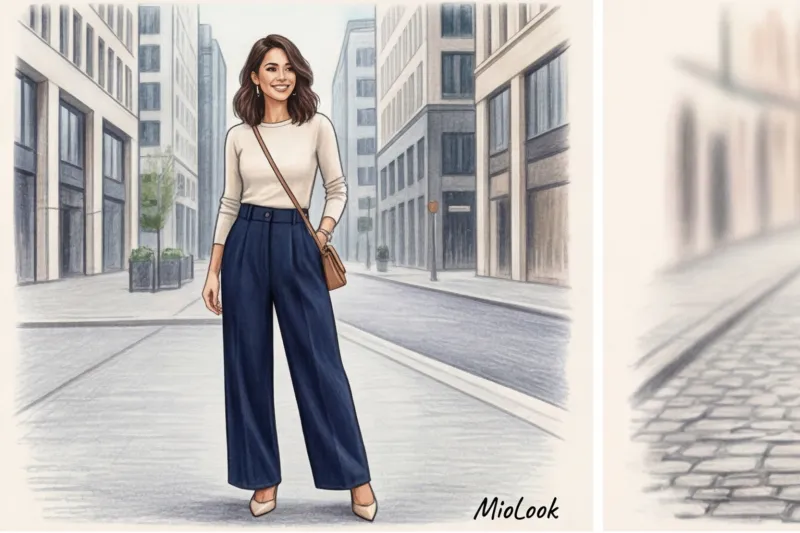
Palazzo pants and wide-leg jeans are another tricky item. The ultimate requirement for petite women when choosing wide bottoms is a strictly high waist. Avoid the low-rise style from the 2000s, unless you want to visually shorten your legs by half.
Here I want to break the most popular stereotype: It is believed that wide trousers require stiletto heels In fact, chunky platform sneakers (often chosen to compensate for height) or sky-high heels paired with oversized pants often make the bottom appear as heavy as hooves.
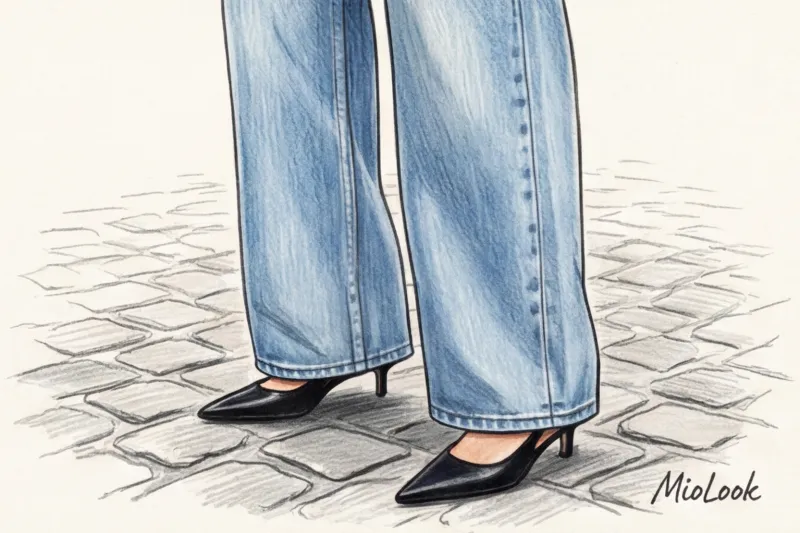
What works best? A pointed toe with a flat sole! Elegant mules, pointed-toe ballet flats, or kitten heels, barely visible from under a wide pant leg, create the illusion of an infinitely long leg. This is a case where the shape of the shoe matters more than the height of the heel.
Oversized Business Style: A Balance of Relaxation and Status
Integrating oversized clothing into a smart casual office is the most challenging. A loose, shapeless jacket will make you look like an intern wearing her mom's clothes for her first interview.
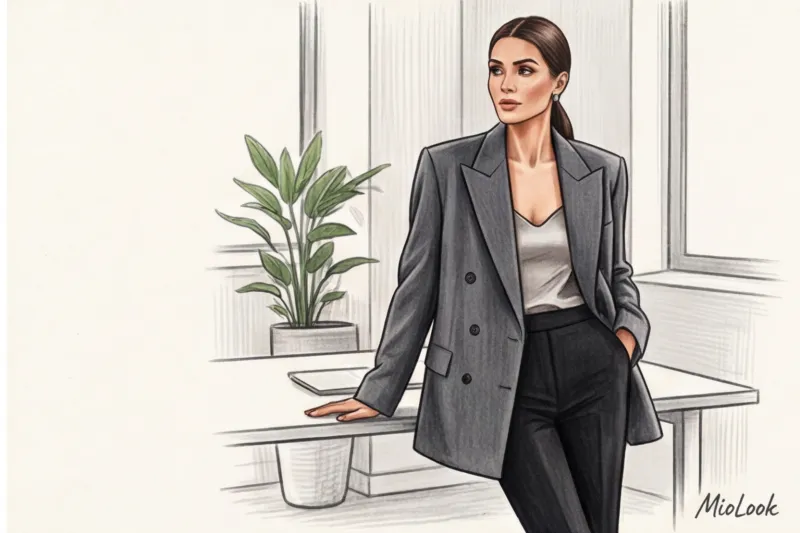
In a business wardrobe, oversized pieces should be architectural. The garment must hold its shape. This means we need dense fabrics (wool from 300 g/m², high-quality heavy cotton). If you're looking for a good jacket, focus on the mid-range or premium segment (in the €150–€300 range), where brands use high-quality interlining to reinforce the front and shoulders.
Limitation to be aware of: This advice absolutely does NOT work with thin, flimsy knitwear. A hyper-voluminous cardigan made of thin viscose will simply hang off you like a rag.
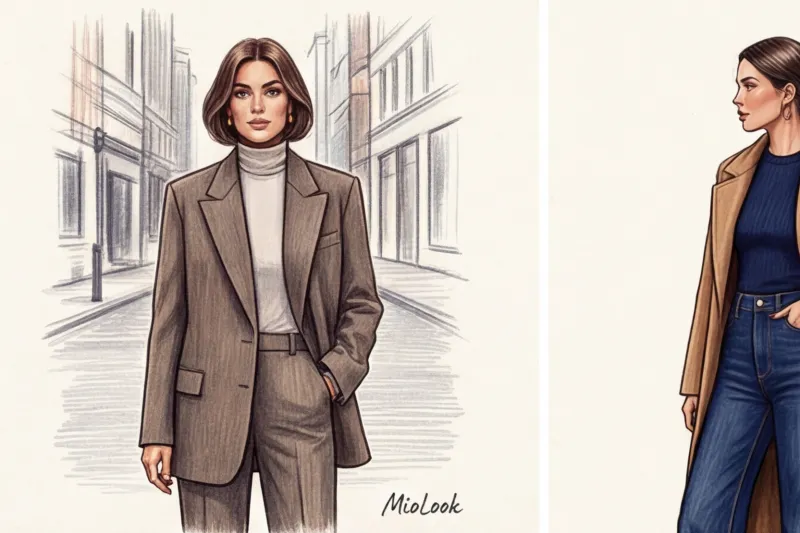
Go monochrome: An oversized two-piece suit in a single color (for example, deep chocolate or graphite) will act as a color column, blurring the lines between top and bottom and visually adding 3-4 centimeters to your height.
Stylist checklist: testing oversized items in the fitting room
Over 12 years of work, I've developed a strict algorithm for checking oversized items. Before taking your oversized find to the checkout, run three quick tests right in the fitting room:
- Motility test: Raise your arms up, then spread them out to the sides. If the entire silhouette of the jacket or dress is pulled down with your arms, revealing your waist, the armhole is cut incorrectly. Leave it at the store.
- Shoulder Line Test: The seam should either be in its proper position (with the shoulder pad slightly wider) or intentionally dropped to mid-forearm. If the seam hangs about two centimeters below the shoulder joint, the garment looks like you simply wore the wrong size.
- Density test: Squeeze the fabric in your fist. If it wrinkles easily and feels like a handkerchief, it will look miserable oversized. Expensive volume requires a heavy, flowy, or stiff fabric.
Oversized clothing for petite women isn't about hiding from the world under layers of fabric. It's an opportunity to highlight your fragility through contrast with a large, architectural form. Forget the fear of losing inches. Simply expose your wrists, tuck the hem of your sweater into your jeans, and wear pointed-toe shoes—and you'll see how volume works for you, not against you.