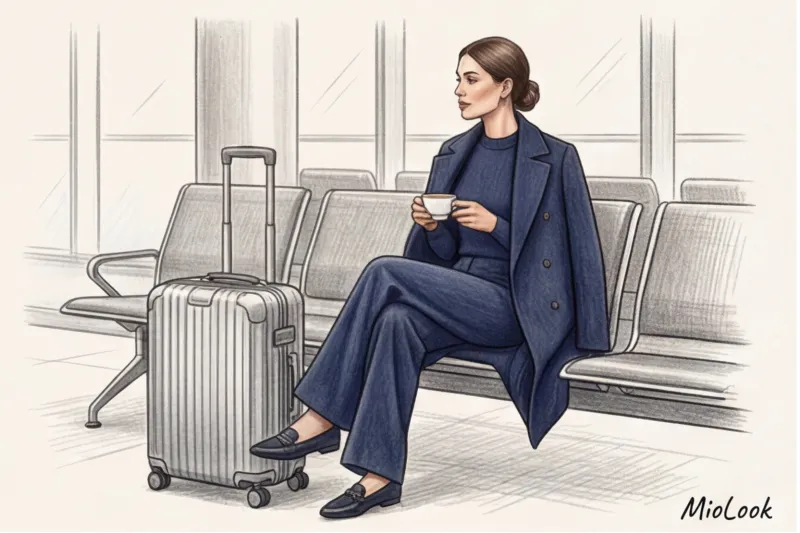
The Business Traveler's Secret Code: Why Regular Packing Rules Don't Work
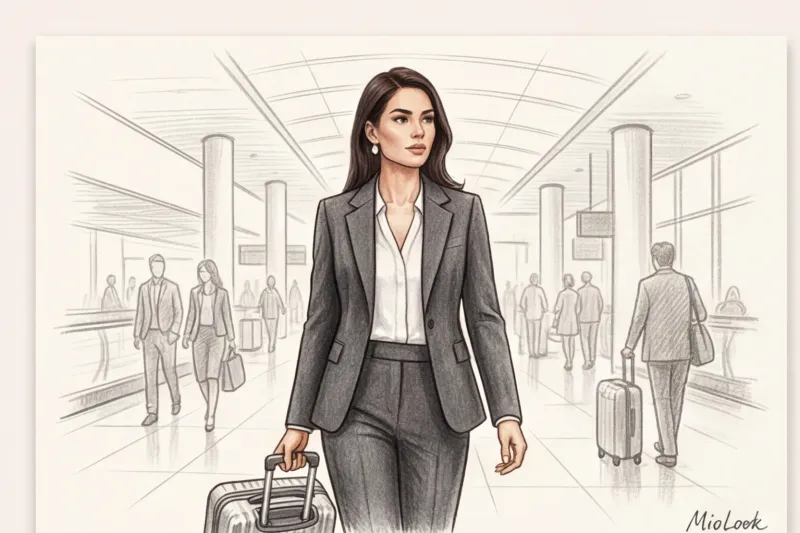
You're standing at the baggage carousel. Twenty minutes pass, then thirty. The conveyor grinds to a halt. And in an hour, you have key negotiations with investors, where you must present a new strategy dressed in the wrinkled jeans and hoodie you wore on the flight. Sound familiar? Properly chosen attire for a woman on a business trip is far more than a matter of aesthetics or a love of fashion. It's a matter of reputation, self-confidence, and rigorous risk management.
Unlike a relaxing vacation, where a forgotten swimsuit or a torn dress can easily be replaced at the nearest resort boutique, a business trip entails a whole new level of stress. There's strict deadlines and zero margin for error. You simply won't have time to run around an unfamiliar city searching for the perfect white shirt in the right size while your colleagues are already gathering in the hotel lobby.
After 10 years of traveling to Fashion Week, I've learned one ironclad rule: if your luggage is checked, you don't control your image.
That's why the main rule of the modern executive wardrobe is categorical: "I carry everything I own with me." Experienced executives and top managers fly exclusively with carry-on baggage, regardless of whether their business trips last two days or a busy week.
Think I'm exaggerating the risks of baggage handling? Let's look at some cold, hard statistics. According to the SITA Baggage IT Insights 2023 global report, the rate of delayed and lost baggage worldwide has risen to 7.6 pieces per 1,000 passengers. And if your itinerary includes transfers, this figure skyrockets. By checking your suitcase, you're literally gambling with your career. Is your favorite, but overly bulky, jacket worth the risk? The answer is obvious.
Fitting status, elegance, and comfort into the strict parameters of a cabin size (typically 55x40x20 cm) requires a fundamental transformation of one's mindset. We no longer throw disparate "things" into a suitcase. We assemble ready-made scenarios.
You need to know the exact sequence of actions for each item of clothing: this thick knitwear is for the gangway and taxi, this deconstructed two-piece suit is for a morning session, and if I swap the loafers for pumps and add some statement earrings, the same look will work perfectly for a business dinner with partners. No skirt or blouse has the right to take up valuable suitcase space unless it is used in at least two, and preferably three, scenarios. This architectural approach largely echoes the way a capsule wardrobe of basic items , but with the obligatory adjustment for the frantic pace, air conditioning on airplanes and time zone changes.
Practical micro-step: Before you start packing, open your trip calendar and write down every step. Breakfast at the hotel, transfer, three meetings, an informal dinner. For each slot, you should already have a mental plan that doesn't require ironing or time-consuming accessory selection on site.
Sounds like a puzzle with a star? Believe me, it's only scary the first time. To avoid panic before a flight, I long ago stopped laying out clothes on the bed, trying to remember dozens of combinations. Today, she solves this problem brilliantly. virtual wardrobe Personally, I plan all my travel plans in the app. MioLook It allows you to visually compose your capsule, check the compatibility of textures, and accurately calculate the number of layers before you even take your suitcase down from the mezzanine.
The 5-4-3-2-1 Basic Formula: The Perfect Business Trip Outfit for Women
When top managers consult with me about travel wardrobes, their biggest mistake is always the same: they try to anticipate every contingency and pack "just in case" items. As a professional wardrobe architect, I offer a completely different approach—a mathematical one. Practical and stylish business travel attire for a woman shouldn't be a random collection of pretty items. It's a rigorous system of interconnected elements, where every detail is 200% responsible for its place in carry-on luggage.
My favorite tool for short to medium business trips is the basic formula 5-4-3-2-1 This matrix limits you to fifteen items (including what you wear on the plane), but with the right selection, it yields 24 to 30 complete combinations. Let's break this architecture down, brick by brick:
- 5 tops: a thick shirt, a silk blouse or top, a basic T-shirt, a long sleeve shirt and one dressy top for dinner.
- 4 bottoms: classic trousers, midi skirt, dark solid denim and alternative trousers (for example, wide palazzos).
- 3 layers: jacket, thick cardigan and outerwear (trench coat or light coat).
- 2 pairs of shoes: a status pair of flat shoes and classic pumps.
- 1 dress or two-piece suit , which can be worn both together and broken down into independent elements.
The magic of this formula is revealed through strict color discipline. I always insist on this rule: two base colors plus one accent color Why this? Basic shades (for example, deep navy and cool camel, or graphite and milky) are easy to mix and match and tolerate minor creases or micro-stains while traveling. Accent colors (emerald, wine, or cobalt) are introduced sparingly: in the form of a silk scarf, a single top, or a bag. This saves the capsule from becoming visually dull.
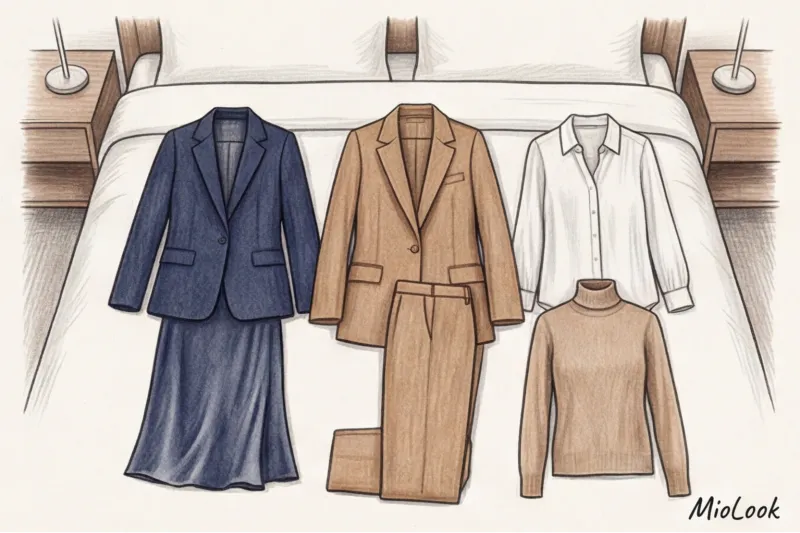
Multitasking is the cornerstone of a travel wardrobe. In classic styling, we use the concept of "cost per wear" to justify the purchase of an expensive item. In the context of business travel, this principle is transformed: We evaluate a thing not by its price, but by the number of scenarios in which it can be used. One top should work flawlessly with at least three bottoms. Take a basic silk blouse: wear it with classic trousers and a jacket during the day for an investor meeting, with dark denim for a casual dinner with partners in the evening, and then pair it with a midi skirt and cardigan for work at a coworking space the next day.
Capsule core: suit group and layers
The centerpiece of any business trip is a jacket. But a classic jacket with a stiff lining, shoulder pads, and a thick lining is the enemy of carry-on luggage. Even with a case, it risks losing its shape. My solution: deconstructed jacket This cut, popularized by Giorgio Armani in the 1980s, is currently experiencing a renaissance in collections from COS to The Row. The lack of a rigid lining and a soft shoulder line allow this garment to adapt delicately to the body's movements during a flight and quickly regain its shape on a hanger in your hotel room afterwards. A high-quality deconstructed wool-blend jacket will cost between €150 and €400, but the investment will pay for itself on your very first trip.
As for trousers, this is where one of the main status markers of modern times lies. Many choose cropped models (7/8 length) because they don't get dirty and seem more practical. However, I recommend opting for full-length trousers (puddle pants or classic straight pants). From a visual psychology perspective, a full length that covers the heel or elegantly drapes over loafers elongates the silhouette and conveys confidence and solidity. Cropped pants, on the other hand, often cut off the leg and veer the look into a more relaxed, casual segment, which is not always appropriate for high-level negotiations.
"One of my clients, a communications director, once spent three days presenting in Zurich with only one deconstructed suit and three different tops. With the changing tops and accessories, no one on the board realized the base layer remained the same."
Don't forget about air conditioning. Meeting rooms in Dubai, Frankfurt, or London often resemble cryogenic chambers. A knitted layer—a thin merino wool cardigan or a cashmere turtleneck—is essential. It takes up minimal space, doesn't wrinkle, and instantly reduces the formality if you decide to remove your jacket.
Digitize your suitcase in advance
Tired of trying to remember what to pair with the pants you stashed at the bottom of your suitcase? Upload your items to the MioLook app. Our AI stylist will automatically assemble them into a capsule wardrobe using the 5-4-3-2-1 formula and display all possible combinations on your smartphone screen.
Create a travel capsule with MioLookTops and blouses: play with textures without the risk of creasing
The top layer underneath your jacket is your impression management tool. While a suit sets a strict framework, a top or blouse reveals your individual style. My absolute favorite for business trips is silk sleeveless or short sleeve top It's important to choose natural Mulberry silk with a minimum density of 19 momme. This material has a refined matte sheen, resists static in the dry air of an airplane, and instantly adds class and femininity to your look. Furthermore, silk takes up no more space than a pair of socks.
If your protocol calls for a dress shirt, choose a blouse made of heavy cotton (such as Oxford weave or cotton twill). The key logistical rule here is: Wear a stiff cotton shirt on the first day of your business trip. , straight onto the plane (if the flight lasts up to 4 hours). No matter how masterful your packing techniques, the stiff collar of a classic men's shirt will deform under the pressure of other items in a tightly packed suitcase.
For smart-casual looks and informal dinners, a basic T-shirt is essential. But forget about thin jersey that loses its shape after the first wash. Invest in a T-shirt made of mercerized cotton (The price range for high-quality models ranges from €60 to €120). The mercerization process removes fuzz from the cotton thread, making the fabric stronger, smoother, and giving it a subtle, almost silky sheen. This T-shirt worn under a deconstructed jacket looks like a deliberate stylistic choice, not an attempt to save money on a blouse.
Fabrics that 'forgive' flights: a textile guide
Have you ever noticed why, after a long flight, some business suits look like they just came off a boutique mannequin, while others become wrinkled disappointments in dire need of dry cleaning? Observing costume designers and stylists at work backstage at European Fashion Weeks, I learned a crucial lesson: how a garment fares during transportation depends less on the folding technique than on the physics of the fabric itself.
Choosing the right clothes for a woman on a business trip starts with carefully reading the labels. In the context of a travel wardrobe, fabric composition isn't just information; it's your insurance against morning panic before an important meeting.
The first rule of modern business luggage: look for high-tech blended fabrics. Completely natural materials often work against you in a suitcase. It's the addition of 3 to 5% elastane (or spandex) to a base cotton or wool that literally saves the look. Why this particular proportion? It doesn't make the fabric look cheap or sporty, but rather gives the yarns structural memory. A suit or heavy shirt made of 95% cotton and 5% elastane has a "spring" effect—the fabric returns to its original smooth shape with the warmth of your body just twenty minutes after you put it on.
Materials known in the industry as "smart synthetics" deserve special attention. Triacetate, cupro, and double crepe are absolute favorites among designers when creating premium travel capsules.
Many people are wary of synthetics out of habit, but modern Japanese triacetate, when worn in a business suit, looks like heavy, expensive silk and wrinkles like a tracksuit—indeed, it doesn't. Moreover, it has a slight cooling effect, which is invaluable in stuffy conference rooms.
Cupro, often considered an eco-friendly silk substitute, has a velvety texture, is highly breathable, and crucially, resists static cling. Double crepe is ideal for trousers and skirts: thanks to its special twist, it drapes beautifully, conceals figure flaws, and exhibits incredible wrinkle resistance. Brands like Theory and Joseph build entire executive collections on these fabrics. And while a high-quality cupro blouse can start at €150, it's worth every penny on your very first trip.
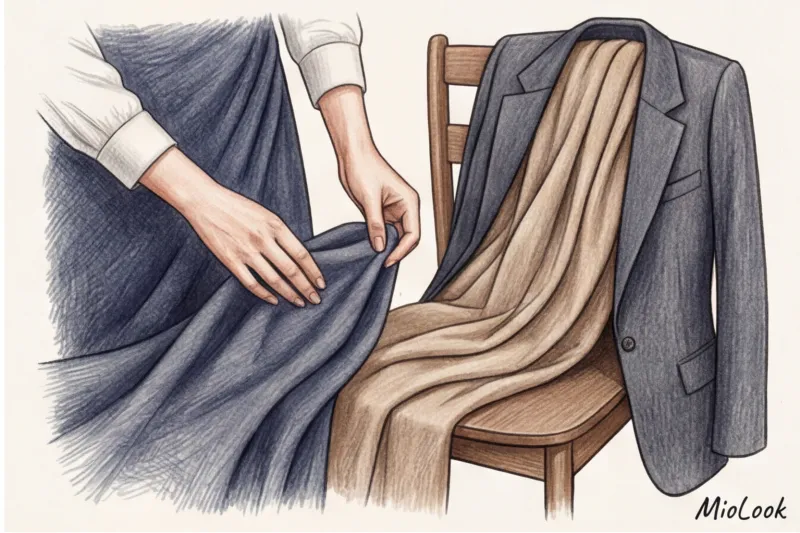
But what about a classic suit? If the dress code calls for formal wool, your best ally is wool marked Super 100s or 120s. These numbers indicate the fineness (thickness) of the thread: the higher the number, the finer, lighter, and more elastic the material. The main secret of highly twisted wool lies in its ability to self-repair. If your jacket has creases after a flight, no need to iron. Simply hang the suit on a hanger in the hotel bathroom, turn on a very hot shower for 10 minutes to create a steam bath, turn off the water, and let the garment hang in this humid environment overnight. By morning, the fabric will have flattened under its own weight.
To avoid having to remember all these train details before each trip, I recommend my clients use digital tools. In the app MioLook You can enter the composition of each item once. When packing your suitcase, simply filter your virtual wardrobe by the "wrinkle-resistant" tag, and the system will automatically suggest ideal options made of triacetate or wool blends.
Blacklist: What you absolutely shouldn't pack in your suitcase
Even if an item fits you perfectly, there are certain categories of textiles that have no place on a business trip. Adding them to your luggage is a guaranteed waste of time and stress.
- 100% linen and fine viscose. These fabrics wrinkle literally at the mere glance or just sitting in a taxi on the way from the airport. Linen is perfect for a vacation on the Riviera, but it's unacceptable for a busy business trip where you don't have 40 minutes to thoroughly steam it before each trip. It looks unkempt by mid-day.
- Items with complex pleating. The only exception to this rule is items made of 100% polyester and created using heat-pressing technology (in the style of the iconic Issey Miyake collections). If pleating is done on natural or semi-natural fabrics, the folds will become distorted under the pressure of a tightly packed suitcase. Restoring their correct geometry in a hotel setting will be impossible without professional equipment.
- Massive decor, rigid fittings and rhinestones. The problem here isn't just the inappropriateness of excessive glitter in a daytime business wardrobe. The main risk is mechanical damage to adjacent items when packed tightly. I once had a heavy metal brooch left on the lapel due to airplane vibrations, causing permanent snags on a basic €300 silk top, completely ruining the outfit I'd planned for the second day. All decorative accessories should be transported strictly in a separate soft case.
Shoes and Accessories: How to Avoid Overloading Your Carry-On Luggage
Did you know that when we shoot editorials for glossy magazines, we rarely change the model's outfit from head to toe for each new shot? It's simply too time-consuming. The secret stylists use to completely change the mood of a look without changing the clothes themselves lies solely in the accessories. We leave the outfit's structure intact and simply change the shoes, bag, and jewelry. In just a couple of minutes, a strict daytime look transforms into relaxed evening chic. On business trips, when every gram of carry-on baggage counts, this professional trick becomes your main weapon.
A well-chosen outfit for a woman on a business trip is just a canvas, but accessories are the paints with which you convey your status. Shoes are traditionally considered the main enemy of a small suitcase. To avoid carrying excess weight, I strongly recommend using an uncompromising 2+1 rule You must have exactly three pairs in your arsenal.
The first pair are minimalist leather flight sneakers (the same ones you wear to the airport to save space in your suitcase). The second pair are flat loafers. High-quality leather loafers (in the €150–€300 price range) have long been a legitimate part of business dress code, and they'll save your feet during a marathon of daytime meetings. And the third pair are classic pumps with a 5–7 cm heel, perfect for tucked away in your luggage for key negotiations or formal dinners.
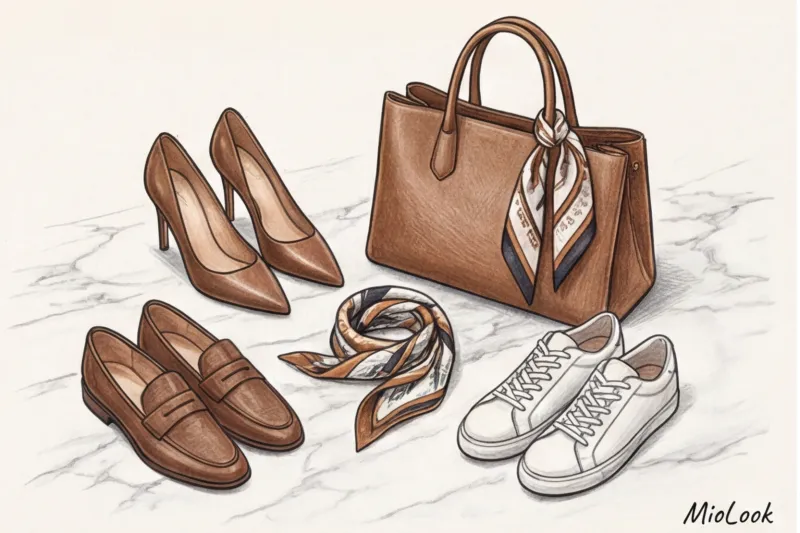
The Matryoshka doll principle applies to bags. Trying to squeeze a second, bulkier bag into a suitcase is a huge mistake. Your hard-shell work tote is carried on board the plane with you. personal item It can hold a laptop, a folder with documents, and a travel cosmetic bag. A completely flat crossbody bag goes inside the suitcase, at the very bottom. In the evening, when heading out to an informal dinner with clients, you won't have to carry a heavy work briefcase.
A jewelry wardrobe weighs practically nothing, yet it brilliantly controls the degree of formality. My workflow for short trips includes three pairs of earrings and two necklaces Subtle studs are for the plane, understated metal hoops are for daytime board meetings, and statement earrings (like those made of crushed metal) are for dinner. Adding the right necklace to a basic top completely changes the overall look.
The finishing touch and my favorite multi-tool is a classic 90x90 cm silk square scarf. It's a brilliant detail whose functionality is often underestimated. During the day, you can tie it elegantly around the handle of your tote bag for a pop of color, drape it around your neck in a harshly air-conditioned conference room, and in the evening, slip it through your trouser belt loops in place of your usual leather belt. And when folded, the thick silk takes up no more space than a compact.
To plan all these micro-transformations in advance and avoid carrying unnecessary items, I create digital accessory capsules. You can use the "smart wardrobe" feature in MioLook , which allows you to visually try on different bags and jewelry with the same outfit before you even open the suitcase.
Access to MioLook for €0.99 — one-time payment
Start creating perfect looks with the help of artificial intelligence and pack your suitcase stress-free.
Get access — €0.99 onceTransforming from an Airplane to a Meeting Room: 3 Ready-Made Scenarios
The timer starts the moment the landing gear touches down. In today's corporate world, the luxury of checking into a hotel, taking a shower, and leisurely changing before a first meeting is a rare exception. More often than not, you're faced with a relentless schedule: passport control, a taxi, and straight to the conference room. That's why women's business travel attire today is designed around the "off the boat, off the ball" concept. Over the years of styling, I've identified three critical transition stages where a well-chosen wardrobe can save both your reputation and your nerves.
Airport: comfort that doesn't violate the boundaries of business class decency
Observing the lounge regulars at Paris' Charles de Gaulle or London's Heathrow, you'll notice a clear pattern: status is determined not by logos, but by texture. We'll save the cotton sweatsuit for Sunday coffee strolls. Your choice for a flight is the so-called elevated comfort (high comfort).
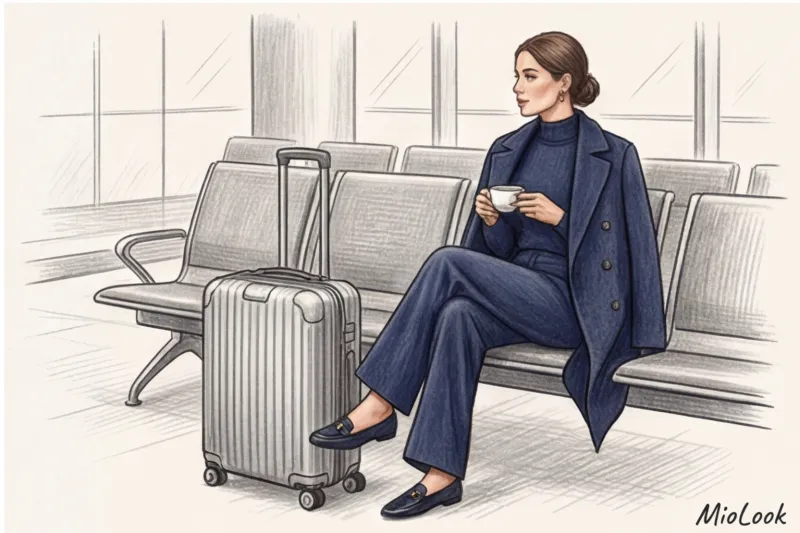
The foundation of this look is the right knitwear set. I recommend loose-fitting drawstring trousers paired with a lightweight merino wool or cashmere-silk blend jumper. The key is color: choose a deep monochrome. Rich chocolate, dark olive, or graphite gray visually align the silhouette. Layer on a voluminous yet structured trench coat or lightweight overcoat (if your budget allows, consider mid-up styles like Joseph or Theory, ranging from €250 to €600). This look will physically relax you in your airplane seat, but flight attendants and fellow travelers will subconsciously recognize your executive status.
Meeting an hour after landing: the secret of the "transformer layer"
You're in a taxi on your way from the airport to your partner's office. You have exactly ten minutes to transform your look. This is where the "transformer layer" comes in—an incredibly effective styling tool.
The idea is to instantly transform a soft, enveloping base layer (that same knit jumper you wore on the flight) into a workwear-ready ensemble with the help of hard lines. You pull out the deconstructed jacket we mentioned earlier from your trunk. You swap out your soft loafers for graphic pumps. The key technical requirement: the base layer shouldn't have voluminous collars that would clash with the jacket's lapels.
The jacket's crisp shoulder is a powerful visual cue for composedness. When you layer an architectural piece over a relaxed base, the entire look automatically gets a business-ready upgrade.
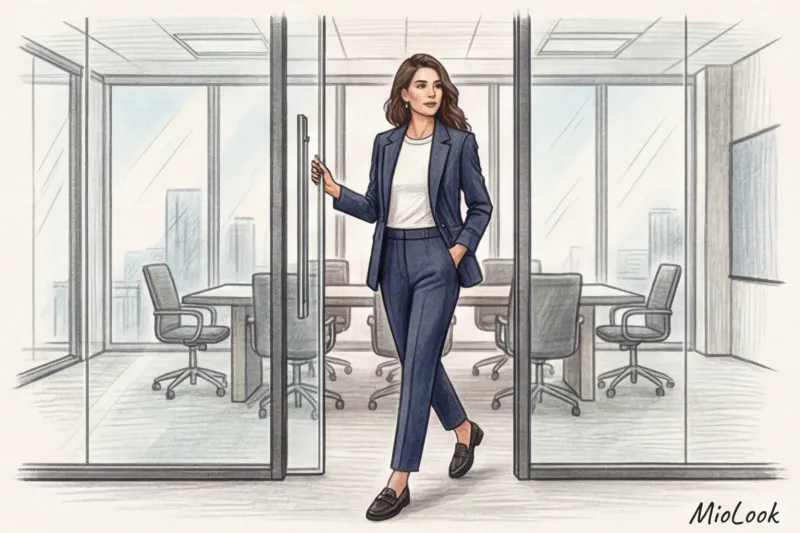
A silk scarf is also a great trick: tie it around your neck under the jacket collar to hide any slight wrinkling of the knit fabric at the neckline. The transformation is complete: you look like you spent two hours getting ready for that meeting in your luxury suite.
Business Dinner: How to Upgrade Your Daytime Look in 5 Minutes
The official part is over, but at 7:30 PM there's an informal dinner with clients or colleagues. You've only managed to pop back to the hotel for fifteen minutes. There's neither the energy nor the time to completely change the base. What do we do? We shift the focus.
Any daytime outfit can easily be transformed into smart-casual evening wear in just 5 minutes in the ladies' room in the lobby or in front of the mirror in your room:
- Silhouette: Take off your tailored jacket. If you're wearing a silk blouse underneath, unbutton it one more button than usual and casually roll up your sleeves (this micro-trick always adds to the Italian relaxed look— sprezzatura ).
- Accessories: Swap your work tote for a miniature crossbody bag that's been carried inside a larger bag. Swap your minimalist daytime studs for chunky, sculptural earrings. This season, the trend for vintage gold, reminiscent of the '80s, is playing to our advantage—these accessories add a bohemian flair to even a basic black turtleneck (invest in quality costume jewelry in the €100-€150 range; it pays for itself instantly).
- Beauty touch: Freshen up your complexion, remove shine with a mattifying wipe, and apply a highlighting lipstick. The dark burgundy shade instantly elevates any everyday look to evening wear.
In my experience, in moments of such urgency, my brain often refuses to make stylistic decisions due to fatigue. To avoid standing frozen in front of an open suitcase, I always open the card beforehand. saved onions in MioLook When you have a clear visual cue (which earrings and shoes were planned to go with this top), getting ready takes exactly those five minutes, leaving precious time for a sip of espresso before heading out.
Suitcase Architecture: The Myth of Rolling and the Bundle Wrapping Method
Search for "packing luggage," and algorithms immediately suggest dozens of videos featuring the same trick: rolling your wardrobe into tight rolls. This method, which became a global trend thanks to Marie Kondo and nomadic minimalists, truly saves space and works great for knitwear and sportswear. But let's be pragmatic: lifestyle gurus' advice mercilessly ruins expensive jackets and structured fabrics.
When your ideal business trip outfit for women includes tailored suits and complexly cut blouses, twisting causes irreparable damage. It breaks the inner interlining (doublerin) on the lapels and creates a network of micro-creases in the premium wool, which are then impossible to iron out with a hotel iron without risking ruining the garment.
Working backstage at Paris shows, I often observed the process of preparing couture collections for transport. No stylist in their right mind would roll up an architectural Balmain jacket or a silk Dior blouse. Instead, the haute couture industry employs a completely different geometry of spatial management.
This geometry is known to professionals as the method Bundle Wrapping , or crisscross folding. The essence of this approach is to completely abandon the traditional method of folding each item individually. You form a single, multi-layered bundle around a central, soft "core." This core is usually a cosmetic bag or a small, dense fabric organizer (packing cube), tightly stuffed with underwear and knitwear.
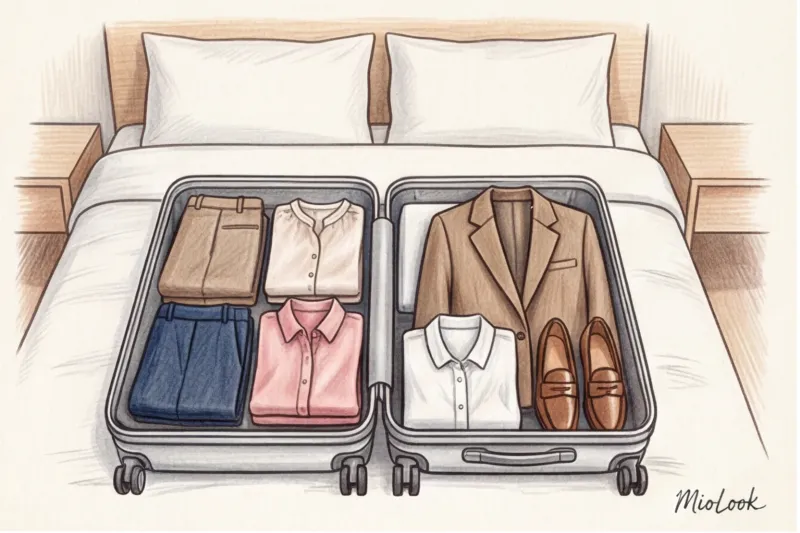
The "bundle" architecture is built in reverse order: from the longest and heaviest items to the lightest. Place your jacket face down at the bottom of the suitcase, leaving the sleeves and tails hanging freely over the sides. Pants are laid crosswise on top, followed by skirts, blouses, and finally basic tops. Place your soft core in the very center, and then wrap the hanging edges of the garments around it one by one, moving from the lightest inner layers to the heaviest outer layers. Avoiding sharp 90-degree folds ensures your items will be in pristine condition upon arrival.
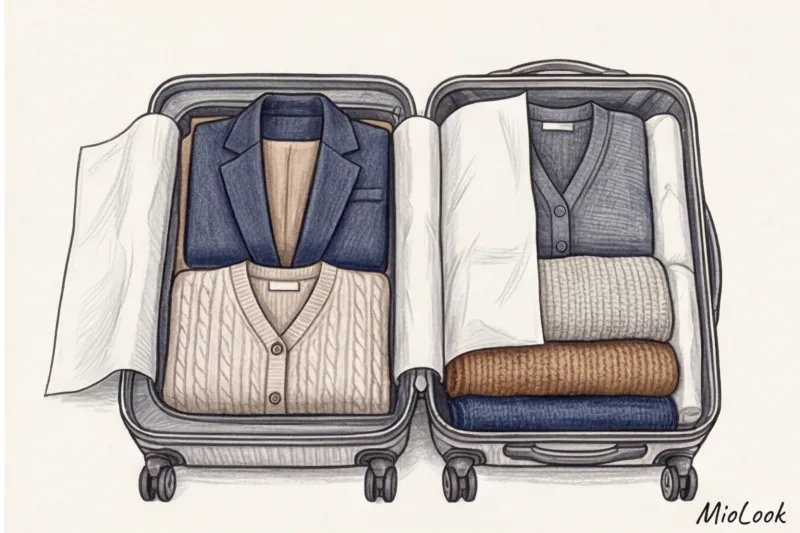
There is one more professional nuance that radically changes everything - the use of tissue paper ( tissue paper ) between layers of clothing. This is a famous secret of luxury boutiques. Remember how carefully the sales assistants at Chanel or Hermès pack your purchases: they generously pad the items with thin sheets of white, rustling paper.
This isn't just for the sake of a beautiful unpacking ritual. The physics of the process are extremely practical: during turbulence, loading, and moving a suitcase, fabrics inevitably rub against each other. It's this microfriction that generates static electricity and forms those hard, stubborn creases. Tissue paper absorbs all the friction, allowing layers of clothing to glide smoothly without fibers catching. Buy a pack of white acid-free paper (a pack of 100 sheets typically costs between €8 and €12) and line the back and shoulder area of your jacket with it before styling. You'll be truly impressed with the results.
Your ideal image begins Here
Join thousands of users who look flawless every day with MioLook. Plan your travel capsule in just one click!
Get access — €0.99 onceFinally, let's rethink our approach to accessories. Proper shoe packing follows a strict rule: we don't carry air. In compact carry-on luggage, shoes and loafers aren't just wardrobe items, but hard, protective cases. We maximize their interior space for tightly rolled leather straps, laptop chargers, adapters, and even fragile bottles (previously placed in a fabric bag).
This simple step elegantly solves two problems at once: it saves precious cubic centimeters of suitcase space and acts as an improvised shoe tree, preventing the toes of your shoes from deforming under the weight of the rest of your wardrobe.
Checklist: Clothes for a Woman's Business Trip for 3, 5, and 7 Days
A behavioral psychology study conducted by Cornell University researchers shows that in an unfamiliar environment (like a hotel room), stress levels associated with choosing clothes in the morning increase by 40%. When you have to defend your budget to the board of directors in an hour, you physically can't afford to waste resources on decision fatigue (Decision fatigue). In such circumstances, choosing the right outfit for a business trip for a woman isn't a matter of inspiration, but a strict checklist. Below are three scenario plans that my senior management clients simply save to their phone notes.
Blitz trip (2-3 days): a micro-capsule with no room for error
For short trips to neighboring countries, we use a "single core" strategy. The entire capsule is built strictly around a single, high-quality pantsuit. There's literally no room for luggage experimentation—often, such trips are made with a soft weekender bag.
- Base on yourself (on the road): Suit trousers, loafers, a thick mercerized cotton T-shirt and a cashmere stole.
- In the bag: A jacket from the same suit (transported in a case or neatly folded), 1 smart cotton shirt for a formal meeting, 1 accent silk blouse or lingerie-style top for dinner, spare shoes (classic pumps).
There's absolutely no room for error here: any spilled cup of espresso can ruin the look. Therefore, the color scheme of the bottoms should be dark, and the fabrics should be spot-washable.
Standard business trip (4-5 days): full cycle 5-4-3-2-1
This is the classic workweek away from the office. It's here that the wardrobe's mathematical formula truly shines, with every element working toward overall functionality.
- 5 tops: 2 basic t-shirts (white and black), 1 structured shirt, 1 flowy blouse, 1 dressy top.
- 4 bottoms: 2 pairs of suit trousers (e.g. graphite and navy), 1 smart midi skirt, 1 pair of dark, non-faded jeans (for smart-casual Friday or the way back).
- 3 layers: 1 architectural jacket, 1 voluminous cardigan, 1 thin turtleneck (as a base layer or on its own).
- 2 pairs of shoes: 1 pair of flat shoes (Chelsea or brogues), 1 pair with a stable heel.
- 1 whole piece: Sheath dress or elegant knit dress.
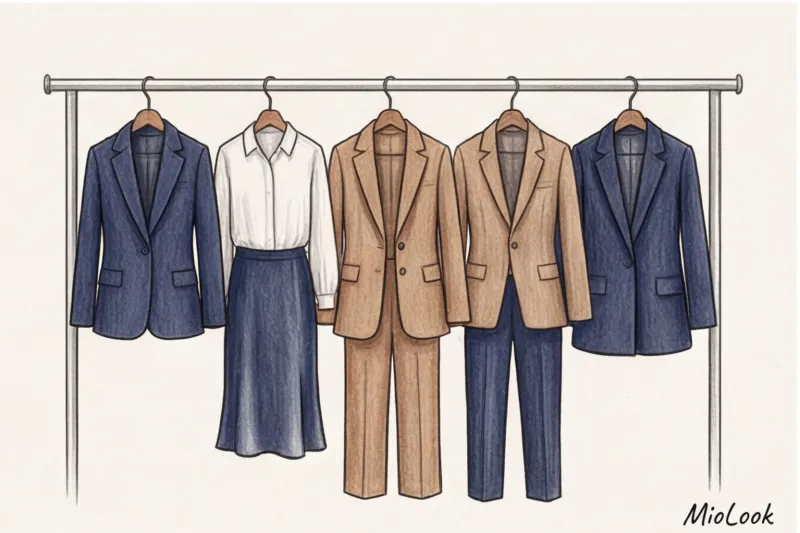
To make sure that these 15 items actually form 30+ working combinations and that you are not taking unnecessary items, I highly recommend uploading your planned items to MioLook digital wardrobe The app's AI stylist will instantly show you which items clash in proportions and help you create ready-made outfits for each day.
Long trip (week or more): planning laundry and bottom rotation
The most dangerous style myth is: "If I'm traveling for 10 days, I'll take 10 shirts." In practice, your carry-on baggage allowance remains exactly the same as for a 5-day trip. Only the logistics of caring for your belongings change.
My rule for long roadshows: we don't overpack; we delegate care to hotel service. Pants and skirts get dirty more slowly, so they can be worn three or four times. The focus shifts to rotating tops.
Set aside a budget for laundry or express dry cleaning at your hotel (standard rates at business hotels range from €15–€30 per item). Pack 30% more underwear, and choose basic tops made of fine merino wool—this material has natural antibacterial properties and doesn't absorb odors, unlike synthetics.
Cosmetic bag and gadgets: miniatures that save lives (travel steamer, stain remover stick)
In 2023, during a panel discussion at a conference in Milan, one of the speakers got a bright stain on the snow-white silk 10 minutes before going on stage. She was saved by an SOS kit, which I make every client buy.
- Stain remover stick (Tide to Go or Dr. Beckmann format): Instantly dissolves fresh organic stains (coffee, wine, sauces). Takes up no more space in your purse than a highlighter.
- Travel Steamer: Never trust hotel irons—they often spit out rusty water and mercilessly burn delicate fabrics. A high-quality folding handheld steamer will cost you around €45–60, but it can save your wardrobe thousands.
- Double-sided tape for clothing (Fashion Tape): A brilliant invention by stylists. It perfectly fixes blouse buttons that are coming apart, a trouser hem that has suddenly come undone, or an unruly collar.
MioLook Integration: Your Digital Pre-Flight Wardrobe
According to a WGSN analytical report (2023), the level of so-called "decision fatigue" among top managers reaches its absolute peak exactly 24 hours before departure. When you're standing in front of an open closet at 11:00 PM the night before a morning flight, your brain is physically incapable of adequately assessing the compatibility of prints, textures, and dress codes. The result is always predictable: you panic and throw random items into your suitcase, overloading it with items you'll never wear.
This is where digital optimization comes into play. Choosing the right outfit for a woman on a business trip should no longer be the result of late-night tossing and turning and stressing. In my practice, I've long since transitioned my clients to a virtual planning system through MioLook app The main benefit of this tool is its complete elimination of panic. You can pack your virtual suitcase in advance, in a calm environment over a cup of morning coffee or in a taxi on the way home, right on your smartphone screen.
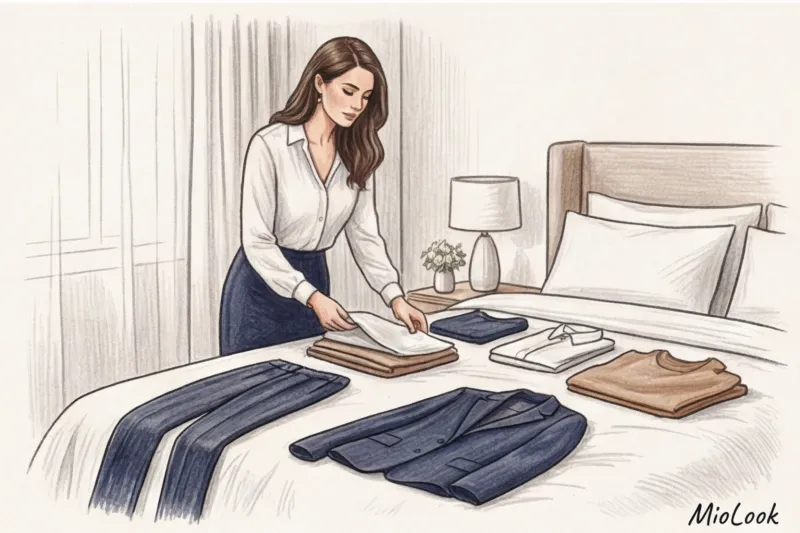
I'll be honest: as a professional stylist, I resisted digitalization for a long time, relying solely on my own experience. But when I first tested saving ready-made outfits before a busy season, I discovered a stunning mathematical effect. Having a pre-saved "travel capsule" in the app saves me and my clients about two hours of getting ready. You no longer need to try on outfits in front of a mirror, questioning their proportions—all the visual decisions have already been made and documented.
The key mechanic that will transform your approach to travel is capsule selection function You upload digital images of the items you plan to buy, and MioLook's built-in AI stylist checks their compatibility. The algorithm doesn't just display wardrobe items in a grid. It analyzes color temperature and silhouettes, and visually assembles ready-made looks.
If any bottoms are missing a pair, the AI will point it out. Moreover, it will ruthlessly weed out the "single items" you were thinking of packing "just in case." It's the perfect digital filter: the system ensures that every item is worth its investment. Remember, the cost of a quality travel wardrobe can range from €800 to several thousand, and each item in your suitcase should have at least three styling options.
My personal life hack: Create capsule templates in the app for different climate zones and formats. Name them, for example, "Autumn Talks in London" or "Summer Tech Summit." Before your next similar trip, all you have to do is tap a button, open the list, and pack the essentials into the suitcase in 15 minutes.
"Any business trip is essentially a runway for your personal brand. There are no casual meetings, and your appearance is the visual equivalent of your professional reputation and your company's status."
To conclude our guide, I want to emphasize a crucial point. The self-confidence so essential during difficult negotiations doesn't begin at the podium with a presentation. It begins at home, with the right, smart suitcase. When you know for sure that every item of your wardrobe is in its place, will travel flawlessly, and coordinate perfectly with everything else, you free up a tremendous amount of attention.
You'll stop worrying about how your skirt fits and start focusing solely on how to close a deal with flying colors. Make technology your ally, invest time in planning once, and every business trip will become a model of impeccable style and unrivaled efficiency.
Guide Chapters
MioLook: A Travel Wardrobe Planning App
Suitcase space is prime real estate, and it shouldn't be overcrowded. We'll show you how to pack a travel capsule into your carry-on.
Travel cosmetic bag for a business trip: a beauty capsule
How can you fit all your essential cosmetics into your carry-on without sacrificing your skincare routine? We'll explore the rules for creating the perfect travel beauty kit.
Women's Business Travel Shoes: A Balance of Style and Comfort
How to assemble the perfect shoe capsule for a business trip and get by with just carry-on luggage? A personal stylist offers tips on choosing stylish pairs.
Wardrobe for a Long Business Trip: A 2-Week Capsule
We're building the perfect capsule for a 14-day, luggage-free trip. An engineered approach to style, a modular system, and the 5-4-3-2-1 rule.
Summer Business Trip Clothing for Women: Stylists' Advice
How to look impeccable on a business trip when it's 38°C outside? We'll break down the rules for putting together the perfect summer wardrobe that won't wrinkle on the plane.
What to pack for a girl on a winter business trip: stylist tips
Planning a business trip in winter? We'll show you how to pack an elegant and warm wardrobe into your carry-on without adding bulk.
What to wear on a business trip: status looks
Your on-airplane look isn't about home comfort; it's about your professional insurance. Learn how to create a stylish and comfortable in-flight wardrobe.
What should a woman wear to a business dinner after work?
The art of micro-substitutions: how to transform a daytime office look into an elegant corporate evening outfit in 15 minutes. Forget stereotypes and embrace texture.
The perfect wardrobe for a 3-day business trip in carry-on luggage
Planning a short trip? Find out how to fit a stylish business capsule into your carry-on and protect yourself from baggage loss.
How to Fold a Jacket in a Suitcase Without Wrinkling: A Guide
Standard luggage packing methods don't work for women's jackets. We'll explain how to pack a jacket properly so it arrives in perfect condition.