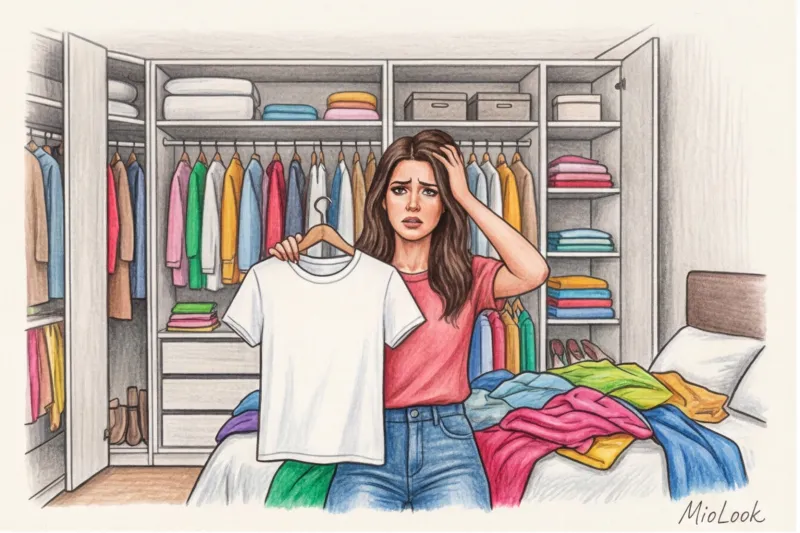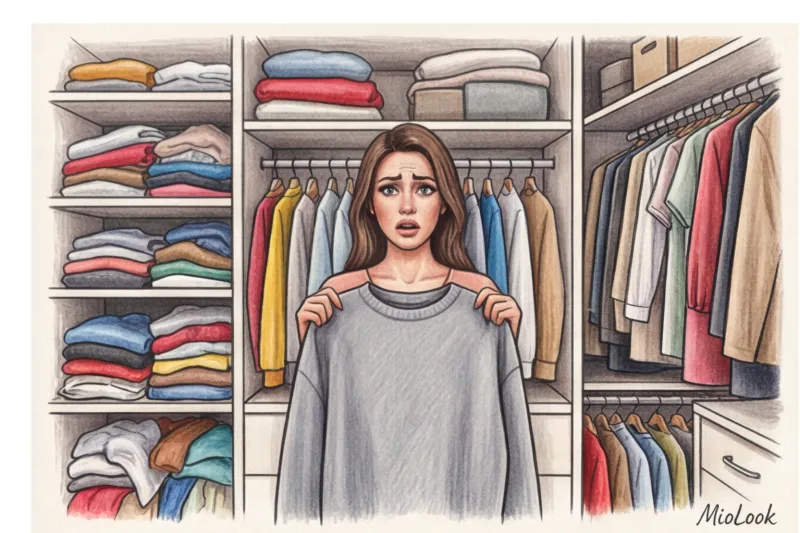

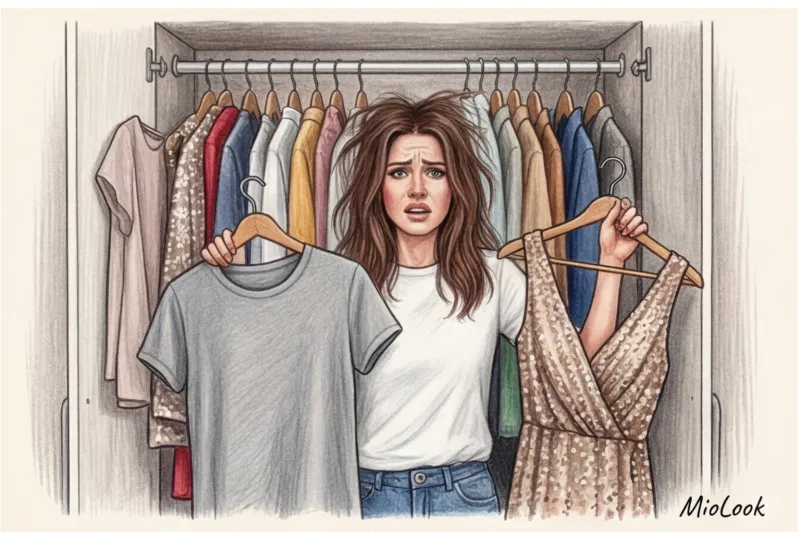
Over 12 years of working as a personal stylist in Europe, I've seen hundreds of closets literally bursting with clothes. Doors wouldn't close, hangers sagged under the weight of fabrics, but do you know what phrase I heard most often during the first meeting? "Katarzyna, I have absolutely nothing to wear." It's a classic scenario: we look at mountains of silk, wool, and denim, and feel nothing but a dull irritation.
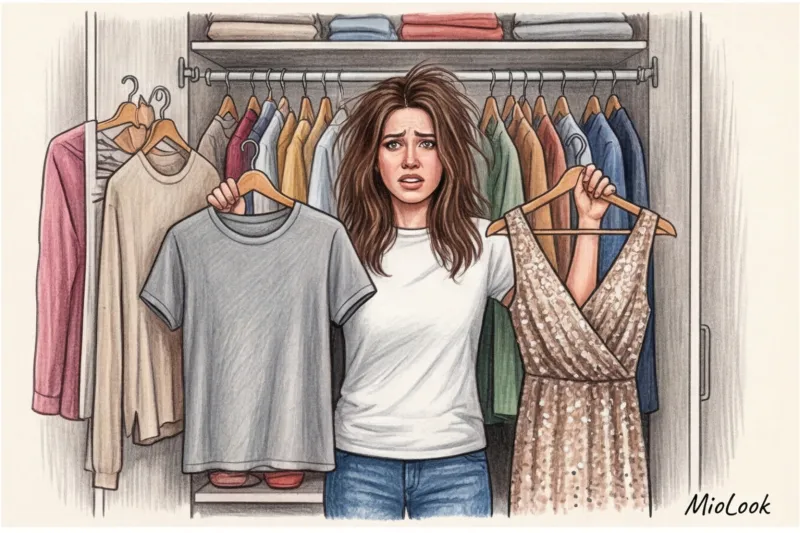
Deep psychology of clothing style The problem is that we buy clothes not for our actual bodies and lifestyles, but for our ambitions, fears, and unfulfilled desires. We discussed the basic principles of wardrobe development in more detail in our complete guide: How to Find Your Clothing Style: A Guide for Women Today we'll explore the math and psychology of your closet.
The Psychology of Clothing Style: Why Your Closet Is Full, But You Have Nothing to Wear
According to statistics, the average woman actively wears only 20-30% of her closet's contents. The remaining 70-80% is a museum of unfulfilled hopes, impulsive decisions, and ephemeral items. The problem lies not in the quantity of clothes, but in their utter inconsistency with your reality.
Forget the myth that another Kibbe test or seasonal color type analysis will magically solve your morning routine. Stylistic templates often serve only to restrict your appearance. I call this problem "wardrobe schizophrenia"—a condition where five completely different people coexist in the same closet: a seductress in leopard print, a stern corporate boss, a bohemian artist, a tired mom in stretched-out sweatpants, and a femme fatale.
Fantasy Life Syndrome
We love buying clothes for the version of ourselves we want to be, completely ignoring reality. One of my clients, Anna, worked as an IT director completely remotely. When we opened her closet, it consisted of 80% cocktail dresses, stiletto heels, and silk blouses. Her real life consisted of Zoom calls in her home office and walks with her Labrador. The clothes were expensive and beautiful, but there was nowhere to wear them.
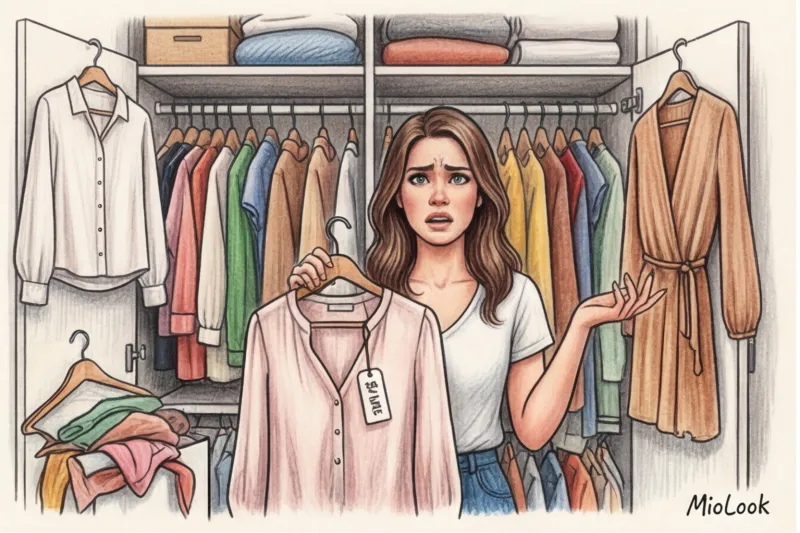
How do you recognize "fancy pieces"? They're usually hanging in bags, have tags, are complexly cut, or require special underwear. You look at them with admiration, but every time you go out, you choose your trusty old jeans.
Emotional shopping and the sales trap
Shopping has long been a legitimate and accessible form of therapy. In times of stress, we don't buy a blouse; we buy an emotion—the anticipation of a holiday, a sense of novelty, the illusion of control over our lives. That's why items on sale at mass-market stores often end up as dead weight in the closet. The red price tag shuts down critical thinking.
The best cure for emotional shopping is the Cost Per Wear formula. Divide the cost of an item by the expected number of times you'll wear it per year. A €40 Zara dress worn once is €40 per wear. But a pair of high-quality, straight-leg, heavyweight denim jeans (12 ounces and up) for €120 that you'll wear 100 times is only €1.20 per wear. The math is sobering.
Your perfect look starts here
Join thousands of users who look flawless every day with MioLook.
Get access — €0.99 onceFear of Standing Out: Where It Comes From and How It Limits Us
The psychology of clothing style is inextricably linked to evolutionary survival mechanisms. Our brains are historically programmed to believe that standing out from the crowd is mortally dangerous. Being too conspicuous meant attracting predators or being ostracized from society.
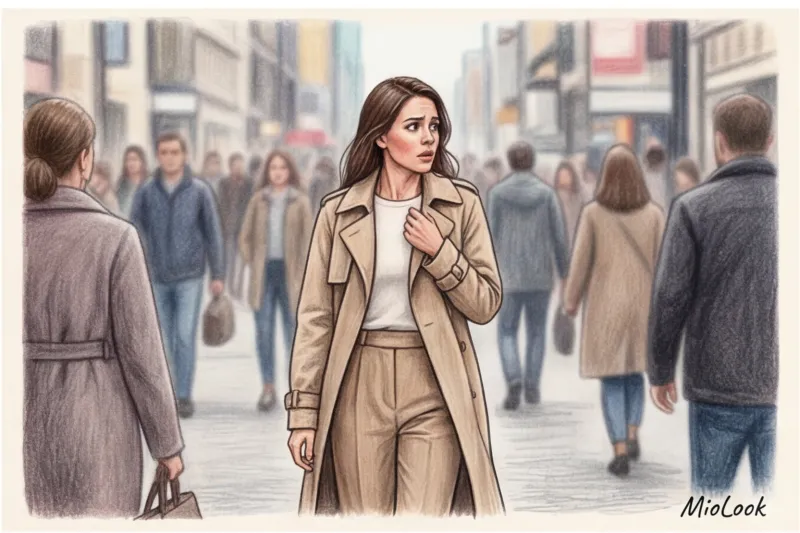
In the modern context, this fear has transformed: we're not so much afraid of attention as of looking "out of place," "ridiculous," or "overdressed." Due to the spotlight effect—a cognitive bias described by psychologist Thomas Gilovich in 2000—we feel like others are observing every detail of our appearance. In reality, people are too preoccupied with themselves to notice that your collar isn't perfectly ironed.
A "basic uniform"—faceless gray sweaters, black pants, and nondescript down jackets—becomes a protective armor against imaginary criticism. Clothing ceases to be a means of self-expression and becomes camouflage.
"What will my colleagues or friends think?"
Our environment dictates our boundaries. If your department is all about casual attire, showing up in a formal three-piece suit will raise questions like, "Are you going to a job interview?" This creates impostor syndrome. Clients often tell me, "This red lipstick is too bold for me; it feels like I'm pretending to be someone else." For more information on how to balance brightness in the work environment, read the article about bright accents in a business look.
How Clothing Affects Our Thinking: A Scientific Approach
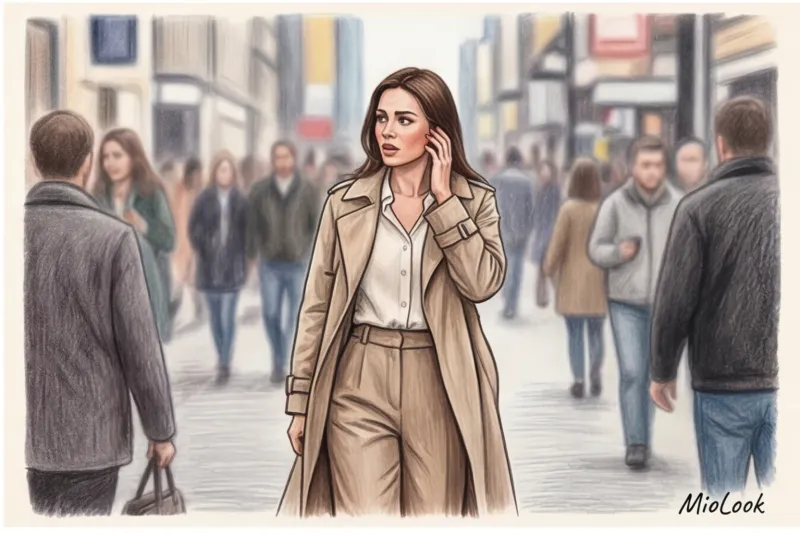
The psychology of clothing style has a solid scientific basis. The concept of Enclothed Cognition, first demonstrated by researchers Hajo Adam and Adam Galinsky in 2012, explains how physically wearing a particular garment alters our brain chemistry and cognitive abilities.
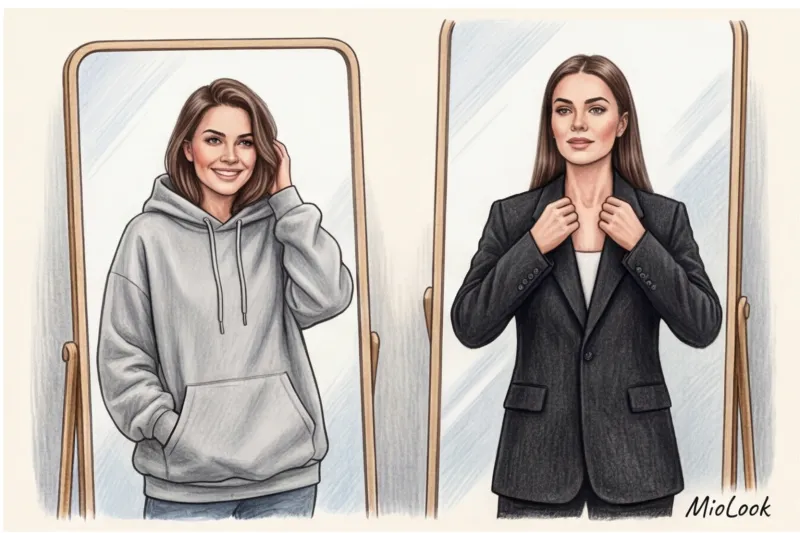
Researchers have shown that people who wore a white coat (thinking it was a doctor's coat) showed significantly better concentration than those who wore the same garment thinking it was an artist's coat. Clothing conveys its symbolic properties to our subconscious.
"What we wear influences not only how others perceive us, but also how we think, feel, and act. Clothing is a cognitive tool," says Professor Karen Pine, a fashion psychology researcher.
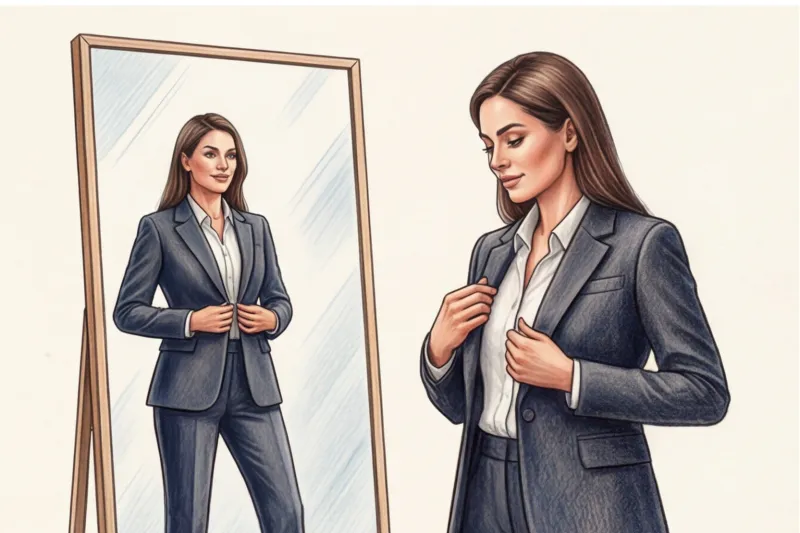
That's why a tailored jacket from Massimo Dutti (with its sharp shoulders, made of wool with 5% elastane) makes us feel physically more composed and authoritative than a soft, oversized hoodie. Use this hack to manage your mood: for complex negotiations, wear structured pieces; for brainstorming and creative sessions, wear tactilely pleasing, soft textures that relieve tension.
Reality Audit: The First Step to a Conscious Wardrobe
Most style articles begin with the advice: "Throw away everything you haven't worn in a year." As a practitioner, I declare this a harmful and destructive myth. Decluttering your closet is the worst first step when dealing with a style crisis. Throwing things away won't solve the psychological problem. You'll experience a short-lived dopamine rush from the feeling of "cleanliness," but a month later you'll go out and buy exactly the same things because your old behavior patterns remain.
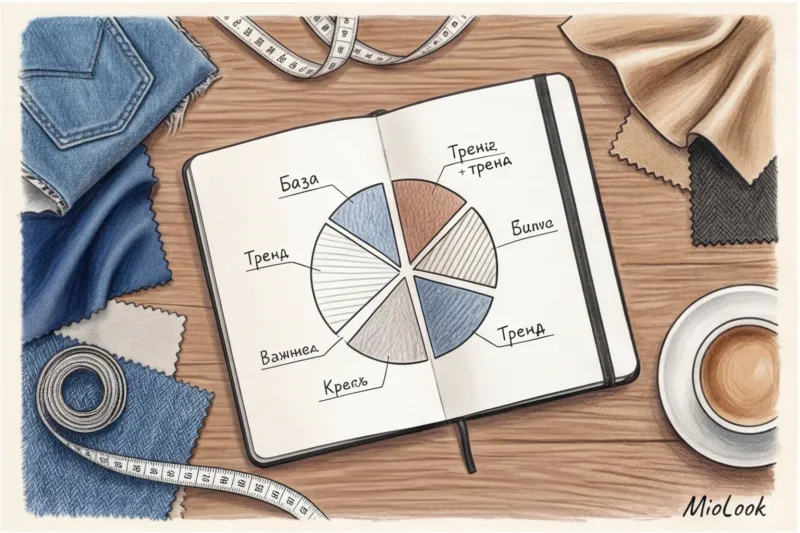
First, you need to audit your real life, not your closet. I give my clients a practical 14-day assignment: an activity diary. Honestly record how many hours you spend at home, in the office, in the car, on walks with the kids, and at evening events. Then draw a pie chart.
A top manager once came to me desperately trying to assemble a "French chic" wardrobe with silk skirts and tweed jackets. But her chart showed that she spent 90% of her time on intercontinental flights, taxis, and hotels. She needed expensive, high-status, yet wrinkle-resistant casual wear made of knitwear and cashmere, not the Parisian cafe aesthetic.
To make it easier to analyze what you already have, I recommend using Smart wardrobe in the MioLook app You will be able to digitize your things and see the real picture, not the one your memory paints.
Access to MioLook for €0.99 — one-time payment
A smart AI stylist will select the perfect look for every day and help you organize your closet.
Get access — €0.99 onceHow to Stop Being Afraid of Bright Things: The Micro-Risk Method
Many people think that changing their style means waking up on Monday and wearing a fuchsia suit instead of their usual gray. This is a surefire way to fashion burnout. Your nervous system simply can't handle the stress of such a sudden change in how you feel.
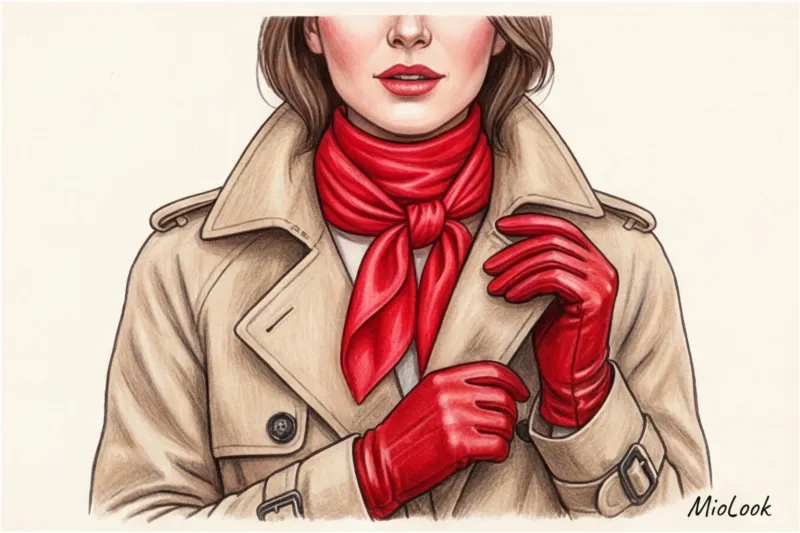
Instead, use the "micro-risks" method (the 10% rule). Keep 90% of the look within your absolute comfort zone, but add one accent that's a little nerve-wracking. Let it be interesting accessory: a textured bag, an unusual shoe heel, or a silk scarf with a complex print against the backdrop of your favorite beige trench coat.
Another professional trick is the "testing ground" concept. Don't invest in an expensive trend right away. Want to try wide-leg palazzo pants or a leather shirt? Buy them first at a mid-price mass-market store (COS, & Other Stories). Wear them for a season. If the item works well and you feel confident in it, feel free to buy a more expensive premium equivalent. If not, you won't lose much money.
Fair Limit: The "micro-risk" method of adding pops of color doesn't work if your work environment has a strict, conservative dress code (for example, in the judiciary or senior banking). Even a red sole or a statement scarf can violate protocol. In such cases, the risk shifts to texture: use jacquard in the same tone as the fabric or expensive, hidden hardware.
Checklist: 5 Steps to a Wardrobe That Gives You Confidence
No water, just practical steps. If today you find yourself "with nothing to wear" again, follow this algorithm.
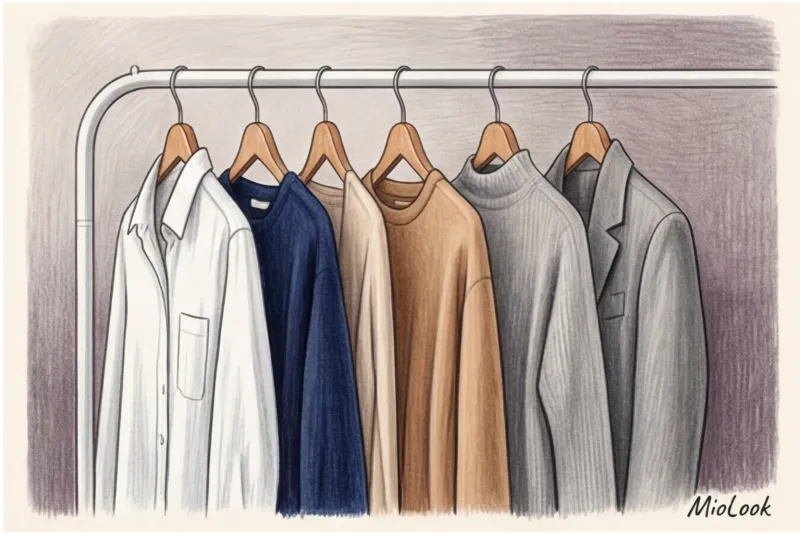
- 1. Create a reality diagram. List your life's areas as percentages. Your closet should mirror this proportion. Do you spend 60% of your time walking with your child? That means 60% of your closet should be stylish, layered, and comfortable outdoor essentials, not sheath dresses.
- 2. Define your “uniform of success.” Find that one combination of items (for example, straight jeans + cashmere sweater + loafers) that makes you feel 100% at ease. This uniform will become your lifeboat on days when you're feeling overwhelmed.
- 3. Implement the Cost Per Wear rule. Before you take an item to the checkout, mentally divide its price by 30 (the minimum number of times a base item is worn). Are you willing to pay that amount for one day of wear?
- 4. Choose one “micro-risk” for this week. Put on that perfect lipstick, pin on a vintage brooch, or choose shoes in a contrasting color. Allow yourself to be the center of attention for a while.
- 5. Clear the information field. Unfollow fashion influencers whose lifestyle (and budget) is radically different from yours. The illusion that you need new looks every day is a marketing gimmick, not a vital necessity.
Instead of a conclusion: your style is a process, not an exam
There's no such thing as a perfect wardrobe from a Pinterest board, because a static wardrobe is a dead wardrobe. Your style should live with you: it should evolve as you change careers, have children, or move to a different climate.

It's perfectly normal to make mistakes when experimenting with style. Every "wrong" item you buy, if you analyze it correctly, gives you a clear understanding of what you really need. Style should serve your life, make your morning routine quicker, and your gait more confident.
Start small tomorrow: pull out that favorite item you've been saving for years "for a special occasion," integrate it into your everyday look (balanced with simple sneakers or denim), and just go about your business. A special occasion is your life today.