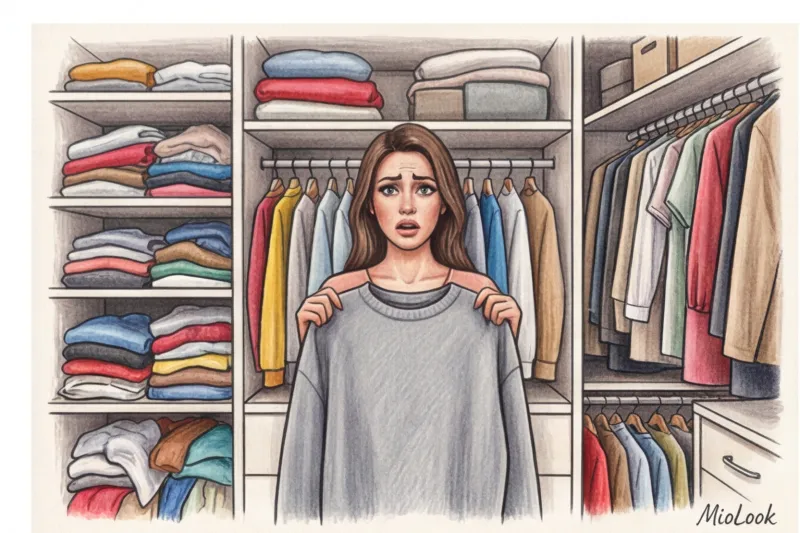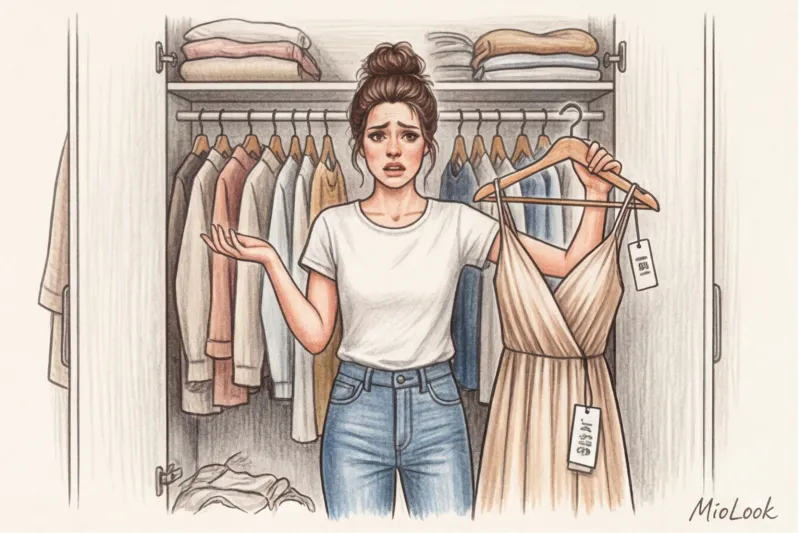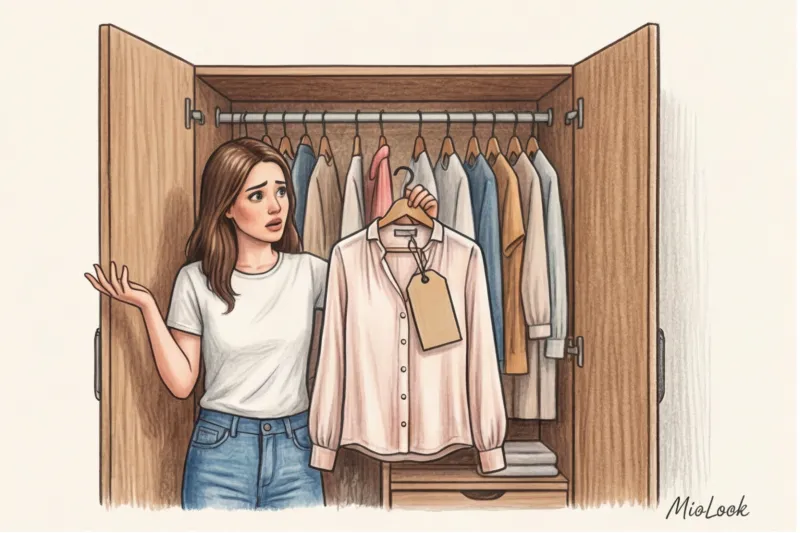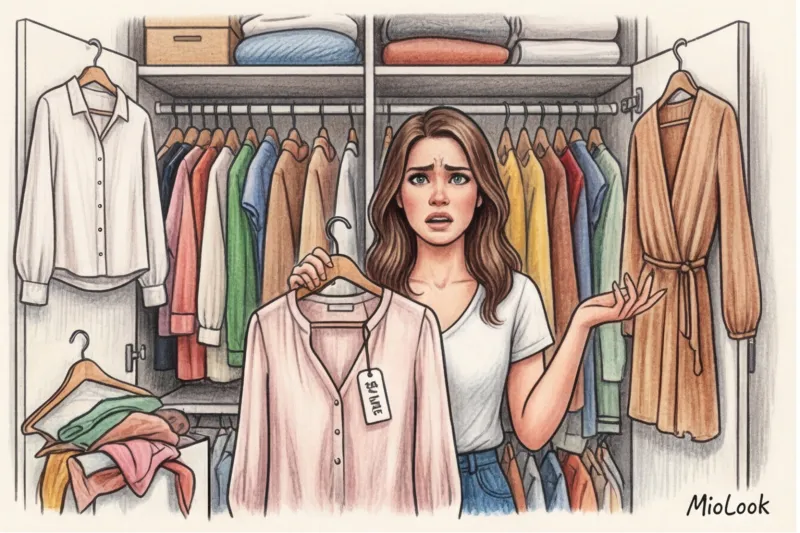
Have you noticed that the most common sound during a professional wardrobe review is the rustling of tags being cut off? My new clients often get confused at this point. In my 12 years as a stylist, I've heard the same confused question hundreds of times: "Katarzyna, Why do I buy clothes and not wear them? her, although in the fitting room she seemed simply perfect to me?”
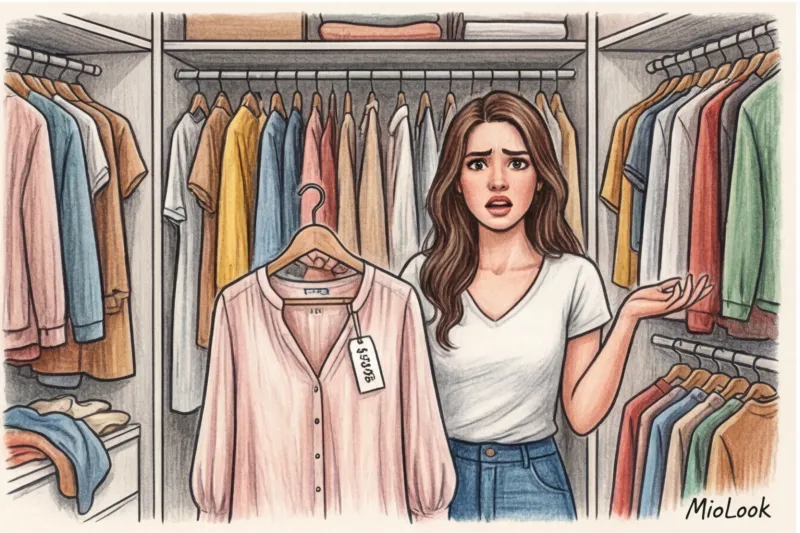
We tend to blame ourselves for wastefulness, lack of taste, or weak willpower. But the truth is, your closet full of unworn clothes isn't evidence of your stupidity. It's the result of brilliant marketing and complex cognitive biases in our brains. We've already discussed the underlying mechanisms of this phenomenon in more detail in our The Complete Guide "How to Stop Buying Unnecessary Things: The Psychology of Shopping".
In this article, we won't offer platitudes like "don't go to the mall when you're sad." Instead, we'll don forensic gloves and dissect your wardrobe to break the cycle of mindless shopping once and for all.
The Anatomy of Dead Weight: Why Do I Buy Clothes and Never Wear Them?
Statistics are merciless: according to surveys, on average, women wear only 20% of their wardrobe 80% of the time. The remaining 80% hangs like dead weight, eating up space, money, and your energy in the morning.
A couple of years ago, I worked with a top manager in Paris. During the pandemic, she went remote but continued to obsessively buy Massimo Dutti silk blouses. When we opened her closet, there were 14 (fourteen!) blouses with tags still hanging there. Meanwhile, she worked on her laptop every day in a cashmere two-piece suit. The gap between her actual lifestyle and the contents of her closet was colossal.
An item with a tag is a symptom. It signals that the purchase was filling an emotional hole, not a physical need for clothing. To understand this mechanism, we need to examine the three main psychological traps of shopping.
Access to MioLook for €0.99 — one-time payment
A smart AI stylist will select the perfect look based on what you already own and help you avoid unnecessary spending.
Get access — €0.99 onceThe Illusion of the Fantasy Self: A Wardrobe for a Fictional Life
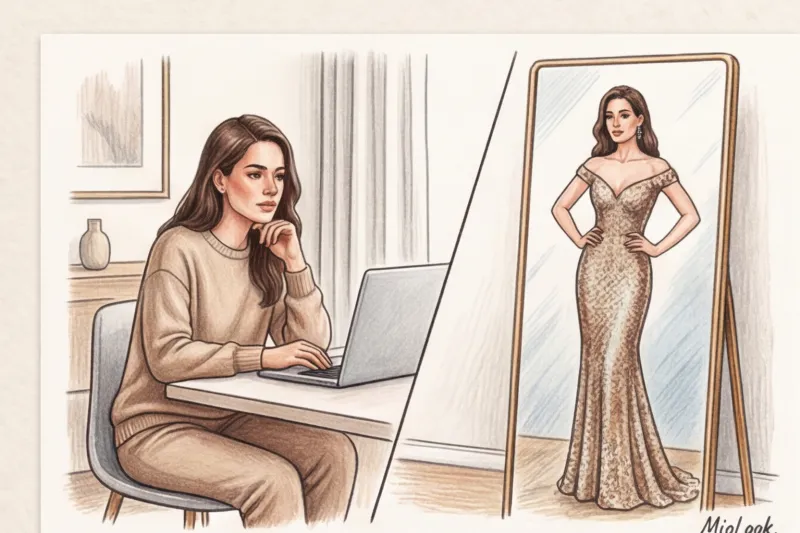
Dr. Dawn Karen, founder of the Fashion Psychology Institute, writes extensively about the concept of the "Fantasy Self." This is the ideal version of you who goes to Sunday brunch, attends theater premieres, and wears beige trench coats with exposed ankles in any weather.
The problem arises when your budget is spent on the needs of your Fantasy Self, while your physical body lives on a “home-office-home” schedule with trips to the subway and walks with the dog.
"We don't buy sequins and velvet because we have nothing to wear to a party. We buy them because we miss the holiday spirit in our daily lives. Clothes become a substitute for emotion."
How can you tell the difference between a real-life item and a fantasy item? Ask yourself: "If this item were in my closet right now, would I wear it tomorrow morning?" If the answer is "no, I'd need a special occasion/weather/mood"—leave it in the store.
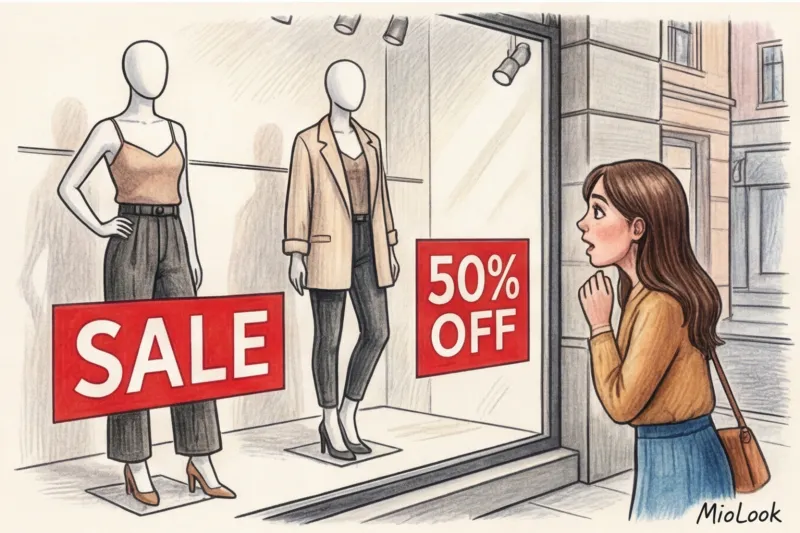
Toxic motivation: things "for the future figure"
Around 50% of women keep clothes in their closets "for weight loss." They often even buy new jeans a size too small, justifying it as motivation to go on a diet. As a stylist, I am categorically against this practice. Here's why.
Buying tight clothes isn't an incentive. It's a daily visual trigger for guilt. Every time you open the closet door, you get a micro-blow to your self-esteem: "You're still not good enough to wear this."
The golden rule of styling: We always dress the body that is here and now. Your clothes should serve you, not you serve your clothes. A beautiful, well-fitting garment in your true size will give you far more confidence and energy to take care of yourself than pants that don't fit at the waist.
The Neuroscience of Mass Market: How Brands Make Us Buy
Think you're completely in control of your shopping experience at a sale? Neuroscientist Robert Sapolsky has demonstrated a surprising fact in his research: the peak release of dopamine (the hormone that produces anticipatory pleasure) occurs not when you actually own the item, but when you anticipate the reward. As soon as you check out at the checkout, dopamine drops sharply.
European mass markets (Zara, H&M, Mango) have built billion-dollar empires on this neurobiological feature.
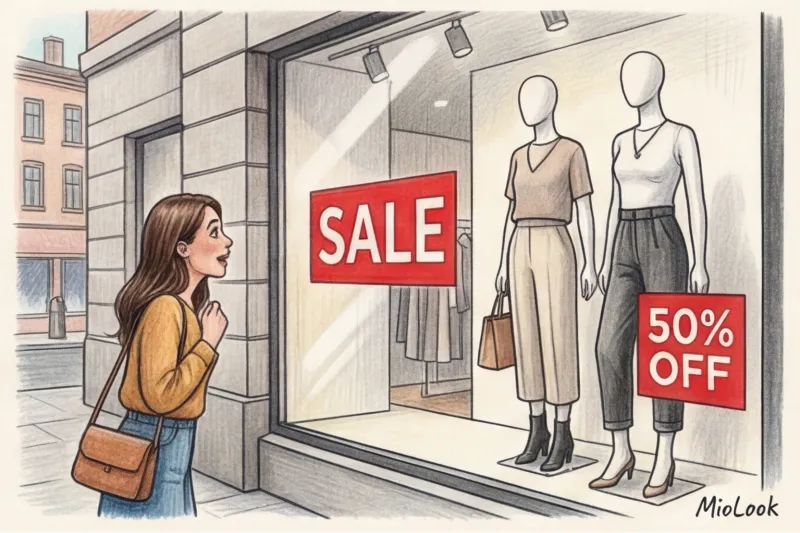
- Artificial scarcity: Countdown timers on websites and half-empty rails in stores scream at your brain: "Grab it, or someone else will!" Your brain switches into survival mode, shutting down logic.
- Tactile and visual deception: Fitting rooms at mass-market stores often feature special warm lighting (around 3000K) to smooth out uneven skin tone. Fabrics are impregnated with special compounds (sizing agents) to help the garment retain its shape. You buy a thick sweater, and after the first wash at home, you're left with a shapeless rag.
According to the McKinsey State of Fashion (2024) report, impulse purchases driven by emotion consume up to 30% of consumers' annual clothing budgets. A third of your money goes toward sponsoring someone else's visual merchandising.
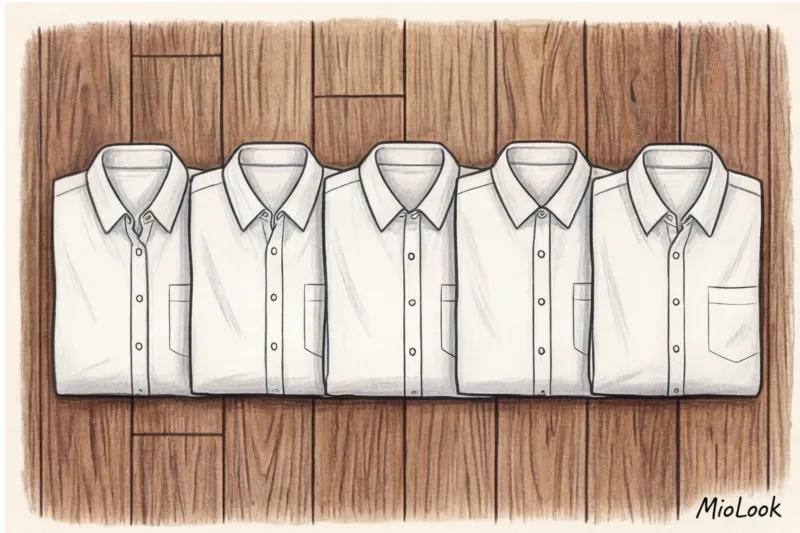
Cloning syndrome: why do you need a fifth white shirt?
Look at the shelves of your closet. There's probably a stack of items that look almost identical. Blue straight-leg jeans, gray sweaters, black turtlenecks. This is what's known as "clone syndrome."
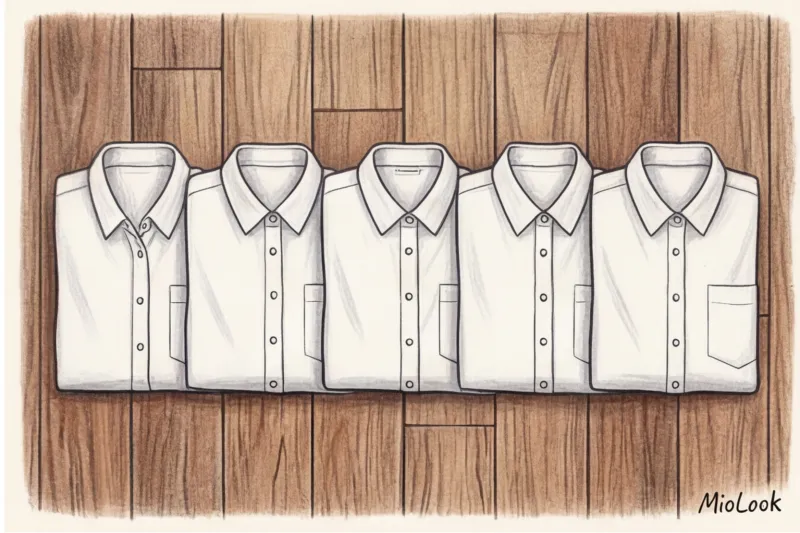
We buy duplicates out of sheer decision fatigue. When our brains are overloaded at work, they choose the safest, tried-and-true path at the store. You buy that fifth white shirt because you know it suits you. There's no risk.
But here's the paradox: buying duplicates never solves the problem of "a full closet, but nothing to wear." A working wardrobe base isn't five identical cotton shirts. It's one classic poplin shirt, one flowing viscose or thick silk shirt, and one relaxed linen shirt. Different textures are what make a wardrobe functional, not a blind repetition of a single silhouette.
Your perfect look starts here
Join thousands of users who look flawless every day with MioLook. Digitize your closet and stop buying duplicates.
Get access — €0.99 onceWardrobe Forensics: How to Conduct an Audit of Bad Purchases
Wardrobe decluttering is often turned into an esoteric ritual to "cleanse the aura of the home." I offer a rigorous yet effective analytical approach, which I use in my offline consultations.
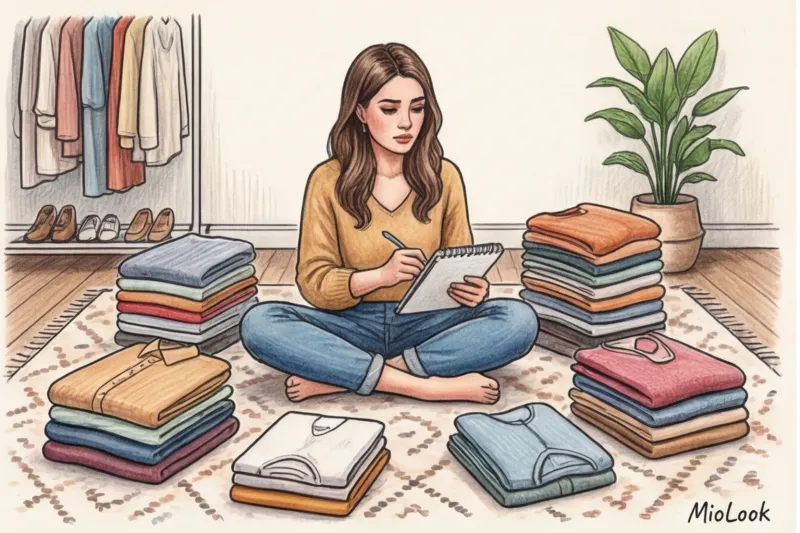
- Step 1: Isolate Evidence. Take out absolutely all unworn items and items with tags. Place them in a pile on the bed. Look at the amount of money you've wasted. It's unpleasant, but necessary for sobering up.
- Step 2: Find common denominators. Start analyzing these items. What do they have in common? Is it always the same brand whose cut doesn't suit you? (For example, COS pants are often made for heights over 175 cm.) Is it a hard-to-care-for fabric like polyester that makes you sweat? Is it an overly bright print that you can't pair with anything? Write down your findings—this will be your personal stop list for future purchases.
- Step 3: Calculate Cost Per Wear. The formula is simple: divide the price of an item by the number of days you wear it. A perfectly fitting €300 wool coat worn 150 times costs €2 per occasion. A €30 neon dress from Zara, bought on impulse and worn just once, costs €30 per occasion. Cheap items on sale end up costing us the most.
To automate this process, I recommend my clients digitize their closets. By uploading items to the "smart wardrobe" feature in MioLook , you will clearly see statistics: which things work for you every day, and which ones just take up space.
A Mindful Shopaholic's Checklist: 5 Questions to Ask Before Checkout
Before you spend money on a new item, run it through this rigorous filter. If the answer to even one question is no, return the item to the hanger.
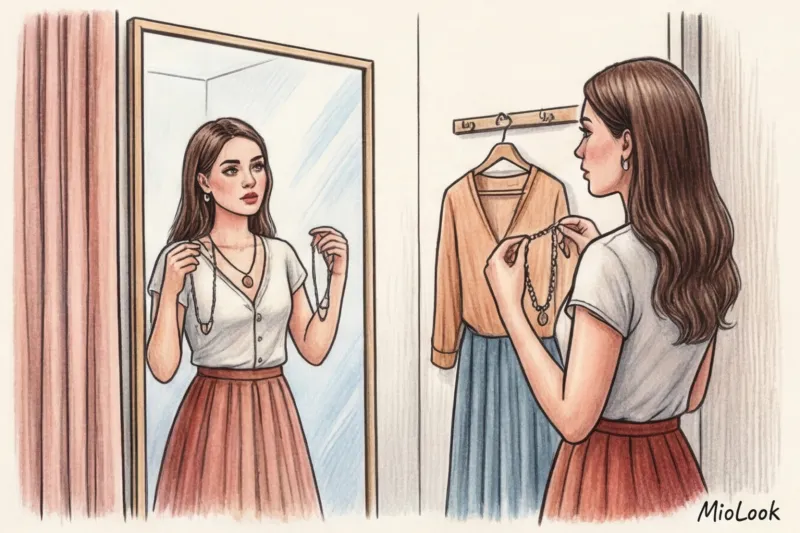
- Will I be able to create 3 looks with things I ALREADY have in my closet? A skirt shouldn't require you to buy new shoes, a blouse, or a bag. If a piece doesn't integrate into your wardrobe immediately, it's a bad investment.
- Would I buy this if there wasn't a 50% discount? Imagine an item is priced at full price. Do you still want it? If not, you don't like the item; you like the discount.
- Is it comfortable to move in? Sit on the ottoman in the fitting room. Raise your arms. Bend over. If your pants dig into your stomach when you sit, or the armhole of your jacket tugs, you won't wear it, no matter how beautiful it looks standing still.
- Am I ready for complex care? I often see women buy beautiful viscose fabric from &OtherStories, only to have it shrink by 7% after the first machine wash. If the tag says dry clean only, ask yourself honestly: are you willing to pay for dry cleaning regularly?
- Has the item passed the 24 hour rule? Put your purchase on hold for a day (either in your online shopping cart or by asking for it to be put on hold at the checkout). Your dopamine levels will drop, and you'll look at the item with a clearer, more sensible eye.
Important clarification: This rule works great in the mass market, but let's be realistic—it does NOT apply to unique vintage or rare resale finds. Decisions there need to be made quickly.
Letting Go of the Past: How to Eco-Friendly Dispose of Unworn Items
Many of my clients keep things that don't suit them for years, arguing, "Well, let it hang there, it's not asking to be eaten." This is a profound misconception. Things ask for and eat up your mental space.
In economics, this is called the "sunk cost fallacy." We feel sorry for the money we spent, so we keep the item, hoping to wear it someday. But the money is ALREADY spent. Storing it in the closet won't get it back.

What to do with "dead weight":
- Premium and mid-range (with tags or in perfect condition): Sell on resale platforms. A 30-40% return is better than nothing, and you'll be guilt-free.
- Mass-market clothing: Organize a clothing swap party with your girlfriends. What didn't fit you perfectly might fit your friend perfectly.
- Charity: Donate your items to trusted charities. Knowing that your shopping mistake has become a warm and precious gift for someone is a great way to relieve guilt.
Ready to start your life with a clean slate?
Try the MioLook free plan and organize your closet without any commitments or hidden fees.
Get access — €0.99 onceHaving free space between hangers is a key source of inspiration in the morning. When your closet breathes, and you only see the things you truly love and that suit you right now, the problem of "nothing to wear" disappears. Your clothes should be your ally, not a silent prosecutor reminding you of wasted money.